Content note. Several frames below caricature Japanese people as U.S. wartime film units drew them, and others come from Japanese and Dutch collaborationist productions that attack named enemies. The Nazi film Der ewige Jude is described on its case-study page with antisemitic narration quoted as evidence. All of it is shown or described as issued, as evidence of what audiences were told. Showing a film is not endorsing it.
What are propaganda films, and which are the famous ones?
Propaganda films are newsreels, documentaries, training films and cartoons made or sponsored by a state or party to shape what an audience believes or does. Famous examples include the Nazi Triumph des Willens, the U.S. Why We Fight, Britain's London Can Take It! and Japan's wartime newsreels. Each is set out below by maker, audience and ask.
What does the collection hold?
The archive tags 22 objects with the medium "film-still": 10 from the United States, 8 from the Empire of Japan, 3 from the Netherlands and 1 from Australia, dated May 1938 to 1965 (counts made from the entry files in examples/entries/). Each is a single frame or title card, not a film. The collection hosts no stills from the Nazi, British Ministry of Information or Soviet films named here, so those are covered through the linked case studies. The counts show what could be hosted with a clear rights basis, not how many films each side made.
Explain moreShow less
Every object uses the same technique definitions. See propaganda examples and types of propaganda.
What did Nazi Germany's film propaganda ask of its audience?
The Reich Ministry of Public Enlightenment and Propaganda under Joseph Goebbels controlled who could work in film, what was shown and who owned the studios. From June 1940 one newsreel, Die Deutsche Wochenschau, was the only newsreel shown in Germany. Two films carry the case study. Triumph des Willens (1935), made by Leni Riefenstahl on Hitler's commission with the rally's cooperation, ends with Rudolf Hess saying "Hitler is Germany, just as Germany is Hitler". Der ewige Jude (1940), directed by Fritz Hippler, cut footage filmed in occupied Poland against shots of rats and presented the result as a documentary. A Security Service report of January 1941 said that in several cities the typical cinema audience partly avoided it. Riefenstahl called her film reportage; Hippler said Goebbels authored his. Sources, disputed points and tags: Film under Goebbels.
Explain moreShow less
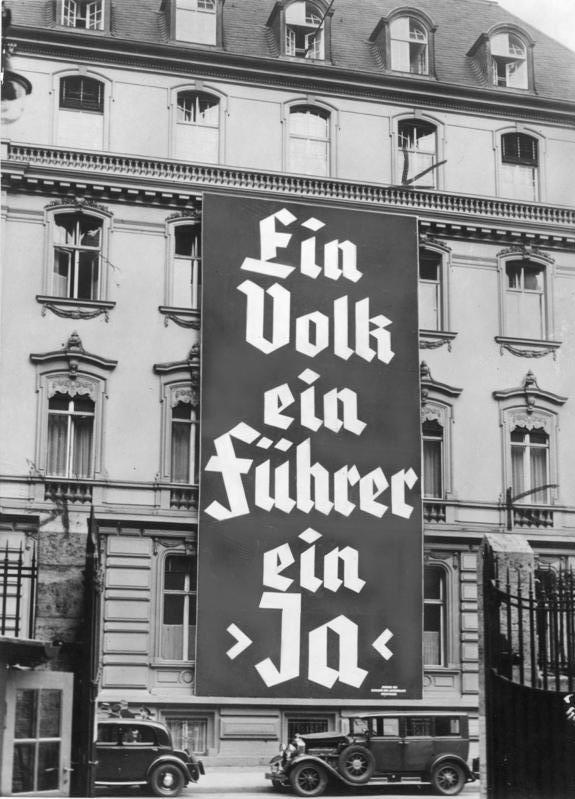
The nearest hosted object is not a film. This NSDAP banner of November 1933, from the Bundesarchiv, equates the nation with its leader and a "Yes" vote with loyalty; the case study sets it beside Hess's closing line in the rally film a year later. It is tagged identity fusion. Read the technique: identity fusion.
What were the Why We Fight films, and what did they ask?
In 1942 the U.S. Army's Chief of Staff, George C. Marshall, asked Frank Capra for films explaining to draftees why the country was fighting. Capra's unit built seven compilation films largely from other people's footage, including Axis newsreels and rally films, re-narrated. The War Department's Research Branch then tested them on soldiers and found large gains in factual knowledge, smaller changes in opinion and little change in motivation to serve (Hovland, Lumsdaine and Sheffield, 1949). The National Archives notes that Prelude to War includes unmarked recreations.
Explain moreShow less
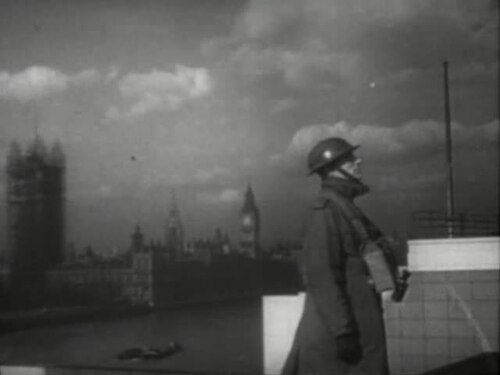
This frame from The Battle of Britain (1943) is the film the Army researchers used to describe the "sleeper effect": some opinion changes were larger nine weeks after viewing than five days after. The entry tags the measured effect, not a visible technique. Read the technique: sleeper effect. Sources and disputes: Why We Fight.
What was Know Your Enemy: Japan?
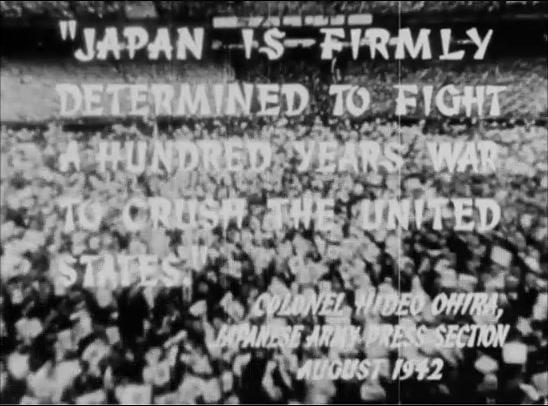
Know Your Enemy: Japan (about 63 minutes, 1945) was an Army orientation film. Its disclosure card says it was compiled from "authentic newsreel, official United Nations, and captured enemy film", with "a few reenactments". It was withdrawn within weeks of release.
Explain moreShow less
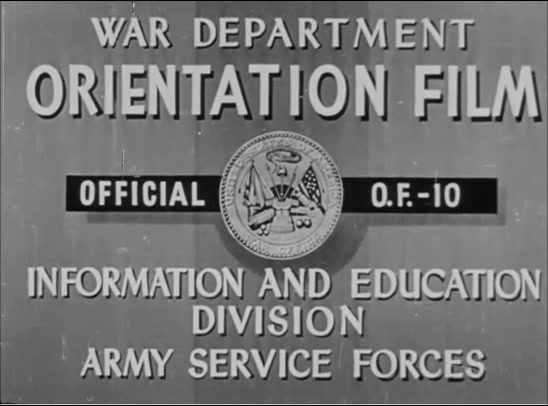
The title card lends the Army seal and the word "Official" to what follows (transfer). Read the technique: transfer.
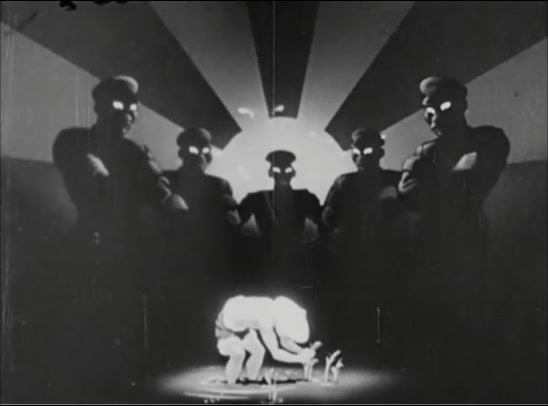
An animated sequence stages the Japanese military leadership as an overwhelming menace over a small farmer through scale, darkness and glowing eyes (fear appeal). The case study records that the film quotes the Tanaka Memorial, a document historians generally regard as a forgery.
A later card quotes a named Japanese Army Press Section colonel of August 1942 saying Japan will fight a "hundred years war". The entry notes the original statement is untraced and the card gives no context. It is also tagged fear appeal. Read the technique: fear appeal.
How did Private Snafu and other U.S. wartime films treat the enemy and the home front?
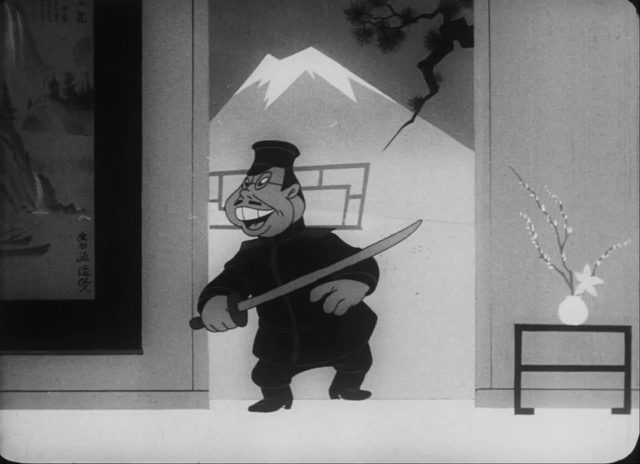
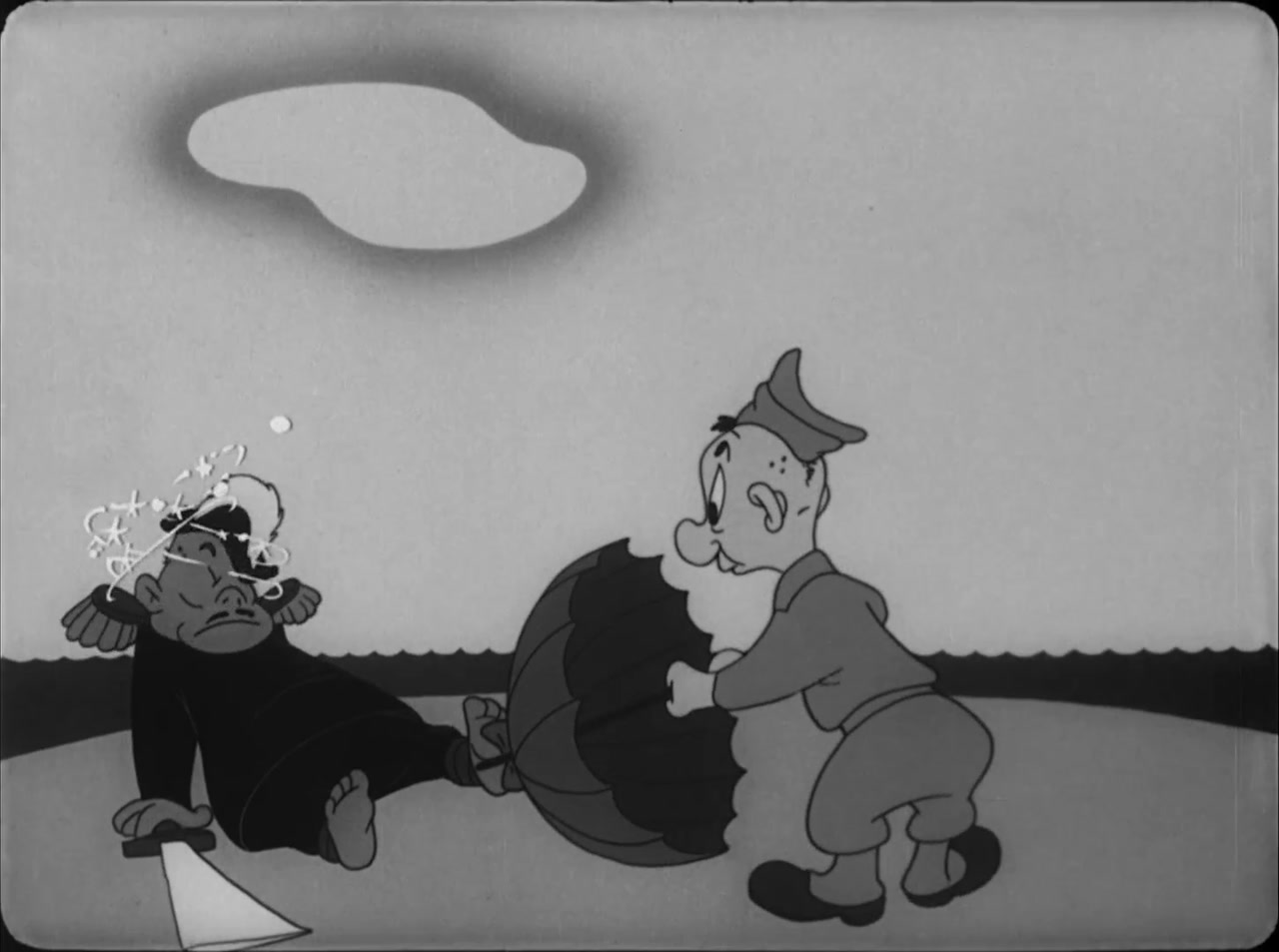
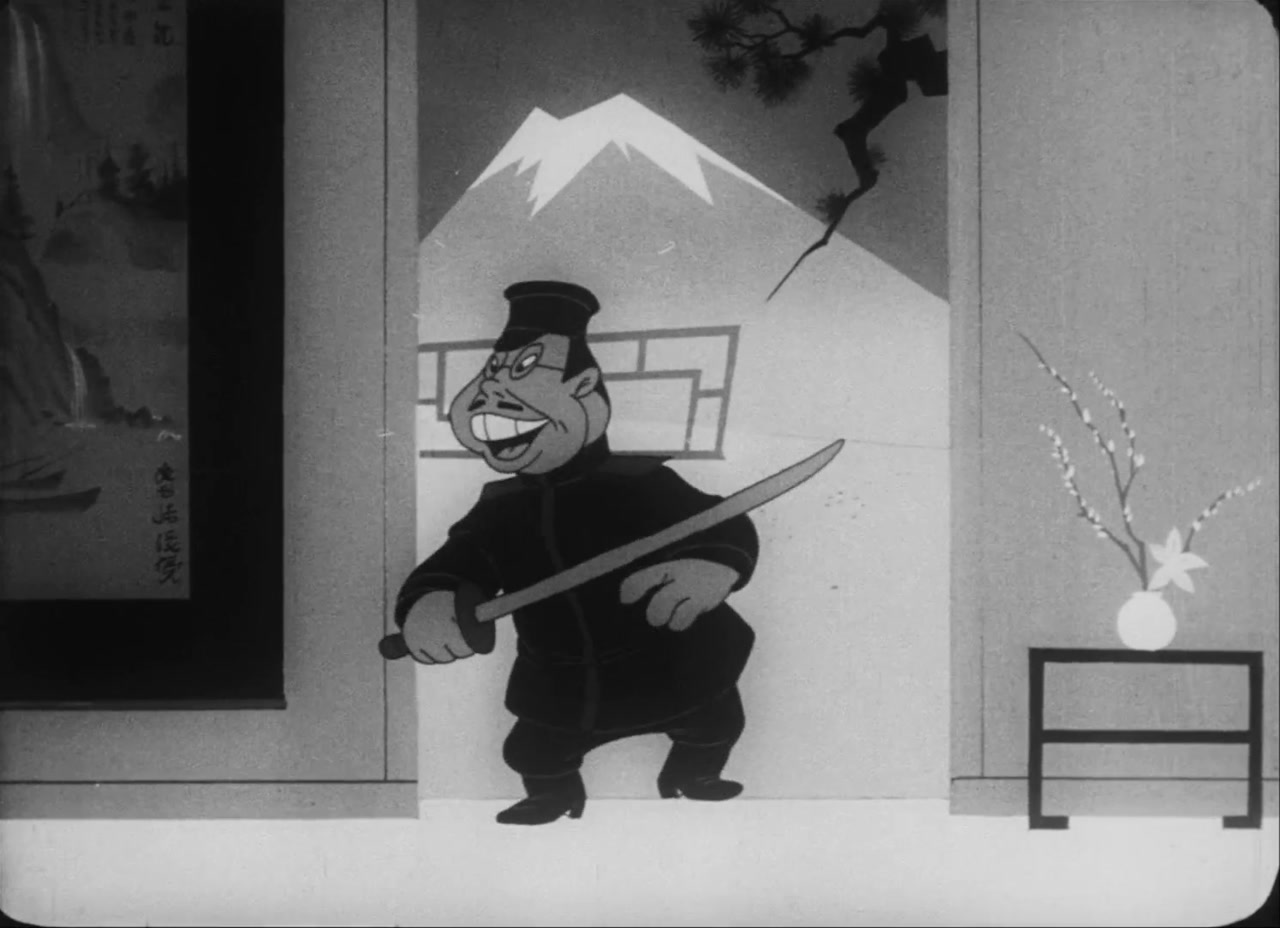
Private Snafu was an Army orientation cartoon programme begun in 1943 by Capra's First Motion Picture Unit, with scripts mostly by Theodor Geisel and animation by Warner Bros. The Internet Archive's collection warns that the shorts "depict some of the ethnic and racial prejudices that were commonplace in American society at their times". Both frames below come from shorts released after Japan's surrender.
Explain moreShow less
No Buddy Atoll (8 October 1945), directed by Chuck Jones, draws a naval officer with a flat face and an ape-like jaw and brow. The entry tags it name-calling by image.
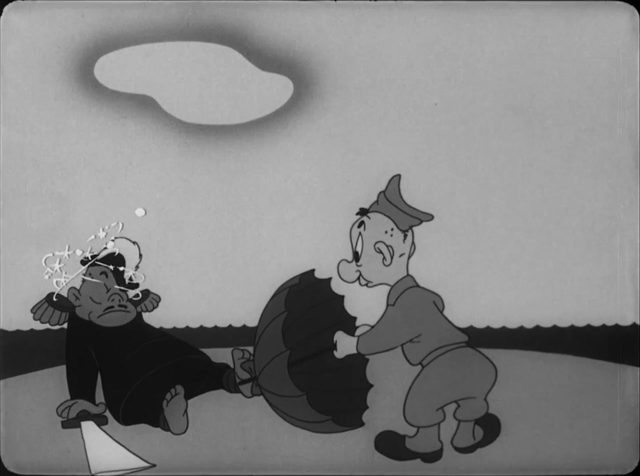
Operation Snafu (22 December 1945), directed by Friz Freleng, draws a soldier with round glasses and large protruding teeth. It is tagged name-calling by image. Read the technique: name-calling. Posters on the same theme: anti-Japanese propaganda posters.
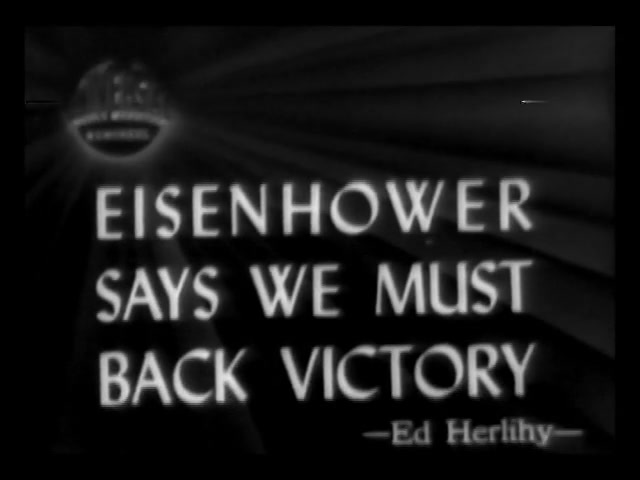
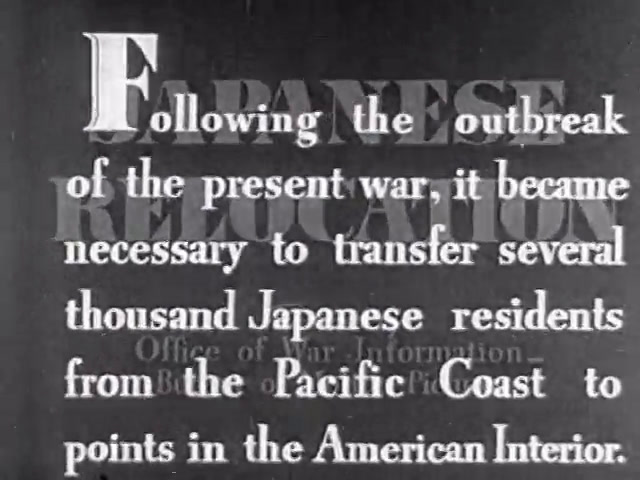
The Office of War Information's Japanese Relocation (about nine minutes, 1943), narrated by Milton S. Eisenhower, the War Relocation Authority's first director, opens with a card that says it "became necessary to transfer several thousand Japanese residents from the Pacific Coast". The entry tags "transfer" and "relocation" as euphemism for removal and confinement; about 120,000 people were removed, most of them U.S. citizens. Read the technique: euphemism.
How did Britain's Ministry of Information use film?
Britain's Ministry of Information put one roughly five-minute film into every cinema programme each week from summer 1940 and ran 16mm vans for village halls and factories. In October 1940 it released London Can Take It!, a Blitz film of roughly ten minutes made by Humphrey Jennings and Harry Watt of the GPO Film Unit. Quentin Reynolds, an American correspondent for Collier's, narrated it and says "I am a neutral reporter"; Warner Bros. distributed it in the United States. The case study notes Reynolds was a real eyewitness under his own name and nothing was forged, though the government origin was not foregrounded. The collection hosts no frame; see Britain's Ministry of Information films.
What did Japan's wartime newsreels and films ask?
Japan's single newsreel company, Nippon Eigasha, was formed in 1941. Dutch authorities confiscated films made for occupied Java after the surrender, and the Netherlands Institute for Sound and Vision released them in 2020 with a warning that they may reflect "erroneous, biased or politically extreme ideas". Eight hosted frames are Japanese.
Content note: Frame from a Japanese military propaganda film made in occupied Java; the archive warns the films may reflect erroneous, biased or politically extreme ideas. This object is shown as it was published. Why 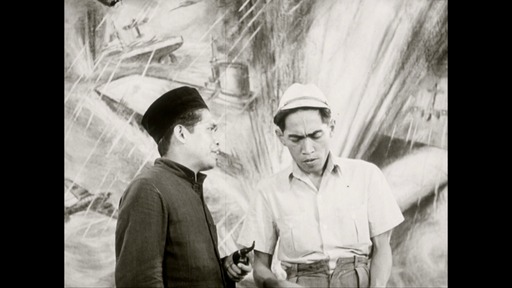
Explain moreShow less
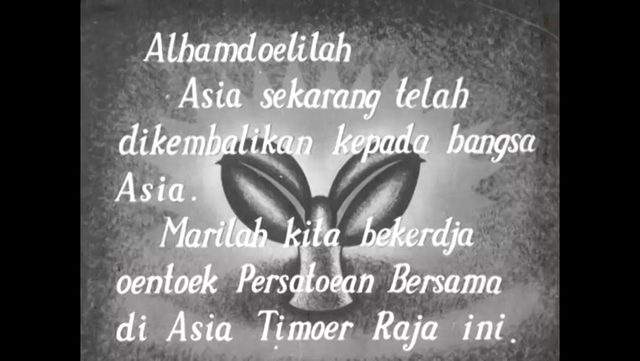
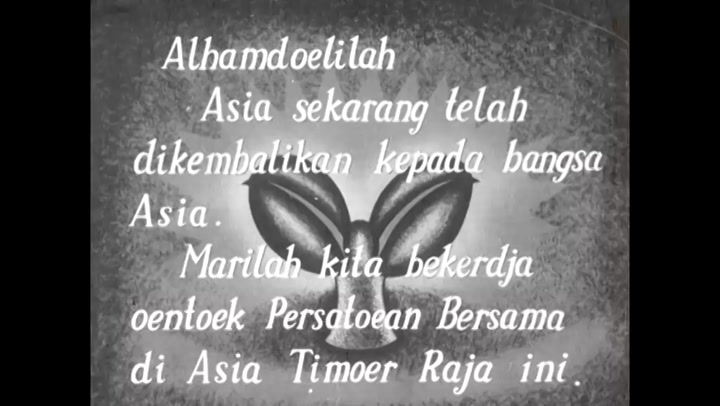
Issue no. 31 of Chabar Dai Toa (19 February 1942) opens with a Muslim formula of thanks, then says Asia "has now been given back" to the Asian peoples and calls viewers to "Persatoean Bersama". No terms are given. Tagged glittering generalities and transfer. Read the technique: glittering generalities.
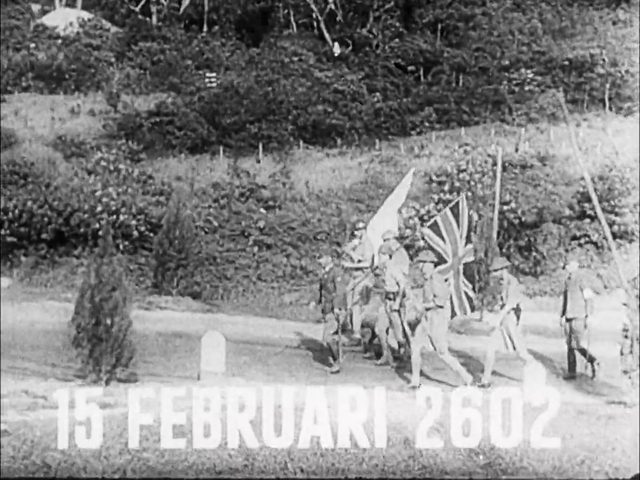
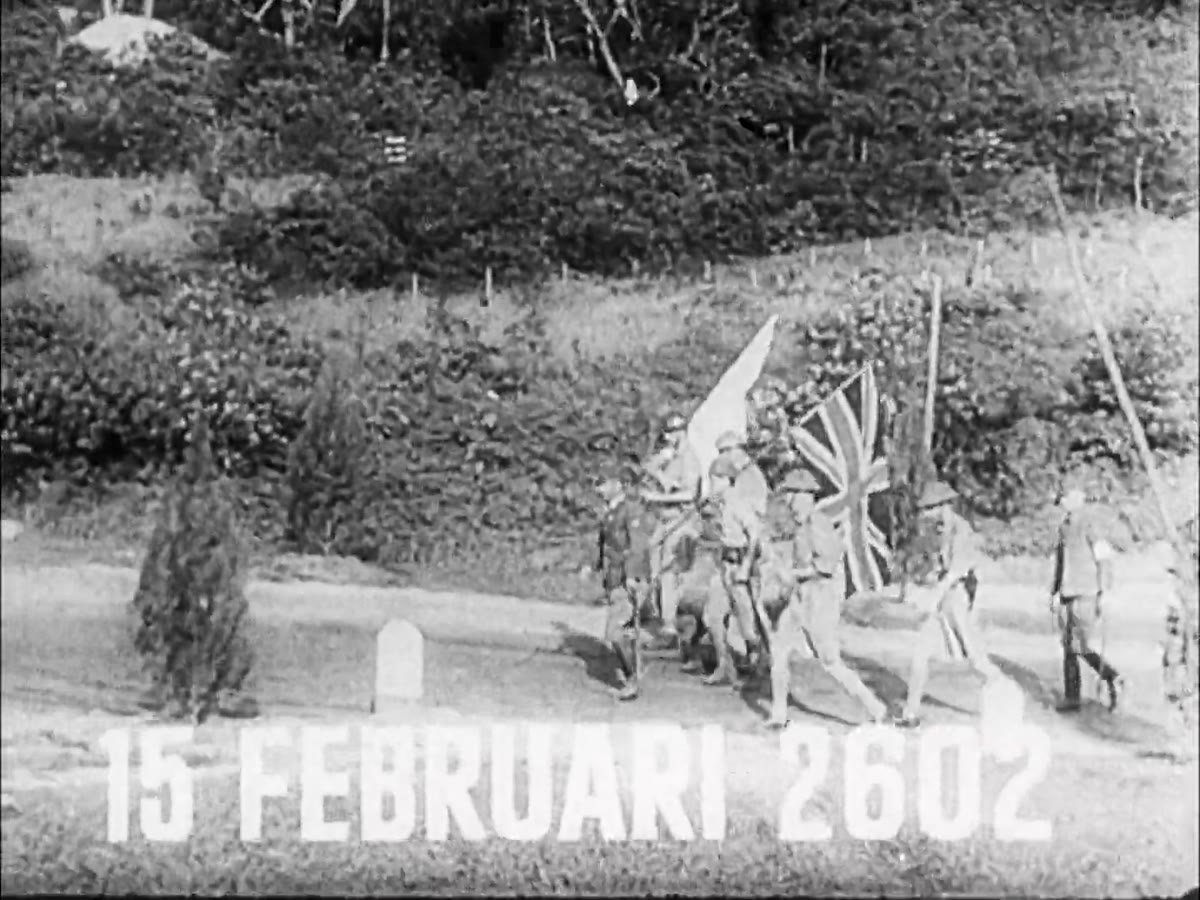
A newsreel on the conquest of South-East Asia ends its sequence of advance cards on the surrender scene at Singapore, dated in the Japanese imperial calendar (card-stacking). Read the technique: card stacking.
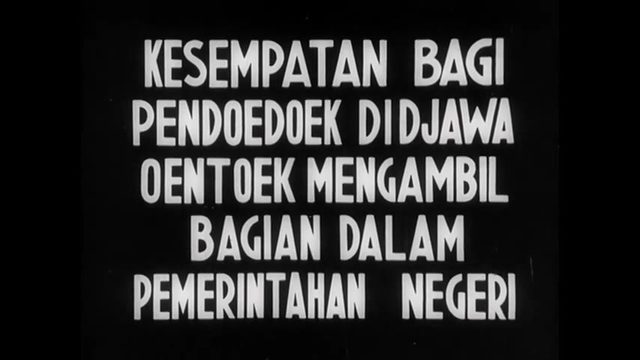
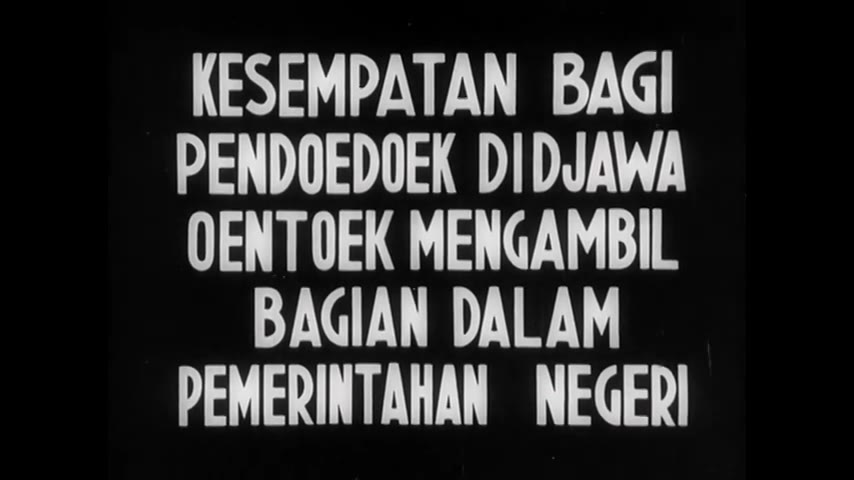
A 1943 card announces that Java's inhabitants may "take part in the government", before showing Prime Minister Tojo and the opening of the Central Advisory Council. The card names no powers (glittering generalities).
In a film of about 1944, two Indonesian men discuss the American fleet before a painted battle. The Dutch archive's catalogue calls the scene staged, so the message comes from ordinary local speakers and not an officer (plain folks).
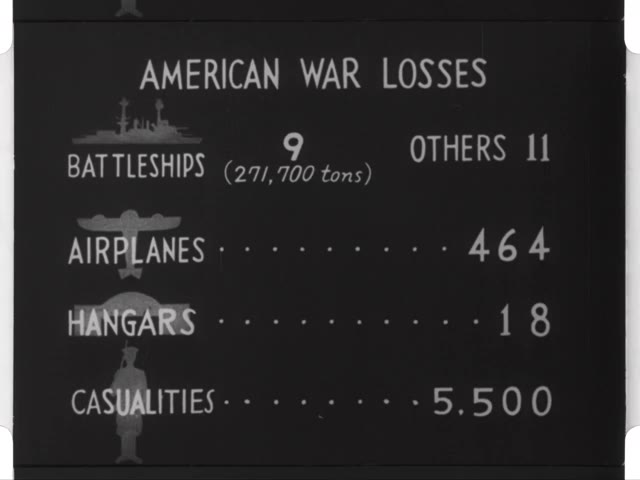
An English-language Daitoa News card lists American losses as round totals with no source or Japanese figure. U.S. Navy figures for 7 December 1941 differ. Tagged card-stacking.
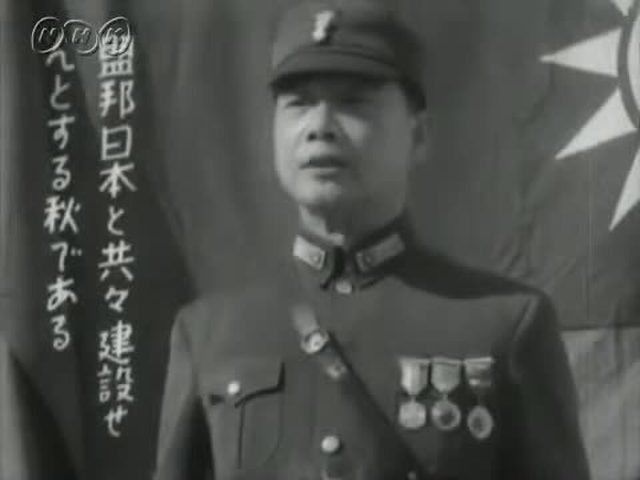
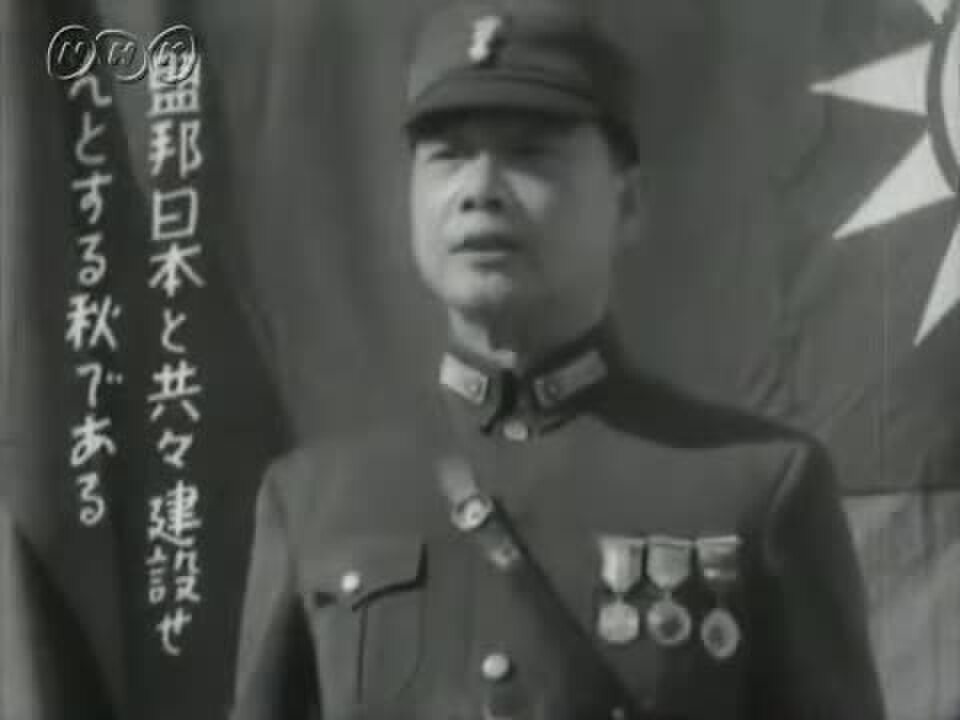
A newsreel carries the New Year address of Wang Jingwei, head of the Japanese-backed Nanjing government, who says it is time to build "together with our allied Japan" (testimonial).
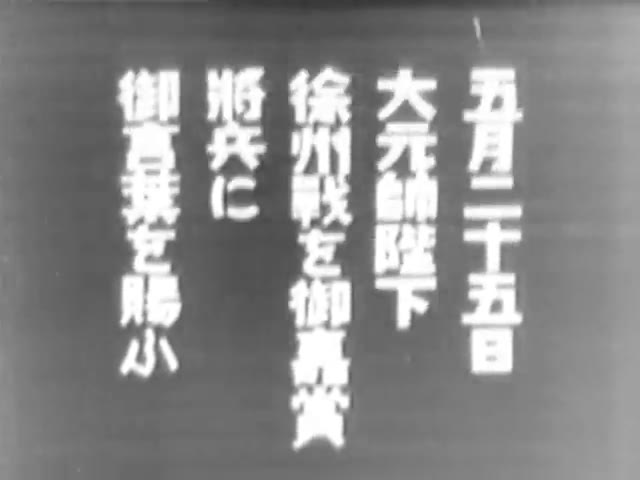
A captured newsreel card of May 1938 announces that the Emperor commends the Xuzhou battle; sovereign approval is the news item (testimonial). Read the technique: testimonial.
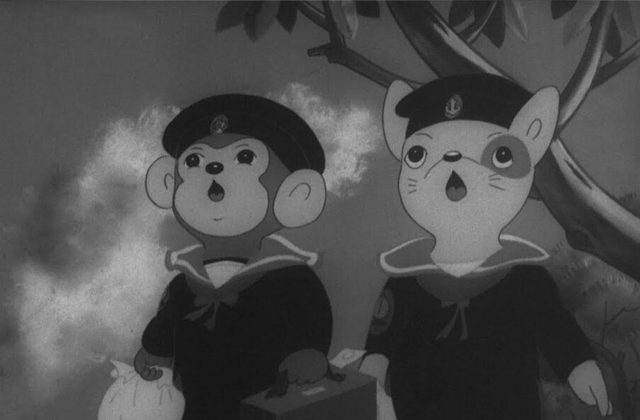
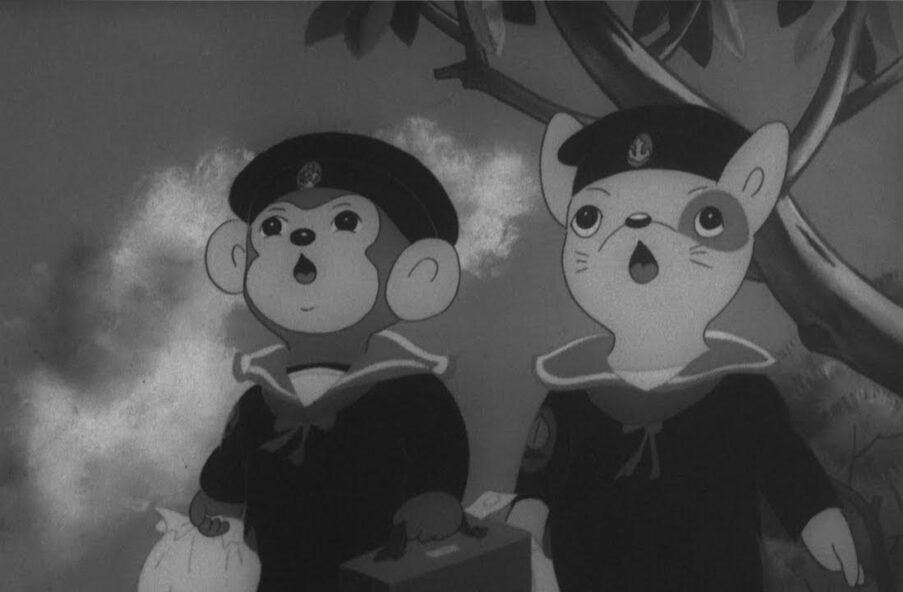
Momotarō: Umi no Shinpei (first screened 12 April 1945), generally called Japan's first feature-length animated film, was made by Shochiku for the Naval Ministry under director Mitsuyo Seo. The frame shows folk-tale animals in naval uniform (transfer).
What did Dutch films and newsreels say, under occupation and after?
The Dutch National Socialist movement (NSB) set up a film service in 1941 under German occupation. Its 171 films were confiscated after the war and released as public domain in May 2018.
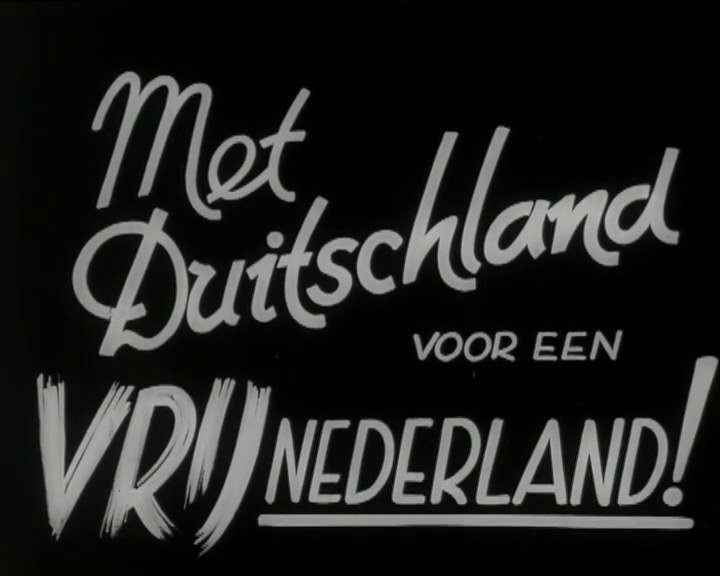
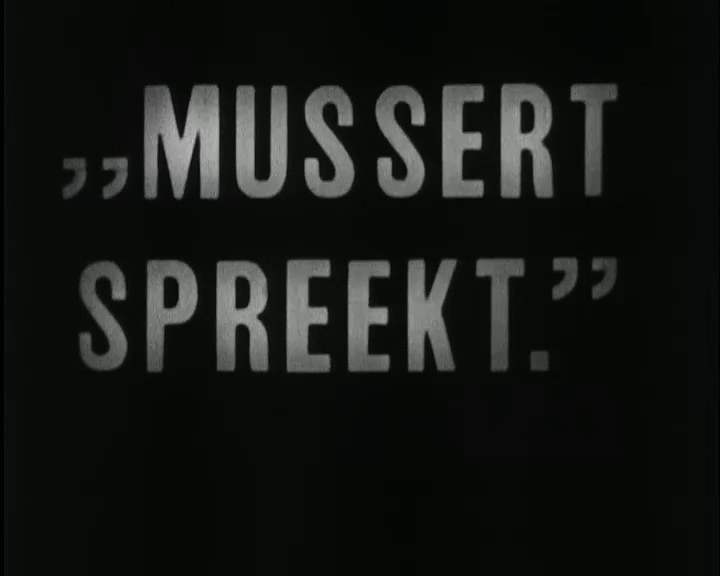
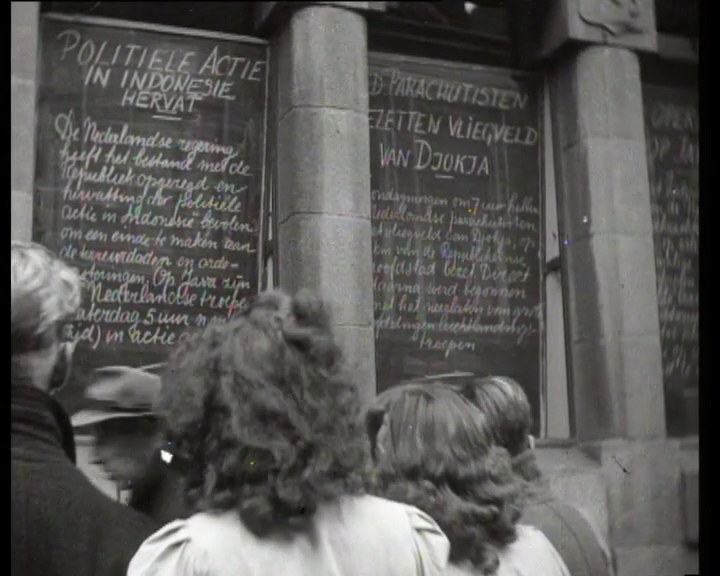
Explain moreShow less
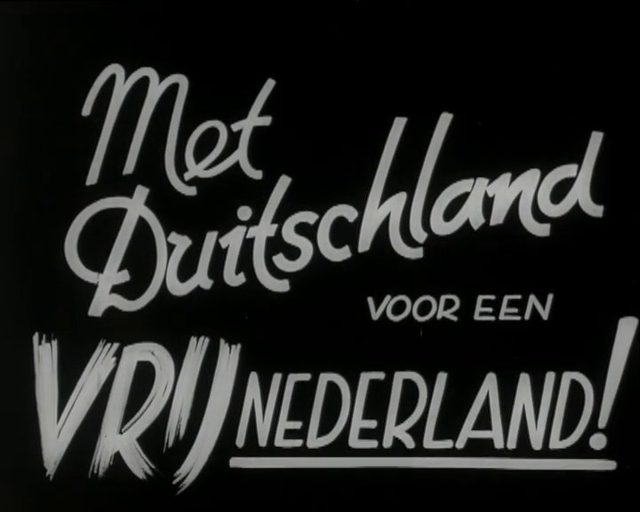
The end card reads "With Germany for a free Netherlands". The holding institution's shot log lists images arranged as a case against Britain and the pre-war order (glittering generalities, card-stacking).
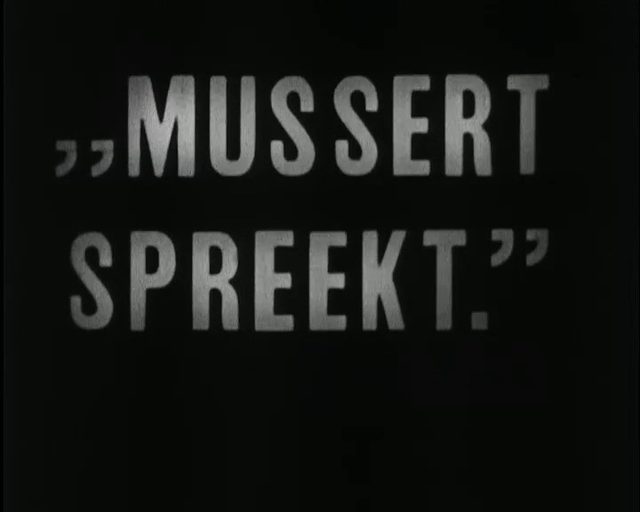
Mussert spreekt retells the movement's founding with the Dutch flag raised and the Wilhelmus sung before "the Leader", so the leader appears through national symbols (transfer).
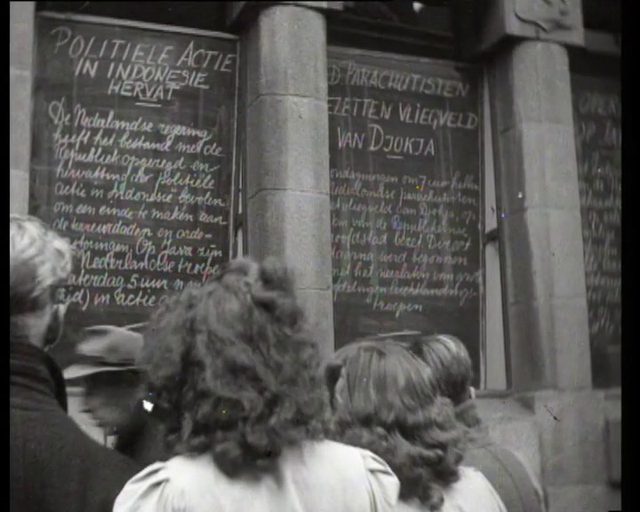
Polygoon Hollands Nieuws, a Dutch newsreel producer, showed chalkboard bulletins in December 1948 headed "Police action in Indonesia resumed" after the government launched its second offensive against the Indonesian Republic. The official term "police action" covered a large military offensive (euphemism). A 2022 Dutch research programme concluded that Dutch forces used extreme violence on a structural basis, and also documented Indonesian violence. Read the technique: euphemism.
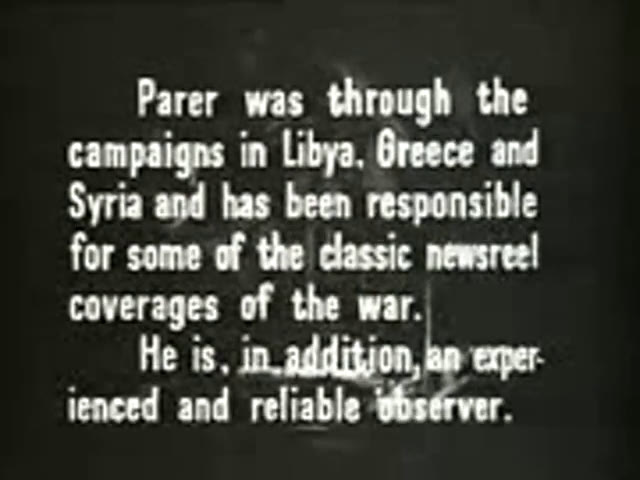
How did Allied and Cold War newsreels and films compare?
Kokoda Front Line! (1942), made by Cinesound for the Australian Department of Information's News and Information Bureau, opens with a card vouching for its cameraman Damien Parer as "an experienced and reliable observer" (testimonial). It shared the 1943 Academy Award for documentary short with Prelude to War and the Soviet Moscow Strikes Back, per the Why We Fight case study.
Explain moreShow less
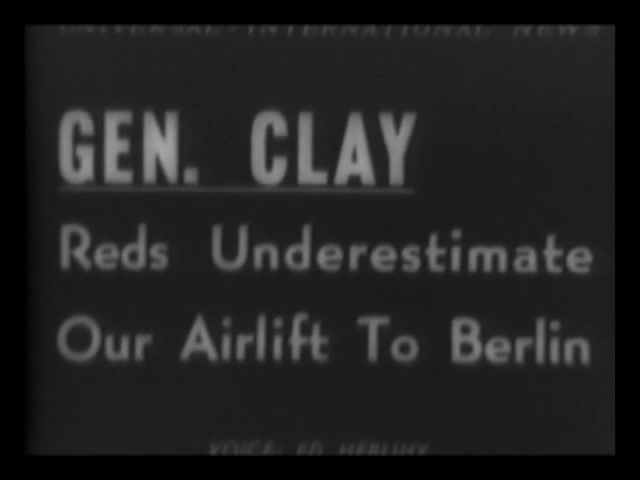
A Universal Newsreel headline of 21 October 1948 attributes a view to General Lucius Clay, the U.S. military governor, and uses "Reds" as a collective label for the Soviet side (name-calling). Universal was a commercial producer; its collection went to the National Archives.
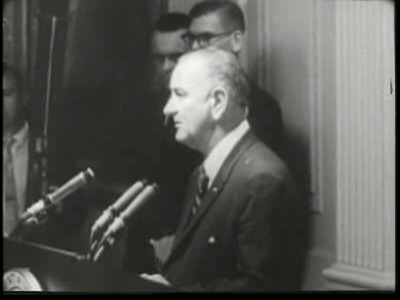
The 1965 Department of Defense film Why Vietnam? (about 31 minutes) outlines policy through statements by Johnson, Dean Rusk and Robert McNamara. Officials address the camera and no outside voice is heard (testimonial). The Vietnam side is on Vietnam War propaganda.
In Indonesia, the state company PPFN released Pengkhianatan G30S/PKI in 1984. TVRI broadcast it every 30 September until 1997 and students and civil servants were required to watch. It restages the torture of the officers killed in 1965 and does not show the mass killings that followed; compulsory screenings ended in 1998 and the army ordered them again in 2017. No frame is hosted; see the New Order's G30S film.
What to look for in a propaganda film
- Who shot the footage. Footage made for one audience changes meaning under another side's narration, as in Why We Fight.
- Cards and captions. A title card can name an authority, a virtue or a euphemism before any image plays.
- What is left out. A tally with no second column is a selection.
- The system around the film. Who owned the studio, whether viewing was compulsory, what research tested the result.
Browse propaganda films
The grid below shows the film-still objects in the collection. Each opens an object page with the holding institution, a link to the original record, the on-screen text and its translation, and the rights basis for hosting. For related pages, see propaganda radio, propaganda posters and psychological operations.
Sources and further reading
Sources and rights
Frames come from the Internet Archive, the Netherlands Institute for Sound and Vision (Open Beelden), the U.S.
Frames come from the Internet Archive, the Netherlands Institute for Sound and Vision (Open Beelden), the U.S. National Archives and Wikimedia Commons. Each object page gives its own rights basis. Transcriptions are verbatim.