Content note. This case quotes 1917 newspaper descriptions of soldiers' bodies being rendered for fat, and shows a 1917 headline calling Germans a "Wolf Tribe" traced to the "Huns". The words are quoted as evidence of the method. They are not this archive's description of anyone.
In one line: In April 1917 British newspapers reprinted a report that Germany was boiling down its own soldiers' corpses for fat; the story ran around the world, the German government denied it, and in December 1925 the British Foreign Secretary told the House of Commons that the government accepted there had never been any foundation for it.
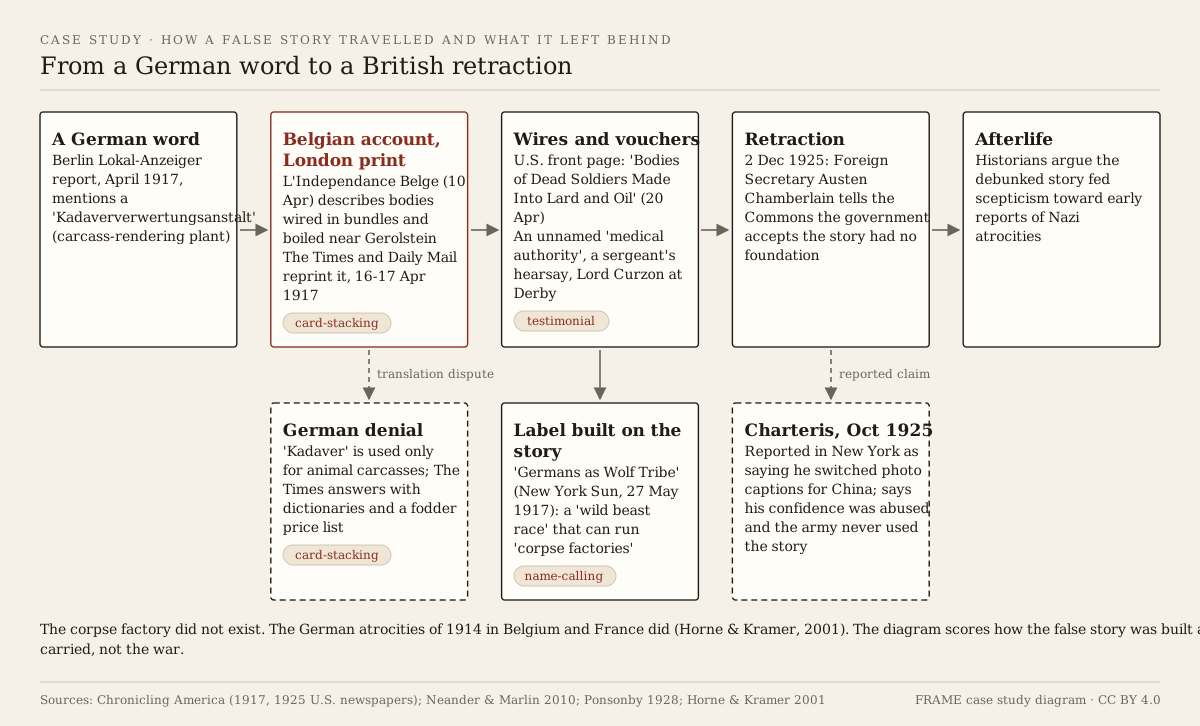
What happened
- Early April 1917. A report in the Berlin Lokal-Anzeiger mentions passing a Kadaververwertungsanstalt, a "carcass utilisation establishment". Kadaver is the ordinary German word for an animal carcass, and such plants rendered dead horses and other animals (Neander and Marlin, 2010).
- 10 April 1917. L'Indépendance Belge, a Belgian newspaper published in exile, prints an account of a "German Offal Utilisation Company" near Gerolstein in the Eifel. It says soldiers' bodies were stripped behind the line, wired into bundles of three or four, sent by train to the plant, and boiled down for fats and oils, with the residue ground into pig food and manure (as cabled to the New York Sun, 20 April 1917).
- 16-17 April 1917. The Times and the Daily Mail reprint the Belgian account. On 19 April The Times prints facsimiles of the Lokal-Anzeiger passage as confirmation, and on 20 April it adds a British sergeant's report of what a German prisoner "told me, mind, I don't know that it's true" (New York Sun, 20 April; Albuquerque Morning Journal, 10 May 1917).
- 20 April 1917. United Press carries the story to U.S. front pages. The Keokuk Daily Gate City runs "Bodies of Dead Soldiers Made Into Lard and Oil", reporting that Pope Benedict XV was "horrified", according to a Rome newspaper.
- Late April to early May 1917. The German government, by wireless, calls the report "loathsome and equally ridiculous" and says Kadaver "is never used for human bodies, but only for the carcasses of animals". The Times replies that this "dementi carefully abstains from denying the charge that matters", quotes dictionaries and a German fodder price list listing Kadavermehl beside Tierkörpermehl, and prints an anonymous letter citing "one of our most distinguished medical authorities". Lord Curzon, a member of the War Cabinet, tells an audience at Derby that the Germans "have not even, as we have read in the papers, spared the corpses of those who have fallen for them in battle" (New-York Tribune, 12 May 1917).
- 25 April 1917. Punch prints Bernard Partridge's cartoon "Cannon-Fodder—and After", built on the story.
- 27 May 1917. The New York Sun prints a London letter headlined "English Learn to Hate Enemy", which reports a British book review presenting Germans as a non-Aryan "Wolf Tribe" and a "wild beast race" that "can conduct 'corpse factories.'"
- 19-24 October 1925. Brigadier-General John Charteris, head of intelligence at British General Headquarters in France in 1917, speaks at the National Arts Club in New York. The Associated Press reports him as saying he started the story as propaganda aimed at China by switching the captions on two captured photographs, one of dead horses marked Kadaver and one of dead German soldiers. On 24 October, sailing for Glasgow, he says the dinner was meant to be private, that his confidence was abused, and that the "corpse factory" story was never used by the British army (San Antonio Light, 20 October; Evening Star, 25 October 1925).
- Early December 1925. With Chancellor Hans Luther and Foreign Minister Gustav Stresemann in London for the Locarno treaties and watching from the gallery, Foreign Secretary Austen Chamberlain tells the House of Commons that Luther has authorised him to say, on the German government's authority, that there never had been any foundation for the story, and that he accepts the denial on behalf of the British government (Associated Press, Evening Star, 4 December 1925). German newspapers welcome the statement (Elkins Inter-Mountain, 4 December 1925). The Literary Digest of 5 December advertises an article titled "The German Corpse-Factory Lie".
- 1928. Arthur Ponsonby, a Labour MP, gives the story a chapter in Falsehood in War-Time, his catalogue of wartime falsehoods.
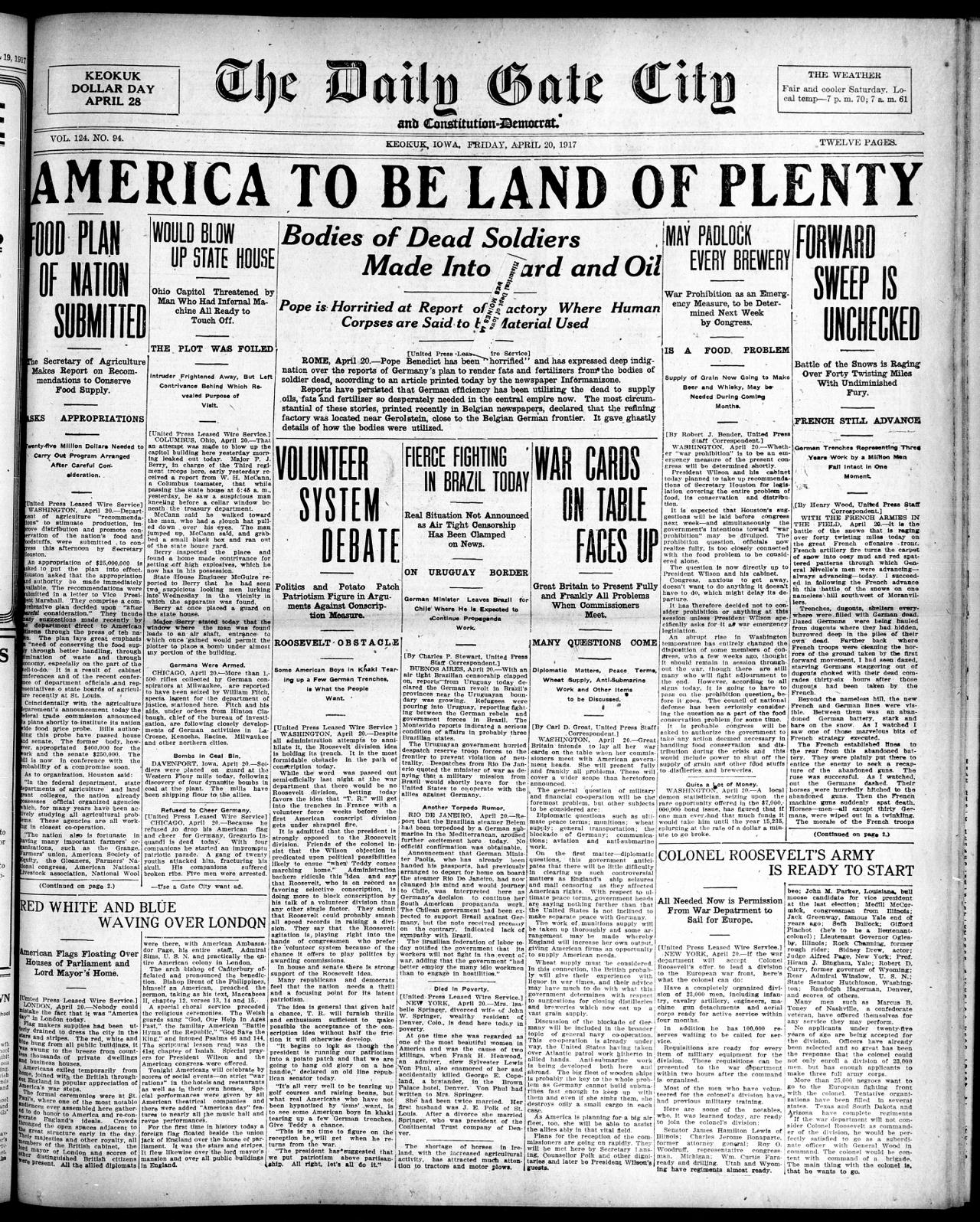
The Daily Gate City (Keokuk, Iowa), 20 April 1917, front page. The United Press story sits under the banner headline, beside war and conscription news. Chronicling America, Library of Congress. Public domain.
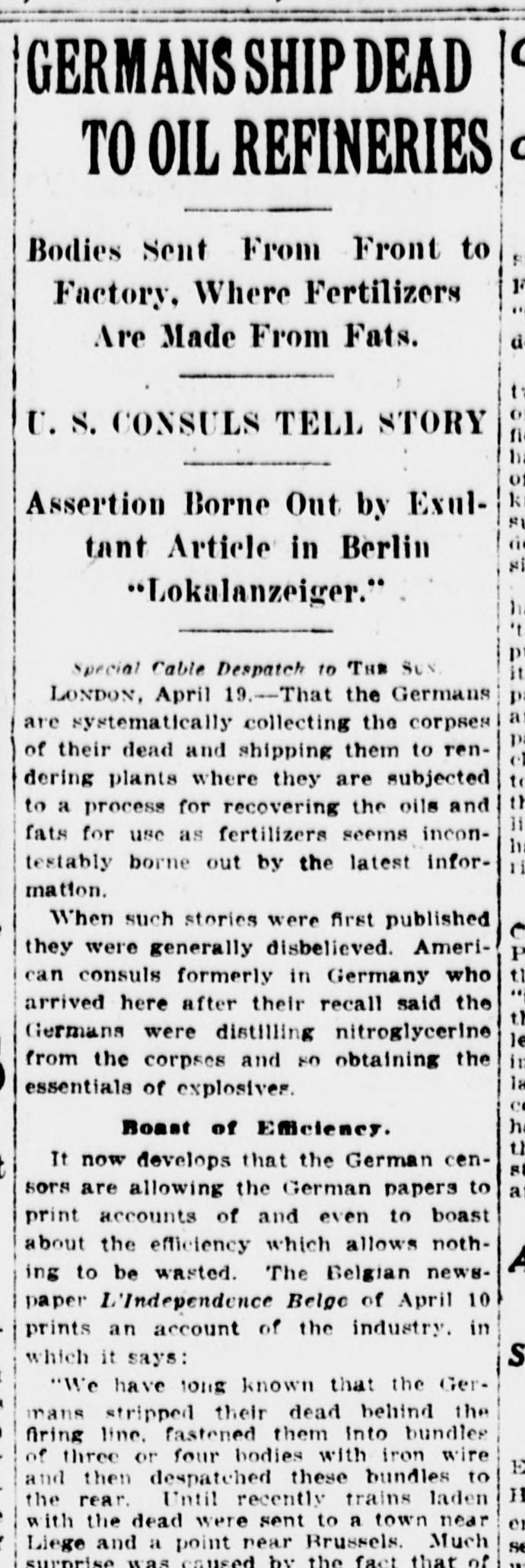
The Sun (New York), 20 April 1917, p. 4 (crop). A London cable relays the Belgian account and says The Times has printed facsimiles of the Lokal-Anzeiger passage as proof. Chronicling America, Library of Congress. Public domain.
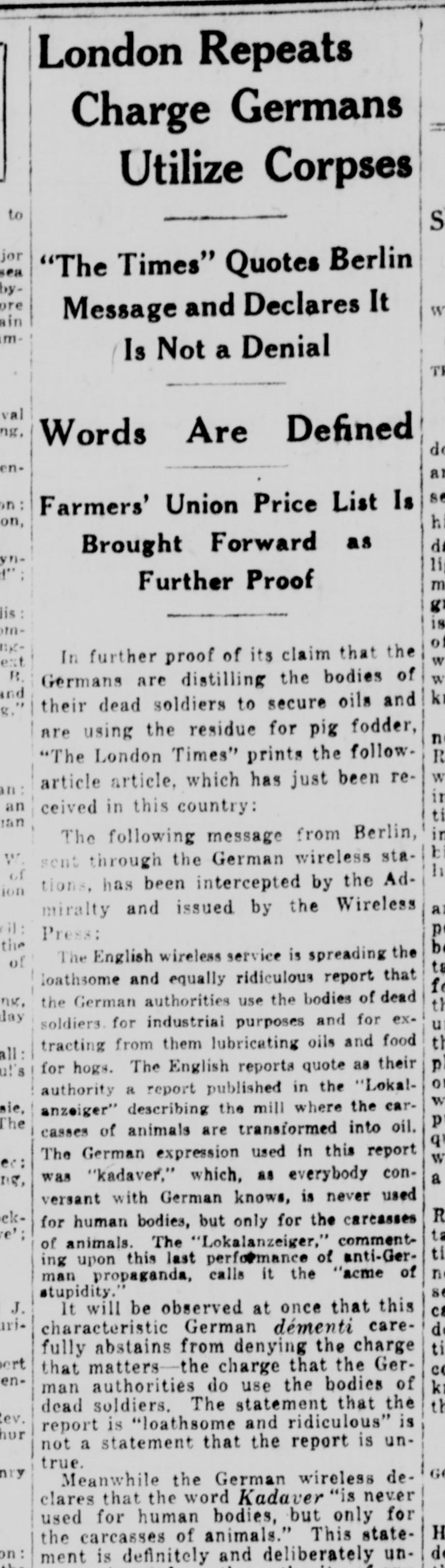
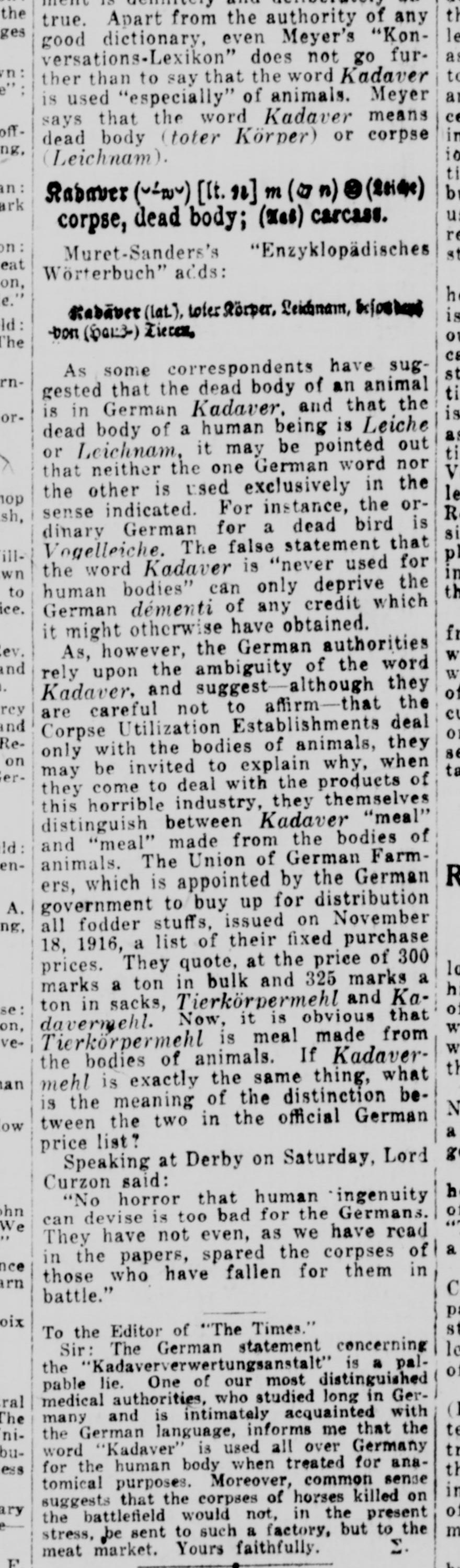
New-York Tribune, 12 May 1917, p. 8 (two crops of one article). The German denial, The Times's reply, the dictionary and price-list argument, Lord Curzon's remark and the anonymous letter, reprinted in full. Chronicling America, Library of Congress. Public domain.
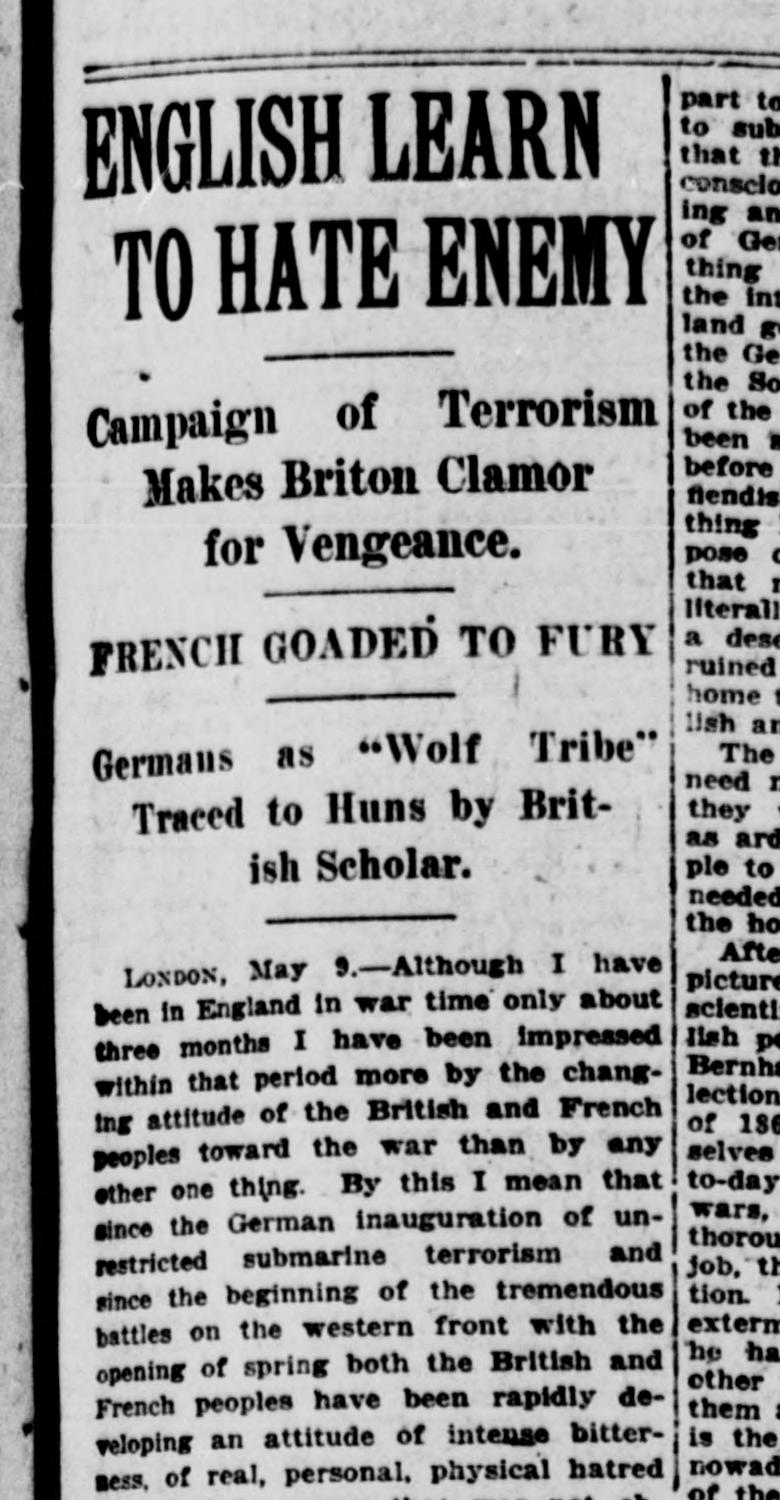
The Sun (New York), 27 May 1917, section 3, p. 1 (crop). The "Wolf Tribe" label is the paper's headline, shown as printed. Further down, the letter cites "corpse factories" as proof of it. Chronicling America, Library of Congress. Public domain.
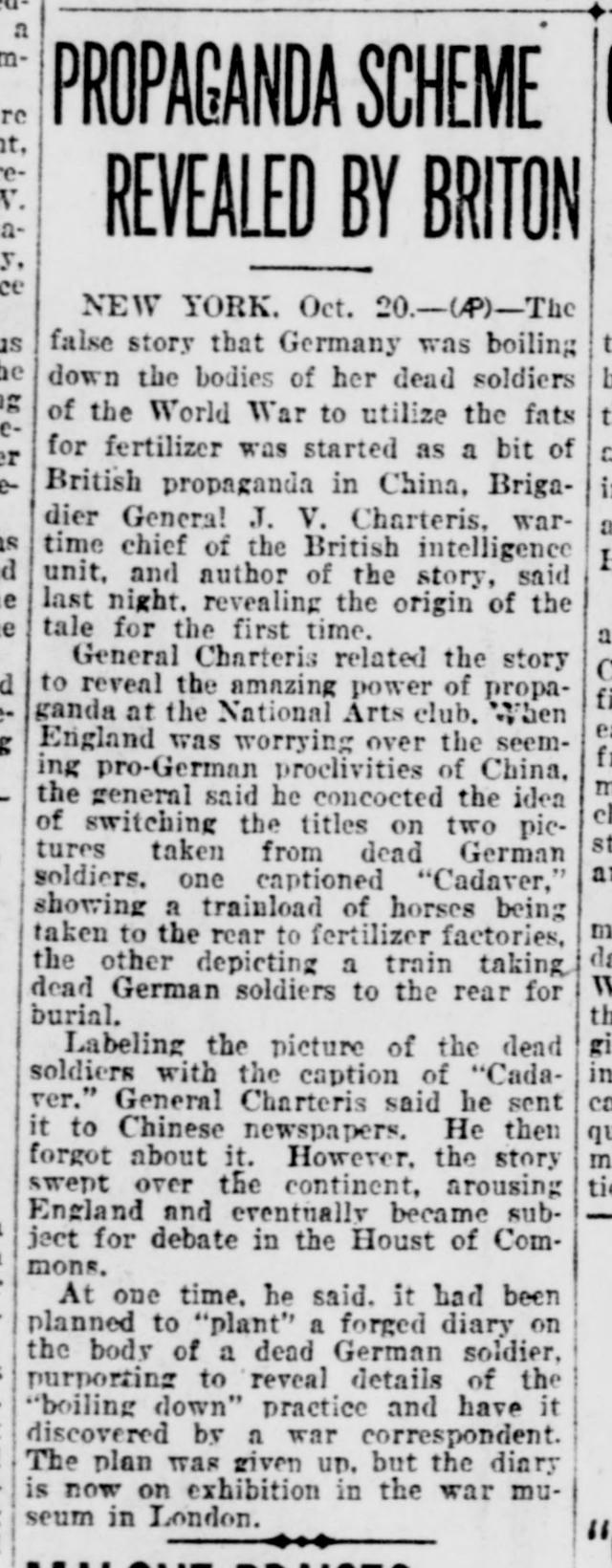
San Antonio Light, 20 October 1925, p. 8 (crop). The Associated Press report of Charteris's remarks at the National Arts Club. Chronicling America, Library of Congress. Public domain.
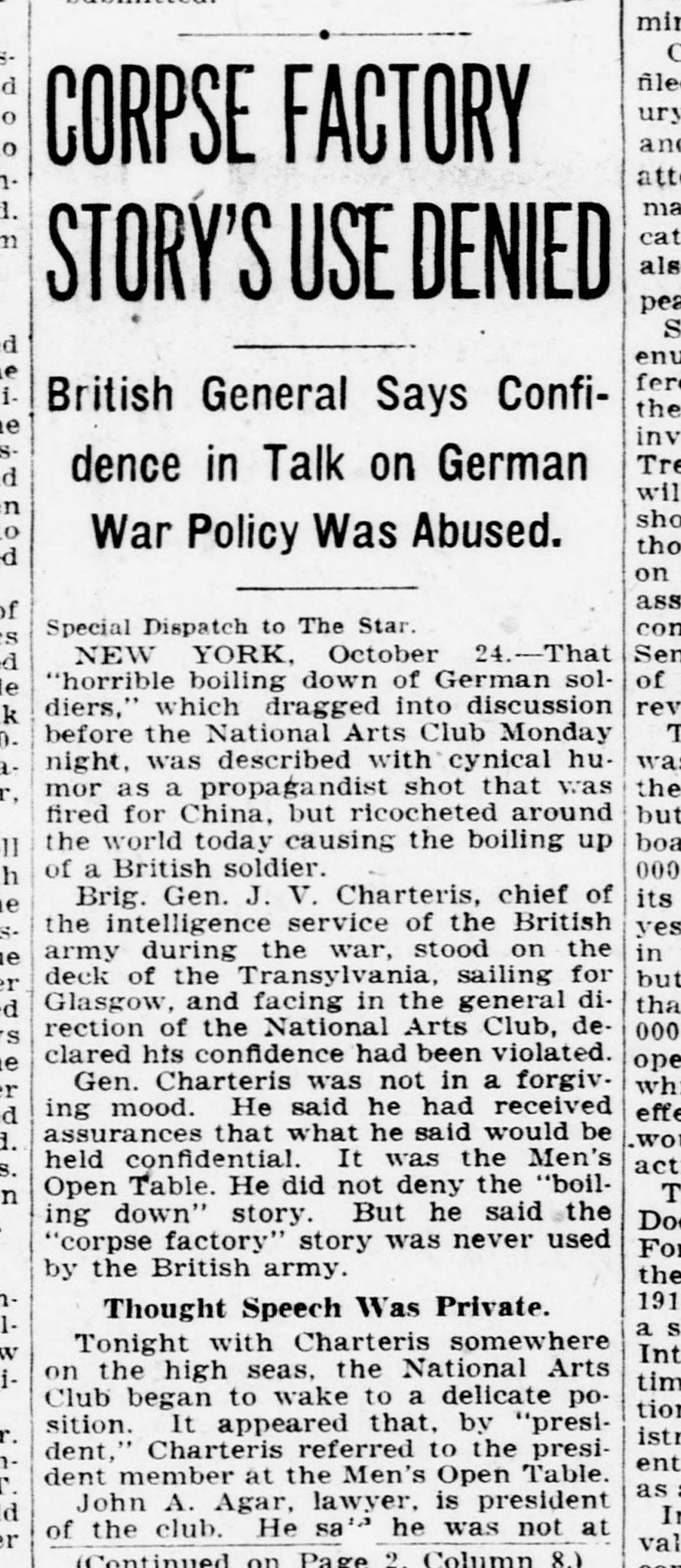
Evening Star (Washington), 25 October 1925, p. 1 (crop). Charteris, sailing home, says his confidence was abused and the army never used the story. Chronicling America, Library of Congress. Public domain.
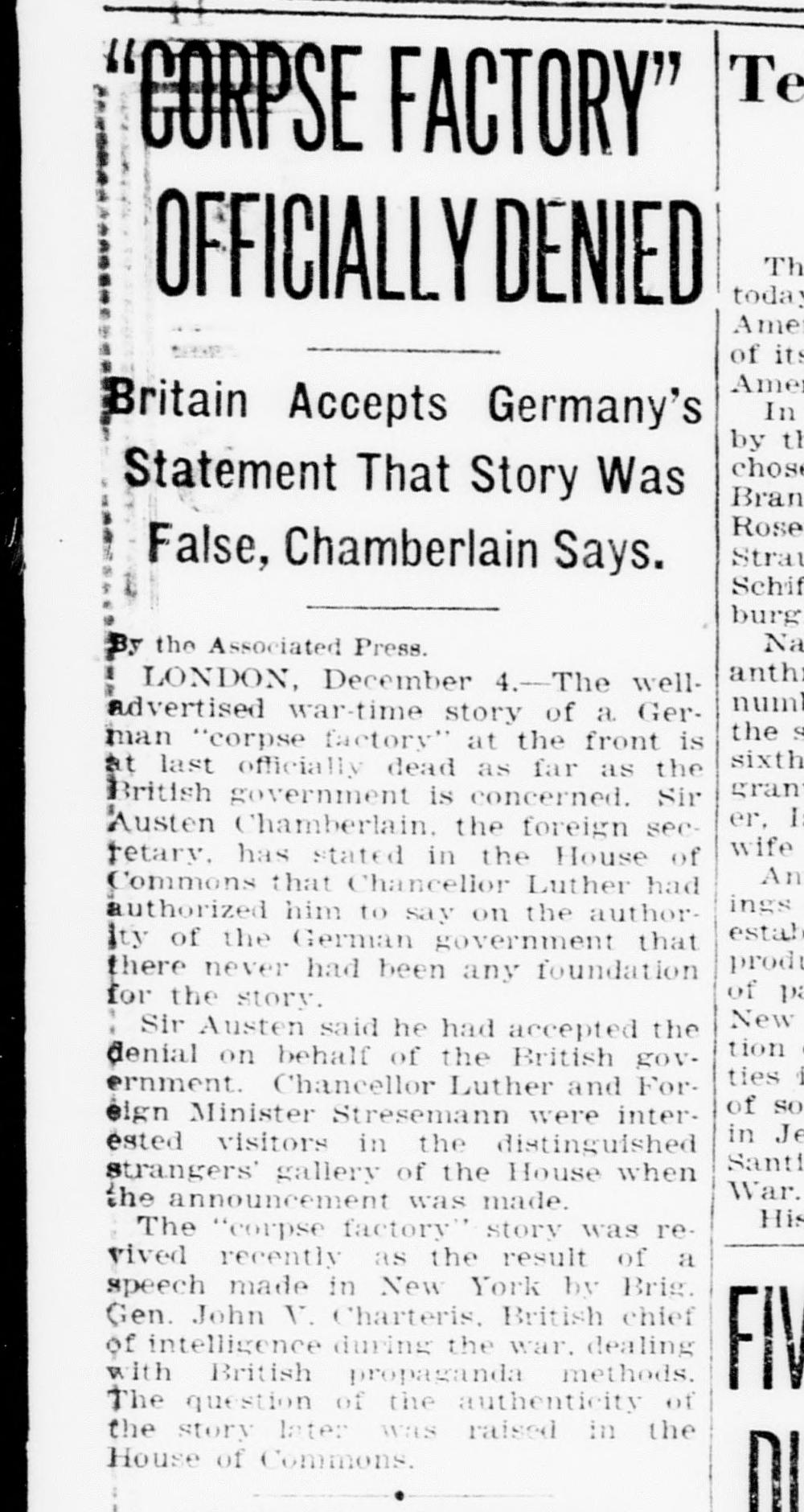
Evening Star (Washington), 4 December 1925, p. 10 (crop). The Associated Press report of Chamberlain's statement in the Commons. Chronicling America, Library of Congress. Public domain.
How it works
- Card stacking: the case was held up by a selected pile. The Times answered the German denial with dictionary entries, a fodder price list and a letter, and left out the ordinary fact that Kadaververwertungsanstalten were rendering plants for animal carcasses. It also treated the denial's failure to use the exact words the paper wanted as proof. Each item could be accurate on its own; the arrangement allowed only one reading.
- Testimonial: the story was vouched for by people and bodies whose standing was meant to end the checking: "one of our most distinguished medical authorities" (unnamed), a sergeant repeating a prisoner's hearsay, U.S. consuls "formerly in Germany", the reported horror of the Pope, and Lord Curzon citing what "we have read in the papers". None of them had seen the plant.
- Name-calling: once printed, the story became evidence for a label. The Sun's "Wolf Tribe" letter uses "corpse factories" as the proof that Germans are a "wild beast race". The label does the work; the factory, which did not exist, is the decoration.
Then and now
Content note: Dehumanizing caricature of Germans as an ape, implied sexual violence and partial nudity. This object is shown as it was published. Why 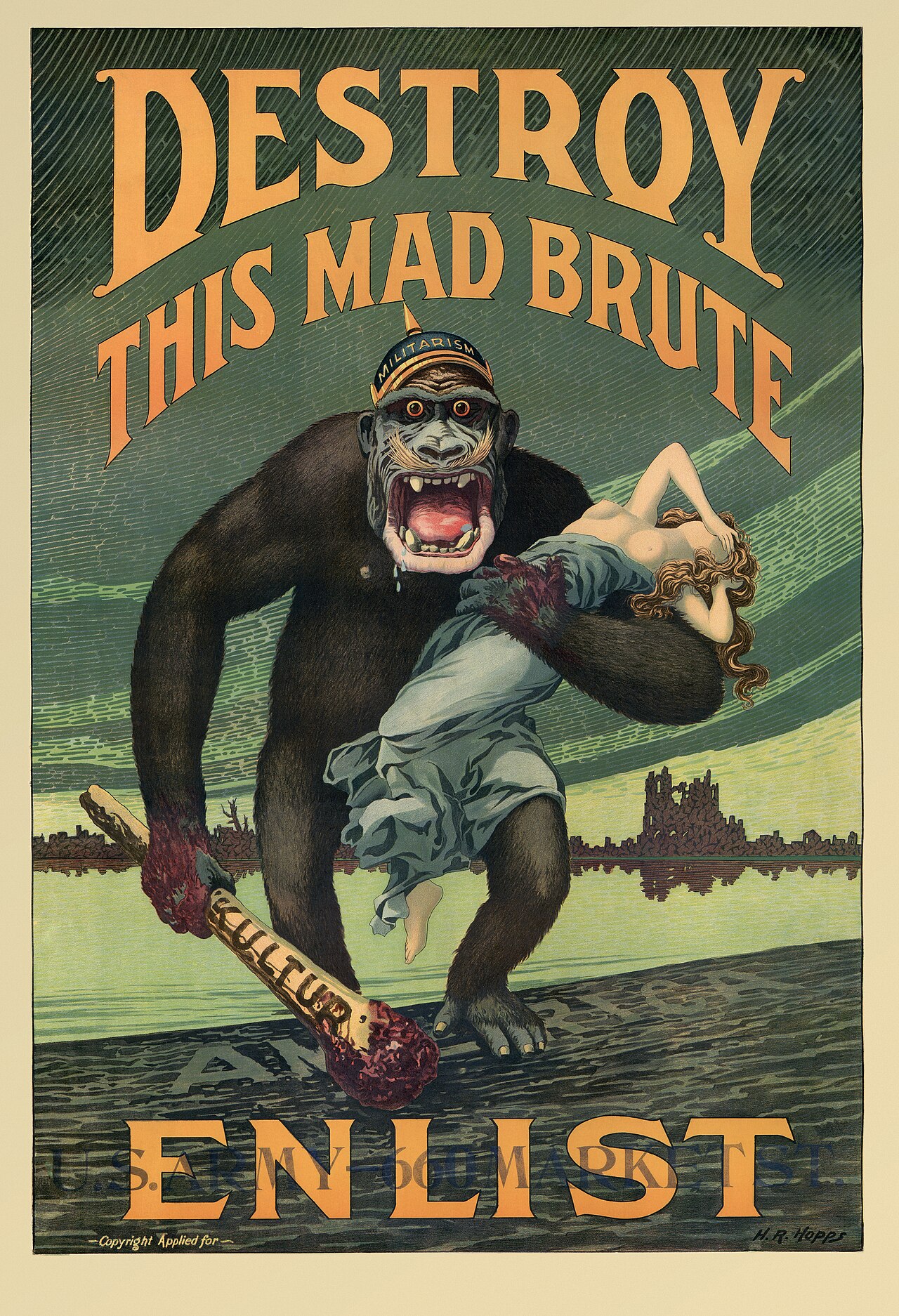
Destroy This Mad Brute — Enlist, U.S. Army recruiting poster by Harry R. Hopps, 1917. Public domain.
The same year, the U.S. Army's Destroy This Mad Brute drew the enemy as an ape. The poster and the "Wolf Tribe" letter make the same move: Germans are placed outside humanity, so any story about them can be believed. The difference is in the claim. The poster is a drawing no one takes as a report. The corpse factory was printed as news, with dates, a place name and a railway line, and it was false. Remember Belgium — Enlist To-Day shows the contrast the other way: it draws on the 1914 invasion of Belgium, where the killing of about 6,500 civilians is documented (Horne and Kramer, 2001).
Positions on the record
- What The Times said at the time: that the German denial was not a denial, that Kadaver can mean a human body, and that the price list showed Germany distinguished corpse meal from animal meal.
- What the German government said: that the report was "loathsome and equally ridiculous" and that Kadaver referred only to animal carcasses.
- What the British government said in 1925: Austen Chamberlain told the Commons that the German government had stated there never was any foundation for the story, and that he accepted that denial on behalf of the British government. That statement, not later scholarship, is the official British record that the story was false.
- What Charteris said: the Associated Press reports him describing the caption switch in New York; the next week he says his remarks were meant to be private and that the army never used the story. No document confirming the caption switch is cited in the sources used here, so his reported account stays a claim, not a finding.
- What historians argue about the afterlife: Neander and Marlin (2010), Phillip Knightley (The First Casualty, 1975) and Deborah Lipstadt (Beyond Belief, 1986) argue that the exposed story taught readers to discount atrocity reports, and that this scepticism slowed belief in the first reports of Nazi mass murder in the 1940s. Horne and Kramer (2001) argue that the interwar debunking of stories like this one also led many to dismiss the German atrocities of 1914, which were real. These are historians' arguments about cause and effect, not facts this page can test.
- What is not shown: who at the Belgian paper wrote the account and on what evidence; whether any British official department fed it to the press; whether the story reached Chinese newspapers in 1917, and with what effect. Charteris's reported account is the main source for the China link, and he disputed how it was reported.
Same-method test
Swap the flag and the finding does not change. A German newspaper that reprinted an exile paper's unverified account of French or British troops rendering their own dead, backed it with an unnamed expert and a price list, and let its ministers quote it would be scored the same way here. So would a government that later told its parliament the story had no foundation: the retraction is part of the record, whichever side issues it.
How to spot it
- Ask who saw it. Count the eyewitnesses to the thing itself, not the people repeating or vouching for the report.
- When a denial turns on a word, check the word. Kadaver had an everyday meaning that fitted a far more ordinary plant.
- Watch for the move from "a report says" to "they are the kind of people who would". When a story becomes proof of a label, the label will survive the story.
- Remember that a debunked atrocity does not make every atrocity report false. 1914 in Belgium is documented; the 1917 corpse factory was not.
Images
| Image | Source | Licence |
|---|---|---|
| Mechanism diagram (above) | Drawn for FRAME from this page's sourced facts (make_diagrams.py) |
CC BY 4.0, FRAME |
| Daily Gate City (Keokuk), 20 April 1917, front page | Chronicling America, Library of Congress | Public domain (U.S., published 1917) |
| The Sun (New York), 20 April 1917, p. 4, "Germans Ship Dead to Oil Refineries" (crop) | Chronicling America, Library of Congress | Public domain (U.S., published 1917); cropped by FRAME |
| New-York Tribune, 12 May 1917, p. 8, "London Repeats Charge Germans Utilize Corpses" (two crops) | Chronicling America, Library of Congress | Public domain (U.S., published 1917); cropped by FRAME |
| The Sun (New York), 27 May 1917, section 3, "English Learn to Hate Enemy" (crop) | Chronicling America, Library of Congress | Public domain (U.S., published 1917); cropped by FRAME |
| San Antonio Light, 20 October 1925, p. 8, "Propaganda Scheme Revealed by Briton" (crop) | Chronicling America, Library of Congress | Public domain (U.S., published 1925); cropped by FRAME |
| Evening Star (Washington), 25 October 1925, p. 1, "Corpse Factory Story's Use Denied" (crop) | Chronicling America, Library of Congress | Public domain (U.S., published 1925); cropped by FRAME |
| Evening Star (Washington), 4 December 1925, p. 10, "'Corpse Factory' Officially Denied" (crop) | Chronicling America, Library of Congress | Public domain (U.S., published 1925); cropped by FRAME |
| Destroy This Mad Brute (1917) | FRAME gallery | Public domain |
Image gaps
- The Times and Daily Mail pages of 16-17 April 1917. Not included: no openly licensed scan was found, and the British Newspaper Archive and Times Digital Archive are subscription services. The U.S. reprints above carry the same text. Fillable if a public-domain scan turns up on Wikimedia Commons.
- Punch, "Cannon-Fodder—and After" (April 1917). Public domain (Bernard Partridge died in 1945; published before 1931), but the Wikimedia Commons API was rate-limiting requests from the build environment and no Library of Congress copy was found. Fillable.
- The Hansard record of Chamberlain's statement. Parliamentary copyright, reusable under the Open Parliament Licence, but api.parliament.uk could not be reached from the build environment, so the exact date and wording follow the Associated Press report. Fillable as a text link, which would also confirm the date.
- The Charteris photographs. Not included: the two captioned photographs he is reported to have switched have not been identified, and may not exist.
- Posters. No Library of Congress World War I poster about the corpse factory was found; the story ran in newspapers, cartoons and pamphlets rather than on recruiting posters.
Sources
Full text in this archive: Ponsonby, Falsehood in War-Time (1928).
- The Daily Gate City and Constitution-Democrat (Keokuk, Iowa), 20 April 1917, p. 1, United Press: "Bodies of Dead Soldiers Made Into Lard and Oil". Chronicling America.
- The Sun (New York), 20 April 1917, p. 4: "Germans Ship Dead to Oil Refineries", cable from London, 19 April, quoting L'Indépendance Belge of 10 April and The Times. Chronicling America.
- Albuquerque Morning Journal, 10 May 1917, p. 5: "Germans Find a Use for Bodies of Troops", quoting The Times of 20 April. Chronicling America.
- New-York Tribune, 12 May 1917, p. 8: "London Repeats Charge Germans Utilize Corpses", reprinting the German wireless denial, The Times's reply, Lord Curzon at Derby and a letter to The Times. Chronicling America.
- The Sun (New York), 27 May 1917, section 3, p. 1: "English Learn to Hate Enemy". Chronicling America.
- San Antonio Light, 20 October 1925, p. 8, Associated Press: "Propaganda Scheme Revealed by Briton". Chronicling America.
- Evening Star (Washington), 25 October 1925, p. 1: "Corpse Factory Story's Use Denied". Chronicling America.
- The Elkins Inter-Mountain (West Virginia), 4 December 1925, p. 1: news summary on Chamberlain's Commons statement. Chronicling America.
- The Bismarck Tribune, 3 December 1925, p. 3: Literary Digest advertisement listing "The German Corpse-Factory Lie". Chronicling America.
- Evening Star (Washington), 4 December 1925, p. 10, Associated Press: "'Corpse Factory' Officially Denied". Chronicling America.
- House of Commons Debates (Hansard), December 1925, statement by the Secretary of State for Foreign Affairs, Austen Chamberlain. The Hansard site could not be reached from the build environment; the wording above follows the Associated Press report.
- Joachim Neander and Randal Marlin, "Media and Propaganda: The Northcliffe Press and the Corpse Factory Story of World War I", Global Media Journal: Canadian Edition 3, no. 2 (2010).
- Joachim Neander, The German Corpse Factory: The Master Hoax of British Propaganda in the First World War (Saarbrücken: universaar, 2013).
- Punch, or the London Charivari, 25 April 1917: Bernard Partridge, "Cannon-Fodder—and After".
- Arthur Ponsonby, Falsehood in War-Time (London: George Allen and Unwin, 1928), chapter on the corpse factory.
- Phillip Knightley, The First Casualty: From the Crimea to Vietnam (London: André Deutsch, 1975).
- Deborah E. Lipstadt, Beyond Belief: The American Press and the Coming of the Holocaust, 1933-1945 (New York: Free Press, 1986).
- John Horne and Alan Kramer, German Atrocities, 1914: A History of Denial (New Haven: Yale University Press, 2001).