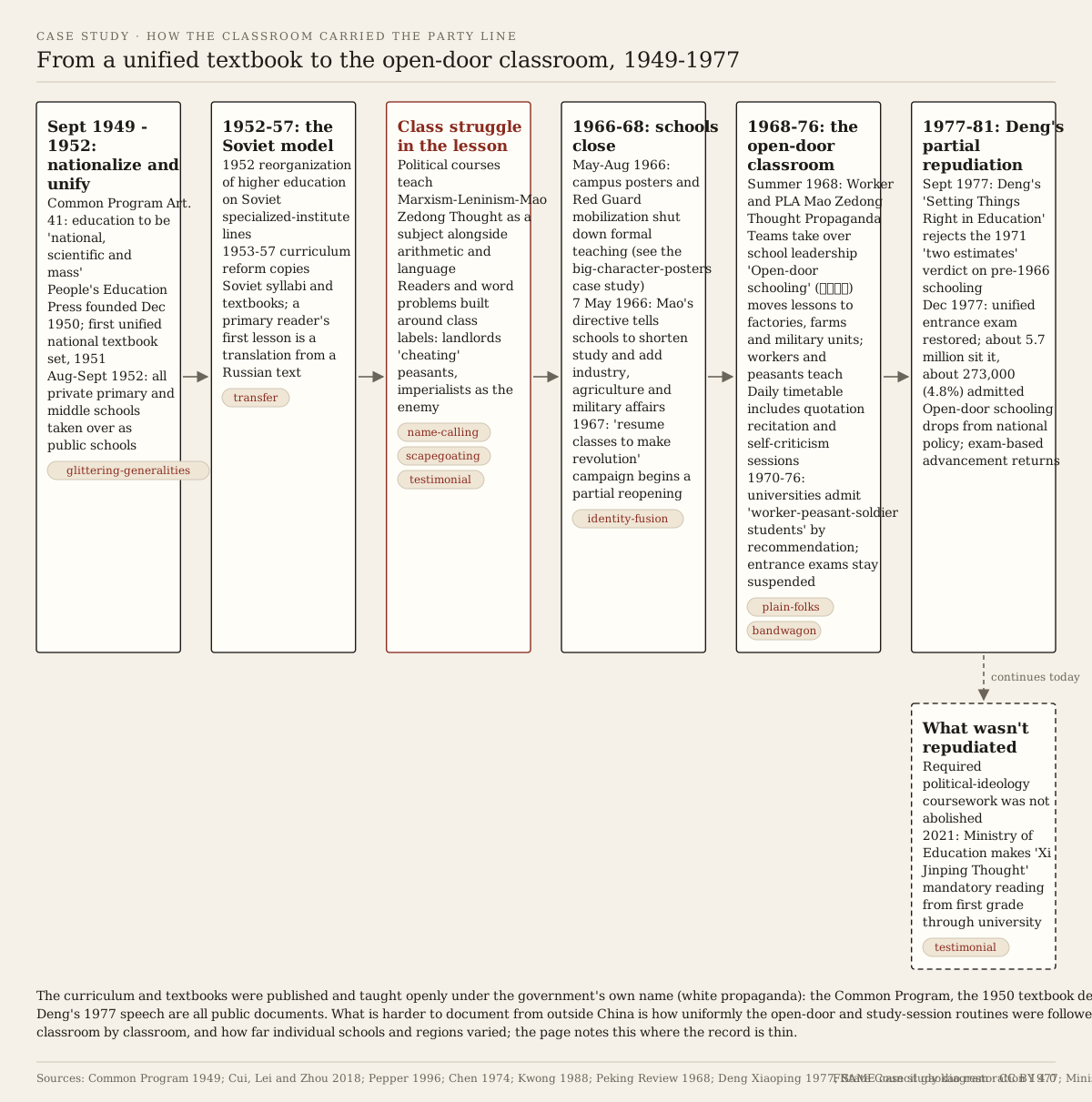
In one line: Between 1949 and 1952 China's new government nationalized every private school and replaced a mixed textbook market with one national set, then remade the curriculum on the Soviet model, made class-struggle framing and Mao Zedong Thought taught subjects, shut schools for two years at the start of the Cultural Revolution, moved classrooms into factories and farms under "open-door schooling," and built daily quotation recitation and self-criticism into the ordinary timetable — a system Deng Xiaoping's 1977 restoration of the entrance exam partly, not wholly, repudiated: political-ideology coursework is still compulsory in Chinese schools today.
What happened
- 29 September 1949. The Common Program, the provisional constitution adopted by the First Plenary Session of the Chinese People's Political Consultative Conference, states in Article 41 that the "culture and education of the People's Republic of China shall be New Democratic — national, scientific and popular [mass]," with the government's main educational task defined as "raising the cultural level of the people," training personnel for "national construction," and "eradicating feudal, compradore and fascist ideology."
- 1 December 1950. The Ministry of Education founds the People's Education Press (人民教育出版社) as the country's dedicated textbook publisher; in 1951 it issues the first nationally unified set of revised primary and secondary textbooks, replacing the mix of commercial, missionary and regional textbooks used before 1949.
- August-September 1952. On Ministry of Education instructions, private middle and primary schools nationwide are taken over by local governments and converted into public schools; the same year's regulations set Ministry curriculum standards "ranging from curriculum content to curriculum evaluation" (Cui, Lei and Zhou 2018).
- 1952. The reorganization of Chinese higher education replaces the pre-1949 American- and European-influenced university system with Soviet-style specialized institutes focused on engineering and technical training (see Divide the land, label the enemy: propaganda and discipline in the Jiangxi Soviet (1927-1934) for the party's earlier, base-area education work).
- 1953-1957. A second national curriculum reform explicitly follows the Soviet Union's syllabi, textbooks and teaching methods; China's first mathematics syllabus is drawn up by consulting the Soviet ten-year-school mathematics syllabus, and at the height of this period the opening lesson of a primary Chinese-language reader is a translation from a Russian textbook (Cui, Lei and Zhou 2018).
- 1950s onward. Every school runs a political course (政治课) alongside arithmetic, language and science, teaching Marxism-Leninism-Mao Zedong Thought as examinable content; language readers, arithmetic word problems and history lessons are built around the party's class categories — students learn, for instance, how "landlords cheated the peasants" in word problems set as ordinary arithmetic exercises (Hoover Institution Maoist-textbooks research; see also the party's 1949-66 "two camps" and then "three worlds" framing of the outside world documented in Cambridge's China Quarterly, cited below).
- 1958. The Great Leap Forward's "education revolution" directs that education be combined with productive labour and study shortened; part-work, part-study schools (半工半读) spread as an early version of what would later be called open-door schooling.
- 16 May - August 1966. Campus posters, a People's Daily editorial and Mao's own "Bombard the Headquarters" poster launch the Cultural Revolution; universities and secondary schools stop regular teaching as students form Red Guard groups and travel to "exchange revolutionary experience." This page does not re-describe that sequence; see Big-character posters: how the opening labels of China's Cultural Revolution did the work of charges (1966-68) for the full, dated account.
- 7 May 1966. Mao's "May 7 Directive," addressed first to the People's Liberation Army, extends to every sector: people should "mainly engage" in their own work but also "learn industrial production, agricultural production and military affairs" and "criticize and repudiate the bourgeoisie"; applied to schools, the directive becomes the standing justification for shortening study and moving lessons outside the classroom for the next decade.
- October 1967. With formal teaching stalled for over a year, the party launches the "resume classes to make revolution" (复课闹革命) campaign; a People's Daily editorial calls for reopening class "in Mao Zedong Thought and in the Great Proletarian Cultural Revolution" — schools reopen, but as sites of continued political campaigning rather than a return to the pre-1966 curriculum.
- Summer 1968. Worker and, in some places, PLA "Mao Zedong Thought Propaganda Teams" (毛泽东思想宣传队, commonly the worker propaganda team or gongxuandui) are sent into universities, middle and primary schools to take over leadership from teachers and academic administrators; Yao Wenyuan's August 1968 Red Flag article "The Working Class Must Exercise Leadership in Everything" supplies the doctrine.
- 1968-1976. "Open-door schooling" (开门办学, kaimen banxue) becomes the standard description of how lessons are run: students and teachers spend part of the school term in factories, on farms or with military units described as the true "big classrooms," and workers, peasants and soldiers are invited in as part-time instructors. Chinese Education (a U.S. journal that translated PRC educational documents for Western researchers) carried contemporary accounts such as "With an Open-Door Policy, the School Is Run Increasingly Well" (1976), describing a school that built its own oil-refinery and auto-parts workshops with teachers and students as the workforce.
- 1968-1976, the ordinary timetable. Within reopened schools, morning recitation of passages from Quotations from Chairman Mao Tse-tung and organized sessions of criticism and self-criticism (批评与自我批评) — a practice with deeper roots in party rectification going back to Yan'an (see The Yan'an Rectification Movement: doctrine, self-criticism and the Rescue Campaign (1942-1945)) — become built into the regular class schedule rather than occasional campaign events.
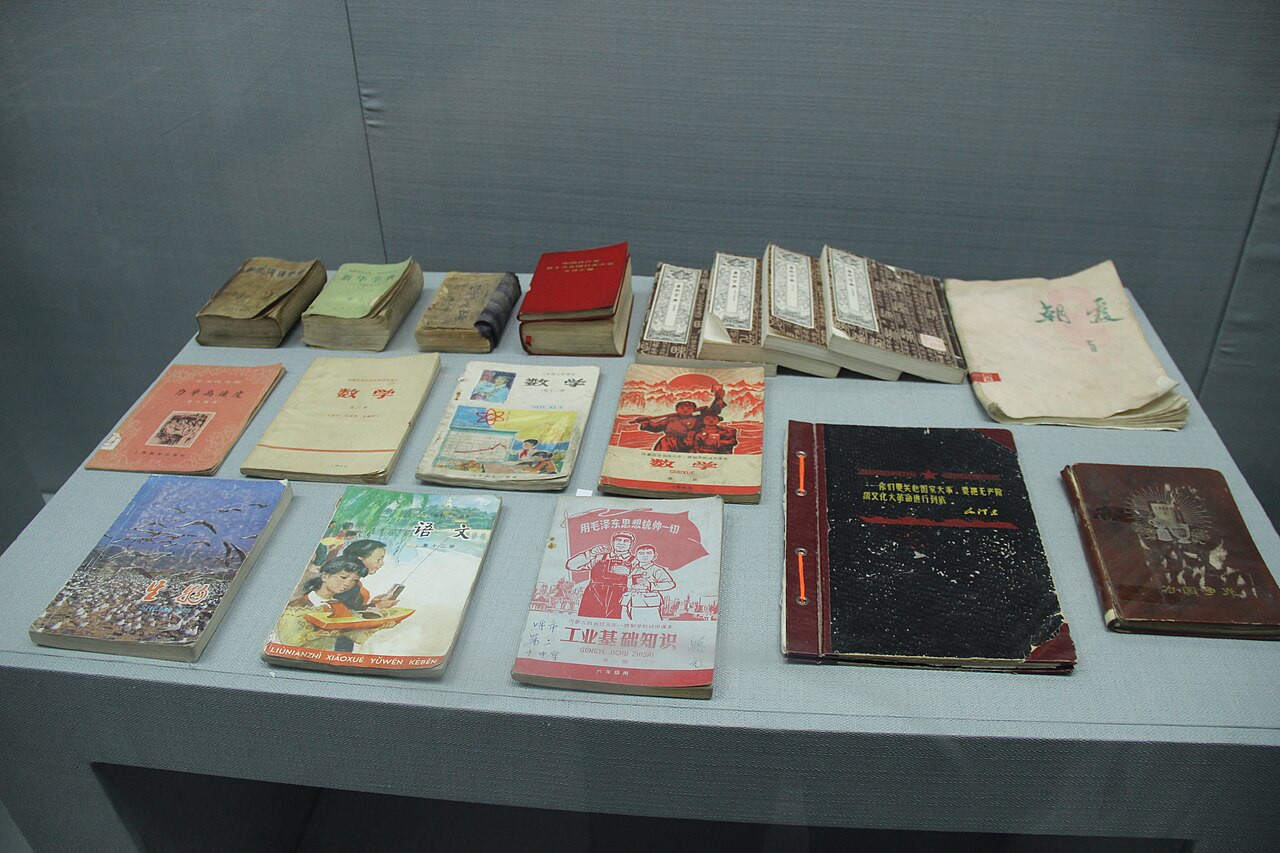
Cultural Revolution-era school textbooks and notebooks in a museum display case at the Inner Mongolia Museum, Hohhot. Among them are a mathematics reader, a language reader and an industrial-basics reader whose cover carries the slogan "Use Mao Zedong Thought to unify everything". Photograph by Gary Todd, 14 July 2015. CC0, via Wikimedia Commons.

- 1970-1976. With the national college entrance exam still suspended (it had stopped in 1966), universities that reopened admitted "worker-peasant-soldier students" (工农兵学员) chosen by political recommendation from their work unit rather than examination.
- 1971, National Education Work Conference. The conference's summary adopts what became known as the "two estimates" (两个估计): that the seventeen years of schooling before 1966 had operated under a "bourgeois dictatorship" over education, and that most teachers were "bourgeois intellectuals" in need of remolding — a verdict that kept the political framing of curriculum and staffing in place even as some ordinary teaching resumed.
- 19 September 1977. In the speech "Setting Things Right in Education," Deng Xiaoping — newly returned to leadership after Mao's death and the arrest of the Gang of Four in 1976 — explicitly repudiates the "two estimates," arguing the pre-1966 education system and its teachers had not in fact operated under bourgeois dictatorship, and calls for the Ministry of Education to resume direct authority over universities and curriculum standards.
- October-December 1977. The State Council formally restores the unified national college entrance exam, suspended since 1966; the exam is held that December — the only year in its history when different provinces sat it on different dates — with about 5.7 million candidates registering and about 273,000 (roughly 4.8 percent) admitted.
- 1978-1981. Textbooks are revised again, the People's Education Press resumes normal publishing, and exam-based advancement replaces political recommendation as the standard route through school and into university; open-door schooling drops out of national policy. Required political-ideology coursework is not abolished: China's schools continue to teach a mandatory political-education subject to the present day, most recently reorganized around "Xi Jinping Thought" (Ministry of Education directives, 2020-2021; see Then and now, below).
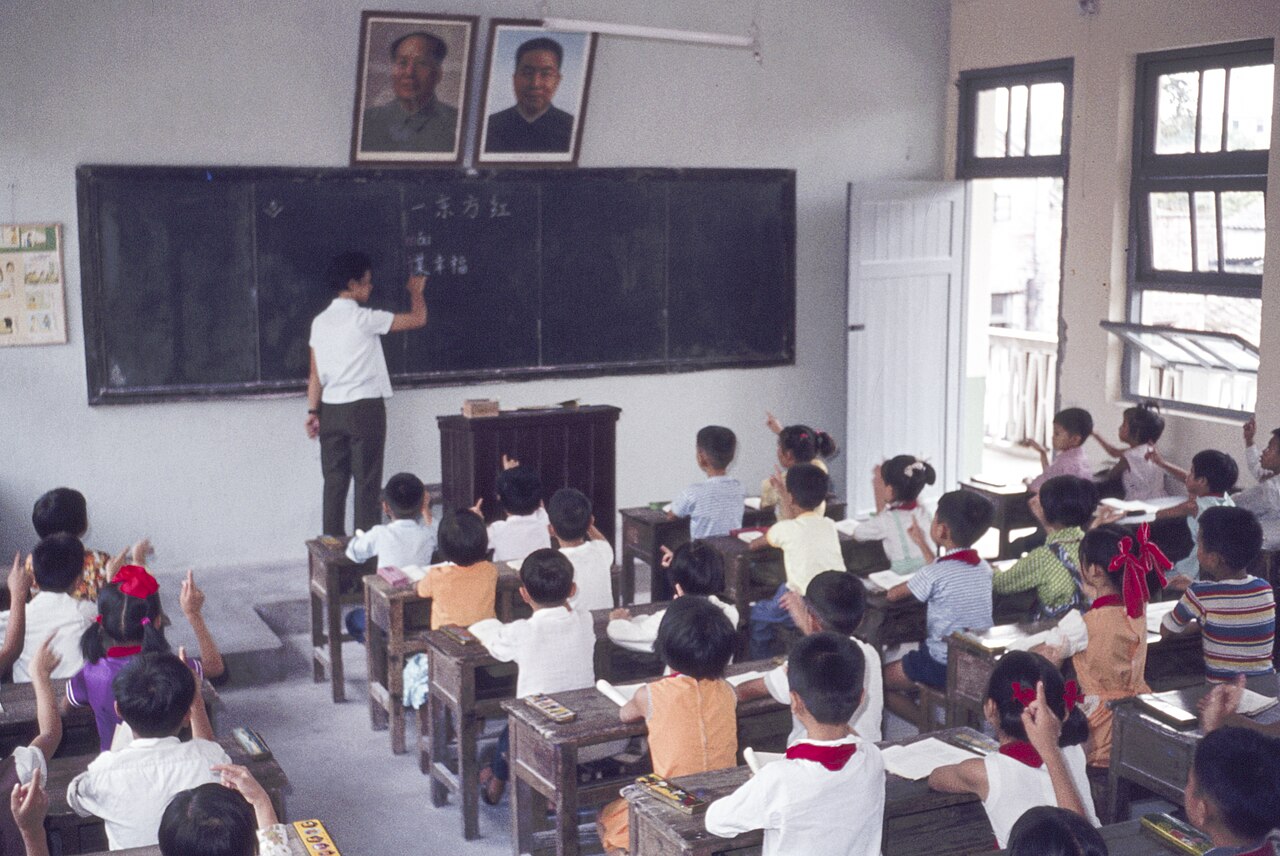
A primary-school class in China during an educational study tour, August 1978; the city is uncertain (the photographer lists Beijing, Shijiazhuang, Wuhan or Guangzhou). The teacher writes at the blackboard under two framed portraits, and the pupils wear red neckerchiefs. Photograph by Wendwelly, CC BY-SA 4.0, via Wikimedia Commons.

How it works
- Glittering generalities: the Common Program's education clause promises "national, scientific and mass" education and "raising the cultural level of the people" — virtue language that commits the state to nothing measurable about what any child would actually be taught, while supplying the moral cover for replacing the entire pre-1949 textbook market at once.
- Transfer: the 1953-57 curriculum reform borrows the Soviet Union's prestige as the senior socialist state directly onto its syllabi and textbooks; a Chinese primary reader opening with a translated Russian lesson carries no argument for that specific content beyond the source it was copied from.
- Name-calling and Scapegoating: class-struggle framing built into ordinary lessons — arithmetic word problems about landlords "cheating" peasants, history and language readers organized around imperialist and class-enemy categories — routes blame for social harm onto a bounded category before any child has learned to check a claim, and the 1971 "two estimates" applies the same move to the teaching profession itself, labeling most teachers "bourgeois intellectuals" in need of correction.
- Testimonial: from the 1950s, and especially from 1966, Quotations from Chairman Mao Tse-tung functions as a citation that ends argument in every subject, not only the political course; daily recitation makes Mao's own words, rather than a textbook's evidence, the thing a student is required to reproduce correctly.
- Identity fusion: the May 7 Directive and the "two estimates" fuse getting the political line right with being a properly educated person — a school, a teacher or a lesson that kept to ordinary academic standards after 1966 was, by the movement's own logic, evidence of the "bourgeois dictatorship" the 1971 conference diagnosed.
- Plain folks: open-door schooling substitutes the ordinary-worker or ordinary-peasant identity of a factory foreman or farm brigade leader for a trained teacher's expertise, and worker-peasant-soldier admission substitutes political and class background for exam performance as the mark of a suitable student.
- Bandwagon: contemporary accounts of open-door schooling, such as the 1976 "run increasingly well" article, report a school's own success as self-evident from the fact that it was following the nationally prescribed method, not from any external measure of what students learned; the reopening campaign's name, "resume classes to make revolution," treats returning to class as itself an act of continuing the movement rather than a neutral resumption of study.
Then and now
China's own present-day curriculum shows the same structure continuing under new content. Ministry of Education guidelines issued in 2020 (for universities) and expanded in August 2021 (for primary and secondary schools) make "Xi Jinping Thought on Socialism with Chinese Characteristics for a New Era" mandatory reading and required curriculum content from first grade through university, phased in nationwide over three years; primary-level material is explicitly framed around cultivating "love for the country, the Communist Party of China, and socialism" (Ministry of Education 2021; VOA and ABC News coverage, cited below). A dedicated, party-authored ideological subject taught nationwide by ministry directive, with a named leader's thought as its core content, is the same structure this page documents for Mao Zedong Thought from the 1950s.
The difference is that the exam-based, non-political core curriculum Deng restored in 1977-81 has stayed in place around it: today's students sit competitive, content-based examinations (the gaokao among them) that determine advancement, something no student could rely on in 1970-76. The ideological subject exists alongside, not instead of, an academically graded curriculum.
Positions on the record
- The government's stated position, 1949-1957. The Common Program frames curriculum unification as ending "feudal, compradore and fascist ideology" and serving "national construction." The 1953-57 Soviet-model reform was presented as adopting the world's most advanced socialist pedagogy, not as importing a foreign system without independent justification.
- The government's stated position, 1966-1976. The May 7 Directive frames shortened, labour-integrated schooling as ending "bourgeois intellectuals['] dominating our schools." The 1971 "two estimates" state directly that the pre-1966 system had operated as a "bourgeois dictatorship," making the open-door and study-session structure a corrective rather than an innovation requiring its own justification.
- The government's later position. Deng Xiaoping's September 1977 speech explicitly repudiates the "two estimates," arguing the great majority of intellectuals and teachers before 1966 had "sided with the working class" rather than against it, and that restoring rigorous, exam-based standards served — rather than betrayed — the country's development. This is a partial repudiation: Deng's speeches from 1977-78 keep education "combined with productive labour" as a stated goal and keep political education as a required subject, while dropping recommendation-based admission, shortened study and the "two estimates" verdict on teachers.
- Scholarship. Theodore Hsi-en Chen's The Maoist Educational Revolution (1974) is a contemporary Western academic account of the open-door and work-study reforms as they were being implemented. Julia Kwong's Chinese Education in Transition: Prelude to the Cultural Revolution (1979) and Cultural Revolution in China's Schools, May 1966-April 1969 (1988) trace the political pressures building through the 1950s-60s system and the 1966-69 collapse in detail. Suzanne Pepper's Radicalism and Education Reform in 20th-Century China (1996) is the standard comprehensive account spanning the whole period, including extensive fieldwork-based material on rural open-door schooling. Cui, Lei and Zhou's "Changes in School Curriculum Administration in China" (ECNU Review of Education, 2018) traces the successive national curriculum reforms (1949-52 unification, 1953-57 Sovietization, and later reforms) from an administrative-history standpoint.
- What is documented. The text and dates of the Common Program's education clause, the 1952 school nationalization, the 1953-57 Soviet-model reform, the May 7 Directive, the 1968 propaganda-team deployments, the 1971 "two estimates," Deng's 1977 speech, and the December 1977 exam's registration and admission figures.
- What is contested or thinly documented from outside China. How uniformly the open-door and daily study-session routines described in official and translated Chinese Education accounts were actually followed school by school and region by region; scholars including Pepper and Kwong note substantial local variation, with rural and urban schools, and different provinces, applying the same central directives unevenly. The precise national numbers of schools closed, teachers denounced or reassigned, and students sent to the countryside during 1966-68 belong to the Big-character posters: how the opening labels of China's Cultural Revolution did the work of charges (1966-68) page and, for rural relocation specifically, to a separate case study on the sent-down youth movement; this page does not re-total them.
- Not ruled on here. Whether Soviet-model or open-door pedagogy produced better or worse learning outcomes than the exam-based system that preceded and followed it; the archive scores the propaganda method embedded in curriculum control, not the underlying pedagogical debate.
Same-method test
The same scoring applies, in general terms, to the two other mid-twentieth-century one-party states most often compared with Maoist China. Nazi Germany centralized curriculum through the Reich Ministry of Science, Education and National Culture (established 1934 under Bernhard Rust) and nationwide curriculum guidelines issued through the later 1930s; textbooks were rewritten to teach National Socialist race doctrine and history as settled fact, an application of Name-calling and Scapegoating to the same age group this page covers (Pine 2010). The Soviet Union moved toward a single standardized set of school textbooks and a restored, centrally scripted history curriculum through Central Committee decrees in the early-to-mid 1930s, including the 15 May 1934 decree "On Civil History Teaching in the Schools of the USSR," which replaced earlier experimental, decentralized pedagogy with fixed dates, facts and a state-authored historical narrative — the same Transfer and Testimonial mechanism this page documents for the 1953-57 "learn from the Soviet Union" reform, run a generation earlier by the country China was then copying. Fuller, independently sourced accounts of both systems are the subject of companion case studies in this archive.
What differs is what each state layered onto textbook control. China's open-door schooling physically relocated teaching into workplaces for extended periods, a step neither Germany's nor the USSR's curriculum reforms took at comparable scale; daily quotation recitation and organized self-criticism as an ordinary classroom routine is also more extensive and more procedurally formalized in the Chinese case than in the other two. All three systems share the underlying move this page scores: a single political authority deciding, by directive rather than by pedagogical debate, what every child in the country would be taught and how.
How to spot it
- Ask who wrote the textbook and who alone is allowed to. One national set, with no market alternative and no independent review, is a different thing from a state curriculum standard that competing publishers must meet.
- Check whether a "subject" is actually an argument to be tested against evidence, or a set of passages to be correctly reproduced. Recitation and self-criticism graded on conformity, not on the content of the criticism, is a tell.
- Watch for a movement or directive that redefines "properly educated" to include political conformity as a pass/fail condition, so that resisting the political content becomes indistinguishable from academic failure.
- Ask what replaced the exam. Recommendation by political category, class background or work-unit loyalty, in place of a content-based test anyone can in principle pass, moves the selection mechanism from the student's demonstrated knowledge to a gatekeeper's judgment of the student's politics.
- Look for what a later reform keeps. A restoration of exams or academic standards that leaves a mandatory, party-authored ideological subject in place has repudiated part of the system, not all of it.
Images
| Image | Source | Licence |
|---|---|---|
| Mechanism diagram (above) | Drawn for FRAME from the sources below (make_diagrams_youth_curriculum_china.py) |
CC BY 4.0, FRAME |
| Cultural Revolution-era textbooks, Hohhot, 2015 | Wikimedia Commons, Gary Todd | CC0 1.0 (photographer's dedication to the public domain); photograph of a museum display of objects |
| Primary-school classroom, China, August 1978 | Wikimedia Commons, Wendwelly (photograph taken on an educational study tour) | CC BY-SA 4.0 (photographer's own work) |
Image gaps
- 1950s-70s Chinese school and classroom photographs by Chinese state or press photographers (unified-textbook classes, open-door lessons in factories and fields, quotation recitation, worker-propaganda-team visits) exist on Wikimedia Commons and in Chinese state photo archives, but the ones located during research carry only a
PD-Chinatag (public domain in China under its 50-year rule for this kind of work) with no independent United States public-domain basis. Chinese works still protected on 1 January 1996 had their U.S. copyright restored under the URAA, and Commons itself flags several of these files as "not PD in the US." Unclear U.S. status, so not hosted, consistent with the same gap documented on Big-character posters: how the opening labels of China's Cultural Revolution did the work of charges (1966-68) and Land reform and the struggle session: how the CCP's class labels decided who kept their land, 1946-1952. - Cultural Revolution-era propaganda posters depicting schooling (e.g. open-door-schooling and "resume classes" themes) are catalogued by Stefan Landsberger's chineseposters.net, which is not openly licensed, and by university and museum collections without a reuse licence. Not hosted.
- A copy of a 1950s-70s People's Education Press textbook cover or page. No openly licensed digitization was located during research; most digitized copies held by university East Asian collections (e.g. Hoover Institution's Maoist-textbook holdings) carry no stated reuse licence. Identified and licence-checked; download not attempted because no candidate file carried an open licence — fillable if one becomes available.
- The 1977 restored gaokao exam itself (exam halls, candidates) is widely reproduced in Chinese state media retrospectives, none openly licensed for reuse under this archive's rules. Not hosted.
Sources
- "Common Program of the Chinese People's Political Consultative Conference," adopted 29 September 1949, Article 41.
- People's Education Press, institutional history (founding 1 December 1950; first unified national textbook set, 1951).
- Ministry of Education directives on the 1952 nationalization of private schools and the 1952 curriculum-administration regulations, discussed in Yunhuo Cui, Hao Lei and Wenye Zhou, "Changes in School Curriculum Administration in China," ECNU Review of Education 1, no. 1 (2018): 46-65.
- "1952 reorganization of higher education in China," standard account of the Soviet-model reorganization of Chinese universities.
- Cui, Lei and Zhou (2018), for the 1953-57 Soviet-model curriculum reform and its mathematics-syllabus and textbook-translation examples.
- Hoover Institution, research on the daily experience of Chinese schoolchildren through Maoist-era textbooks (Silas Palmer Fellowship project).
- Mao Zedong, "Directive of 7 May 1966" (the "May 7 Directive"), text and context discussed in Chinese Education (M.E. Sharpe, translated PRC document series), multiple issues, 1968-1976, including "The 'May 7 Directive' Is the Guideline for Educational Revolution," Chinese Education 5, no. 1 (1972).
- "With an Open-Door Policy, the School Is Run Increasingly Well," Chinese Education 9, no. 3 (1976); ERIC EJ154252.
- Yao Wenyuan, "The Working Class Must Exercise Leadership in Everything," Red Flag, 30 August 1968.
- "Workers' Mao Tsetung's Thought Propaganda Teams in Colleges and Schools," Peking Review 11, no. 43 (1968).
- Records of the 1971 National Education Work Conference and the "two estimates" (两个估计) verdict on pre-1966 education, as summarized and contested in Deng Xiaoping's 1977 speech below.
- Deng Xiaoping, "Setting Things Right in Education," 19 September 1977, in Selected Works of Deng Xiaoping (1975-1982) (Foreign Languages Press).
- State Council of the People's Republic of China, decision restoring the unified national college entrance examination, October 1977; examination held December 1977, approximately 5.7 million candidates registered, approximately 273,000 admitted.
- Theodore Hsi-en Chen, The Maoist Educational Revolution (Praeger, 1974).
- Julia Kwong, Chinese Education in Transition: Prelude to the Cultural Revolution (McGill-Queen's University Press, 1979).
- Julia Kwong, Cultural Revolution in China's Schools, May 1966-April 1969 (Hoover Institution Press, 1988).
- Suzanne Pepper, Radicalism and Education Reform in 20th-Century China: The Search for an Ideal Development Model (Cambridge University Press, 1996).
- Lisa Pine, Education in Nazi Germany (Berg, 2010), for the same-method test.
- Council of People's Commissars of the USSR and Central Committee of the All-Union Communist Party (Bolsheviks), decree "On Civil History Teaching in the Schools of the USSR," 15 May 1934, for the same-method test.
- Ministry of Education of the People's Republic of China, guidelines on incorporating "Xi Jinping Thought on Socialism with Chinese Characteristics for a New Era" into curricula and textbooks, 2020 (universities) and August 2021 (primary and secondary schools), for the Then and now comparison.
- VOA News, "China's New Mandatory Curriculum Focuses on 'Xi Thought'" (2021); ABC News, "China's school curriculum overhauled to educate young children on Xi Jinping's principles" (1 September 2021), for the Then and now comparison.