Content note. This page describes torture used to produce confessions, mass execution, forced labour and a child-informant cult built around a boy's death. It quotes the label "enemy of the people" and a propaganda cartoon depicting purge targets as vermin. These are quoted and described as evidence of the method, not as this archive's judgement of anyone the label was applied to.
In one line: the Soviet secret police, Dzerzhinsky's Cheka (1917) refounded in July 1934 as the NKVD, sold its own coercive power to the public as vigilant defence of socialism rather than terror, through a legal label ("enemy of the people") that ended argument before it began, a nationwide network of paid and volunteer informants that made denunciation a civic duty, a Gulag press that marketed forced labour as moral "reforging," and a cult of the heroic Chekist and border guard, while the small number of open trials the public actually saw sat on top of a far larger, secret quota-driven killing process the institution never had to defend in public at all.
What happened
From the Cheka to the NKVD
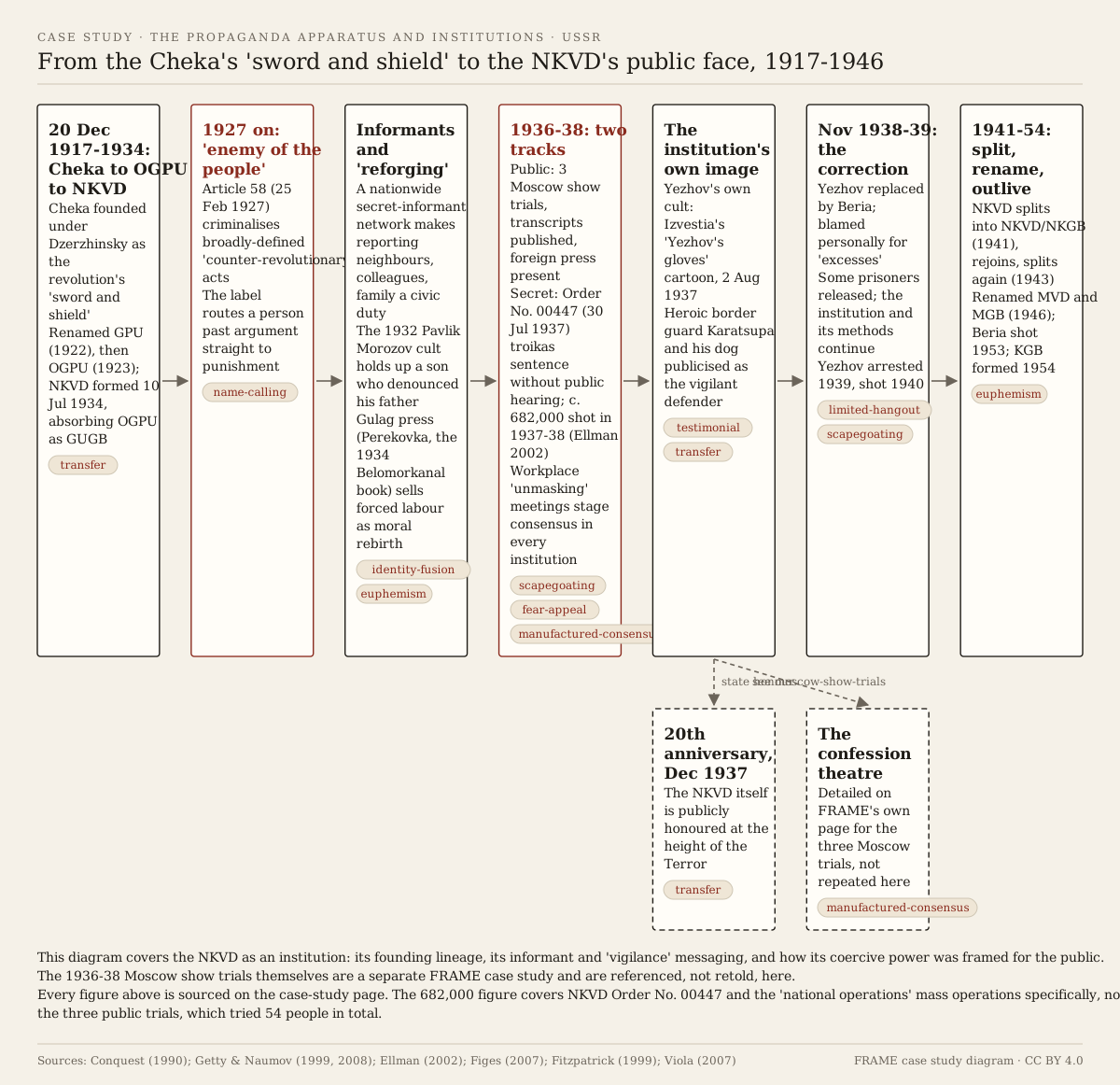
- 20 December 1917. The Council of People's Commissars creates the All-Russian Extraordinary Commission for Combating Counter-Revolution and Sabotage, the Cheka, under Felix Dzerzhinsky, to defend the new Soviet government. Within the security services' own culture the date became an internal anniversary, and Dzerzhinsky described the Cheka's dual purpose as the revolution's "sword and shield": a shield defending the state, a sword against its enemies.
- 6 February 1922 and 15 November 1923. The Cheka is reorganised as the State Political Directorate (GPU), then, with the formation of the USSR, as the Unified State Political Directorate (OGPU), reporting directly to the Council of People's Commissars rather than a single ministry.
- 10 July 1934. A decree creates the all-Union People's Commissariat of Internal Affairs (NKVD) and folds the OGPU into it as the Main Directorate for State Security (GUGB), alongside directorates for the regular police (militia), the Gulag's camp administration, and the border and internal troops. One commissariat now ran secret political policing, ordinary law enforcement, forced-labour camps and frontier defence under a single minister. Genrikh Yagoda, OGPU's deputy chief since the 1920s, becomes the first NKVD commissar.
- 26 September 1936. Nikolai Yezhov replaces Yagoda as commissar. The following two years, remembered as the Yezhovshchina, are the most intense phase of what historians call the Great Terror.
- 25 November 1938. Lavrentiy Beria replaces Yezhov.
- 1941-1946. The NKVD splits into the NKVD and a separate state-security commissariat, the NKGB, in February 1941; the two merge back together after the German invasion that June; they split again in April 1943. In March 1946 Soviet commissariats become ministries: the NKVD becomes the MVD (Ministry of Internal Affairs) and the NKGB becomes the MGB (Ministry of State Security). Beria, by then a Politburo member overseeing both, is arrested after Stalin's death and shot in December 1953; the security police is reorganised again in 1954 as the KGB, formally presented as a break with the abuses of the Stalin years.
The label: "enemy of the people"
- The phrase itself long predates the Soviet state: the Roman Senate had declared Nero hostis publicus in AD 68, and Robespierre told the French National Convention on 25 December 1793 that "the revolutionary government owes to the good citizen all the protection of the nation; it owes nothing to the Enemies of the People but death," a formula the Law of 22 Prairial (1794) turned into an expanded remit for the Revolutionary Tribunal.
- Lenin used the phrase before the Cheka itself existed: an article of June 1917 was titled "About the Enemies of the People," and a decree of 28 November 1917 declared leaders of the Constitutional Democratic Party "enemies of the people," to be arrested and tried by revolutionary tribunal, without a court first finding any individual guilty of anything.
- 25 February 1927. Article 58 of the RSFSR Criminal Code, and equivalent articles in the other republics' codes, criminalises a broad, loosely defined range of "counter-revolutionary" acts and speech. Its "measures of social defence" clause allowed a person to be declared "an enemy of the workers" and stripped of citizenship. The label did not describe a specific act; once attached, it decided the case.
- Nikita Khrushchev's 1956 "Secret Speech" to the 20th Party Congress later singled out the term for its function rather than its content: applying it, he said, "made possible the usage of the most cruel repression ... against anyone who in any way disagreed" with the leadership, because a person so labelled needed no proof of guilt and the label itself "actually eliminated the possibility of any kind of ideological fight."
Informants and the vigilant citizen
- By the mid-1930s the NKVD had built a nationwide network of secret, usually paid informants (sekretnye sotrudniki, shortened in period slang to seksoty), run by handlers and present, historians agree, in factories, offices, apartment blocks and schools, so that the security police did not need to watch everyone directly: neighbours, colleagues and relatives did much of the watching for it. Precise coverage is not established; the historian Orlando Figes's The Whisperers (2007) reports an unnamed former police official's claim that "every fifth" Soviet office worker was an informer, a figure Figes presents without corroborating documentation rather than as a settled count.
- 1932. A 13-year-old boy in the Ural village of Gerasimovka, Pavel ("Pavlik") Morozov, is killed, along with his younger brother, by relatives after reportedly denouncing his father to the OGPU for hoarding grain. The Soviet press and school curriculum turned Pavlik into a national hero, a Young Pioneer martyred for loyalty to the state over family, and Soviet children were exhorted for decades to emulate him. Later research, notably by Yuri Druzhnikov (Informer 001, 1997), found the official version built up around the case to be substantially unreliable in its particulars; the cult nonetheless did real work, and historians of the period record children writing denunciations of their own parents in its wake.
- Postal censorship (perlustration) and building-level "house committees" (domkomy), which every apartment block was required to maintain, gave the network physical reach into private correspondence and everyday residential life, a structure separate from, but feeding into, the NKVD's own case files.
The Gulag's own press: "reforging"
- 1931-1933. OGPU forced-labour convicts build the White Sea-Baltic Canal (Belomorkanal), officially completed in August 1933. The camp administration ran its own newspaper for prisoners, Perekovka ("Reforging"), publicising the project's official narrative that criminal and political prisoners alike were being morally "reforged" into loyal Soviet citizens through labour.
- 1934. A group of thirty-six Soviet writers, edited by Maxim Gorky, Leopold Averbakh and the OGPU official Semyon Firin, publishes Belomorsko-Baltiisky Kanal imeni Stalina (The White Sea-Baltic Canal Named After Stalin), a lavishly produced volume presenting the OGPU-run project, and forced labour generally, as a humane, successful instrument of prisoner rehabilitation. The canal's real death toll among its forced labourers, not stated in the book, is estimated by later historians in the tens of thousands. The book itself later fell out of official favour once its NKVD subjects, Firin among them, were purged and shot in 1937, and surviving copies were pulled from circulation and libraries.
Two tracks, 1936-1938
- The public track is FRAME's own subject on The Moscow show trials: confession, spectacle and consent (1936-1938): three trials in Moscow, transcripts published by the Soviet state itself, foreign correspondents present, and a total of 54 defendants tried in open court across August 1936, January 1937 and March 1938. That page covers the trials themselves and is not repeated here.
- The much larger, secret track ran in parallel and did almost all of the killing. The mechanism was not new: OGPU troikas had already sentenced households classed as "category 1 kulaks" without a hearing during dekulakization from 1930 (see "Liquidate the kulaks as a class": the propaganda campaign for collectivization (1929-1933)). 30 July 1937. NKVD Order No. 00447 revives and generalises the same device, setting, by region, arrest and execution quotas for "former kulaks" and other listed categories, to be sentenced by three-person regional panels (troikas) of NKVD, prosecutorial and party officials, without the accused present, without defence counsel, and usually without appeal; sentences and the timing of executions were kept secret even from the condemned's families, who for years afterward were commonly told only that a relative had been sentenced to "ten years without the right of correspondence," a phrase historians have since established was in most such cases a euphemism for execution. Archival research after 1991 puts executions under these mass operations in 1937-38 alone at roughly 681,692 (Ellman 2002). The three public trials supplied the justification; the troikas supplied the deaths, almost entirely out of public view.
- Beneath both tracks, ordinary institutional life carried its own smaller confession theatre. Open Communist Party meetings in factories, universities and government offices during 1937-38 regularly required members to publicly "unmask" colleagues as suspected enemies and to vote, on the spot, to expel them from the party, a first step that commonly preceded arrest; workplace wall newspapers named local "wreckers" in the same register the national press used for the Moscow trials' defendants (Fitzpatrick 1999; Getty and Naumov 1999).
The institution's own image
- December 1937. The Cheka-OGPU-NKVD's twentieth anniversary is publicly marked, and the NKVD is awarded the Order of Lenin, the Soviet state's highest civilian honour, at the peak of the Terror the same institution was then carrying out.
- 2 August 1937. Izvestia publishes a cartoon by Boris Efimov titled "Yezhov's gloves" (Ezhovye rukavitsy), a pun on Yezhov's surname (which resembles the Russian for hedgehog) and a Russian idiom for ruling with an iron hand: a fist, labelled as Yezhov's, crushes a serpent representing the regime's "enemies." The image, and others like it, cast the NKVD's own chief as the personal instrument of the nation's defence.
- Nikita Karatsupa, a Soviet border guard from 1932, and his tracking dogs (the best known named Indus, later renamed Ingus) were built up through the Soviet press, and later children's books and film, into a folk-hero image of the vigilant frontier defender catching foreign spies and saboteurs; he was eventually named a Hero of the Soviet Union. The figure gave the security apparatus a benign, competence-based public face distinct from its interrogation rooms and troikas.
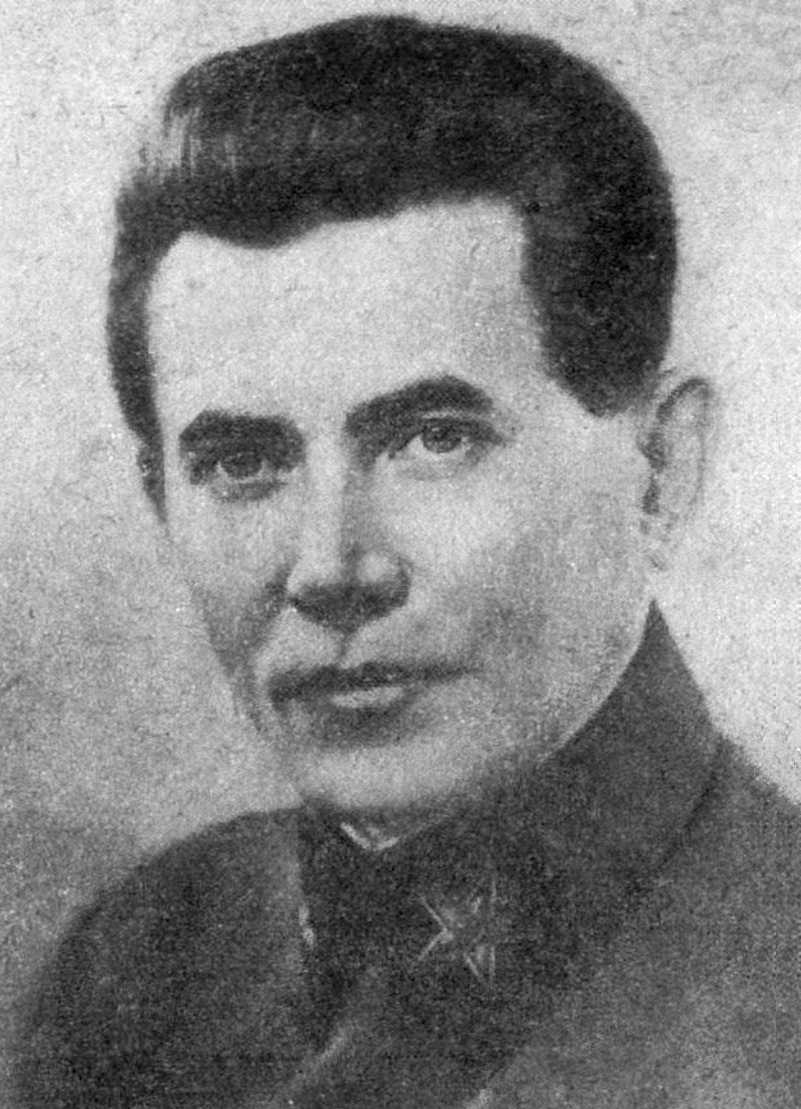
Nikolai Yezhov, the NKVD chief the Soviet press built up as the personal instrument of the nation's vigilance during the Terror, as published in Ogonyok magazine no. 3, 1938, the same year Beria replaced him. Wikimedia Commons, public domain (PD-Russia-1996).
The correction: blaming Yezhov
- After Beria replaced Yezhov in November 1938, the state publicly acknowledged, in general terms, that "excesses" had occurred under Yezhov's leadership, released a limited number of prisoners (estimates run to roughly 100,000 released from labour camps over the following period) and presented the change as a restoration of "socialist legality." Yezhov himself was arrested in April 1939, tried in secret and shot in February 1940. Official photographs and publications that had shown him beside Stalin were quietly altered to remove him, a practice FRAME documents on its own page, Glavlit and the retouched photographic record. The institution's methods, quota-driven arrests, secret sentencing, and the security police's fused control of ordinary policing and the Gulag, continued essentially unchanged under Beria; what had been publicly corrected was a person, not the system.
How it ended
- Stalin died in March 1953. Beria, who had briefly headed a reunified Ministry of Internal Affairs, was arrested in a Politburo coup in June 1953 and shot in December 1953 after a secret trial, the same extrajudicial pattern the institution had used against its own victims for two decades. In 1954 the security functions were reorganised as the Committee for State Security, the KGB, formally separated from ordinary policing and presented as a clean break from the Yezhovshchina, even as most of its senior structure and many of its officers carried over. Khrushchev's 1956 Secret Speech, discussed above, was the first public Soviet acknowledgment that torture had produced the era's confessions; the institution itself was never put on public trial for it, a difference FRAME's German case study, The Reich Ministry of Public Enlightenment and Propaganda, 1933-1945, notes was also true of most of the ministry that ran that state's own propaganda.
How it works
- Name-calling: "enemy of the people" named a legal status, not a documented act. Once a court, a party meeting or a newspaper attached it, the label carried its own penalty; asking what the person had actually done became, itself, suspect.
- Scapegoating: industrial accidents, food shortages and missed targets were recast as "wrecking" by a bounded, named category of "enemies," and when the Terror itself became too costly to sustain, the state scapegoated a single person, Yezhov, for what had in fact been an institutional and policy-level campaign.
- Fear appeal: vigilance messaging told citizens that undetected enemies threatened the revolution from within; the remedy on offer, report what you notice, cost the reporter nothing and could not be checked by the person reported on.
- Identity fusion: informing on a neighbour, colleague or parent was framed as loyalty to the socialist motherland rather than as an act with a cost to a real relationship; the Pavlik Morozov cult made that fusion literal, holding up a child who chose the state over his own family as the model citizen.
- Testimonial: the state's own press supplied the informant's answer to "why would I do this?" before anyone asked it: Karatsupa's decorated career and the Gulag's "reforged" former convicts, held up in Perekovka and the Belomorkanal volume as living witnesses, vouched for the institution's benevolence from inside the very system it ran.
- Transfer: the Cheka's "sword and shield" emblem, and the Order of Lenin awarded to the NKVD itself in December 1937, borrowed the state's own founding prestige and its highest civilian honour and pasted them onto an organisation whose actual daily work was interrogation, deportation and secret execution.
- Manufactured consensus: workplace "unmasking" meetings staged a vote of colleagues as though it were independent judgment, when the outcome, expulsion followed commonly by arrest, was set before the meeting began; this is the same pattern documented at national scale in the factory resolutions covered on The Moscow show trials: confession, spectacle and consent (1936-1938), reproduced continuously at local scale in ordinary institutions no press ever covered.
- Limited hangout: Beria's 1938-39 "correction" admitted a bounded, survivable fact, individual excesses under one now-disgraced commissar, while withholding the load-bearing one, that the quota system, the troikas and the fused security-police structure were policy, not personal failing, and continued under his own leadership.
- Euphemism / doublespeak: "reforging" (perekovka) renamed forced labour as moral improvement; "special settlement," "unmasking" and "ten years without the right of correspondence" each let evaluation stop at the phrase rather than reach the deportation, denunciation or execution underneath it.
Colour. Most of what the public actually saw was white: the state press, the Gulag's own named newspapers, and an institution that signed its own name to its "vigilance" campaigns and to the trials it chose to publish. The informant network sits closer to gray: the state that ran it was never hidden, but the identity of any given informant, by design, was. The NKVD also ran operations abroad under false flags, including the 1940 assassination of Trotsky in Mexico by an agent using a false Canadian identity, which is black propaganda in Jowett and O'Donnell's sense and is covered in FRAME's material on the Stalin-Trotsky rivalry, 'Trotskyism or Leninism': the press campaign that removed Trotsky from Soviet leadership (1924-1929), rather than here.
Then and now
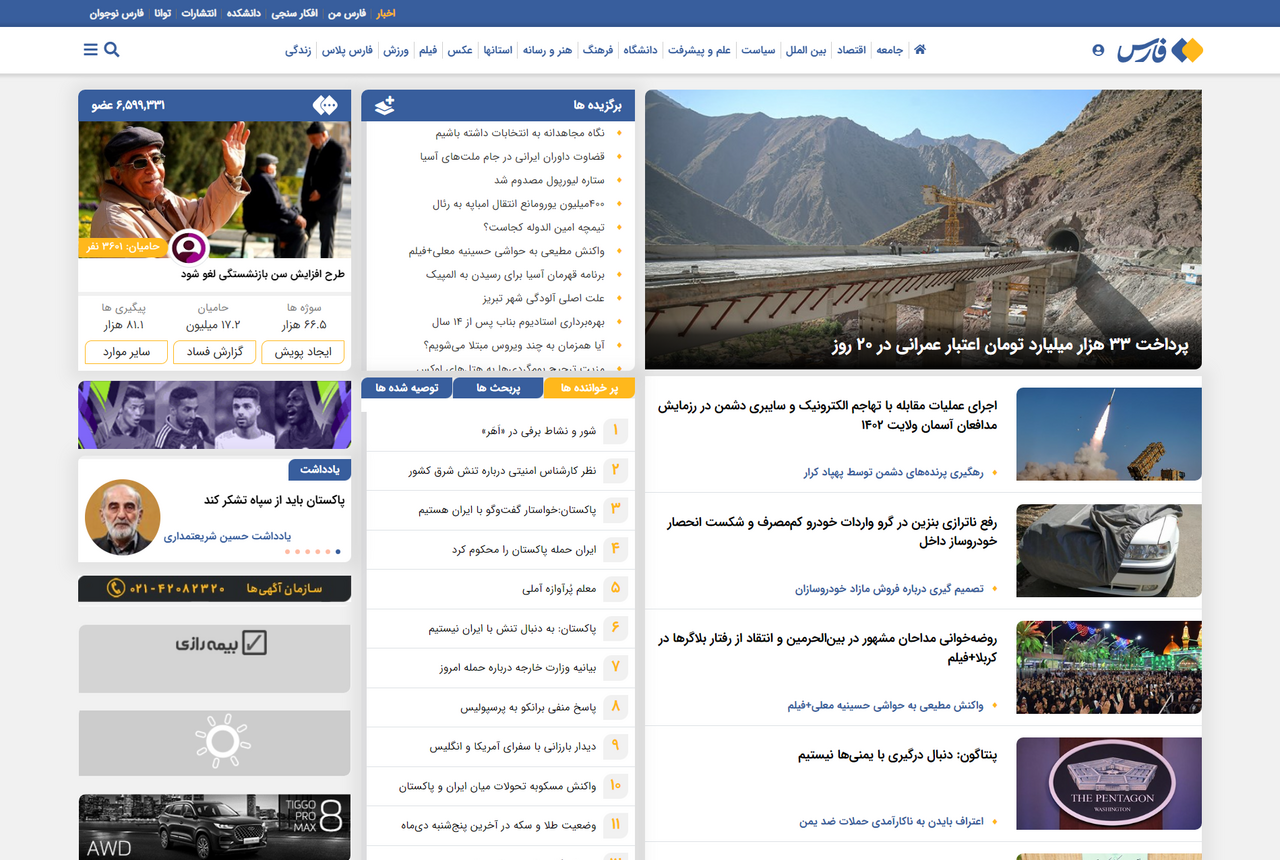
Fars News Agency's homepage, January 2024, the outlet that announced the Alaj informant platform in 2026. Screenshot © Fars News Agency, CC BY 4.0, cropped to the top of the page by FRAME.
In September 2026, Iranian state media announced Alaj, a platform inviting citizens to report Iranians abroad it labelled "traitors" and "anti-homeland," promising informants confidentiality and the people they named the loss of citizenship privileges and financial and media access; see FRAME's case study Alaj: the portal Iranian state media promoted for reporting 'traitors abroad'. The mechanism is the NKVD's seksot network and the Pavlik Morozov cult in updated form: reporting a fellow citizen, in this case an emigrant rather than a neighbour, is again presented as a civic good, and the informant is again promised anonymity while the named person is not promised a hearing. The differences are real. Alaj's operators are not publicly named, ran through a website and messaging apps rather than a state ministry with its own courts, camps and executioners, and the site itself went offline within a day of launch; nothing in the 2026 record shows Alaj feeding a Gulag, a troika or a firing squad. The NKVD's informant network fed directly into an institution that could arrest, deport, torture and secretly execute the people its informants named, at a scale, roughly 682,000 executions in 1937-38 alone under the mass operations, that no contemporary digital informant portal has approached. The pattern travels; the machine it once fed did not.
Positions on the record
- The institution's own account. Dzerzhinsky described the Cheka's purpose as defending the revolution against counter-revolution and sabotage; Yezhov's own public statements and the Soviet press throughout the 1930s presented arrests, the informant culture and the "unmasking" of enemies as vigilance, the ordinary and necessary alertness of a socialist citizenry surrounded by hidden foreign and domestic threats. Vigilance appears repeatedly in period usage as a virtue word applied to exactly this behaviour.
- Contemporary critics. Open criticism inside the USSR was itself criminal, so the clearest contemporary record of doubt comes from those who left: Alexander Orlov, an NKVD officer who defected in 1938, described relay interrogation ("the conveyor") and the pre-trial rehearsal of confessions in The Secret History of Stalin's Crimes (1953). Abroad, exiled Bolsheviks around Trotsky and Western journalists who did not accept the trials' framing, documented on The Moscow show trials: confession, spectacle and consent (1936-1938), made the same argument about the institution generating its own evidence.
- What is documented. The founding dates and reorganisations above; Article 58's text and its "enemy of the people" clause; the existence and rough shape of the informant network, though not a reliable national count of informants; Order No. 00447 and the troika procedure; the Ellman (2002) archival death-toll estimate for the 1937-38 mass operations; the Belomorkanal book and Perekovka; Yezhov's arrest and execution; Beria's own arrest and execution in 1953.
- What is contested. The exact scale of the informant network is argued precisely because it was secret by design; Figes's "every fifth" figure is a claim from a single unnamed source, not an archival count, and historians differ on how representative it is. The particulars of the Pavlik Morozov case, as opposed to the cult built on it, are themselves disputed (Druzhnikov 1997). Whether Beria's 1938-39 release of some prisoners reflected a genuine, if limited, change of policy or only a public-relations correction is argued differently by historians who otherwise agree the underlying system continued; this page reads it as the latter, following the doctrine's Limited hangout pattern, while noting the released prisoners' relief was nonetheless real.
- This archive's reading. Documented: an institution that fused political police, ordinary law enforcement, the Gulag and border defence under one command, applied a legal label that pre-empted argument, built and used an informant network, and framed its own coercive core, arrest, interrogation, deportation, execution, in the public register of vigilance, heroism and moral rehabilitation. Not shown here: a reliable count of how many Soviet citizens actually served as informants, or how ordinary Soviet audiences privately weighed the NKVD's public image against what many of them witnessed directly; the historical record on both points is thinner than the institution's own output.
Same-method test
Nazi Germany's Gestapo, covered in FRAME's own case study The Gestapo's Denunciation Apparatus: Policing by Public Tip-Off, 1933-1945, is the direct comparison: another single-party state's political police, publicly framed as defending the national community against hidden internal enemies, and equally dependent on ordinary citizens choosing to inform. The two systems differ sharply in scale and design. The NKVD ran a large, formally organised network of registered secret collaborators embedded inside a commissariat that also owned the camp system its targets were sent to; the Gestapo, by contrast, was chronically understaffed for the population it policed and leaned harder on unsolicited denunciations from ordinary Germans, who brought many, in some regional studies most, of its cases to it unprompted, rather than on a comparably large roster of its own paid informants. Both institutions, all the same, sold surveillance as protection: vigilance and Volksgemeinschaft loyalty on one side, vigilance and socialist loyalty on the other, each turning a citizen's choice to inform on a neighbour into an act of belonging rather than betrayal. Neither the NKVD nor the Gestapo, unlike the wartime propaganda ministries covered elsewhere on FRAME, needed to persuade a sceptical foreign audience; both were selling the informant culture to the people already inside the system, which is why the message in each case ran through the institution's own hero figures and its own honours as much as through argument.
How to spot it
- Ask whether a label describes a specific, dated act someone can check, or a status that, once applied, answers every future question about the person on its own.
- Notice when an institution asks ordinary people to report on each other and calls it protection rather than surveillance; the cost of being wrong falls on the person reported, almost never on the person who reported them.
- Look for two tracks running at once: a small number of visible, procedurally dressed-up cases the public is shown, and a much larger, unpublicised process doing most of the actual coercion. The visible track's fairness, or lack of it, tells you little about the larger one.
- Watch for a security institution's own cult: hero officers, honours awarded to the institution itself, forced-labour projects marketed as rehabilitation. All soften a coercive core into a story about virtue.
- When an institution's abuses are publicly "corrected" by removing or blaming one leader, check whether the underlying structure, the quotas, the secret courts, the fused chain of command, changed with him or survived him.
Images
| Image | Source | Licence |
|---|---|---|
| Mechanism diagram (above) | Drawn for FRAME from this page's sourced facts (make_diagrams_apparatus_nkvd.py) |
CC BY 4.0, FRAME |
| Nikolai Yezhov, People's Commissar for Internal Affairs, from Ogonyok magazine no. 3, 1938 (above) | Wikimedia Commons | Public domain (Commons licence tag PD-Russia-1996) |
| Fars News Agency homepage, January 2024 (for the "Then and now" comparison) | Wikimedia Commons, Fars News Agency, reused from FRAME's Alaj: the portal Iranian state media promoted for reporting 'traitors abroad' gallery | CC BY 4.0 (cropped by FRAME) |


Image gaps
- Felix Dzerzhinsky, portrait, 1919, by M. S. Nappelbaum. Identified and licence-checked on Wikimedia Commons: public domain under the Commons tag PD-Russia-expired (published before 1 January 1931). The file could not be downloaded in this session: every request to
upload.wikimedia.org, including thumbnail sizes, returned Wikimedia's HTTP 429 "too many requests" response across repeated retries spaced 25-40 seconds apart. This gap can be filled; the licence work above is already done. - The front page of Perekovka ("Reforging"), the Belomorkanal camp newspaper, 16 November 1934. Identified and licence-checked on Wikimedia Commons: tagged Public Domain Mark 1.0 / PD-old. Same download failure as above. This gap can be filled.
- The "Yezhov's gloves" cartoon, Izvestia, 2 August 1937, by Boris Efimov. Not included: Efimov (1900-2008) lived well past the URAA's 1996 restoration date, so this specific cartoon's US copyright status could not be confirmed as expired in the time available, unlike the anonymous or long-dead-author images used elsewhere on this page.
- Nikita Karatsupa and a tracking dog. No photograph with a clear, openly licensed source was located and confirmed in this session; the figure is described from text sources only. Could be filled by a future pass with more search time.
- The Order of Lenin, or a photograph of the NKVD's December 1937 anniversary observance. Not located with a confirmed open licence in this session.


Sources
- Decree of the Council of People's Commissars establishing the All-Russian Extraordinary Commission (Cheka), 20 December 1917.
- Decree forming the People's Commissariat of Internal Affairs (NKVD) and transferring the OGPU to it as the Main Directorate for State Security, 10 July 1934.
- Article 58, Criminal Code of the RSFSR, in force from 25 February 1927.
- V. I. Lenin, "About the Enemies of the People," Pravda, June 1917; decree of the Council of People's Commissars on the Constitutional Democratic Party, 28 November 1917.
- Maximilien Robespierre, address to the National Convention, 25 December 1793; Law of 22 Prairial, Year II (10 June 1794).
- NKVD Order No. 00447, "On the Punishment of Former Kulaks, Criminals, and Other Anti-Soviet Elements," 30 July 1937.
- Robert Conquest, The Great Terror: A Reassessment (Oxford University Press, 1990).
- J. Arch Getty and Oleg V. Naumov, The Road to Terror: Stalin and the Self-Destruction of the Bolsheviks, 1932-1939 (Yale University Press, 1999).
- J. Arch Getty and Oleg V. Naumov, Yezhov: The Rise of Stalin's "Iron Fist" (Yale University Press, 2008).
- Michael Ellman, "Soviet Repression Statistics: Some Comments," Europe-Asia Studies 54, no. 7 (2002): 1151-1172.
- Sheila Fitzpatrick, Everyday Stalinism: Ordinary Life in Extraordinary Times: Soviet Russia in the 1930s (Oxford University Press, 1999).
- Orlando Figes, The Whisperers: Private Life in Stalin's Russia (Metropolitan Books, 2007).
- Lynne Viola, The Unknown Gulag: The Lost World of Stalin's Special Settlements (Oxford University Press, 2007).
- Yuri Druzhnikov, Informer 001: The Myth of Pavlik Morozov, trans. Andrew Bromfield (Transaction Publishers, 1997; Russian original 1988).
- Alexander Orlov, The Secret History of Stalin's Crimes (Random House, 1953).
- Maxim Gorky, Leopold Averbakh and Semyon Firin (eds.), Belomorsko-Baltiisky Kanal imeni Stalina (OGIZ, 1934); English edition The White Sea Canal (John Lane, 1935).
- Nikita Khrushchev, "On the Cult of Personality and Its Consequences" ("Secret Speech"), 20th Congress of the Communist Party of the Soviet Union, 25 February 1956; English translation, U.S. Department of State, 1956.
- FRAME case study: The Moscow show trials: confession, spectacle and consent (1936-1938), for the three public trials this page references rather than retells.
- FRAME case study: Alaj: the portal Iranian state media promoted for reporting 'traitors abroad', for the "Then and now" comparison.