Content note: this page quotes wartime Soviet texts that describe Germans as "not human beings", a U.S. Navy sign with an anti-Japanese slur, and describes the Katyn mass shootings.
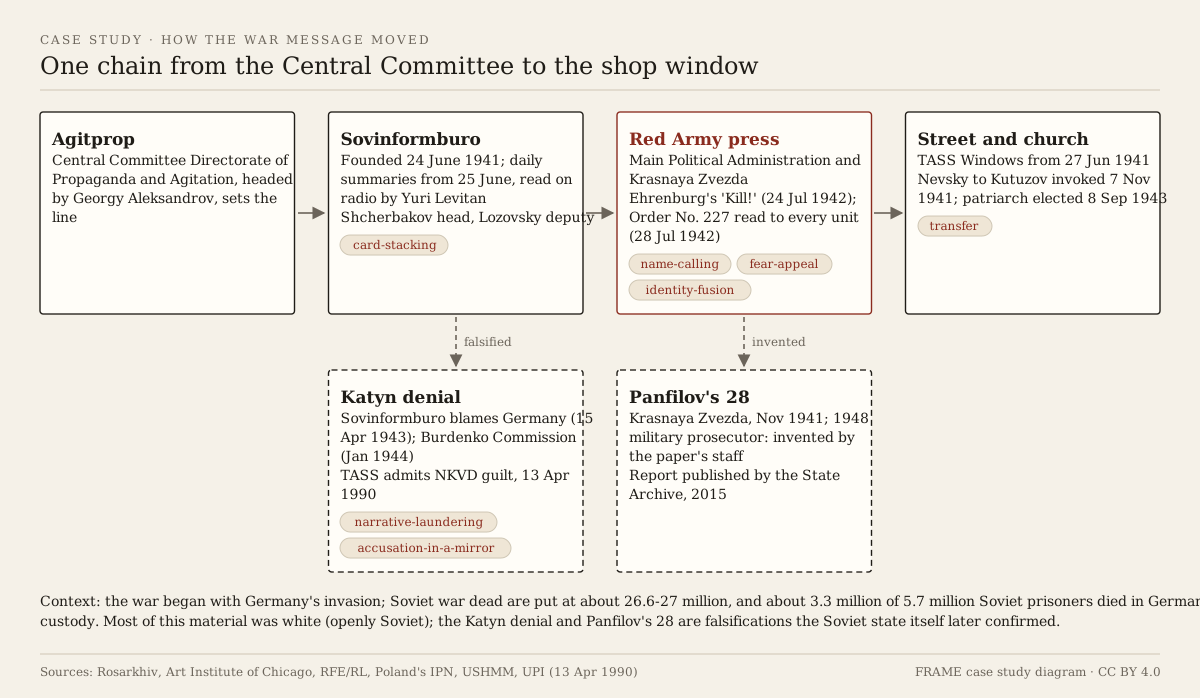
In one line: after Germany's invasion of 22 June 1941, the Soviet state ran its war message through a single party-controlled chain (the Central Committee's propaganda directorate, the Soviet Information Bureau, the Red Army's political administration, TASS and the newspapers) that swapped class-war language for Russian national history and the Orthodox Church, told soldiers to kill and not retreat, and also published documented falsifications: an invented last stand, and a denial of the Katyn shootings backed by a staged commission.
What happened
Scale and context. The Soviet Union's war with Germany began with an invasion. On 22 June 1941 Germany and its allies attacked along the whole western frontier. The Russian government's figure for Soviet war dead, based on a 1993 Russian Academy of Sciences study, is about 26.6 million; the commonly cited round figure is 27 million, the majority of them civilians. Of some 5.7 million Red Army soldiers captured by German forces, about 3.3 million died in German custody, according to the U.S. Holocaust Memorial Museum. Soviet propaganda of 1941-1945 was made inside that war; this page also states plainly the falsifications the Soviet record itself later confirmed.
1939-1941: the pact line.
- 23 August 1939. The USSR and Germany sign the non-aggression pact. Eisenstein's anti-German film Alexander Nevsky (1938) is withdrawn from circulation, and Soviet anti-fascist films are shelved for the life of the pact.
- 17 September 1939. The Red Army enters eastern Poland. Soviet media present the operation as the liberation of "Western Ukraine and Western Belorussia".
- 31 October 1939. Foreign Minister Vyacheslav Molotov tells the Supreme Soviet that an ideology cannot be destroyed by force and that it is "not only senseless but criminal" to wage war for "the destruction of Hitlerism" under the banner of democracy.
- 30 November 1939 to March 1940: the Winter War. The Soviet attack on Finland follows the Mainila shelling incident of 26 November, which Moscow blamed on Finland (covered in FRAME's then-and-now section). On 1 December a "People's Government" of a "Finnish Democratic Republic" under the Comintern veteran Otto Kuusinen is proclaimed at Terijoki, the first Finnish town the Red Army took; Molotov signs a mutual-assistance treaty with it on 2 December. Soviet leaflets told Finnish soldiers the Red Army came to free them from their own government. The Terijoki government won no Finnish following and was dropped at the March 1940 peace.
- 14 June 1941. A TASS communiqué printed in Pravda calls rumours of an impending German attack devoid of foundation and says Germany is observing the pact as strictly as the USSR. The invasion comes eight days later.
1941-1945: the war machine.
- 22 June 1941. Molotov announces the invasion by radio, heard in the cities through street loudspeakers. Private wireless sets are then called in, and for the rest of the war most listeners hear the news through the wired loudspeaker network.
- 24 June 1941. A joint decree of the Council of People's Commissars and the Central Committee founds the Soviet Information Bureau (Sovinformburo) to issue war news at home and abroad. Its daily operational summaries start on 25 June, read on Moscow radio above all by Yuri Levitan. Aleksandr Shcherbakov, Central Committee secretary and Moscow party chief, heads it until 1945, with Solomon Lozovsky as deputy and then, from 1945, head. Anti-fascist committees for foreign audiences, the Jewish Anti-Fascist Committee among them, work under it.
- The party line is set by the Central Committee's Directorate of Propaganda and Agitation (Agitprop), headed through the war by the philosopher Georgy Aleksandrov.
- The army's own chain is the Main Political Administration of the Red Army (GlavPURKKA), under Lev Mekhlis from June 1941 and under Shcherbakov from June 1942. It runs the political officers in every unit, the army newspapers and the leaflets and front loudspeakers aimed at German troops. The army daily Krasnaya Zvezda (Red Star), edited until 1943 by David Ortenberg, carries Ilya Ehrenburg, Konstantin Simonov and Vasily Grossman.
- 27 June 1941: TASS Windows (Okna TASS). A studio of artists and poets in Moscow, working under the TASS news agency, issues its first stencilled posters: TASS 1, "The Fascist Took the Route through Prut", by Mikhail Cheremnykh. The posters, often about six feet tall and stencilled by hand, hung in shop windows at close to one design a day; contributors included the Kukryniksy trio and the poet Samuil Marshak. Sets were also sent abroad as cultural "ambassadors" (Art Institute of Chicago).
- 6 and 7 November 1941. With German troops near Moscow, Stalin tells a party meeting that the Red Army has lost 350,000 killed, 378,000 missing and 1,020,000 wounded in four months, and that Germany has lost more than 4.5 million killed, wounded and captured. Next day, at the Red Square parade, he tells troops: "Let the manly images of our great ancestors, Alexander Nevsky, Dimitry Donskoy, Kuzma Minin, Dimitry Pozharsky, Alexander Suvorov and Mikhail Kutuzov, inspire you in this war!"
- 27-28 November 1941: Panfilov's 28. Krasnaya Zvezda reports, and then eulogises in an editorial, a last stand by 28 men of General Ivan Panfilov's 316th Rifle Division at the Dubosekovo crossing near Moscow on 16 November, who were said to have destroyed German tanks and died to a man. In July 1942 all 28 are named Heroes of the Soviet Union.
- April 1942. The Jewish Anti-Fascist Committee, set up under Sovinformburo at Lozovsky's initiative and chaired by the actor Solomon Mikhoels, issues its first appeal to "Jews throughout the world". In 1943 Mikhoels and the poet Itzik Fefer spend seven months in the United States, Mexico, Canada and Britain raising money for the Soviet war effort; their rally at New York's Polo Grounds on 8 July 1943 draws about 50,000 people.
- 24 July 1942. Krasnaya Zvezda prints Ehrenburg's "Kill!" (Ubei!), during the German summer offensive on the Don.
- 28 July 1942: Order No. 227. Stalin's order "Not one step back!" (Ni shagu nazad!) sets up penal units and blocking detachments. The order is read aloud to every unit rather than printed in the newspapers, and "Not one step back" becomes the main slogan of the Soviet press that summer.
- 29 July 1942. New military orders named after Suvorov, Kutuzov and Alexander Nevsky are created.
- 13-15 April 1943: Katyn. German radio announces mass graves of Polish officers in the Katyn forest near Smolensk. On 15 April Moscow radio broadcasts a Sovinformburo statement calling the report an invention of "Goebbels' slanderers" and blaming "German-fascist" killers. When the Polish government in London asks the Red Cross to investigate, Moscow breaks off relations with it (25 April).
- 4 and 8 September 1943: the concordat with the Church. Stalin receives three Orthodox metropolitans, Sergius, Aleksei and Nikolai, and agrees to the election of a patriarch. A council of bishops elects Sergius Patriarch of Moscow on 8 September. A new state Council for the Affairs of the Russian Orthodox Church is set up under Georgy Karpov, an NKVD officer.
- January 1944: the Burdenko Commission. After Smolensk is retaken, a "Special Commission" chaired by the surgeon Nikolai Burdenko, with members including the writer Aleksei Tolstoy and Metropolitan Nikolai, reports (published 24 January 1944) that the Germans shot the Polish officers in autumn 1941. Western correspondents and Kathleen Harriman, the U.S. ambassador's daughter, are taken to the site. According to Poland's Institute of National Remembrance, an NKVD-NKGB team under Vsevolod Merkulov and Sergei Kruglov had worked on the site and the version before the commission began.
- 14 April 1945. Pravda prints Aleksandrov's article "Comrade Ehrenburg oversimplifies", arguing that the Germans could not all be treated alike. Ehrenburg replies that he meant the armed invaders, not the German people. The line on Germany shifts as the Red Army advances into it.
- 15 May 1945. Sovinformburo issues its last war summary.
- 1942-1943: the Soviet image in Allied media. As a co-belligerent the USSR was presented warmly in U.S. and British media; the U.S. Government Printing Office issued "This man is your friend: Russian. He fights for freedom" in 1942. Time named Stalin its Man of the Year for 1942, and Life devoted its issue of 29 March 1943 to the USSR, with Stalin on the cover. Warner Bros.' Mission to Moscow (1943) presented the defendants of the 1930s Moscow trials as guilty. The U.S. Army's Why We Fight film on the USSR is covered in FRAME's wartime film and radio pages (Why We Fight: the U.S. Army's orientation films, 1942-1945).
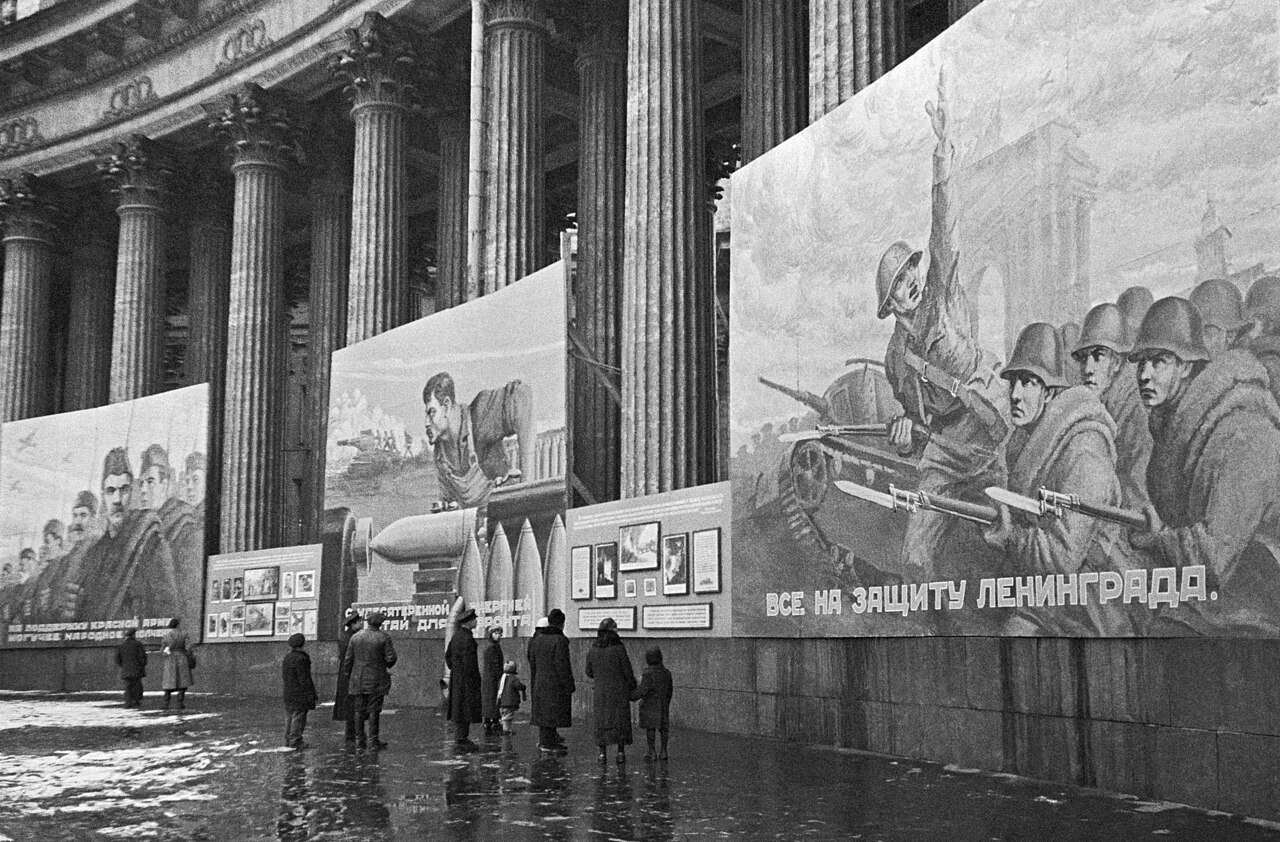
Placards on the colonnade of the Kazan Cathedral, Leningrad, October 1941, weeks into the siege. The right-hand one reads "Everyone to the defence of Leningrad!" The cathedral, where Field Marshal Kutuzov is buried, then housed a museum of the history of religion and atheism. Photo: Anatoliy Garanin, RIA Novosti archive #637354, CC BY-SA 3.0.
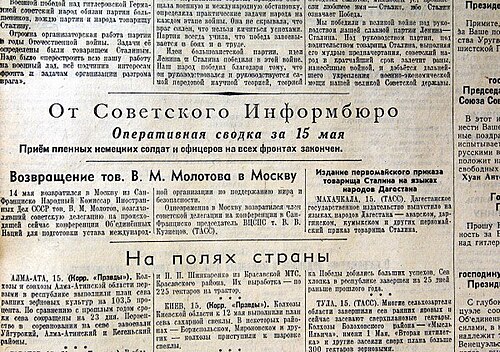
Sovinformburo's last operational summary as printed in the press: "From the Soviet Information Bureau. Operational summary for 15 May. The acceptance of captured German soldiers and officers on all fronts is complete." RIA Novosti archive #409373, CC BY-SA 3.0.
How it ended, and what came out later.
- 10 May 1948. The USSR's chief military prosecutor, Lieutenant General Nikolai Afanasyev, reports that the Panfilov's 28 story was an invention of the Krasnaya Zvezda reporter Vasily Koroteyev, the editor Ortenberg and above all the paper's literary secretary Aleksandr Krivitsky. The inquiry began after one of the 28, Ivan Dobrobabin, turned up alive and was tried for serving the Germans as a policeman. The report was filed away and the story stayed canonical. In July 2015 the State Archive of the Russian Federation, under its director Sergei Mironenko, published the report online; Mironenko was moved from the directorship in 2016 after criticism from the culture minister, Vladimir Medinsky (RFE/RL).
- 1948-1952. The Jewish Anti-Fascist Committee is closed in November 1948. Mikhoels had been killed in January 1948. Thirteen people linked to it, including Lozovsky and Fefer, are shot on 12 August 1952 after a secret trial.
- 13 April 1990. A TASS statement acknowledges that the NKVD carried out the Katyn killings, placing "direct responsibility" on Lavrentiy Beria, Merkulov and their subordinates. On 14 October 1992 the Russian government hands Poland the Politburo decision of 5 March 1940, signed by Stalin, Voroshilov, Molotov and Mikoyan, which ordered the shooting of Polish prisoners of war and detainees. About 22,000 were killed at Katyn and other sites.
How it works
- Transfer: the Red Square speech of 7 November 1941 borrows the prestige of Nevsky, Donskoy, Minin, Pozharsky, Suvorov and Kutuzov (princes, a merchant, tsarist generals) for a state that had spent twenty years denouncing the old order. The 1942 military orders put those names on medals, and the 1943 concordat added the authority of a patriarch. The war was named the "Great Patriotic War" after the Patriotic War of 1812 against Napoleon.
- Name-calling: the enemy in Sovinformburo communiqués is the "German-fascist invader" or the "Hitlerite"; in Ehrenburg's "Kill!" (24 July 1942) the label covers a whole nation: "We have understood: the Germans are not human beings".
- Fear appeal: "Kill!" frames killing as the only protection for the reader's own family ("If you do not kill the German, the German will kill you") and tells the soldier that a day without killing a German is a day wasted. Order No. 227 adds the threat from behind: penal companies and blocking detachments for those who retreat without orders.
- Identity fusion: Order No. 227 calls commanders and political officers who leave a position without orders from above "traitors to the Motherland" and says "panic-mongers and cowards" must be destroyed on the spot. Retreat, whatever the tactical case for it, is recast as betrayal of the nation.
- Card stacking: the 6 November 1941 speech set Soviet losses of about 1.75 million (killed, missing and wounded) against German losses of 4.5 million, weeks after several Soviet armies had been encircled around Kiev and Vyazma. The Russian General Staff study edited by G. F. Krivosheev counts more than 3 million Soviet irrecoverable losses (killed, died, missing and captured) for the last six months of 1941 alone. The figure given to the public kept the true proportion out of view.
- Euphemism / doublespeak: the September 1939 occupation of eastern Poland was the "liberation of Western Ukraine and Western Belorussia"; the attack on Finland was presented as support for a Finnish "People's Government" with which Moscow had just signed a treaty.
- Narrative laundering: the Burdenko Commission put the state's Katyn version under the names of a famous surgeon, an academician-novelist and a metropolitan, and showed it to foreign reporters and an ambassador's daughter, so that the denial reached Allied readers as the finding of a commission of eminent people rather than as an NKVD statement.
- Accusation in a mirror: the Sovinformburo statement of 15 April 1943 accused the Germans of the Katyn shootings and of slandering the USSR, for a crime the NKVD had committed three years earlier. The fit is close but not exact: the taxonomy's definition is about accusing a target in advance; here the accusation came after the act.
- Invented heroism, with no exact technique id. The Panfilov's 28 story is a fabrication in a newspaper report: the details, the last words given to the political officer Vasily Klochkov ("Russia is vast, but there is nowhere to retreat: Moscow is behind us"), which according to the 1948 report Krivitsky said he had composed himself, and the claim that all 28 died. No technique id describes a straight invention in a news report, so it is recorded as a documented falsification, untagged.
Colour. Most of this material is white propaganda: communiqués, Pravda articles, TASS Windows and orders all carried their source. Two parts were gray: the Terijoki government, a Moscow-formed body presented as Finnish, and the Burdenko Commission, which spoke as an independent panel of eminent people while working to a version prepared by the security services. The source of the Katyn denial was open; its content was false.
Then and now
Content note: Caricature of Hitler with a swastika. This object is shown as it was published. Why 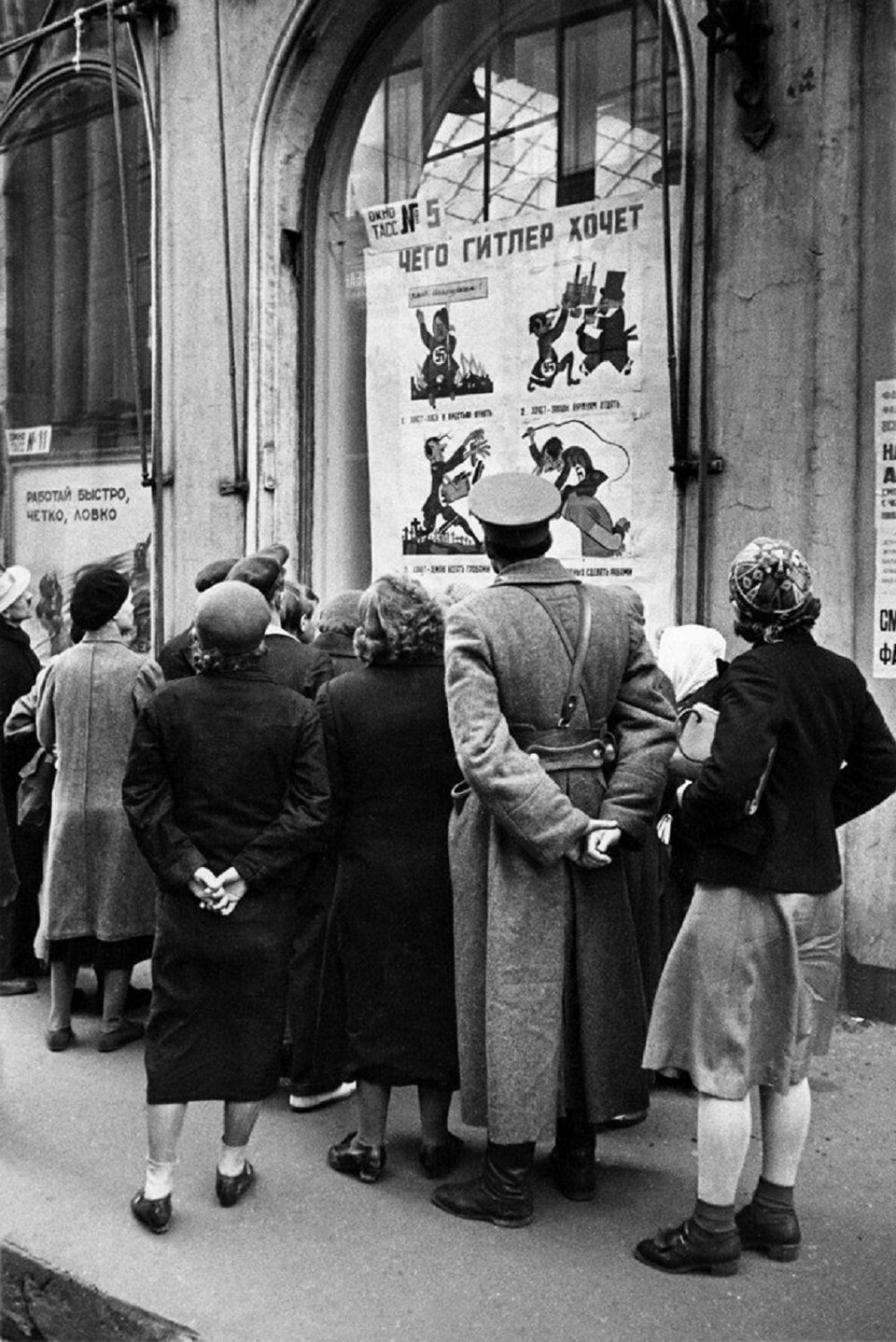
Muscovites at TASS Window No. 5, 'What Hitler Wants' (Chego Gitler khochet): Muscovites at TASS Window No. 5, "What Hitler Wants" (poster by Mikhail Cheremnykh), Kuznetsky Most, July 1941. Photo: A. V. Ustinov, Moscow Main Archive, CC BY 4.0.
In July 1941 a state news agency put the enemy's aims in a shop window under its own name, for a population whose country had just been invaded. The later case in this archive from the same capital is the Russian government's address of 24 February 2022 announcing a "special military operation" (Address announcing a 'special military operation'). They share a structure: one state voice with rival channels closed (in 1941 private radio sets were called in; in 2022 a law of 4 March made "discrediting" the armed forces a crime). The 2022 wording is closer to the Soviet vocabulary of 1939, when the entry into eastern Poland was a "liberation", than to that of 1941. The differences are as plain. In 1941 the Soviet Union was the invaded country, with German forces on its soil and its civilians and prisoners dying in their millions; in 2022 Russian forces entered Ukraine.
Positions on the record
- The Soviet state's stated rationale. The war was a defensive, national war against an invader, and its propaganda existed to mobilise the population and the army for the country's survival. Soviet sources presented the 1939-1940 annexations as a security buffer and the Winter War as a response to Finnish provocation.
- Contemporaries. The Polish government in London disputed the Katyn denial from April 1943. Aleksandrov's Pravda article of April 1945 amounted to an official rebuke from inside the Soviet system. A leaflet attributed to Ehrenburg in German wartime propaganda, calling on Soviet soldiers to take German women as spoils, has no known Soviet original and Ehrenburg denied writing it; this page does not treat it as his text.
- Later historians. Jeffrey Brooks (Thank You, Comrade Stalin!, Princeton 2000) describes the wartime press as giving more room to patriotic and personal writing, before the postwar return to the leader cult. NKVD responsibility for Katyn is established by the U.S. House Select Committee of 1951-52 and, after 1990, by the Soviet and Russian documents themselves.
- This archive's reading. Documented: the institutions, dates and texts above; the scale of the invasion and of Soviet losses; the Soviet state's own later admissions that the Katyn denial was false (1990) and that the Panfilov's 28 story was invented (1948 report, published 2015). Not shown here: that Soviet wartime propaganda was false in general. Much of its content, including most of its reports of German atrocities on Soviet territory, is consistent with the record established after the war (covered in FRAME's genocide case studies); Katyn is the documented exception in which a Soviet commission blamed Germany for a Soviet crime. Also not shown: that the propaganda, rather than the fighting, decided the outcome.
Same-method test
The same findings, with the flag swapped:
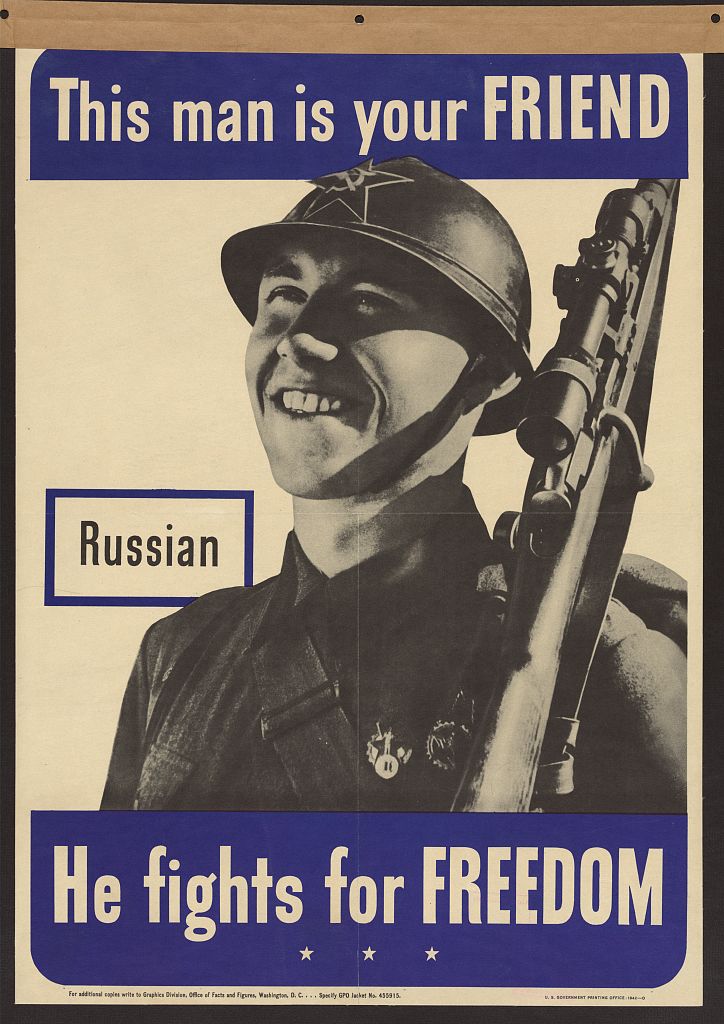
This Man Is Your Friend: Russian. He Fights for Freedom: U.S. Government Printing Office, 1942. Public domain.
- The ally, softened. The U.S. poster above presents a Red Army soldier as a man who "fights for freedom", three years after Molotov had called a war to destroy "Hitlerism" criminal. It is a white poster with a virtue word standing in for a description of the ally (Glittering generalities). The difference in scale is large: one U.S. poster series and a warm season in the magazines, against a state monopoly of print and radio.
- Invented or inflated heroism. In December 1941 U.S. radio and newspapers reported that the B-17 pilot Colin Kelly had sunk the Japanese battleship Haruna by crashing into it; the commentator Lowell Thomas told listeners Kelly "sank the battleship Haruna". Haruna was not there, and Kelly's crew had near-missed a smaller ship. Kelly did fight and die; the story grew from confused early reports, not from a newspaper staff writing dialogue for men they had not interviewed. It is scored the same way on a smaller scale: a heroic story that outran the record.
- An ally's atrocity kept quiet. In May 1943 the British ambassador to the Polish government in exile, Owen O'Malley, sent the Foreign Secretary a report concluding that Soviet guilt at Katyn was likely. Churchill's reaction, as recorded, was that "we should none of us ever speak a word about it", and the report was not published. In 1952 a U.S. House select committee found that Office of War Information and Federal Communications Commission staff had pressed Polish-language radio stations in Detroit and Buffalo to stop covering the Katyn allegations. The difference is plain: the Soviet government committed the crime and fabricated evidence; the British and U.S. governments suppressed doubts about an ally's crime to protect the alliance. Both are Card stacking of the record; only one is a cover-up of its own act.
- Kill slogans. In 1943 a billboard at the U.S. Navy base at Tulagi in the Solomon Islands, signed with Admiral William Halsey's name, read "Kill Japs, kill Japs, kill more Japs!" (Evan Thomas, Sea of Thunder, 2006). Halsey's sign was one sign at one base; Ehrenburg's articles ran in a mass army newspaper for three years. U.S. home-front material also reduced the enemy to a single menacing figure (This Is the Enemy). The method, a slur-level label and an order to kill, is scored the same.
How to spot it
- Check the loss figures against the map. When a government gives its own losses in round figures and the enemy's in larger ones during a retreat, look for what it says about the ground lost.
- Watch the ancestors. When a state that rejected a past suddenly borrows its heroes, the shift is a message about who is now meant to fight.
- Ask who staffed the commission. Eminent names on an investigating body are not evidence of independence; check who prepared the site, who chose the witnesses and whether outsiders could test the findings.
- Read the story against the unit records. Heroic accounts with exact last words, a round number of men and no survivors are worth checking against casualty lists; the Panfilov report was undone by a survivor.
- Look for what an ally did not say. Wartime alliances produce silence as well as praise, as the Katyn record in London and Washington shows.
Images
| Image | Source | Licence |
|---|---|---|
| Mechanism diagram (above) | Drawn for FRAME from this page's sourced facts (make_diagrams.py) |
CC BY 4.0, FRAME |
| What Hitler Wants at a TASS Window, Moscow, July 1941 | FRAME gallery (Wikimedia Commons), photo A. V. Ustinov, Moscow Main Archive | CC BY 4.0 |
| Placards on the Kazan Cathedral, Leningrad, October 1941 | Wikimedia Commons, RIA Novosti archive #637354, Anatoliy Garanin | CC BY-SA 3.0 |
| Sovinformburo's last summary in print, May 1945 | Wikimedia Commons, RIA Novosti archive #409373 | CC BY-SA 3.0 (RIA Novosti); Commons also tags it PD-Russia-1996 |
| This man is your friend: Russian (1942) | FRAME gallery (Library of Congress) | Public domain (U.S. government work) |


Image gaps
- Soviet wartime posters themselves (TASS Windows as artworks, and posters such as Irakli Toidze's The Motherland Calls). Dropped: their U.S. copyright status is unclear, so this archive hosts only photographs of them on display. The Art Institute of Chicago's TASS site shows the posters.
- The Krasnaya Zvezda pages carrying "Kill!" (24 July 1942) and the Panfilov's 28 report (November 1941). No openly licensed scan was found.
- The Burdenko Commission at Katyn (January 1944): no openly licensed photo was found. Photographs of the exhumations exist in Polish and German collections; their licences were not checked.
- A street loudspeaker during the 22 June 1941 broadcast: no RIA Novosti CC BY-SA photo of one turned up in searches (Wikimedia Commons was heavily rate-limited from the build environment). This gap can probably be filled.
- Residents of Stalino (Donetsk) reading TASS Windows, September 1943 (photo by Vladimir Ivanov, on Commons): tagged public domain in Russia only, with no U.S. rationale, so not hosted.
- The Tulagi billboard (1943): a U.S. Navy photograph (80-G-259446) is held by the Naval History and Heritage Command and would be public domain, but the NHHC site could not be reached from the build environment. Fillable.
- The Allied side: the Life issue of 29 March 1943, Time's Man of the Year cover and Mission to Moscow stills are copyrighted; cited only.
Sources
- Art Institute of Chicago, Windows on the War: Soviet TASS Posters at Home and Abroad, 1941-1945 (exhibition site), including the chronology of the TASS studio and Soviet posters abroad.
- Federal Archival Agency of Russia (Rosarkhiv), TASS communiqué on Soviet-German relations, Pravda, 14 June 1941.
- J. V. Stalin, speech of 6 November 1941 and speech at the Red Army parade, 7 November 1941 (English texts as published by the Soviet government); U.S. Embassy Moscow telegram on the 6 November speech, FRUS 1941, vol. I.
- V. M. Molotov, speech to the Supreme Soviet, 31 October 1939, pamphlet catalogued at the Modern Records Centre, University of Warwick.
- I. Ehrenburg, "Ubei!" (Krasnaya Zvezda, 24 July 1942), Russian Historical Society electronic library of historical documents.
- T. Gliniecki, "The Development of the Soviet Military Propaganda during the War with Germany (1941-1945)", Institute of National Remembrance Review 4 (2021-2022), pp. 119-141 (Aleksandrov's article of 14 April 1945; GlavPU leadership).
- Order No. 227 of the People's Commissar of Defence, 28 July 1942, English translation on Wikisource.
- Seventeen Moments in Soviet History (Michigan State University), Stalin's meeting with three Orthodox bishops, 4 September 1943.
- RFE/RL, "Russian Archive Chief Out After Debunking Soviet WW II Legend", 2016; Eurasianet, "Soviet WWII Legend of Panfilov Guardsmen Debunked as 'Fiction'", 2015.
- Institute of National Remembrance (Poland), "The Katyn lie. Its rise and duration"; Katyn Museum, "The backstage and the scene of lies: Soviet Katyn commissions".
- UPI, "Soviets admit, apologize for Katyn massacre", 13 April 1990.
- U.S. National Archives, Records relating to the Katyn Forest Massacre (including the 1952 House Select Committee report); East Carolina University, Congress investigates the Katyn Forest Massacre.
- International Churchill Society, "Churchill and Roosevelt 'hid the truth about Stalin atrocity'" (O'Malley report).
- YIVO Encyclopedia of Jews in Eastern Europe, "Jewish Anti-Fascist Committee"; Blavatnik Archive, "Soviet Jewish Anti-Fascist Committee: Propaganda, Advocacy, and a Call for Unity, 1941-1948".
- U.S. Holocaust Memorial Museum, "Nazi Persecution of Soviet Prisoners of War"; M. Harrison, "Counting the Soviet Union's War Dead: Still 26-27 Million", Europe-Asia Studies 71:6 (2019).
- The Criterion Collection, "Alexander Nevsky" (withdrawal after the 1939 pact).
- The National WWII Museum, "The Legacy of Courageous B-17 Pilot Colin Kelly"; U.S. Naval Institute, "The Final End of the Haruna", Naval History, 1989.
- E. Thomas, Sea of Thunder: Four Commanders and the Last Great Naval Campaign, 1941-1945, Simon & Schuster 2006, sample text via the Library of Congress (Tulagi billboard).
- J. Brooks, Thank You, Comrade Stalin! Soviet Public Culture from Revolution to Cold War, Princeton University Press 2000.
- P. Kort Zegers and D. Druick (eds.), Windows on the War: Soviet TASS Posters at Home and Abroad, 1941-1945, Art Institute of Chicago / Yale University Press 2011.