Content note. This page quotes the director of these wartime U.S. Army films using the slur "Japs", quotes one of the films describing Japanese soldiers as a single uniform mass, and mentions footage of killings of Chinese civilians. The words are quoted as evidence of what the films and their makers said. They are not this archive's description of anyone.
In one line: the U.S. Army asked Hollywood director Frank Capra for films that would, in General Marshall's brief, explain to its draftees why the U.S. was fighting, and he built seven compilation films largely out of other people's footage, including Axis newsreels and rally films, re-narrated to argue the Allied case; Army researchers then tested the films on soldiers and found they taught facts far better than they changed attitudes.
What happened
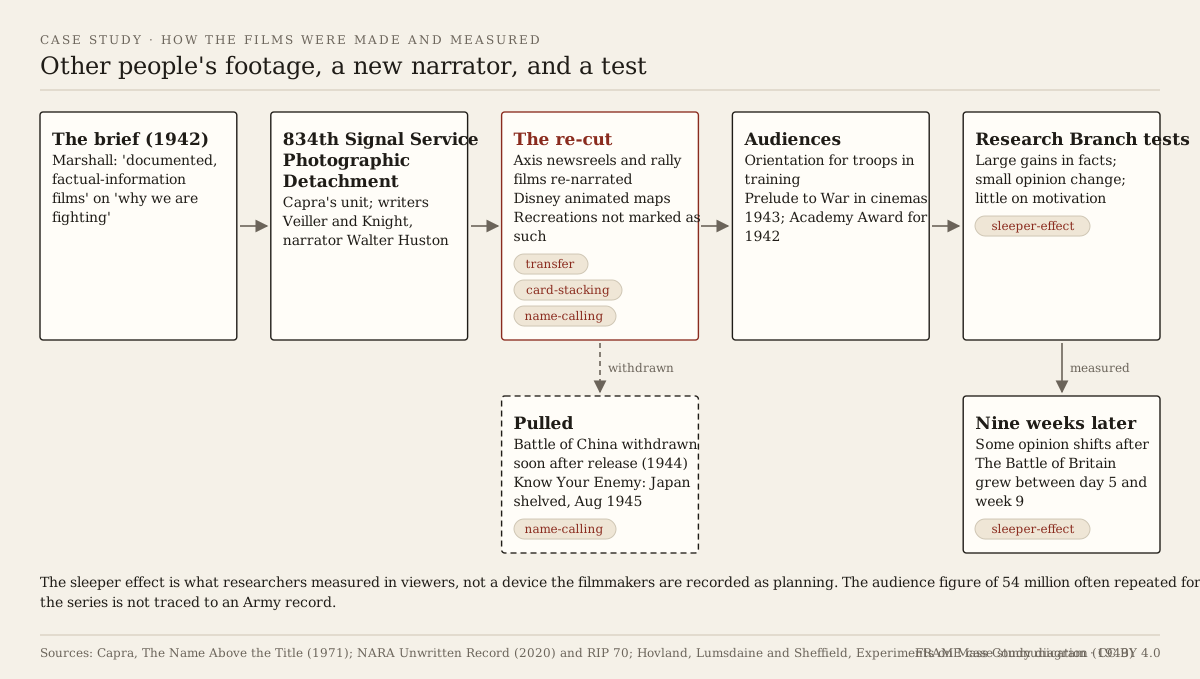
- Early 1942. The brief. After Capra joined the Army, Chief of Staff George C. Marshall asked him, as Capra later recalled it, for "a series of documented, factual-information films" that would "explain to our boys in the Army why we are fighting, and the principles for which we are fighting" (Capra, The Name Above the Title, 1971, as quoted in reference accounts). Marshall's own letter of 9 February 1943 says he had found officers' lectures to the men "so unsatisfactory because of the mediocrity of presentation that I directed the preparation of this series of films" (George C. Marshall Foundation).
- The unit. Capra was commissioned a major in the Signal Corps and given a new unit, the 834th Signal Service Photographic Detachment. Its starting size is reported as eight officers and 35 enlisted men, with the staff grown to 150 by 1943 (reported by the Encyclopedia.com biography of Capra; this page did not find a unit record). The National Archives names writers Anthony Veiller and Eric Knight and narrator Walter Huston; a Library of Congress essay adds director Anatole Litvak, editor William Hornbeck and composer Dimitri Tiomkin (Bohn, National Film Registry essay). Litvak co-directed The Battle of Russia and The Battle of China.
- Seeing Triumph of the Will. Capra watched Axis films, including Leni Riefenstahl's 1935 Nuremberg rally film, at the Museum of Modern Art in New York. In his autobiography he wrote that it "fired no gun, dropped no bombs. But as a psychological weapon aimed at destroying the will to resist, it was just as lethal." He described his answer as: "Use the enemy's own films to expose their enslaving ends. Let our boys hear the Nazis and the Japs shout their own claims of master-race crud" and, he went on, "our fighting men will know why they are in uniform" (Capra, 1971, as quoted in reference accounts).
- How the films were built. The National Archives says Capra's staff "used the compilation method," drawing footage from the National Archives, the Library of Congress, the Museum of Modern Art, the Army Pictorial Center and New York newsreel libraries, and that "films from Allied Governments and those captured from the Axis were also used" (NARA RIP 70, entry 111.8). Its account of Prelude to War says the film "draws upon an eclectic variety of foreign sources and newsreels and includes some original footage, including reenactments," with map animations by Walt Disney Studios personnel. It notes that "some of the scenes in the film are recreations, which the film does not indicate," that the footage of the murders of Axis opponents "is clearly staged," and that a scene of children singing in praise of Hitler is "an American imagining of such a scene" (NARA, The Unwritten Record, 2020).
- The seven films. Prelude to War (1942), The Nazis Strike (1943), Divide and Conquer (1943), The Battle of Britain (1943), The Battle of Russia (1943), The Battle of China (1944) and War Comes to America (1945). The National Archives holds them within a Signal Corps series titled Orientation Films, "consisting of 32 documentaries on the war" (NARA Reference Information Paper 70, entry 111.8). The Army's series title gives their stated purpose: orientation of troops in training.
- Theatrical release and the Academy Award. Prelude to War was first shown on 30 October 1942 and released to U.S. cinemas on 27 May 1943, distributed by Twentieth Century-Fox and the War Activities Committee of the Motion Picture Industry (AFI Catalog). At the ceremony of 4 March 1943 the Academy's documentary category for 1942 had four joint winners: Prelude to War (U.S. Army Special Services), The Battle of Midway (U.S. Navy), Kokoda Front Line! (Australian News and Information Bureau) and the Soviet Moscow Strikes Back (Artkino) (Academy of Motion Picture Arts and Sciences). The National Archives says the films, "designed for new recruits," were "eventually shown to civilian warworkers and the general public" (NARA RIP 70). The AFI Catalog, citing modern sources, reports that Prelude to War did poorly at the box office.
- Audience size. A figure of more than 54 million Americans having seen the series by 1945 is repeated in reference accounts (Wikipedia; Military History Now). This page could not trace it to an Army, OWI or distributor record, so it is reported, not documented.
- 1944. The Battle of China. The film presents the Tanaka Memorial, a purported Japanese plan for world conquest that historians generally regard as a forgery, as genuine (as does Prelude to War), and includes footage of Chinese civilians being shot at close range during the Nanjing massacre. The National Archives says it was "quickly withdrawn from circulation after its release" and "is the least historically accurate of the series" (NARA RIP 70, entry 111.8).
- 1944. The Negro Soldier. Made by Capra's unit, directed by Stuart Heisler and written by Carlton Moss, who also appears on screen as a preacher. The National Archives describes it as reviewing "the contribution of African-Americans to U.S. history, with special emphasis on their participation in the war" (NARA RIP 70). Cripps and Culbert (1979) place it within the Army's response to racial tension in its segregated ranks; it was first meant for Black troops and then shown to wider military and civilian audiences. The Library of Congress added it to the National Film Registry in 2011.
- 1945. Know Your Enemy: Japan. Directed by Capra with the Dutch documentary maker Joris Ivens, narrated by Walter Huston and Dana Andrews. Reference accounts report that its completion was delayed by disputes between Hollywood and Washington; its treatment of Emperor Hirohito is the subject of a later study in Education About Asia. An opening scrolling title distinguishes Nisei (Japanese-American) soldiers, praised for their service against the Nazis, from the people of Japan; reference accounts report that Assistant Secretary of War John McCloy had it added. The narration says the typical Japanese soldier and his fellow soldiers are as much alike as "photographic prints off the same negative" (quoted in Dower, War Without Mercy, 1986). It was released to Army screenings on 9 August 1945, the day of the Nagasaki bombing, and withdrawn by the end of August after Japan's surrender. Reference accounts report that its first public screening was in a 1977 PBS special.
- The measurement. The War Department's Research Branch, whose Experimental Section was led by Carl Hovland, tested the early films on soldiers using matched groups who did or did not see a film, with questionnaires before and after. The results were published as Hovland, Lumsdaine and Sheffield, Experiments on Mass Communication (Princeton University Press, 1949), volume III of the series Studies in Social Psychology in World War II, whose first two volumes are The American Soldier. The films produced large gains in factual knowledge about the events leading to the war, smaller changes in opinions on points the films covered directly, and little or no measurable change in soldiers' general motivation to serve.
- The "sleeper effect." With The Battle of Britain, some opinion changes were larger nine weeks after viewing than five days after, even as memory of the facts faded. The authors named this the "sleeper effect" and suggested, as one possible explanation, that viewers forget over time that they had discounted the source while keeping its message. Later laboratory work (Hovland and Weiss, 1951) and a meta-analysis (Kumkale and Albarracín, 2004) found the effect is real but appears only under narrow conditions.
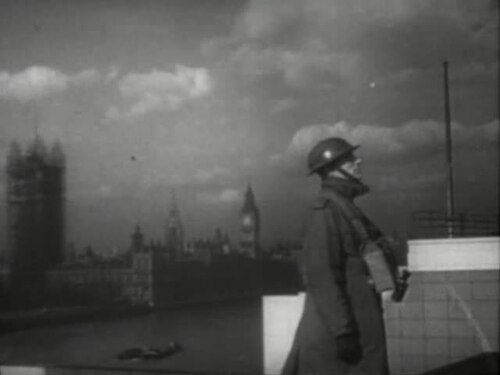
Why We Fight: The Battle of Britain (film frame), U.S. Army (Frank Capra's Why We Fight series), 1943. Public domain.
- Afterwards. Eric Knight, by then a major, was killed on 15 January 1943 when a U.S. Army Air Forces C-54 crashed in Dutch Guiana (now Suriname) (reference accounts; McBride, 1992). Capra received the Legion of Merit in 1943 and the Distinguished Service Medal in 1945, and left the Army in June 1945 as a colonel (U.S. Army; NARA, The Unwritten Record, 2017). The films entered the public domain as U.S. government works and remain in circulation through NARA and the Internet Archive.
How it works
- Name-calling: Capra's own statement of method uses the slur "Japs" for the Japanese enemy. Fan transcripts of the Prelude to War narration show the same word in its passage on Japan's "Co-Prosperity Sphere," but they differ on the exact line and this page could not check them against the NARA print, so the line is not quoted here. The narration also labels Axis leaders with ridicule, for example Mussolini "beat his chest like Tarzan" (quoted in Bohn, Library of Congress). Know Your Enemy: Japan describes Japanese soldiers as alike as "photographic prints off the same negative." Dower documents that U.S. wartime media often separated Nazi leaders from ordinary Germans but treated the Japanese as a single people; the label arrives in place of any distinction between a government, an army and a population.
- Card stacking: Prelude to War presents staged recreations, including killings, alongside newsreel without marking which is which (NARA). Prelude to War and The Battle of China present the Tanaka Memorial as a genuine Japanese plan. The National Archives rates The Battle of China the least accurate of the series. The selection and order of real footage leaves one reading available; the viewer is not told where the staged parts are.
- Transfer: Capra's stated method was to take Axis rally films and newsreels, which had been made to attach glory to their leaders, and re-narrate them so the same images carry stigma instead. NARA describes the result as damning the Axis powers "with their own images and words." The imagery does the work: marching columns and rally crowds, shot by the other side for its own audiences, become the evidence of that side's aims.
- Sleeper effect: this is the effect Army researchers measured in viewers of The Battle of Britain, not a device the filmmakers are recorded as planning. Some opinion shifts grew between five days and nine weeks, and the authors offered, as one possible explanation, that viewers forgot they had discounted the film as an official source. It is tagged here because this series is the documented origin of the finding, with the later research showing the effect is conditional.
Then and now
The same Academy ceremony that honoured Prelude to War also honoured a Soviet state film: Defeat of the German Armies Near Moscow (1942), directed by Ilya Kopalin and Leonid Varlamov at the Central Studio of Newsreels in Moscow. Its U.S. version, Moscow Strikes Back, was released through Artkino Pictures with an English commentary written by Albert Maltz and narrated by Edward G. Robinson, editing and montage by Slavko Vorkapich, and a score arranged by Dimitri Tiomkin, who also scored the Why We Fight films (New York Times credits, as reported by Wikipedia).
The two films share a method: a government film unit turning documentary footage into an argument about the war, then winning the same award from a foreign film industry. The differences are plain. The Soviet film was shot by Soviet cameramen, covering their own army's campaign in the Battle of Moscow. Capra's films were compiled largely from footage shot by others, including the enemy, and re-narrated. The Soviet film was made first for Soviet home audiences and given a new English commentary and edit for American ones; Why We Fight was made first for U.S. soldiers and released to civilians second. The U.S. films were then tested on their own audiences, and the published results (large factual gains, small attitude changes) are why the series matters to research on persuasion; this page found no comparable published audience study of the Soviet film.
Positions on the record
- The makers' stated purpose: Marshall, as Capra recalled it, wanted "documented, factual-information films" to explain "why we are fighting," and Marshall wrote that he ordered the films because officers' lectures were unsatisfactory. Capra framed his method as letting the enemy's own films make the case.
- Inside the Army at the time: The Battle of China was "quickly withdrawn from circulation after its release" (NARA), and Know Your Enemy: Japan was withdrawn within weeks of its release. Reference accounts report that a senior War Department official, McCloy, had the Nisei title added to the Japan film.
- Later historians: Dower (1986) treats the Japan films as examples of the racial framing that ran through U.S. and Japanese wartime material alike. Cripps and Culbert (1979) describe The Negro Soldier as an Army attempt to address racial tension within its own ranks, made within the limits of a segregated Army.
- What is documented: the brief, the unit, the use of Axis and newsreel footage, the Disney maps, the unmarked recreations in Prelude to War, the Academy Award, the withdrawal of The Battle of China, and the published Research Branch findings.
- What is not shown: a sourced basis for the "54 million" audience figure; the exact wording of the Prelude to War narration on Japan's "Co-Prosperity Sphere"; evidence that the films changed soldiers' willingness to fight (the Army's own tests found little); and any plan by the filmmakers to produce the sleeper effect.
Same-method test
If a Soviet, Japanese or German army film unit had re-cut American newsreels under its own narration, staged scenes without marking them, and called Americans by a slur, this archive would tag the same techniques with the same words. The measured result would also be read the same way: a film that raises factual recall without moving motivation is scored on what it did, whichever army made it.
How to spot it
- Ask who shot the footage and for whom. Images made by one side for its own audience change meaning under another side's narration.
- Look for unmarked recreations: a staged scene cut into newsreel carries the authority of the real footage.
- Check key documents the film relies on (such as the Tanaka Memorial) against what historians now say about them.
- Notice when a label covers a whole people rather than a government or army.
- Separate "the audience learned the facts" from "the audience changed its mind." The Army's own tests found those are different results.
Images
| Image | Source | Licence |
|---|---|---|
| Mechanism diagram (above) | Drawn for FRAME from the page's sourced facts (make_diagrams.py) |
CC BY 4.0, FRAME |
| The Battle of Britain (1943), film frame | FRAME gallery (Wikimedia Commons) | Public domain (U.S. government work) |
| Frank Capra and Roy Boulting at an editing bench, 1944 | Wikimedia Commons | Public domain (Crown copyright expired) |
_of_the_US_Army_Signal_Corps_confers_with_Captain_Roy_Boulting_of_the_British_Army_Film_Unit_on_the_editing_of_the_film_%27Tunisian_Victory%27_in_February_1944._D18377.jpg)
Stills
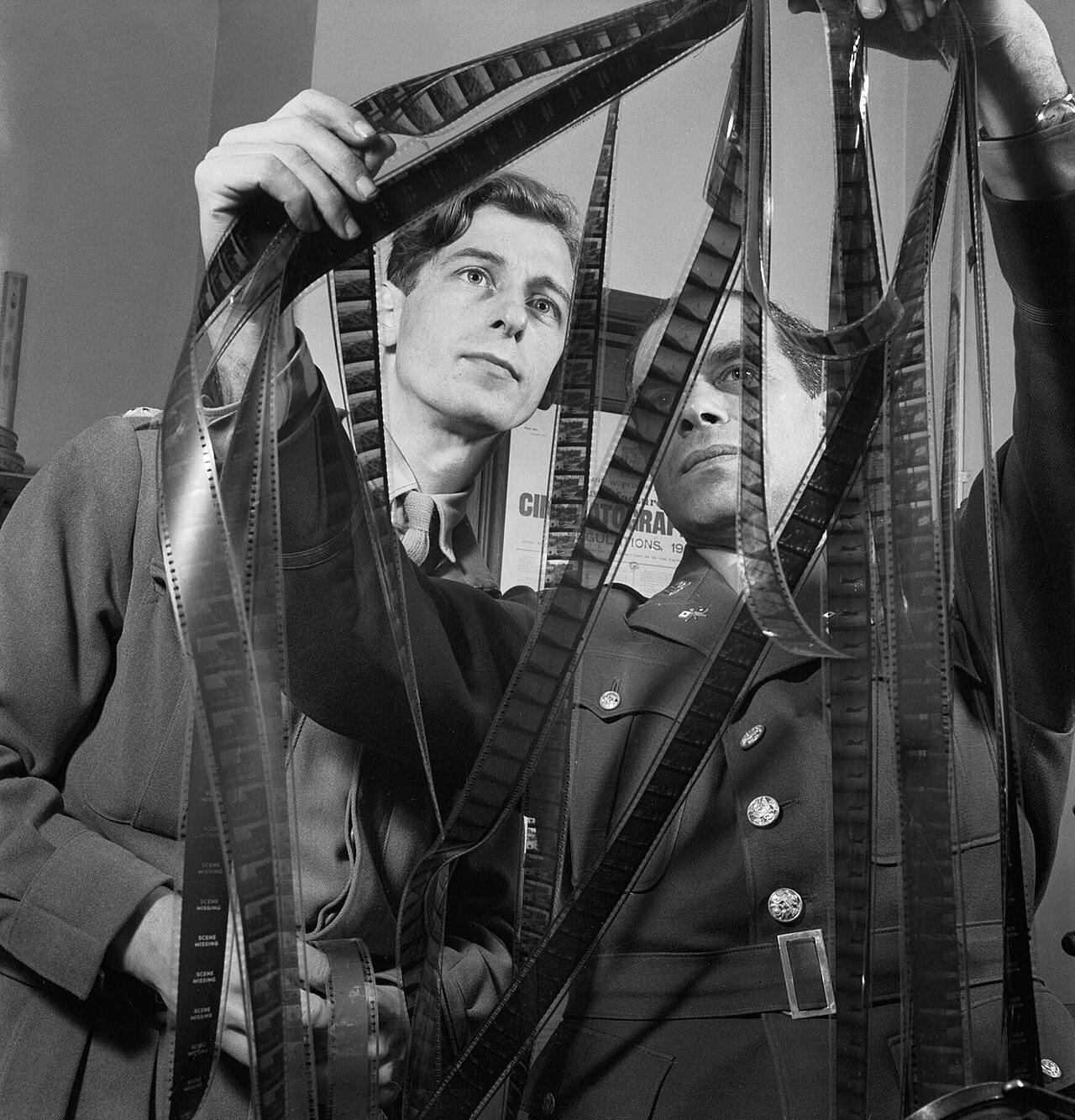
Colonel Frank Capra (right) of the U.S. Army Signal Corps with Captain Roy Boulting of the British Army Film Unit, editing the joint film Tunisian Victory, February 1944. Ministry of Information photograph, Imperial War Museum D 18377. Public domain (Crown copyright expired).
Image gaps
- Frames from Prelude to War, The Battle of China and Know Your Enemy: Japan, including the title card added by McCloy. U.S. government works and so public domain, with copies at NARA and the Internet Archive, but neither site could be reached from the environment used to build this page. This gap can be filled.
- A frame from The Negro Soldier. Public domain (War Department film, National Film Registry). This gap can be filled the same way.
- The Disney animated maps. Made for the War Department and included in public-domain prints; a frame taken from a NARA print would be usable. Fillable, with the source print recorded.
- Frames from Triumph of the Will as reused by Capra. Only usable as they appear inside the U.S. prints; the original film's rights are separate. Not added.
- A frame from Moscow Strikes Back. The rights status of the Soviet original and of Republic's English version is unclear. Not added.
Sources
- Frank Capra, The Name Above the Title: An Autobiography (Macmillan, 1971).
- NARA, The Unwritten Record, 1 September 2020: "Why We Fight: Prelude to War, America's Crash History Lesson"
- NARA, Reference Information Paper 70, Part II, RG 111 entry 111.8, Orientation Films
- NARA, The Unwritten Record, 11 July 2017: "Spotlight: Hollywood Goes to War" (Capra's Distinguished Service Medal)
- Thomas W. Bohn, "Why We Fight," National Film Registry essay (Library of Congress)
- NARA, Pieces of History, 18 June 2012: "National Archives specialists bring movies 'Out of the Dark'"
- George C. Marshall Foundation: "Marshall and the 'Why We Fight' Films"
- George C. Marshall Foundation: "Marshall, Frank Capra, and Film"
- Warfare History Network: "Director Frank Capra"
- Encyclopedia.com: "Frank Capra" (unit size)
- U.S. Army: "Signal regiment honors Hollywood director" (2016) (Legion of Merit, Distinguished Service Medal, rank)
- AFI Catalog: Prelude to War (first showing, theatrical release, distribution, box office)
- Joseph McBride, Frank Capra: The Catastrophe of Success (Simon & Schuster, 1992).
- Prelude to War is NARA 111-OF-1. Fan transcripts of its narration exist online but were not checked against the print and are not quoted here.
- Carl I. Hovland, Arthur A. Lumsdaine and Fred D. Sheffield, Experiments on Mass Communication (Studies in Social Psychology in World War II, vol. III; Princeton University Press, 1949).
- Carl I. Hovland and Walter Weiss, "The Influence of Source Credibility on Communication Effectiveness," Public Opinion Quarterly 15, no. 4 (1951): 635-650.
- G. Tarcan Kumkale and Dolores Albarracín, "The Sleeper Effect in Persuasion: A Meta-Analytic Review," Psychological Bulletin 130, no. 1 (2004): 143-172.
- John W. Dower, War Without Mercy: Race and Power in the Pacific War (Pantheon, 1986).
- Education About Asia (Association for Asian Studies): "Propaganda or Documentary? The Showa Emperor and 'Know Your Enemy: Japan'"
- Thomas Cripps and David Culbert, "The Negro Soldier (1944): Film Propaganda in Black and White," American Quarterly 31, no. 5, Special Issue: Film and American Studies (Winter 1979): 616-640.
- Britannica: Why We Fight
- Academy of Motion Picture Arts and Sciences: the 15th Academy Awards (1943)
- Film copy: Know Your Enemy: Japan, Internet Archive
- Reference accounts for the quoted Capra and Marshall wording, the "54 million" figure, the Know Your Enemy: Japan production and release history, Eric Knight's death and the Moscow Strikes Back credits: Wikipedia, Why We Fight; Wikipedia, Know Your Enemy: Japan; Wikipedia, The Negro Soldier; Wikipedia, Eric Knight; Wikipedia, Moscow Strikes Back; Military History Now, 21 November 2014