Content note. This page quotes or describes antisemitic lines broadcast on both Axis and Allied stations. They are reported as evidence of how the broadcasts worked. They are not this archive's description of anyone.
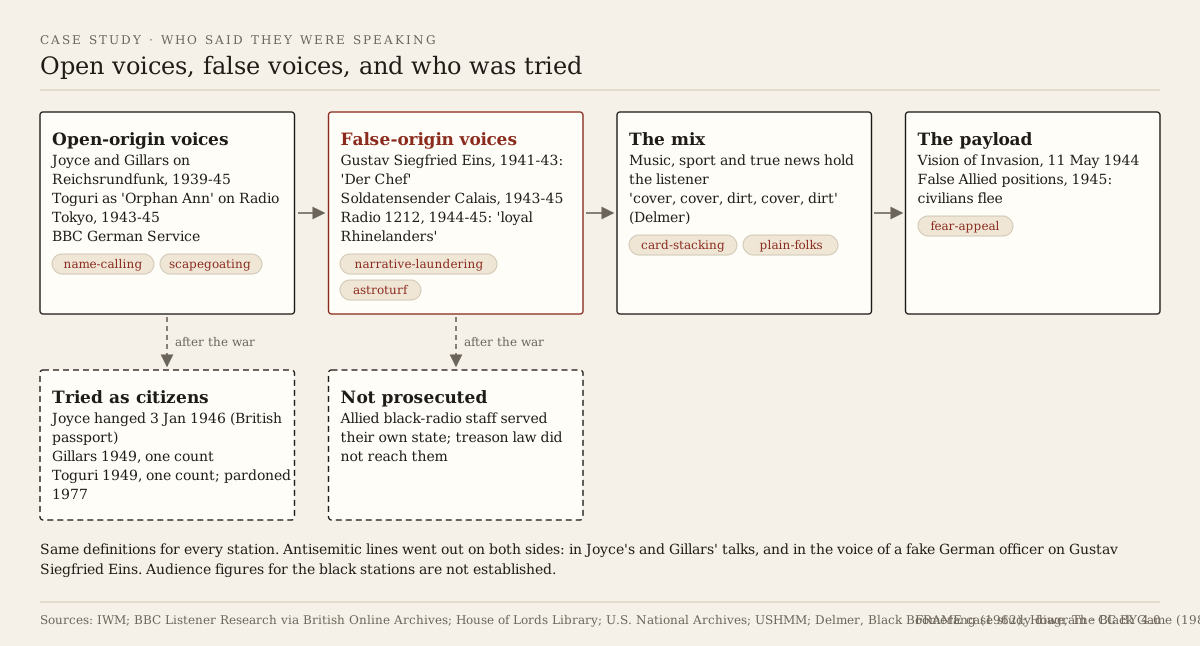
In one line: in the Second World War each side broadcast to the other's troops and civilians, some under their own name (Joyce, Gillars and Toguri on German and Japanese state radio; the BBC German Service) and some under a false one (Britain's Gustav Siegfried Eins and Soldatensender Calais; the U.S. Army's Radio 1212).
What happened
The terms. Garth Jowett and Victoria O'Donnell's textbook Propaganda and Persuasion sorts propaganda by how honestly it names its source and how accurate it is. White propaganda comes from a correctly identified source and tends to be accurate. Black propaganda is material where "the source is concealed or credited to a false authority". Grey sits between: "The source may or may not be correctly identified, and the accuracy of the information is uncertain." Howard Becker used the same source-based sense of "black" in 1949, as did Sefton Delmer's wartime unit in Britain.
This page applies the source test first, because the record settles it. By that test, Joyce's, Gillars' and Toguri's programmes and the BBC German Service were open-origin; Gustav Siegfried Eins, Soldatensender Calais, the Atlantiksender and Radio 1212 were false-origin. Accuracy is a separate question, answered station by station below.
Axis open-origin broadcasts in English
- Late August to September 1939. William Joyce, born in Brooklyn and a former British Union of Fascists organiser who had founded the National Socialist League, leaves Britain for Germany and joins the English-language service of the Reichsrundfunk, the German state radio under Goebbels' ministry. His talks open with "Germany calling". Biographical accounts, including the Dictionary of Irish Biography, record that they urged Britain to surrender and blamed Jews for the war.
- September 1939, the nickname. On 14 September the Daily Express radio critic "Jonah Barrington" (the pen name of Cyril Carr Dalmaine) writes of an announcer heard from Zeesen who spoke English "of the haw-haw, damit-get-out-of-my-way variety"; four days later he names him "Lord Haw-Haw". The voice he first heard is widely thought to have been another announcer, often identified as Wolf Mittler; the name later settled on Joyce (IWM).
- January 1940, the audience. A special study for the Ministry of Information by the BBC's Listener Research unit, with a parallel Mass Observation study, found that at the end of January 1940 about one adult in six in Britain listened to the German English-language broadcasts regularly and about three in six occasionally. The report, issued in March 1940, concluded that most listened out of curiosity or frustration with official news and that the most regular listeners tended to be educated and politically interested (The Conversation; British Online Archives).
- 1940 onward, German black stations. The Propaganda Ministry's Büro Concordia ran false-origin stations aimed at Britain from Berlin studios. Between 1940 and 1945 five of them posed as British dissident, anti-war groups broadcasting from inside the United Kingdom, voiced and written by about two dozen British nationals working for Germany (Graham Smyth, 2024). The first, the New British Broadcasting Station, went on air on 25 February 1940. Joyce wrote scripts for it and for other Concordia stations (Warfare History Network).
- 1940-1945, Mildred Gillars. Gillars, born in Portland, Maine, works as an announcer for German state radio from 1940. Her programmes, including Home Sweet Home aimed at homesick U.S. troops, mixed American dance music with attacks on Roosevelt, Churchill and Jews (Britannica; History.com). History.com quotes her: "I say damn Roosevelt and Churchill, and all of their Jews who have made this war possible."
- 11 May 1944, Vision of Invasion. In a radio play written by her superior, Max Otto Koischwitz, Gillars plays an Ohio mother who dreams that her son dies on a ship in the Channel during the coming invasion. It was aimed at U.S. troops in England before D-Day (West Virginia Archives and History; Britannica).
- 1941-1945, Iva Toguri and "Tokyo Rose". "Tokyo Rose" was, in the U.S. National Archives' words, "a GI term used to refer to a variety of female Japanese broadcasters". Toguri, a U.S. citizen born in Los Angeles in 1916, was visiting a sick aunt in Japan when the Pacific war began and refused to renounce her citizenship (Britannica). From late 1943 she hosted segments of Radio Tokyo's Zero Hour as "Orphan Ann". The programme was directed by an Australian prisoner of war, Major Charles Cousens, and she read scripts written by a U.S. POW, Ted Ince, and a Filipino POW (National Archives). State Library Victoria describes Cousens and Toguri as using the programme to undermine its propaganda aims and to entertain Allied troops.
Allied false-origin and open-origin broadcasts in German
- 23 May 1941, Gustav Siegfried Eins (GS1). The Political Warfare Executive's Sefton Delmer, a former Daily Express Berlin correspondent, starts a shortwave station that claims to be an illegal transmitter inside Germany. Its voice, "Der Chef", played by the Berlin émigré Peter Seckelmann, presents himself as an old-school Prussian officer loyal to Germany and hostile to Nazi Party officials. In the first broadcast, after Rudolf Hess's flight to Scotland, Der Chef abused Churchill in crude antisemitic terms, calling him a drunken Jew (Smithsonian). Most of his attacks, full of graphic sexual detail and stories of corruption, targeted mid-level party officials. The station was closed with a staged Gestapo raid in which Der Chef was "shot" on air, in autumn 1943.
- 1943, the Atlantiksender. Deutscher Kurzwellensender Atlantik, another PWE station, aimed at U-boat crews. It carried dance music and detailed German news, with items meant to convince submariners that the Allies knew their operations.
- 14 November 1943 to 30 April 1945, Soldatensender Calais. Presented as a station for German forces, it broadcast on medium wave from Aspidistra, a 600-kilowatt transmitter at Crowborough, Sussex, built for the U.S. station WLW. Live programmes came from a studio at Milton Bryan, with the émigré actress Agnes Bernelle as announcer "Vicky". Delmer's formula for its method was "cover, cover, dirt, cover, dirt": real news, sport and jazz forbidden in Germany, with morale-damaging items threaded in.
- Late 1944 to April 1945, Radio 1212 ("Operation Annie"). The Psychological Warfare Branch of the U.S. 12th Army Group, staffed from the Army, the Office of Strategic Services, the Office of War Information and the British PWE, ran nightly programmes from the Radio Luxembourg transmitter under the name Radio 1212, claiming to broadcast from inside Germany (National Archives). It posed as a group of loyal Rhinelanders and played traditional German songs. The U.S. Holocaust Memorial Museum, which holds recordings from December 1944, says it made 127 broadcasts and, under Eisenhower's instruction, went on to broadcast false reports of Allied positions that led civilians to flee, which hindered the German retreat.
- Throughout the war, the BBC German Service. Open-origin, led during the war by Hugh Carleton Greene, it built a reputation for accurate news, including British losses. Oxford Polyglot reports Greene's later view that, if the Allies held out, having told the truth would lead German listeners to believe them. It worked alongside the PWE, the same department that ran the black stations.
After the war
- Joyce. Convicted of high treason on 19 September 1945: his British passport, obtained in 1933 by falsely declaring himself a British subject and renewed on 24 August 1939 for a year, was held to bind him to allegiance while valid. The count covered broadcasts from 18 September 1939 to 2 July 1940. The House of Lords dismissed his appeal in December 1945 (Joyce v DPP [1946] AC 347). He was hanged at Wandsworth on 3 January 1946. The House of Lords Library notes the conviction has been criticised because he was not a British subject.
- Gillars. Arrested by the U.S. Army in March 1946; convicted on 10 March 1949 on one count, for Vision of Invasion; sentenced to 10 to 30 years and fined $10,000; paroled in 1961.
- Toguri. Convicted on 29 September 1949 on one count (speaking into a microphone "concerning the loss of ships" in October 1944); sentenced to ten years and fined $10,000; released in January 1956. In 1976 the Chicago Tribune's Ron Yates reported that the two key prosecution witnesses, Kenkichi Oki and George Mitsushio, said they had been pressured and coached. President Ford pardoned her on 19 January 1977.
- Cousens. Charged in Australia under the Treason Act 1351 in 1946; the charge was dropped in November 1946 (State Library Victoria; Canberra Times).
- Allied black-radio staff. No prosecutions: they broadcast for their own state, so treason law did not reach them.
How it works
- Name-calling: the loaded label arrives before any charge. Joyce and Gillars attacked "Jews" and Allied leaders as the makers of the war. On the Allied side, Der Chef's first broadcast abused Churchill as a Jew and branded Nazi Party officials as corrupt, depraved gangsters. Same method, both sides; in the British case the abuse was voiced by a fake German persona.
- Scapegoating: Joyce's broadcasts, as his biographers describe them, and Gillars' quoted line place blame for the war on a bounded out-group, Jews. The Allied stations in this record blamed Nazi officials, a named ruling group, not an ethnic or religious group, so this tag rests on the Axis broadcasts.
- Fear appeal: Vision of Invasion stages a son's death to make the invasion look like certain disaster. The Atlantiksender told U-boat crews their movements were known. Radio 1212's false reports of Allied advances were meant to make civilians flee; USHMM says they did.
- Plain folks: Gillars voices an ordinary Ohio mother, a role, not her own register. Radio 1212 presents itself as ordinary loyal Rhinelanders playing their own songs.
- Card stacking: Soldatensender Calais placed true news, sport and music around its "dirt", so the true items vouched for the false ones. The Atlantiksender did the same for submariners.
- Narrative laundering: Gustav Siegfried Eins, the Atlantiksender, Soldatensender Calais and Radio 1212 hid a British or American origin behind a German-looking surface, as Germany's Concordia stations did in reverse. Joyce, Gillars and Toguri did not hide theirs: their broadcasts said they came from Berlin or Tokyo.
- Astroturfing: Der Chef and his "circle", the "loyal Rhinelanders" of Radio 1212 and a German forces station that was not German were personas that were not what they claimed.
Not tagged. Toguri's own segments: the record gathered here shows no technique in them that can be quoted, and the evidence used to convict her was later reported to be coached. The BBC German Service: open-origin, and the sources used here report accurate news from it rather than a technique that can be quoted.
Then and now
Deutscher Freiheitssender 904, East Germany, 1956-1971. On the evening of 17 August 1956, the day West Germany's Federal Constitutional Court banned the Communist Party (KPD), a medium-wave station on 904 kHz began broadcasting in the KPD's name. It said it was transmitting from a cellar somewhere in the Federal Republic, hunted by the police, and called itself the only West German station not under government control. It was produced and sent out from East German territory, on the transmitter at Burg, and financed by the East German ruling party, the SED (Dokumentationsarchiv Funk; André Scheer; German Wikipedia). Announcers used West German accents, programmes mixed talk with Western hit records, and it read out messages to alleged KPD underground groups. It went off the air on 30 September 1971.
Similarities. A false location, local accents, popular music as cover and an underground persona: the moves of Gustav Siegfried Eins and Radio 1212, used by an Eastern-bloc state against a Western one.
Differences. It ran in peacetime for fifteen years, not in a shooting war. It spoke for a party that really existed and had just been banned, while Der Chef and his circle were invented. Its target was the other half of a divided nation, not an enemy army. Radio Free Europe and Moscow's Radio Peace and Progress, Cold War stations whose funding and origin raise their own questions, are covered in The Crusade for Freedom: Truth Dollars for a CIA-funded radio, 1950-1971.
Positions on the record
- Joyce, Gillars and Toguri. The argument at Joyce's trial and appeal turned on allegiance and nationality, not on what he broadcast (House of Lords Library). Gillars pleaded not guilty (History.com). Toguri said she had worked under compulsion, alongside Allied POWs who were trying to undermine the programme; the witnesses' 1976 statements and the 1977 pardon are on the record, and Zero Hour recordings are in the National Archives.
- Delmer and the PWE. Delmer presented black radio as a weapon of war aimed at German morale, and his "cover, cover, dirt" formula says the true material was there to carry the rest. Later writers, including Ellic Howe (1982) and Peter Pomerantsev (2024), differ on what the stations achieved. Some accounts say German officers took Soldatensender Calais for a German station; others say soldiers knew it was British and listened for the music. Neither is measured.
- What is documented: the stations, dates, staff and transmitters, the 1940 audience study, the verdicts, the Lords appeal and the 1977 pardon.
- What is not shown: reliable audience figures for any of the black stations; that any single broadcast on either side changed a battle; that Toguri's own segments contained the "Tokyo Rose" taunts GIs described.
Same-method test
The finding would not change with the flags swapped. If a German unit had run a station posing as disaffected British officers, cursing a British minister in antisemitic terms to sound authentic, it would be tagged narrative-laundering, astroturf and name-calling exactly as Gustav Siegfried Eins is. The difference in postwar treatment follows from treason law, which reaches citizens broadcasting against their own state, not from a difference in method.
How to spot it
- Ask where the transmitter is and who pays. A station that claims to be inside the target country is making a checkable claim.
- Watch the mix. Real news, sport and music are cheap to verify; the items that matter are the ones that are not.
- Treat a vivid persona (an angry officer, a worried mother, loyal locals) as a production choice until its existence is shown.
- Separate a nickname from a person. "Tokyo Rose" and "Lord Haw-Haw" were audience labels that covered several voices.
Images
| Image | Source | Licence |
|---|---|---|
| Mechanism diagram (above) | Drawn for FRAME from the page's sourced facts (make_diagrams.py) |
CC BY 4.0, FRAME |
| William Joyce lying wounded in an ambulance after his arrest, May 1945 | Wikimedia Commons | Public domain (Crown copyright expired) |
| Mildred Gillars, prison mugshot, 1949 | Wikimedia Commons | Public domain (U.S. government work) |
| Iva Toguri at a microphone with U.S. correspondents, September 1945 | Wikimedia Commons | Public domain (U.S. government work) |
| Sefton Delmer in 1958 | Wikimedia Commons | CC BY-SA 3.0 DE (Bundesarchiv) |
_in_Germany,_May_1945_BU6911.jpg)


Stills
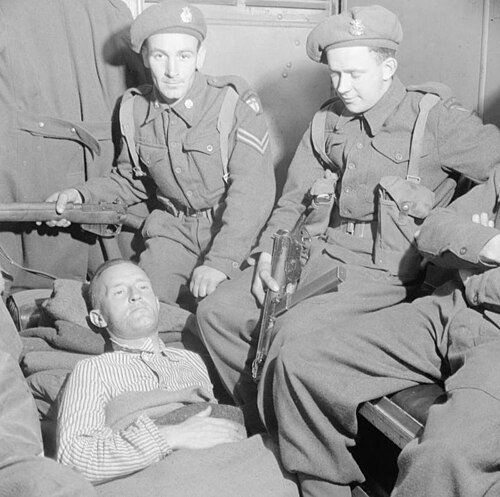
William Joyce in an ambulance after his arrest by British officers near Flensburg, 29 May 1945; he was shot during the arrest. Photo by Bert Hardy, No 5 Army Film and Photographic Unit, Imperial War Museum BU 6911. Public domain (Crown copyright expired).
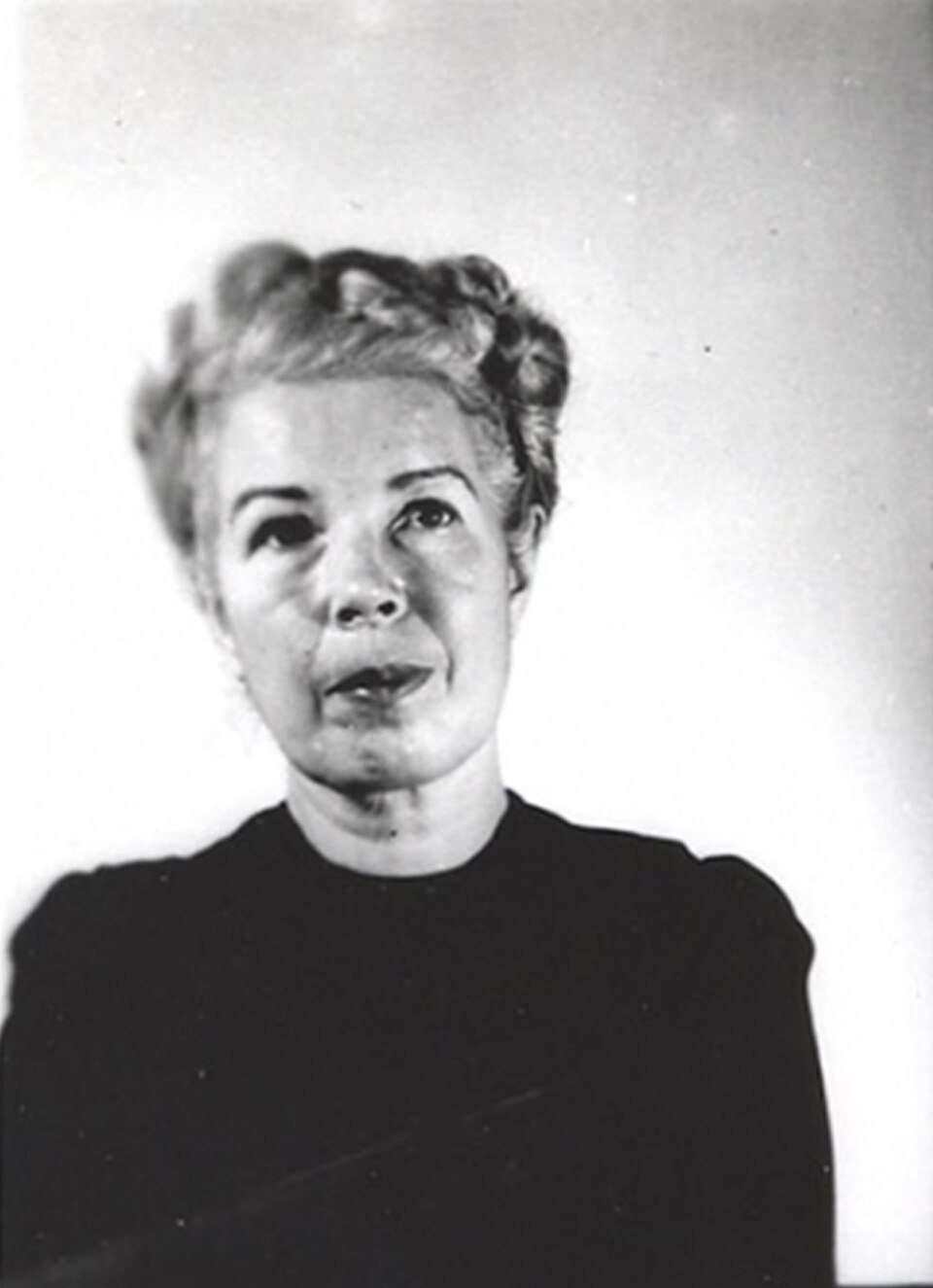
Mildred Gillars, Federal Bureau of Prisons mugshot, 1949. Public domain (U.S. government work).
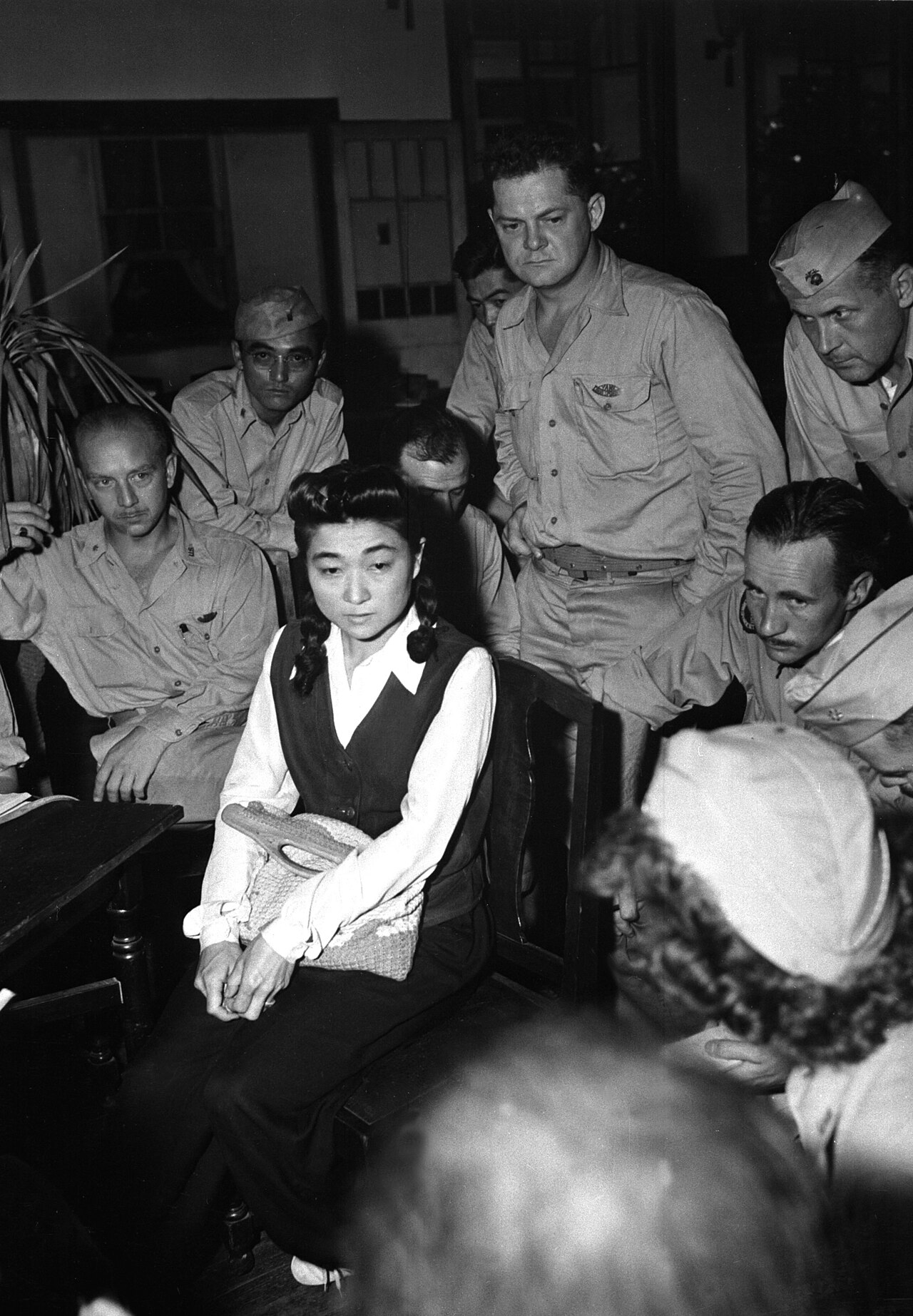
Iva Toguri interviewed by U.S. correspondents in Japan, September 1945, under the label "Tokyo Rose". U.S. Navy photograph, NARA 80-G-490488. Public domain (U.S. government work).
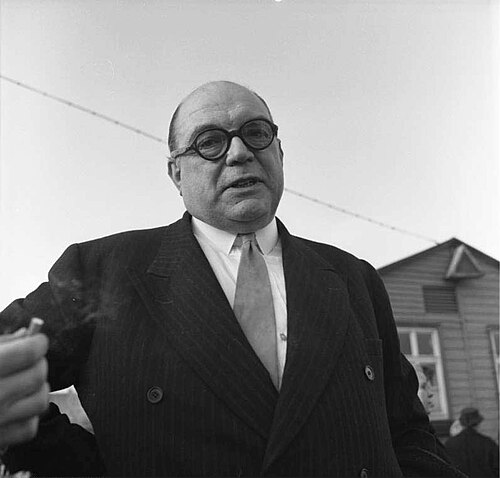
Sefton Delmer, who ran Britain's black radio stations, in 1958, working as a journalist at the Friedland transit camp. Photo by Egon Steiner. Bundesarchiv, B 145 Bild-F005102-0003, CC BY-SA 3.0 DE.
Image gaps
- Photographs of Joyce, Gillars and Toguri. Photographs of Toguri held by the National Archives (identifiers 296677 and 296678) are likely U.S. government works in the public domain. Fillable. British Crown photographs of Joyce may be out of copyright; needs checking.
- Aspidistra transmitter and the Milton Bryan studio. Crown or IWM material; some may be Crown copyright expired. Maybe fillable.
- Audio. Recordings of Zero Hour (NARA catalog 2292471) and Radio 1212 (USHMM) exist; a still or waveform is not a substitute, and FRAME hosts images only. A Wikimedia Commons audio file of Deutscher Freiheitssender 904 exists; licence not checked.
- German Reichsrundfunk material. Rights unclear; not included.
Sources
- Garth S. Jowett and Victoria O'Donnell, Propaganda and Persuasion (SAGE, several editions), chapter 1; summary at Salisbury University Nabb Center.
- Howard Becker, "The Nature and Consequences of Black Propaganda", American Sociological Review 14:2 (1949).
- Imperial War Museums: The rise and fall of Lord Haw-Haw
- The Conversation: Lord Haw-Haw's popularity made the BBC up its game
- British Online Archives: the origins of BBC Listener Research 1936-1950
- Dictionary of Irish Biography: Joyce, William Brooke
- Wikipedia: Jonah Barrington (journalist) (with IWM above)
- House of Lords Library: Treason law reform and the Lord Haw-Haw case 75 years on; Joyce v Director of Public Prosecutions [1946] AC 347.
- Colin Holmes, Searching for Lord Haw-Haw: The Political Lives of William Joyce (Routledge, 2016).
- Graham Smyth, "Nazi 'black' Propaganda to Britain: Secret Radio Stations and British Renegades", Historical Journal of Film, Radio and Television 44:2 (2024), doi:10.1080/01439685.2023.2296215; Warfare History Network: Nazi propagandist William Joyce.
- Britannica: Mildred Gillars; History.com: Gillars pleads not guilty, 24 September 1948; U.S. Army: CIC arrests Axis Sally, 14 March 1946; West Virginia Archives and History: "Axis Sally".
- Richard Lucas, Axis Sally: The American Voice of Nazi Germany (Casemate, 2010).
- U.S. National Archives, Pieces of History: The orphan called Tokyo Rose (2010)
- FBI: Iva Toguri D'Aquino and "Tokyo Rose"; FBI Vault: Tokyo Rose files
- Britannica: Iva Toguri D'Aquino; Densho Encyclopedia: Iva Toguri D'Aquino; National Registry of Exonerations: Iva Toguri D'Aquino
- Masayo Duus, Tokyo Rose: Orphan of the Pacific (Kodansha International, 1979).
- State Library Victoria: Charles Cousens and Iva Toguri; Canberra Times, 7 November 1946: Treason charge against Cousens dropped (Trove)
- Sefton Delmer, Black Boomerang (Secker & Warburg, 1962).
- Ellic Howe, The Black Game: British Subversive Operations against the Germans during the Second World War (Michael Joseph, 1982).
- Peter Pomerantsev, How to Win an Information War: The Propagandist Who Outwitted Hitler (PublicAffairs, 2024); Time, 2024.
- Smithsonian: The fake British radio show that helped defeat the Nazis; Smithsonian: Agnes Bernelle
- U.S. Holocaust Memorial Museum: Operation Annie recording, 10 December 1944; U.S. National Archives catalog: Sound Recordings Relating to World War II Operations (Operation Annie)
- Oxford Polyglot: Broadcasting nations, a history of the BBC German Service; Modernism/modernity: Erika Mann and the BBC German Service
- Dokumentationsarchiv Funk: Deutscher Freiheitssender 904; André Scheer: Roter Schwarzfunk; Wikipedia (de): Deutscher Freiheitssender 904