Content note. This page describes filmed violence against civilians, including the shooting of a child and of a mother, in the Odessa Steps sequence of Battleship Potemkin, and anti-religious imagery in October. They are described as they appear on screen.
In one line: the young Soviet state nationalised film, then commissioned feature films for the 20th anniversary of 1905 and the 10th anniversary of 1917; the directors staged and edited those events for effect, the anniversary film October was recut to remove Trotsky, and photographs of staged re-enactments of the Winter Palace assault later circulated as if they were documentary pictures of 1917.
What happened
- 1918-1919: film on trains. From August 1918 the Soviet government sent "agit-trains", starting with the V.I. Lenin, to the Civil War fronts. Dziga Vertov ran a film car on one of them and edited the first Soviet newsreel, Kino-Nedelya (1918-1919) (Heftberger, INCITE).
- 27 August 1919: nationalisation. A decree signed by Lenin transferred the photographic and cinema trade and industry to the People's Commissariat of Enlightenment (Narkompros). Vance Kepley argues its immediate practical effect has been overstated (Kepley, 1990).
- Lenin's view of cinema. The line usually translated as "of all the arts, for us the most important is cinema" comes from a letter by Anatoly Lunacharsky, the commissar for enlightenment, recalling a private conversation with Lenin. It was first published in G. M. Boltyansky's Lenin i kino (1925): a second-hand recollection, not a text Lenin wrote.
- 1922-1928: state studios. In December 1922 Goskino was given a monopoly over film distribution; Vertov's newsreel Kino-Pravda ran from 1922 to 1925. From 1924 Sovkino took over, including film imports, whose income helped pay for Soviet production (Kenez, 1992).
- The Kuleshov effect. Lev Kuleshov's workshop is said to have shown that one neutral close-up read as hunger, grief or tenderness depending on the shot beside it. The footage is lost; a 1992 replication (Prince and Hensley) found no effect and a 2016 study (Barratt and colleagues) a smaller one. The idea that editing steers meaning became the montage directors' working principle.
- 1925: the commission for 1905. A state jubilee commission for the 20th anniversary of the 1905 revolution commissioned Nina Agadzhanova-Shutko in March 1925 to write The Year 1905, a panorama of the whole year, for Eisenstein to direct. By August the plan was cut to one episode: the June 1905 mutiny on the battleship Prince Potemkin-Tavrichesky (BFI programme notes). Eduard Tisse filmed it; Grigori Aleksandrov was assistant director.
- What the film shows. Sailors refuse maggot-ridden meat, the crew kill officers and take the ship, and the sailor Vakulinchuk's body is laid out on the Odessa quay. In daylight a line of soldiers marches down the Odessa Steps firing into a crowd; a mother is shot and her pram rolls down the steps. The film ends with the Black Sea squadron letting the Potemkin pass. In early prints the flag was hand-coloured red.
- What happened in Odessa in June 1905. On 15 June 1905 (Old Style) thousands gathered in the port; by late afternoon warehouses were looted and harbour buildings set on fire, and around midnight troops fired into the crowd (Weinberg, 1993; History Today). Death toll estimates range from hundreds to about 2,000. Some accounts, including Neal Bascomb's Red Mutiny (2007), describe killings around the steps that night. What the record does not show is the sequence as filmed: a daylight march of soldiers down the whole staircase into a peaceful crowd. That staging is Eisenstein's. The film also ends before the crew surrendered the ship at Constanța, Romania, on 25 June 1905 (Old Style), eleven days after the mutiny.
- 21 December 1925: premiere. The film was first shown at the Bolshoi Theatre at the anniversary meeting and went on general release in January 1926. Kenez reports that it played in two Moscow cinemas for four weeks, while Douglas Fairbanks' Robin Hood ran in eleven for months, and argues that Soviet audiences preferred imported entertainment films (Kenez, 1992).
- 1926: Germany. The Soviet trade mission in Berlin commissioned a score from Edmund Meisel. The censors first banned the film on 24 March 1926; on 10 April they passed it by one vote with 22 cuts. An army order of 15 April 1926 forbade soldiers to see it. It opened in Berlin on 29 April and was a popular and critical success; approval was withdrawn in July 1926 at the request of four state governments (Bulgakowa, Weimar Cinema dossier).
- 1926-1954: Britain. The British Board of Film Censors rejected the film on 30 September 1926 for "inflammatory subtitles and Bolshevist propaganda". The Film Society, a private members' club, showed it in London on 10 November 1929 at the Tivoli Palace, on the programme that premiered John Grierson's Drifters; Eisenstein attended. The film was passed with an X certificate in 1954.
- 1933-1934: Goebbels. On 28 March 1933 Joseph Goebbels, the new propaganda minister, told film makers at the Hotel Kaiserhof in Berlin that Potemkin was "fabelhaft gemacht" ("superbly made") and "filmische Kunst ohnegleichen" ("cinematic art without equal"), adding: "Wer weltanschaulich nicht fest ist, könnte durch diesen Film zum Bolschewisten werden" ("anyone without firm convictions could become a Bolshevik through this film") (filmportal.de). In a February 1934 speech at the Kroll Opera he asked for a National Socialist Potemkin. Eisenstein replied in an open letter in Literaturnaya gazeta on 9 March 1934 rejecting the idea of a National Socialist art (Bulgakowa).
- 1927: the commission for 1917. Sovkino commissioned October for the tenth anniversary of the Bolshevik seizure of power, directed by Eisenstein and Aleksandrov, partly filmed in the Winter Palace. A worker, Vasily Nikandrov, played Lenin. Sequences are built on symbols: a tsar's statue reassembled in reverse, Kerensky intercut with a mechanical peacock and Napoleon statuettes, and a chain of religious images ending in wooden idols.
- 7 November 1927: the Trotsky cut. An unfinished version was shown at the Bolshoi on the anniversary. The same day, after opposition demonstrations in Moscow and Leningrad, Eisenstein was directed to cut the scenes featuring Leon Trotsky, who was expelled from the party that month. Aleksandrov recalled in his memoir that Stalin came to the editing room himself; this rests on his account. The recut film was released in early 1928. In March 1928 a party conference on cinema criticised montage films as hard for mass audiences to follow. Abroad it was titled Ten Days That Shook the World, after John Reed's 1919 book.
- What happened at the Winter Palace in 1917. On the night of 25-26 October 1917 (Old Style), the palace's few hundred defenders, many of whom left or surrendered, offered little resistance. Accounts agree the assault cost few lives (Rabinowitch, 1976; Figes, 1996). October shows a mass armed assault with crowds pouring through the gates and up the staircases.
- November 1920: the first re-enactment. For the third anniversary, Nikolai Evreinov staged The Storming of the Winter Palace on Palace Square, with sets by Yuri Annenkov. Participant counts range from about 2,500 to 10,000; spectators are usually put at about 100,000. It was filmed and photographed.
- From 1922: re-enactment pictures as documents. No photographs of the 1917 night assault are known. One photograph of the 1920 performance, retouched, was reproduced from 1922 on in Soviet and foreign publications, including the press and school textbooks, as an image of 1917 (Arns, Chubarov and Sasse, The Storming of the Winter Palace: Forensics of an Image, 2017-2018). Stills from October's storming have been reported in the same use, including in Soviet museums of the revolution (Artforum); how widely is not quantified.
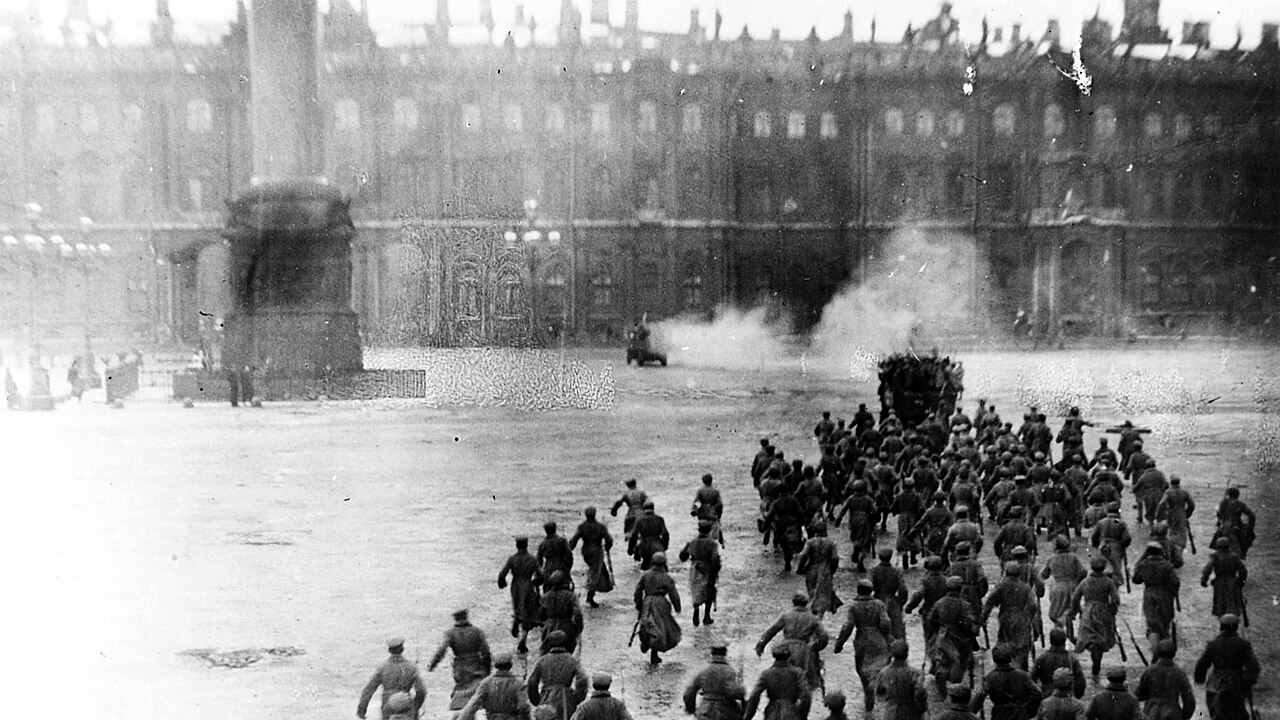
Photograph of the November 1920 mass re-enactment The Storming of the Winter Palace, Palace Square, Petrograd, staged by Nikolai Evreinov; this retouched version, with spectators and the director's tower removed, was reproduced from 1922 as an image of 1917. Photographer unknown. Public domain (published before 1931), via Wikimedia Commons.
How it works
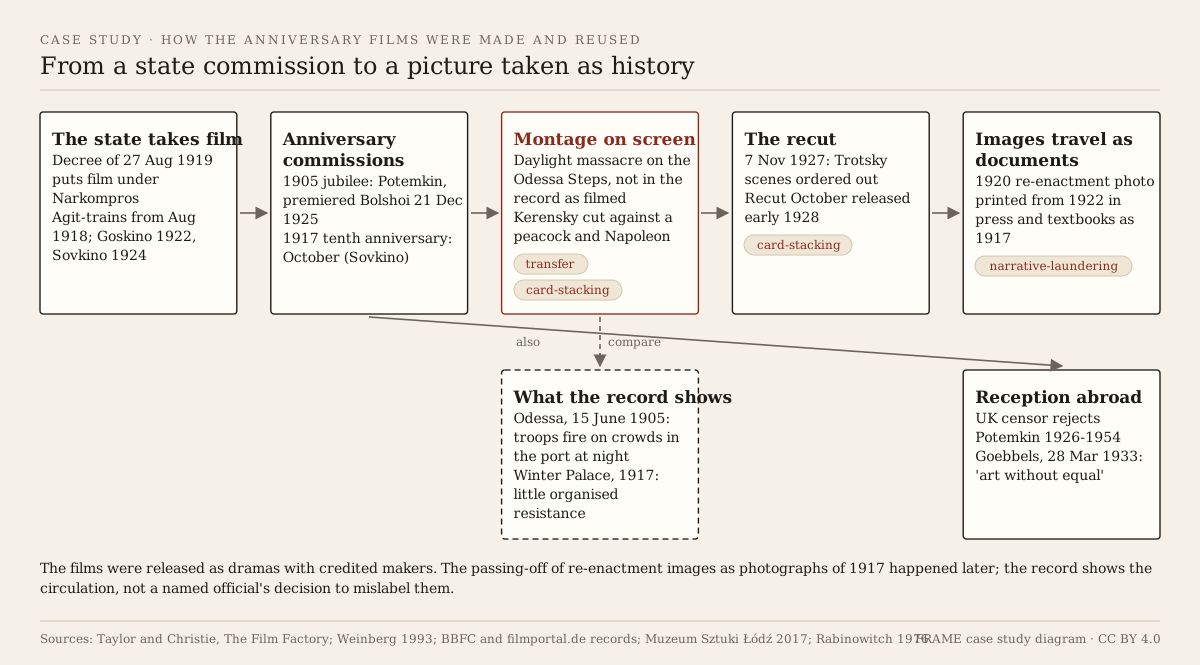
- Card stacking: Potemkin selects the mutiny's high points and ends on the squadron letting the ship pass, leaving out its surrender in Romania eleven days later, so the episode reads as a victory. October's recut removed Trotsky, who chaired the Petrograd Soviet in October 1917 and was a leading figure in its Military Revolutionary Committee, from the tenth-anniversary account of the seizure of power. The edit was ordered after the film was made, on the day of opposition demonstrations, and took out of the anniversary account a leader whose part in October 1917 is documented.
- Transfer: October pastes stigma onto figures by cutting them against symbols: Kerensky beside a mechanical peacock and Napoleon statuettes, General Kornilov's appeal to "God and Country" beside a chain of religious images that ends in wooden idols. In Potemkin a hand-coloured red flag, the only colour in the film, carries the prestige of the revolutionary banner onto the mutineers. The images make the case the intertitles do not argue.
- Narrative laundering: this tag applies to what happened to the images after the films, not to the films themselves, which were released as dramas with credited directors and actors. Photographs of the 1920 state re-enactment, and reportedly stills from October, were reproduced in press and textbooks as pictures of 1917. A staged state commemoration passed through the more trusted surface of the documentary photograph, and its origin became hard to see. The record shows the circulation; it does not show a documented decision by a named official to mislabel the images.
- Considered and not tagged. Scapegoating and Name-calling were weighed for the films' portrayal of officers, Cossacks and troops. They are not tagged: tsarist troops did fire on crowds in Odessa in 1905, so attributing the violence to them is not blame parked on the wrong group, and this page could not verify loaded labels in the intertitles precisely enough to quote them.
Then and now
The closest documented parallel comes from Britain, the country that banned Potemkin. The Battle of the Somme (1916) was shot by the official cinematographers Geoffrey Malins and John McDowell and released with War Office sanction. The Imperial War Museum reports that it was seen by about 20 million people in Britain in its first six weeks. Most of its footage is genuine, but one sequence, in which soldiers climb out of a trench and cross wire, some falling as if hit, was staged behind the lines for the camera. Roger Smither of the IWM's film department concluded in a 1993 study that most of the film is genuine and that this sequence was faked (Smither, 1993). Frames from it have since been widely reproduced as pictures of the attack of 1 July 1916.
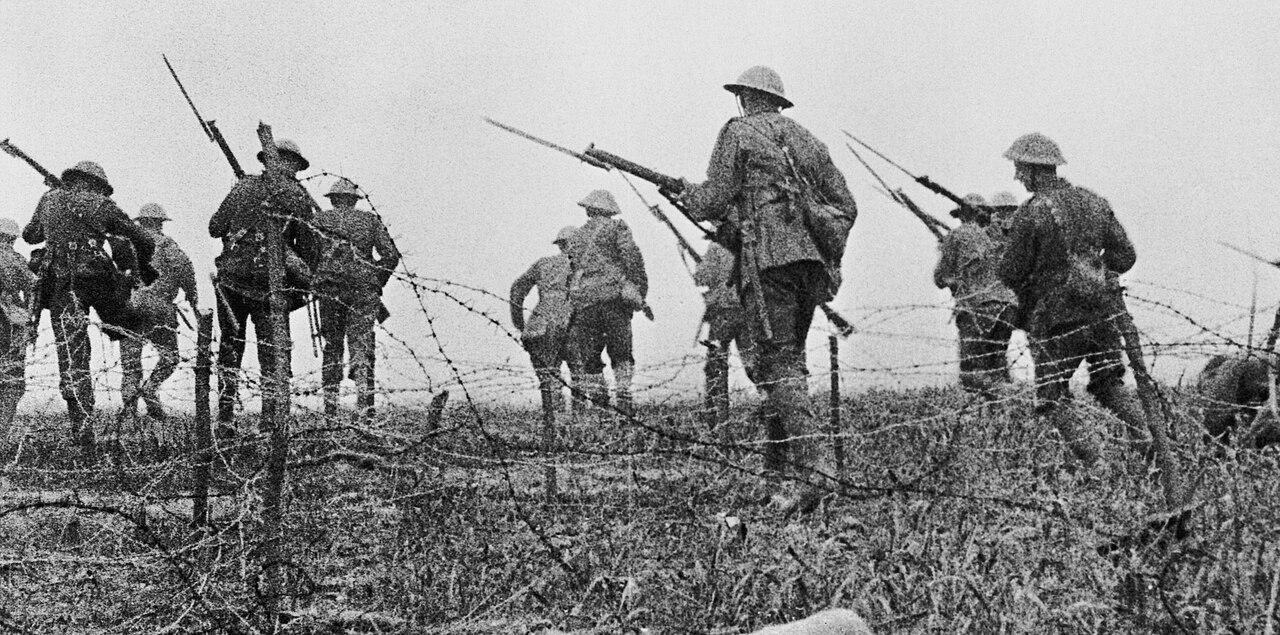
Still from The Battle of the Somme (1916, Geoffrey Malins and John McDowell) showing the sequence of a staged attack, thought to have been filmed behind the lines before 1 July 1916, possibly at a trench mortar school. Imperial War Museums (Q 70168). Public domain (UK Crown copyright expired; published 1916), via Wikimedia Commons.
The differences are plain. The Battle of the Somme was presented as actuality, so the staged sequence was passed off inside the film itself. Potemkin and October were presented as dramatised features; the passing-off happened later, when re-enactment photographs and stills were detached and used as documents. The British staging was a single short sequence in a film of largely real footage; the Soviet films were dramas that restaged whole events on a large scale. Both were made for governments, and in both cases the staged picture outlived the knowledge that it was staged.
Positions on the record
- The makers' stated purpose. Eisenstein described his method, in the 1923 essay "The Montage of Attractions", as subjecting the spectator to calculated emotional shocks, and treated the commissions as political work for the revolution (Taylor and Christie). The anniversary commissions stated their purpose as commemoration of 1905 and 1917.
- Censors and critics at the time. The British censor rejected Potemkin as Bolshevist propaganda likely to inflame; German military authorities barred soldiers from it. Goebbels praised its method while warning of its politics. Inside the USSR, the 1928 party conference criticised the montage films as too difficult for mass audiences, and the party ordered the October recut that removed Trotsky.
- Later historians. Film historians such as Richard Taylor and Peter Kenez treat both films as state commissions and as works that shaped how 1905 and 1917 are pictured. Robert Rosenstone examines October as a work of history on film (Rosenstone, 2025).
- What is documented: the commissions, the studios, the premiere dates, the British and German censorship decisions, Goebbels' 1933 remarks, the Trotsky cut and its date, shootings in Odessa's port on the night of 15 June 1905, the small scale of the 1917 assault, and the reproduction of 1920 re-enactment photographs as images of 1917.
- What is not shown or is disputed: a daylight massacre on the staircase as filmed; exact 1905 death figures; Stalin's personal presence in the editing room (Aleksandrov's recollection only); the often-repeated claim that more people were hurt filming October than in the 1917 assault, which rests on no cited casualty record; and how widely October stills themselves were used as documents.
Same-method test
If a U.S. or British state-sponsored film restaged a real massacre in a place and form where it did not happen, cut a leader who had fallen from favour out of an anniversary history, and saw stills of its re-enactment printed in textbooks as photographs of the event, it would be tagged the same way here. The Battle of the Somme above is scored by the same definitions.
How to spot it
- Ask whether a picture of a famous historical moment is a photograph of the event, a frame from a later film, or a photograph of a re-enactment. Captions often drop the difference.
- For events before about 1930, check whether any camera is known to have been present. If no photograph of the moment is known, a crisp, well-composed "photo" of it needs a source.
- Compare anniversary films with the dated record: who is missing from the version shown, and when was it last edited?
- Watch the cuts, not only the shots: when a person is repeatedly placed next to a symbol, the symbol is making the argument.
- Separate what a film is (a drama, credited as one) from how its images travel later (as documents).
Images
| Image | Source | Licence |
|---|---|---|
| Mechanism diagram (above) | Drawn for FRAME from the page's sourced facts (make_diagrams.py) |
CC BY 4.0, FRAME |
| Retouched photograph of the 1920 Winter Palace re-enactment, Petrograd | Wikimedia Commons | Public domain (published before 1931; photographer unknown) |
| Still from The Battle of the Somme (1916): staged attack | Wikimedia Commons, Imperial War Museums Q 70168 | Public domain (UK Crown copyright expired) |
| Still from Battleship Potemkin (1925): a woman shot in the eye on the Odessa Steps | Wikimedia Commons | Public domain (U.S.: published 1925) |


Stills
Content note: Film still showing a graphic wound. This object is shown as it was published. Why 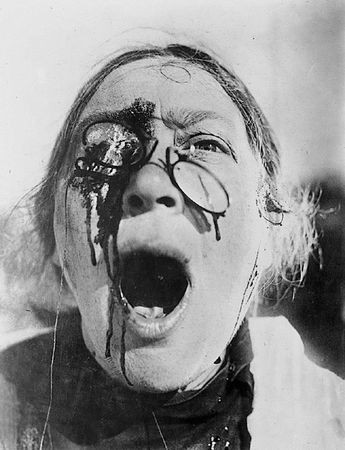
Still from the Odessa Steps sequence of Battleship Potemkin (1925), actress N. Poltavseva. The massacre on the steps is the film's staging; the record shows shootings in the port that night, not this daylight sequence. Public domain in the U.S. (published 1925). Content note: shows a graphic wound.
Image gaps
- Frames from the October storming. An Odessa Steps still from Battleship Potemkin is now hosted above (public domain in the U.S., published 1925). October (1927) frames still need a licence check against Wikimedia Commons' notes, since Eisenstein died in 1948 and terms differ by country. Probably fillable.
- The BBFC rejection record and Goebbels' speech text. Not openly licensed as images; quoted from filmportal.de and BBFC records instead.
Sources
- Richard Taylor and Ian Christie (eds), The Film Factory: Russian and Soviet Cinema in Documents, 1896-1939 (Routledge, 1988), including Lunacharsky's recollection of Lenin, first published in G. M. Boltyansky (ed.), Lenin i kino (Moscow/Leningrad, 1925).
- Richard Taylor, Film Propaganda: Soviet Russia and Nazi Germany (Croom Helm, 1979; 2nd ed. I.B. Tauris, 1998); Richard Taylor, October (BFI Film Classics, 2002); Richard Taylor, The Battleship Potemkin: The Film Companion (I.B. Tauris, 2000).
- Peter Kenez, Cinema and Soviet Society, 1917-1953 (Cambridge University Press, 1992).
- Vance Kepley Jr, "Soviet Cinema and State Control: Lenin's Nationalization Decree Reconsidered", Journal of Film and Video, 1990 (ERIC record)
- Adelheid Heftberger, "Soviet Agit-Trains from the Vertov Collection of the Austrian Film Museum", INCITE
- "Propaganda in Motion: Dziga Vertov's and Aleksandr Medvedkin's Film Trains and Agit Steamers of the 1920s and 1930s", Apparatus
- Daniel Barratt et al., "Does the Kuleshov Effect Really Exist?", Perception, 2016; Stephen Prince and Wayne E. Hensley, "The Kuleshov Effect: Recreating the Classic Experiment", Cinema Journal 31(2), 1992.
- BFI Southbank programme notes, Battleship Potemkin; BFI film page; BFI, The Soviet Influence (Potemkin and Drifters); University of Stirling Archives, "Battleships and Drifters" (Film Society screening, 10 November 1929)
- Robert Weinberg, The Revolution of 1905 in Odessa: Blood on the Steps (Indiana University Press, 1993); review, Project MUSE
- Neal Bascomb, Red Mutiny: Eleven Fateful Days on the Battleship Potemkin (Houghton Mifflin, 2007).
- "The Mutiny on the Potemkin", History Today
- Ambassador George von L. Meyer to the Secretary of State, on the Odessa troubles and the Potemkin mutiny, Foreign Relations of the United States, 1905, doc. 794
- Oksana Bulgakowa (curator), "Eisenstein's Potemkin in Berlin 1926", Weimar Cinema film dossier
- NCAC Censorpedia, The Battleship Potemkin (BBFC rejection of 30 September 1926 and 1954 X certificate); BBFC-rejected works list, Wikipedia
- filmportal.de (Deutsches Filminstitut), "Die Goebbels-Rede im Kaiserhof am 28.3.1933"
- Harvard Film Archive, October; Britannica, October; "'October' Surprise: The Revolution Will Be Edited", CineMontage
- "Montage 'October': Dialectic of the Shot", Artforum
- Robert A. Rosenstone, "Eisenstein's October as History", Film & History 55(1), 2025
- Alexander Rabinowitch, The Bolsheviks Come to Power (W. W. Norton, 1976); Orlando Figes, A People's Tragedy: The Russian Revolution 1891-1924 (Jonathan Cape, 1996); Figes, "The Storming of the Winter Palace"
- Monoskop, "Sovkino"
- Seventeen Moments in Soviet History: "Taking of the Winter Palace" (1917 text) and "Taking of the Winter Palace Re-enacted"
- Stanford CREEES, "The Storming of the Winter Palace: the 1920 Reenactment, Caught on Film"
- Inke Arns, Igor Chubarov and Sylvia Sasse (curators), The Storming of the Winter Palace: Forensics of an Image, exhibition shown at Gessnerallee Zurich (2017), HMKV Dortmund (2017-2018) and Muzeum Sztuki, Łódź (2018); Sylvia Sasse, "Retouch = Attack", Das Magazin 28, Kulturstiftung des Bundes
- Imperial War Museums, "Making of the Battle of the Somme film"; Roger Smither, "'A wonderful idea of the fighting': the question of fakes in The Battle of the Somme", Historical Journal of Film, Radio and Television 13(2), 1993, pp. 149-168.