In one line: Britain's wartime information ministry made short films for home cinemas and village halls, and in autumn 1940 sent a Blitz film to neutral America voiced by an American reporter who told viewers "I am a neutral reporter". A 2010 magazine history reports that his was the only name on the American opening credits.
What happened
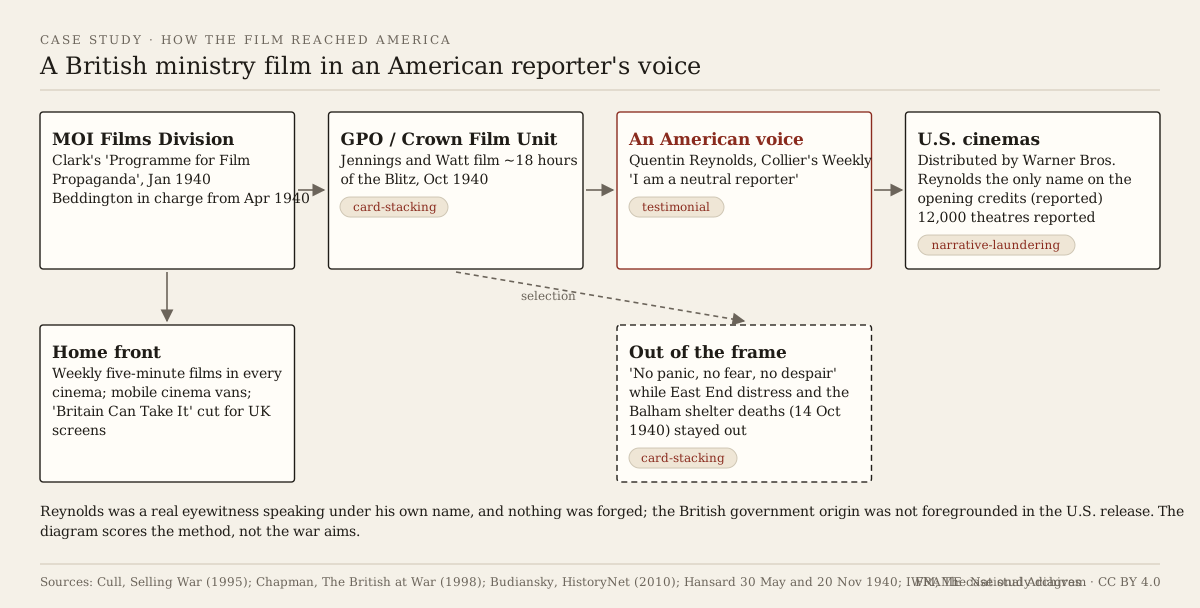
- September 1939. Britain sets up a Ministry of Information (MOI) on the outbreak of war. Its Films Division is responsible for official film. The GPO Film Unit, the Post Office's documentary unit founded in 1933, becomes part of the MOI in 1940 and is renamed the Crown Film Unit (Chapman, 1998).
- January 1940. The plan. Kenneth Clark, director of the National Gallery, heads the Films Division. He consults film-makers and writers and issues a paper, Programme for Film Propaganda (C.C. Paper no. 1, January 1940; The National Archives, INF 1/867). It sets three themes for official film: what Britain is fighting for, how Britain fights, and the sacrifices needed to win (The National Archives, Focus on Film notes). In April 1940 Clark moves to Controller of Home Publicity and Jack Beddington, the former publicity head of Shell-Mex and BP, takes over the Films Division.
- 30 May 1940. Harold Nicolson, the MOI's parliamentary secretary, tells the Commons the ministry had commissioned 60 films before the recent intensification of hostilities, and that some were inappropriate to the present crisis and had been temporarily abandoned (Hansard).
- Summer 1940 onward. Five-minute films. Under an agreement with the Cinematograph Exhibitors' Association, one MOI film of about five minutes is shown in every cinema programme each week. The Minister of Information tells the Commons on 20 November 1940 that the agreement has been satisfactorily carried out (Hansard). The weekly scheme runs until 1942. One example is Miss Grant Goes to the Door (released 5 August 1940, seven minutes, directed by Brian Desmond Hurst), a drama in which two sisters in a country cottage find that a dying man in uniform is a German parachutist, and take his revolver. It was made to show people keeping their heads during an invasion (IWM catalogue).
- June 1940 onward. Films without cinemas. The Films Division expands the 16mm mobile units it took over from the GPO into a "non-theatrical" service. Vans carrying films, screen and projector give shows in village halls, factories and schools (Helen Forman, who was second in charge of the Films Division's non-theatrical distribution section, describes the service in Pronay and Spring, 1982).
- Audience research. Mass-Observation, the social-research group founded in 1937 by Tom Harrisson, Charles Madge and Humphrey Jennings, studies how cinema audiences respond to official films. Harrisson's November 1940 article Social Research and the Film is one result. The MOI's Home Intelligence division also collects weekly reports on public mood (The National Archives, Home Intelligence reports).
- 7 September 1940. Sustained German night bombing of London begins.
- October 1940. London Can Take It! Humphrey Jennings and Harry Watt of the GPO Film Unit make a film of roughly ten minutes showing about eighteen hours of the Blitz in London, from dusk to the next morning. It is made for the MOI and aimed at American audiences (IWM). The narration is spoken by Quentin Reynolds, London correspondent of the American magazine Collier's Weekly. The narration has him say: "I am a neutral reporter. I have watched the people of London live, and die, ever since death in its most ghastly garb began to come here as a nightly visitor five weeks ago." Later he says: "I can assure you there is no panic, no fear, no despair in London town" (the film; IWM).
- How it was presented in America. Warner Bros. distributes the film across the United States. According to Stephen Budiansky's history of the British campaign (World War II magazine, 2010), Reynolds's was the only name on the opening credits of the American release, and his narration was recorded at London's Savoy Hotel. FRAME has not checked either detail against a surviving American print. Harry Watt later recalled: "All America imagined that this was an unbiased, personal report made by one of their own people" (as quoted in secondary accounts including The Space Between; the original is believed to be Watt's memoir Don't Look at the Camera, 1974, which was not checked for this page).
- Reach and reception. Secondary accounts report that within a couple of months the film had been shown in 12,000 American theatres to an audience estimated at 60 million (reported by The Space Between; FRAME has not checked these figures against Warner or MOI records). Budiansky reports that it also made money. Nicholas Cull, in Selling War (1995), treats the film's American success as a turning point for British film propaganda in the United States. It is nominated for the 1941 Academy Award for best one-reel short subject. A shorter version, Britain Can Take It, with an on-screen introduction by Reynolds, is released in British cinemas (IWM catalogue).
- The wider British effort in America. Separately, the Secret Intelligence Service sets up what becomes British Security Coordination (BSC) in New York in 1940 under William Stephenson, who arrives there in June. Its own history, written in 1945 and published in 1998, describes secretly supporting pro-British, pro-intervention groups in the United States. The sources used for this page do not link BSC to the making or distribution of London Can Take It!, which went through Warner Bros.
- 1942. Listen to Britain. Humphrey Jennings and editor Stewart McAllister make a short for the Crown Film Unit, produced by Ian Dalrymple. It has no narration: sounds and music carry it, from dance halls and factory canteens to a lunchtime concert at the National Gallery where Myra Hess plays Mozart's Piano Concerto K. 453 with Queen Elizabeth in the audience (BFI).
- Afterwards. Jennings goes on to make Fires Were Started (1943) and A Diary for Timothy (1945) and dies in a fall in Greece in 1950. Watt makes Target for Tonight (1941) for the Crown Film Unit. When the MOI closes in 1946, the Crown Film Unit passes to the Central Office of Information, which closes it in 1952 (The National Archives).
How it works
- Testimonial: the film's warrant is a named person. Reynolds is not only a narrator; the narration has him vouch for his own neutrality ("I am a neutral reporter") while voicing a film shot and edited by a British government film unit for a British ministry. This page tags the neutrality vouch, not his description of the raids. Reynolds did live in London through the raids and was an eyewitness, which is the technique's "not" case. The tag rests on the difference between what he saw and the claim that the film was a neutral report.
- Narrative laundering: a government message reaches its audience through a surface that looks more independent. For American viewers the surface was an American magazine correspondent, with, as Budiansky reports, his name alone on the opening credits of the release, and Watt later recalled that viewers took it as "one of their own people" reporting. The limits matter and are stated here: nothing was forged, Reynolds was a real reporter speaking under his own name, and the film was not presented through an invented front body. The government origin was left off the credits and out of the narration, but no author was invented. How many viewers knew it came from the British government is not shown.
- Card stacking: the film makes an absolute claim ("no panic, no fear, no despair") and supports it only with images of calm. In the same weeks, Mass-Observation recorded distress and anger in parts of the East End after the first raids (Harrisson, Living Through the Blitz, 1976), and on 14 October 1940 a bomb killed at least 64 people sheltering at Balham Underground station (the Commonwealth War Graves Commission records 66), an event kept largely out of the news at the time. Later, security grounds were given for withholding the inquiry report on the March 1943 Bethnal Green shelter crush (173 dead) until January 1945 (Hansard, 19 January 1945; The National Archives). The film's selection leaves one reading. Angus Calder (The Myth of the Blitz, 1991) argues that the picture of uniform calm was partly built by this kind of selection. Harrisson's and Calder's own accounts also record calm and endurance in many places, so the film's picture is not false as a whole; this page tags the selection, not the underlying question of how Londoners felt.
Tested and not tagged: Plain folks (Reynolds speaks as himself, and the Londoners shown are ordinary people, not performers of ordinariness); Glittering generalities (the films rely on pictures and sound, not virtue words); Fear appeal for Miss Grant Goes to the Door (the evidence gathered here does not show enough of its prescribed remedy); Transfer for Listen to Britain (it makes no argument for its imagery to stand in for).
Then and now
Sixty-five years later a different government addressed a foreign public through voices that looked local. On 30 November 2005 the Los Angeles Times (Mark Mazzetti and Borzou Daragahi) reported that U.S. military information-operations staff in Baghdad were writing articles that were translated into Arabic and placed in Iraqi newspapers, with the Lincoln Group, a Washington-based contractor, arranging and paying for the placements. The paper reported that the articles appeared as ordinary news or opinion pieces and did not tell readers that the U.S. military had written or paid for them. The reports led to a Pentagon review of the practice.
The differences are large and are stated plainly. London Can Take It! was one ten-minute film, voiced by a real American reporter under his own name, who was an eyewitness to what he described; its British government origin was not foregrounded, but no author was invented. The Iraqi newspaper pieces, as reported, were written by military staff and ran without any sign of their author or sponsor, and money went to the outlets that printed them. The settings also differed: Britain was at war and seeking help from a neutral democracy, while U.S. forces, present since the 2003 invasion, were fighting in Iraq, the country whose public the articles addressed. The shared method is narrower: a government speaking to another country's public through a voice that public would read as closer to its own.
Positions on the record
- The makers' stated purpose. Clark's January 1940 programme set film the task of explaining what Britain was fighting for, how it fought and what sacrifices were needed. Watt's own recollection is that London Can Take It! worked because Americans took it as a personal report.
- Critics and later historians. Cull (1995) places the film inside a wider British campaign to move American opinion away from neutrality and treats it as one of the campaign's main successes. Chapman (1998) argues that the MOI's film effort was more coherent than its early critics said. Calder (1991) argues that official and documentary images of the Blitz helped build a durable picture of unbroken calm that the Home Intelligence and Mass-Observation records complicate.
- What is documented: the MOI structure, the Clark programme, the five-minute scheme and its parliamentary record, the mobile-van service, the film's makers, narrator and American distributor, its narration lines and its Academy Award nomination.
- What is not shown: what share of American viewers knew the film was a British government production; the exact wording of every credit on every American print; the audience figures from primary distribution records; and any causal link from the film to later changes in U.S. policy such as Lend-Lease (March 1941).
Same-method test
If a German or Soviet ministry had, in 1940, sent American cinemas a film of its own cities under attack, voiced by an American correspondent who told viewers "I am a neutral reporter" and whose name alone appeared on the opening credits, this page would tag it the same way: testimonial for the neutrality vouch, narrative-laundering for the government origin carried by a local-looking voice, and card-stacking if it asserted "no panic" while comparable events were kept out of the news. The finding depends on the method, not on which side made the film or which side history favours.
How to spot it
- When a narrator says "I am neutral", check who commissioned, shot and paid for the piece. That is a separate question from who speaks.
- Look at the credits of the version you are actually watching. Domestic and export cuts of the same film can credit different people.
- Treat absolute claims ("no panic", "everyone", "nobody") as a prompt to look for the counter-evidence of the same weeks: diaries, social surveys, official morale reports, casualty records.
- Separate an eyewitness's description of what they saw from the framing laid over it. Both can be true of the same film.
Images
| Image | Source | Licence |
|---|---|---|
| Mechanism diagram (above) | Drawn for FRAME from the page's sourced facts (make_diagrams.py) |
CC BY 4.0, FRAME |
| Frame from Britain Can Take It (1940): a bus thrown against a bombed building | Wikimedia Commons | Public domain (Crown copyright expired) |
| Humphrey Jennings directing a Crown Film Unit shot in Westminster Abbey, 1941 | Wikimedia Commons | Public domain (Crown copyright expired) |
_COI944.jpg)

Stills
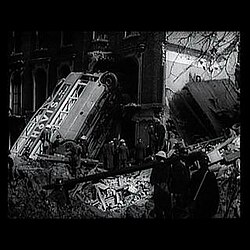
Frame from Britain Can Take It (GPO Film Unit, November 1940), the version of London Can Take It! catalogued by the Imperial War Museum as COI 944, narrated by Quentin Reynolds. Public domain (Crown copyright expired).
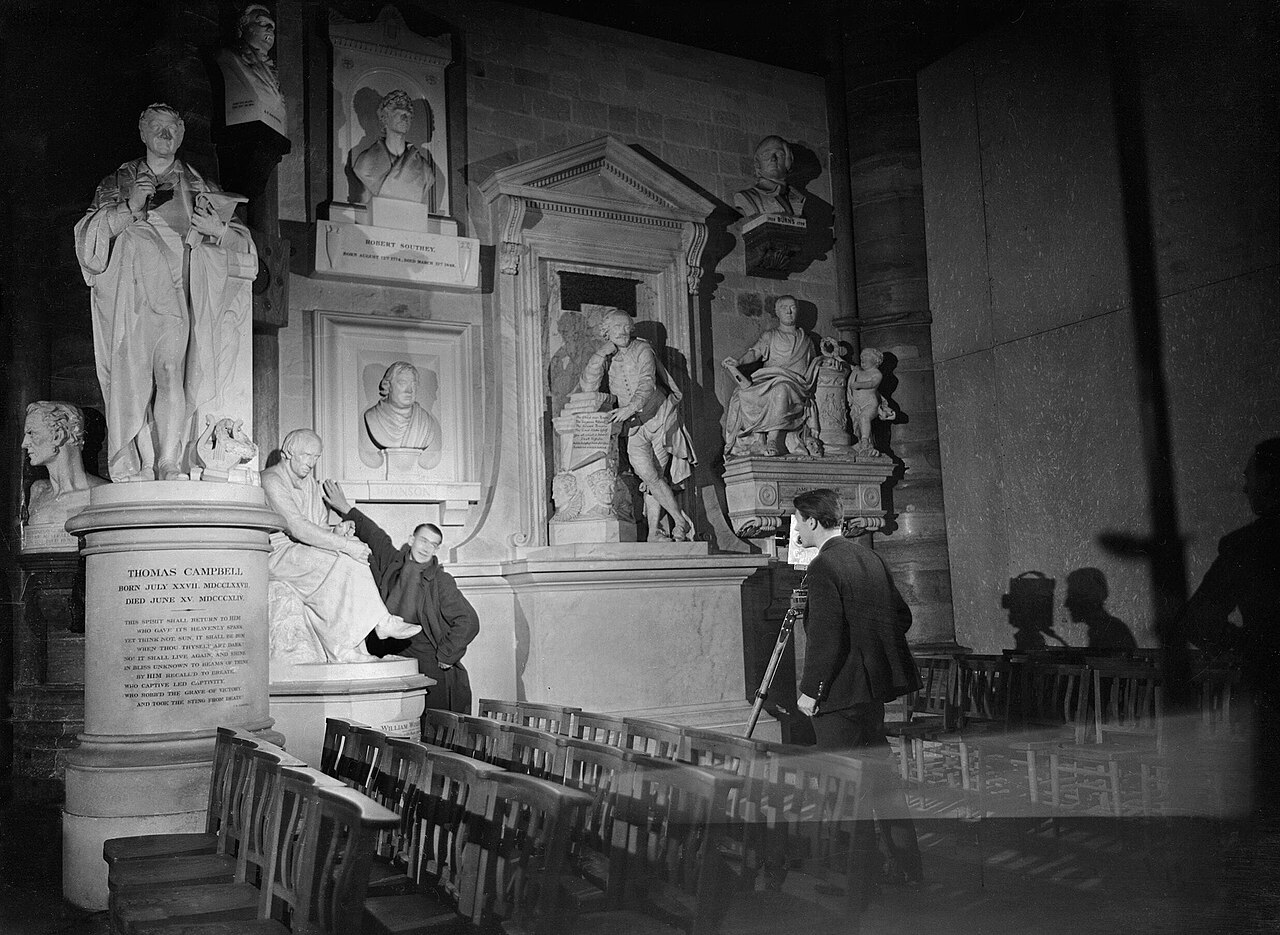
Humphrey Jennings (left) suggests a shot to Crown Film Unit camera operator Chick Fowle in Poets' Corner, Westminster Abbey, January 1941. Ministry of Information photograph, Imperial War Museum D 1861. Public domain (Crown copyright expired).
Image gaps
- Frames from London Can Take It!, Britain Can Take It, Listen to Britain and Miss Grant Goes to the Door. These are Crown copyright films. Crown copyright in a published work lasts 50 years from the end of the year of publication (Copyright, Designs and Patents Act 1988, s. 163), so these 1940-1942 films are public domain in the UK. Their U.S. status was not checked for this page. The IWM and BFI hold copies, but neither site could be reached from the build environment. This gap can be filled: the opening credit of the American release, with Reynolds's name, is the most useful still to add.
- Clark's Programme for Film Propaganda (INF 1/867). Crown copyright, expired; no digitised copy was reachable. Fillable from The National Archives.
- A mobile cinema van. The IWM holds a 1940 MOI film on the mobile units (Crown copyright, expired); not reachable from the build environment. Fillable.
Sources
- London Can Take It! (GPO Film Unit for the Ministry of Information, 1940): IWM catalogue; BFI Player; Britain Can Take It: IWM catalogue.
- IWM, "This propaganda film shows what it was like to live in London during the Blitz"
- Listen to Britain (Crown Film Unit, 1942): BFI catalogue entry.
- Miss Grant Goes to the Door (Ministry of Information, 1940, dir. Brian Desmond Hurst): IWM catalogue entry.
- Hansard, House of Commons, 30 May 1940, "Propaganda Films" and 20 November 1940, "Propaganda Films"; 19 January 1945, "Shelter Accident, Bethnal Green".
- The National Archives, Focus on Film notes; Home Intelligence weekly reports (Ministry of Information records); Bringing the Bethnal Green disaster to light.
- Kenneth Clark, Programme for Film Propaganda (C.C. Paper no. 1), January 1940, The National Archives, INF 1/867.
- Helen Forman, "The non-theatrical distribution of films by the Ministry of Information", in Nicholas Pronay and D. W. Spring (eds), Propaganda, Politics and Film, 1918-45 (Macmillan, 1982). Springer
- Tom Harrisson, Social Research and the Film, November 1940; Tom Harrisson, Living Through the Blitz (Collins, 1976).
- Nicholas John Cull, Selling War: The British Propaganda Campaign Against American "Neutrality" in World War II (Oxford University Press, 1995). OUP
- James Chapman, The British at War: Cinema, State and Propaganda, 1939-1945 (I.B. Tauris, 1998).
- Anthony Aldgate and Jeffrey Richards, Britain Can Take It: The British Cinema in the Second World War (Blackwell, 1986; 2nd edn Edinburgh University Press, 1994).
- Angus Calder, The Myth of the Blitz (Jonathan Cape, 1991).
- Stephen Budiansky, "Britain's Propaganda War on America", World War II magazine, May/June 2010; republished by HistoryNet.
- "London Can Take It!", The Space Between: Literature and Culture 1914-1945, University of Southern California (Scalar).
- Balham, 14 October 1940: "The Balham Tube Station Disaster" (local history account giving published death counts of 64 to 68 and the Commonwealth War Graves Commission figure of 66).
- British Security Coordination: The Secret History of British Intelligence in the Americas, 1940-45 (compiled 1945 under William Stephenson; St Ermin's Press, 1998); Thomas E. Mahl, Desperate Deception: British Covert Operations in the United States, 1939-44 (Brassey's, 1998).
- Mark Mazzetti and Borzou Daragahi, "U.S. Military Covertly Pays to Run Stories in Iraqi Press", Los Angeles Times, 30 November 2005.
- Copyright, Designs and Patents Act 1988, s. 163 (Crown copyright)
- Follow-up reporting on the Iraqi press placements: Spokesman-Review (Los Angeles Times wire), 18 December 2005: "Pentagon knew of planted Iraq news"; NPR transcript.