
Content note. This page quotes Stalin's own words as published, including calls to exterminate German soldiers, to shoot panicking soldiers, to liquidate kulaks as a class and to destroy "wreckers". They are quoted as evidence of what was said and ordered, and several are shown beside the posters of the same years. Showing a quotation or a poster is not endorsing it, and nothing here is a verdict on any people or party.
Are these Stalin quotes real?
Every quotation below is in the archive's Stalin file and has status "verified": the wording was checked against a published source, with date, place and translator recorded. A famous line that no source could be found for is not quoted as his, and the five such lines the file rejects, including "one death is a tragedy, a million is a statistic", are listed below. Quotes data: Quotes README.
What did the archive check, and how?
The archive's Stalin quotes data lists 25 quotations and 5 rejected claims (counts made from that file). Of the 25, 22 have status "verified" and 3 "verified-secondary", meaning an English text was only read in an editor's excerpt or the English edition is not named. The three are not reproduced here. Where the Russian original is in the file, the English wording below is the one the record names, and several English renderings differ from each other (see the notes under the individual lines). The archive applies one rule to every person file: a line is quoted only when a source can be named. The rules and the other people files are in the Quotes README.
Did Stalin say "one death is a tragedy, a million is a statistic"?
The archive does not publish it as his. Its entry reads: no citation to a Stalin speech, letter, interview or contemporaneous record was located, and the attribution appears only in later secondary and popular sources. The file's reason code is "unverifiable". That is a finding about the source trail, not a claim that he could not have said it. Four other well-known lines get the same treatment:
Explain moreShow less
- "Death solves all problems. No man, no problem." Rejected as "apocryphal". No Stalin source was located; reference works trace the line to a character's speech in Anatoly Rybakov's novel Children of the Arbat (1987), and the file notes the novel was not checked in that pass.
- "The Pope? How many divisions has he got?" Rejected as "unverifiable". It is reported second-hand, in Churchill's The Gathering Storm (1948), as an exchange with Pierre Laval in Moscow in May 1935. No Soviet or contemporaneous record was located and Churchill's text was not checked in that pass.
- "It doesn't matter who votes, but who counts the votes." Rejected as "unverifiable". It is attributed to Stalin only in a memoir by his former secretary Boris Bazhanov; no stenogram or contemporaneous record was located.
- The "speech to the Politburo of 19 August 1939". Rejected as "apocryphal". The text first appeared in a Havas news-agency dispatch from Geneva in November 1939. No stenographic record or draft has appeared in Soviet archives opened since 1991, and a Stalin statement in Pravda in November 1939 called the Havas report a lie. Secondary literature, including work by Tatyana Bushuyeva (1994), treats it as a fabrication, though the file says these works were not read in full.
A rejected line is open to re-checking: if a primary source turns up, the entry changes.
What did Stalin say about the press and propaganda?
April 19, 1923, Moscow, Twelfth Congress of the R.C.P.(B.). Translator: Foreign Languages Publishing House, Moscow, official English edition (J. V. Stalin, Works), translator not credited. Source: Reply to the discussion on the Central Committee's organisational report, Twelfth Congress of the R.C.P.(B.), 19 April 1923. Status: verified.
Explain moreShow less
"The press must grow day in and day out—it is our Party's sharpest and most powerful weapon."
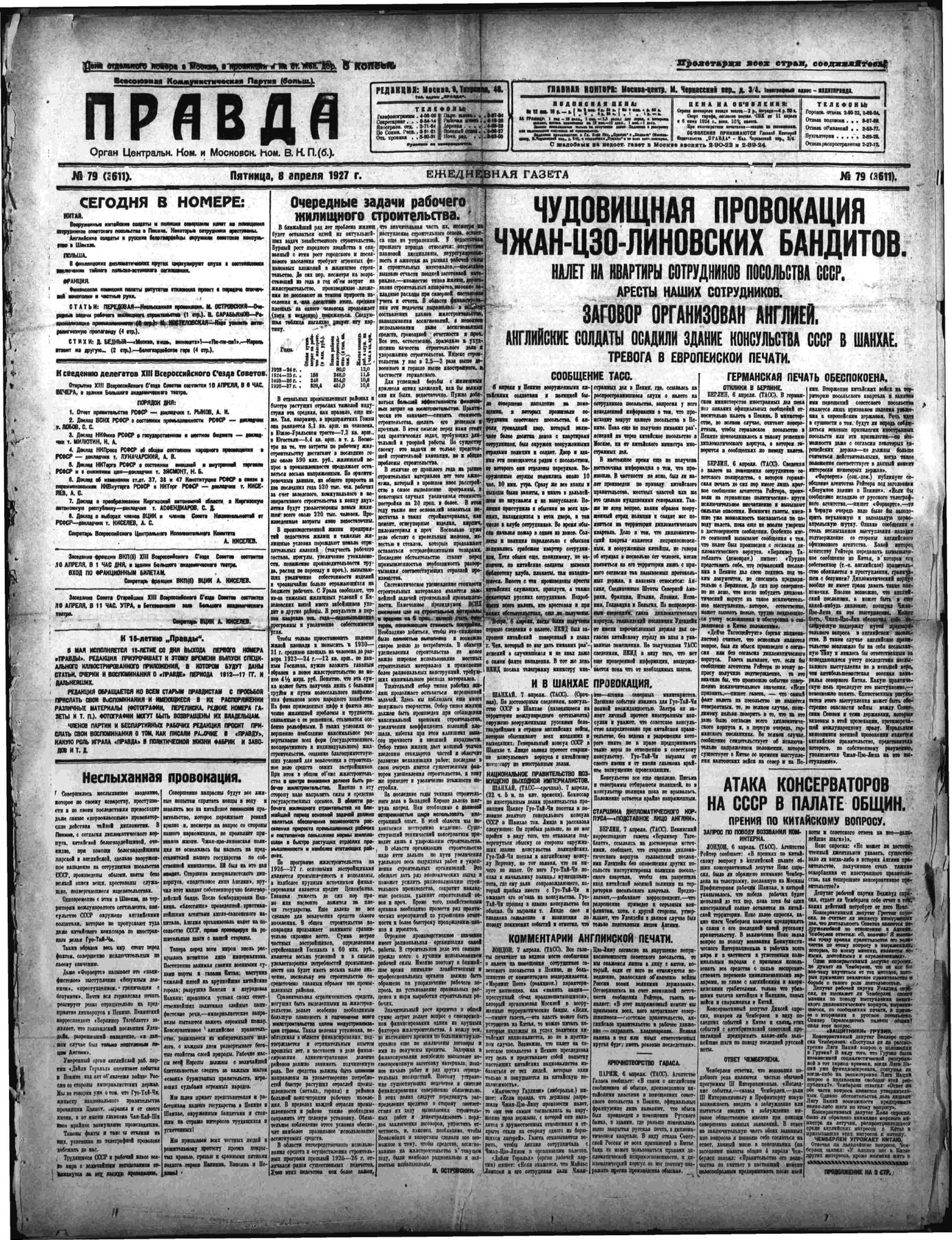
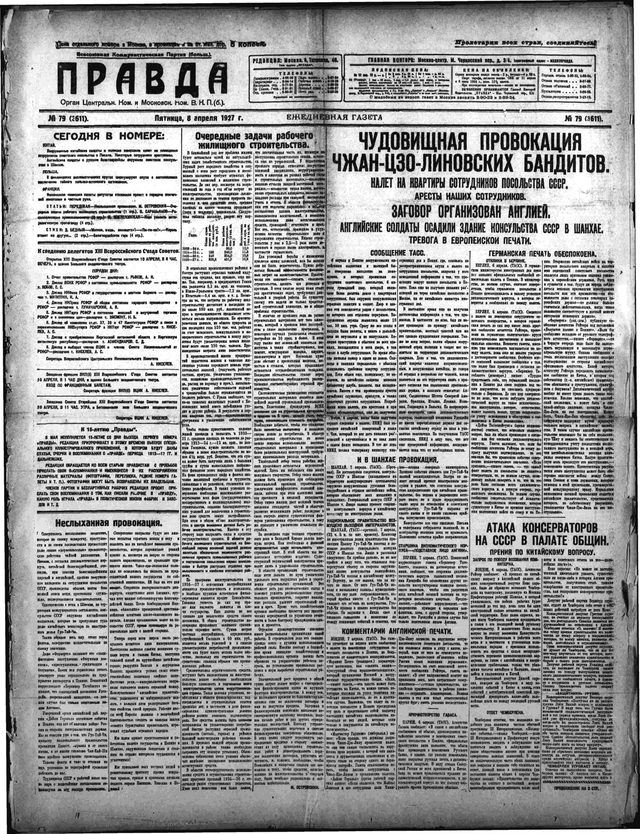
Pravda's front page of 8 April 1927, two days after police entered the Soviet embassy compound in Peking. The banner labels the raiders "bandits" and states that the plot was organised by England, and the page leans on quoted German and British press to vouch for the Soviet account. The entry tags name-calling, testimonial and loaded language. Read the technique: name-calling.
"Life has improved, comrades. Life has become more joyous. And when life is joyous, work goes well. Hence the high rates of output. Hence the heroes and heroines of labour."
November 17, 1935, Moscow, First All-Union Conference of Stakhanovites. Translator: Red Star Press, London, 1978 reprint of the official English edition (J. V. Stalin, Works, vol. 14), translator not credited. Source: Speech at the First All-Union Conference of Stakhanovites, 17 November 1935. Status: verified.
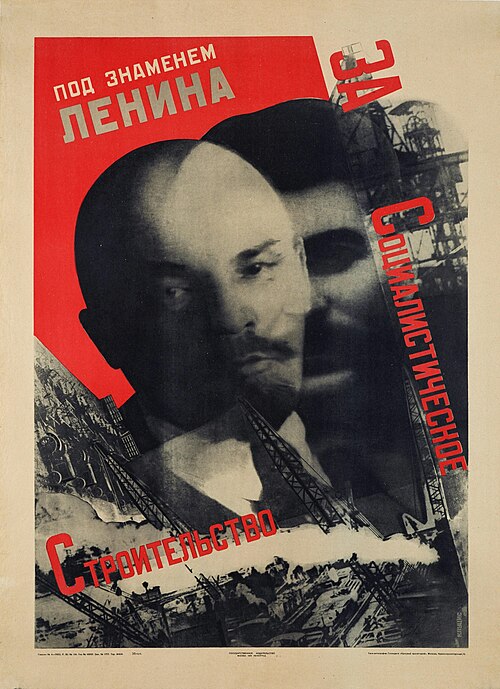
Gustav Klutsis's 1930 photomontage places Stalin, identified by the Commons record, inside Lenin's likeness and slogan. The entry tags it transfer. On the cult around Stalin's own image, see cult of personality and Stalin propaganda.
What did Stalin say about the kulaks and collectivisation?
December 27, 1929, Moscow. Translator: Foreign Languages Publishing House, Moscow, official English edition (J. V. Stalin, Works), translator not credited. Source: Speech at a Conference of Marxist Students of Agrarian Questions, 27 December 1929, 'Concerning Questions of Agrarian Policy in the U.S.S.R.'. Status: verified. (Content note: Announces the elimination of a social class (dekulakisation).)
Explain moreShow less
"What does this mean? It means that we have passed from the policy of restricting the exploiting tendencies of the kulaks to the policy of eliminating the kulaks as a class. It means that we have carried out, and are continuing to carry out, one of the decisive turns in our whole policy."
"Collective farms must not be established by force. That would be foolish and reactionary."
March 2, 1930, Pravda, no. 60. Translator: Foreign Languages Publishing House, Moscow, 1955 (J. V. Stalin, Works, vol. 12), translator not credited. Source: 'Dizzy with Success: Concerning Questions of the Collective-Farm Movement', Pravda, no. 60, 2 March 1930. Status: verified.
The two statements point in different directions, and the record gives both. The file notes that the second is given as a statement of policy and that how it related to the practice of collectivisation is a question for historians. The outcome is covered in the collectivization case study.
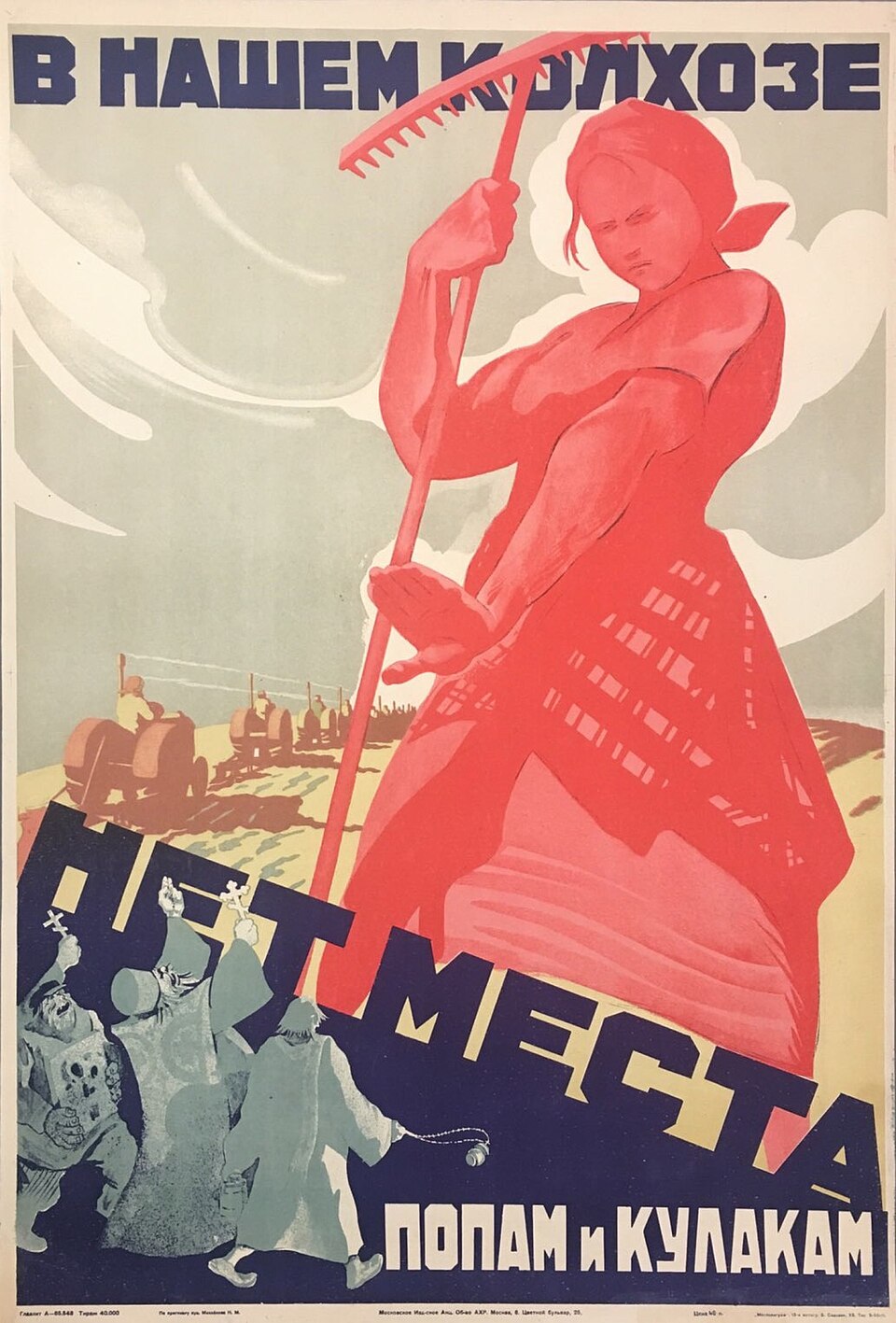
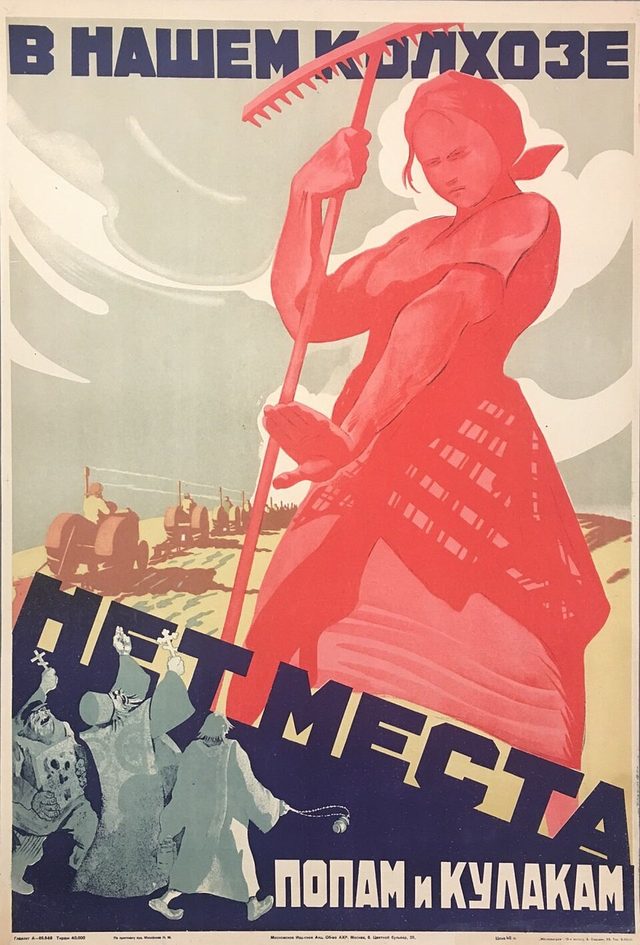
Nikolay Mikhailov's lithograph for the Association of Artists of the Revolution, print run 40,000 at 40 kopecks, is dated 1930 on the entry (exact year uncertain, 1929 to 1930). Its title excludes priests and kulaks from the collective farm. Tagged name-calling and scapegoating. Read the technique: scapegoating.
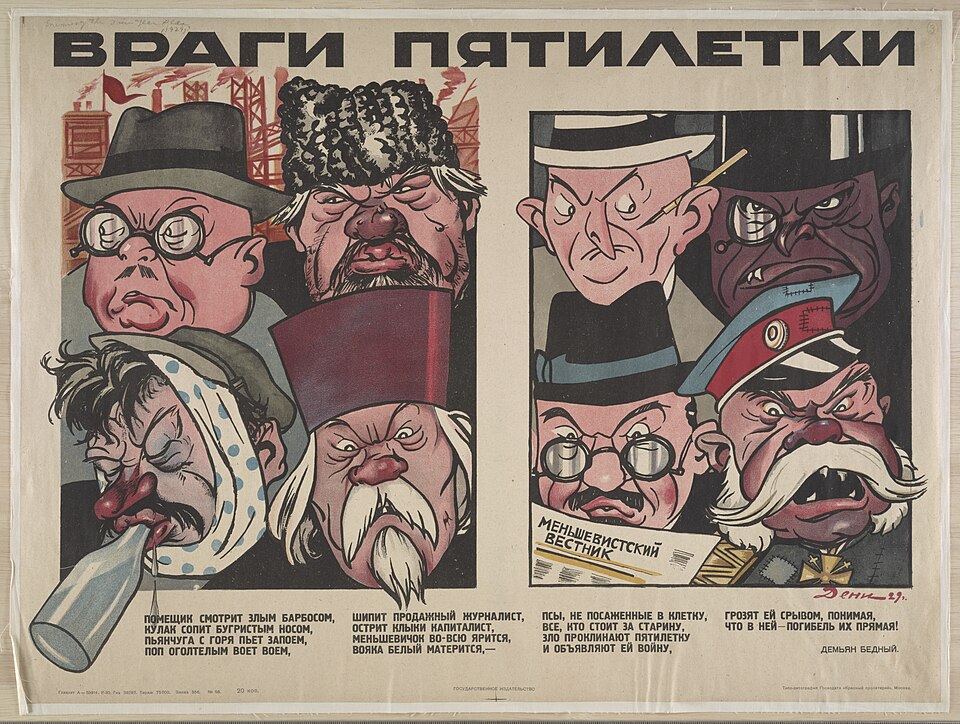
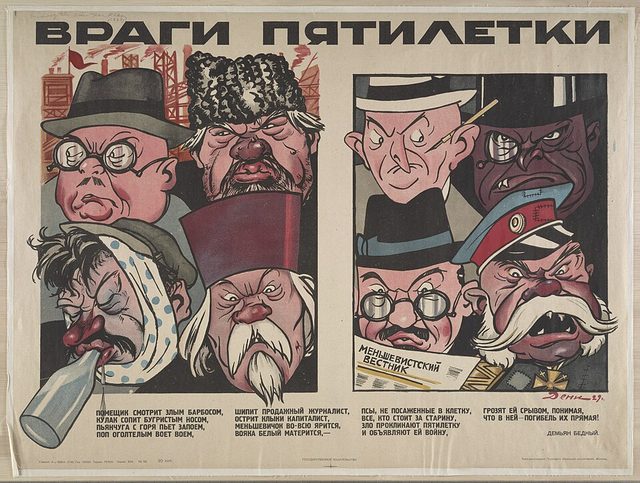
Viktor Deni drew and Demyan Bedny wrote the verse for this 1929 sheet, priced at 20 kopecks. Eight heads, among them the landowner, kulak, priest and White officer, are called "dogs not yet put in a cage". A mixed list is blamed as one pack. Tagged name-calling and scapegoating.
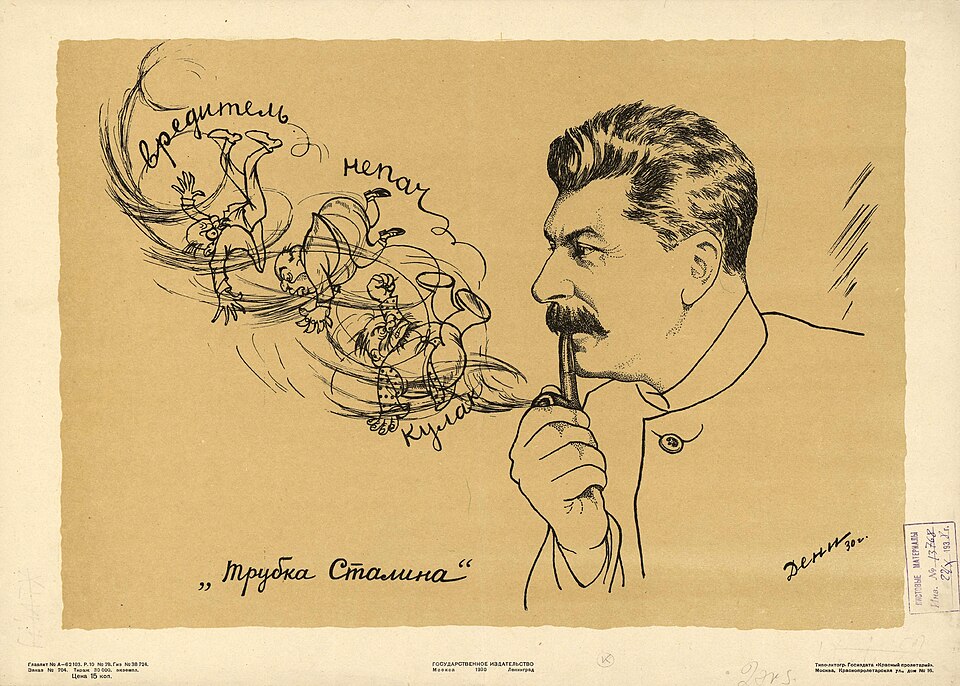
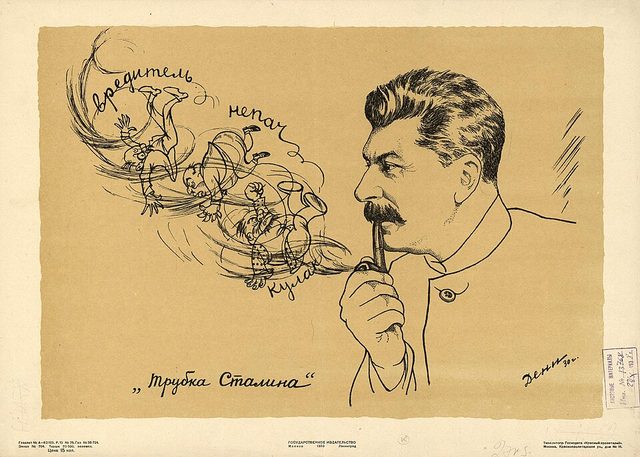
Deni's 1930 lithograph, signed "Deni 30g" with a State Publishing House imprint, shows three labels, "wrecker", "NEPman" and "kulak", blown away by one breath. Tagged name-calling and scapegoating.
What did Stalin say about industrialisation and the Five-Year Plan?
February 4, 1931, Moscow, First All-Union Conference of Leading Personnel of Socialist Industry. Translator: Foreign Languages Publishing House, Moscow, official English edition (J. V. Stalin, Works), translator not credited. Source: 'The Tasks of Business Executives', speech at the First All-Union Conference of Leading Personnel of Socialist Industry, 4 February 1931. Status: verified.
Explain moreShow less
"We are fifty or a hundred years behind the advanced countries. We must make good this distance in ten years. Either we do it, or we shall go under."
"A Bolshevik's word is his bond. Bolsheviks are in the habit of fulfilling promises made by them."
February 4, 1931, Moscow, First All-Union Conference of Leading Personnel of Socialist Industry. Translator: Foreign Languages Publishing House, Moscow, official English edition (J. V. Stalin, Works, vol. 13, 1954), translator not credited. Source: Speech 'The Tasks of Business Executives', 4 February 1931. Status: verified.
"It is time to realise that of all the valuable capital the world possesses, the most valuable and most decisive is people, cadres. It must be realised that under our present conditions "cadres decide everything.""
May 4, 1935, Moscow, Kremlin, address to graduates of the Red Army academies. Translator: Red Star Press, London, 1978 reprint of the official English edition (J. V. Stalin, Works, vol. 14), translator not credited. Source: Address to the Graduates from the Red Army Academies, Kremlin, 4 May 1935. Status: verified.
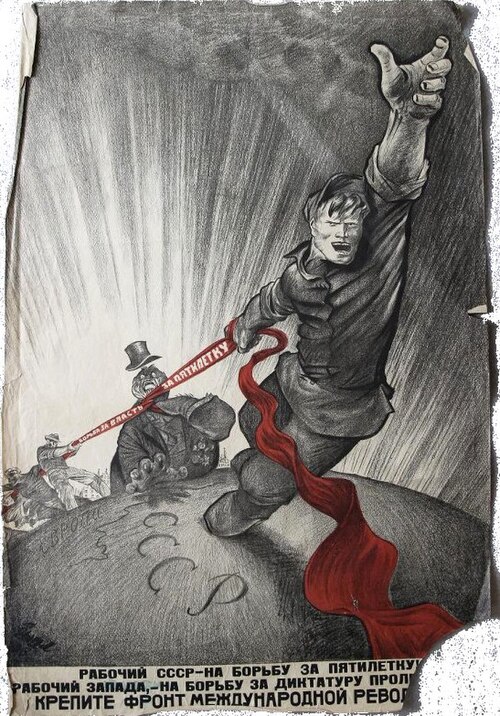
Vladislav Griffel's 1930 poster, "Worker of the USSR: Fight for the Five-Year Plan!", draws the capitalist as a fat top-hatted figure dragged along against his will. The entry notes the hosted image is a thumbnail of a damaged sheet with torn edges. Tagged name-calling.
What did Stalin say about enemies and class struggle?
January 7, 1933, Moscow, Joint Plenum of the Central Committee and Central Control Commission. Translator: Foreign Languages Publishing House, Moscow, official English edition (J. V. Stalin, Works), translator not credited. Source: 'The Results of the First Five-Year Plan', report to the Joint Plenum of the C.C. and C.C.C., C.P.S.U.(B.), 7 January 1933. Status: verified.
Explain moreShow less
"The abolition of classes is not achieved by the extinction of the class struggle, but by its intensification. The state will wither away, not as a result of weakening the state power, but as a result of strengthening it to the utmost, which is necessary for finally crushing the remnants of the dying classes and for organising defence against the capitalist encirclement that is far from having been done away with as yet, and will not soon be done away with."
"Contemporary Trotskyism is not a political trend within the working class, but an unprincipled and intellectually devoid band of wreckers, diversionists, intelligence agents, spies, and killers; a band of sworn enemies of the working class in the hire of the intelligence service organs of foreign states."
March 3, 1937, Moscow, Plenum of the Central Committee of the RKP(b). Translator: Cooperative Publishing Society of Foreign Workers in the USSR, Moscow, 1937 (pamphlet translation), translator not credited. Source: 'Defects in Party Work and Measures for Liquidating Trotskyite and Other Double Dealers', report to the Plenum of the Central Committee of the RKP(b), 3 March 1937 (Moscow: Cooperative Publishing Society of Foreign Workers in the USSR, 1937). Status: verified. (Content note: Denounces political opponents as spies and killers.)
The word "wreckers" also appears on the 1930 poster above. The scapegoating page records how the charge of "wrecking" was extended from the 1928 Shakhty trial to other specialists, with the scholarship it cites.
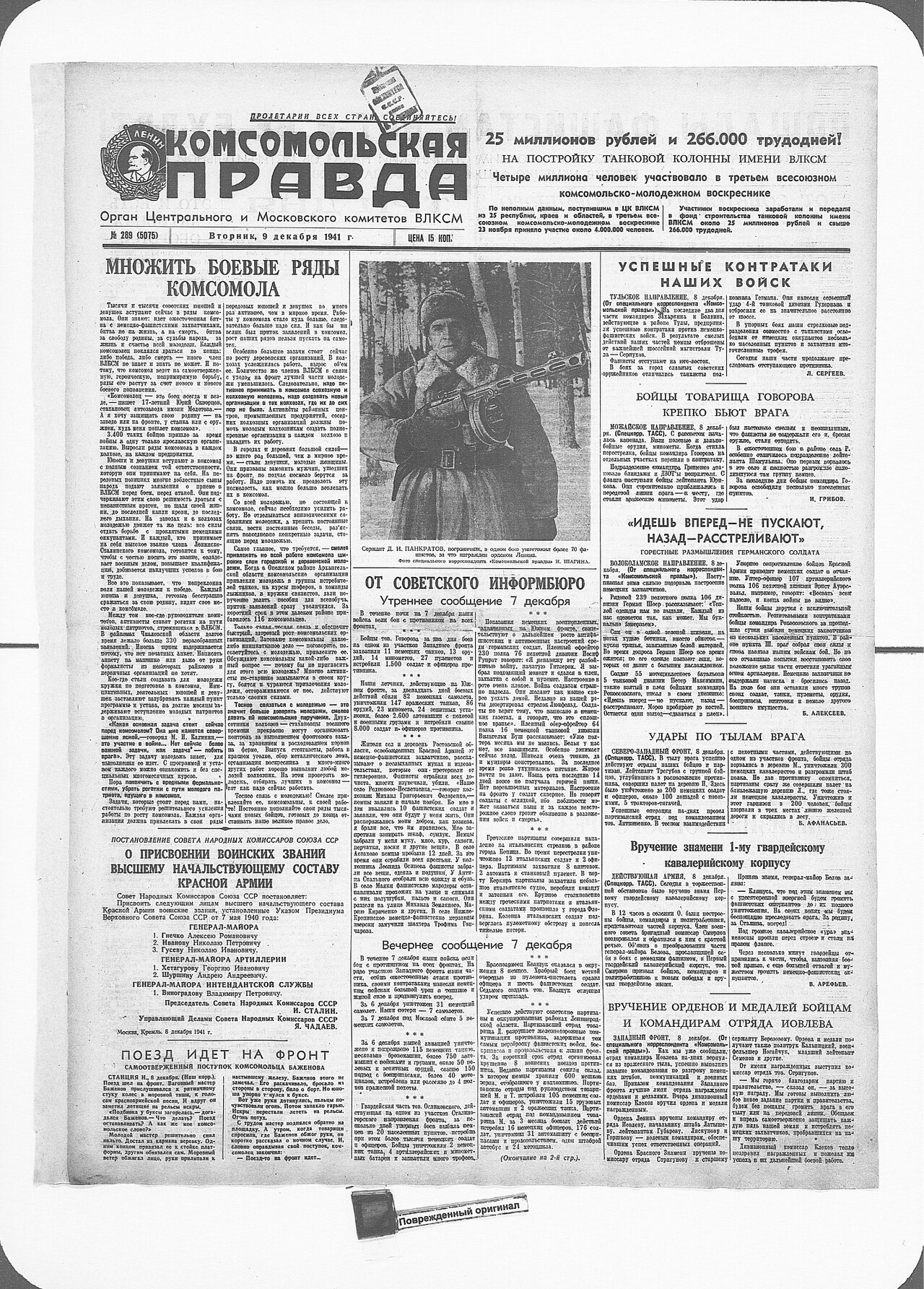
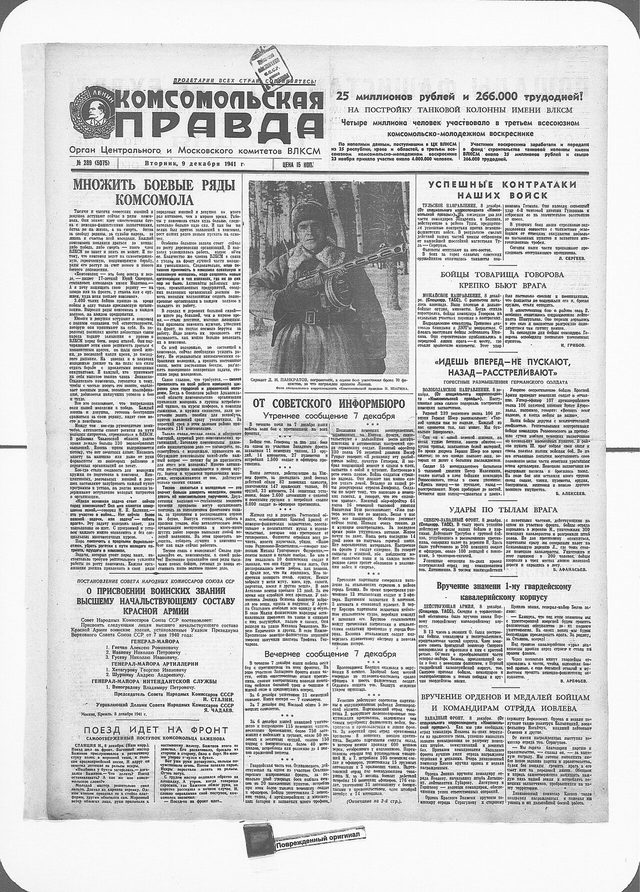
Komsomolskaya Pravda, 9 December 1941, front page. It leads with the Komsomol and the Sovinformburo communiques "Successful counter-attacks of our troops", and the entry notes nothing on the page concerns the Pacific, which is on page 4. Tagged name-calling and card-stacking. Read the technique: card-stacking.
What did Stalin say about foreign policy and the 1939 pact?
March 1, 1936, Moscow. Translator: Red Star Press, London, 1978 reprint of the official English edition (J. V. Stalin, Works, vol. 14), translator not credited. Source: Interview between J. Stalin and Roy Howard, 1 March 1936. Status: verified.
Explain moreShow less
"You see, we Marxists believe that a revolution will also take place in other countries. But it will take place only when the revolutionaries in those countries think it possible, or necessary. The export of revolution is nonsense. Every country will make its own revolution if it wants to, and if it does not want to, there will be no revolution. For example, our country wanted to make a revolution and made it, and now we are building a new, classless society."
"To be cautious and not allow our country to be drawn into conflicts by warmongers who are accustomed to have others pull the chestnuts out of the fire for them;"
March 10, 1939, Moscow, Eighteenth Congress of the C.P.S.U.(B.). Translator: Red Star Press, London, 1978 reprint of the official English edition (J. V. Stalin, Works, vol. 14), translator not credited. Source: Report on the Work of the Central Committee to the Eighteenth Congress of the C.P.S.U.(B.), 10 March 1939. Status: verified.
"I know how much the German nation loves its Führer; I should therefore like to drink to his health."
August 23, 1939, Moscow, conversation after the signing of the German-Soviet non-aggression treaty. Translator: U.S. Department of State, translation of the German Foreign Ministry record, in Nazi-Soviet Relations 1939-1941: Documents from the Archives of the German Foreign Office, ed. Raymond J. Sontag and James S. Beddie (Washington, 1948). Source: Memorandum of a Conversation Held on the Night of August 23d to 24th, Between the Reich Foreign Minister, on the One Hand, and Herr Stalin and the Chairman of the Council of People's Commissars Molotov, on the Other Hand, item 8 (toasts). Status: verified. (Content note: Toast to the health of Adolf Hitler.)
"What did we gain by concluding the non-aggression pact with Germany? We secured our country peace for a year and a half and the opportunity of preparing our forces to repulse fascist Germany should she risk an attack on our country despite the pact. This was a definite advantage for us and a disadvantage for fascist Germany."
July 3, 1941, Moscow, radio address. Translator: Soviet English text of the speech hosted by Marxists Internet Archive; translator and print edition are not named on that page. Source: Radio broadcast, 3 July 1941. Status: verified.
The 1939 toast comes from a German note-taker's record, not a Soviet transcript; the record says so, and the 1941 passage is Stalin's later public account of the same agreement.
What are Stalin's quotes on war?
The war lines in the file are 8 of the 25 (count made from the file's topics, which tags them "second-world-war"). They span the invasion, the army's discipline and the postwar settlement.
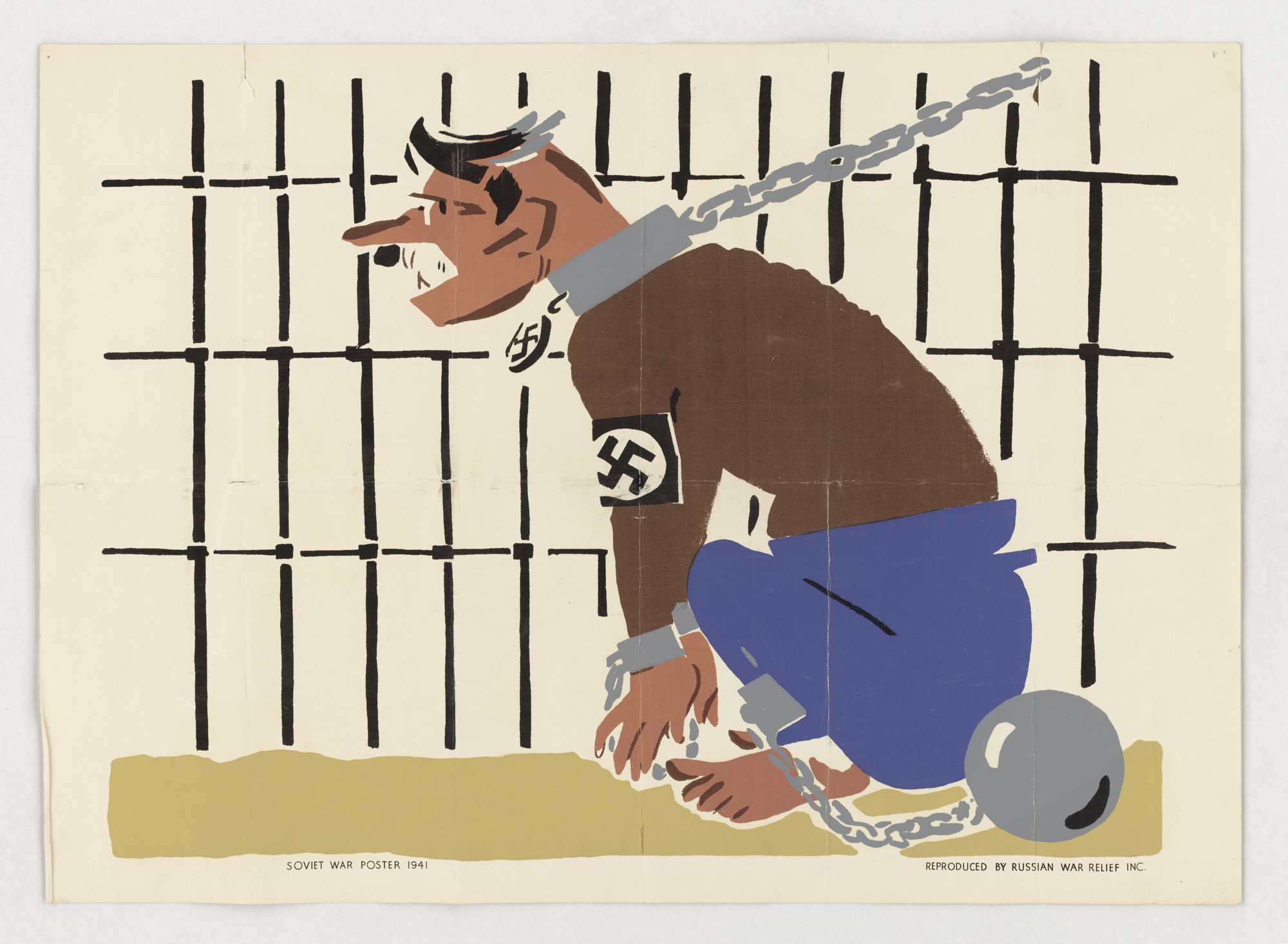
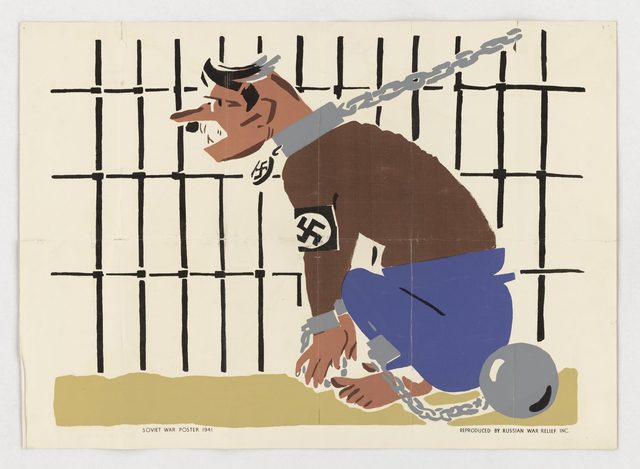
Content note: Caricature of Hitler with a swastika. This object is shown as it was published. Why 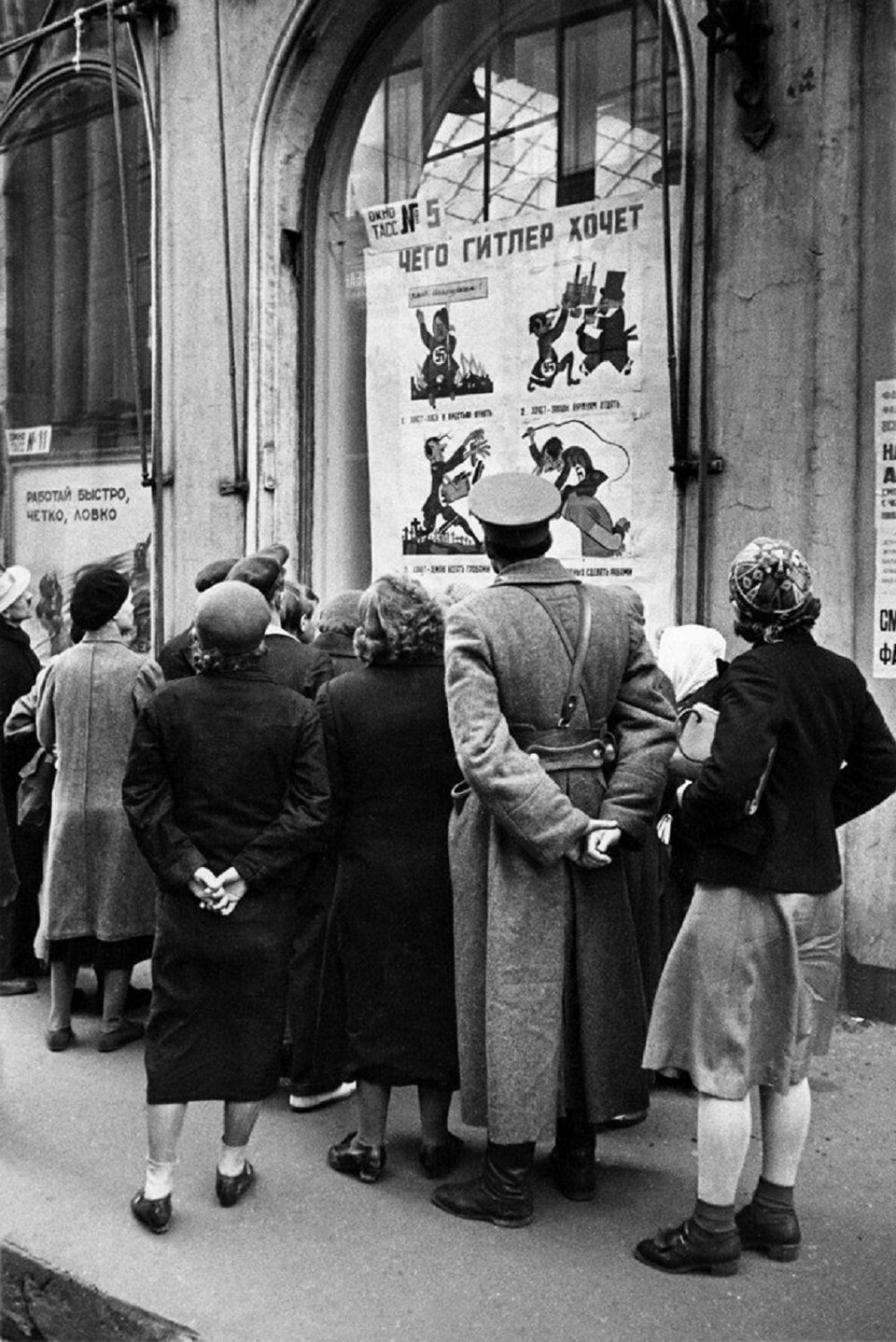
Explain moreShow less
"The German invaders want a war of extermination with the peoples of the U.S.S.R. Well, if the Germans want to have a war of extermination, they will get it. (Loud and prolonged applause.) From now on our task, the task of the peoples of the U.S.S.R., the task of the fighters, commanders and the political workers of our Army and our Navy will be to exterminate every single German who has set his invading foot on the territory of our Fatherland."
November 6, 1941, Moscow, celebration meeting of the Moscow Soviet on the eve of the October Revolution anniversary. Translator: Soviet English text of the speech hosted by Marxists Internet Archive; translator and print edition are not named on that page. Source: Speech at the Celebration Meeting of the Moscow Soviet of Working People's Deputies and Moscow Party and Public Organizations, 6 November 1941. Status: verified. (Content note: Calls for killing every German soldier on Soviet territory.)
"The Red Army has not and cannot have such idiotic aims. The Red Army’s aim is to drive the German occupants from our country and liberate Soviet soil from the German-fascist invaders. It is very likely that the war for the liberation of Soviet soil will lead to the exile or destruction of Hitler’s clique. We would welcome such an outcome. But it would be ludicrous to identify Hitler’s clique with the German people, with the German state. The experience of history indicates that Hitlers come and go, but the German people and the German state remain."
February 23, 1942, Moscow, Order of the Day No. 55. Translator: Soviet English text of the speech hosted by Marxists Internet Archive; translator and print edition are not named on that page. Source: Order of the Day No. 55, People's Commissar for Defence of the U.S.S.R., 23 February 1942. Status: verified.
Read together, the two passages are separated by under four months. The first speaks of exterminating every German who has set foot on Soviet territory; the second, in an order of the day, separates the "Hitler clique" from "the German people". Both are in the record.
"The panic-mongers and cowards should be exterminated in place."
July 28, 1942, Moscow, Order No. 227. Translator: English translation on Wikisource ('Order No. 227 by the People's Commissar of Defence of the USSR'), credited there to 'Frank' of www.stalingrad-info.com; a web translation, not a published edition. Source: Order of the People's Commissar of Defence of the U.S.S.R. No. 227, 28 July 1942. Status: verified. (Content note: Order to kill soldiers who panic or retreat.)
"At least 50,000 and perhaps 100,000 of the German Commanding Staff must be physically liquidated."
November 29, 1943, Tehran, tripartite dinner. Translator: Charles E. Bohlen, English-language minutes (Bohlen Minutes), in Foreign Relations of the United States: The Conferences at Cairo and Tehran, 1943 (Washington: Government Printing Office, 1961), document 368. Source: Bohlen Minutes, tripartite dinner meeting, 29 November 1943, 8:30 p.m.. Status: verified. (Content note: Proposal to execute tens of thousands of German officers.)
The Tehran line is the American minute-taker's English record of remarks made in Russian, written in the third person, and the file calls it a record, not a transcript.
"I drink in the first place to the health of the Russian people because it is the most outstanding nation of all the nations forming the Soviet Union. I propose a toast to the health of the Russian people because it has won in this war universal recognition as the leading force of the Soviet Union among all the peoples of our country. I propose a toast to the health of the Russian people not only because it is the leading people, but also because it possesses a clear mind, a staunch character, and patience."
May 24, 1945, Moscow, Kremlin, reception for Red Army commanders. Translator: Soviet English text of the speech hosted by Marxists Internet Archive; translator and print edition are not named on that page. Source: Toast to the Russian people at a reception in honour of Red Army commanders given by the Soviet Government in the Kremlin, 24 May 1945. Status: verified.
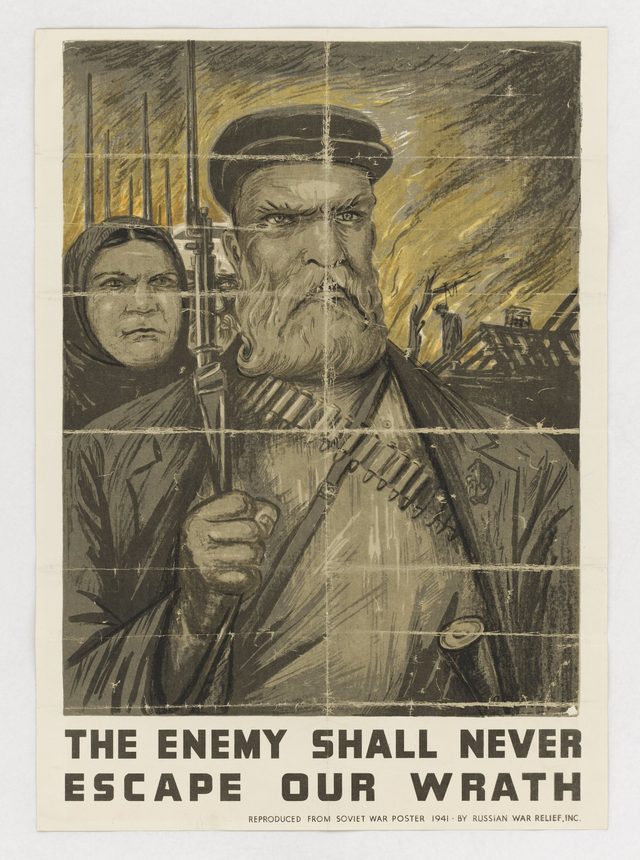
The sheet is captioned "Soviet War Poster 1941" and "Reproduced by Russian War Relief Inc."; no Soviet issuer or artist is named. Tagged name-calling.
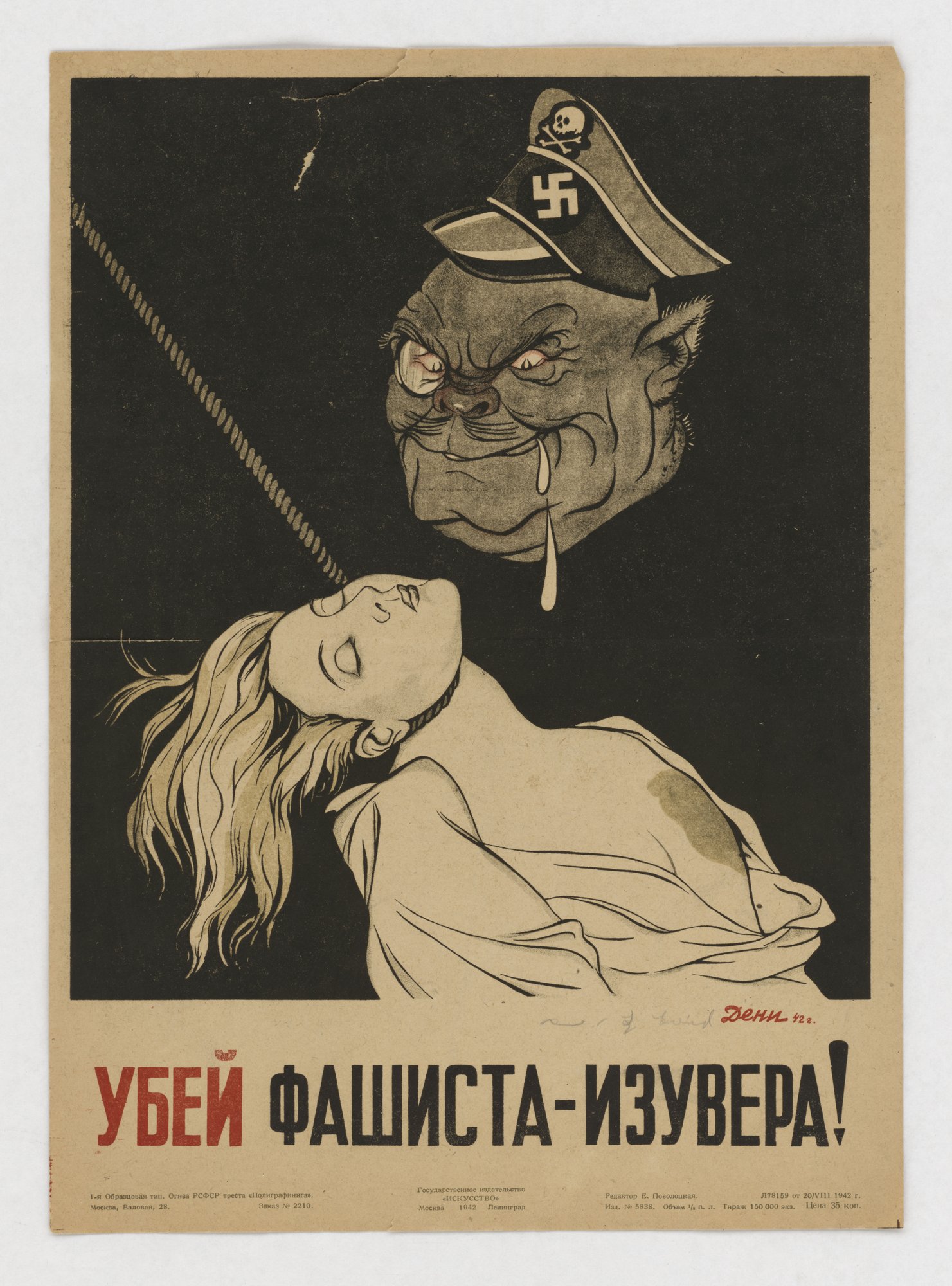
Viktor Deni signed this poster in 1942; the imprint gives approval of 20 August 1942 and a print run of 150,000. The entry tags name-calling and fear-appeal and carries a content note for the dead woman. Read the technique: fear-appeal.
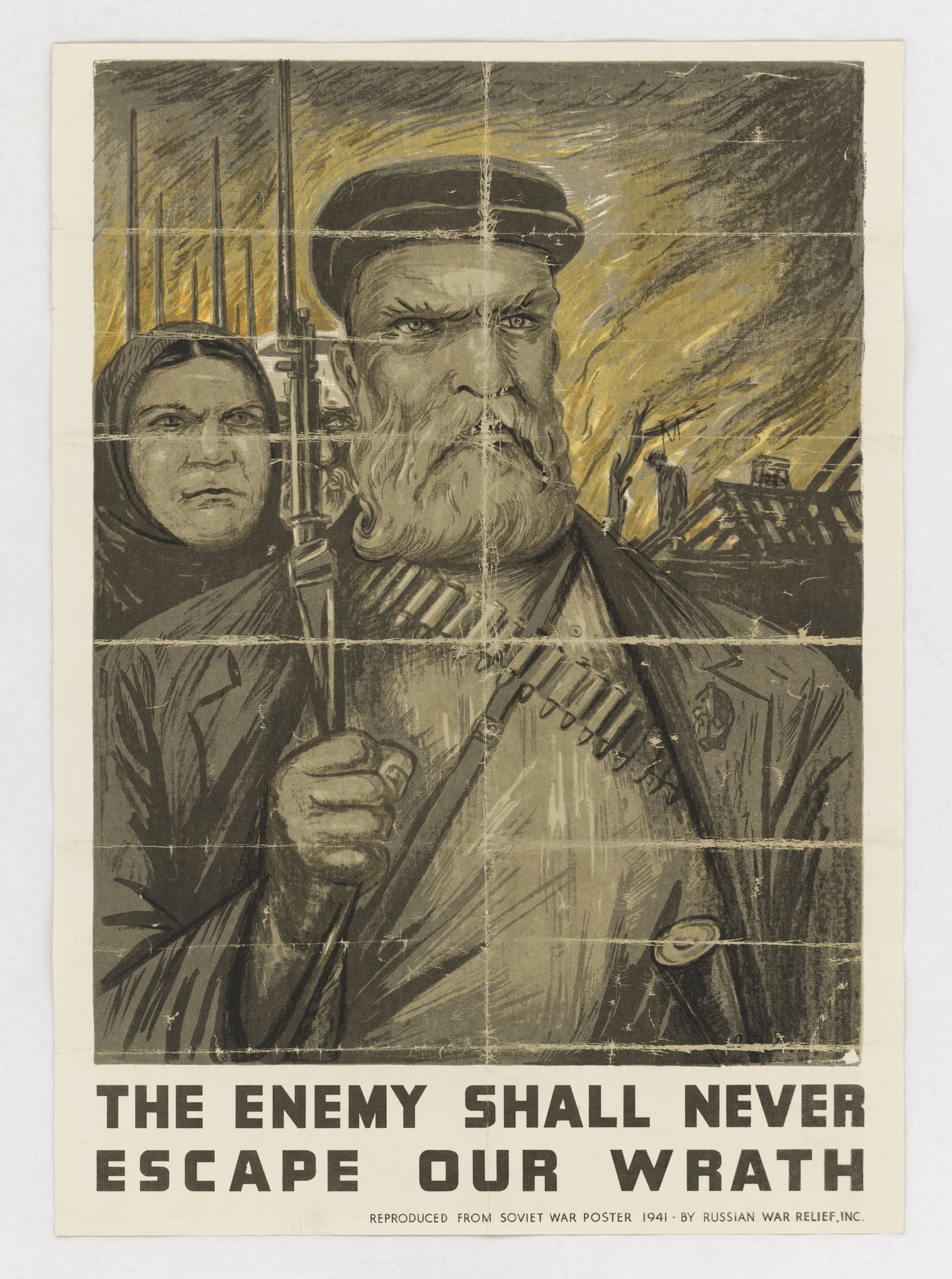
A US reproduction by Russian War Relief of a Soviet poster of 1941, "The Enemy Shall Never Escape Our Wrath". Tagged fear-appeal; the entry carries a content note for the hanged figure and burning village.
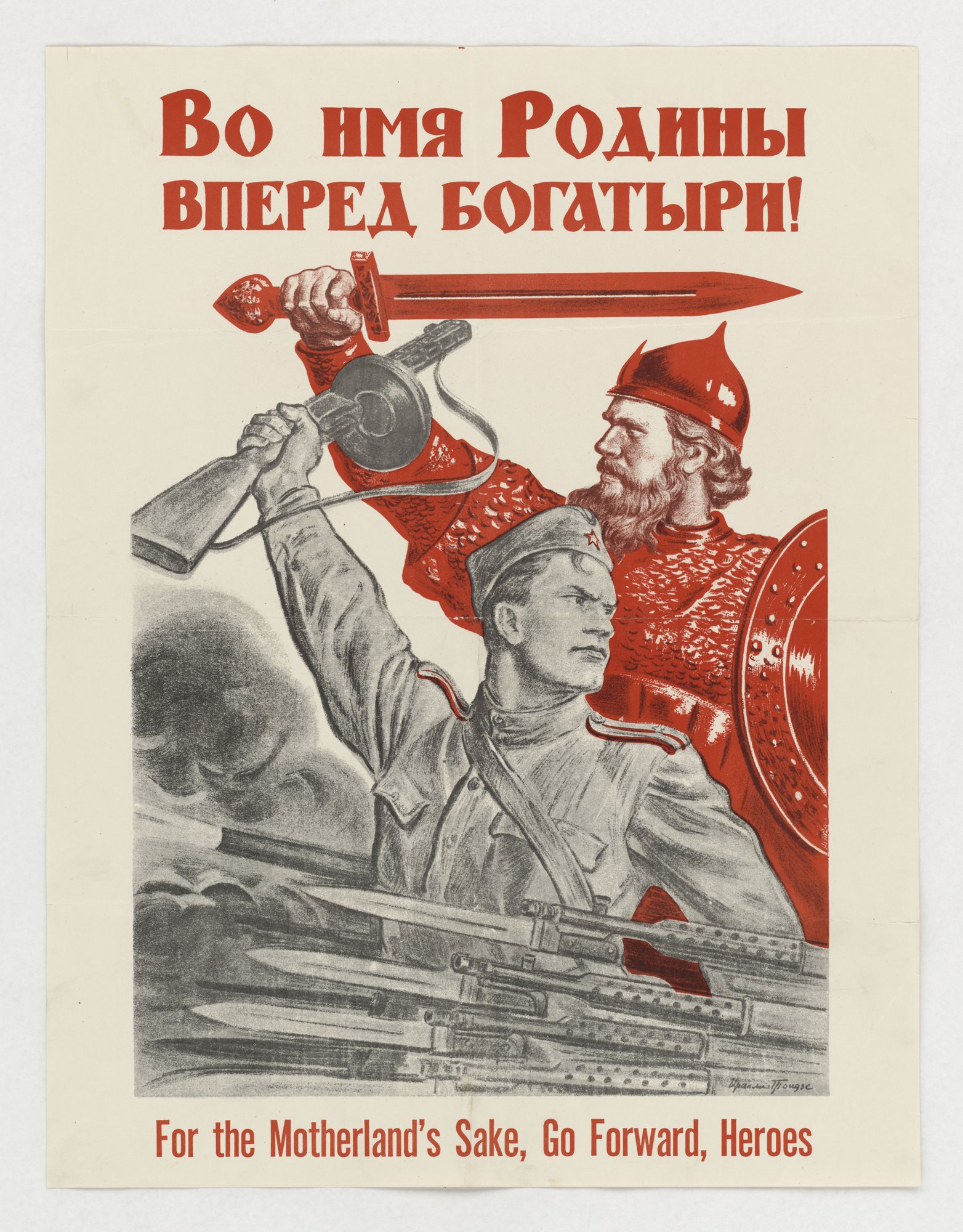
Irakli Toidze's poster, dated 1943 in the entry, pairs a soldier with a legendary warrior under "For the Motherland's sake, forward, heroes!". Tagged transfer and glittering generalities. Read the technique: transfer.
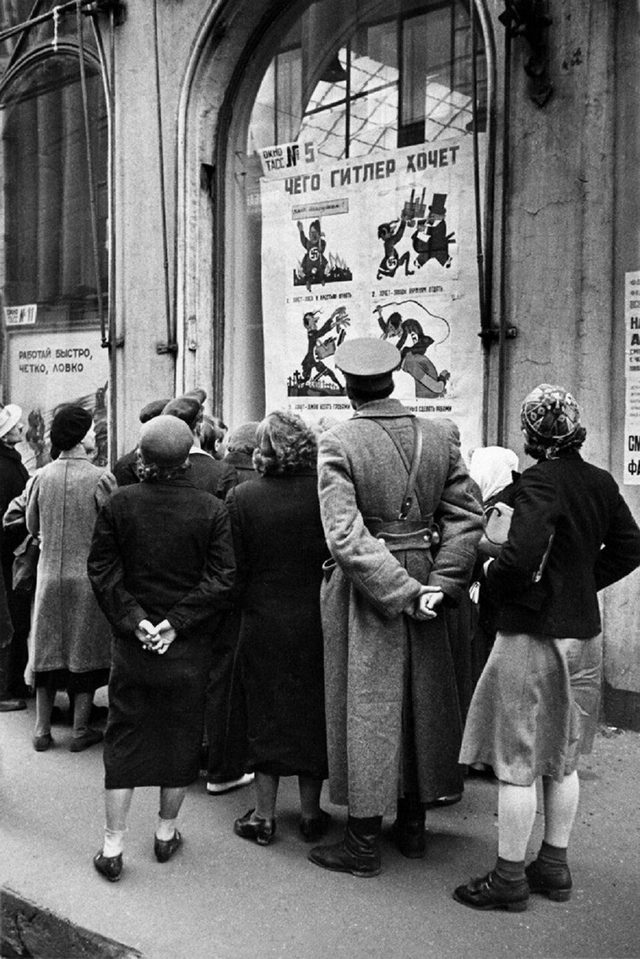
A photograph by A. V. Ustinov of July 1941 shows a crowd reading TASS Window No. 5, "What Hitler wants", in four cartoon panels. Tagged fear-appeal.
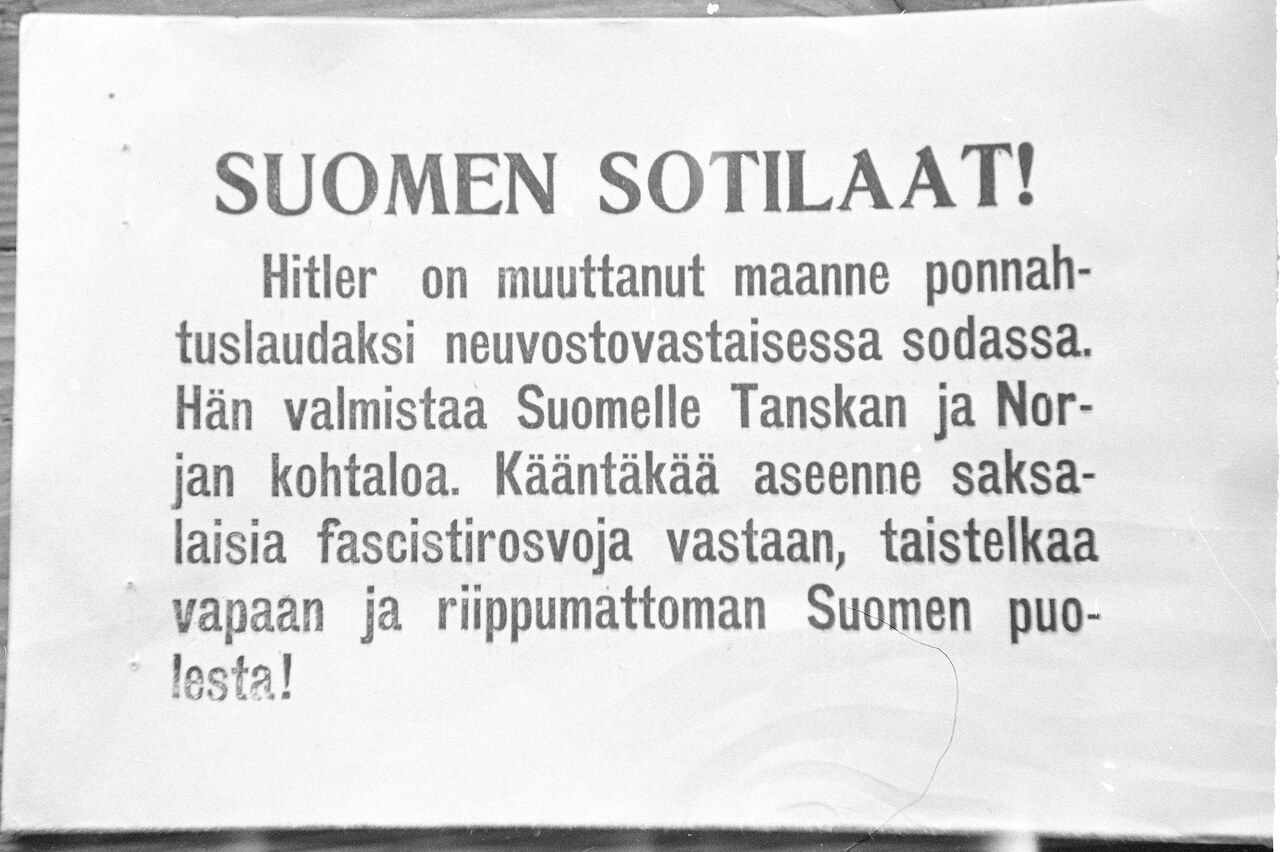
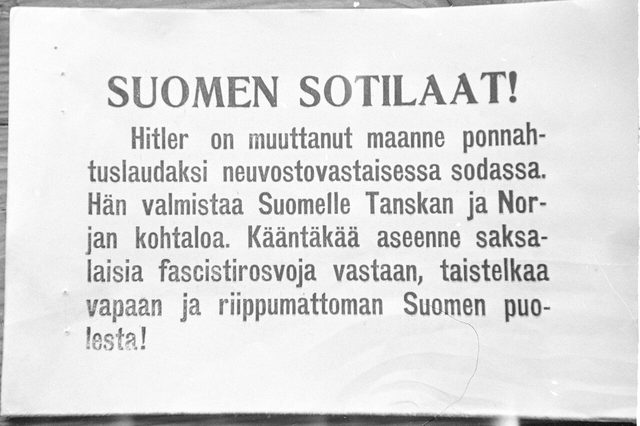
A Soviet leaflet in Finnish, photographed in July 1941 and held by the Finnish wartime photograph archive. It calls Finland a German "springboard" and compares its prospects to "the fate of Denmark and Norway". Tagged fear-appeal and name-calling.
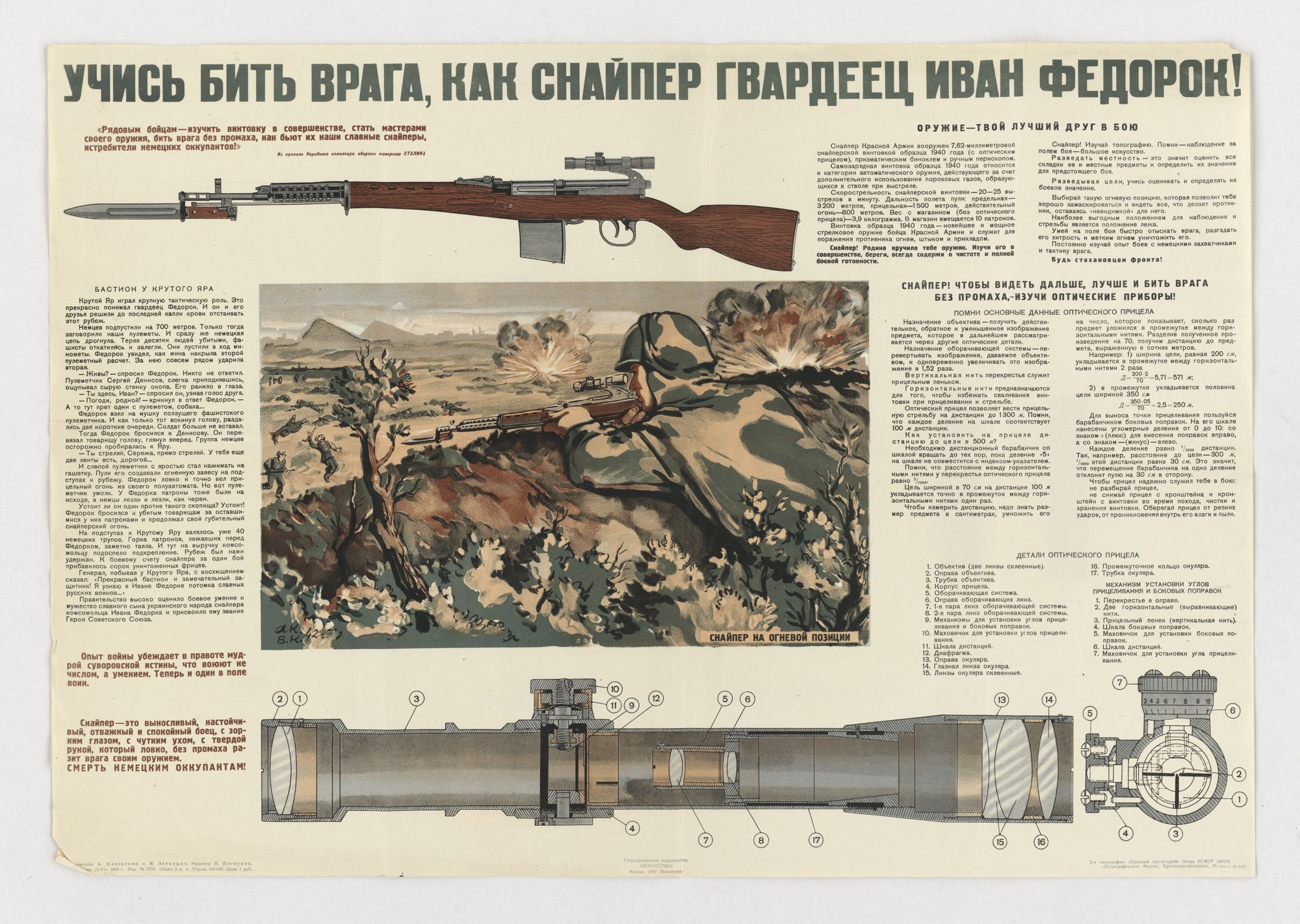
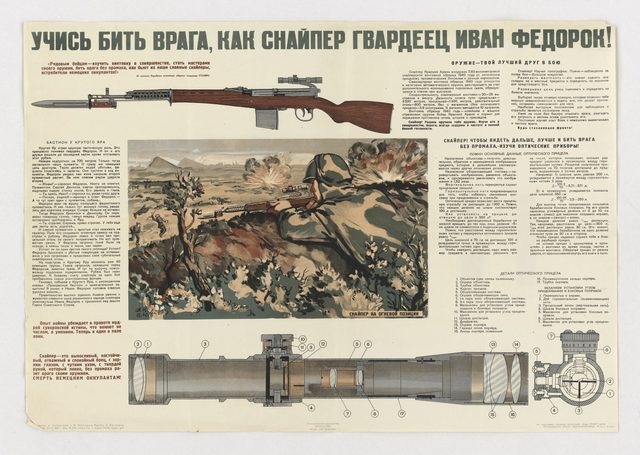
A 1942 State Publishing House sheet that quotes the People's Commissar of Defence, Stalin, and offers the sniper Ivan Fedorok as a model. Tagged testimonial; most of the sheet is technical instruction.
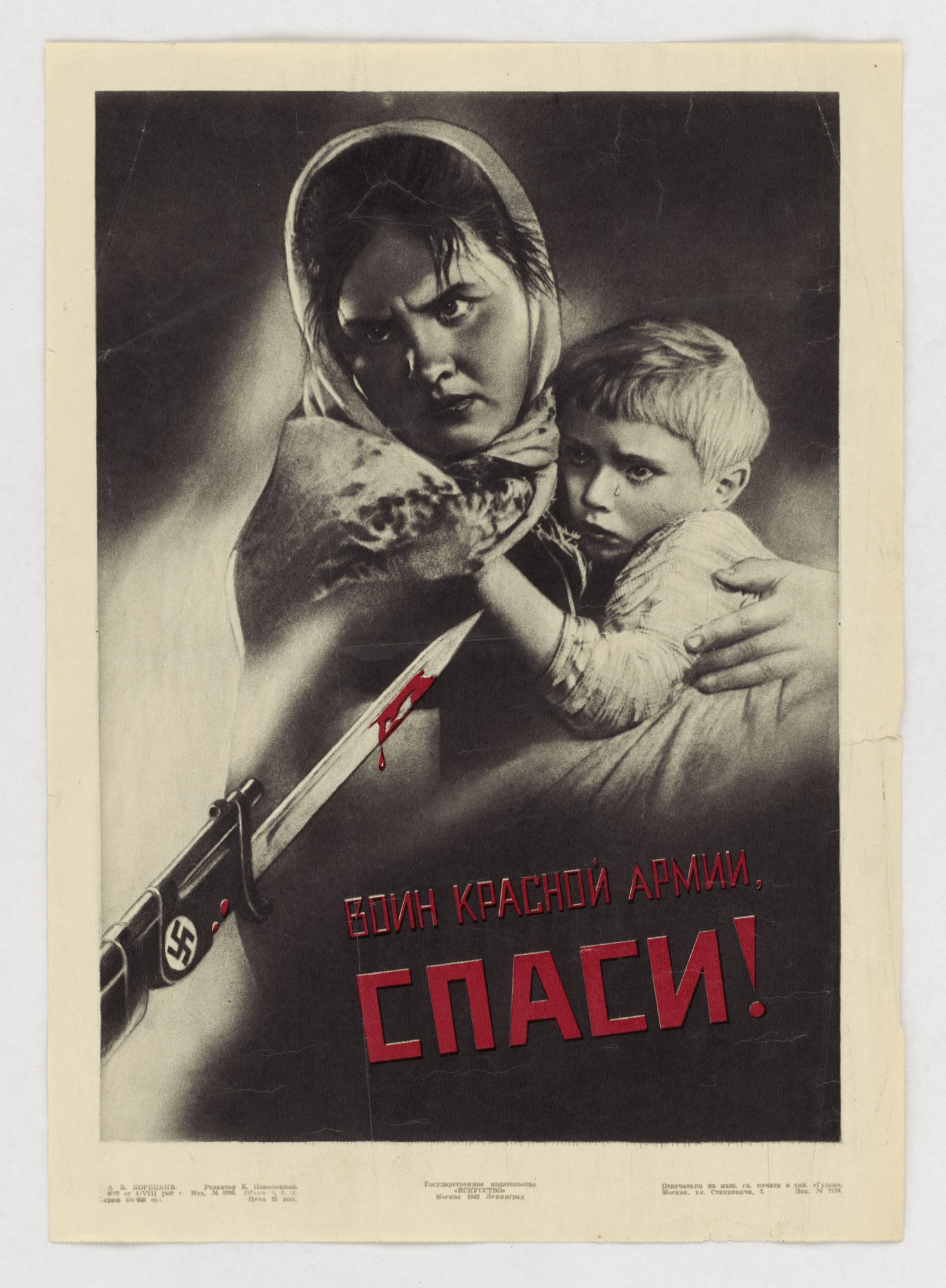
Viktor Koretsky's 1942 photomontage "Red Army warrior, save!" addresses the soldier directly. Tagged fear-appeal and outrage-bait. Read the technique: outrage-bait.
The wartime sheets from both sides use the same family of techniques; for the German side see Goebbels propaganda, and for Soviet material generally Soviet propaganda posters.
How should you cite a Stalin quote?
Give the date, the occasion, the edition and the translator, as the entries do, and say whether the English follows the Russian closely. Two entries show why: "we shall go under" in the 1931 speech is one English rendering of a Russian phrase that, the file notes, other English versions give as "crush us", and the 1939 toast exists only in a German note-taker's record. When a quotation has no source beyond "attributed to", treat it as unverified.
Browse the collection
- Stalin propaganda: cult-of-personality posters and sheets for and against him.
- Soviet propaganda posters
- Communist propaganda
- Soviet Union regime page
- Quotes README: all people files and their status rules.
Sources and further reading
Sources and rights
Quotations are copied from the Stalin quotes data; each entry in that file gives its date, place, source, translator and…
Quotations are copied from the Stalin quotes data; each entry in that file gives its date, place, source, translator and verification note, and links to the published text it was read against, mostly the Marxists Internet Archive hosting of the Foreign Languages Publishing House and Red Star Press editions, the US State Department's Nazi-Soviet Relations volume and Foreign Relations of the United States. Image rights and sources are in each object's entry under examples/entries/. Illustrative items from the poster series are held by their named institutions with the rights basis noted in the entries; nothing here is a generated image.
![Убей фашиста-изувера! [Kill the fascist brute!]](../collection/images/soviet-kill-the-fascist-brute-deni-1942-640.jpg)
![Воин Красной Армии, спаси! [Red Army warrior, save!]](../collection/images/soviet-warrior-of-the-red-army-save-koretsky-1942-640.jpg)
![Во имя Родины вперед богатыри! [For the Motherland's Sake, Go Forward, Heroes!]](../collection/images/soviet-for-the-motherlands-sake-go-forward-heroes-toidze-1943-640.jpg)