Content note. Two items on this page concern the Beslan school hostage-taking of September 2004, which ended with more than 330 dead, many of them children. They are Kremlin statements about it, shown as issued. Showing an item is not endorsing it.
What was propaganda in the Second Chechen War?
Propaganda in the Second Chechen War is the organised persuasion that the Russian state issued about the war that began in autumn 1999 and the republic it then governed through the Chechen administration it appointed. The collection holds 12 objects from 2000 to 2009, each tagged by issuer, audience and technique, with the same definitions applied to every issuer.
Explain moreShow less
All 12 come from one issuer, the Russian presidency. The page applies the working definition used for every country (how FRAME defines propaganda). For the Russian state, see the regime page Russian Federation under Vladimir Putin and the landing Russian propaganda. Related landings: Ukraine war propaganda and Russo-Georgian war propaganda.
A gap, stated plainly. The collection holds no Chechen separatist, Chechen government or independent-monitor object from the war. Ichkeria's own material and Chechen and Western press items could not be cleared for hosting. That reflects what has been found and cleared, not the amount of persuasion produced on those sides. Read this page as a record of one party's messaging, not of the whole war.
The sections run in date order. Each object is described from its catalogue entry: issuer, audience, the ask and the technique.
How did the Kremlin present the war in 2000?
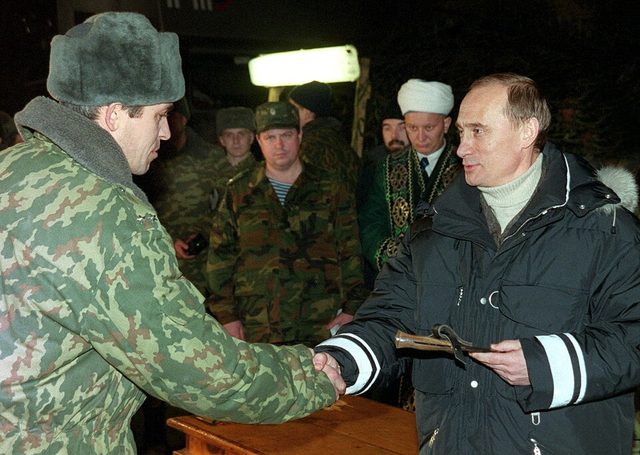
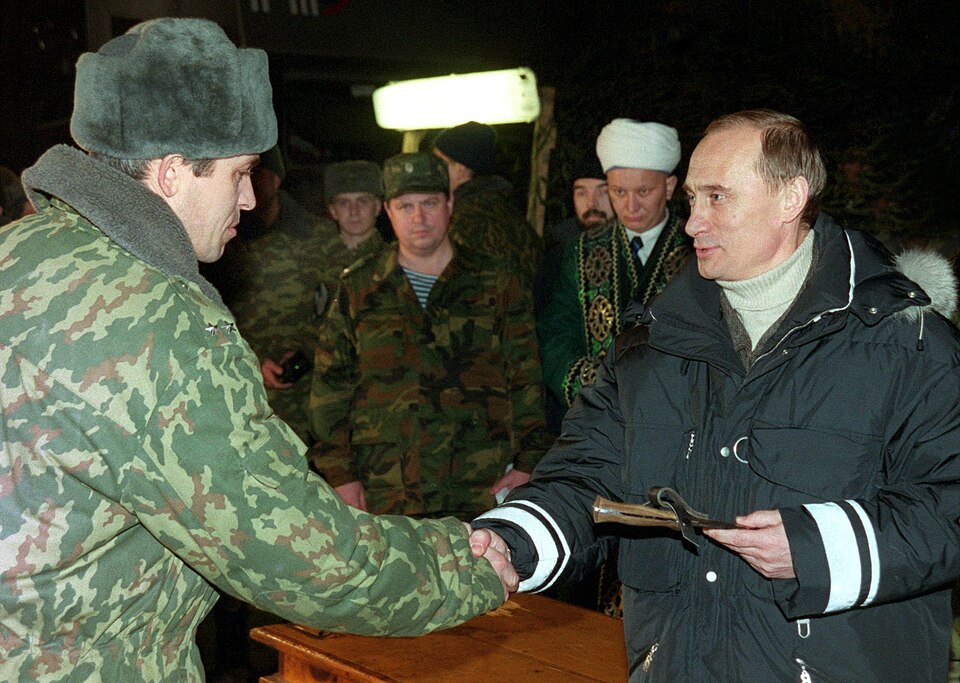
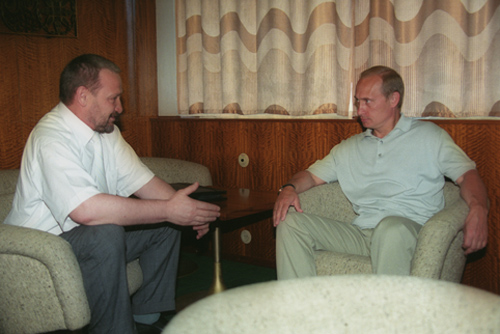
On 1 January 2000, the day Boris Yeltsin's resignation made him acting president, Vladimir Putin visited Gudermes and presented state awards to servicemen of the Joint Group of Federal Forces. A man in a white turban and robe looks on. The entry tags transfer: the new head of state is placed among troops in the war zone. Read the technique: transfer.
Explain moreShow less
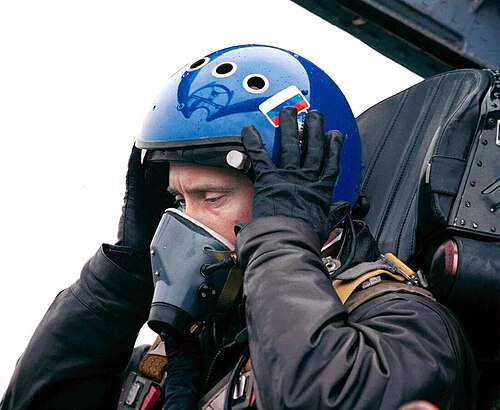
The Kremlin caption reads "Acting President Vladimir Putin arrived in Grozny on a SU-27 fighter jet." The flight was six days before the presidential election of 26 March 2000. The entry tags transfer: the head of state is shown in a combat aircraft's equipment.
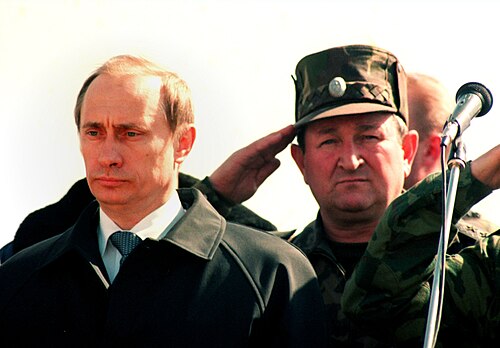
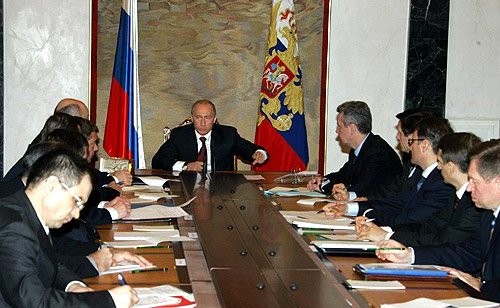
On the same day, Putin attended the ceremony marking the withdrawal of the 331st Parachute Regiment, with General Gennady Troshev named in the Commons description. The entry tags transfer.
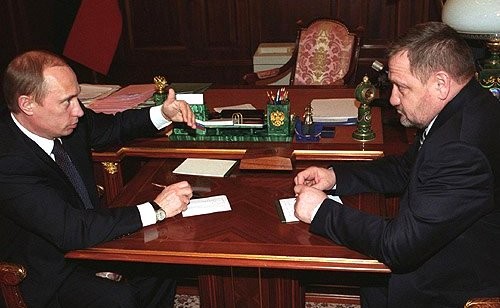
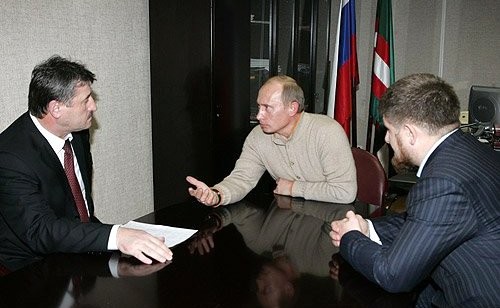
The Kremlin caption identifies the second man as Akhmad Kadyrov, head of the Chechen Provisional Administration. Kadyrov, a cleric who had backed independence and called for jihad against Russia in the First Chechen War, sided with the federal government. The entry tags transfer: the informal setting presents the local appointee as a trusted interlocutor of the president.
How did the Kremlin present Chechen politics, 2003 to 2005?
On 27 March 2003 Putin congratulated Kadyrov on the reported approval of a draft Chechen constitution in the referendum of 23 March. The Kremlin text says the result "proved that the population trusted the authorities". The entry tags testimonial: the head of state vouches for the result. Read the technique: testimonial.
Explain moreShow less
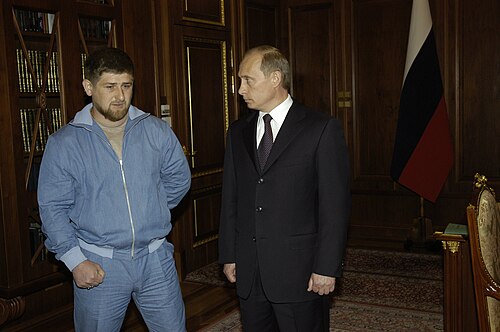
The Commons page dates this meeting to 9 May 2004, the day Ramzan Kadyrov's father, the Chechen president Akhmad Kadyrov, was killed in a bombing at a Victory Day event in Grozny. The entry tags transfer: the Russian flag and presidential study frame a Chechen figure under the head of state's attention.
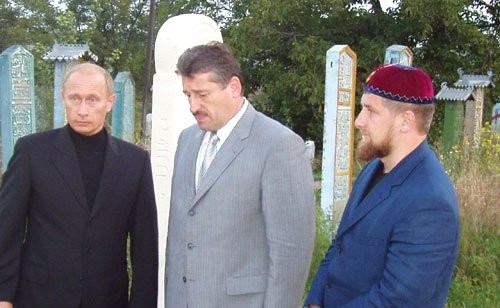
Three months later, Putin laid flowers at the grave with Alu Alkhanov and Ramzan Kadyrov. A presidential election followed. The entry tags transfer: the Kremlin is paired with the Kadyrov name and the grave site at Tsentoroi.
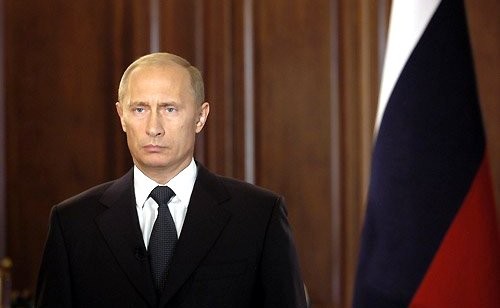
After the Beslan hostage-taking, Putin's televised address described the attacks as "direct intervention of international terror against Russia" and "a total, cruel, full-scale war", asking the country to mobilise "in the face of this common danger". The entry tags fear appeal. Read the technique: fear appeal.
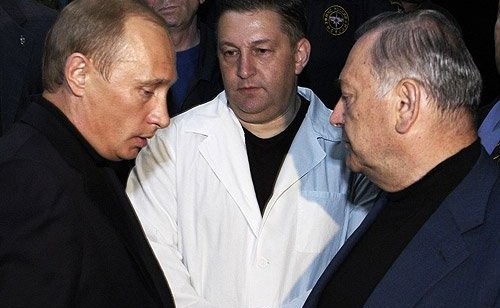
At the Beslan hospital the Kremlin text says "everyone who gives in to this kind of provocation will be seen as accomplices in this act of terrorism and supporters of the terrorists". The entry tags guilt by association: those who yield are placed on the side of the attackers. Read the technique: guilt by association.
The day after the first parliamentary elections in Chechnya since the war began, the Kremlin text quotes Putin saying the Chechen people "have shown that no one and nothing can frighten them" and that turnout exceeded 60 percent. The entry tags testimonial.
Putin sat between Alu Alkhanov and Ramzan Kadyrov under the Russian and Chechen flags. The entry tags transfer: federal and local authority is shown as one.
How did the Kremlin end the war's legal regime in 2009?
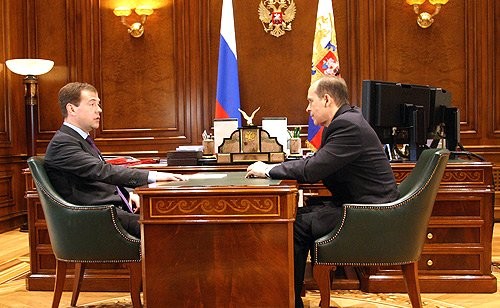
In March 2009 President Dmitry Medvedev told the FSB director to prepare lifting the "counter-terrorist operation regime" in Chechnya, with agencies still to monitor the republic. The entry tags euphemism: a decade of armed conflict is described by an administrative regime that can be "lifted". Read the technique: euphemism.
Which techniques recur?
The same definitions apply to every issuer. These recur:
Explain moreShow less
- Transfer. Soldiers, a cockpit, flags and a grave lend prestige and legitimacy. Transfer.
- Testimonial. The head of state certifies a vote as proof of the population's trust. Testimonial.
- Fear appeal and guilt by association. After Beslan, a war frame and a warning about who counts as an accomplice. Fear appeal.
- Euphemism. An administrative regime stands for an armed conflict. Euphemism.
Scale, intent and context differ from other pages. The Russian presidency is the state that waged the war, and its officials appear with the local leaders it photographs; and these items are official photographs and statements, not anonymous leaflets. The entries cite the Kremlin's own text and note what the objects themselves cannot show: whether the votes were free, or what the war cost. The page does not treat this record as the whole of the conflict. It shows what one issuer told its audience.
What to look for in Chechen war propaganda
- Who is speaking. Here, always the presidency. Official photographs choose what the viewer sees.
- Staging. Who stands beside the head of state, and under which flags.
- The date against the event. A meeting on the day a leader was killed, or the day after an election.
- What is left out. The other parties to the war are absent from this collection.
See also types of propaganda, propaganda examples and psychological operations.
Browse Chechen war propaganda
The grid below shows objects from the collection tagged to the Second Chechen War. Each opens an object page with the holding institution, a link to the original record, a transcription of any text and the rights basis for hosting.
Sources and further reading
Sources and rights
Objects on this page come from the Presidential Executive Office of Russia (kremlin.ru, CC BY 4.0) and Wikimedia Commons copies…
Objects on this page come from the Presidential Executive Office of Russia (kremlin.ru, CC BY 4.0) and Wikimedia Commons copies of Kremlin photographs. Each object page gives its own rights basis. Transcriptions are verbatim. Counts were made from the entry files in examples/entries/.