Content note: this page reproduces anti-suffrage material that argues for "White Supremacy" and refers to Black voters as "the negro", and cartoons that caricature opponents as vice figures.
In one line: both the US campaign for women's votes and the campaign against it ran mostly on open, signed persuasion (petitions, parades, hearings, leaflets), and each side also printed material that fits the same few technique definitions; the violence and imprisonment in the record fell on suffragists.
What happened
- 1890. The two national suffrage bodies merge into the National American Woman Suffrage Association (NAWSA), which leads much of the campaign until 1920 (National Archives).
- 1908 to 1914, Britain (context). The Pankhursts' militant wing uses heckling and property damage under the slogan "Deeds not words"; members are arrested and hunger-strike (National Archives). Opponents form the Women's National Anti-Suffrage League, whose July 1908 organising meeting the Library of Congress holds in a press clipping. Alice Paul works with the militants, is imprisoned and is force-fed before returning to the US.
- Anti-suffrage associations, US. State associations publish reports and periodicals, such as the Massachusetts association's quarterly The Remonstrance. Many officers are women: Alice Hill Chittenden presides over the New York State Association Opposed to Woman Suffrage.
- 3 March 1913. NAWSA's procession in Washington, organised by Paul's committee the day before Woodrow Wilson's inauguration: more than 5,000 marchers, nine bands, about twenty-four floats, Inez Milholland on a white horse, and an allegorical tableau with Columbia on the Treasury steps. Paul and her committee suggest Black women march at the rear rather than with their state delegations; Paul writes to Alice Stone Blackwell that "it would be unfortunate if we had any large number of negroes in our Suffrage Procession" in segregated Washington (Library of Congress). Ida B. Wells-Barnett refuses to march at the back and walks with the Illinois delegation (National Archives).
- Same day. Crowds, mostly men in town for the inauguration, block the route; marchers are "jeered, tripped, grabbed, shoved" (Library of Congress). About 100 are taken to hospital and cavalry is called from Fort Myer. A Senate subcommittee hears over 100 witnesses; the police chief is removed in 1915.
- 30 May 1913. Anti-suffrage leaders take 1,200 people up the Hudson for a Decoration Day picnic (Library of Congress caption).
- 10 January 1917. The National Woman's Party (NWP) begins picketing the White House, the first organised protest at its gates. From June to November 1917, 218 pickets are arrested, charged with "obstructing sidewalk traffic". Jailed pickets hunger-strike and are force-fed. On 4 March 1918 the D.C. Court of Appeals reverses the convictions in Hunter et al. v. District of Columbia (National Archives).
- 1917. The Women Voters Anti-Suffrage Party of New York petitions the Senate not to pass a federal amendment (National Archives).
- 1918 to 1920. Wilson backs an amendment in 1918. Congress passes it on 4 June 1919. During ratification, southern opponents print broadsides against it. Tennessee ratifies on 18 August 1920.
How it works
- Transfer, both sides. The NWP banner addressed "Kaiser Wilson" in 1917 borrows the stigma of the wartime enemy's ruler for the President. A 1915 pro-suffrage Puck cartoon stands the "Anti" singer in front of a chorus labelled procurer, dive keeper, grafter and sweat shop owner. On the other side, the Virginia Association Opposed to Woman's Suffrage calls suffrage "THE VANGUARD OF SOCIALISM" because suffragists and socialists "openly marched together" in a New York parade. In each case, closeness to a stigmatised group stands in for evidence about the target.
- Fear appeal, documented here on the anti-suffrage side. A Georgia card warns of "danger to farmers' families if negro men vote". The Virginia broadside ends "Danger lies ahead of you." A 1920 Alabama broadside predicts "a nation of degeneration". Each offers one remedy: a vote against. No suffrage item examined for this page fits the definition as closely. The British poster of a force-fed prisoner shows a practice that is documented, so it is not scored here.
- Testimonial, anti-suffrage side. The Alabama broadside opens with a quotation credited to "Dr. William J. Hichson, Chicago University", and his title stands in for evidence. The famous marchers of 1913, such as Helen Keller and Nellie Bly, took part in the event themselves, which the definition excludes.
- Bandwagon, anti-suffrage side. The Georgia card's first reason is "the women of Georgia do not want the vote", given with no count. NAWSA's 1913 call said the parade "will be taken to indicate the importance of the suffrage movement". It pointed to a real turnout, which the definition's "not" clause excludes.
- Open persuasion, both sides. Most of the record is signed and attributed: NAWSA petitions every year from 1869, anti-suffrage petitions and annual reports, testimony at hearings, parades, picnics, newspapers and pickets holding signed banners. This is ordinary open advocacy, not a technique in the taxonomy. The New York State Woman Suffrage Association's journal used the word itself, saying that "no propaganda work undertaken by the State Association and the Party has ever achieved such publicity" as the 1913 hike to Washington.
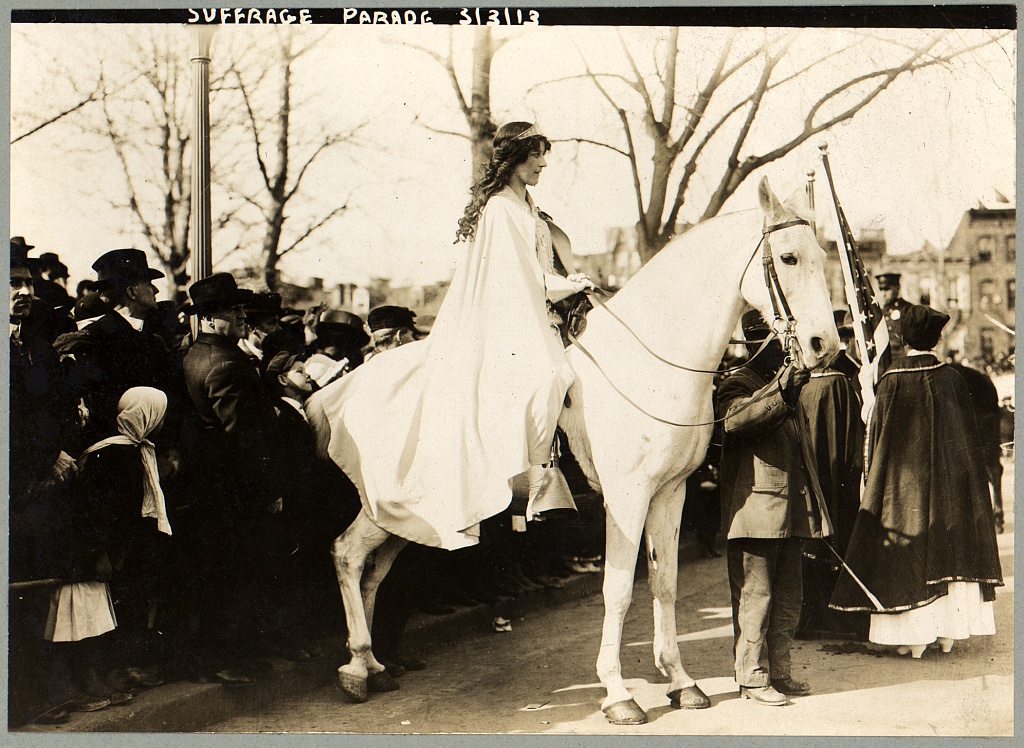
Inez Milholland leads the NAWSA procession, Washington, 3 March 1913 (Bain News Service). Public domain.
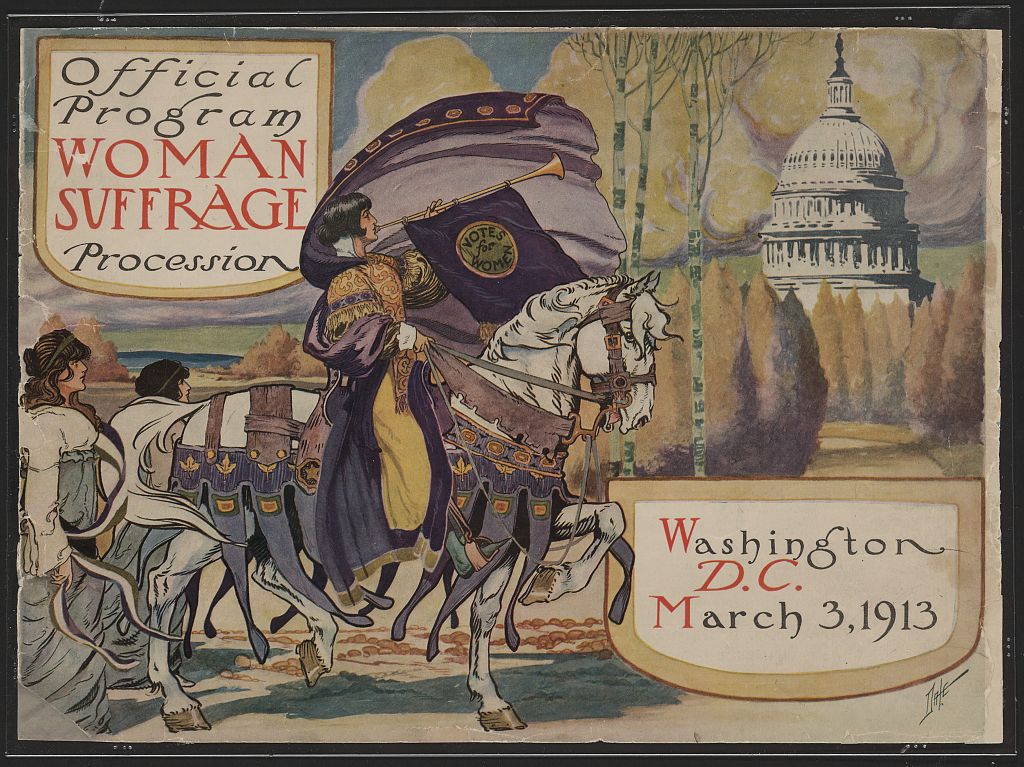
Official programme of the 3 March 1913 procession, cover by Benjamin M. Dale. Public domain.
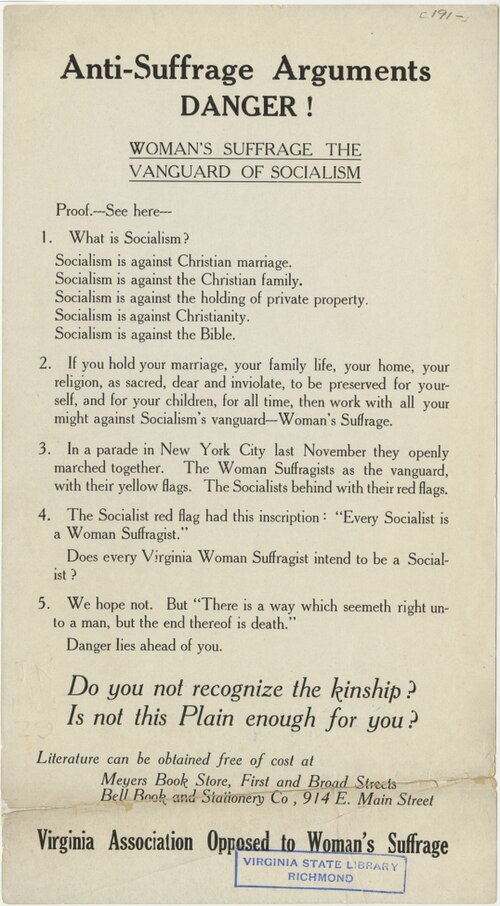
"Anti-Suffrage Arguments: DANGER!", Virginia Association Opposed to Woman's Suffrage, c. 1913. Public domain.
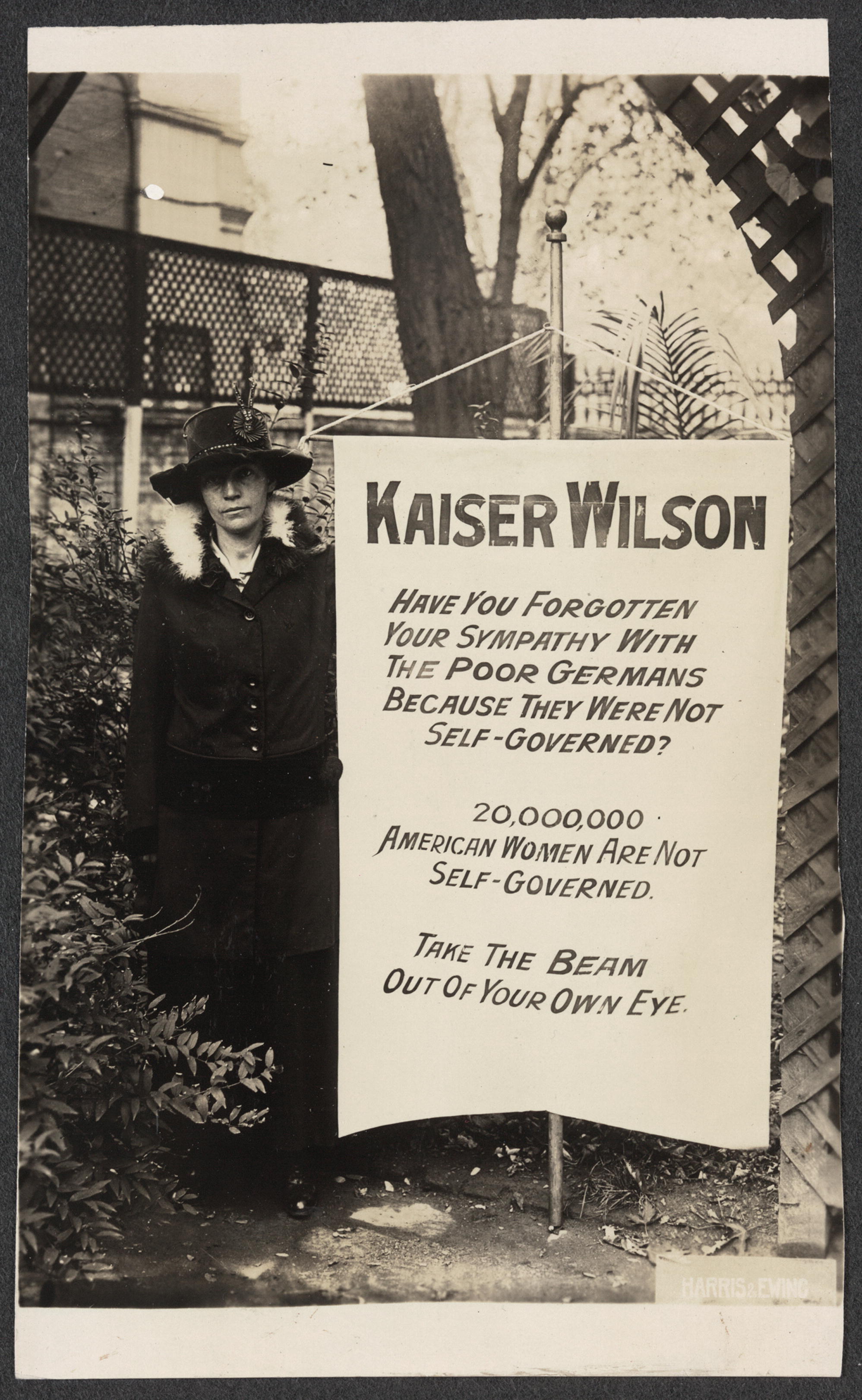
Virginia Arnold [holding Kaiser Wilson banner], National Woman's Party (photo: Harris & Ewing), 1917. Public domain.
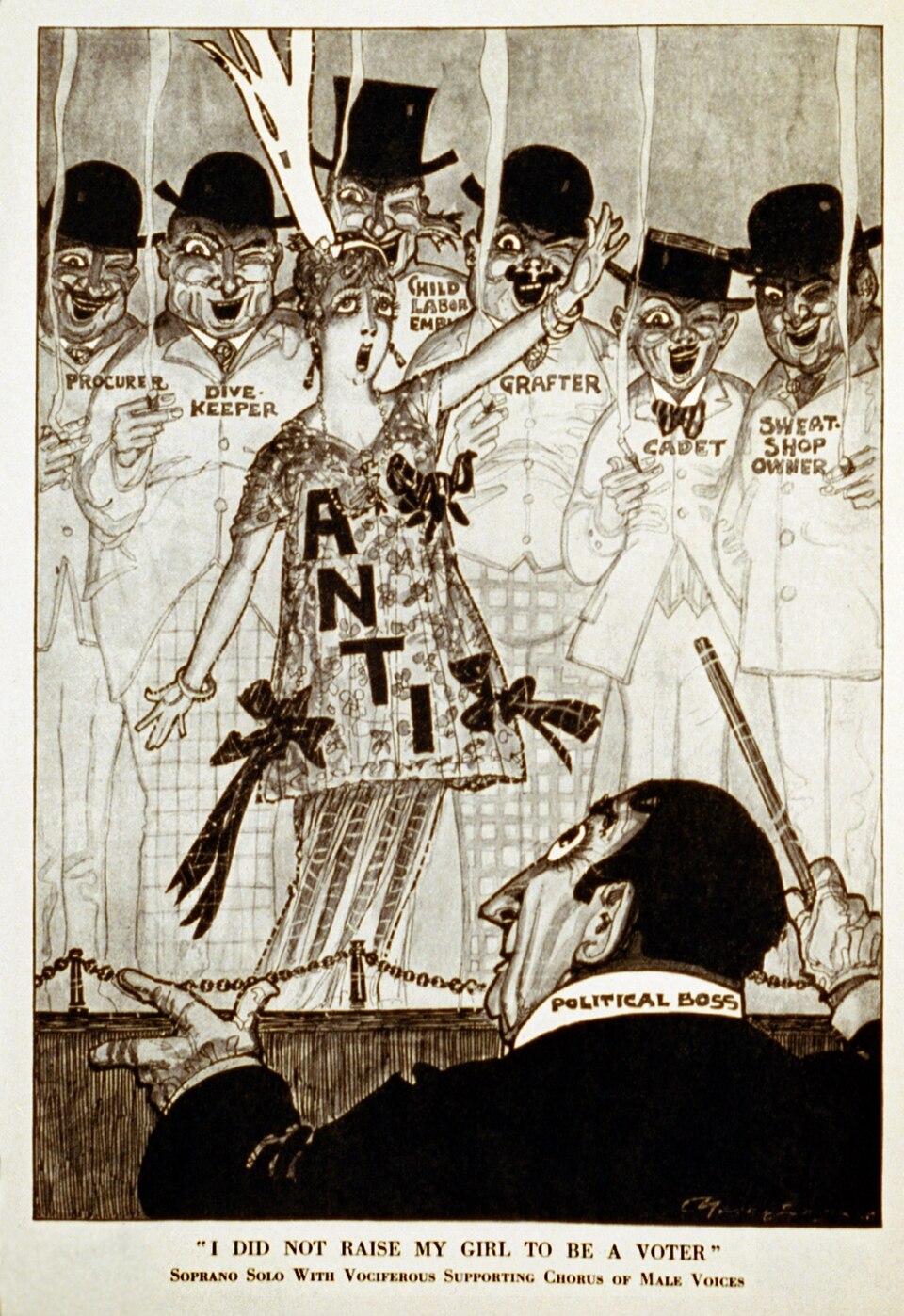
"I did not raise my girl to be a voter", Puck, 1915. Public domain.
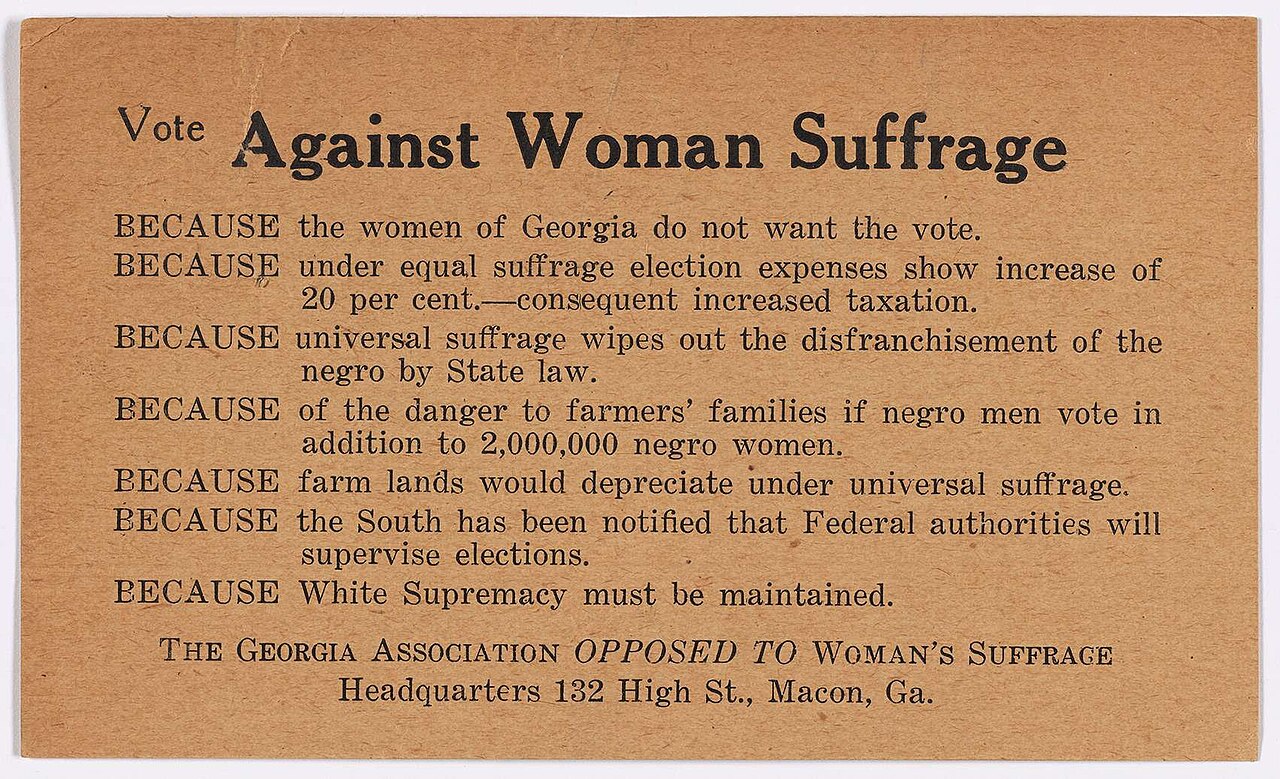
Vote Against Woman Suffrage, Georgia Association Opposed to Woman's Suffrage, c. 1915. Public domain.
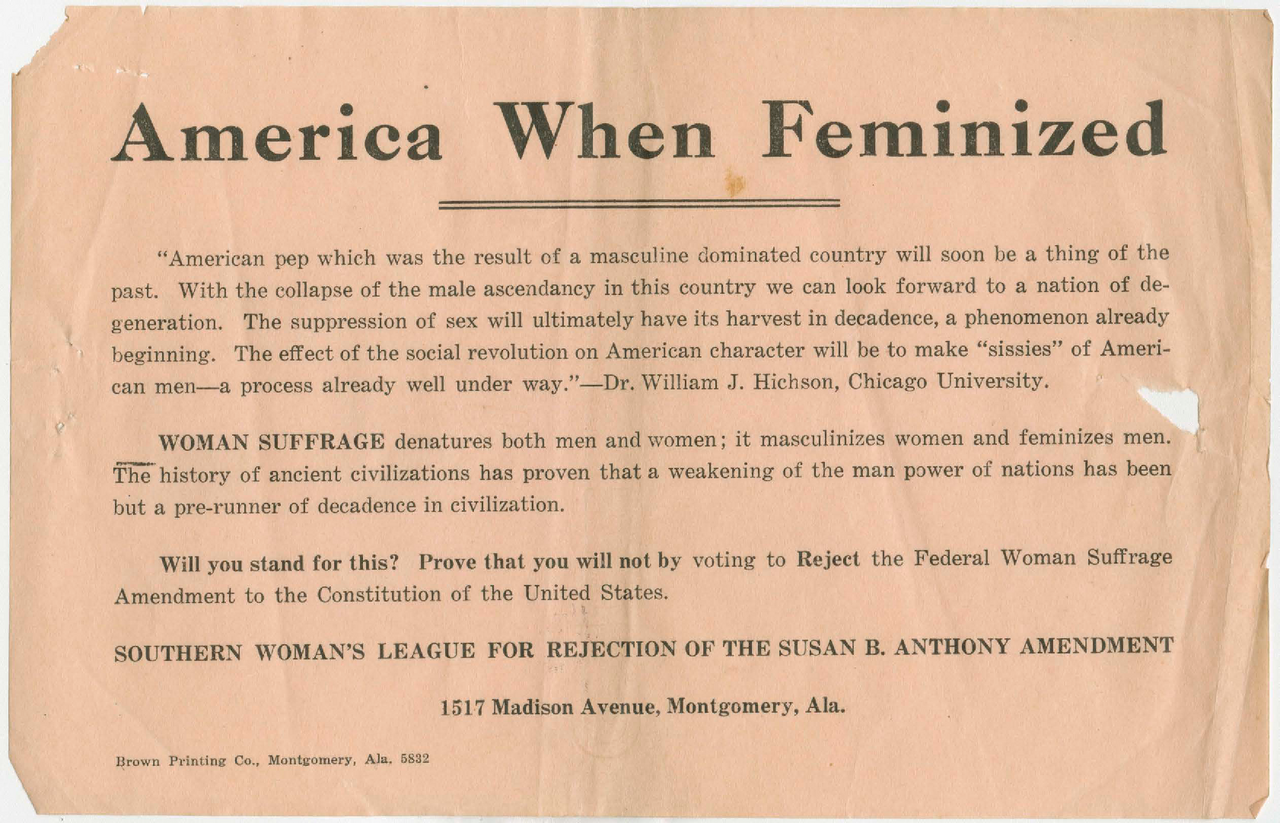
America When Feminized, Southern Woman's League for Rejection of the Susan B. Anthony Amendment, 1920. Public domain.
Then and now
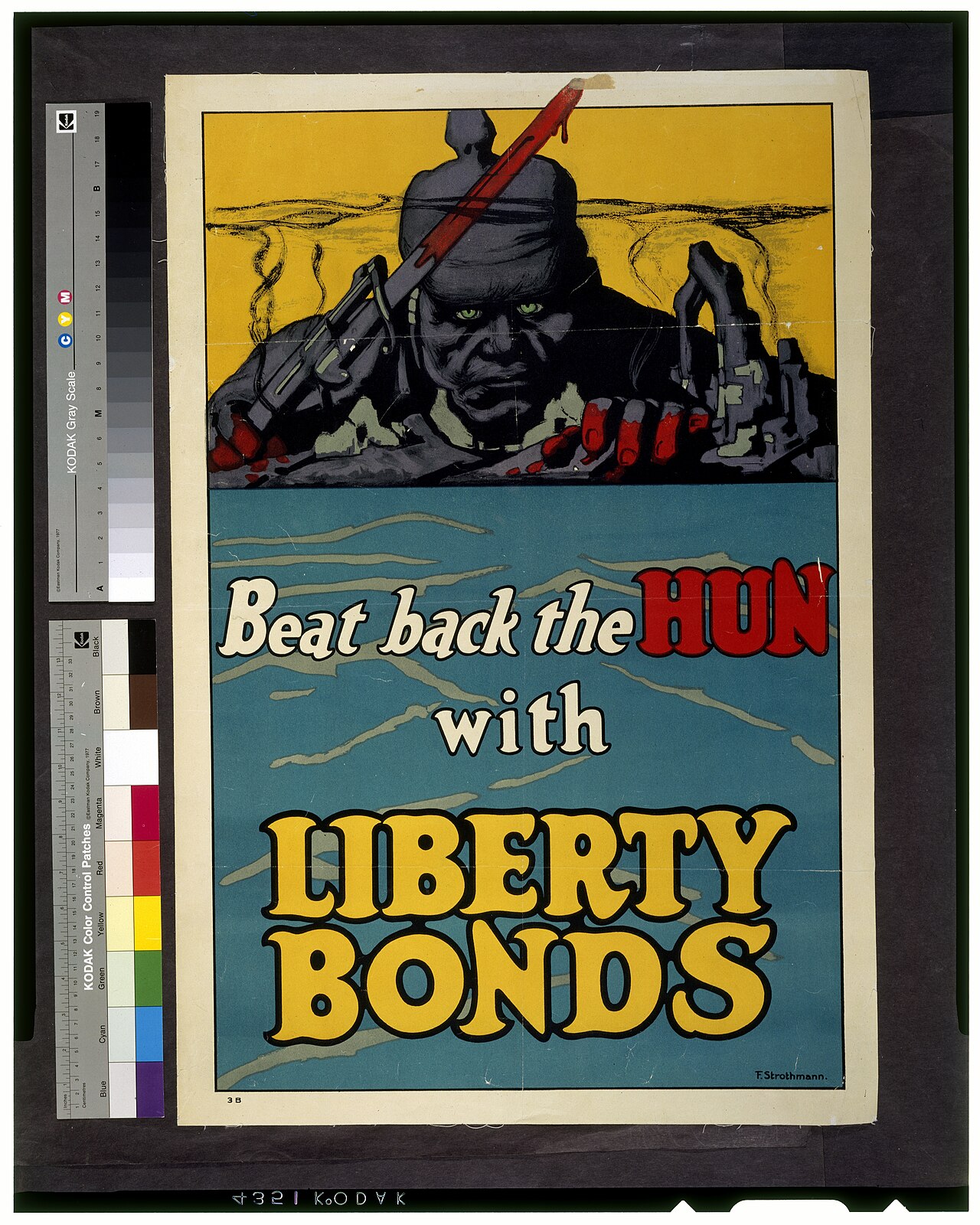
Beat Back the Hun with Liberty Bonds, U.S. Treasury Department, 1918. Public domain.
In 1917 and 1918 US government war posters such as Beat Back the Hun with Liberty Bonds attached wartime enemy stigma to Germany. The NWP's "Kaiser Wilson" banner turned that stigma against the government itself. The banner also made a claim a reader could check ("20,000,000 American women are not self-governed"), while the Treasury poster paired its label with a request to buy bonds. The difference in power is plain: the government printed its posters with state backing, and NWP pickets were being arrested and jailed in the same months.
The 1913 procession shows a second pattern. The crowd's treatment of the marchers became the story, and suffrage papers used it: "Parade Struggles to Victory Despite Disgraceful Scenes, Nation Aroused by Open Insults to Women-Cause Wins Popular Sympathy" (Woman's Journal). This was reporting of real, documented events, so it is not Outrage bait.
Positions on the record
- Suffragists, in their own words: marchers came to "march in a spirit of protest against the present political organization of society, from which women are excluded" (1913). The pickets' banner said: "Kaiser Wilson Have you forgotten your sympathy with the poor Germans because they were not self-governed? 20,000,000 American women are not self-governed. Take the beam out of your own eye."
- Anti-suffragists, in their own words: "If you hold your marriage, your family life, your home, your religion, as sacred ... then work with all your might against Socialism's vanguard—Woman's Suffrage" (Virginia). "BECAUSE White Supremacy must be maintained" (Georgia). Woman suffrage "masculinizes women and feminizes men" (Alabama, 1920).
- This archive's reading: the organisations on both sides mostly argued in the open and under their own names. Racial exclusion appears on both sides of the record: the Georgia card states it as a reason, and the 1913 organisers tried to keep Black women out of the main line. The physical violence documented here (the 1913 crowd, the 1917 attacks on pickets that an NWP photograph caption records, force-feeding in jail) fell on suffragists. It came from crowds and the authorities; this record does not show that any anti-suffrage association organised it. In Britain, the militant suffrage wing did damage property. Not covered here: the racial arguments some white southern suffragists made, and any liquor-industry funding of anti-suffrage work. Neither could be checked against a source during this build, so neither is described here.
Same-method test
Swap the sides and the scores stay the same. A pro-suffrage card saying "the women of Georgia want the vote" with no count would be scored Bandwagon. An anti-suffrage banner calling a pro-suffrage governor "Kaiser" would be scored Transfer. The Georgia card's racial lines are scored because of how they argue (a staged threat with one remedy), not because of which side printed them.
How to spot it
- Check what a label is doing. "Kaiser", "vanguard of socialism" or a chorus of labelled vice figures links a target to a stigmatised group. Ask what the target itself did.
- When a leaflet claims a majority ("do not want the vote"), look for the count, the poll or the vote behind it.
- When a quoted expert is the only support for a prediction, check who the expert is and what data they cite.
- Keep form and cause apart. A parade, a petition or a signed banner is open advocacy whatever it argues for.
Images
| Image | Source | Licence |
|---|---|---|
| Virginia Arnold with "Kaiser Wilson" banner (1917) | Library of Congress, NWP records, Harris & Ewing | Public domain (LoC: no known restrictions) |
| "I did not raise my girl to be a voter", Puck (1915) | Library of Congress, via Wikimedia Commons | Public domain (published 1915) |
| "Vote Against Woman Suffrage", Georgia (c. 1915) | National Archives, DocsTeach, via Wikimedia Commons | Public domain (published before 1931) |
| "America When Feminized" (1920) | Alabama Department of Archives and History, via Wikimedia Commons | Public domain (published 1920) |
| Inez Milholland on horseback (1913) | Library of Congress, Bain News Service | Public domain (published 1913; no known restrictions) |
| Official programme, suffrage procession (1913) | Library of Congress, cover by Benjamin M. Dale | Public domain (published 1913; no known restrictions) |
| "Anti-Suffrage Arguments: DANGER!", Virginia (c. 1913) | Wikimedia Commons, from the Library of Virginia | Public domain (published before 1931) |
| Beat Back the Hun (1918) | FRAME gallery | Public domain (U.S. government work) |

Image gaps
- The NWP's "Sailors attacking pickets, 1917" photograph (LoC). Not added, to keep the images to campaign material from each side; a good addition to show the violence described above.
- The anti-suffrage "Household Hints" leaflet and anti-suffrage postcards. No reachable source copy with a verifiable date was found during this build.
- British WSPU and Artists' Suffrage League posters. Public domain in the US, but some artists died after 1955 (Duncan Grant, 1978), so UK copyright may still apply. Cited, not hosted.
Sources
- Library of Congress, "Marching for the Vote: Remembering the Woman Suffrage Parade of 1913"
- Library of Congress, "Parade Planning Exposes Racial Divides," Shall Not Be Denied exhibition
- National Archives, "19th Amendment at 100: Woman Suffrage Comes to Washington"
- National Archives, "Suffrage and suffering at the 1913 March"
- National Archives, "Women Are First to Protest White House"
- National Archives, "The Movement as a Mosaic: Alice Paul and Woman Suffrage"
- National Archives, Woman Suffrage and the 19th Amendment (educator resources)
- National Archives, 19th Amendment milestone document
- Library of Congress, Virginia Arnold holding Kaiser Wilson banner
- Library of Congress, Puck, 9 October 1915
- Library of Congress, The Remonstrance, Massachusetts association, 1909
- Library of Congress, Women's National Anti-Suffrage League organizing meeting, 1908
- Library of Congress, Alice H. Chittenden
- Library of Congress, anti-suffrage leaders' Decoration Day picnic, 1913
- Library of Congress, British poster "Torturing women in prison"
- Library of Virginia, "Woman Suffrage: The Vanguard of Socialism"
- National Archives, petition of the Women Voters Anti-Suffrage Party of New York, 1917