Illustration: a dossier collage of an evidence wall of pinned propaganda posters, leaflets and printed matter from many eras, with contact sheets and catalog labels.

Collection

Spanish-American War propaganda: yellow press, Maine and cartoons

Spanish-American War propaganda of 1896 to 1900: Maine front pages, Puck and Judge cartoons, Spanish magazine art and Aguinaldo's decree, tagged.

Illustration, not an archive object

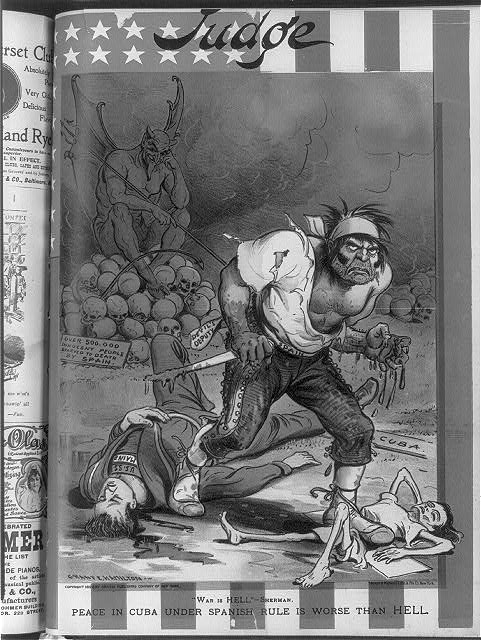
Content note. Several American cartoons of 1896 to 1900 use racial caricature of Cubans, Filipinos, Hawaiians, Puerto Ricans and Black Americans, one cartoon shows a brutal figure of Spain trampling a child, and one photograph shows two dead Filipino soldiers. They are shown as issued, as evidence of what each side told its public. Showing an item is not endorsing it.

What was Spanish-American War propaganda?

Spanish-American War propaganda is the cartoons, front pages, prints and notices that argued for, against or about the war of 1898 between the United States and Spain, and the Philippine war that followed. The archive holds American newspaper and magazine items, two Spanish magazine cartoons, a Cuban-cause print and one Filipino decree, and tags each by technique.
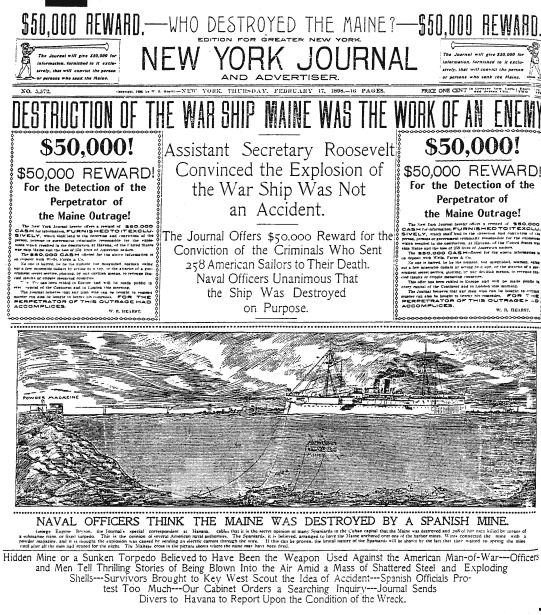
New York Journal and Advertiser front page, 17 February 1898, with a banner saying the Maine was destroyed by an enemy and a $50,000 reward

Newspaper coverage of the Maine, 1898

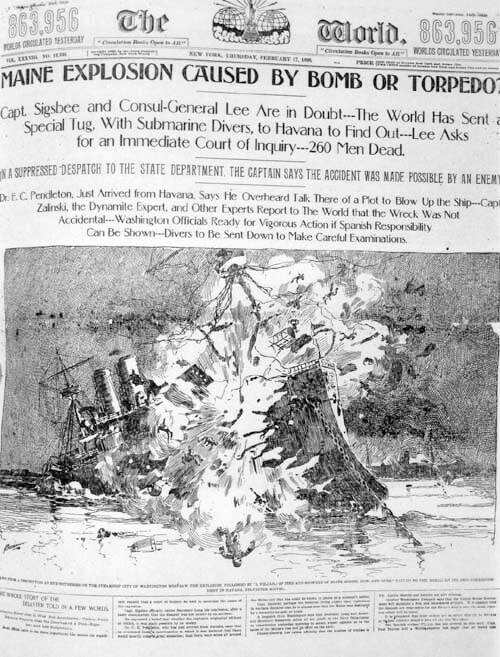
The battleship USS Maine exploded in Havana harbour on 15 February 1898. Two days later, before the Navy court of inquiry had taken evidence, Hearst's Journal ran a banner that the ship was "the work of an enemy" beside a $50,000 reward box (Card stacking). Pulitzer's World led the same day with "bomb or torpedo", though its deck admitted the officers were in doubt. The inquiry of March 1898 reported an external mine; a 1976 study judged an internal fire more probable, and the cause remains debated. Historians of the "yellow press" also question how far the papers caused the war.

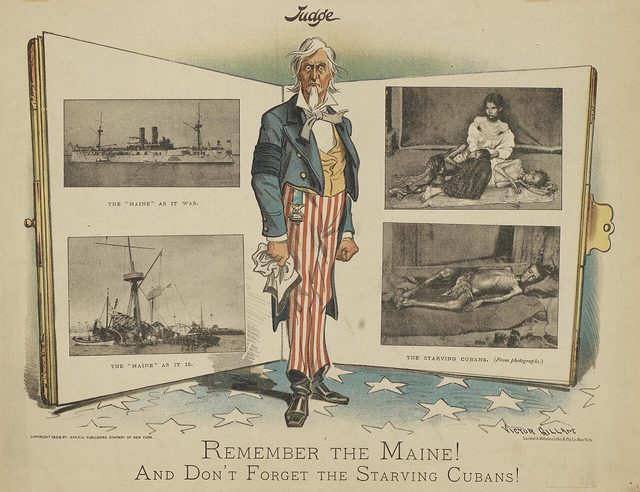
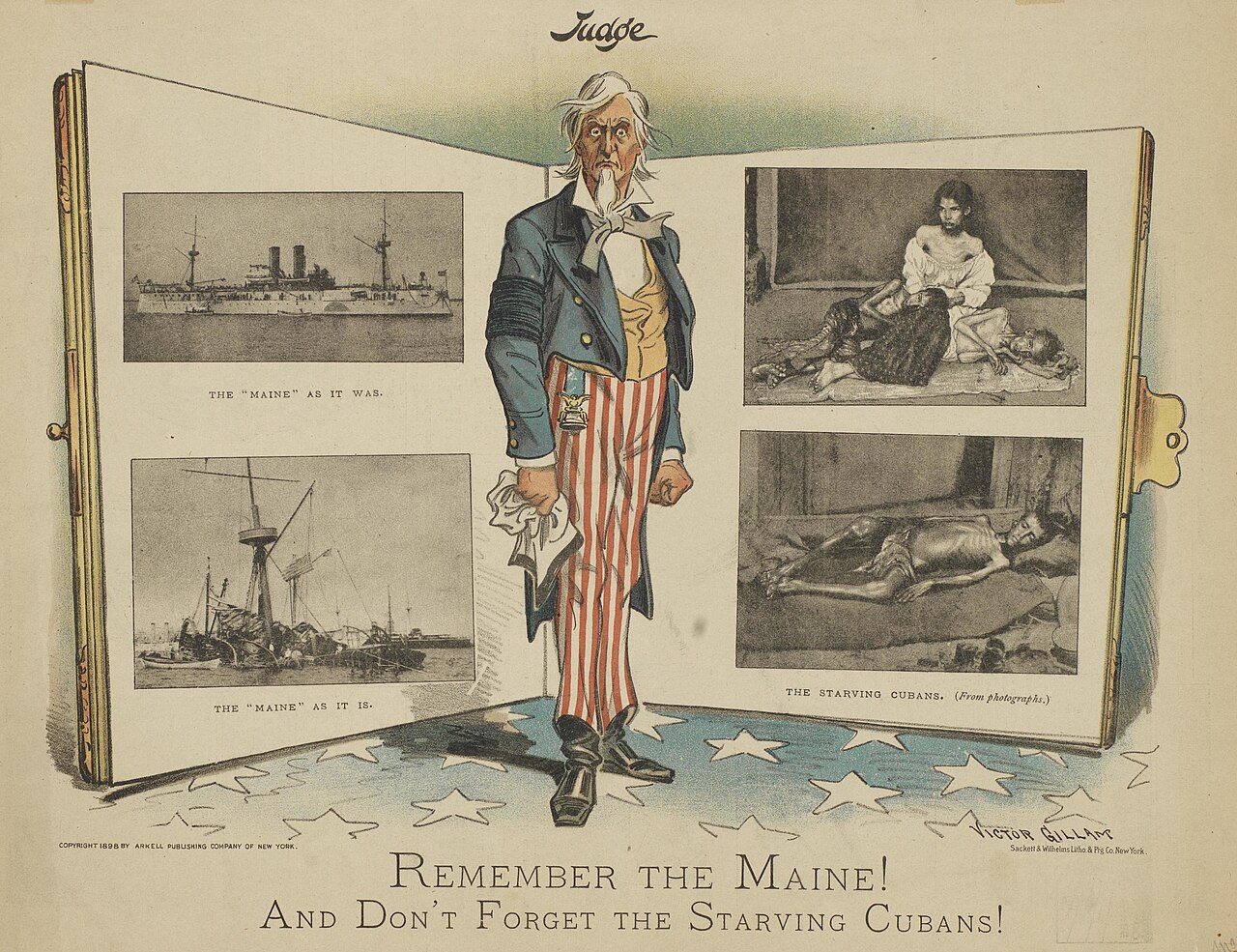
Content note: Photographs of emaciated, starving Cuban civilians reproduced in an 1898 American magazine cartoon. This object is shown as it was published. Why Judge cartoon of 1898: Uncle Sam stands between photographs of the wrecked Maine and starving Cuban civilians
Explain moreShow less

Judge of 7 May 1898 set the wreck and photographs of starving Cubans on facing album pages. Judge of 30 April showed Spain trampling a child and a dead sailor and borrowed Sherman's line on war (Fear appeal, Scapegoating).

Cuba before the war, 1896
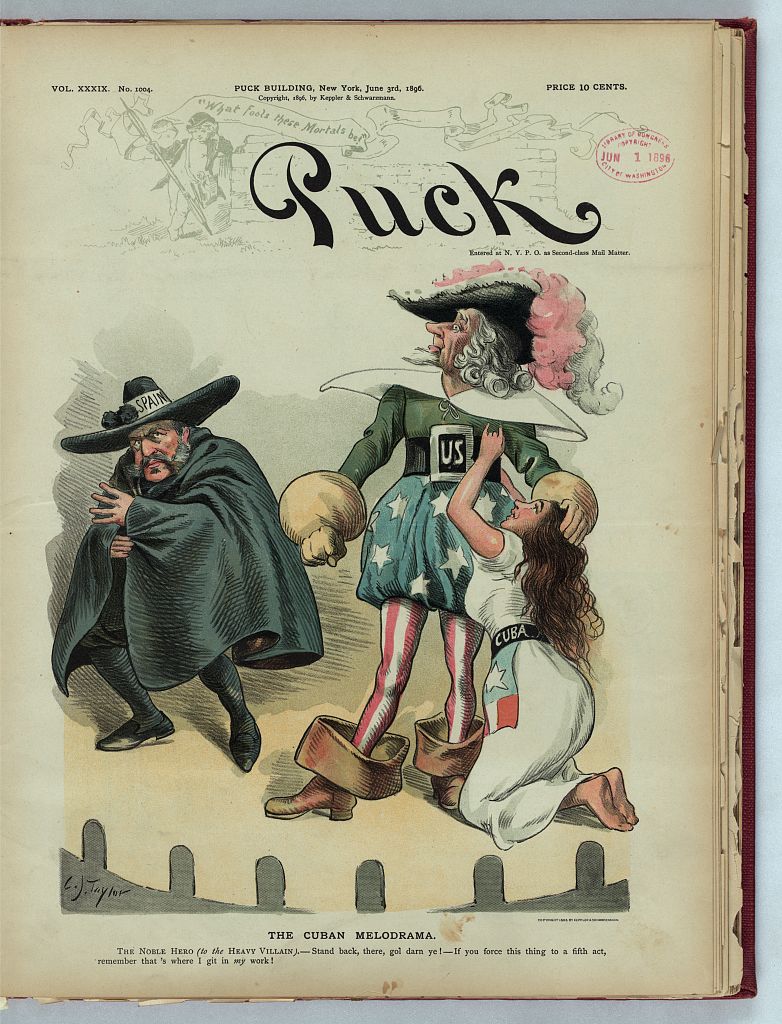
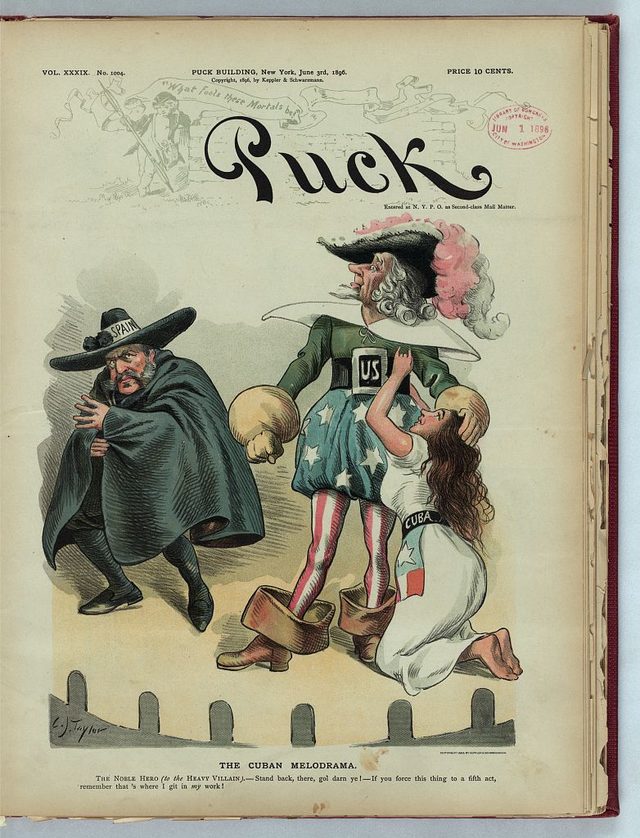
Puck cover of 1896: Uncle Sam as Noble Hero tells a villain marked Spain to stand back from a kneeling woman marked Cuba

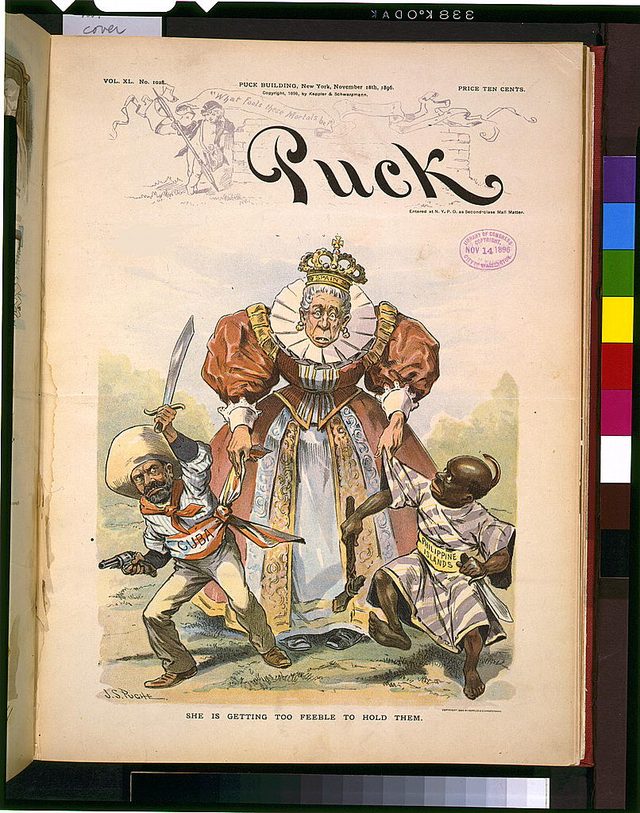
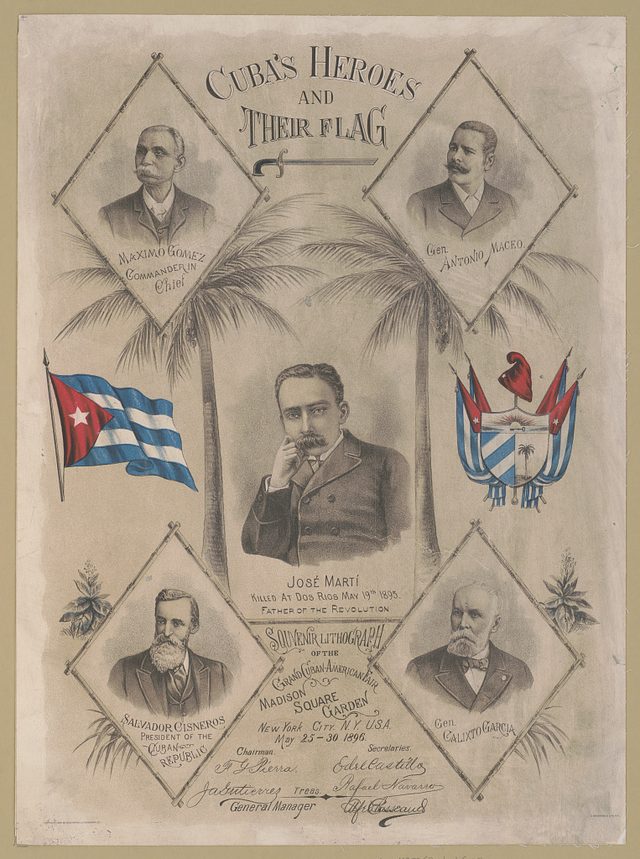
Puck cast the conflict as a stage melodrama in June 1896, two years before the declaration of war (Name-calling, Transfer). A November 1896 cover drew Cuba and the Philippines as armed boys that Spain could no longer hold. A New York fair committee's souvenir lithograph of May 1896 gathered portraits of five insurgent leaders under the Cuban flag.

The Spanish side
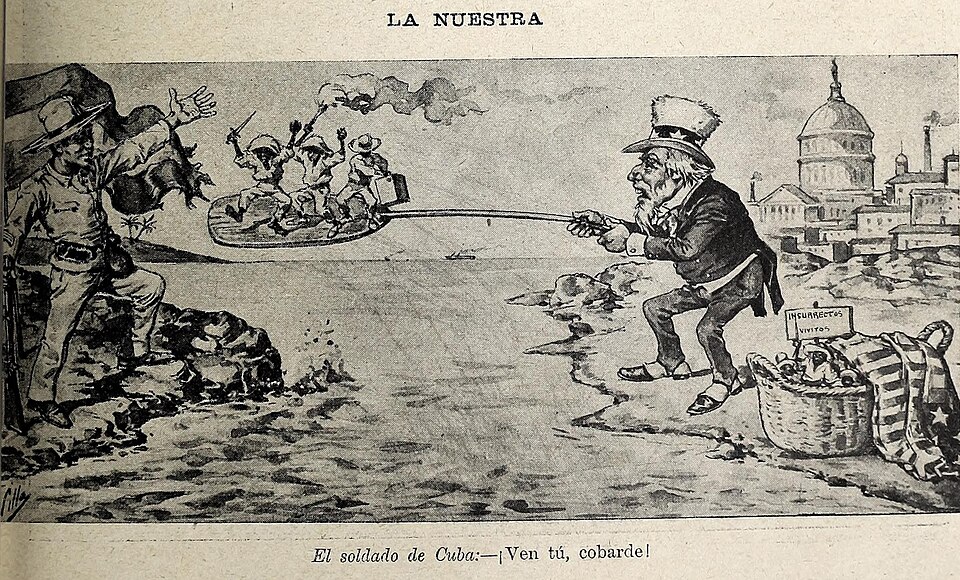
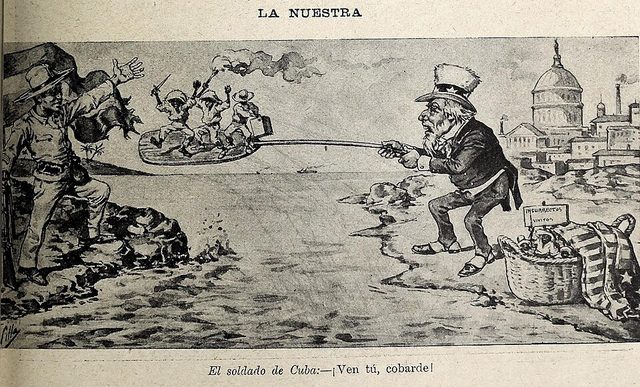
Blanco y Negro, 1898: a Spanish soldier on a Cuban shore shouts across the water at Uncle Sam

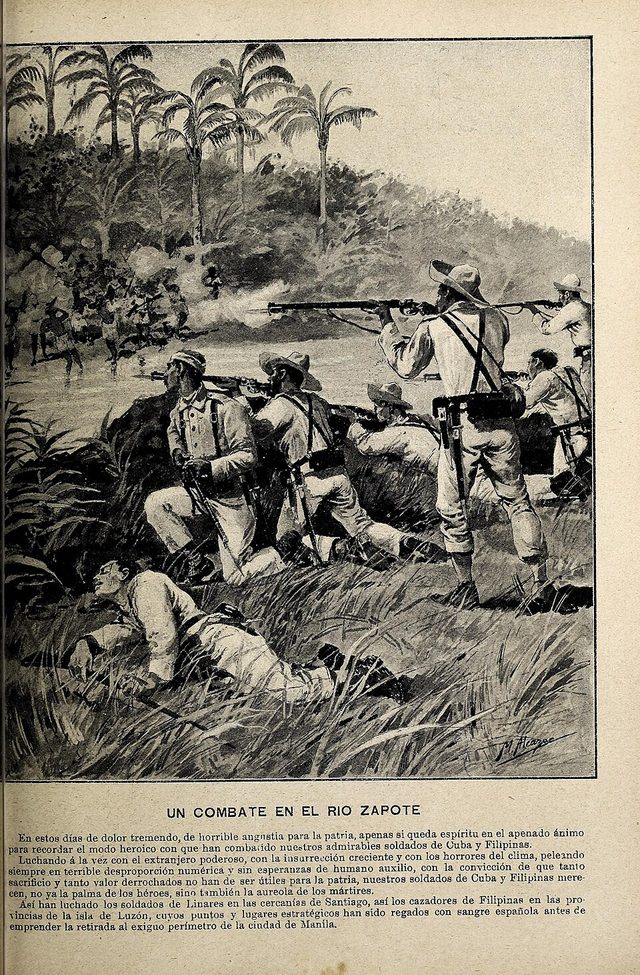
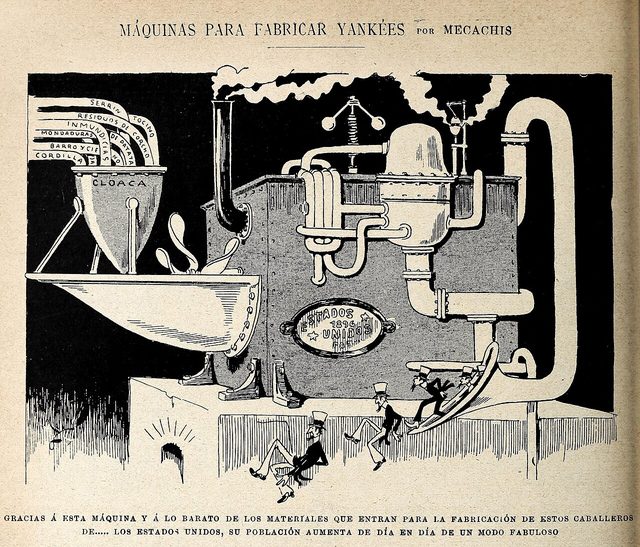
The Madrid weekly Blanco y Negro drew the United States as a machine turning rubbish into Yankees (April 1896) and, in May 1898, as a coward holding the insurgents on a platter. Its July 1898 full page praised Spanish infantry at the Zapote river in stacked virtue words (Glittering generalities). The same techniques appear on both sides.

The Philippine war, 1899 to 1900
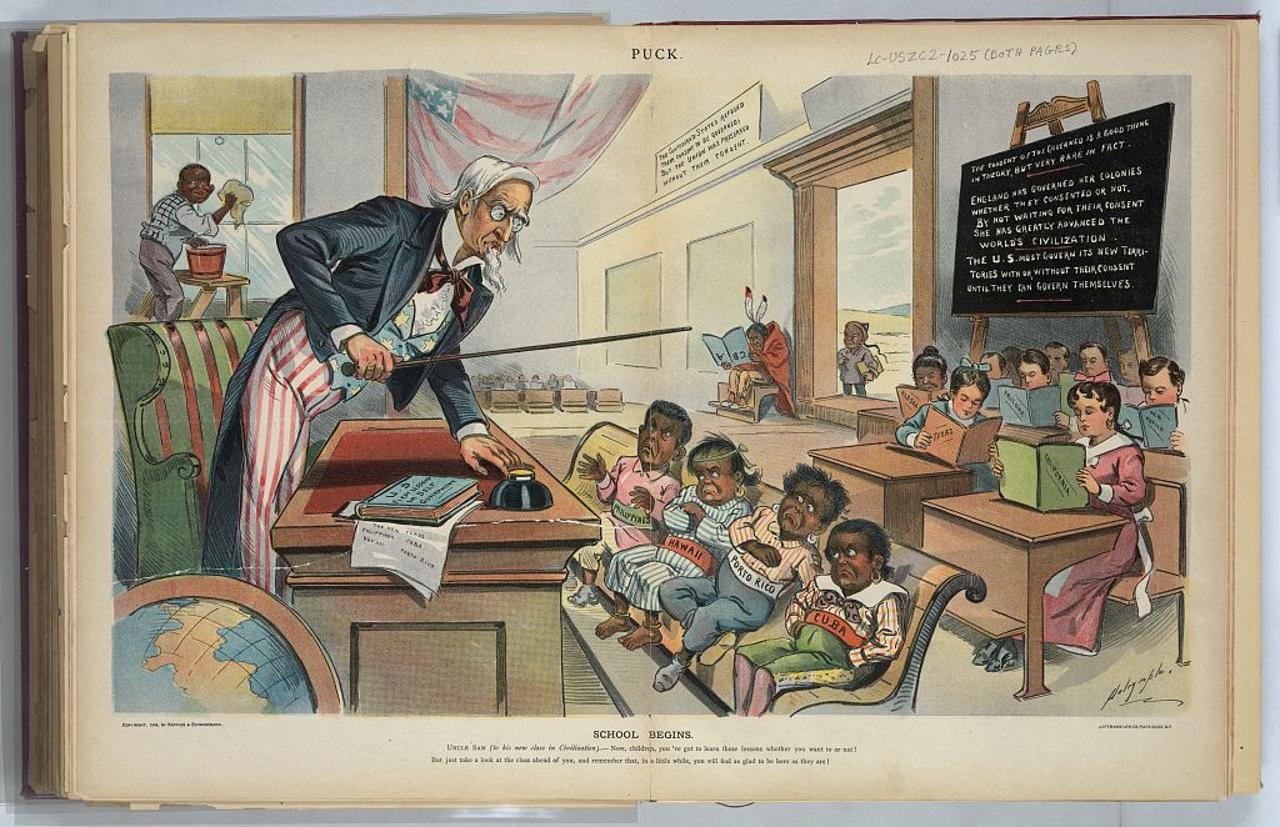
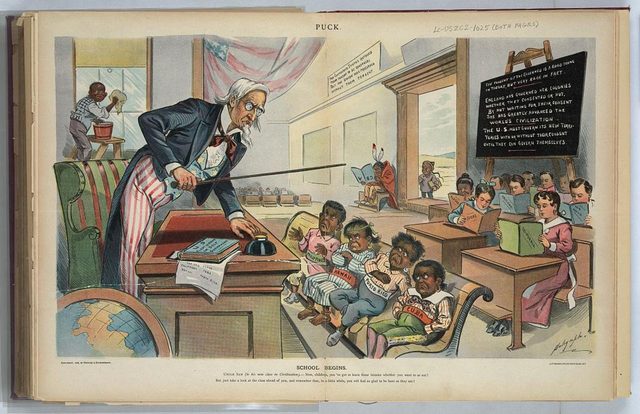
Puck cartoon of 1899: Uncle Sam teaches pupils marked Philippines, Hawaii, Porto Rico and Cuba

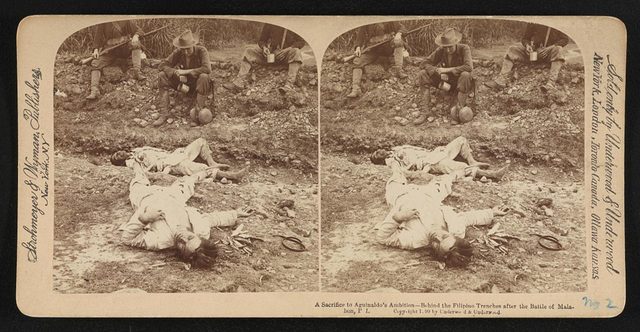
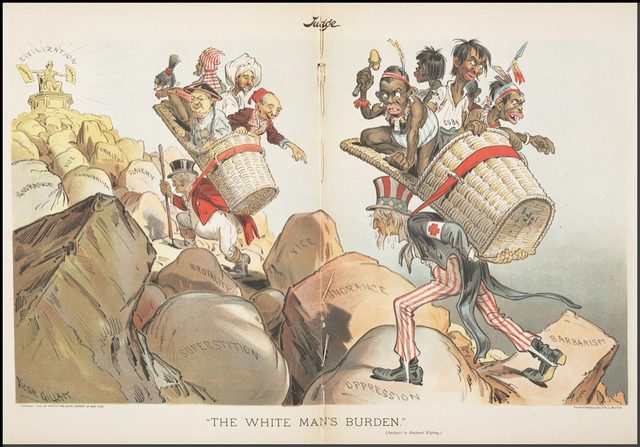
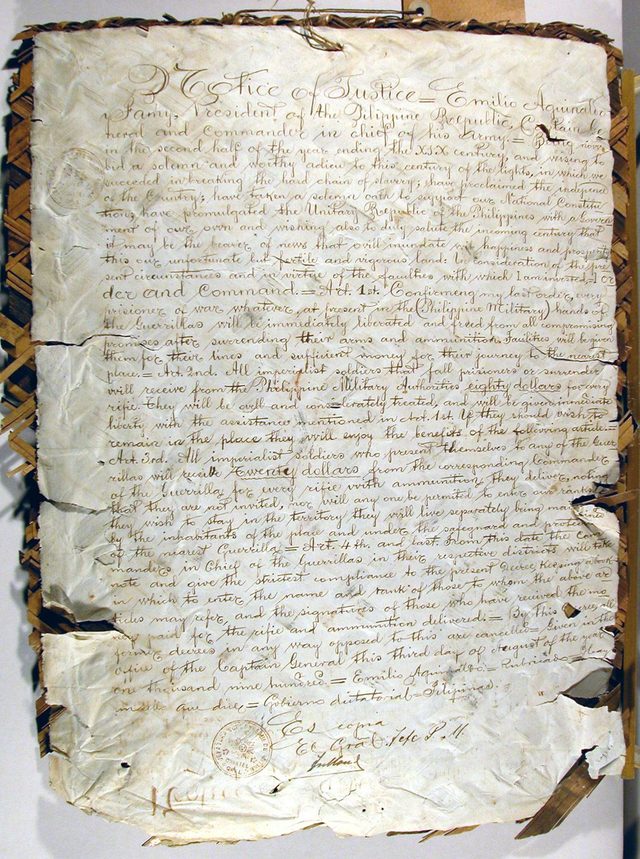
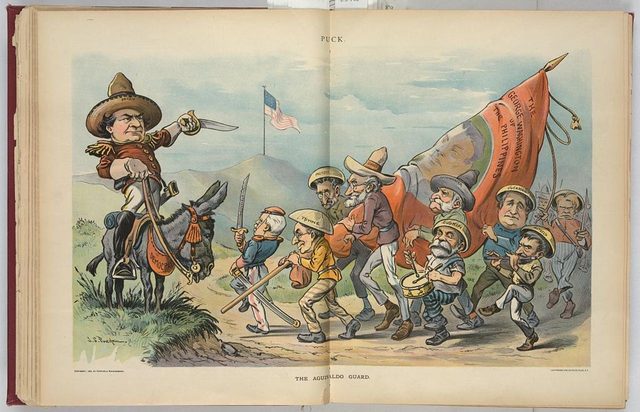
After the peace of 1898 the American press argued over the new territories. Puck's "School Begins" and Judge's "The White Man's Burden" (1899) present annexation as teaching and duty. A stereograph sold to households captioned dead Filipino soldiers as a sacrifice to Aguinaldo's ambition, and Puck in 1900 drew American anti-imperialists as Aguinaldo's guard. From the Filipino side the collection holds Aguinaldo's decree of 3 August 1900 offering rifle money to soldiers who surrender.

What the collection does not hold

  • Not here: US recruiting posters and volunteer appeals of 1898, Rough Rider imagery, and sheet music or advertising of the war.
  • Not here: Cuban insurgent leaflets and newspapers, and Filipino newspapers and posters beyond the one decree.
  • Not here: the Spanish daily press, and Spanish government statements.
  • Not hosted: the 1902 "kill every one over ten" cartoon is catalogued but has no hosted image.

See also: Cuban propaganda posters.

Sources and further reading

Sources

W. Joseph Campbell, The Year That Defined American Journalism (2006).

W. Joseph Campbell, The Year That Defined American Journalism (2006). Library of Congress, Prints and Photographs Division. Wikimedia Commons. Each item in the grid carries its own source and rights note.
Spanish-American War propaganda in the collection

Showing 16 of 16 objects. Filter the whole collection.

Cuba's Heroes and Their Flag: Souvenir Lithograph of the Grand Cuban-American FairCuban Independence MovementCuba's Heroes and Their Flag: Souvenir Lithograph of the Grand Cuban-American Fair1896 · TransferMáquinas para fabricar yankées (Machines for Manufacturing Yankees)SpainMáquinas para fabricar yankées (Machines for Manufacturing Yankees)Apr 11, 1896 · Name-calling"The Cuban Melodrama" (Puck cover, 3 June 1896)United States"The Cuban Melodrama" (Puck cover, 3 June 1896)Jun 3, 1896 · Name-calling, Transfer"She Is Getting Too Feeble to Hold Them" (Puck cover, 16 November 1896)United States"She Is Getting Too Feeble to Hold Them" (Puck cover, 16 November 1896)Nov 16, 1896 · Name-callingContent noteNew York Journal and Advertiser, front page, 17 February 1898 ($50,000 reward, Maine 'work of an enemy')United StatesNew York Journal and Advertiser, front page, 17 February 1898 ($50,000 reward, Maine 'work of an enemy')Feb 17, 1898 · Card stackingNew York World, front page, 17 February 1898 (Maine explosion 'caused by bomb or torpedo')United StatesNew York World, front page, 17 February 1898 (Maine explosion 'caused by bomb or torpedo')Feb 17, 1898 · Card stackingUncle Sam looks at "Cuba" holding a "Cuban Revolutionist" baby (Bartholomew cartoon, April 1898)United StatesUncle Sam looks at "Cuba" holding a "Cuban Revolutionist" baby (Bartholomew cartoon, April 1898)Apr 1898 · Appeal to emotion"'War is Hell.' Sherman, [but] Peace in Cuba under Spanish Rule Is Worse than Hell" (Judge, 30 April 1898)United States"'War is Hell.' Sherman, [but] Peace in Cuba under Spanish Rule Is Worse than Hell" (Judge, 30 April 1898)Apr 30, 1898 · Fear appeal, ScapegoatingContent noteEl soldado de Cuba: —¡Ven tú, cobarde! (The Soldier of Cuba: 'Come here, you coward!')SpainEl soldado de Cuba: —¡Ven tú, cobarde! (The Soldier of Cuba: 'Come here, you coward!')May 7, 1898 · Name-callingContent noteRemember the Maine! And Don't Forget the Starving Cubans! (Judge)United StatesRemember the Maine! And Don't Forget the Starving Cubans! (Judge)May 7, 1898 · Card stackingUn combate en el río Zapote (A Fight on the Zapote River), Blanco y NegroSpainUn combate en el río Zapote (A Fight on the Zapote River), Blanco y NegroJul 9, 1898 · Transfer, Glittering generalities"A Sacrifice to Aguinaldo's Ambition" (commercial stereograph, 1899)United States"A Sacrifice to Aguinaldo's Ambition" (commercial stereograph, 1899)1899 · Card stacking, Name-callingContent note"School Begins" (Puck, 1899)United States"School Begins" (Puck, 1899)Jan 25, 1899 · Name-calling, Glittering generalitiesContent note"The White Man's Burden (Apologies to Rudyard Kipling)" (Judge, 1899)United States"The White Man's Burden (Apologies to Rudyard Kipling)" (Judge, 1899)Apr 1, 1899 · Transfer, Glittering generalitiesContent noteNotice of Justice: Aguinaldo's decree of 3 August 1900 paying 'imperialist soldiers' for surrendered riflesFirst Philippine RepublicNotice of Justice: Aguinaldo's decree of 3 August 1900 paying 'imperialist soldiers' for surrendered riflesAug 3, 1900 · Name-calling, Glittering generalitiesContent note"The Aguinaldo Guard" (Puck, 1900)United States"The Aguinaldo Guard" (Puck, 1900)Oct 17, 1900 · Name-calling, Transfer