Content note. A few home-front salvage posters from the United States use an ethnic slur for Japanese people and a caricature of Japanese and German leaders. They are shown as issued, as evidence of what the public was told. Showing a poster is not endorsing it.
What were WW2 rationing and salvage posters?
WW2 rationing and salvage posters were government and trade sheets issued from 1939 to 1945 in Britain, the United States and Canada that asked civilians to share scarce goods, hand in scrap, fats and rags, grow vegetables, or save fuel. The collection holds about 233 such posters, by title keywords: 123 American, 94 British and 16 Canadian.
The figure counts what this archive holds, not what each country printed. The same technique vocabulary is applied to every country (how FRAME defines propaganda). For the wider war, see the WW2 propaganda hub and propaganda posters.
Who ran the rationing and price-control posters in the United States?
The Office of Price Administration (OPA) was created inside the Office for Emergency Management by Executive Order 8875 on 28 August 1941. The National Archives describes its job as setting maximum prices and rents and rationing scarce essential goods; it was abolished in May 1947. The National Park Service records that Americans received their first ration cards in May 1942, the "Sugar Book", and that rationed goods eventually included tires, gasoline, fuel oil, shoes and meat.
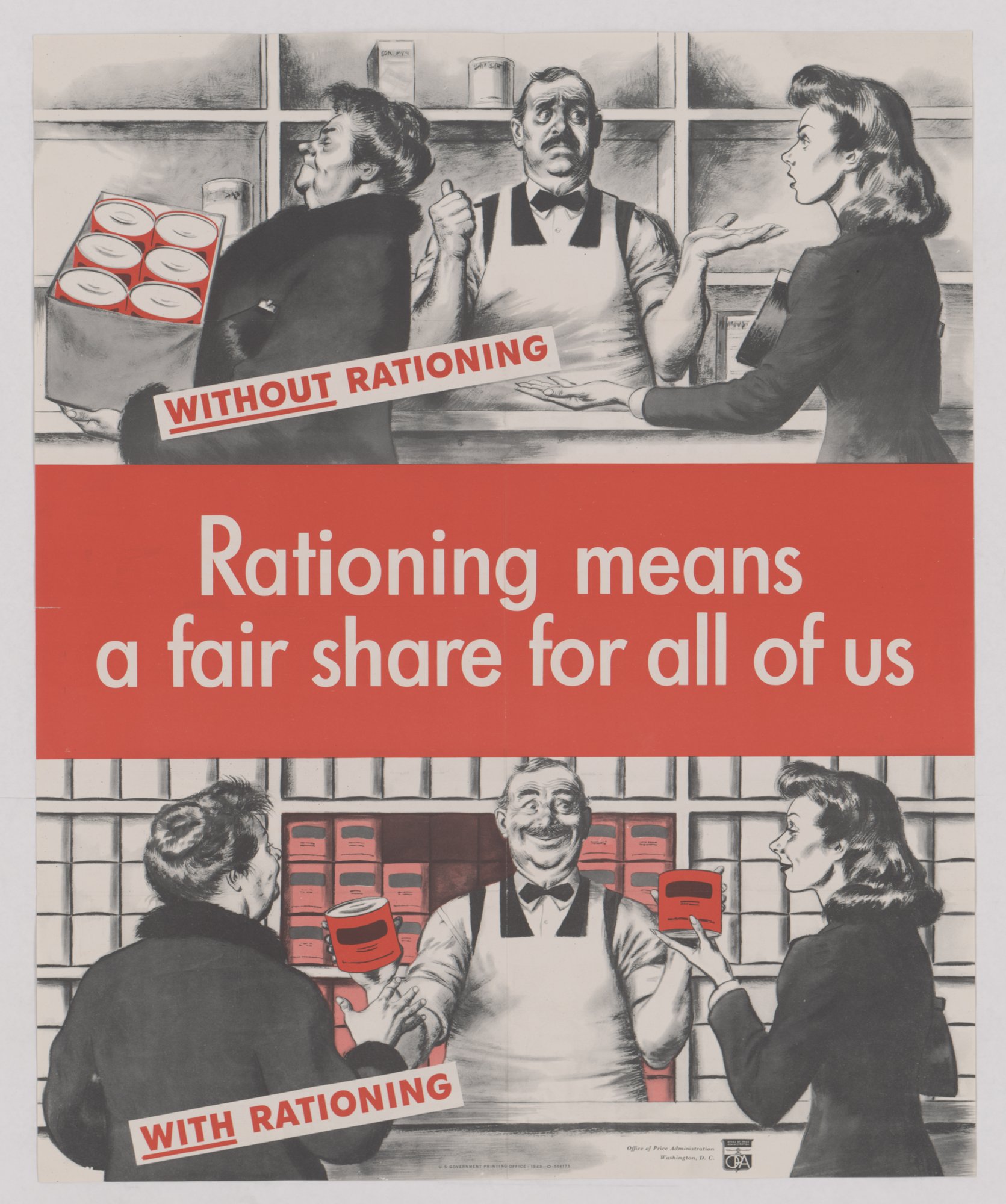
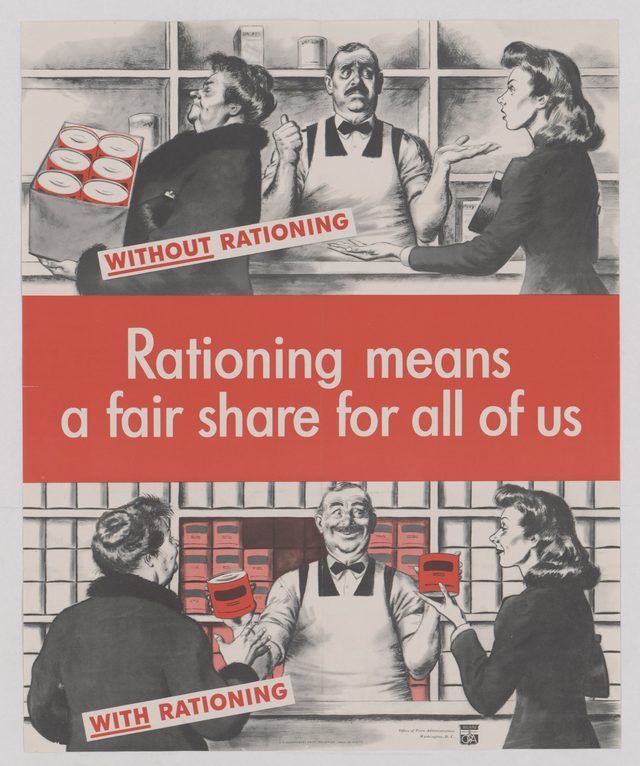
This 1943 Office of Price Administration poster has two panels. Without rationing, a well-dressed woman carries off a box of cans while a grocer and another shopper look on. With rationing, the grocer hands cans to both women. Only the benefit side is drawn, and "all of us" makes sharing the default. The contrast is a card-stacking tell: no cost of the system appears. Read the technique: card stacking.
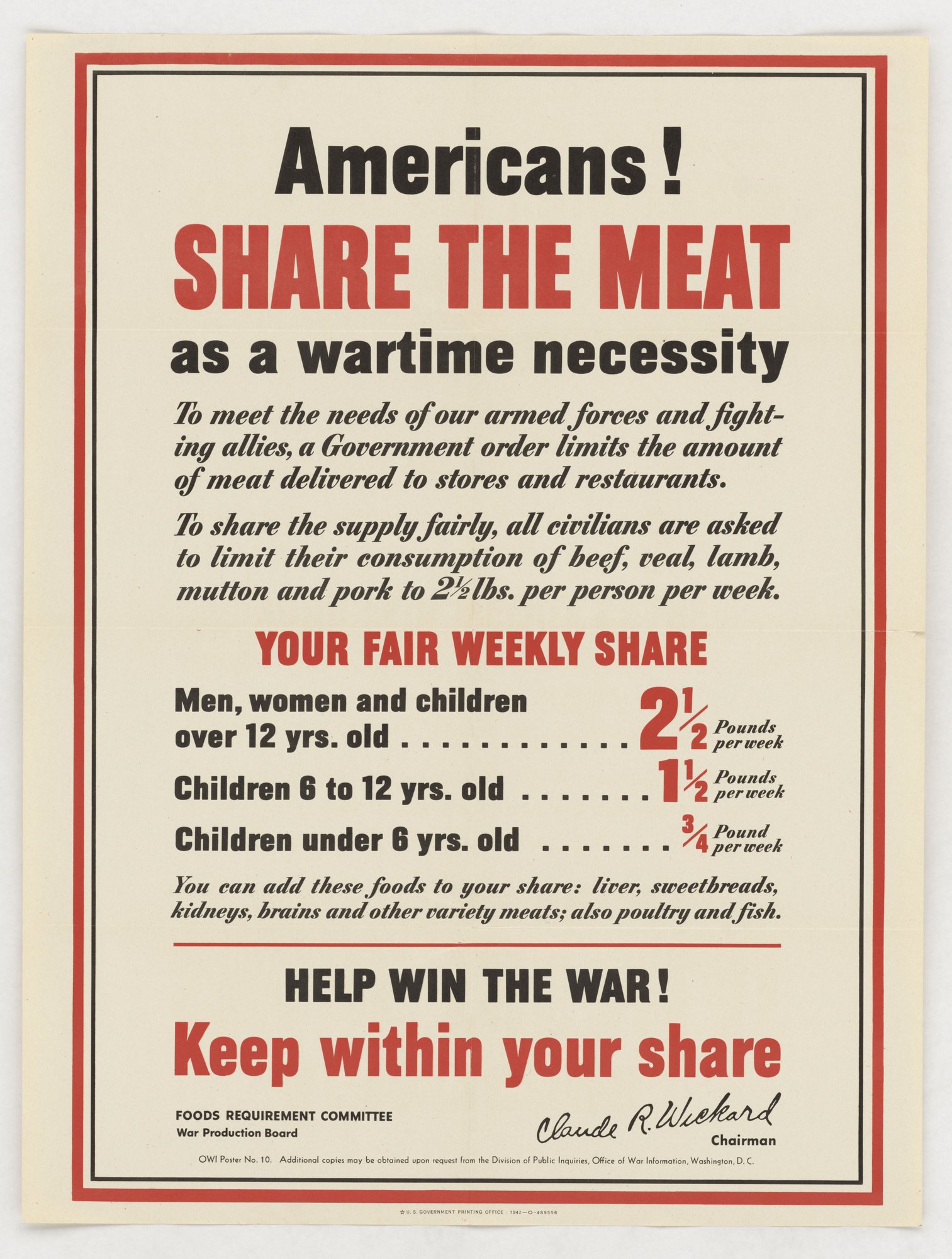
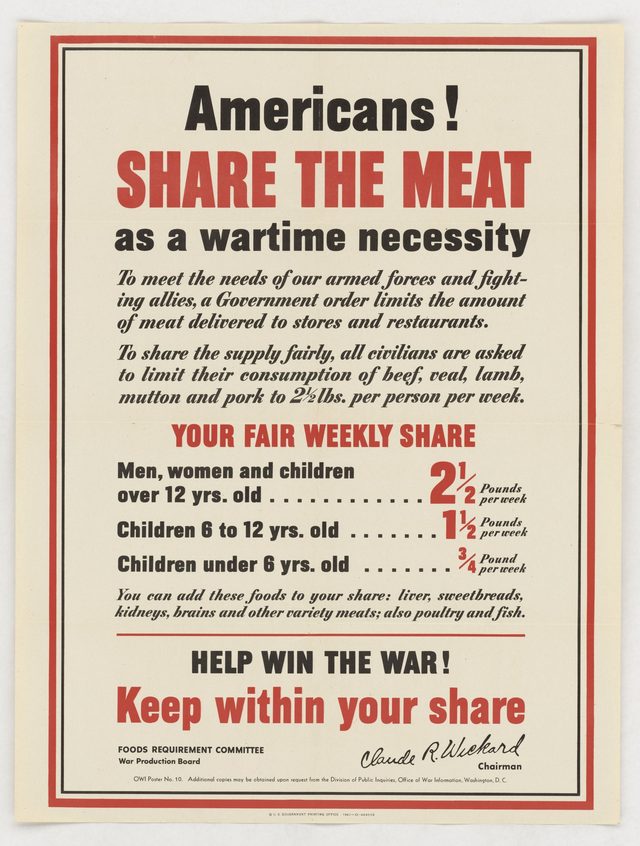
OWI Poster No. 10 of 1942, signed by Claude R. Wickard for the Foods Requirement Committee of the War Production Board, is a table. It lists 2 1/2 pounds of meat a week for those over 12, 1 1/2 pounds for children 6 to 12 and 3/4 pound for the under-6s, and closes with "Help win the war! Keep within your share." Persuasion is limited to "fair", "necessity" and "help win the war".
Did "When You Ride Alone, You Ride with Hitler" really appear on a poster?
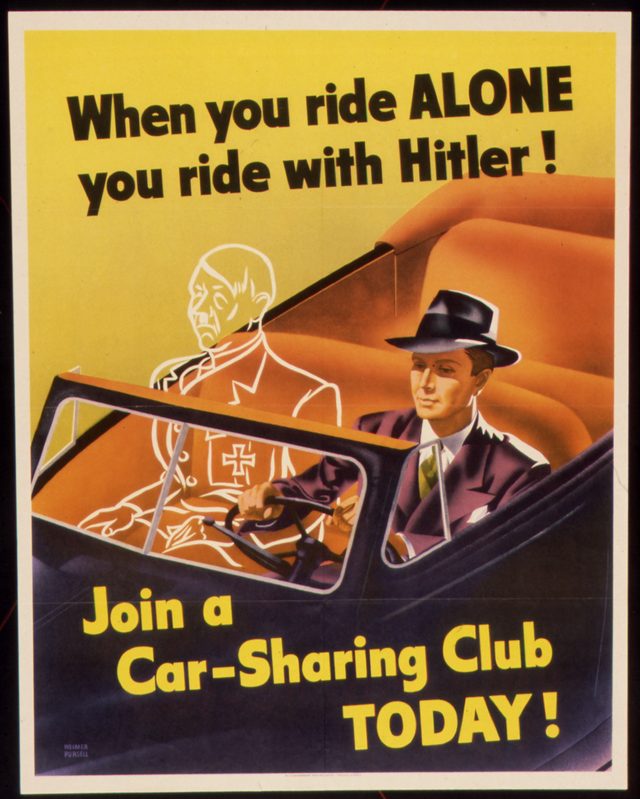
Yes. The collection holds the 1943 U.S. government car-sharing poster, signed by the artist Weimer Pursell. It shows a man in a hat driving alone, with an outline of Hitler, wearing an Iron Cross, in the passenger seat.
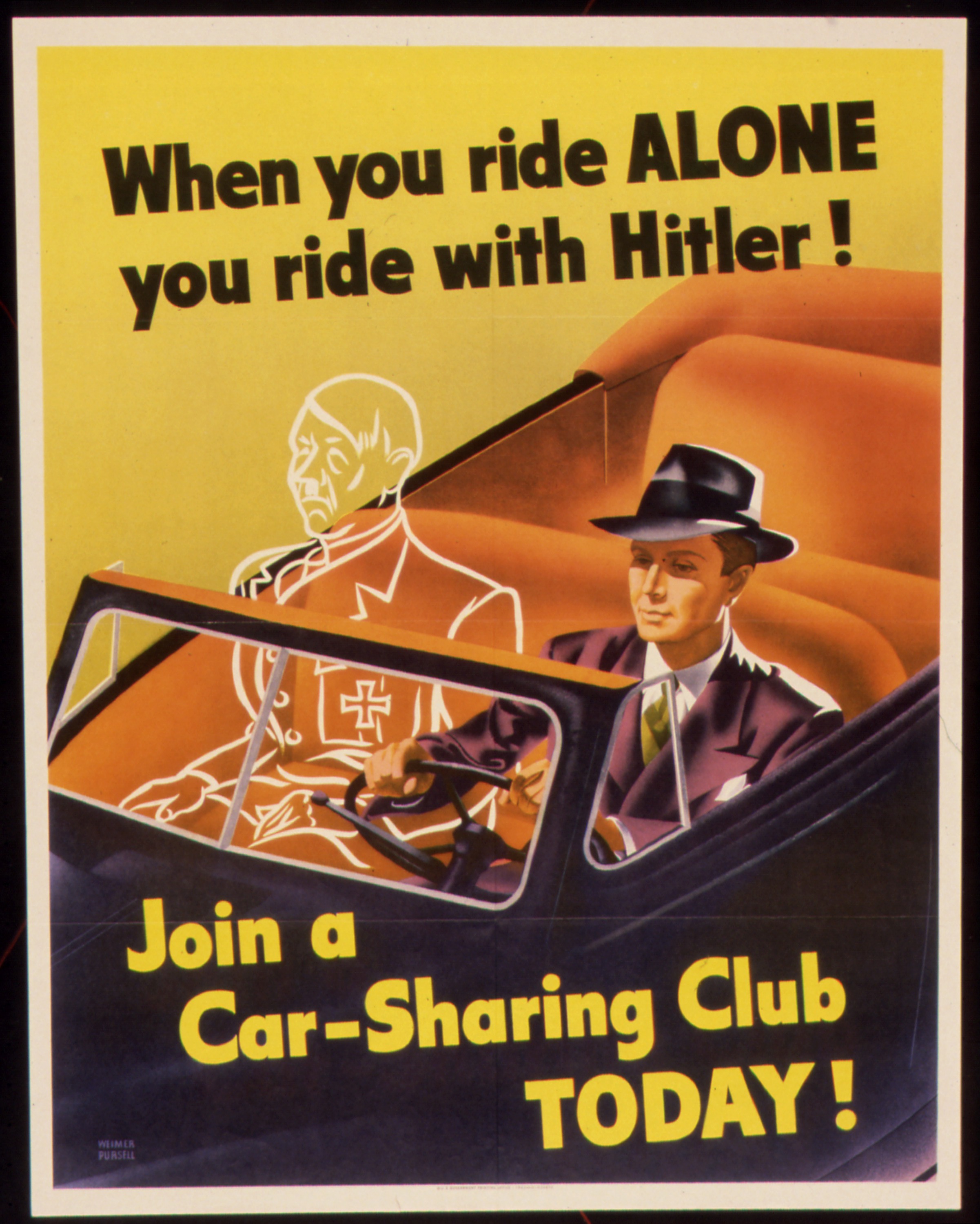
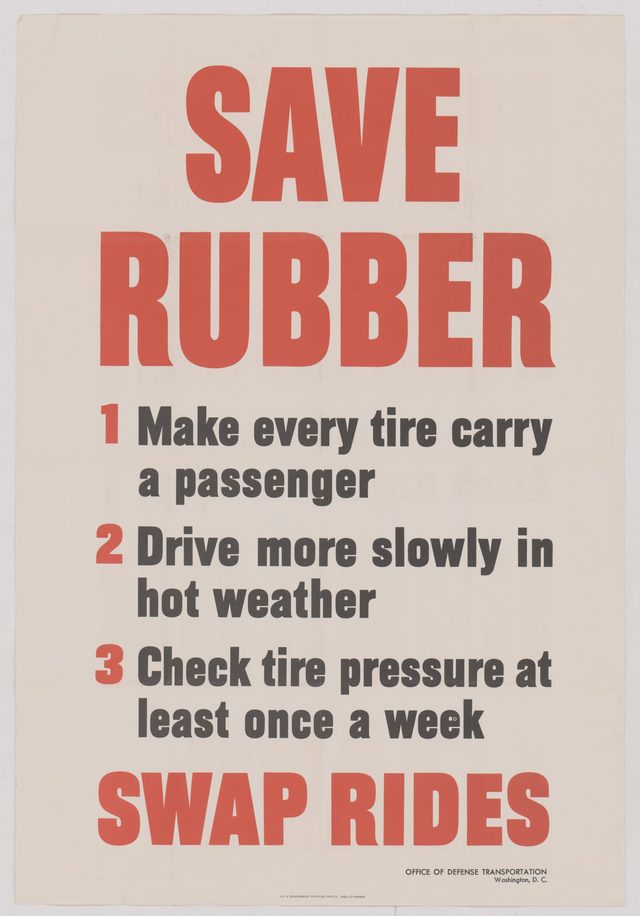
The poster asks drivers to join a car-sharing club to save gasoline and rubber. It cites no figures. The claim that a solo driver "rides with" Hitler is rhetorical: Hitler's stigma is attached to an everyday act, which is name-calling and transfer. Read the technique: name-calling and transfer.
What was Dig for Victory?
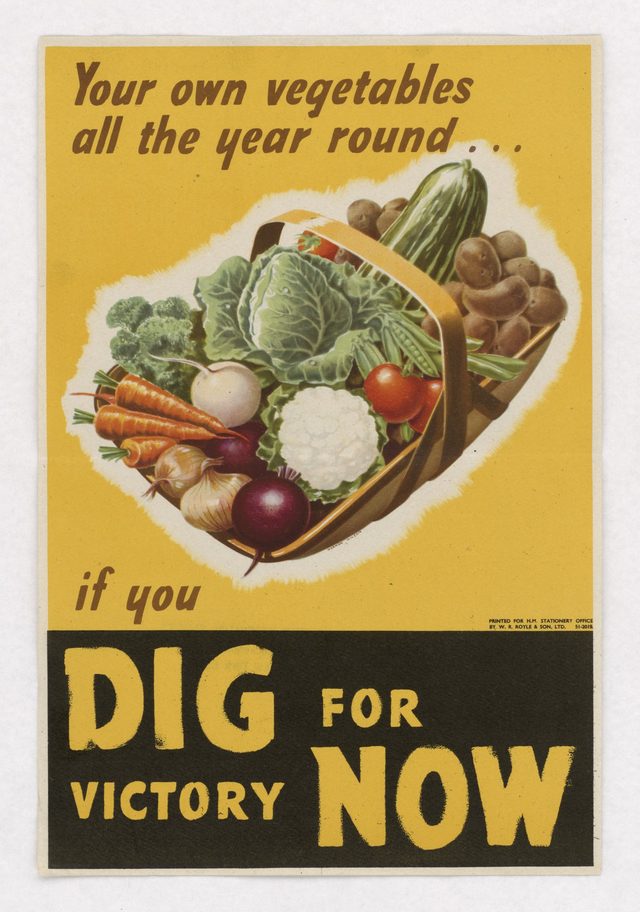
Dig for Victory was the British campaign to turn gardens, allotments and parks into food-growing land. Food rationing began in January 1940 under the Ministry of Food, covering sugar, meat, fats, bacon and cheese, and the Imperial War Museums record that the government encouraged home vegetable growing under the name "Dig For Victory". By 1943, the IWM's poster record says, more than 1.4 million people had allotments producing over a million tons of vegetables a year.
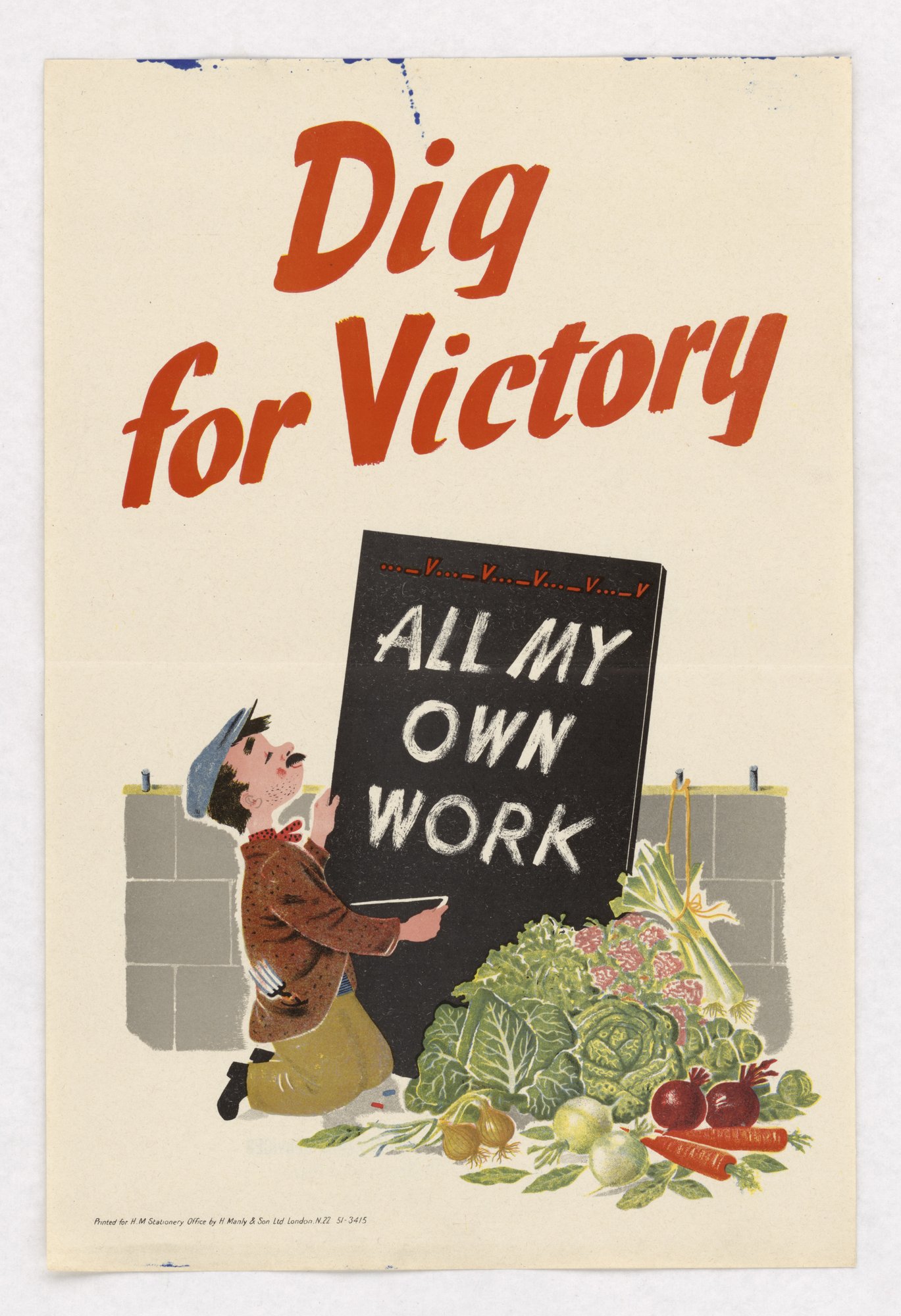
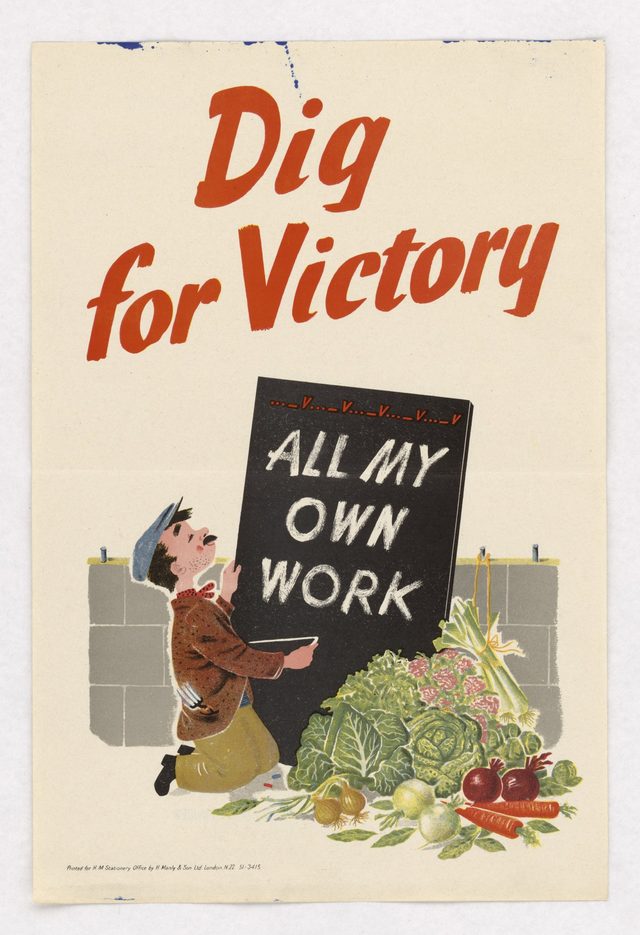
A British government sheet printed for H.M. Stationery Office shows a boy with chalk beside a blackboard reading "All my own work", with cabbages, beetroot, carrots and onions at its foot. An ordinary schoolboy shows growing food as something anyone can do, which is plain folks. Read the technique: plain folks.
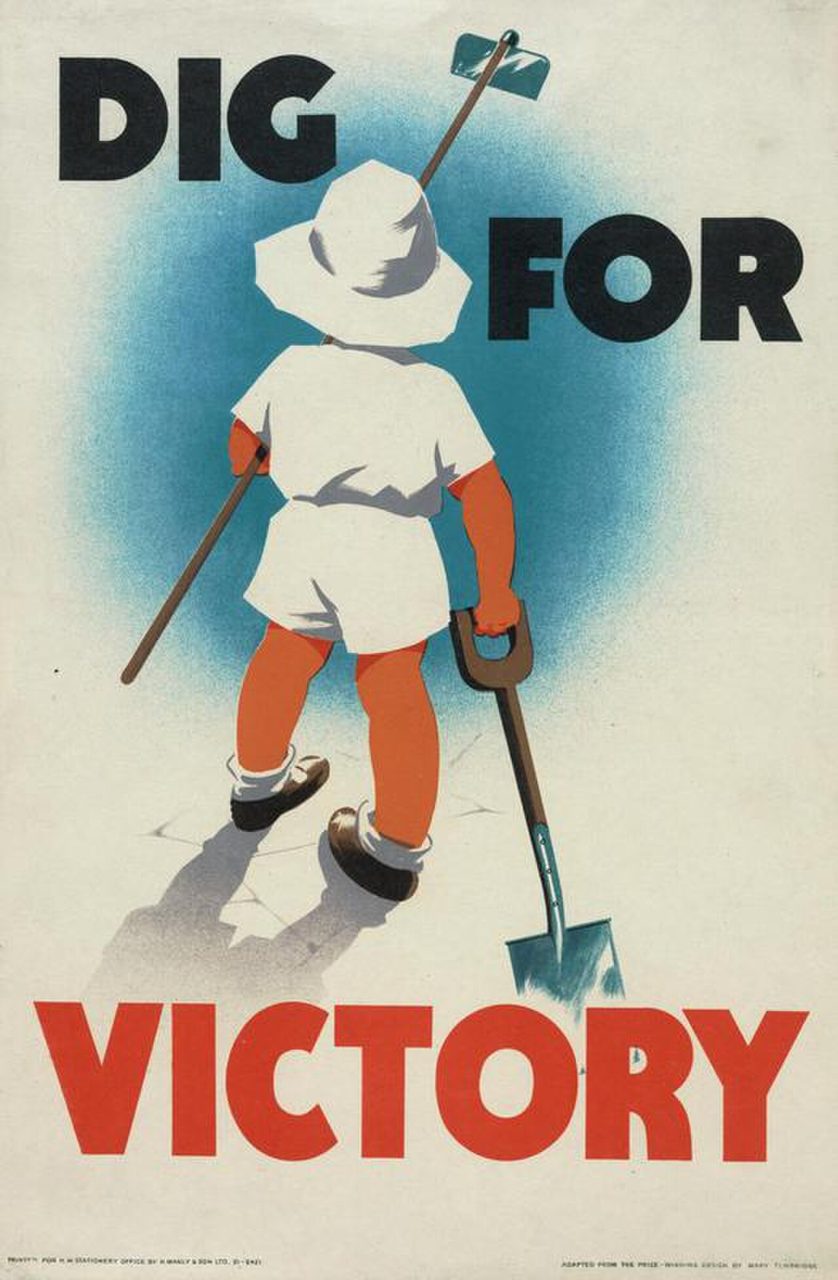
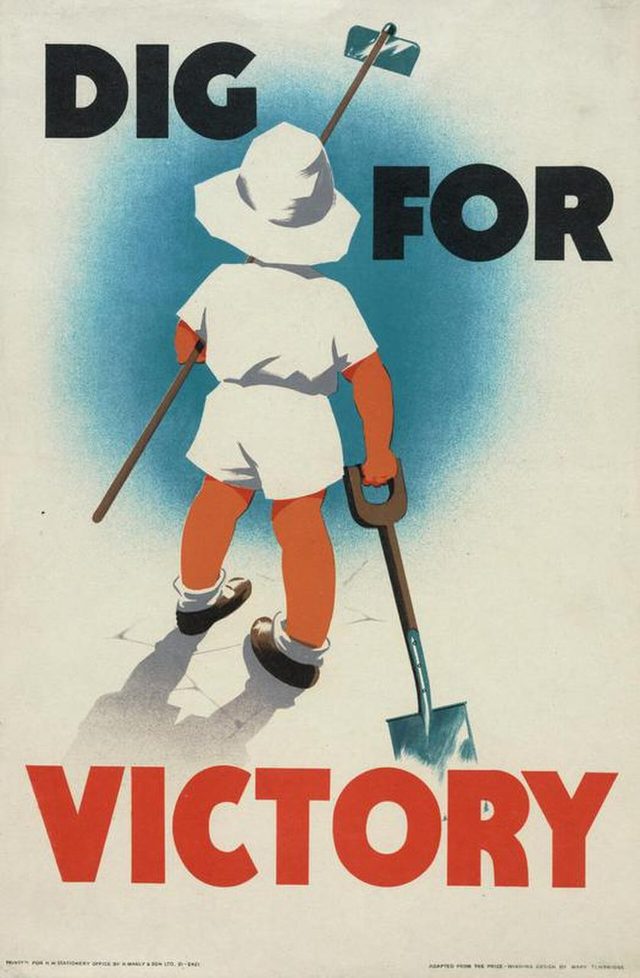
The Ministry of Agriculture and Fisheries version, catalogued by the IWM as Art.IWM PST 0696, shows a small child dragging a spade towards the word "VICTORY". The imprint credits an adaptation of the prize-winning design of Mary Tunbridge. The slogan equates digging with winning, and the abstract word stands in for a testable claim about food supply: glittering generalities. Read the technique: glittering generalities.
What were American Victory Gardens?
Victory Gardens were home vegetable plots promoted in the United States by federal posters, many printed through the Office of War Information (OWI) and the Department of Agriculture. For the OWI itself, see the OWI domestic branch case study.
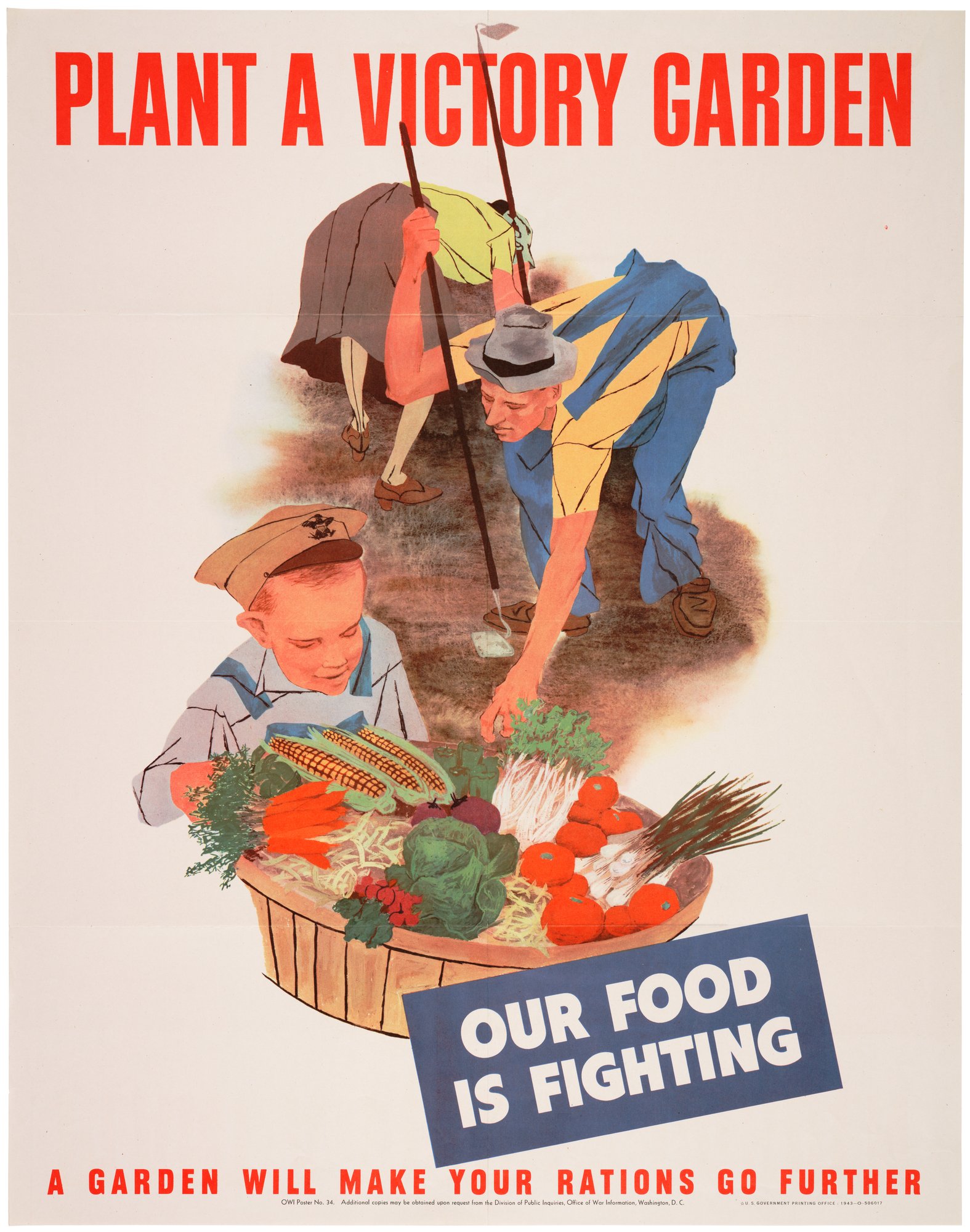
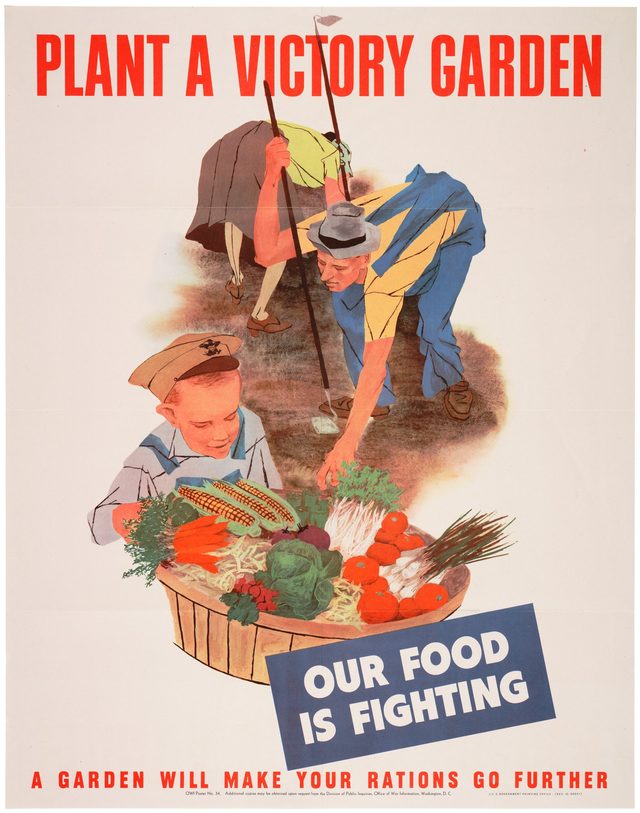
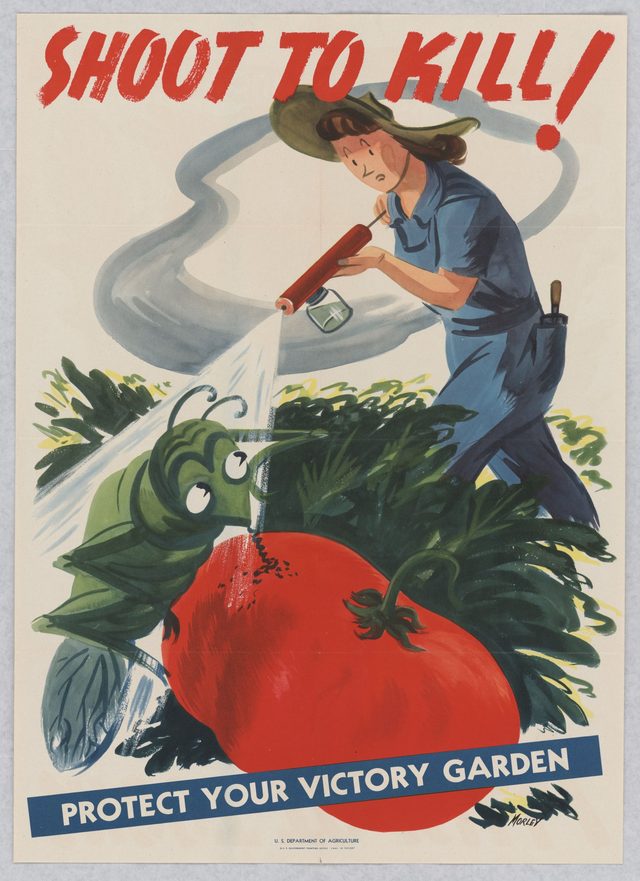
OWI Poster No. 34, printed by the Government Printing Office in 1943, shows two adults working a plot while a boy in a sailor-style cap looks into a basket of vegetables. A banner reads "Our food is fighting", and a foot line says "A garden will make your rations go further". Military vocabulary is carried onto vegetables, which is transfer. A Department of Agriculture sheet of 1943 shows a woman spraying a tomato pest under "Shoot to kill! Protect your Victory Garden"; the target is an insect, not a person. Read the technique: transfer.
Did salvage drives contribute materially, or mainly to morale?
Sources disagree in emphasis, and both readings are on the record.
The economist Hugh Rockoff, in a 2007 National Bureau of Economic Research paper, re-examined five American drives: aluminum, silk, cooking fat, iron and steel, and rubber. He found that the drives "had a more limited impact on the economy than might be imagined" and that at most they raised scrap collections by relatively small margins above what a prosperous peacetime period would have collected. He adds that "if the drives were important it was through their impact on civilian morale."
For Britain, H. Irving's study of paper salvage, published in Historical Research in 2016, reports about 4.2 million tons of waste paper salvaged between September 1939 and May 1945, roughly half from household collection. She also finds that a gap between publicity and the collection system left some of the public feeling that not enough was being done. For Canada, the Canadian War Museum says a Salvage Division formed in the Department of National War Services in January 1941 ran drives for scrap metal, rubber, fat, bones, paper, glass and rags until 1944, and that salvage let "every Canadian feel a part of the war effort."
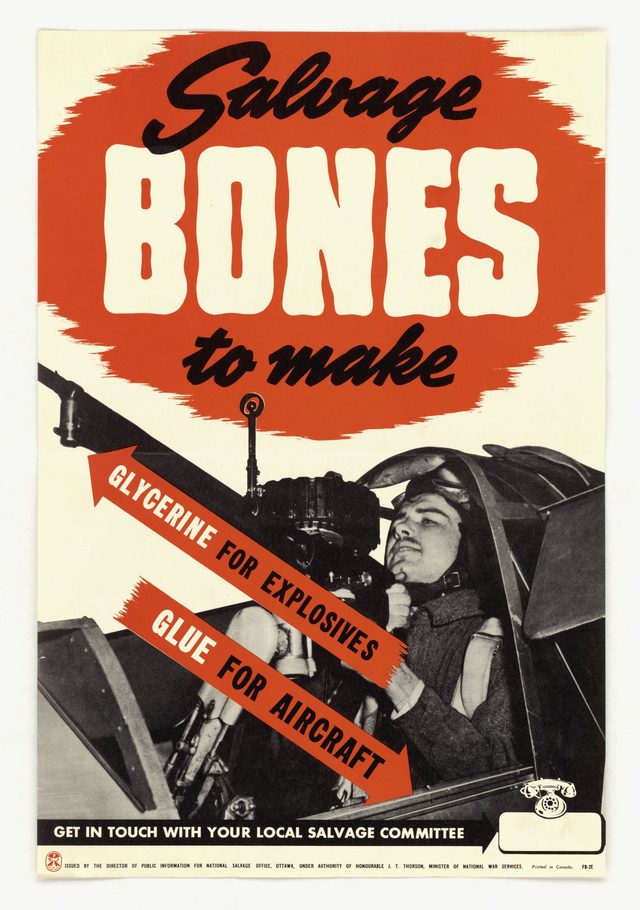
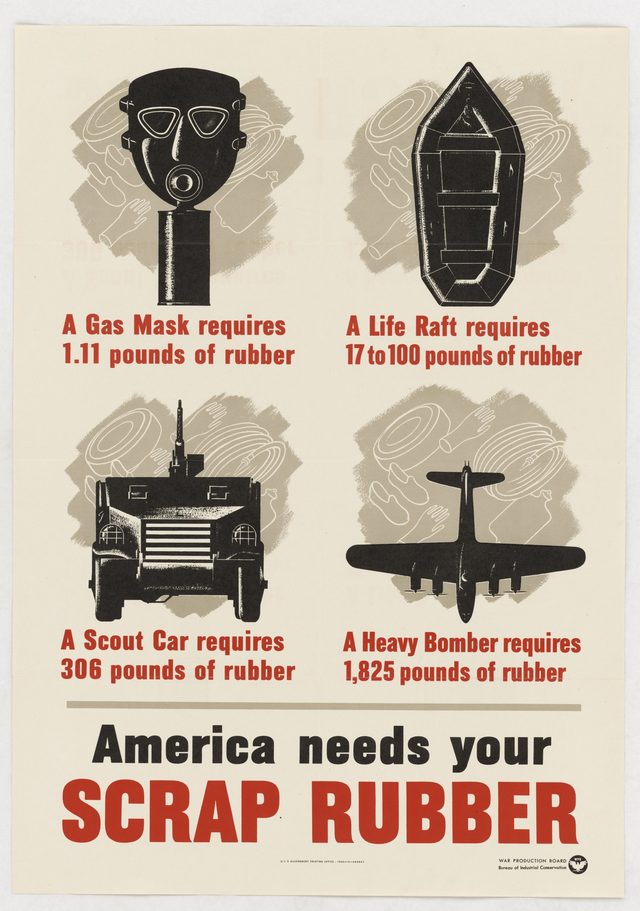
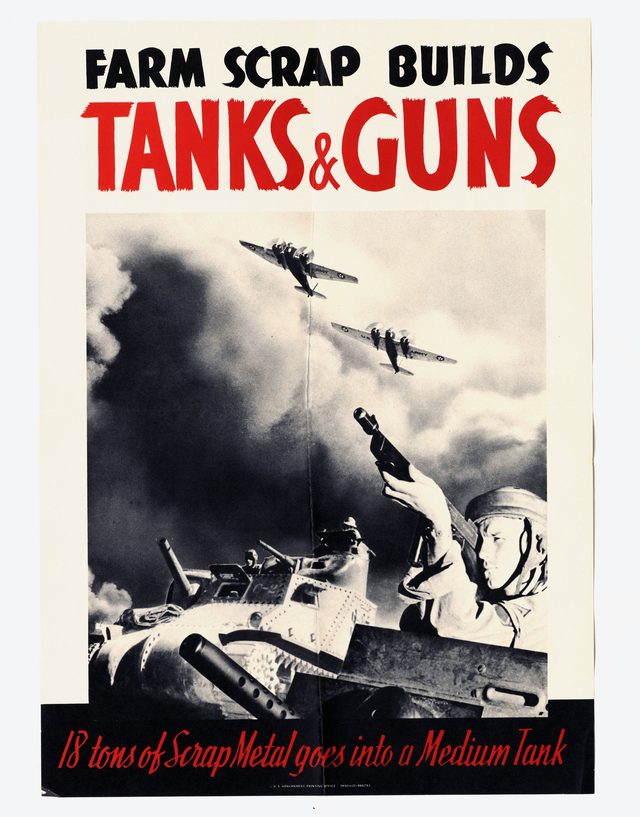
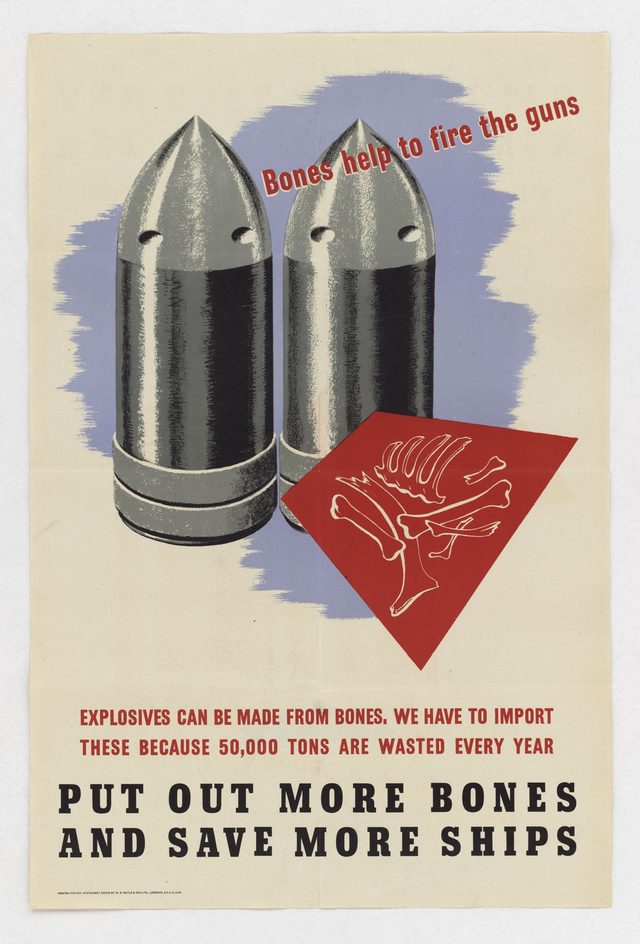
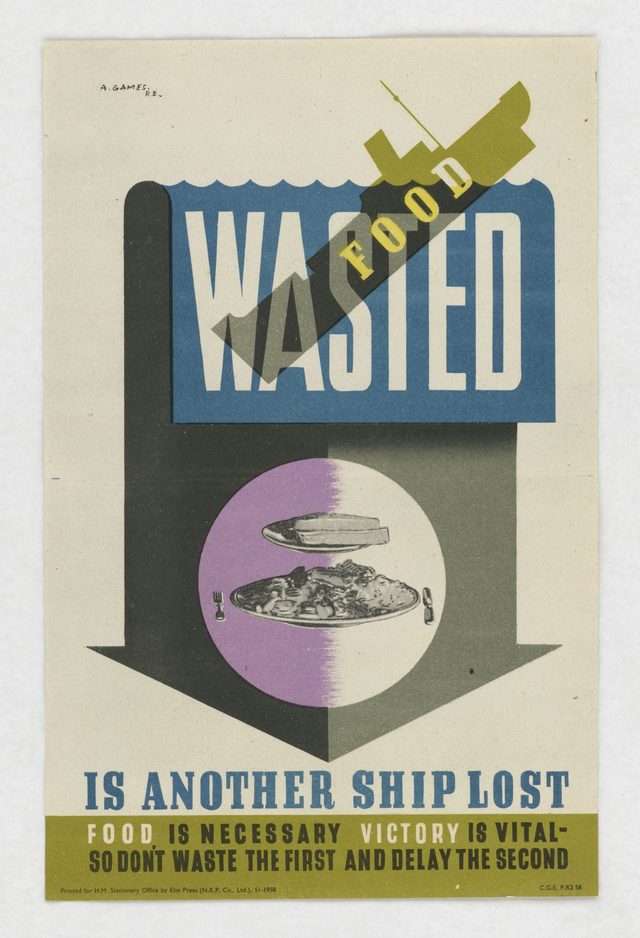
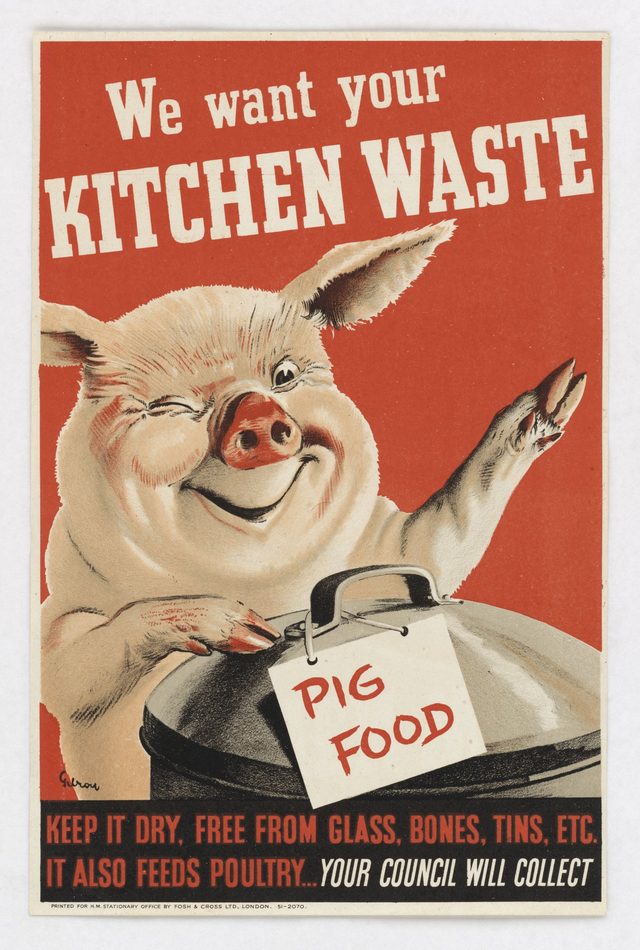
The sources measure different things in different countries. The posters themselves state material claims, such as "18 tons of Scrap Metal goes into a Medium Tank" on a U.S. farm-scrap sheet, and, on a British bone poster, "50,000 tons are wasted every year". The catalogue entry notes that the British figure was not checked against other sources.
How did the salvage posters work?
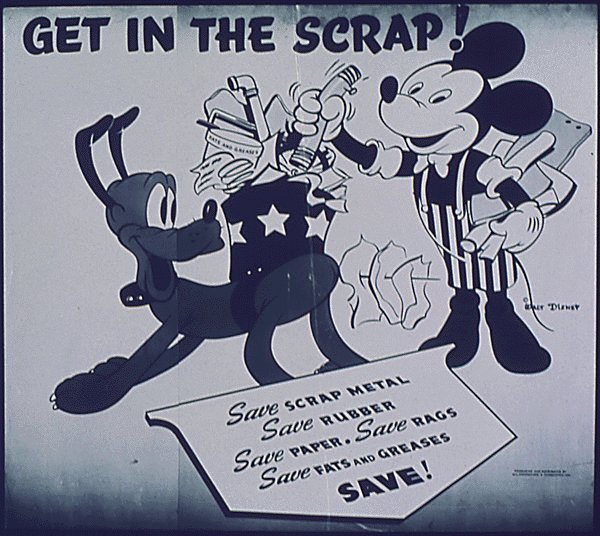
A U.S. scrap-drive poster credited to Walt Disney shows Mickey Mouse and Pluto gathering metal, rubber, paper, rags and fats under the banner "Save scrap metal, save rubber, save paper, save rags, save fats and greases, save!". The appeal of well-known cartoon characters is borrowed for a collection drive, which is transfer.
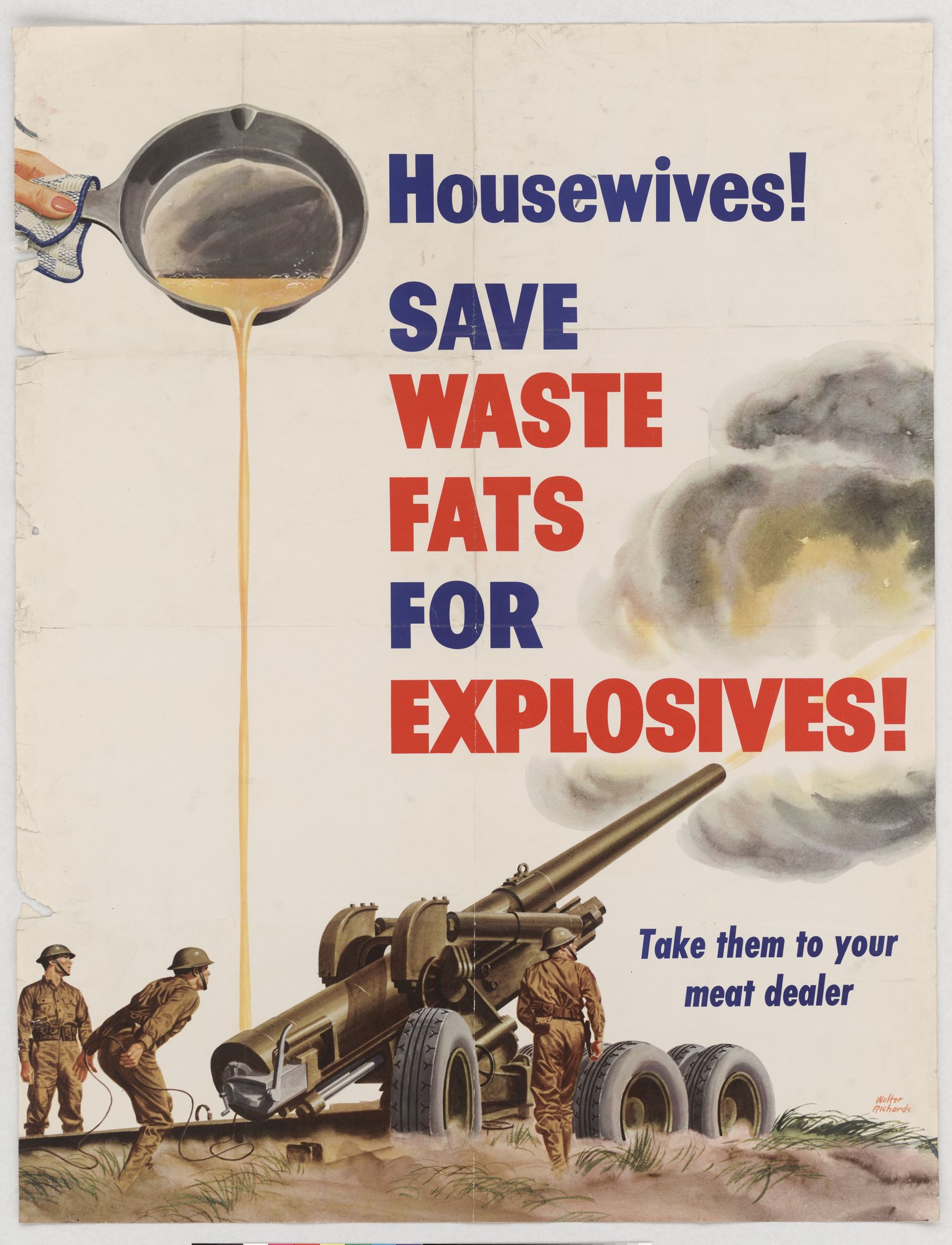
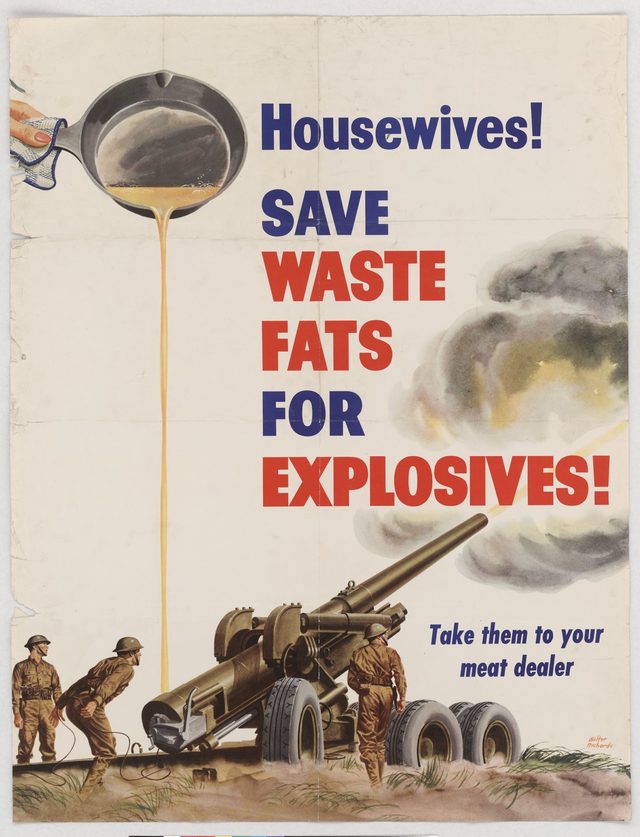
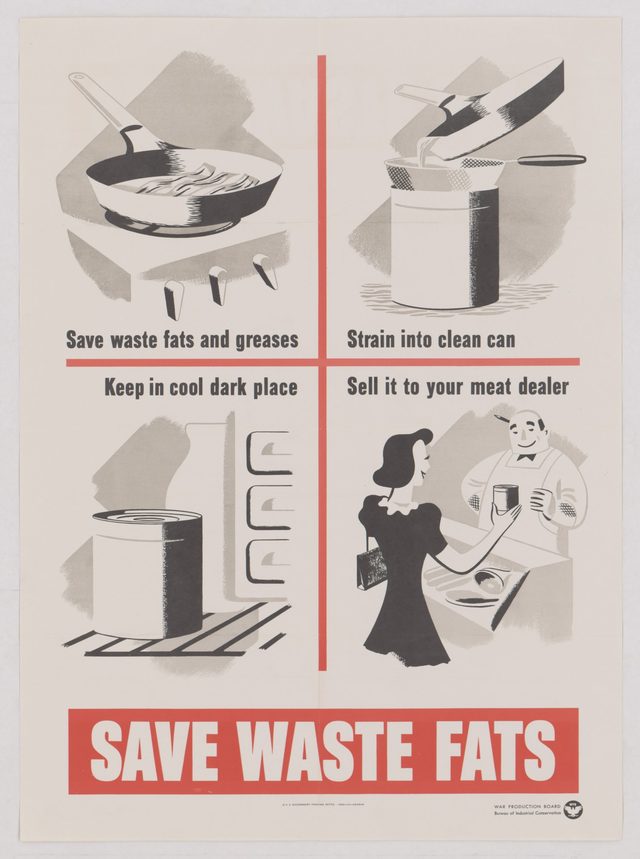
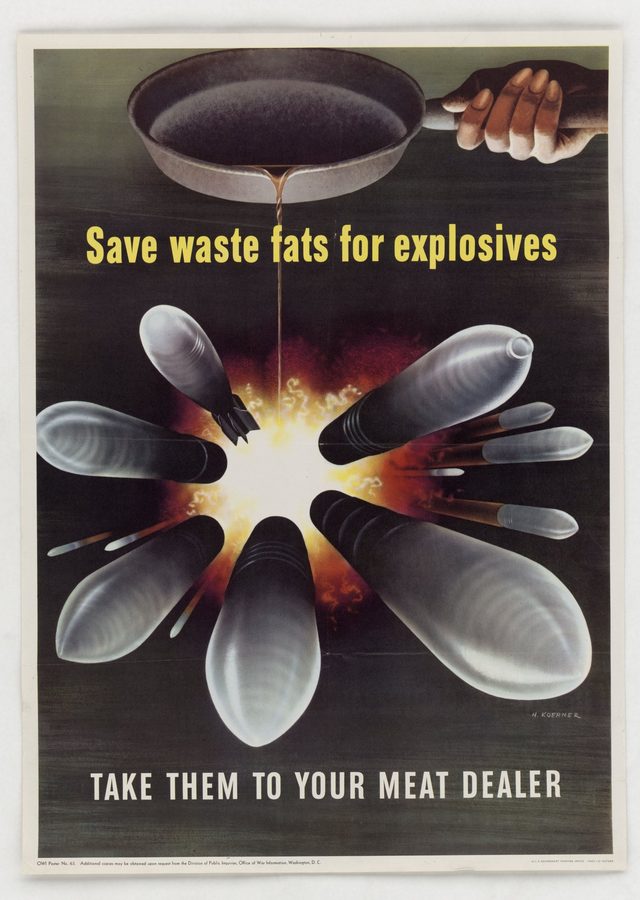
Walter Richards's poster addresses "Housewives" directly. A thread of cooking fat runs from a frying pan into a field gun, and the instruction is to take the fats to the meat dealer. The line from pan to gun links a kitchen chore to artillery.
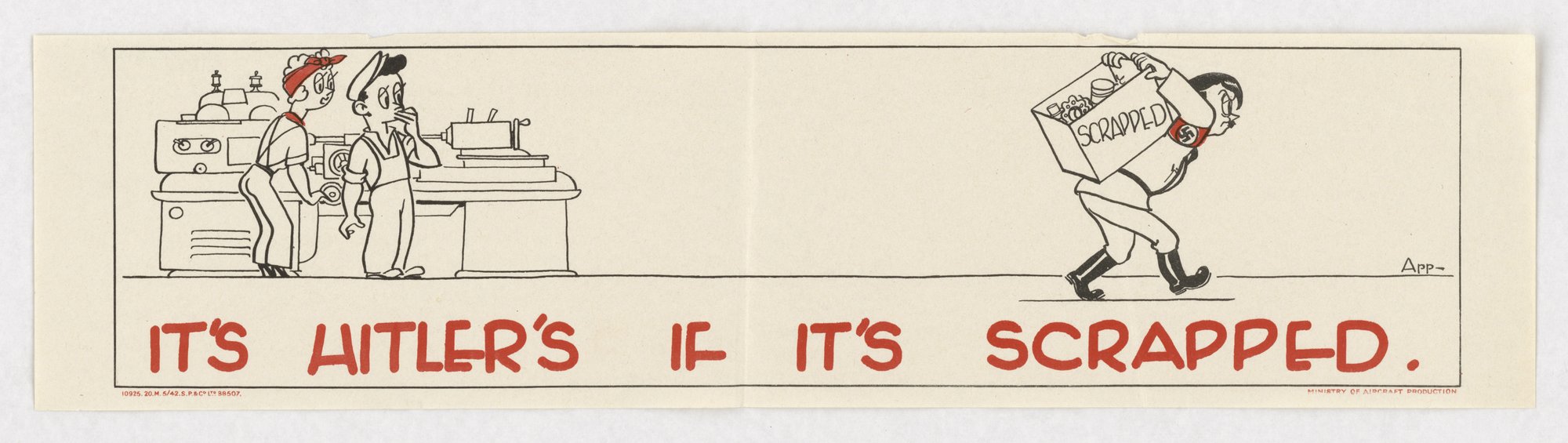
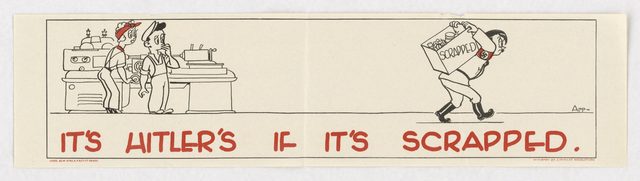
The British Ministry of Aircraft Production's May 1942 strip frames wasted material as a gift to the enemy: two workers look on as a cartoon Hitler walks off with a box marked "SCRAPPED". The caricature is name-calling and the loss to the enemy is a fear appeal. Read the technique: fear appeal.
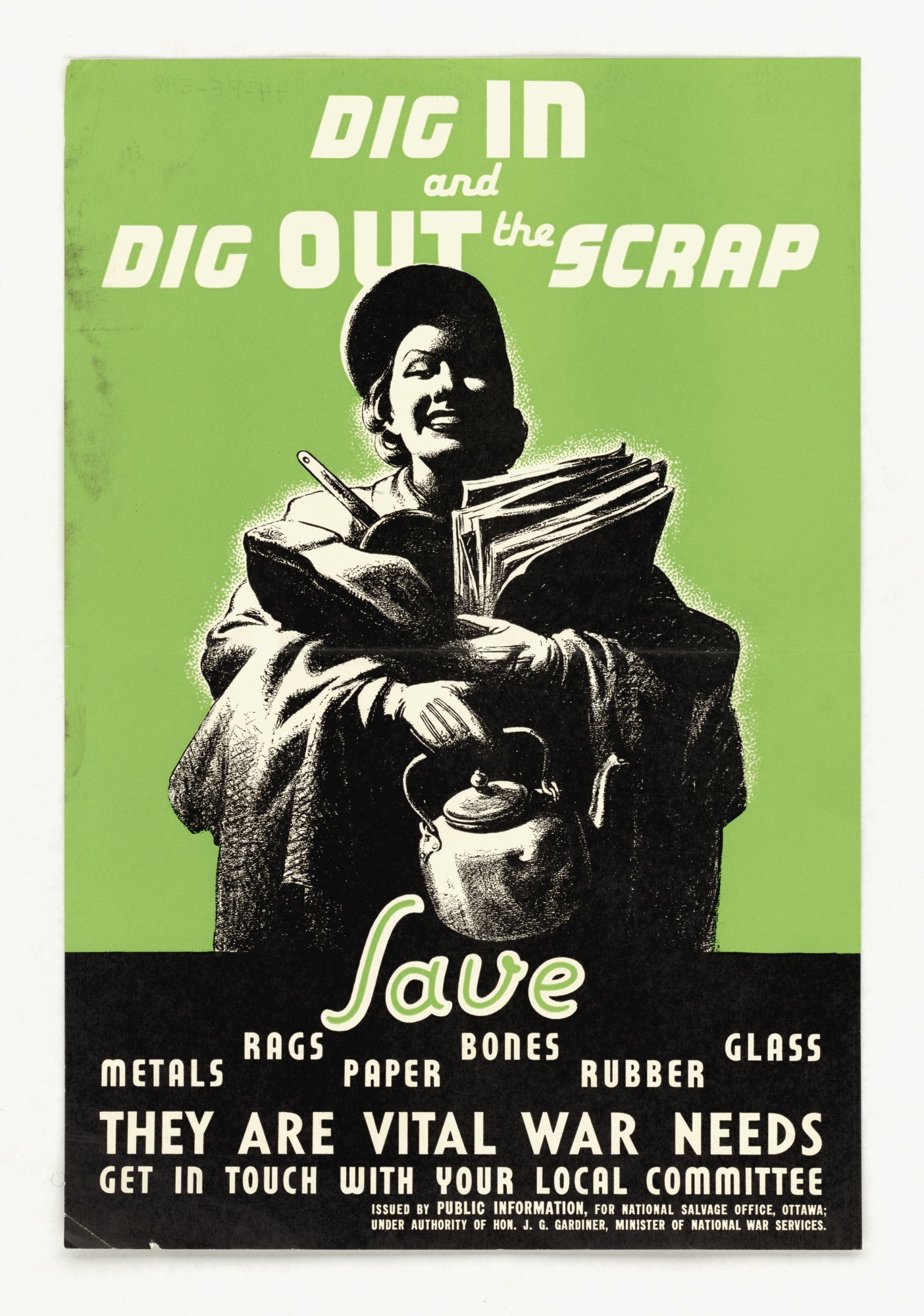
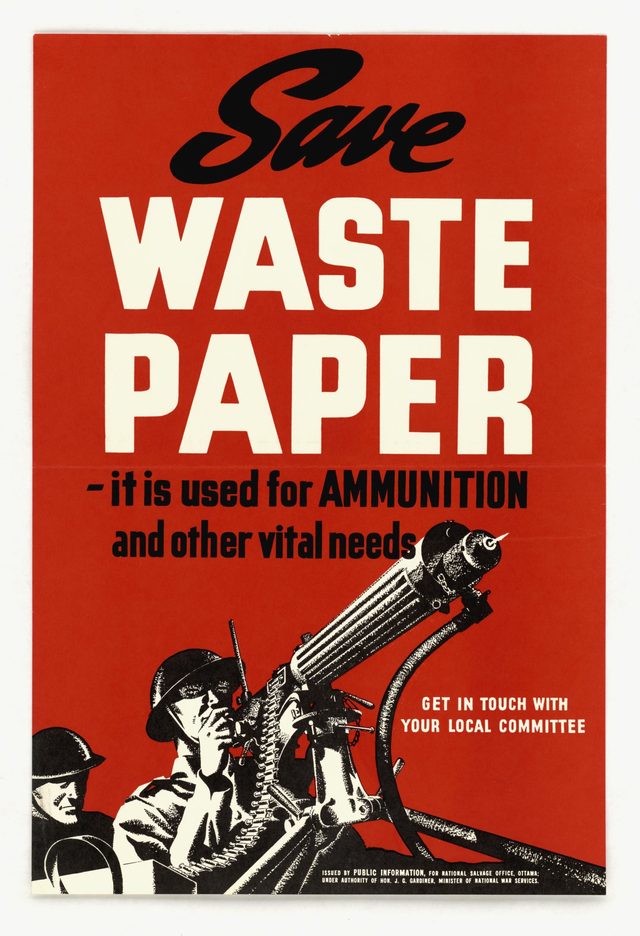
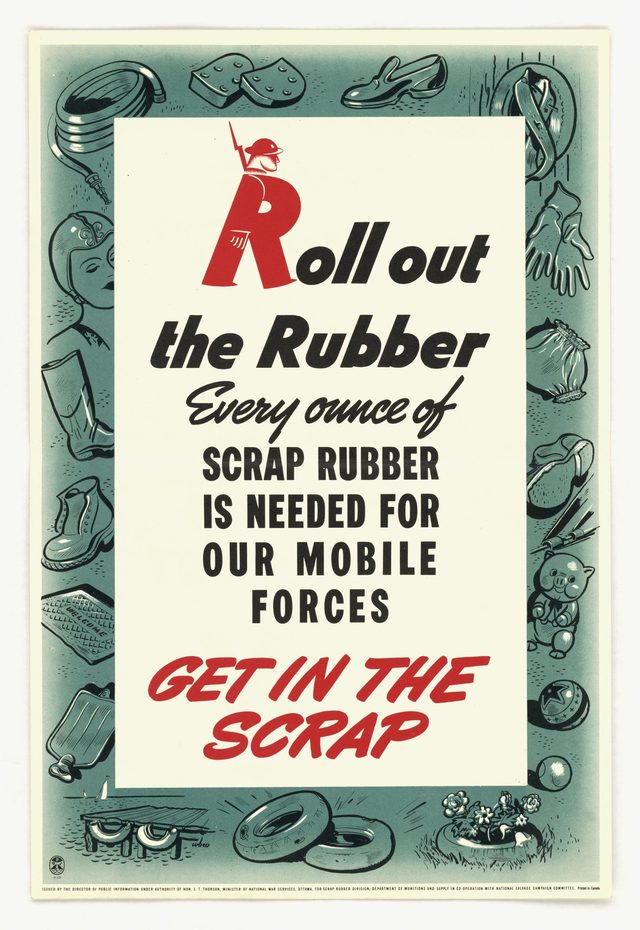
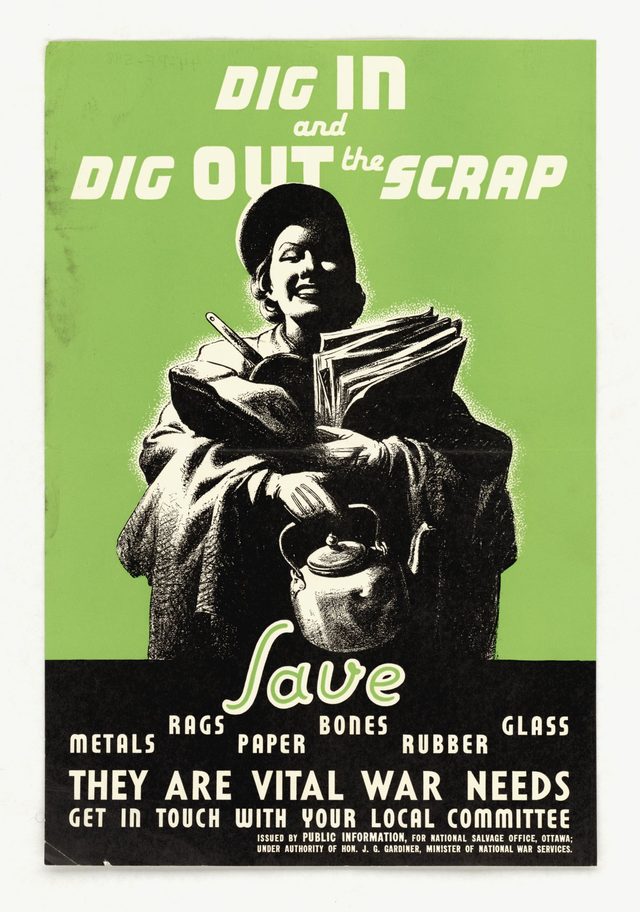
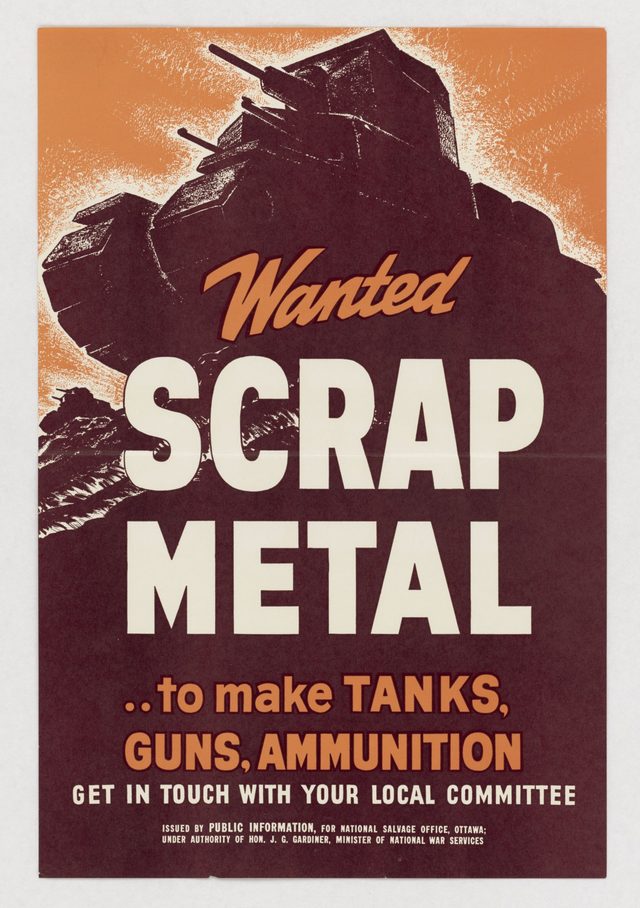
Canada's National Salvage Office issued this sheet, with J. G. Gardiner, Minister of National War Services, named in the imprint. A housewife figure with household items presents collection as a familiar domestic act, and the text asserts that the listed materials "are vital war needs". Canadian sheets also appear in French, such as "La Ménagère en guerre récupère". Read the technique: plain folks.
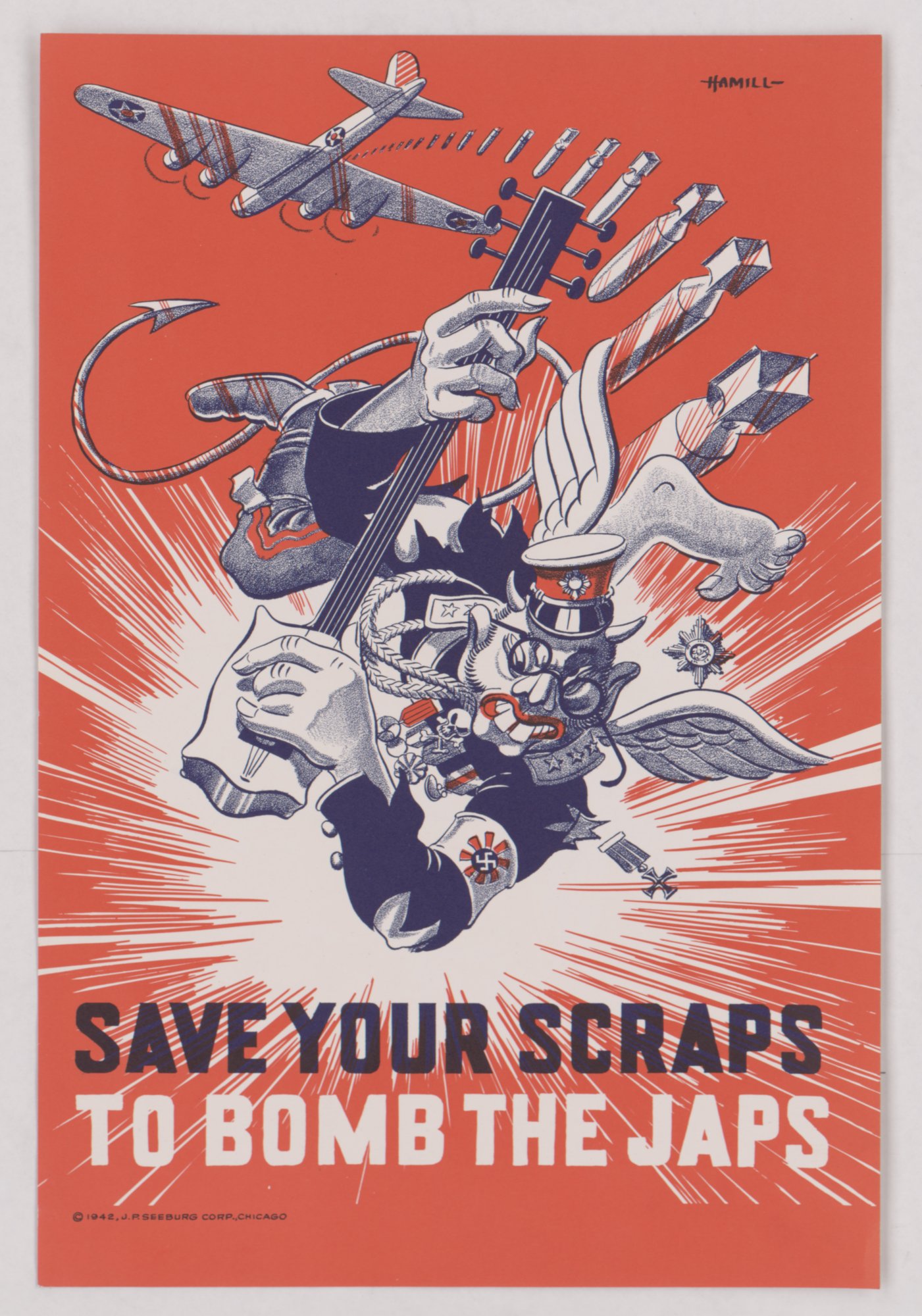
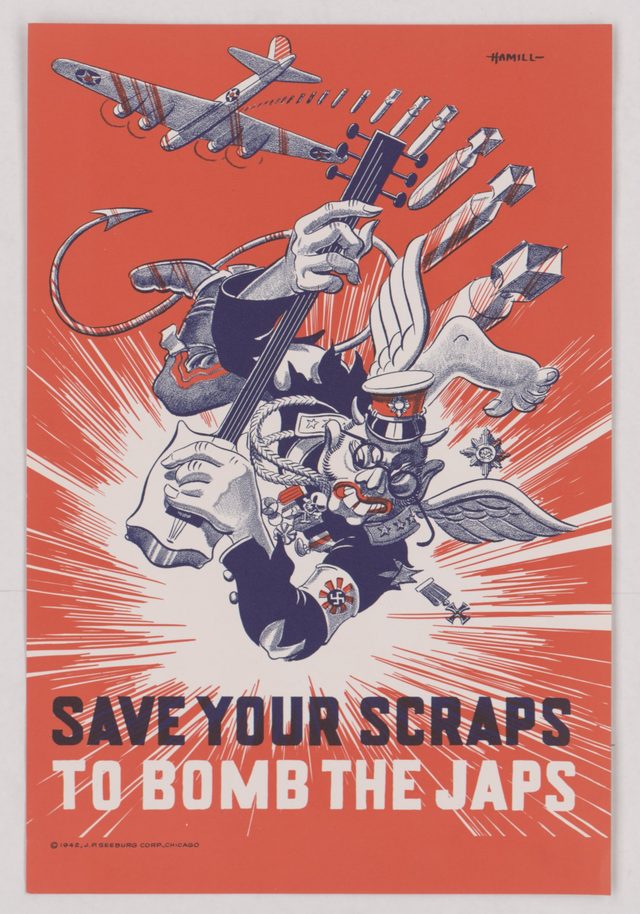
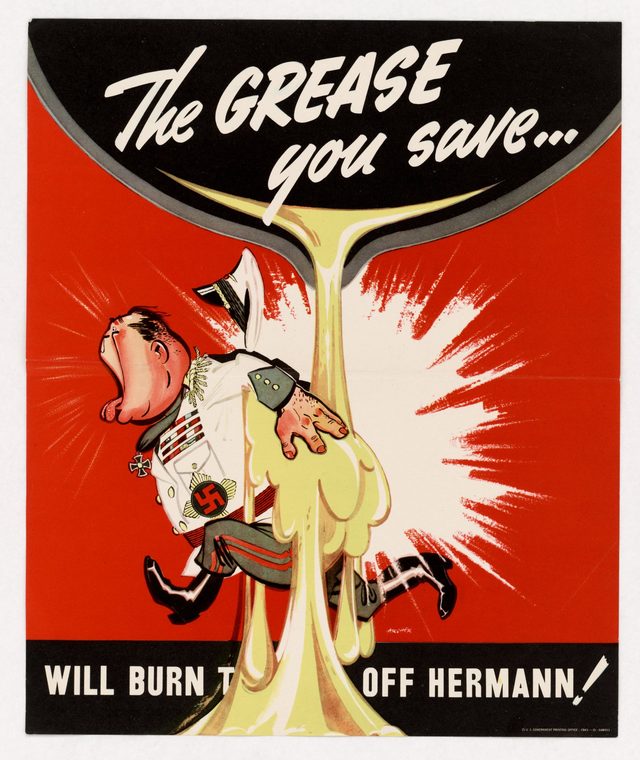
This 1942 sheet carries the copyright line of J. P. Seeburg Corp., Chicago, and names no agency. Its title uses an ethnic slur, and the caricature mixes Japanese and German markers. Scrap is tied to bombs by transfer and the enemy is named by slur and caricature, which is name-calling. The collection hosts it as printed. Read the technique: name-calling.
What did Britain's Make Do and Mend posters ask?
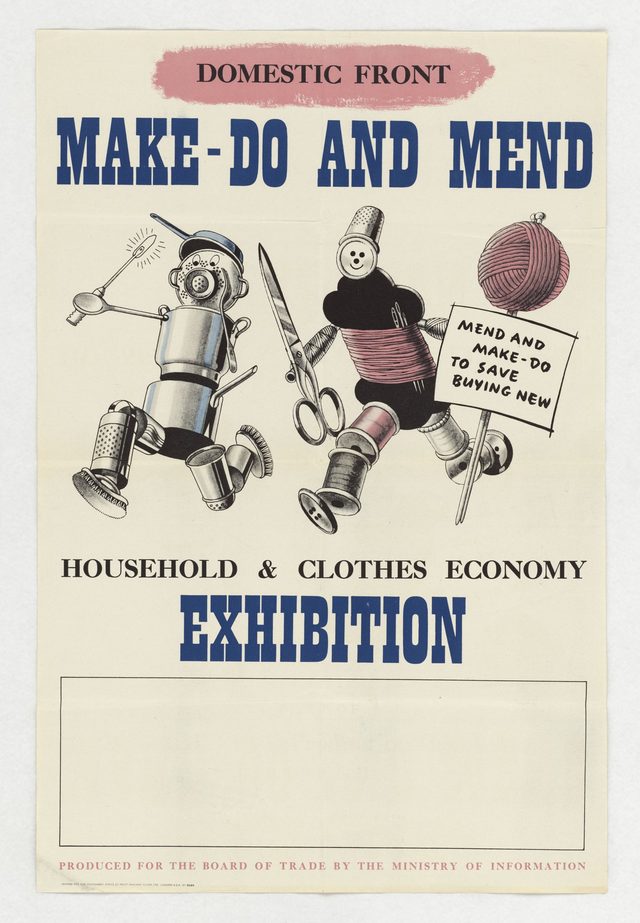
Clothes rationing was announced on 1 June 1941 by Oliver Lyttelton, President of the Board of Trade. According to the Imperial War Museums, the Make Do and Mend campaign encouraged people to make their existing clothes last, with Ministry of Information materials, classes and Women's Voluntary Service clothing exchanges.
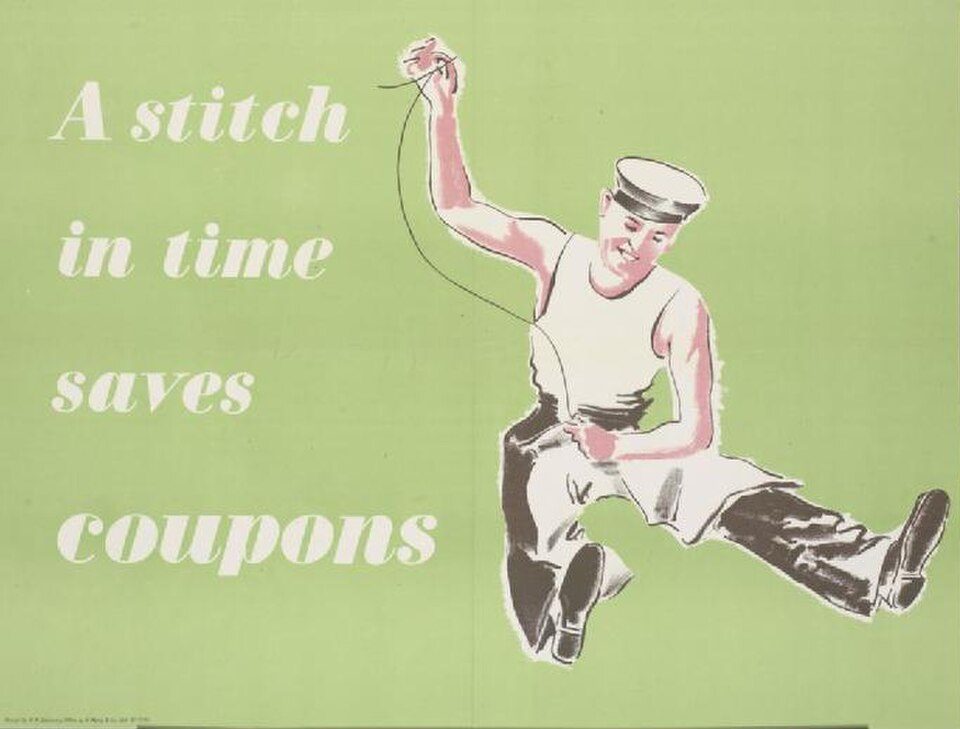
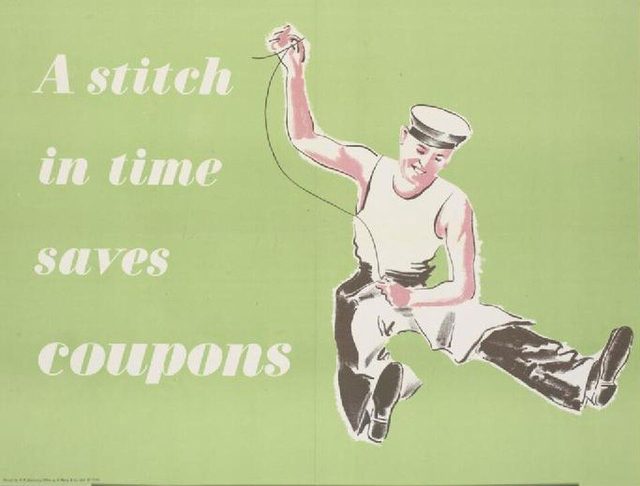
A Board of Trade poster, catalogued by the IWM as Art.IWM PST 14931, shows a sailor sewing his own collar beside "A stitch in time saves coupons". An ordinary serviceman mending his own clothes presents thrift as common sense. The IWM dates it only to 1939 to 1945; 1941 is the earliest possible year, since clothes rationing began that June.
How to read a rationing or salvage poster
- Find the object. Does the poster name a specific material and a use ("explosives", "tanks")? A named use turns a chore into a contribution, which is transfer.
- Look for numbers. Tonnages and weekly weights are the poster's own claims. The collection's catalogue notes record where they were not checked.
- Ask who the figure is. An ordinary housewife, schoolboy or sailor signals plain folks. An enemy leader, a cartoon Hitler or a slur signals name-calling.
- Check the imprint. Government printing office marks, trade sponsors and local war councils tell you who was asking and who gained.
How do the three countries compare?
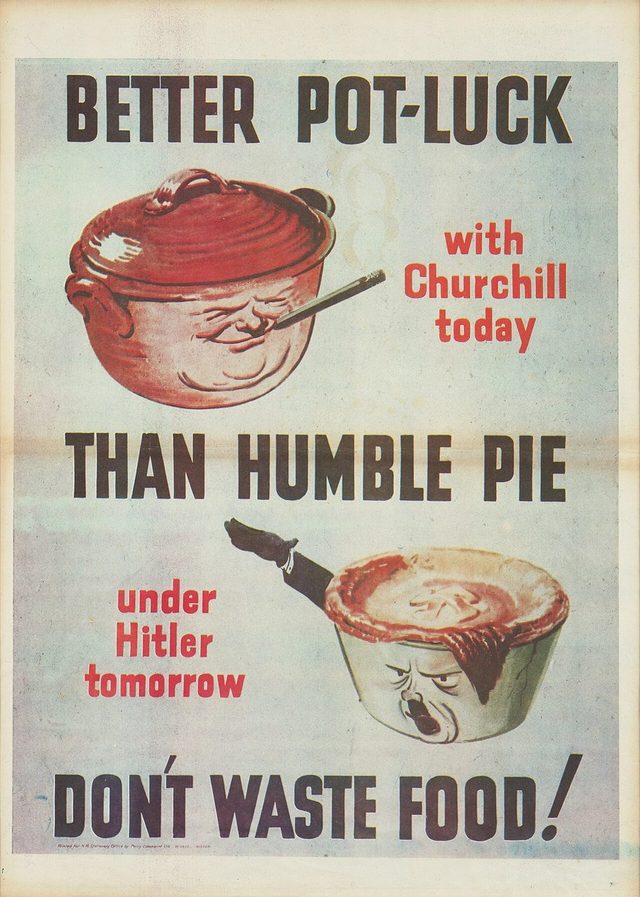
The same techniques recur: transfer onto a household chore, plain-folks domestic figures, and an enemy named as the beneficiary of waste. The differences in the record are institutional. American sheets came from the OPA, the War Production Board, the OWI, the Department of Agriculture, the military and private sponsors. British sheets mostly carry H.M. Stationery Office imprints from ministries including Supply, Food, Fuel and Power and Agriculture. Canadian sheets come from the National Salvage Office and Wartime Information Board, in English and French.
Browse WW2 rationing and salvage posters
The grid below shows posters about rationing, price control, salvage, fats and waste, Victory Gardens and fuel. Each opens an object page with the holding institution, a link to the original record, a transcription of any text and the rights basis for hosting. Related pages: American propaganda posters, British propaganda posters, Canadian propaganda posters, WW2 careless talk posters, WW2 war bonds posters and WW2 women posters.
Sources and rights
Posters on this page come from the U.S. National Archives (Record Group 44, World War II Posters and Foreign Posters) and from the Imperial War Museums via Wikimedia Commons. Where an issuer or date is not printed on a sheet, the object page says so. Transcriptions are verbatim and translations are labelled.
![La Ménagère en guerre récupère : caoutchouc, métaux, os, matières grasses [The Housewife at War Salvages: rubber, metals, bones, fats]](../../collection/images/canada-la-menagere-en-guerre-recupere-1939-640.jpg)
![Jetez vos Chiffons dans la Bataille! [Throw Your Rags into the Battle!]](../../collection/images/canada-jetez-vos-chiffons-dans-la-bataille-french-1940-640.jpg)