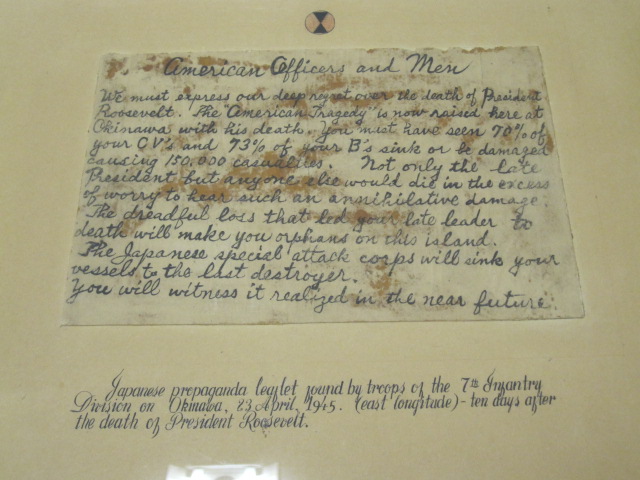
Content note. These posters use the slur "Jap" and racial caricature of Japanese people, and some show violence against prisoners. The Japanese material uses caricature of Allied leaders and appeals to racial and sexual resentment. All of it is shown as issued, as evidence of what each government told its own people and its enemies. Showing a poster is not endorsing it.
What were anti-Japanese propaganda posters in World War II?
They were wartime posters, mostly American, Australian and British, that urged output, saving and vigilance against Japan from 1941 to 1945. Many named the enemy with the slur "Jap" or drew a racial caricature. Japan's own propaganda pictured Allied leaders as caricatures too, in leaflets, magazines and posters for occupied Asia.
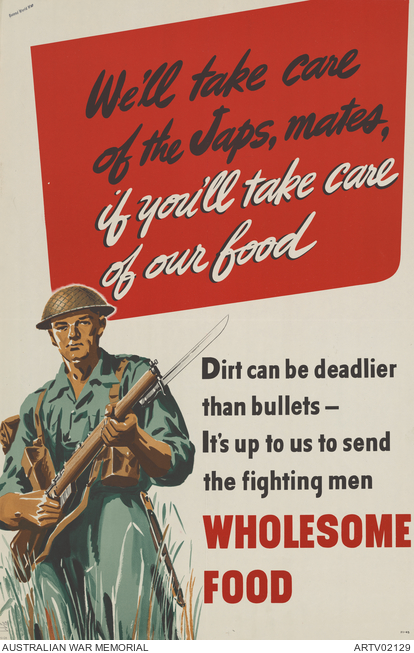
The collection counts 43 posters dated 1941 to 1945 whose titles use "Jap", "Japanese", "Japanazi", "Tojo" or "Tokio": 38 from the United States, 4 from Australia and 1 from the Empire of Japan (count made from the entry files in examples/entries/, by title only, so posters that name the enemy only in the picture are missed). Separately, the collection holds 48 entries from the Empire of Japan dated 1937 to 1945: 9 leaflets, 8 film stills, 8 posters, 5 stamps and others (same method). This page applies one set of questions to every side: who issued it, who it was for, what it asked, and which technique carried the ask. For the wider war, see WW2 propaganda posters and propaganda posters.
Who made the American anti-Japanese posters, and what did they ask?
Most were production, security and bond posters in which Japan supplied the name of the enemy. Issuers included the U.S. Army, the Navy, the War Manpower Commission, the Treasury and private firms.
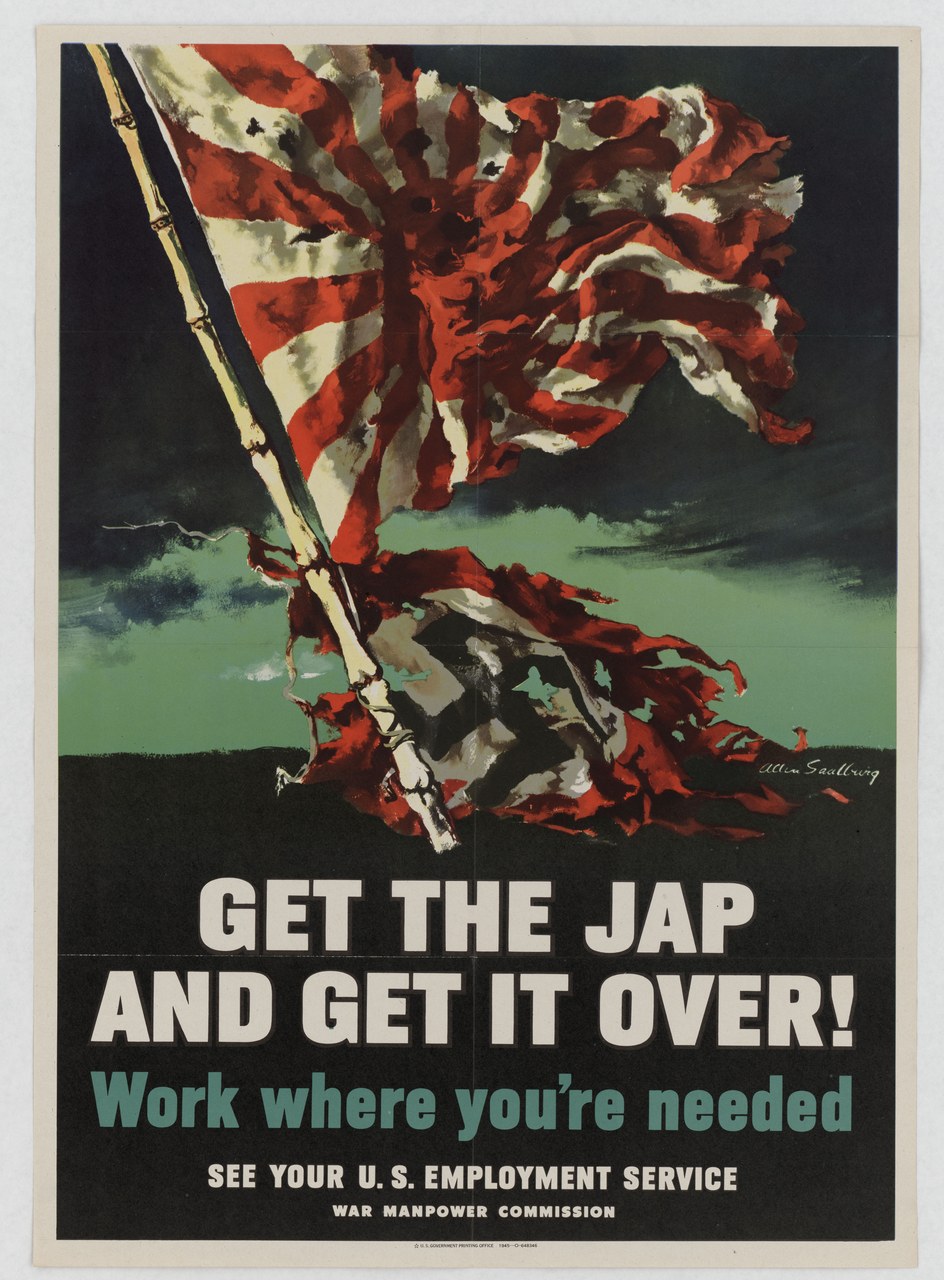
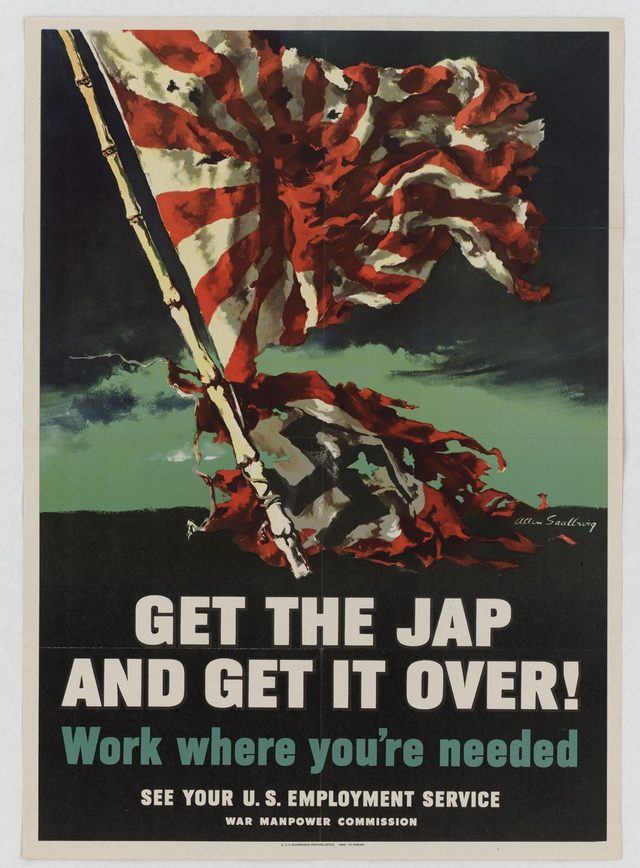
The War Manpower Commission poster, signed Allen Saalburg and dated 1945 by its Government Printing Office imprint, asks workers to take jobs "where you're needed" through the U.S. Employment Service. The caption says the slur stands in for the whole nation. Read the technique: name-calling.
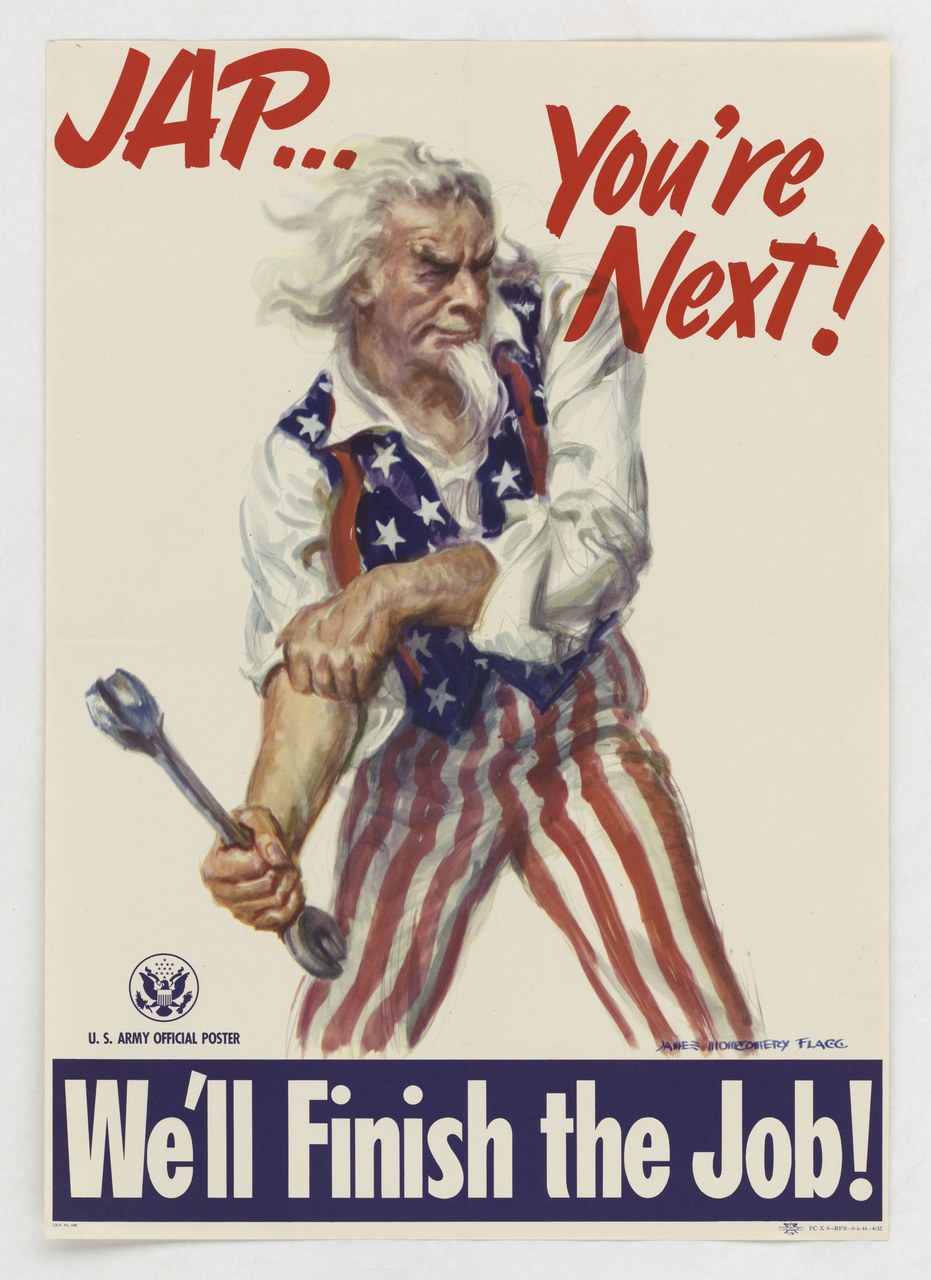
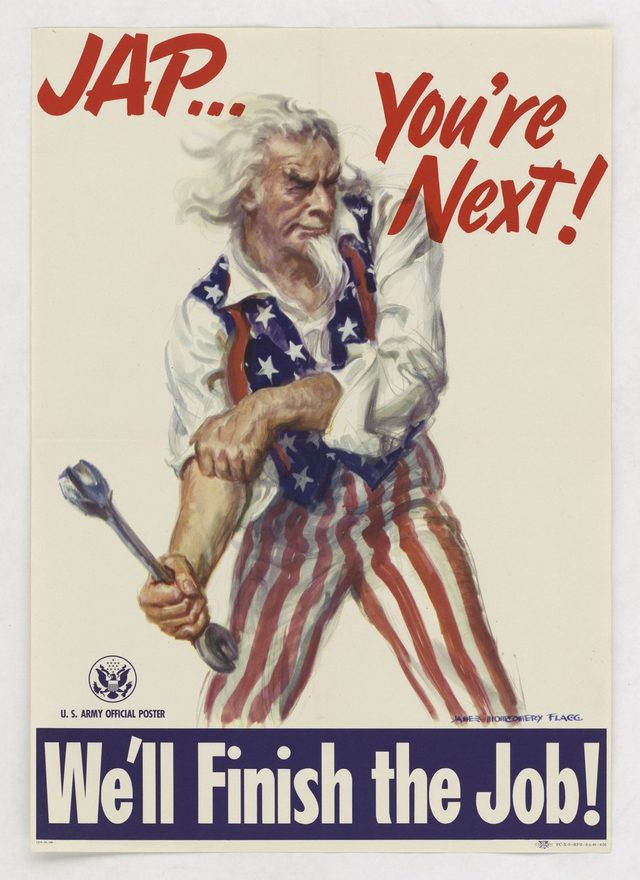
U.S. Army poster I.S.D. No. 198, drawn by James Montgomery Flagg (printing code dated 9-6-44), borrows Uncle Sam to give a worker's task the standing of the nation. The slur names the target. Read the technique: transfer.
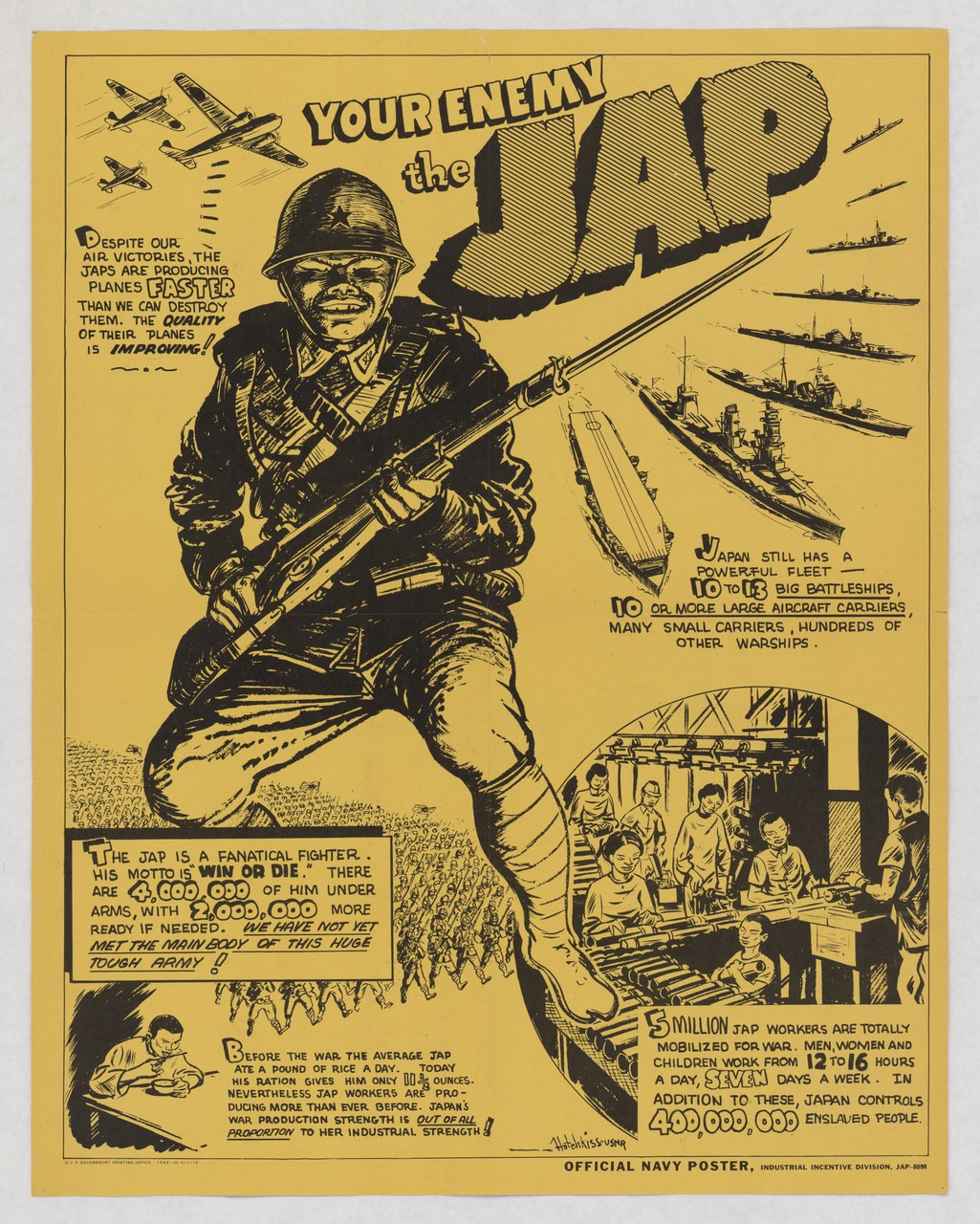
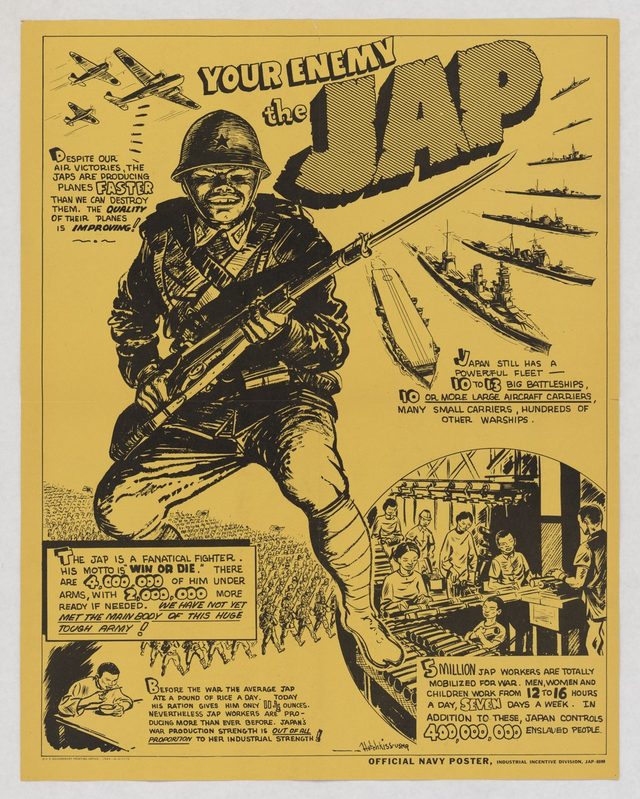
The Navy's Industrial Incentive Division issued this 1944 sheet for war-plant workers. It prints figures such as "400,000,000 enslaved people" and workers on 12 to 16 hour days, with no sources, dates or comparison with American output. The entry does not check the figures. Read the technique: card stacking.
How did posters tie the enemy to atrocity reports?
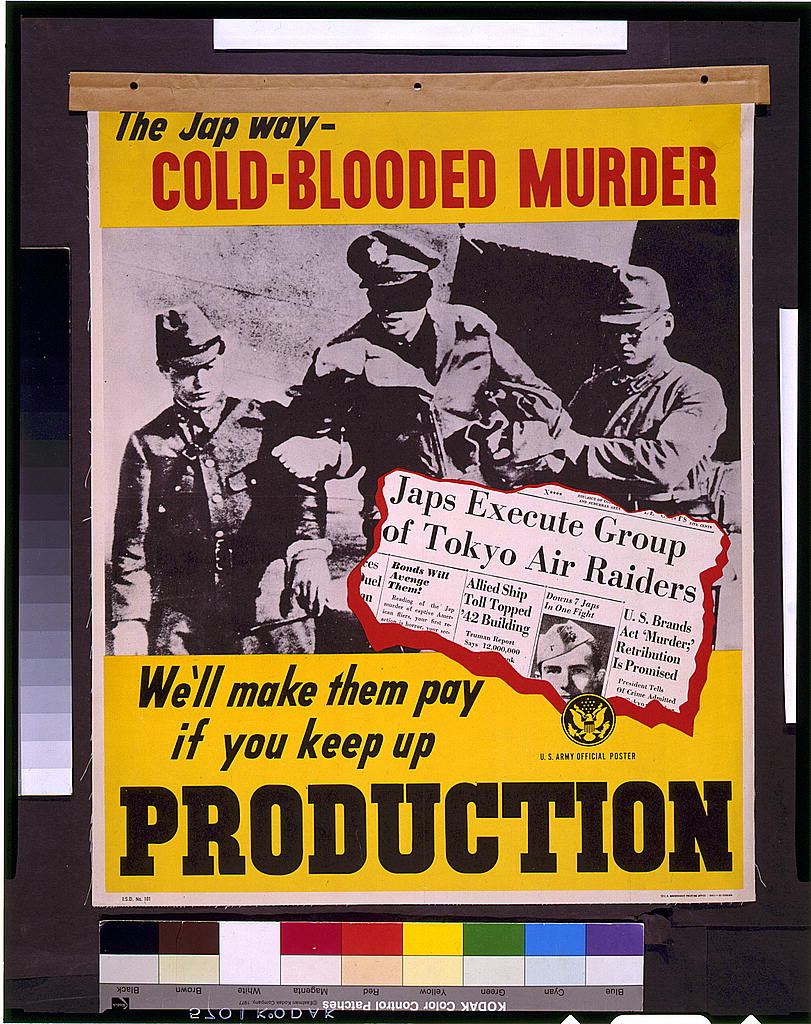
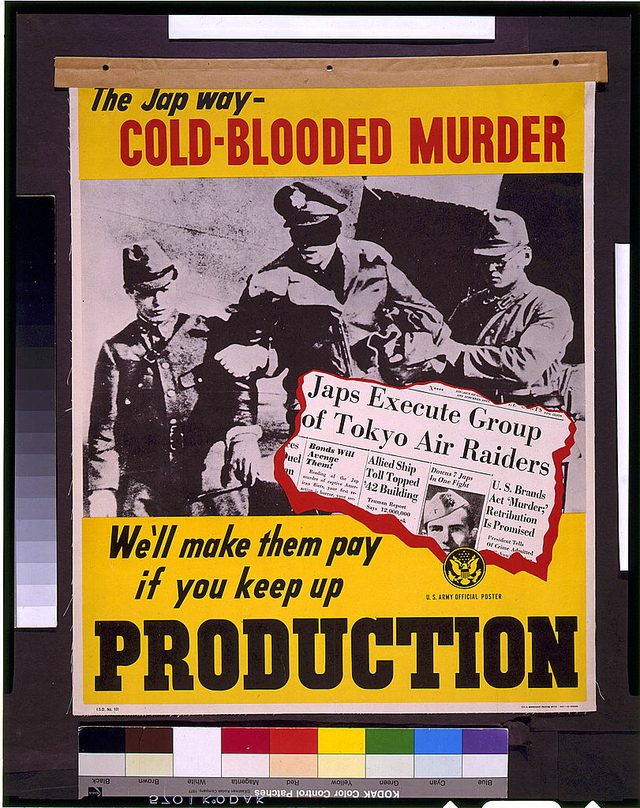
U.S. Army poster I.S.D. No. 101 (1943) overprints a photograph with a clipping, "Japs Execute Group of Tokyo Air Raiders". The entry says the clipping refers to the announcement of 21 April 1943 that Japan had executed some of the American airmen captured after the Doolittle raid of 18 April 1942. The record also says the headline label "The Jap way" turns one reported act into a national trait, and the poster closes by offering revenge through output. Read the technique: fear appeal.
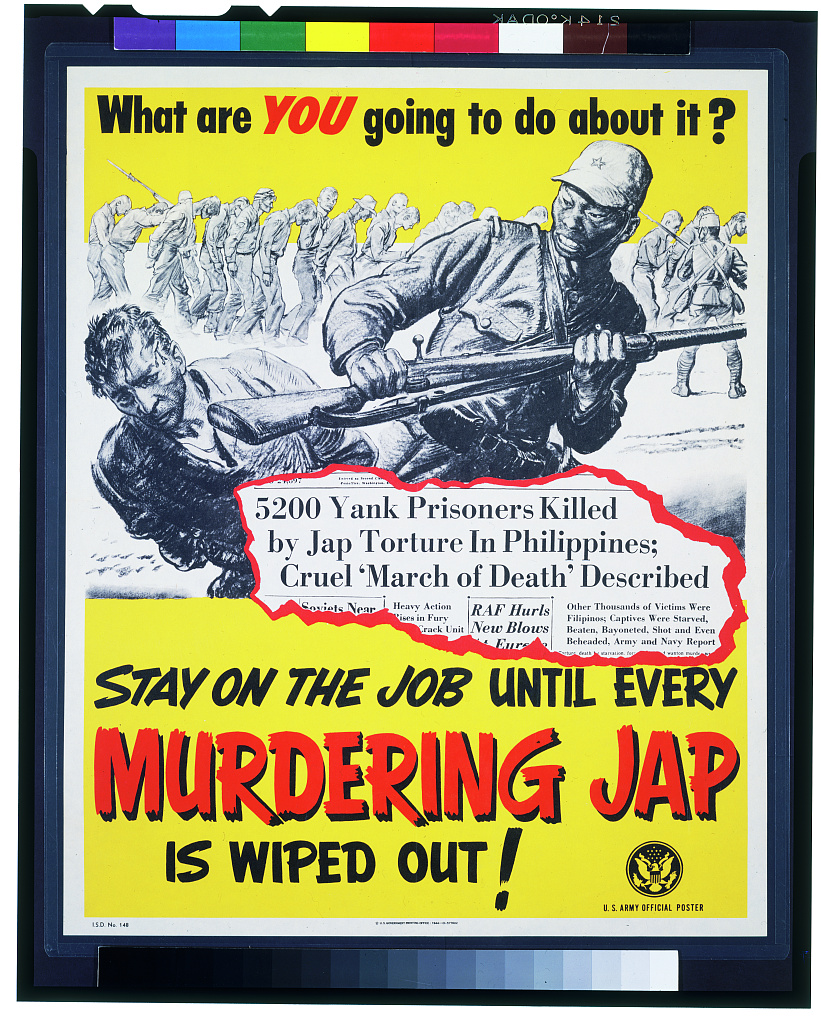
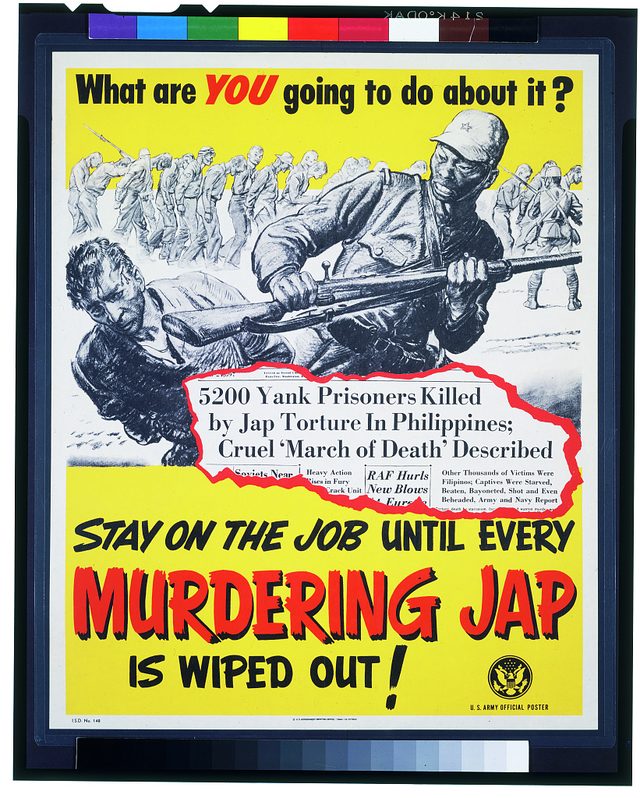
A companion Army sheet, I.S.D. No. 148 (1944), carries a clipping about the Philippines "March of Death". The entry notes that accounts by escaped American prisoners were released by the Army and Navy in late January 1944 and that estimates of deaths on the march vary widely by source. The entry tags the slur and the headline as the carriers of the call to keep producing. Read the technique: name-calling.
Why did some posters draw the enemy as vermin or as a cartoon?
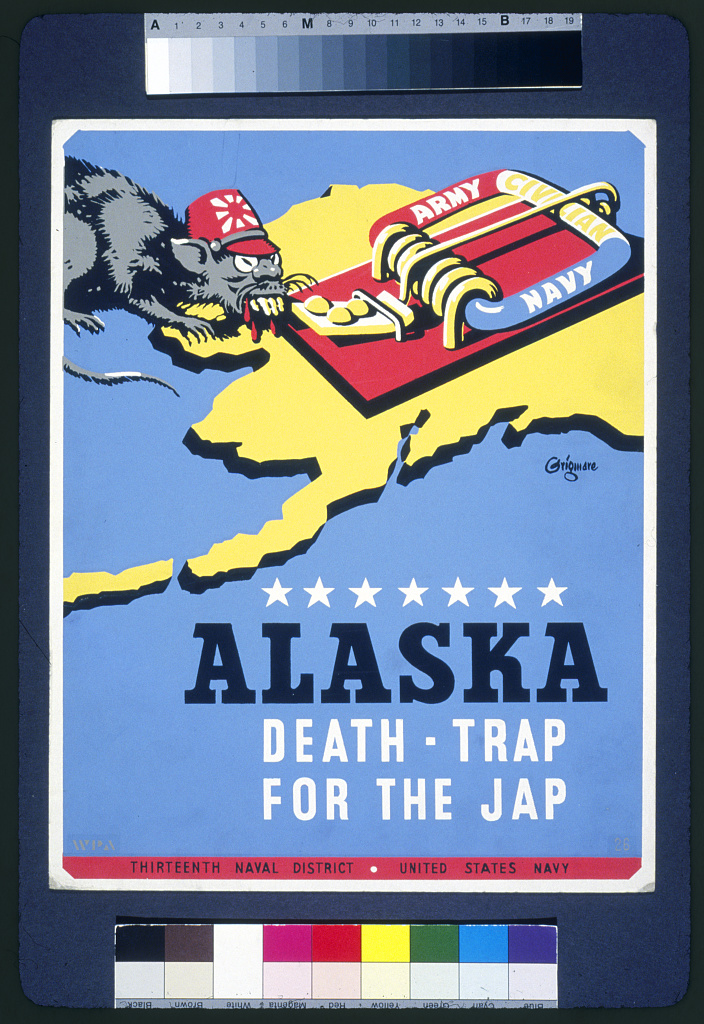
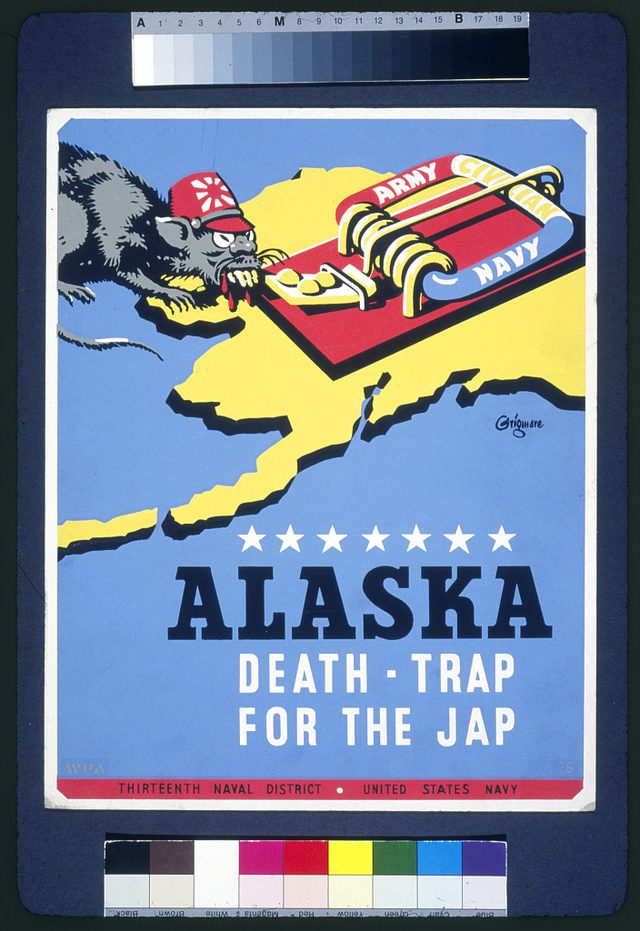
This poster was printed by the Washington State unit of the WPA Federal Art Project for the Navy's Thirteenth Naval District. The Library of Congress catalogues it as made between 1941 and 1943; the collection dates it 1942 from the Aleutian campaign it refers to. Japanese forces occupied Attu and Kiska in June 1942. The caption says the enemy is drawn as vermin and named with the slur, with no evidence given. Read the technique: name-calling.
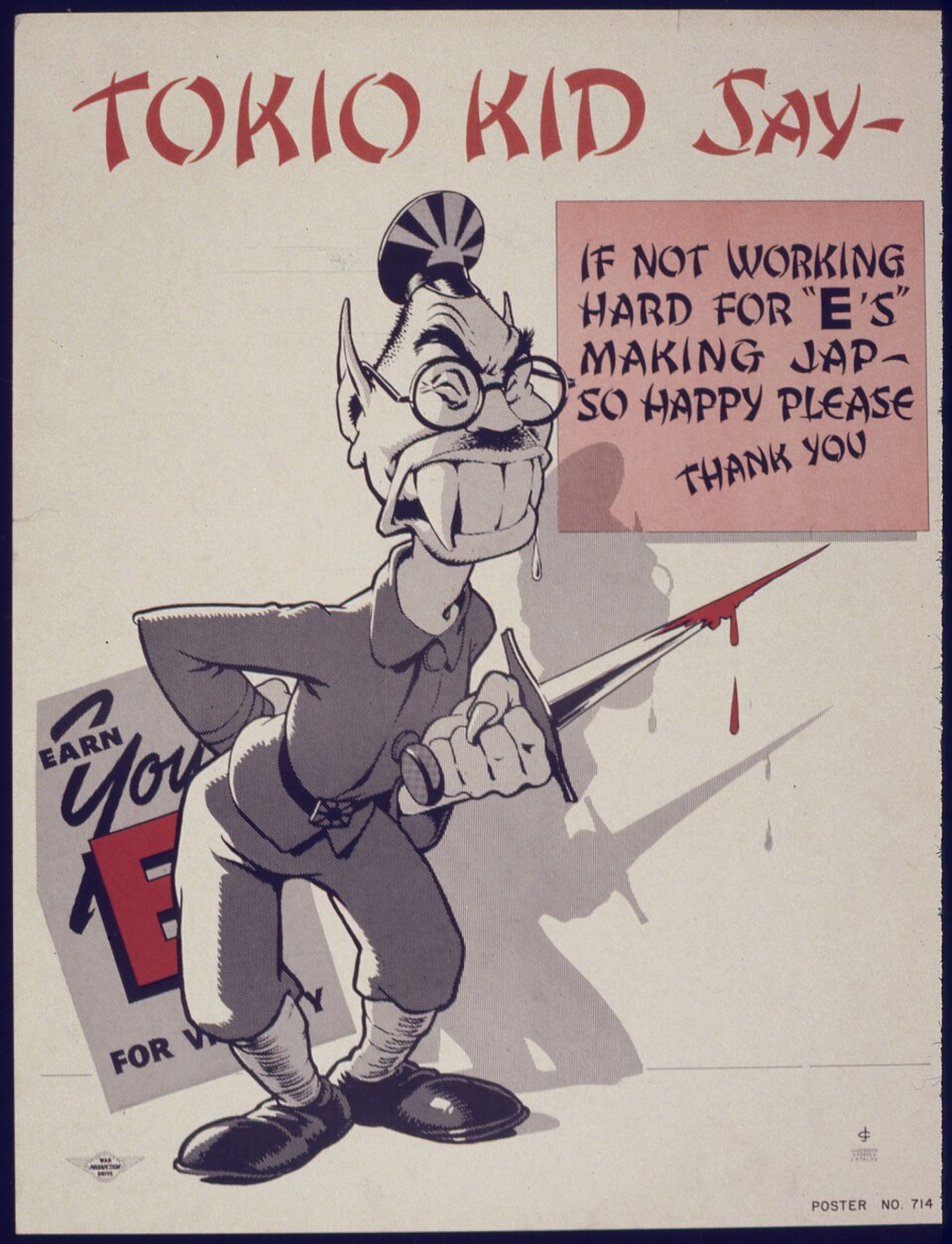
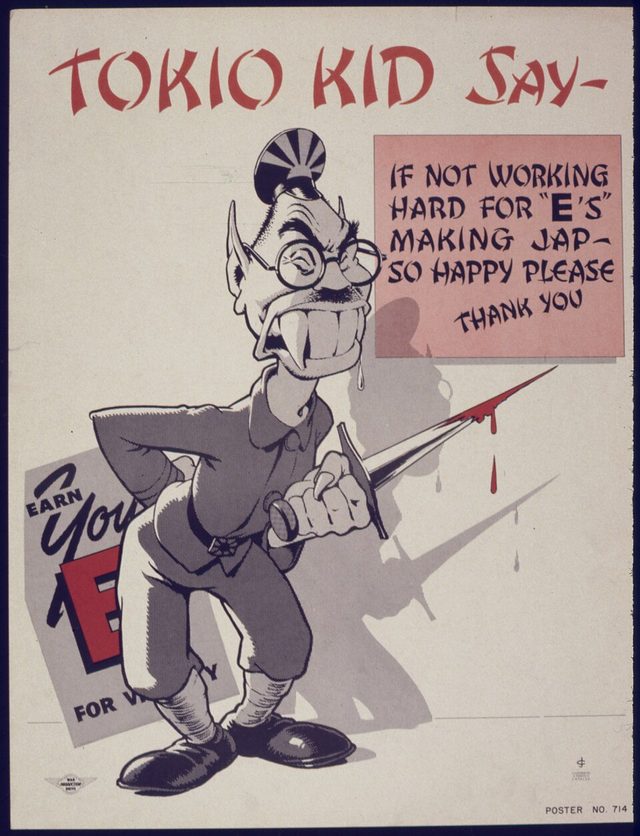
"Tokio Kid" was a plant-poster character created at Douglas Aircraft, according to the entry (citing Time, 15 June 1942), and later adopted by other firms and by the Treasury. This sheet is Poster No. 714 in a War Production Board series, circa 1942 to 1943. It pins slack production on the enemy's pleasure and offers the Army-Navy "E" award as the remedy. Read the technique: name-calling.
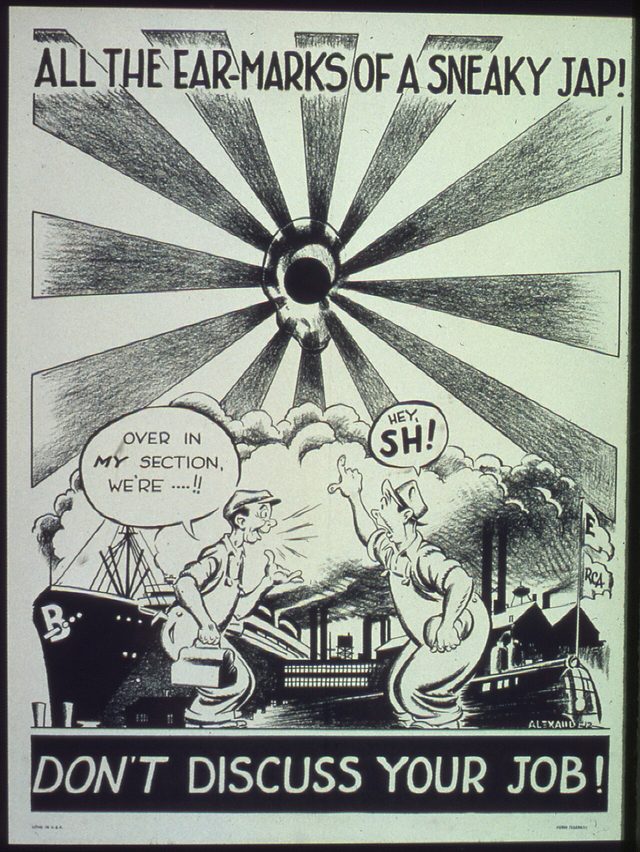
Content note: Ethnic slur against Japanese people in the headline. This object is shown as it was published. Why 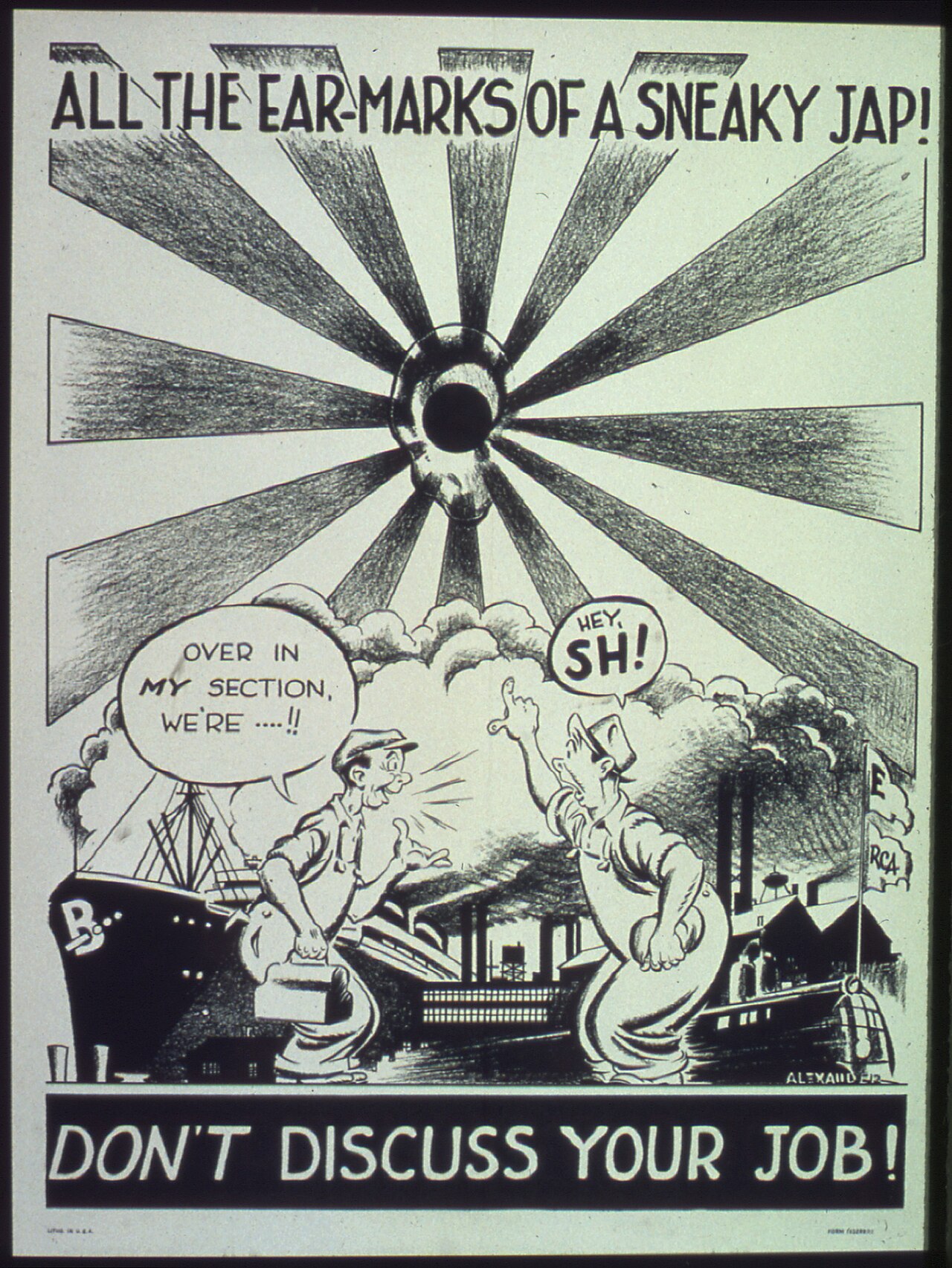
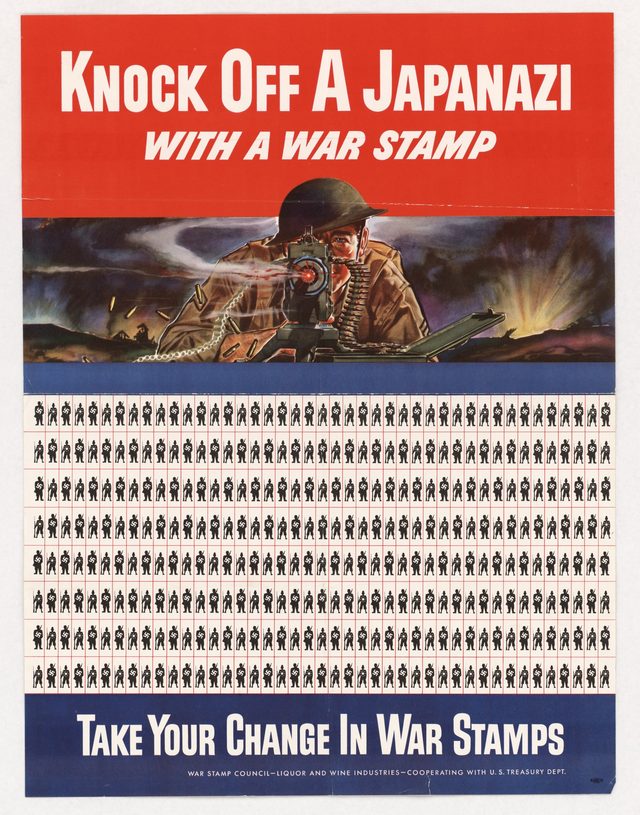
This security poster of 1943 is also covered on the careless talk page. The headline attaches a slur and a trait to a whole nationality and offers no evidence. Read the technique: name-calling.
What happened to Japanese Americans while these posters were on the walls?
Executive Order 9066 of 19 February 1942 led to the removal of about 120,000 people of Japanese ancestry, roughly two-thirds of them U.S. citizens, from the West Coast. They were held in camps. The collection's entries state this context on the posters above and on the objects below. In 1983 the Commission on Wartime Relocation and Internment of Civilians concluded that the policy was driven by "race prejudice, war hysteria and a failure of political leadership", and the Civil Liberties Act of 1988 issued a formal apology and redress.
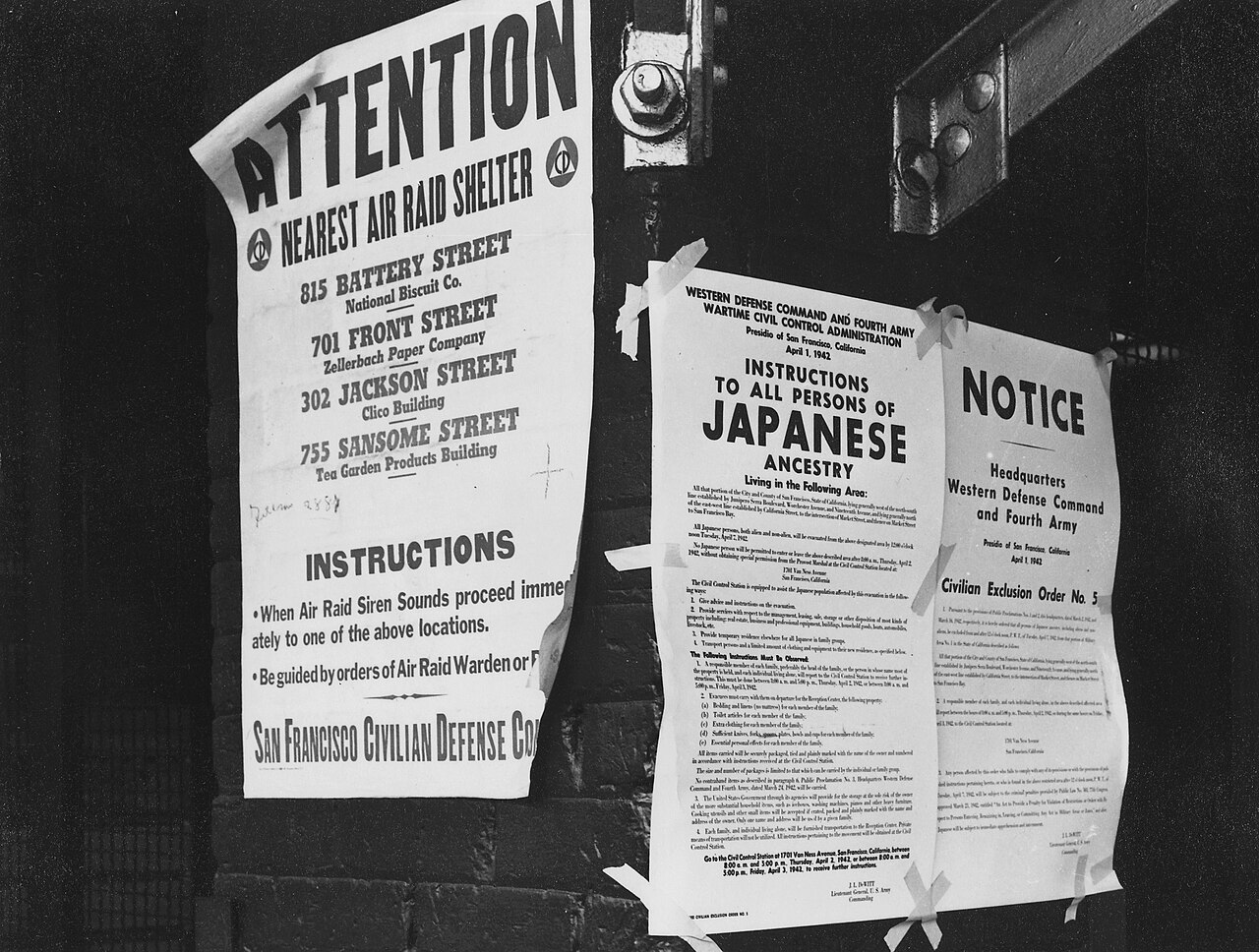
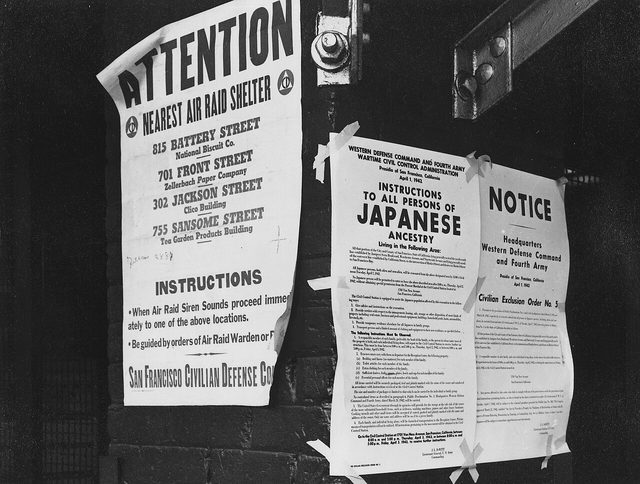
This photograph by Dorothea Lange for the War Relocation Authority (NARA 536018) shows an Army civilian exclusion order dated 11 April 1942, issued by the Western Defense Command and the Wartime Civil Control Administration. The collection's caption points to the official vocabulary: citizens were "non-aliens", forced removal was "evacuation" and the racetracks and fairgrounds where families were held were "assembly centers". Read the technique: euphemism.
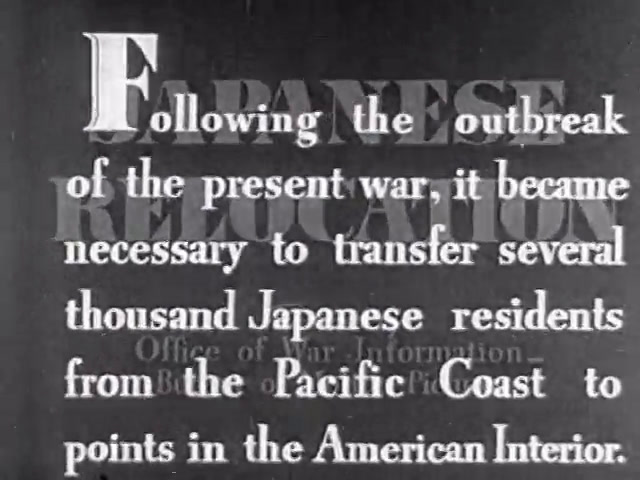
The Office of War Information film Japanese Relocation (about 9 minutes, 1943) opens with the card "it became necessary to transfer several thousand Japanese residents from the Pacific Coast to points in the American Interior". The entry tags the wording euphemism: "transfer" and "relocation" stand where the removal and confinement would be named. The OWI itself is covered in the OWI case study.
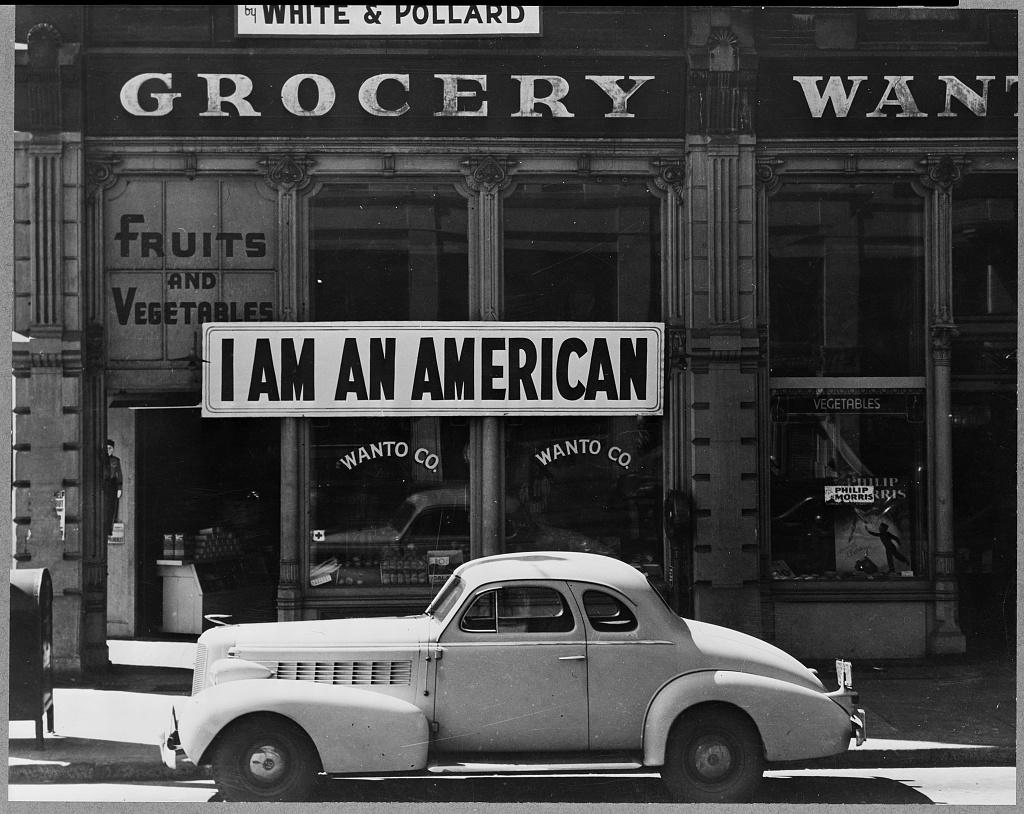
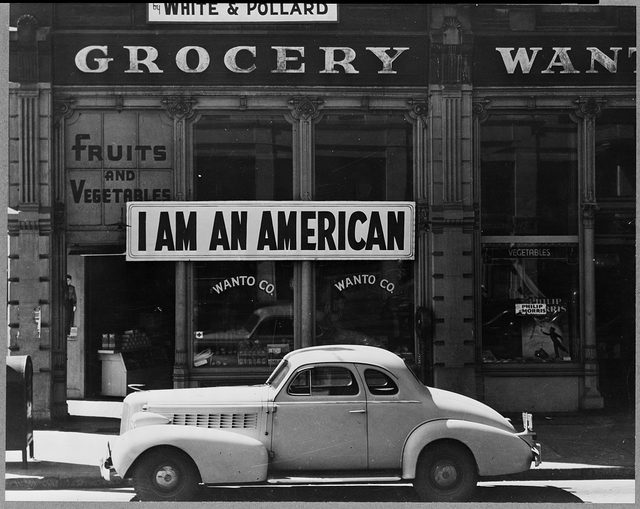
The Library of Congress holds Lange's March 1942 photograph of a sign in the window of the Wanto Co. store in Oakland. According to the entry, the owner, a University of California graduate of Japanese ancestry, displayed it on 8 December 1941, and the store had closed under the evacuation orders. It is a private individual's message, not an issued poster, and it is shown here because it answers the hostile signage of the period.
How did Australia and Britain picture Japan?
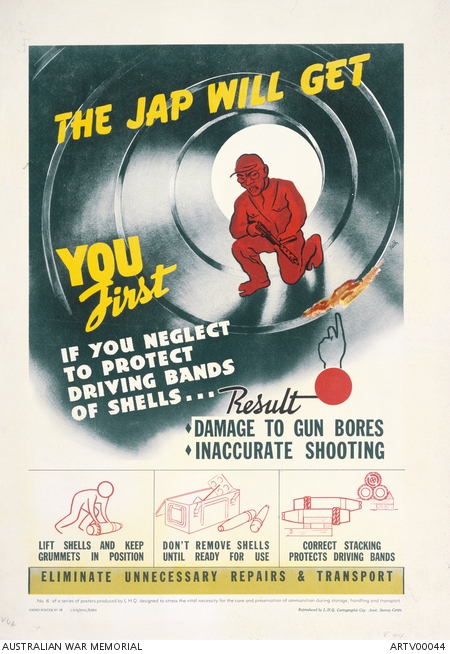
This Allied Land Forces Headquarters poster, by Harry Garnet Kelly, is held by the Australian War Memorial. The AWM says it was meant to stress care of ammunition, and records 1942 to 1945, so the entry year of 1943 is a midpoint. The threat is placed at the muzzle so that damaged shell bands read as danger to the gunner. Read the technique: fear appeal.
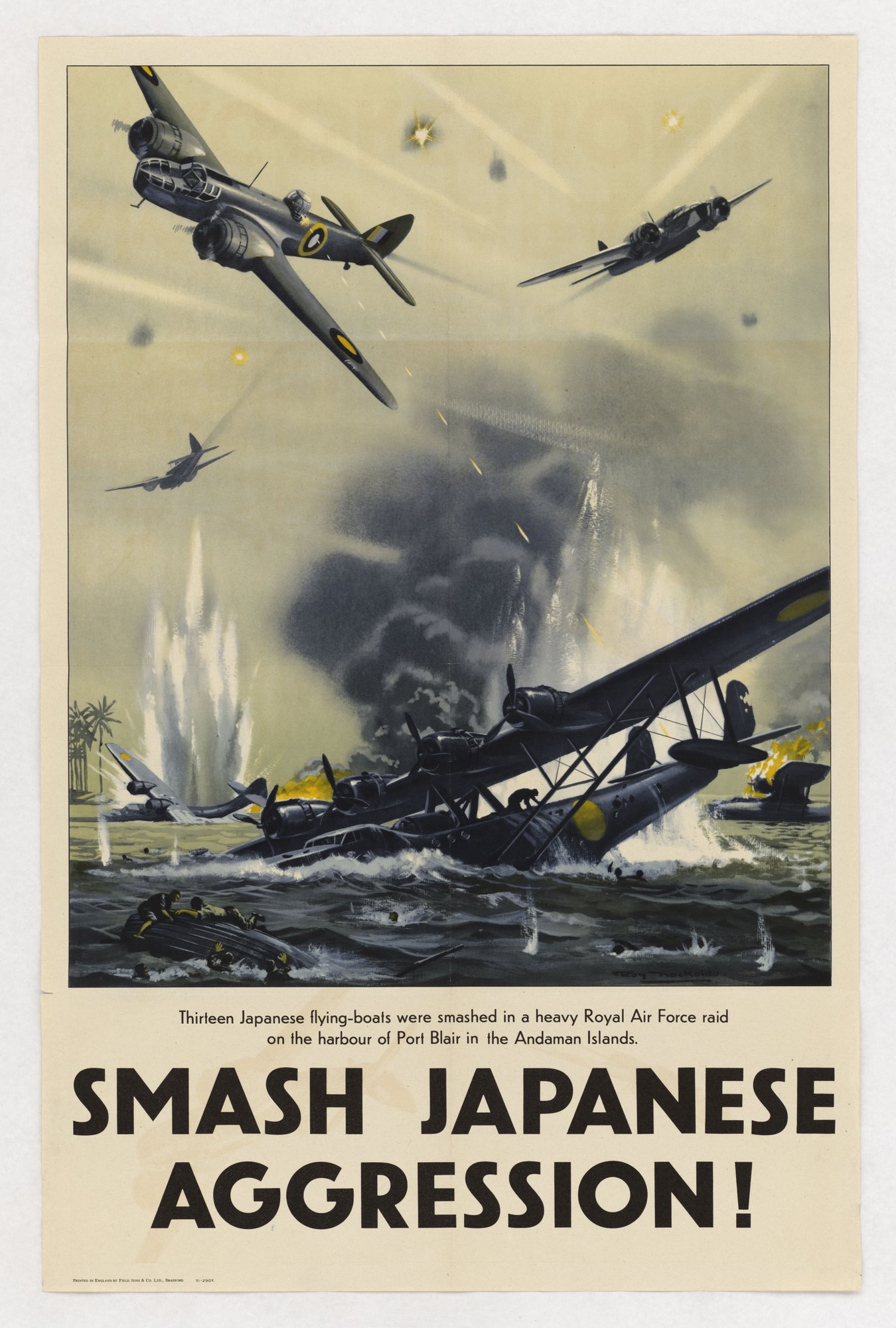
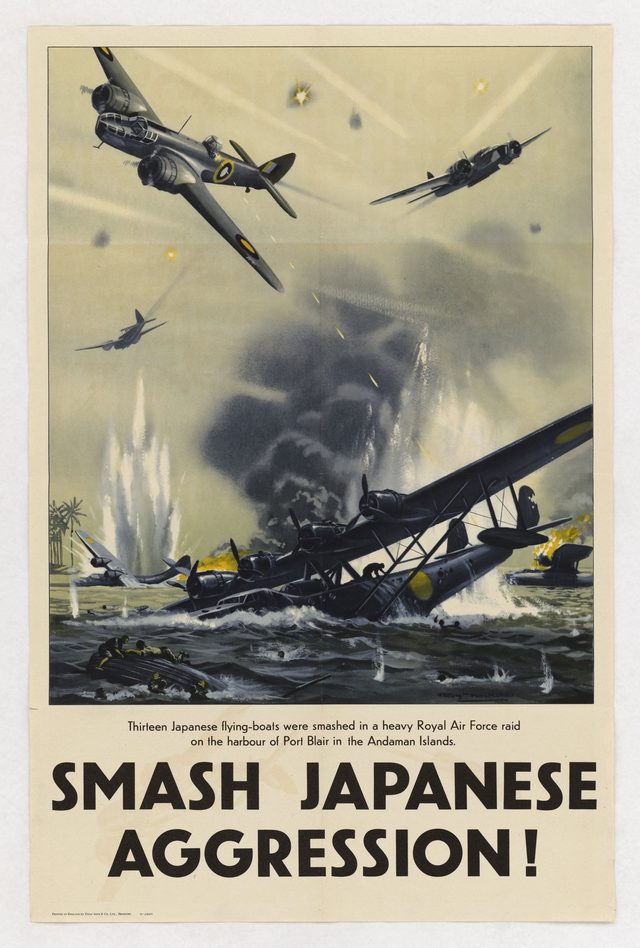
The British sheet, signed Roy Nockolds and printed in Bradford, reports a Royal Air Force raid on Port Blair in the Andaman Islands. The poster names no issuing ministry. Port Blair was held by Japan from March 1942, so the sheet is not earlier than that. The caption points out that one reported success is shown with no date or losses. Read the technique: card stacking. More on the British side is on British propaganda posters.
How did Americans address Asian audiences about Japan?
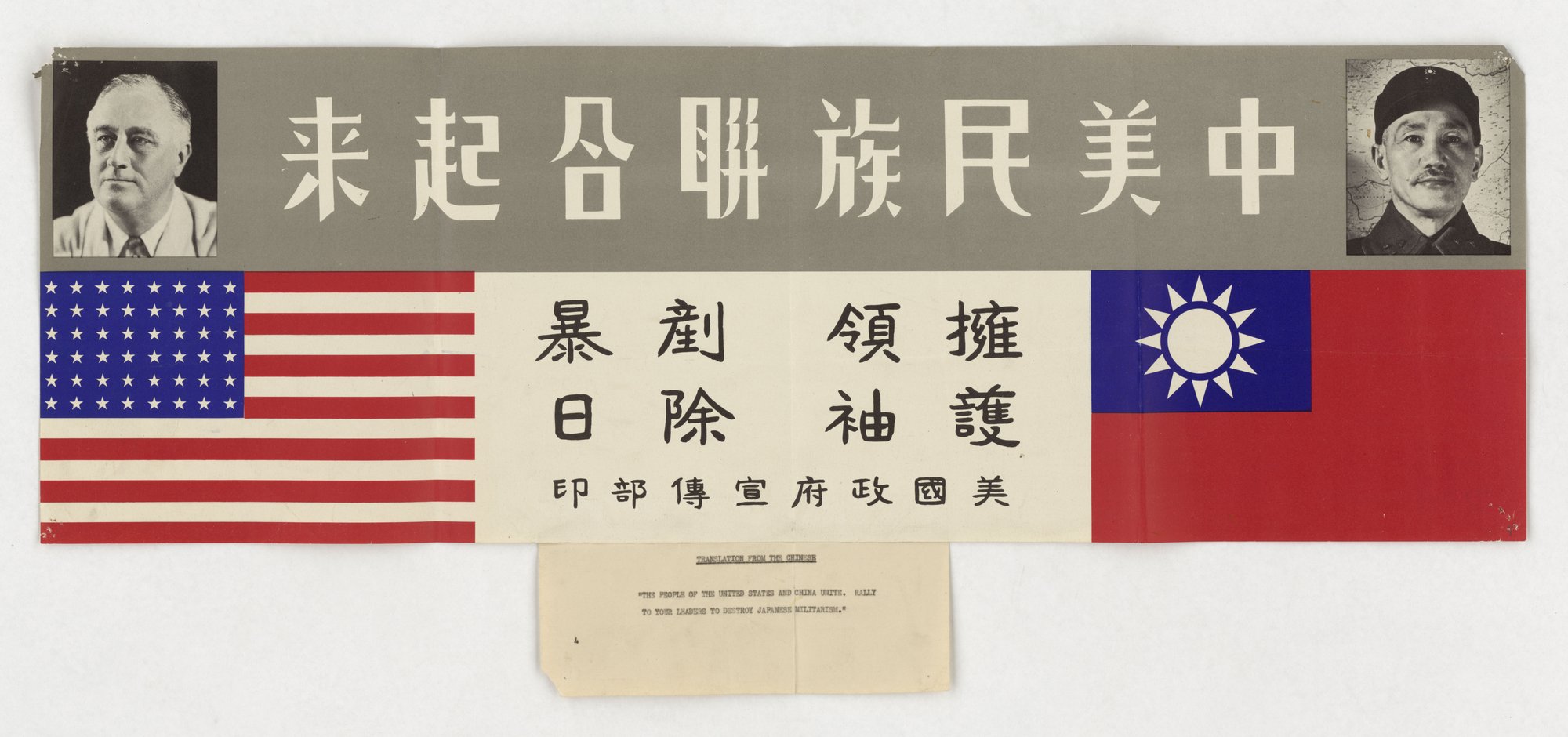
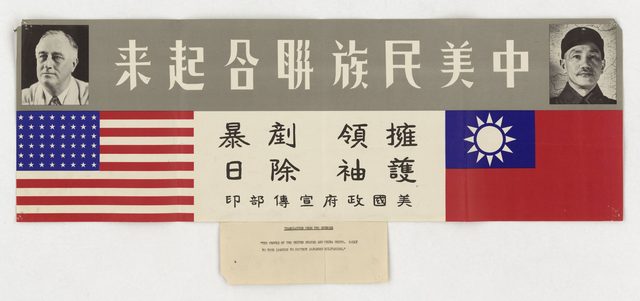
This banner is imprinted 美國政府宣傳部 ("American Government Propaganda Department" as printed) and carries the slogan "The People of the United States and China Unite. Rally to Your Leaders to Destroy Japanese Militarism". The collection dates it to 1942 as the earliest supportable wartime year, an estimate. Its loaded label is "violent Japan" (暴日). Read the technique: transfer.
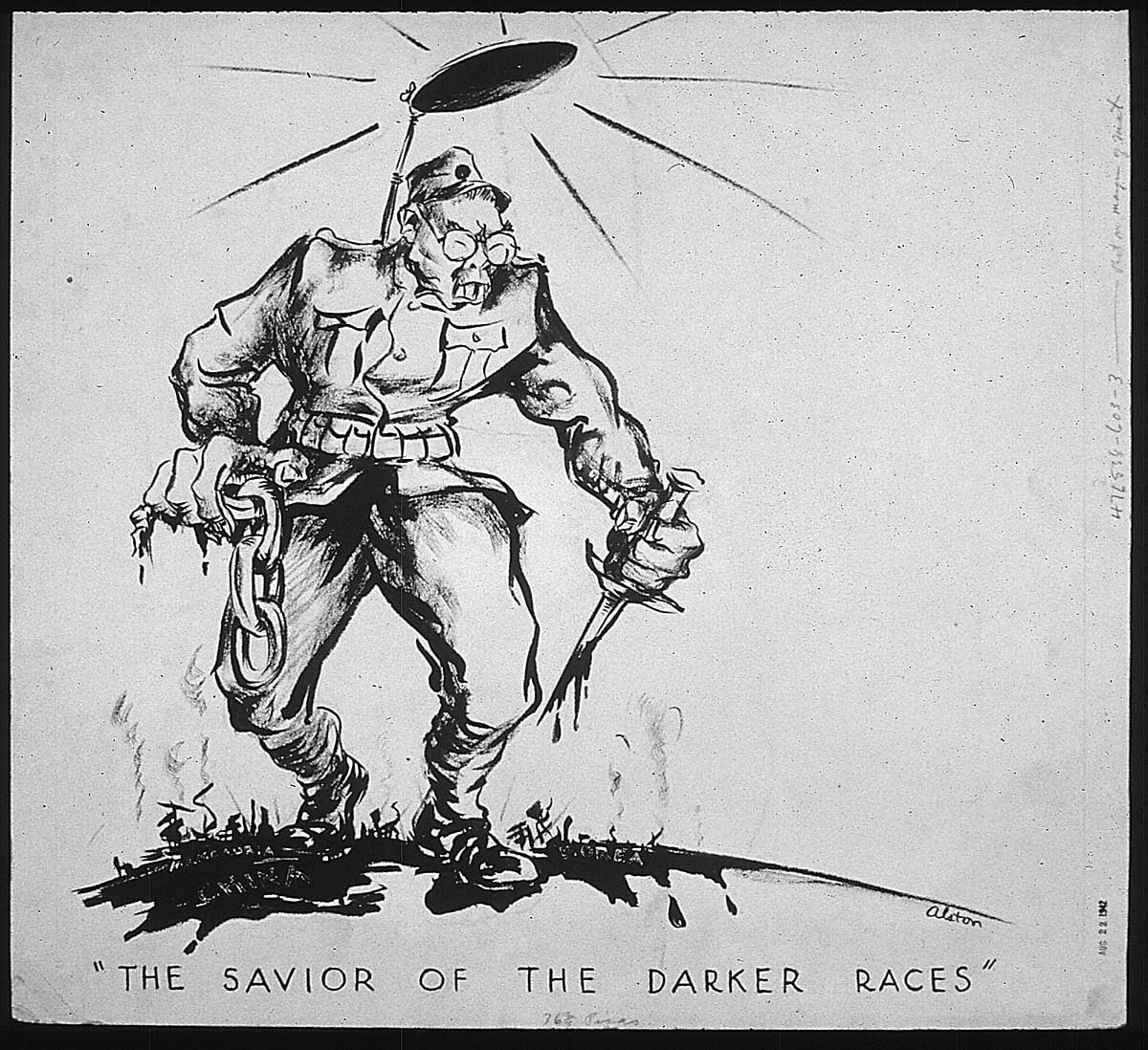
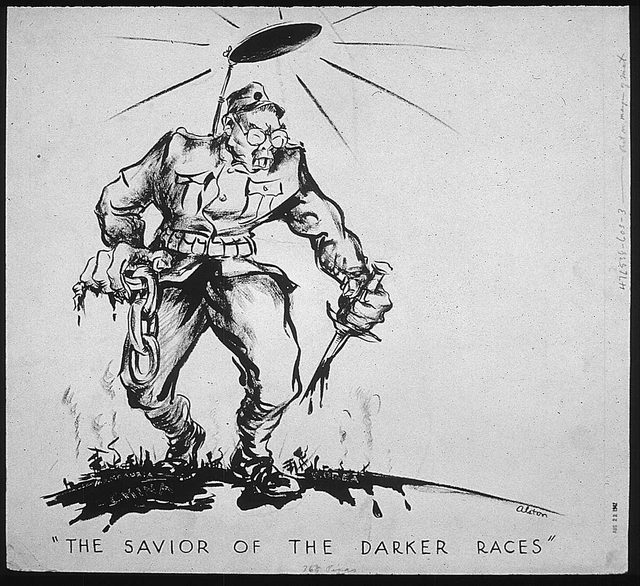
An Office of War Information cartoon by Charles Alston, held in a National Archives series, answers Japanese claims to champion non-white peoples. The entry reads it as aimed at Black American readers. It uses the racial caricature of Japanese people common in American wartime art, and the collection's tag is accusation in a mirror: it borrows Japan's own claim and contradicts it with chains and a dagger. Read the technique: accusation in a mirror.
How did Japanese propaganda picture the Allies?
The same questions apply. The Japanese government's own side is covered in the imperial Japan home-front case study.
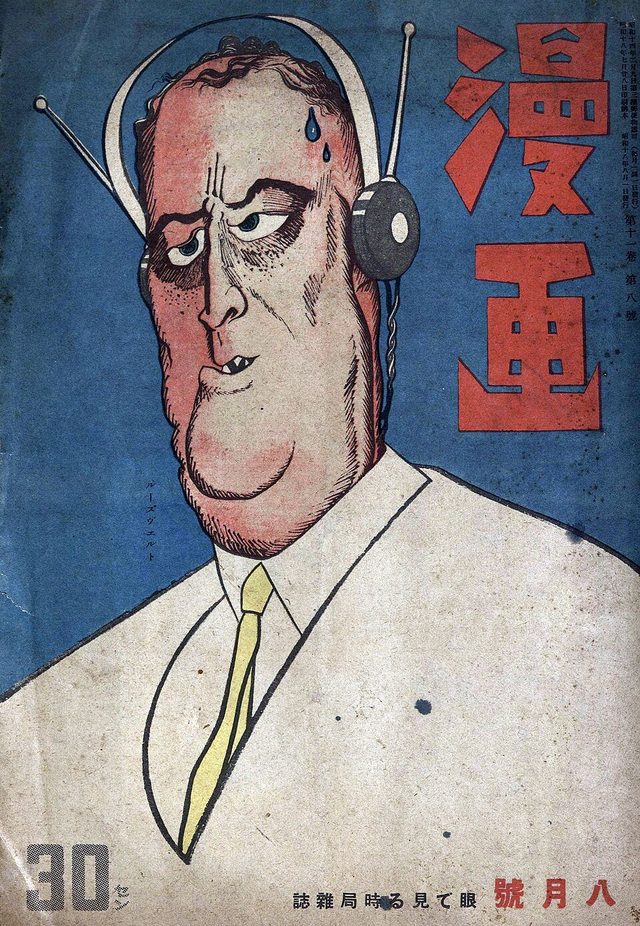
Content note: Wartime Japanese magazine cover with a caricature of US President Franklin D. Roosevelt (exaggerated jaw, buck tooth, sweat drop). This object is shown as it was published. Why 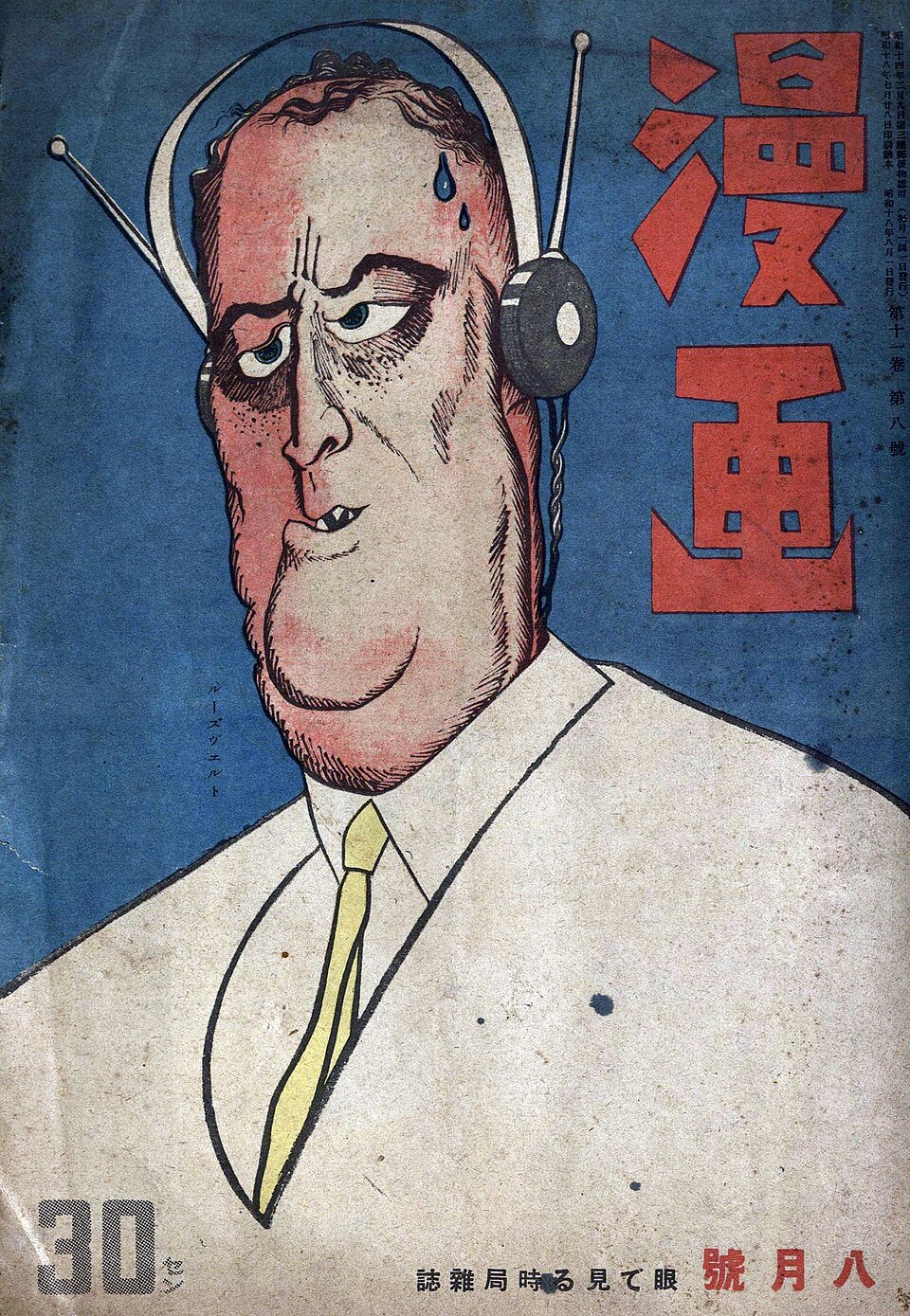
The cover of Manga (vol. 11, no. 8, 1 August 1943) shows a flushed, heavy-jawed Roosevelt with a bead of sweat, a buck tooth and headphones. The entry names the publisher as Manga-sha, Tokyo, a magazine that Japanese reference works say passed to government-promoted control from about July 1941. The caption's tell is the drawing itself: exaggeration does the insulting and the cover makes no argument. Read the technique: name-calling.
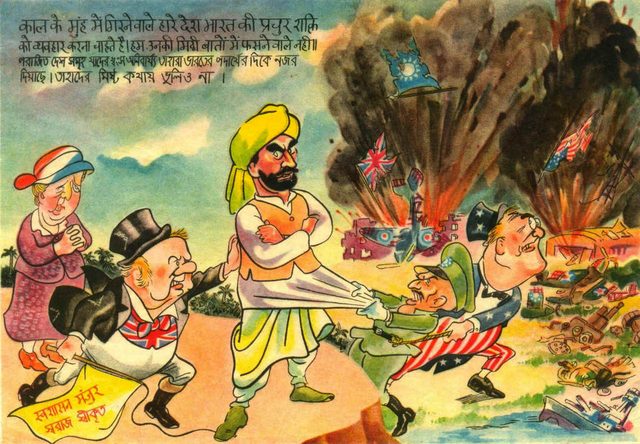
Content note: Wartime national caricature of Allied leaders (including Chinese and Dutch figures) in a Japanese leaflet aimed at Indian readers. This object is shown as it was published. Why 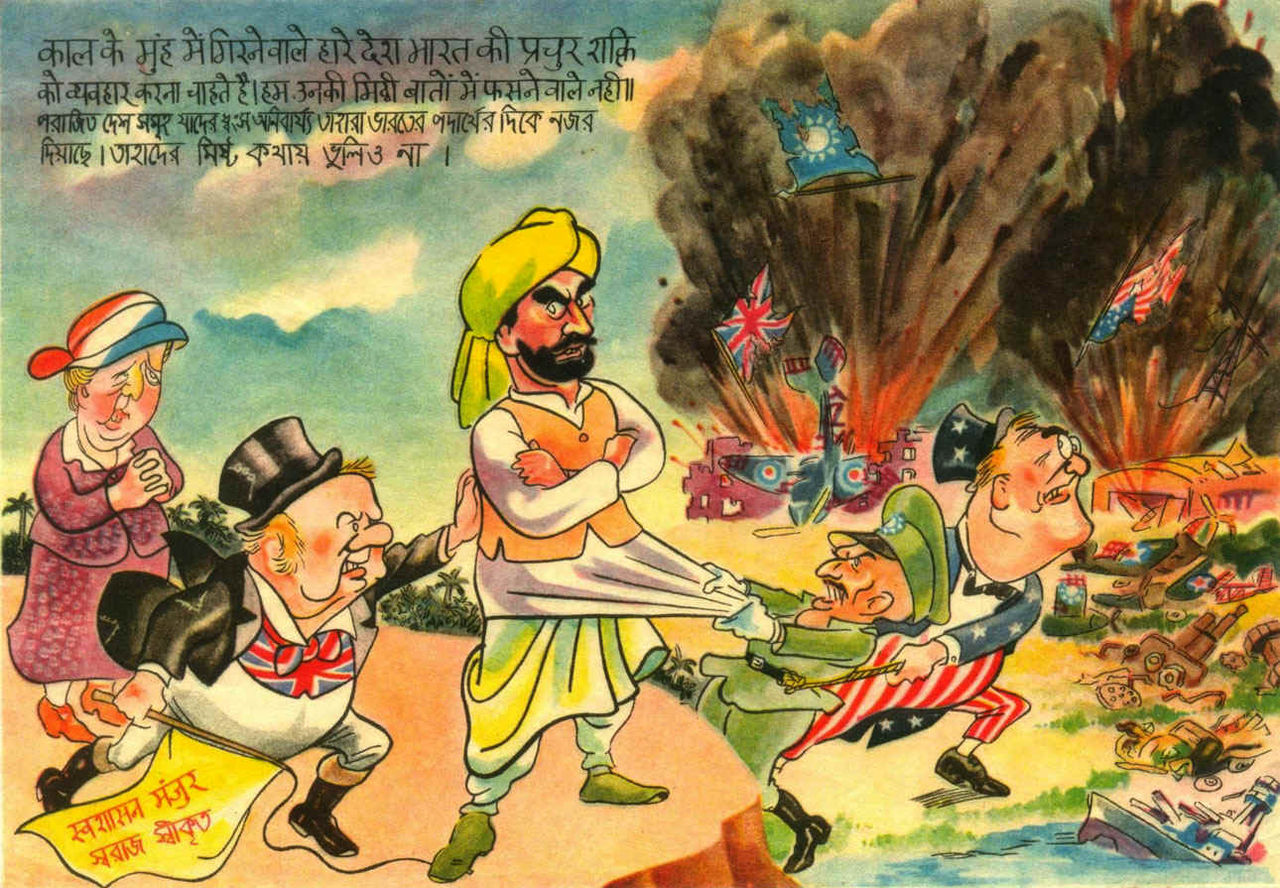
The 1943 leaflet is catalogued on Wikimedia Commons as showing Churchill pushing and Chiang Kai-shek and Roosevelt pulling an Indian into the fight against Japan. The entry says the leaflet names no issuer and that its attribution to Japan rests on outside cataloguing. Read the technique: bandwagon.
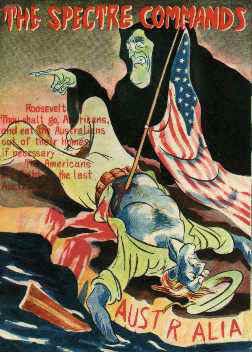
This leaflet puts invented words in Roosevelt's mouth about fighting "to the last Australian". The entry states that the attributed speech is the leaflet's invention and not a record of anything he said, and that the date comes from Commons. Read the technique: scapegoating.
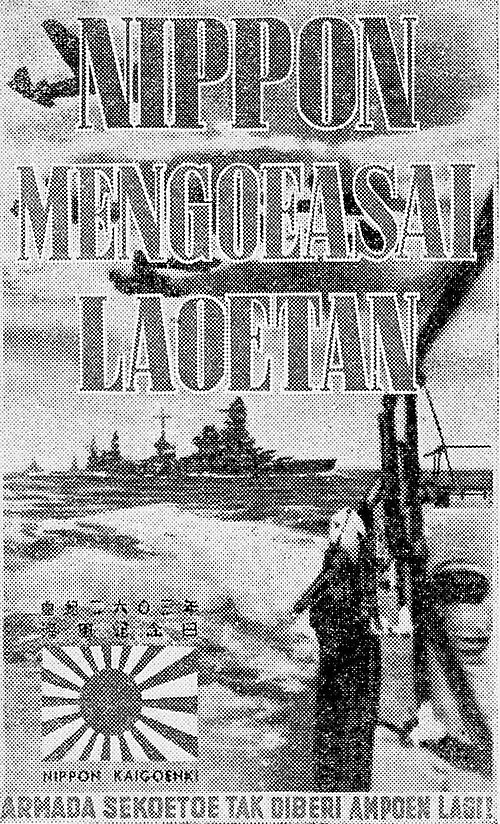
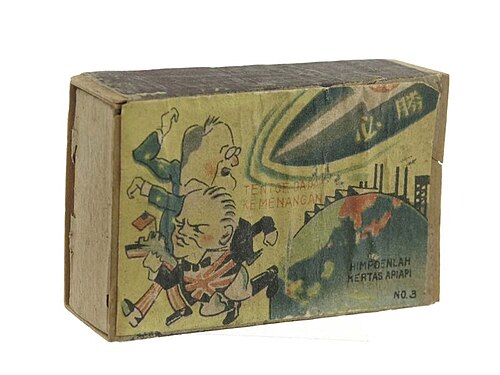
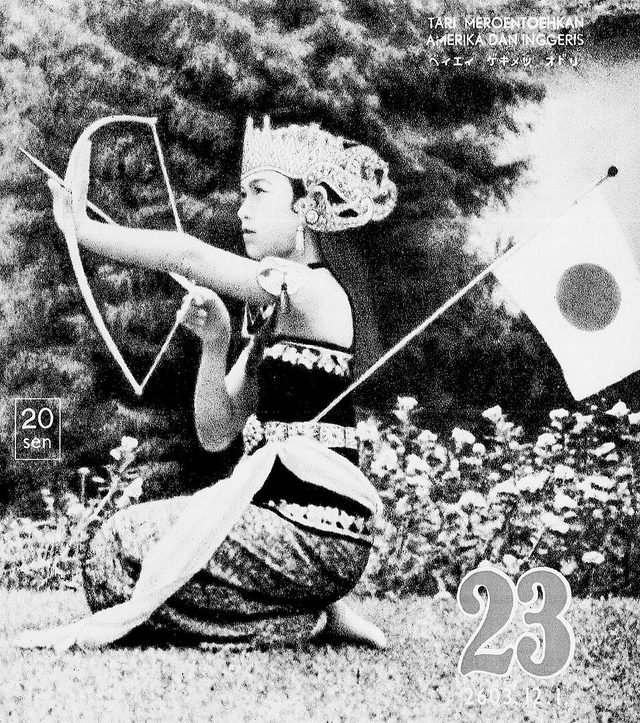
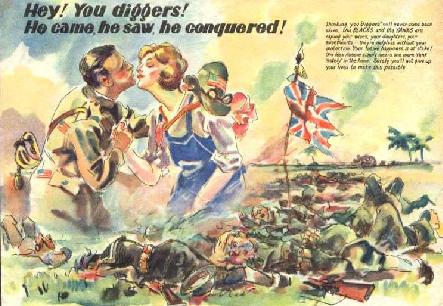
In Java, the Japanese military administration's Propaganda Department published the Indonesian-language magazine Djawa Baroe. Its issue of 1 June 1943 reproduces a poster, "Nippon Mengoeasai Laoetan" ("Japan controls the seas"), dated by the entry to Navy Memorial Day. A bottom line says the Allied fleet gets no more mercy. The tell is a slogan stated as settled fact, with massed ships as the proof. Read the technique: bandwagon.
What to look for in an anti-Japanese poster
- A label for a nation. The headline names the enemy with a slur or a trait, and no individual or act is shown.
- One act made typical. A single reported event, such as an execution or a march, stands for a whole people.
- A borrowed symbol. Uncle Sam, flags or a folk-tale hero lend authority to a factory or farm task.
- The issuer. Check whether the sheet names an army, a ministry, a company or no one at all.
How the sides compare
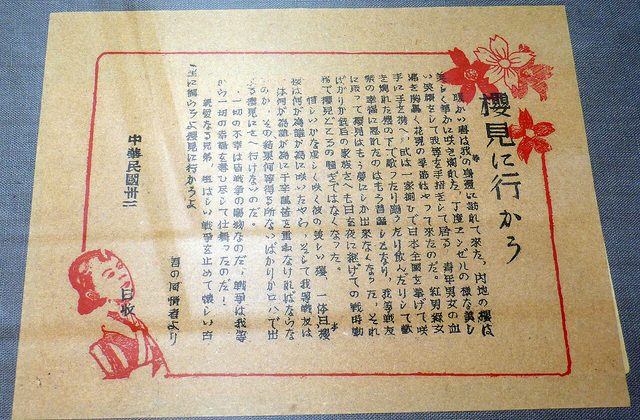
The tells on this page, name-calling, fear appeal, transfer and card stacking, are the same in American, Australian, British and Japanese material. Differences are in audience and issuer. American and Australian sheets mostly spoke to their own workers, soldiers and civilians, in a country where, at the same time, citizens of Japanese ancestry were removed from their homes. Japanese leaflets and magazines spoke to Allied troops and to people in occupied Asia, and some of them drew Allied leaders as caricatures; the items in the collection are fewer, and each is described on its own terms above. The collection also holds a 1943 leaflet by a Japanese anti-war league in China, "Let's go cherry-blossom viewing", aimed at Japanese soldiers and urging them to stop the war. For the American record more widely, see American propaganda posters.
Browse anti-Japanese and Japanese WW2 propaganda
The grid below shows posters and related objects from the collection. Each opens an object page with the holding institution, a link to the original record, a transcription of any text and the rights basis for hosting. For other home-front themes, see careless talk, war bonds, rationing and salvage and women in WW2 posters.
Sources and rights
Objects on this page come from the U.S. National Archives, the Library of Congress, the Australian War Memorial, the Tropenmuseum and the Internet Archive, directly or through Wikimedia Commons. The object page gives each rights basis. Transcriptions are verbatim. Context cited above comes from the collection's own entries, which cite the National Archives, the Australian War Memorial and the Commission on Wartime Relocation and Internment of Civilians.