Content note. One poster shown here attaches an ethnic slur and the word "sneaky" to Japanese people, and another draws a caricature of the Nazi regime. A third uses a photograph of books burning in Nazi Germany. All are shown as issued, as evidence of what the U.S. government told the public. Showing a poster is not endorsing it.
What were Office of War Information posters?
Office of War Information (OWI) posters were Second World War sheets issued or distributed by the U.S. federal information agency created on 13 June 1942. Many were numbered and printed by the Government Printing Office, often for other agencies such as the Treasury or the War Manpower Commission. They covered security, rationing, bonds, jobs and the war's aims.
The collection has 302 entries whose actor field names the Office of War Information; 189 are posters, 111 are cartoons, and one each is a photograph and a film still (counts made from the entry files in examples/entries/). This page shows 18 of them. It asks the same four questions of each: who issued it, who it was for, what it asked, and which technique carried the ask. For the wider war, see WW2 propaganda posters, American propaganda posters and propaganda posters.
How did the Office of War Information come about?
President Roosevelt created the OWI by Executive Order 9182 on 13 June 1942. The order merged four earlier information offices: the Office of Facts and Figures, the Office of Government Reports, the Division of Information of the Office for Emergency Management, and the Foreign Information Service of the Coordinator of Information. Elmer Davis, a CBS newscaster, was named director. The order told him to run information programmes through "press, radio, motion picture, and other facilities" so the public would have "an informed and intelligent understanding" of the war effort.
The agency had two parts. A Domestic Branch, directed in 1942-43 by the publisher Gardner Cowles Jr., handled news, radio, publications, graphics (posters), magazines and motion pictures. An Overseas Branch, under the playwright Robert Sherwood, handled material for Allied, neutral and enemy audiences. See the OWI Domestic Branch case study and the OWI and Writers' War Board case study.
Who ran the OWI poster programme, and what happened to it?
Posters came from the agency's graphics bureau, which at various points included the art director Francis Brennan and the painter Ben Shahn. Its predecessor had called its approach the "strategy of truth", a phrase Davis took over.
Inside the agency there was a dispute over method. On 14 April 1943 writers in the domestic writers' division, among them Arthur Schlesinger Jr., resigned. Their statement said it was "impossible for us, under those who now control our output, to tell the full truth" and that home-front work was "now dominated by high pressure promoters who prefer slick salesmanship to honest information". In Congress the objection was political: Representative John Taber said an OWI comic book on Roosevelt's life was meant to promote a fourth term. Davis replied that the comic was made mainly for overseas readers and ordered staff to avoid partisan material.
In summer 1943 the House voted to strip the Domestic Branch of funding for fiscal 1944. Money was restored with tight limits, and accounts put the branch at about a tenth of its earlier budget. OWI was abolished on 31 August 1945. Both sides of the argument are on the record, and this page does not rule on it.
What did OWI security posters ask the public to do?
Security sheets asked civilians not to discuss sailings, troop movements or war work. For the wider comparison, see WW2 careless talk posters.
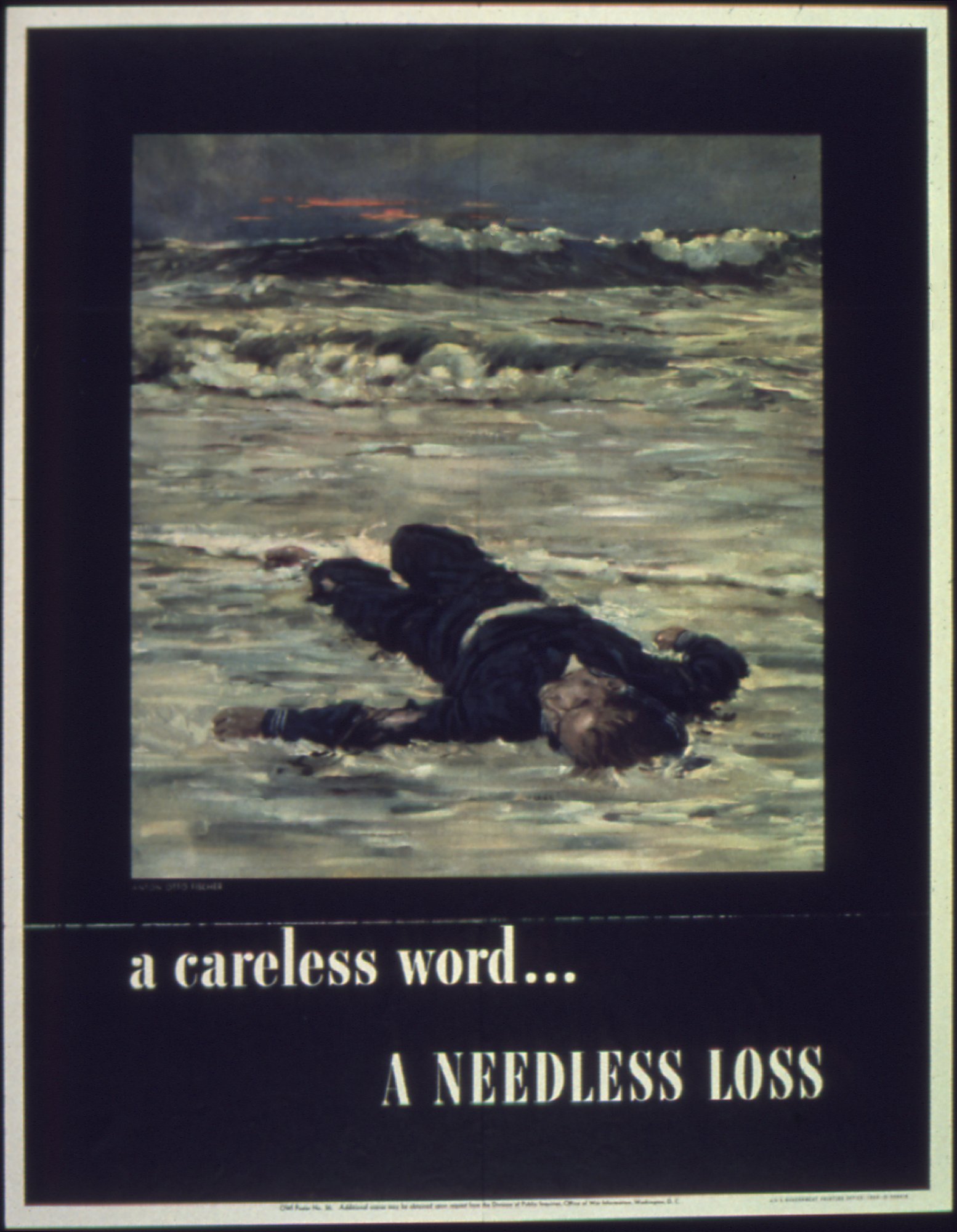
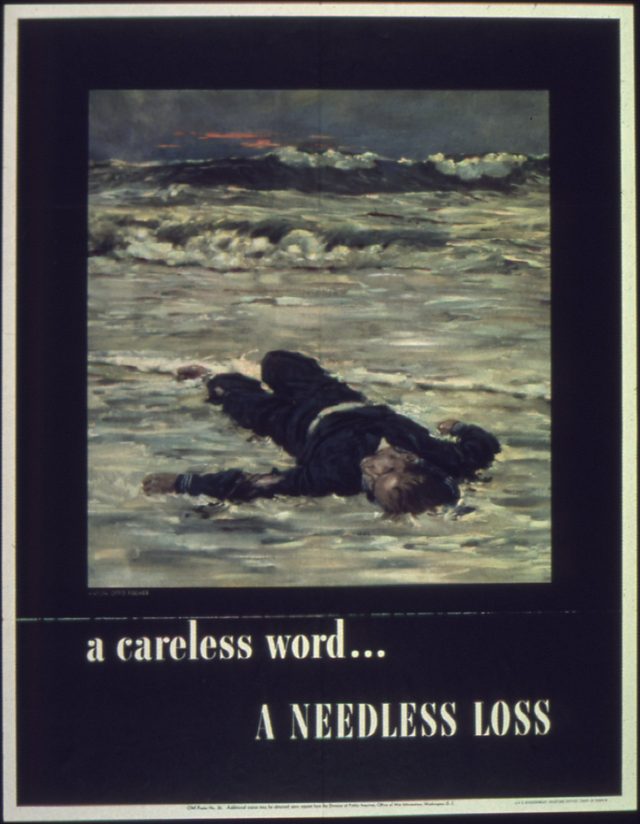
OWI Poster No. 36 is a painting by Anton Otto Fischer, held by the U.S. National Archives (RG 44). It shows a drowned sailor in the surf under "a careless word... A needless loss". The entry dates it to 1942 by inference from a sister sheet, since the printing line is too small to read. The caption says it links casual talk to the death of a seaman. Read the technique: fear appeal.
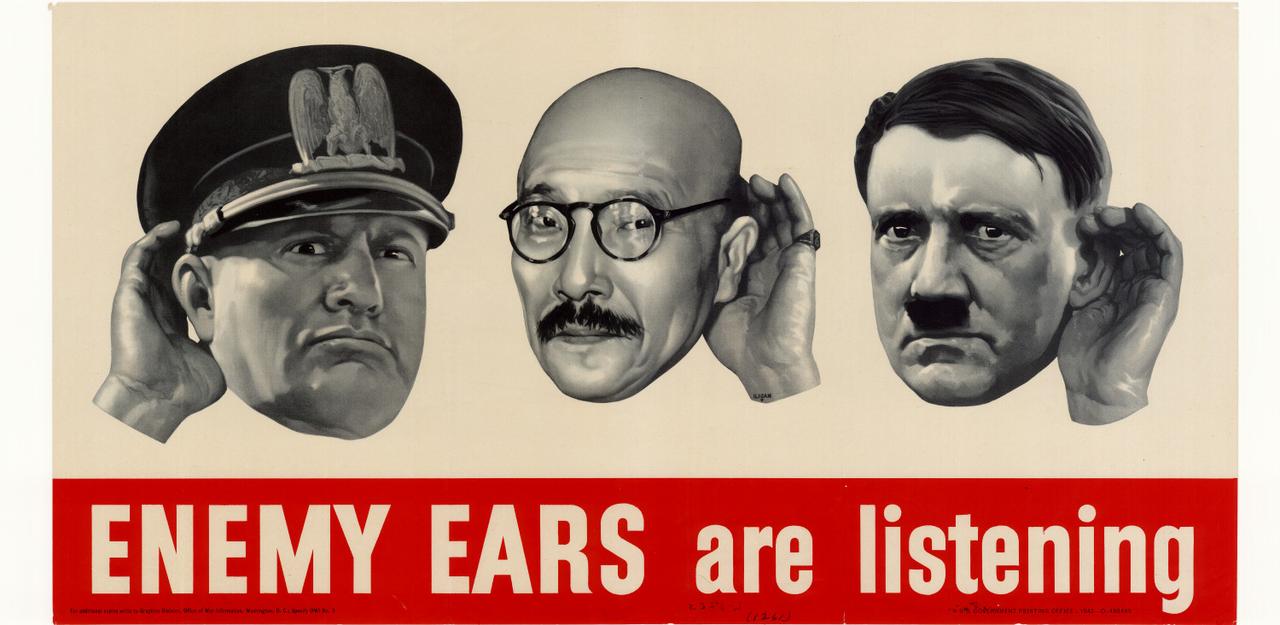
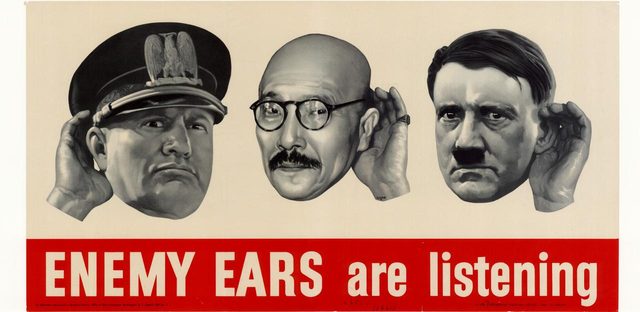
OWI Poster No. 5 (1942, artist Ralph Iligan, printed by the Government Printing Office) shows three Axis leaders with a hand behind one ear. The entry notes that the heads are realistic portraits, not line caricature. They stand in for an unseen listening threat in ordinary conversation, and no case is cited. Read the technique: fear appeal.
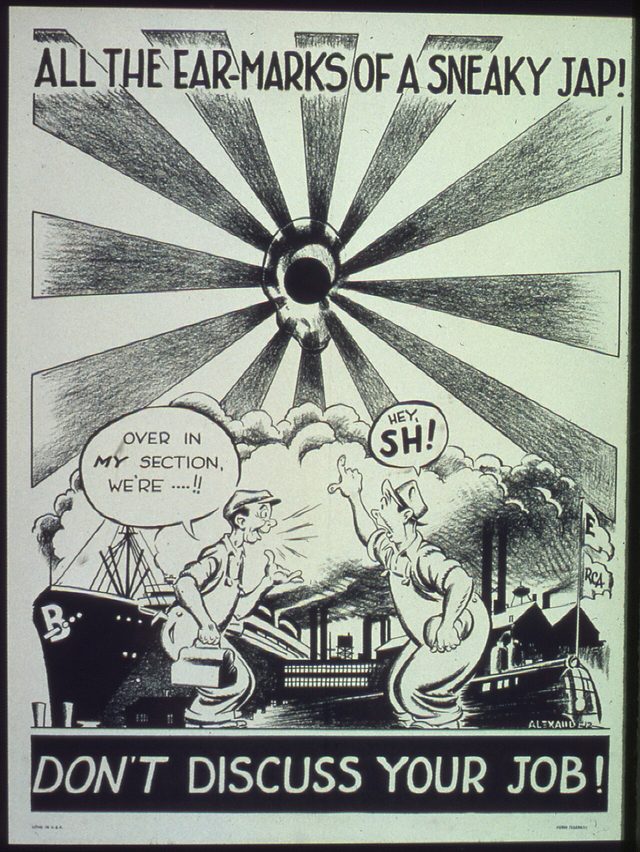
Content note: Ethnic slur against Japanese people in the headline. This object is shown as it was published. Why 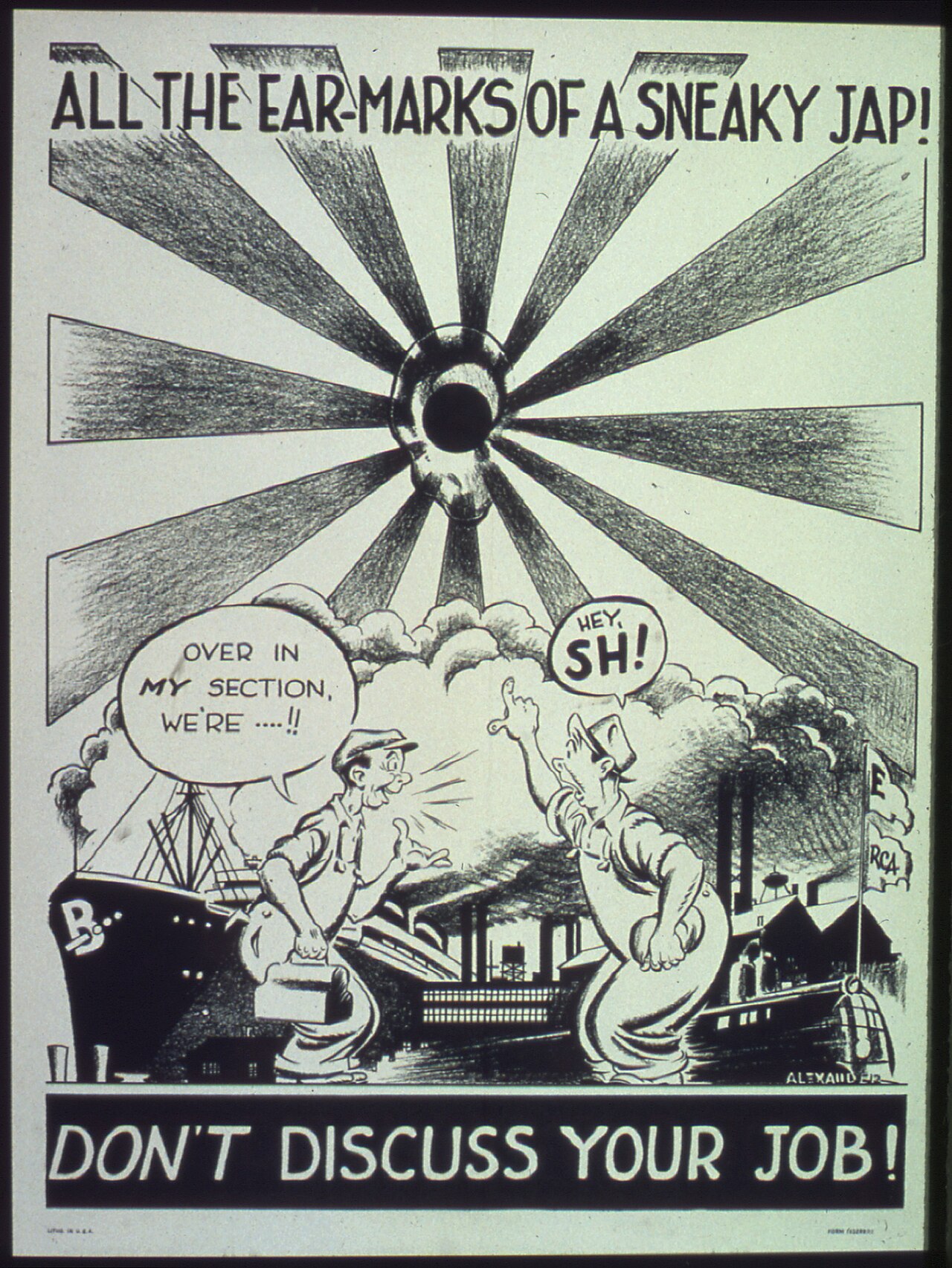
This plant-security sheet, signed "Alexander", is held in the poster file of the OWI Bureau of Special Services; the National Archives dates it only to "between 1941 and 1945". The collection's caption says the headline attaches a slur and a trait to a whole nationality, so the label, not any evidence, carries the warning. The entry notes that Executive Order 9066 of 19 February 1942 led to the forced removal and incarceration of about 120,000 people of Japanese ancestry, most of them U.S. citizens. Read the technique: name-calling.
What did OWI posters say about the war's aims?
Many numbered OWI sheets state aims in broad words and borrow prestige from history, leaders or symbols.
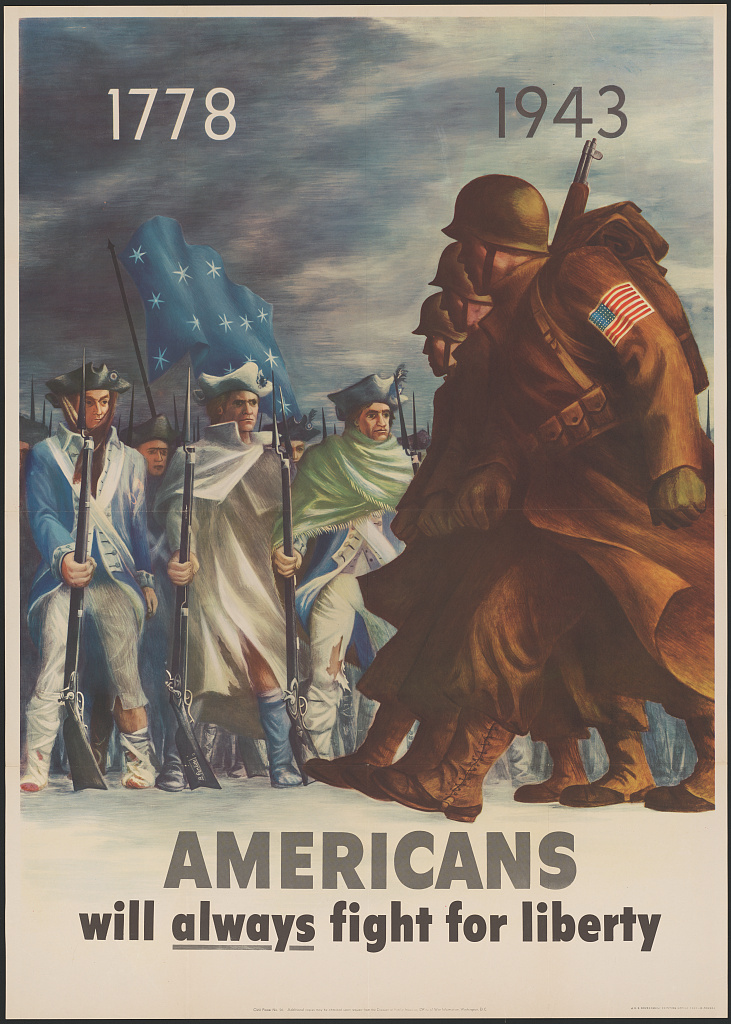
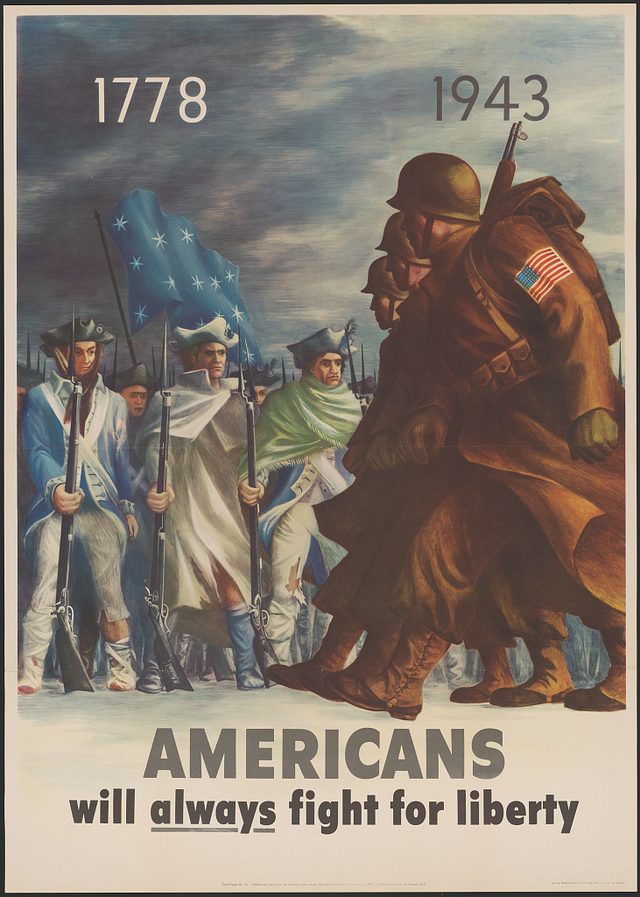
OWI Poster No. 26, painted by Bernard Perlin and printed in 1943, shows Revolutionary War soldiers beside GIs. The caption says the Revolution's prestige is transferred to the present war, with "liberty" offered as the aim of both. Read the technique: transfer.
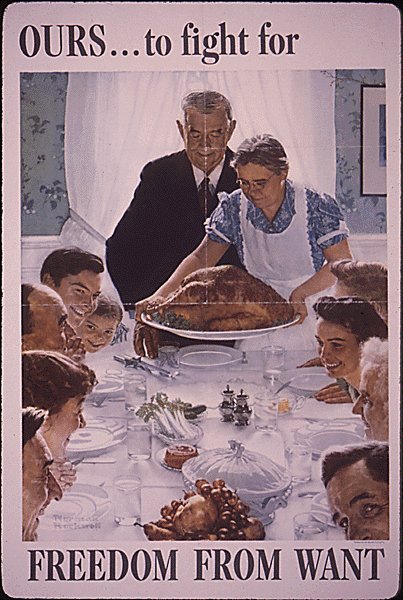
This poster reuses Norman Rockwell's painting of a family at a holiday table, headed "Ours... to fight for". The entry notes that no issuer line or date is legible; 1941 is the start of the National Archives' date range for the series, not a stated date. The caption describes the pairing of an abstract value with a warm domestic scene. Read the technique: glittering generalities.
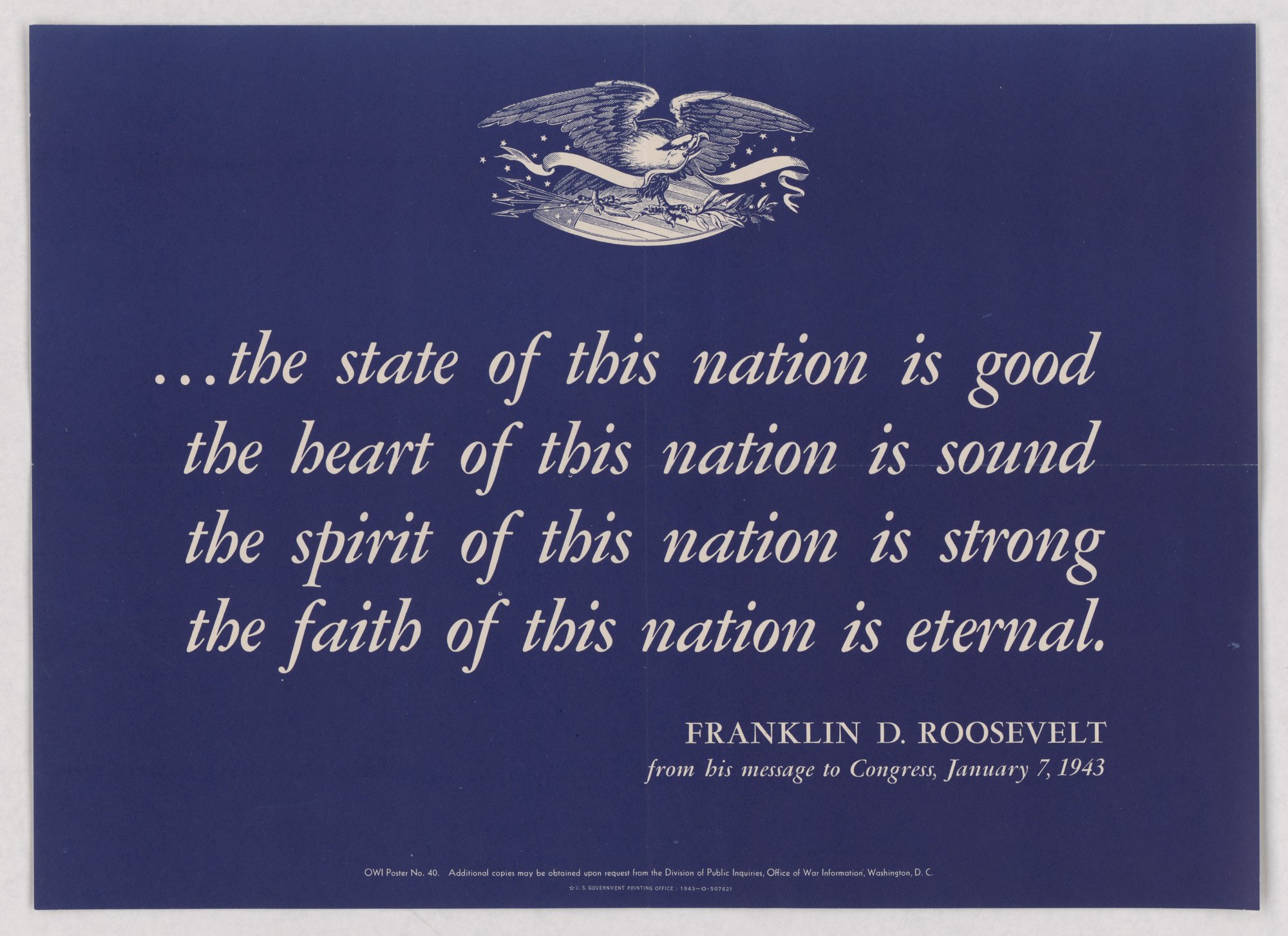
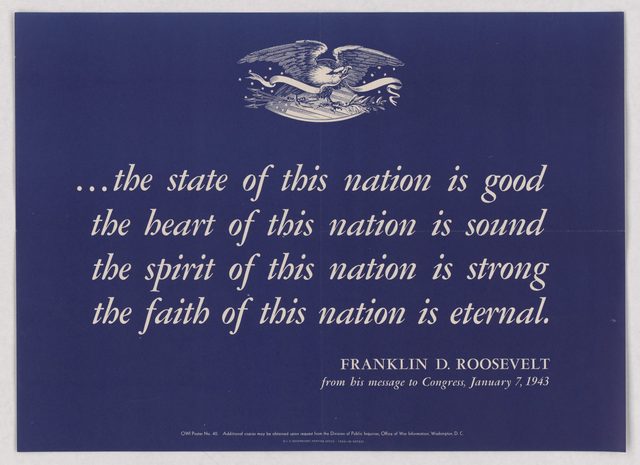
OWI Poster No. 40 quotes four lines from Roosevelt's message to Congress of 7 January 1943: the nation's state is good, its heart sound, its spirit strong, its faith eternal. The collection tags it glittering generalities with the President's name as testimonial. Read the technique: testimonial.
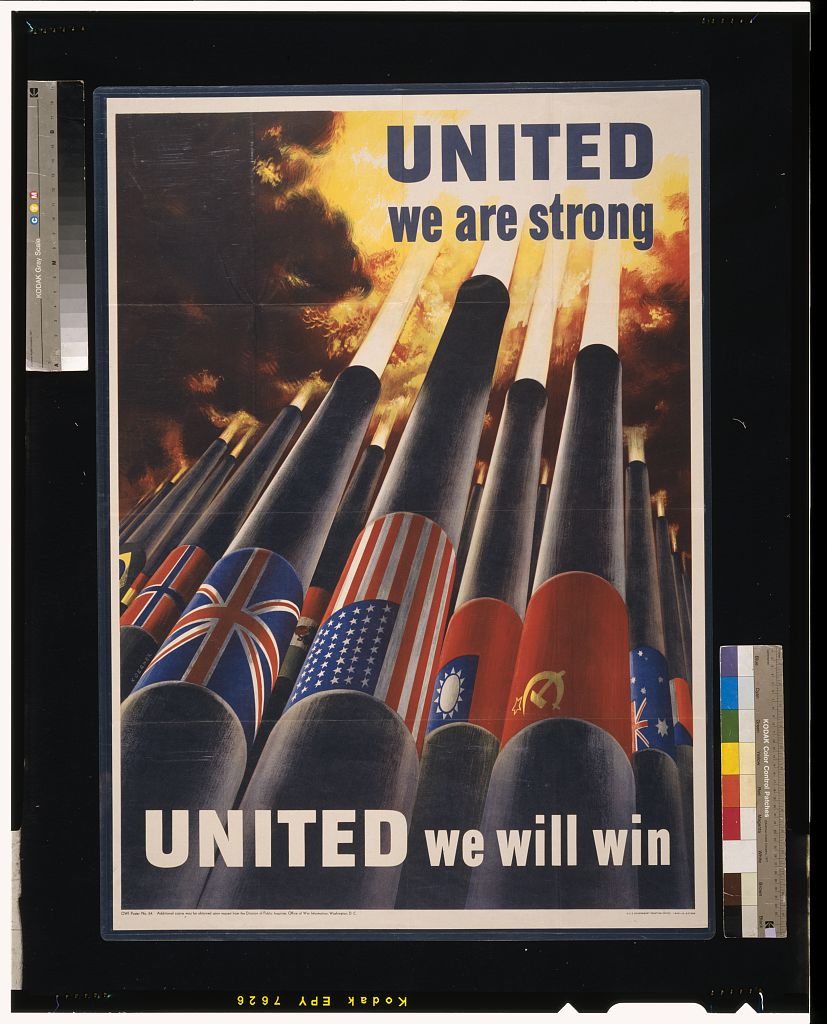
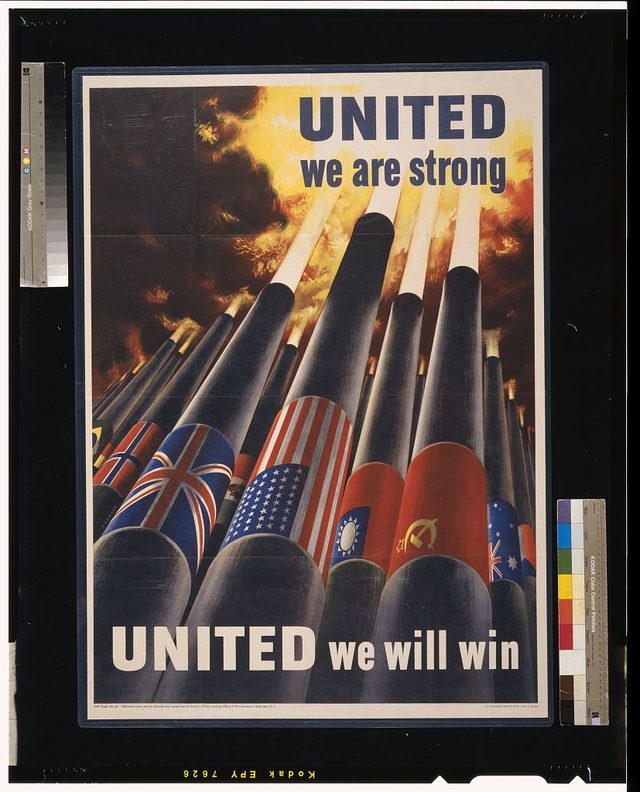
Henry Koerner's lithograph of 1943, held by the Library of Congress, pins Allied flags, including the Union Jack, the Stars and Stripes and the Soviet flag, to a bank of guns. The caption says "united" is offered as a virtue with no policy specified.
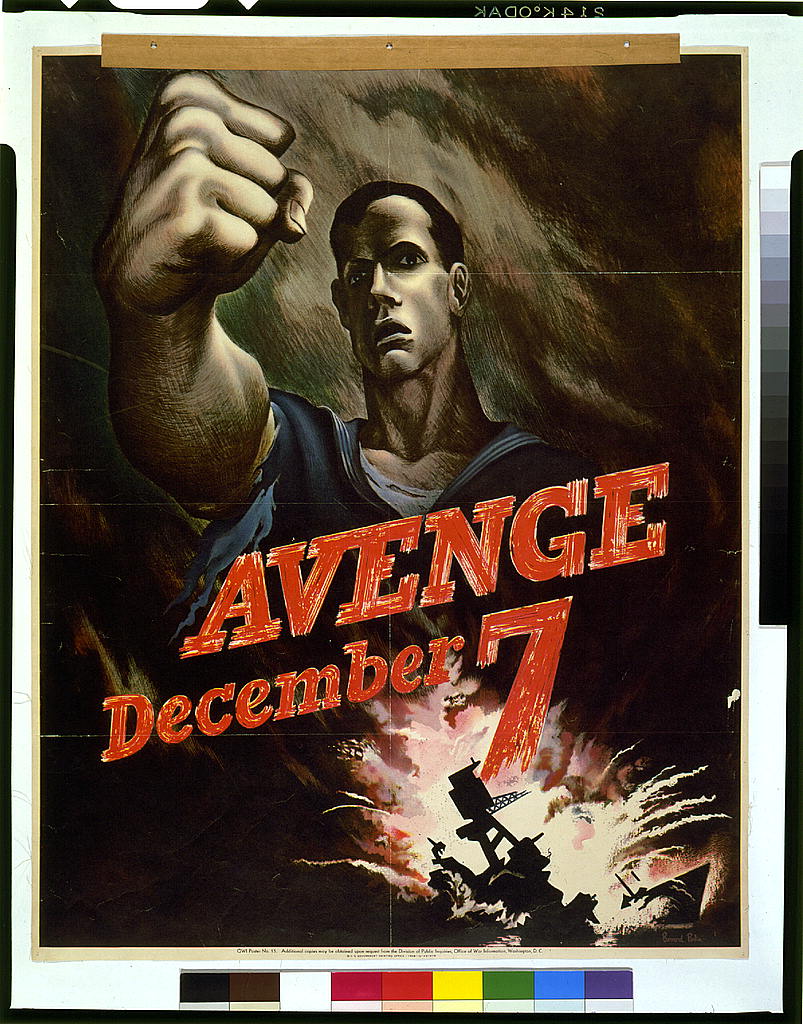
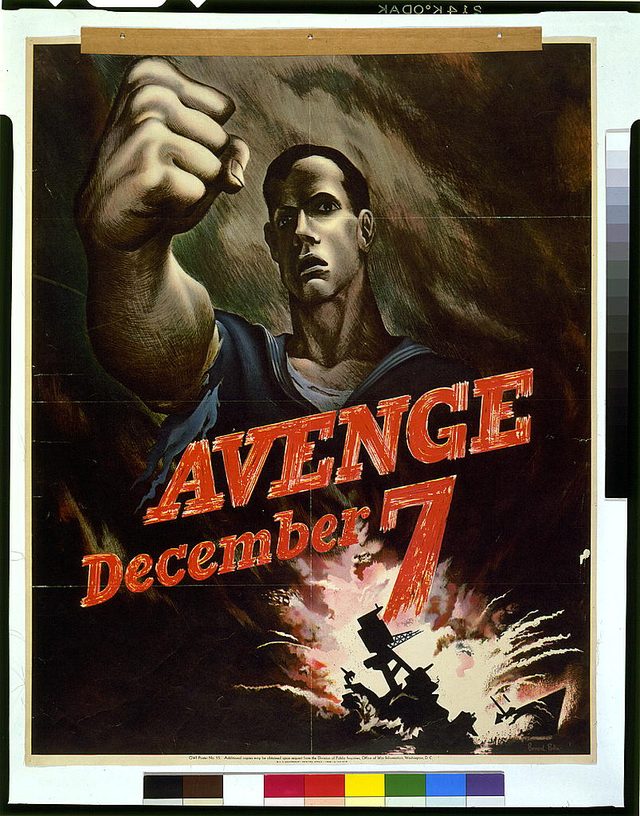
OWI Poster No. 15, signed Bernard Perlin and printed in 1942, names no enemy or country. According to the entry, it ties the Pearl Harbor attack to a demand for action. The U.S. Naval History and Heritage Command, cited in the entry, puts American deaths in that attack at 2,403. Read the technique: transfer.
What did OWI posters ask of civilians at home?
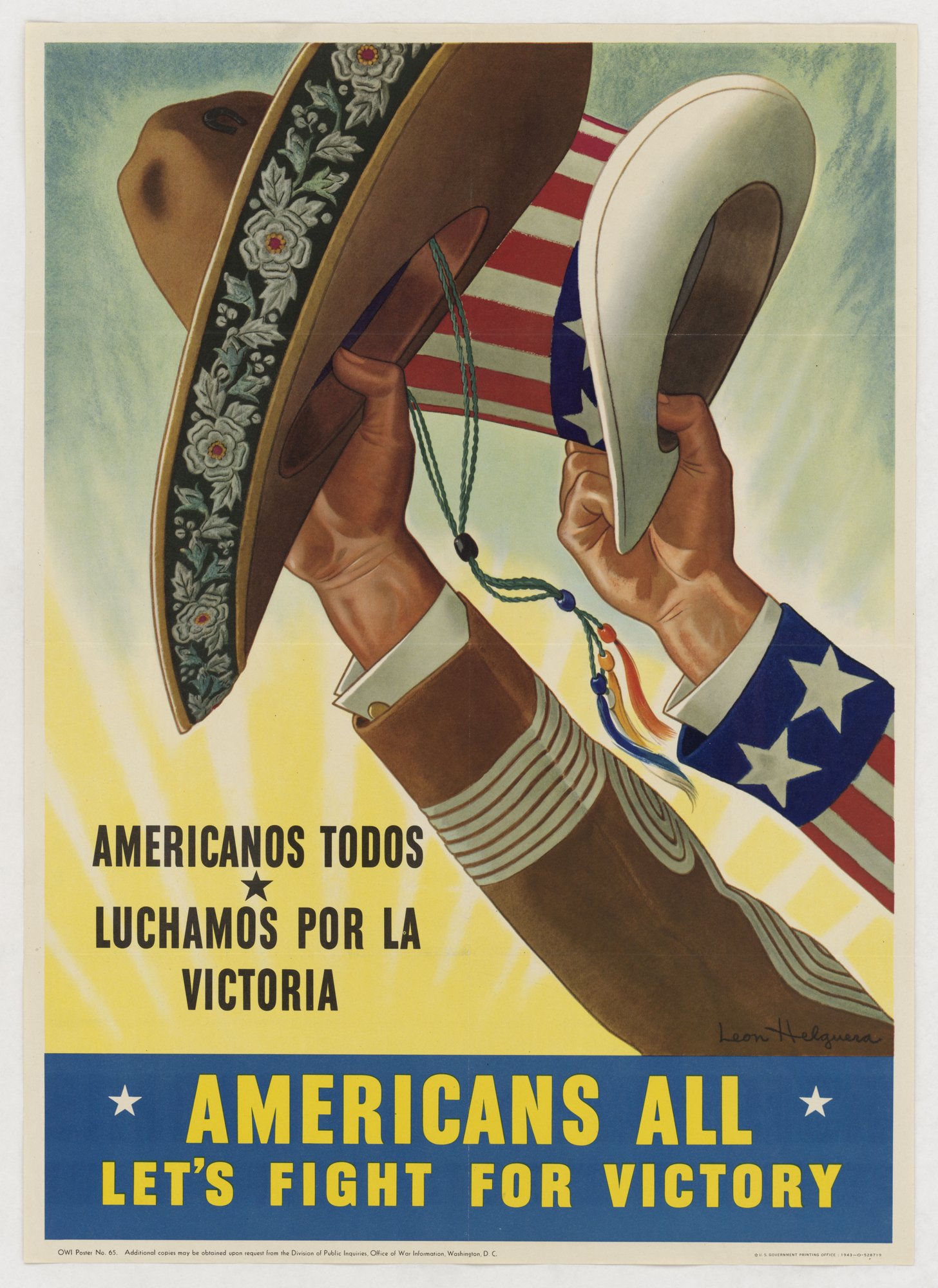
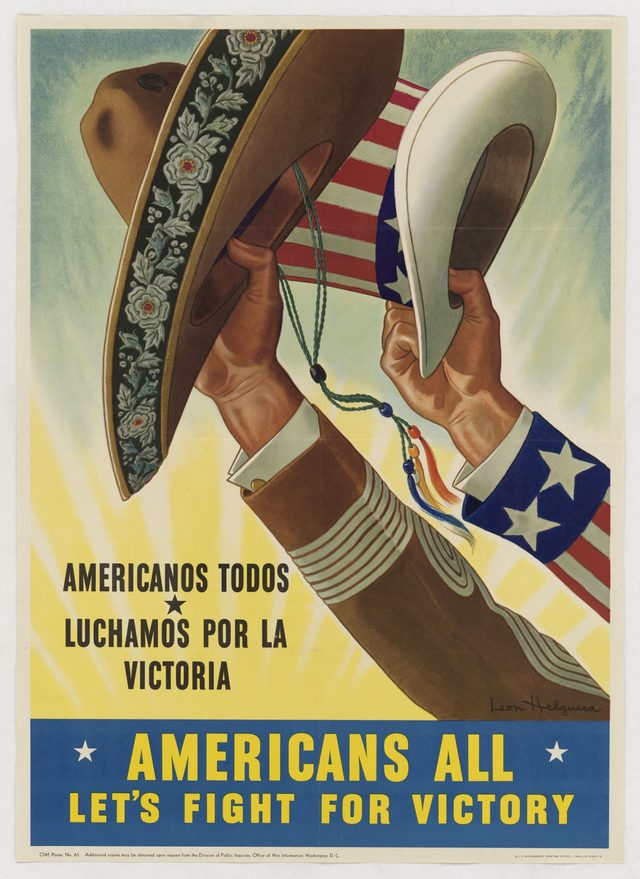
OWI Poster No. 65 is signed Leon Helguera and carries bilingual text, "Americans All" and "Americanos Todos". The entry says the Spanish is aimed at Spanish-speaking readers in the United States, and tags it identity fusion. Read the technique: identity fusion.
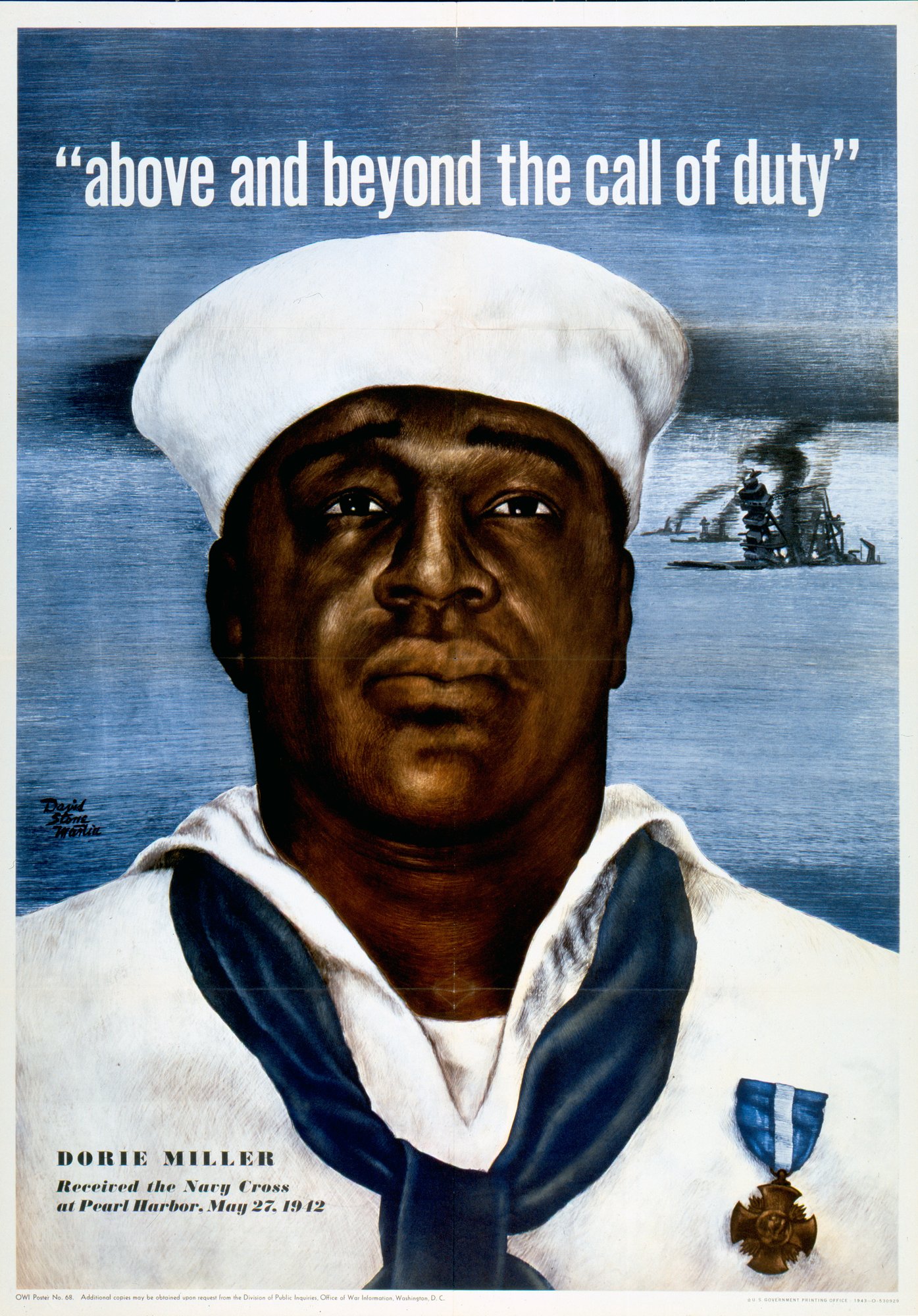
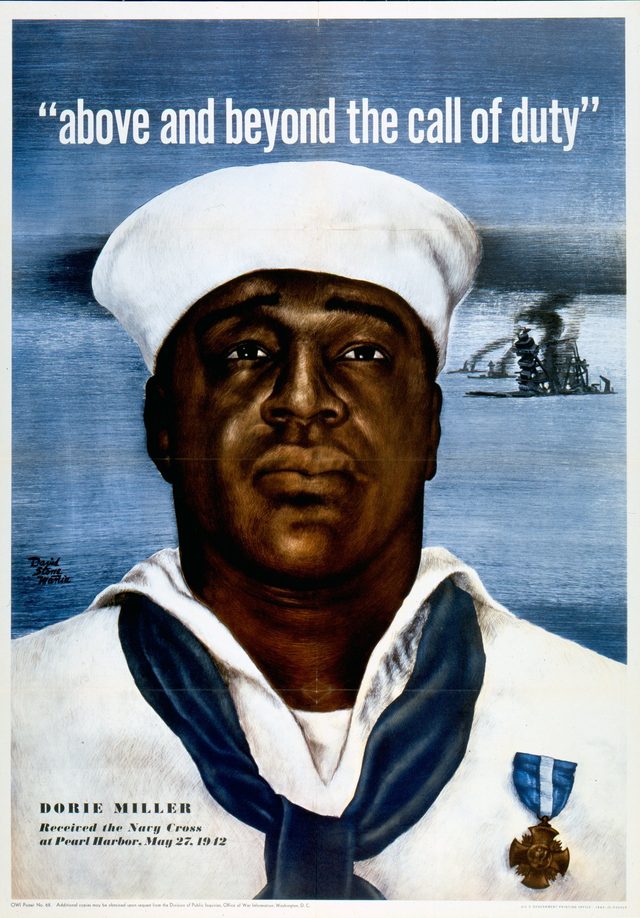
OWI Poster No. 68, by David Stone Martin, shows a named Black sailor, Dorie Miller, with the Navy Cross; the legend reads "Received the Navy Cross at Pearl Harbor, May 27, 1942". The caption describes a named individual's recognised conduct attached to the war effort. Read the technique: testimonial.
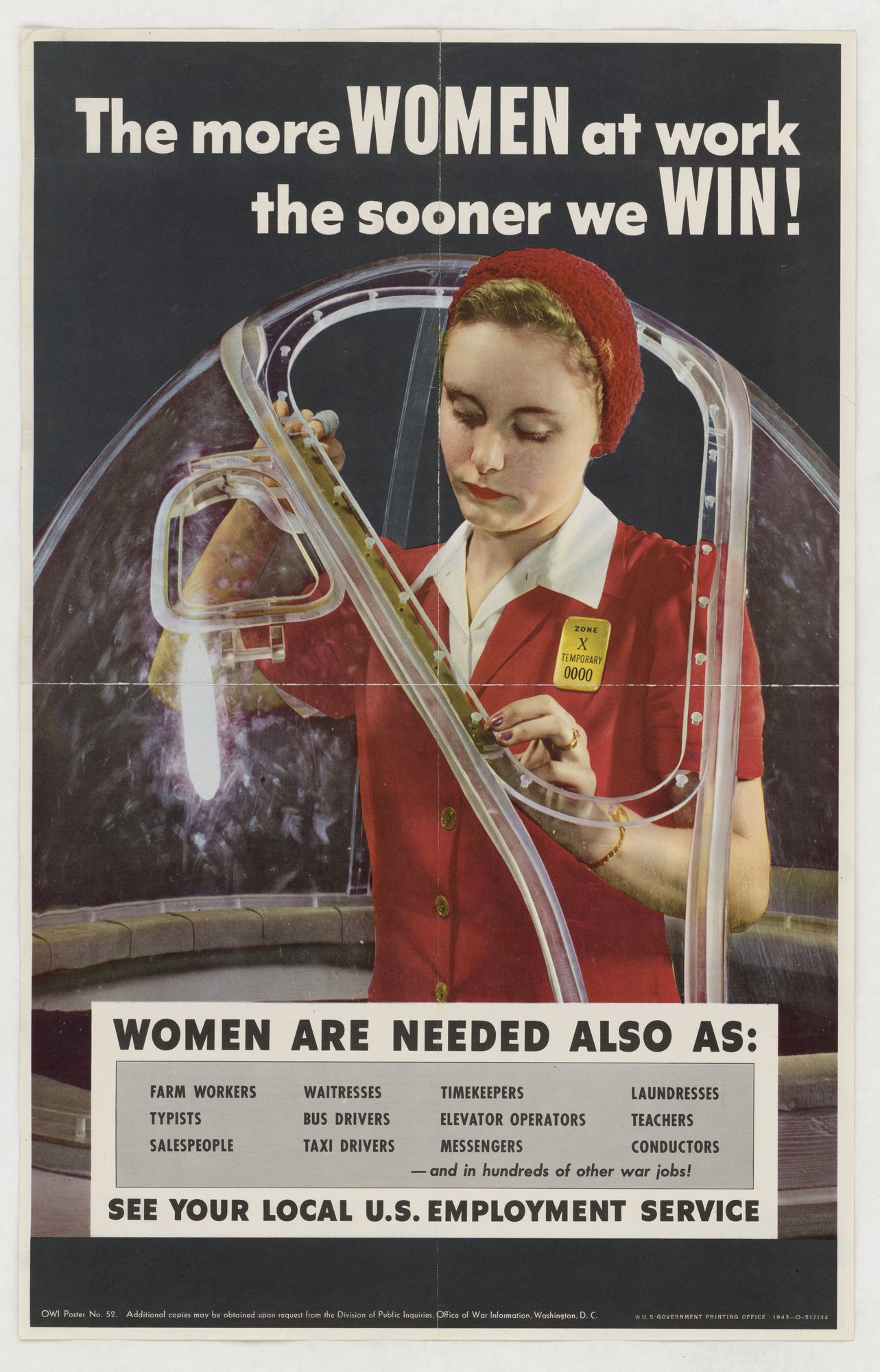
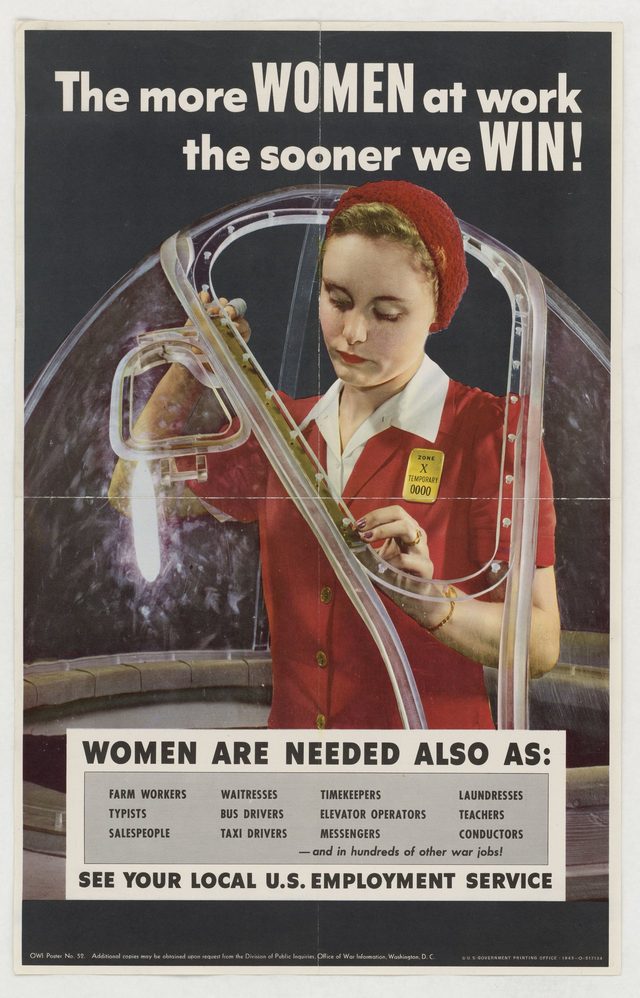
OWI Poster No. 52, issued for the U.S. Employment Service, lists ordinary jobs for women and "hundreds of other war jobs". The caption notes that the list is offered as the whole picture of available work. See women in WW2 posters. Read the technique: card stacking.
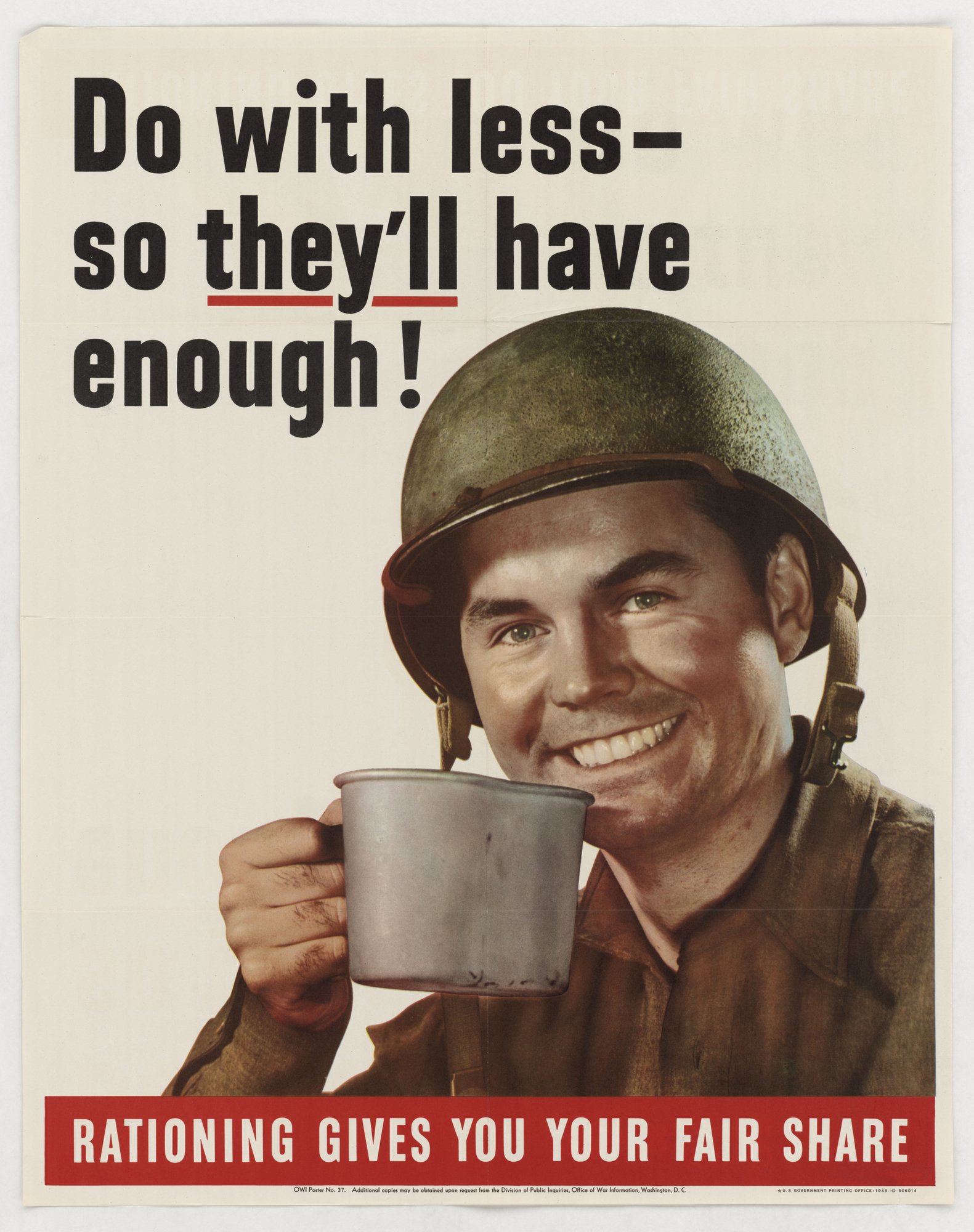
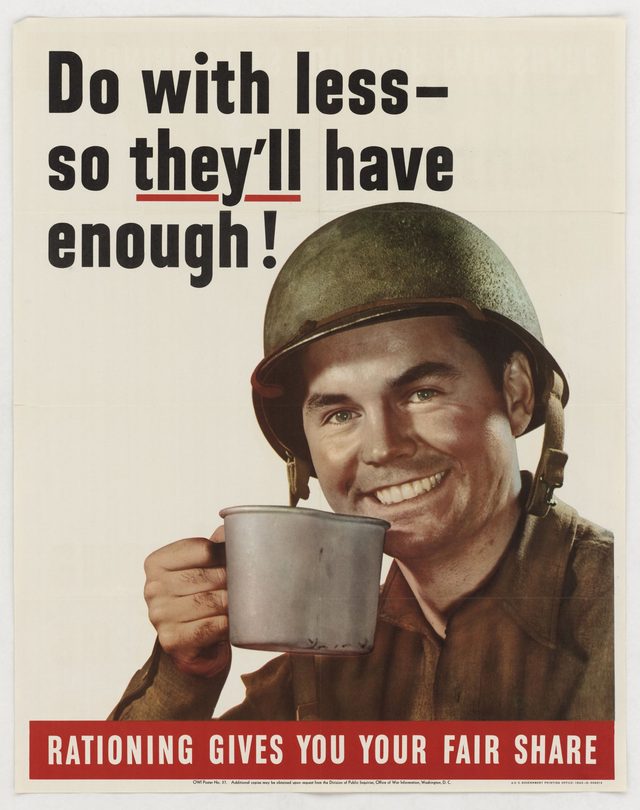
OWI Poster No. 37 pairs a soldier's cheerful face with the line "Rationing gives you your fair share". The caption calls "fair share" a broad fairness phrase. See rationing and salvage posters. Read the technique: glittering generalities.
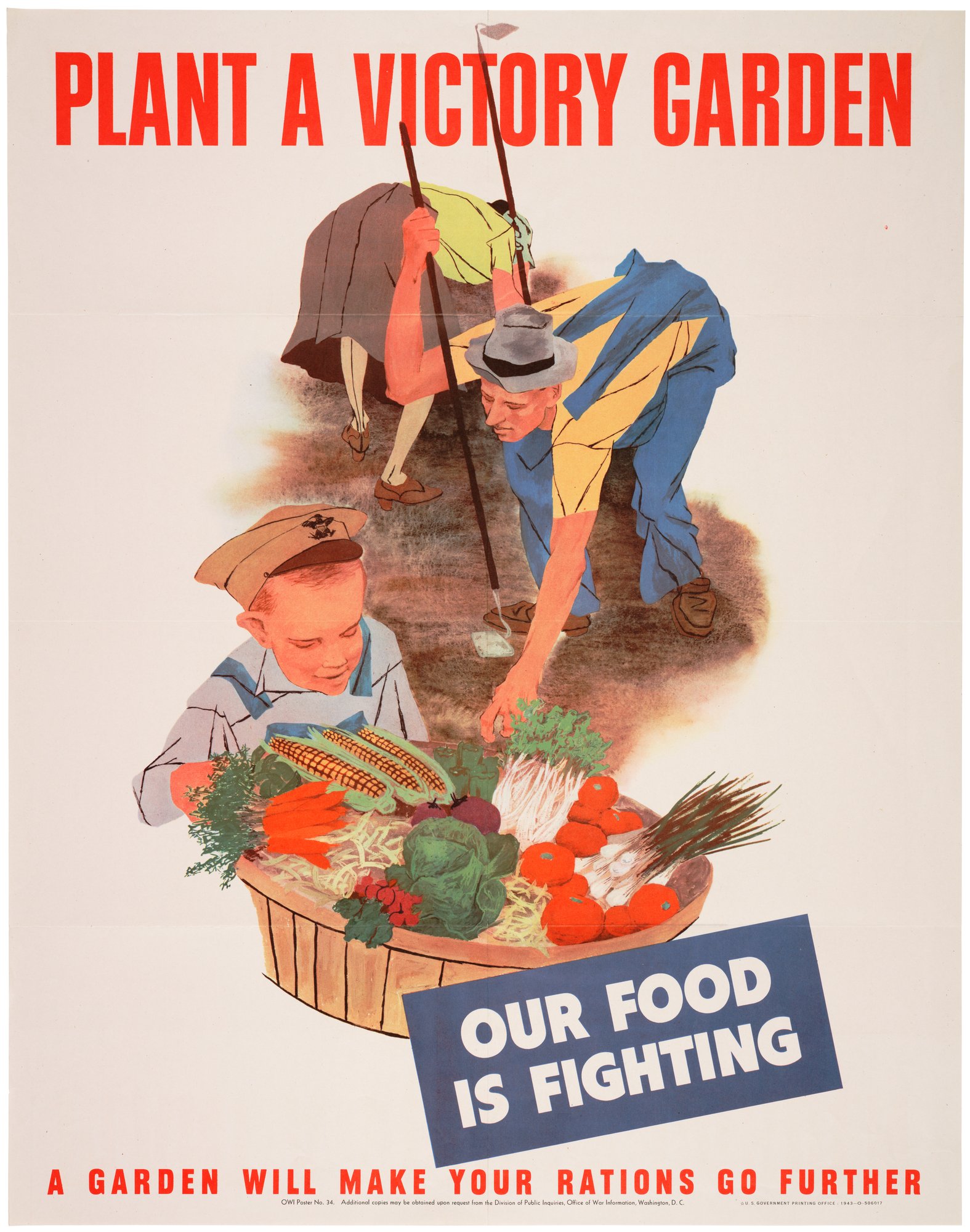
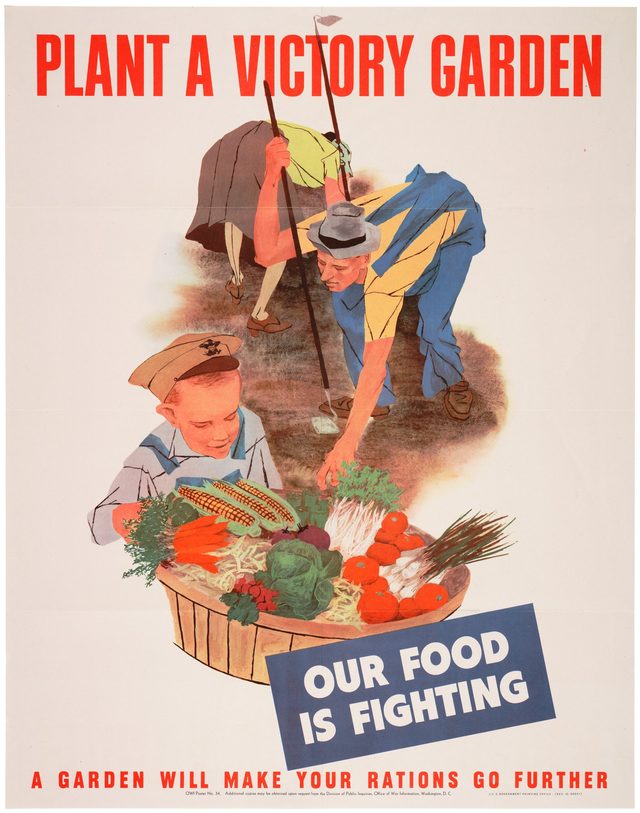
This 1943 sheet, printed by the Government Printing Office, carries the banner "Our food is fighting". The caption says it carries the vocabulary of war onto home vegetables. Read the technique: plain folks.
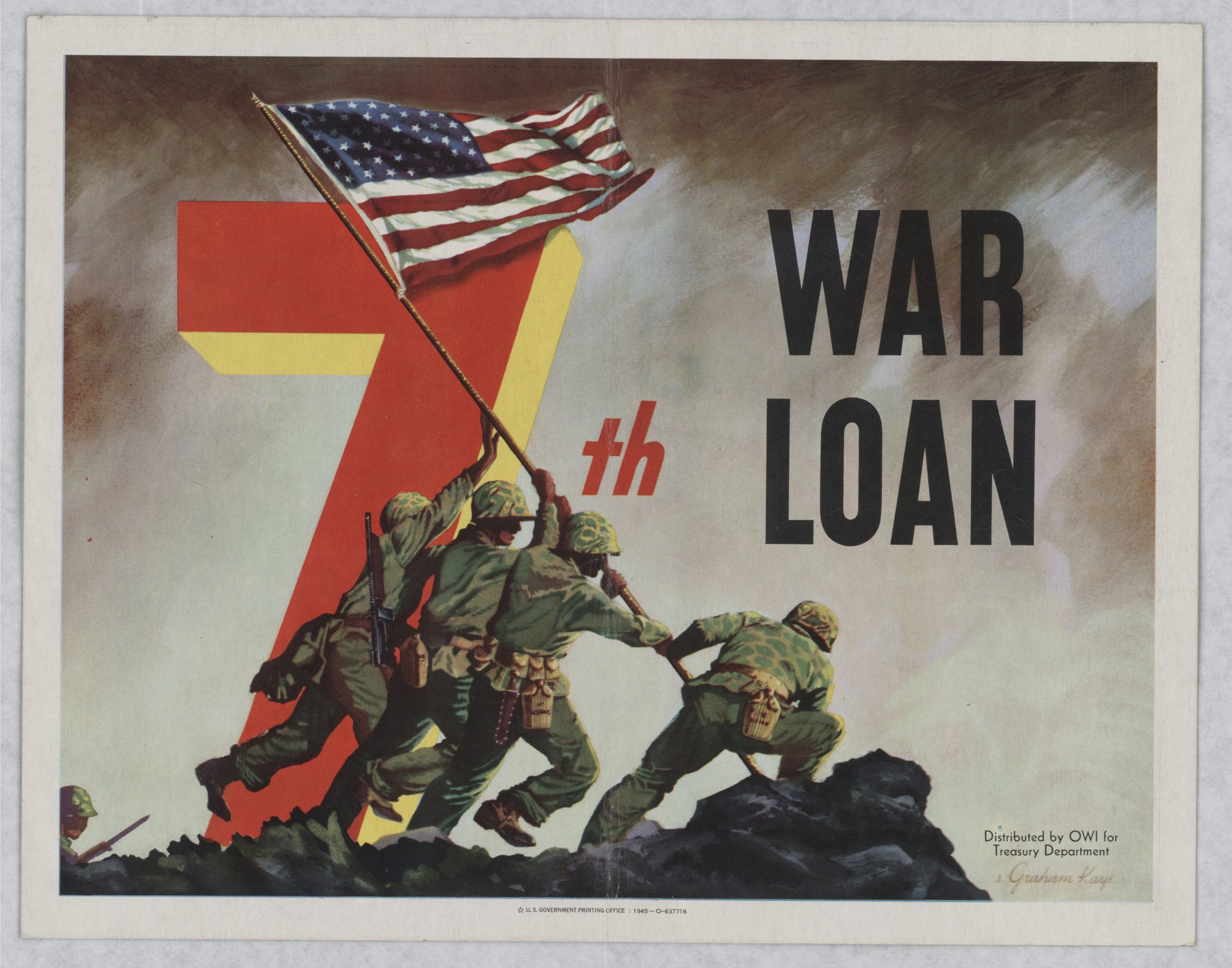
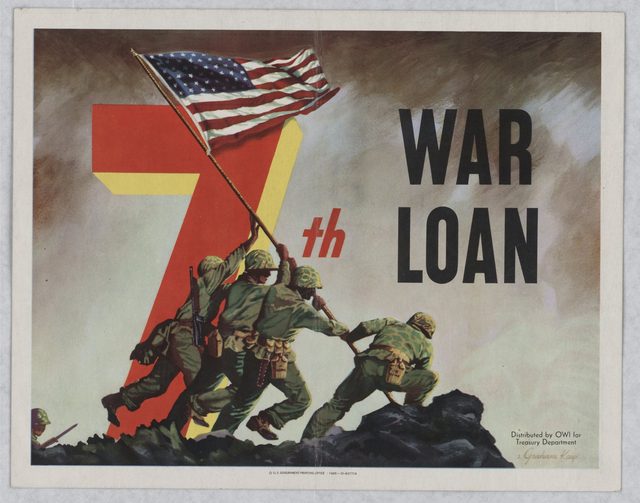
The print says it was "Distributed by OWI for Treasury Department". The Seventh War Loan drive ran May to June 1945, and the scene follows the Iwo Jima flag-raising of February 1945. The entry notes that the poster carries no explicit ask in its text. See war bonds posters. Read the technique: transfer.
How did OWI posters describe the enemy?
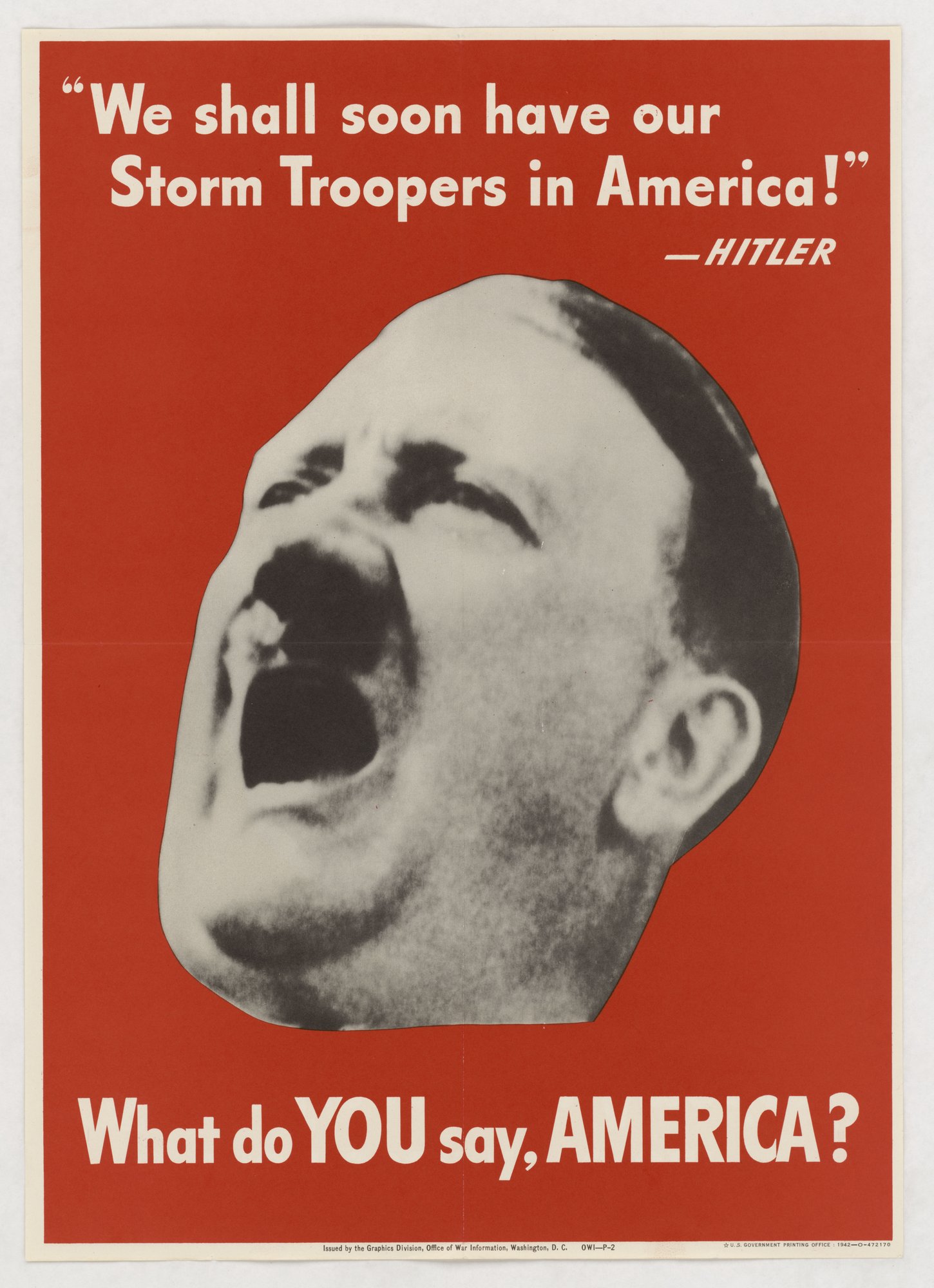
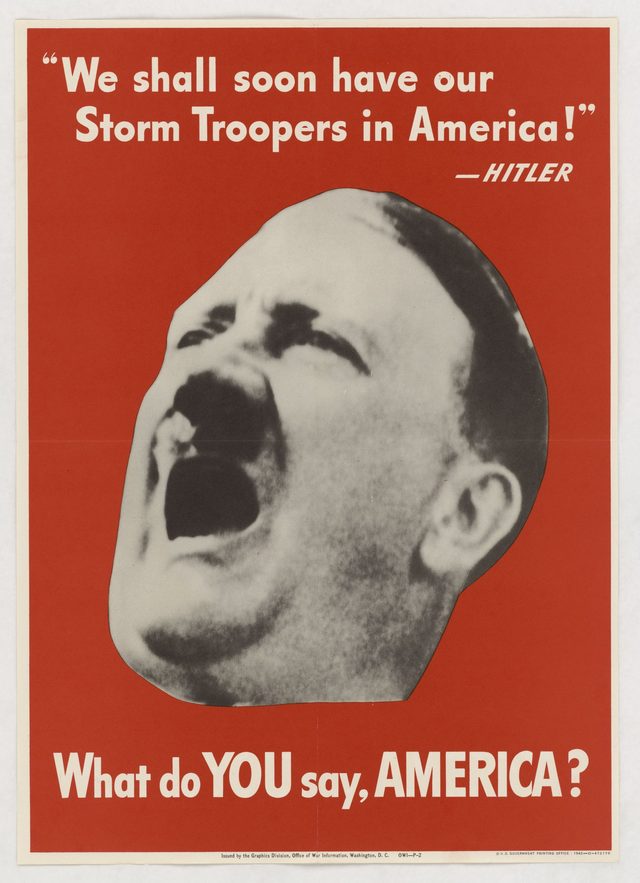
This sheet from the OWI Graphics Division prints a quotation attributed to Hitler, "We shall soon have our Storm Troopers in America!", and asks "What do YOU say, America?". The entry notes that the poster gives no source for the quotation. Read the technique: fear appeal.
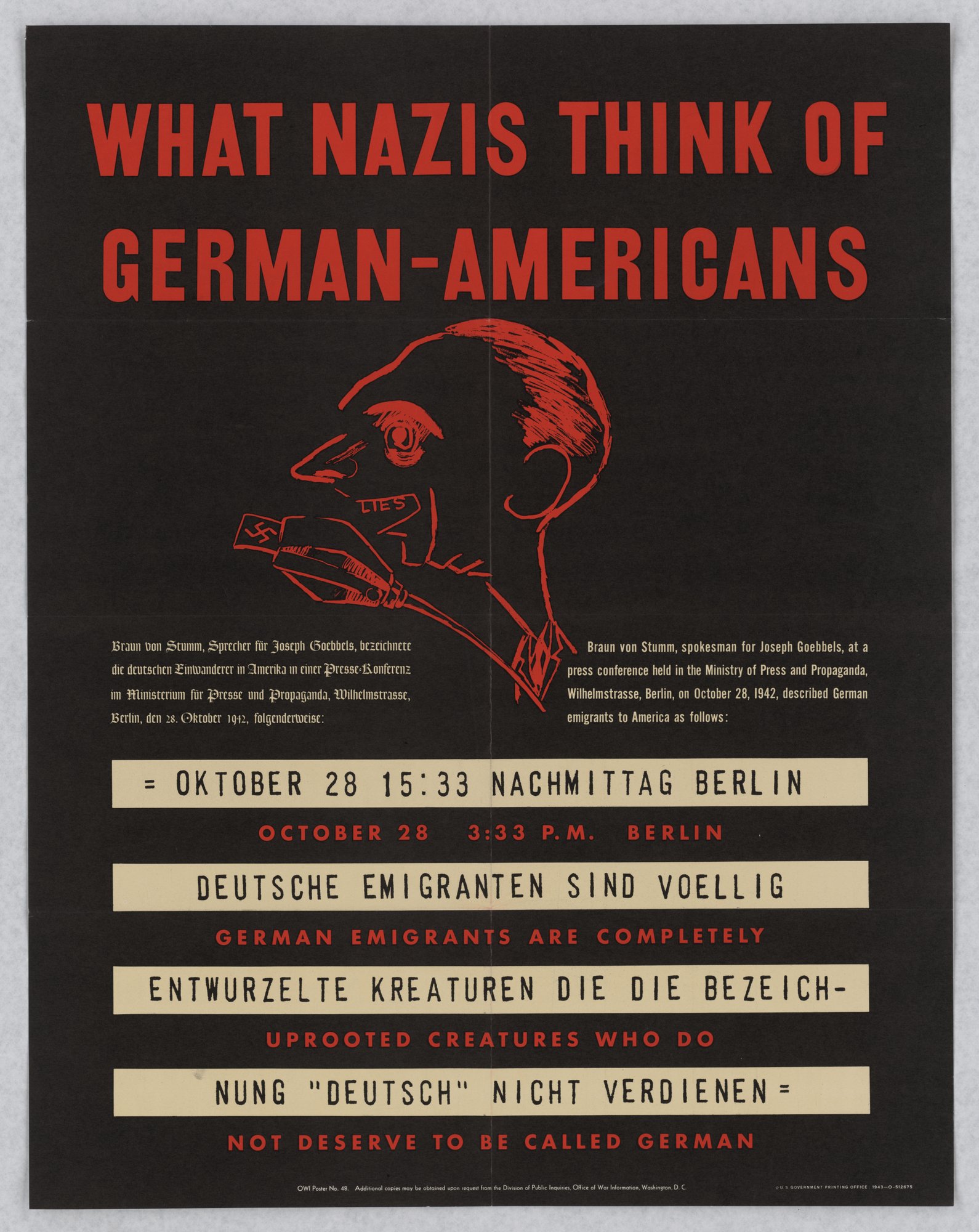
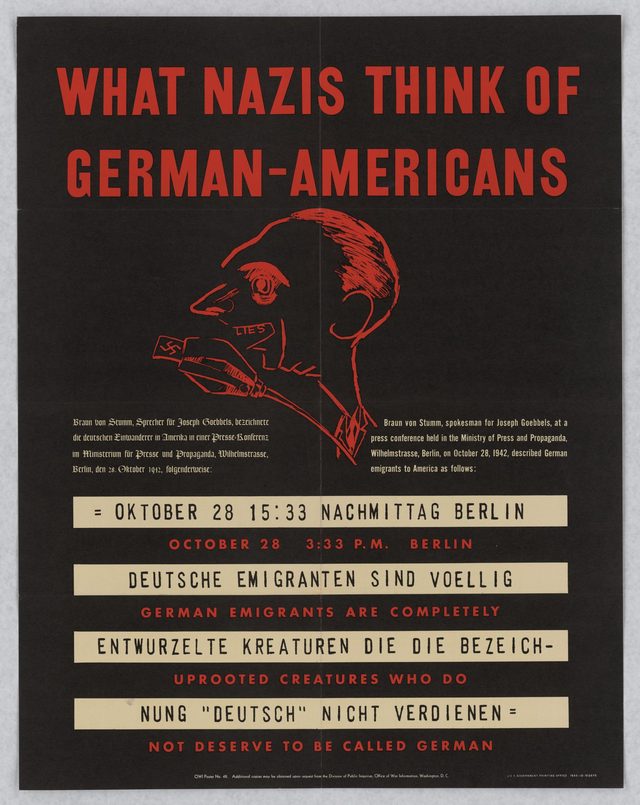
OWI Poster No. 48 prints German and English text together, so German-language readers were a target alongside the general public. It quotes a Berlin spokesman of 28 October 1942 calling German emigrants "uprooted creatures"; the sheet gives no source. The caption says the caricature is name-calling aimed at the Nazi regime. Read the technique: card stacking.
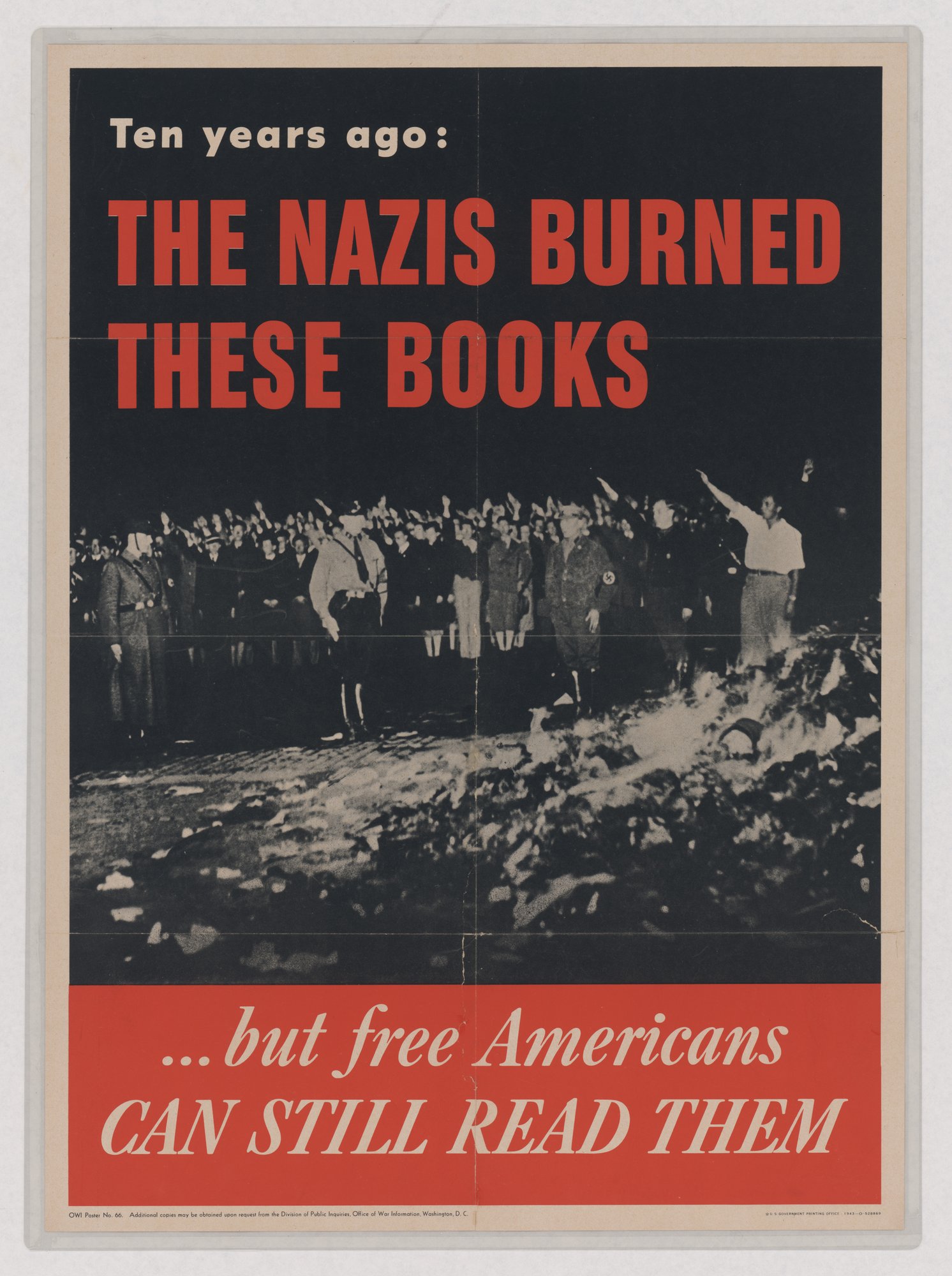
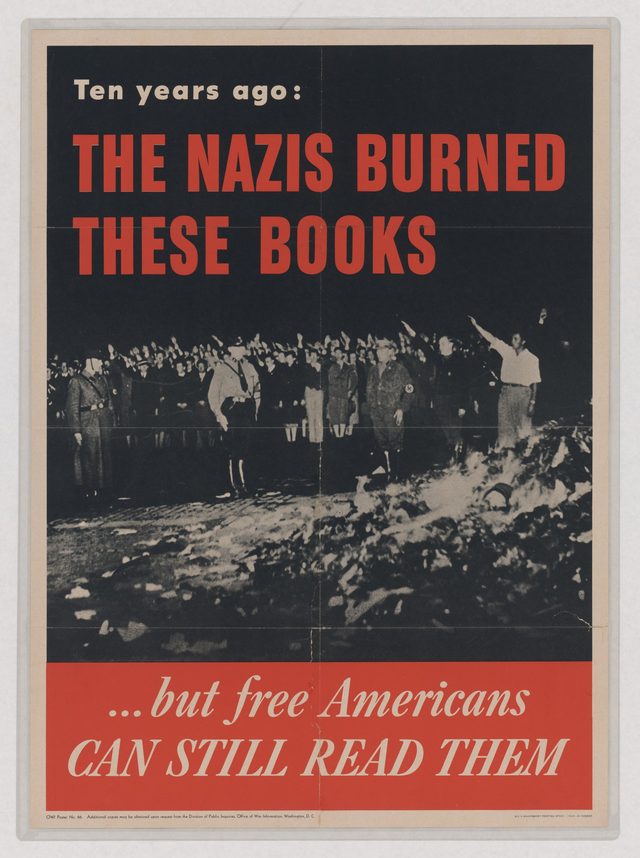
OWI Poster No. 66 uses a photograph of the German book burnings, which the headline dates to "ten years ago" (May 1933), and no photo credit is printed. The closing line sets "free Americans" against it. Read the technique: glittering generalities.
Did OWI also make posters for audiences abroad?
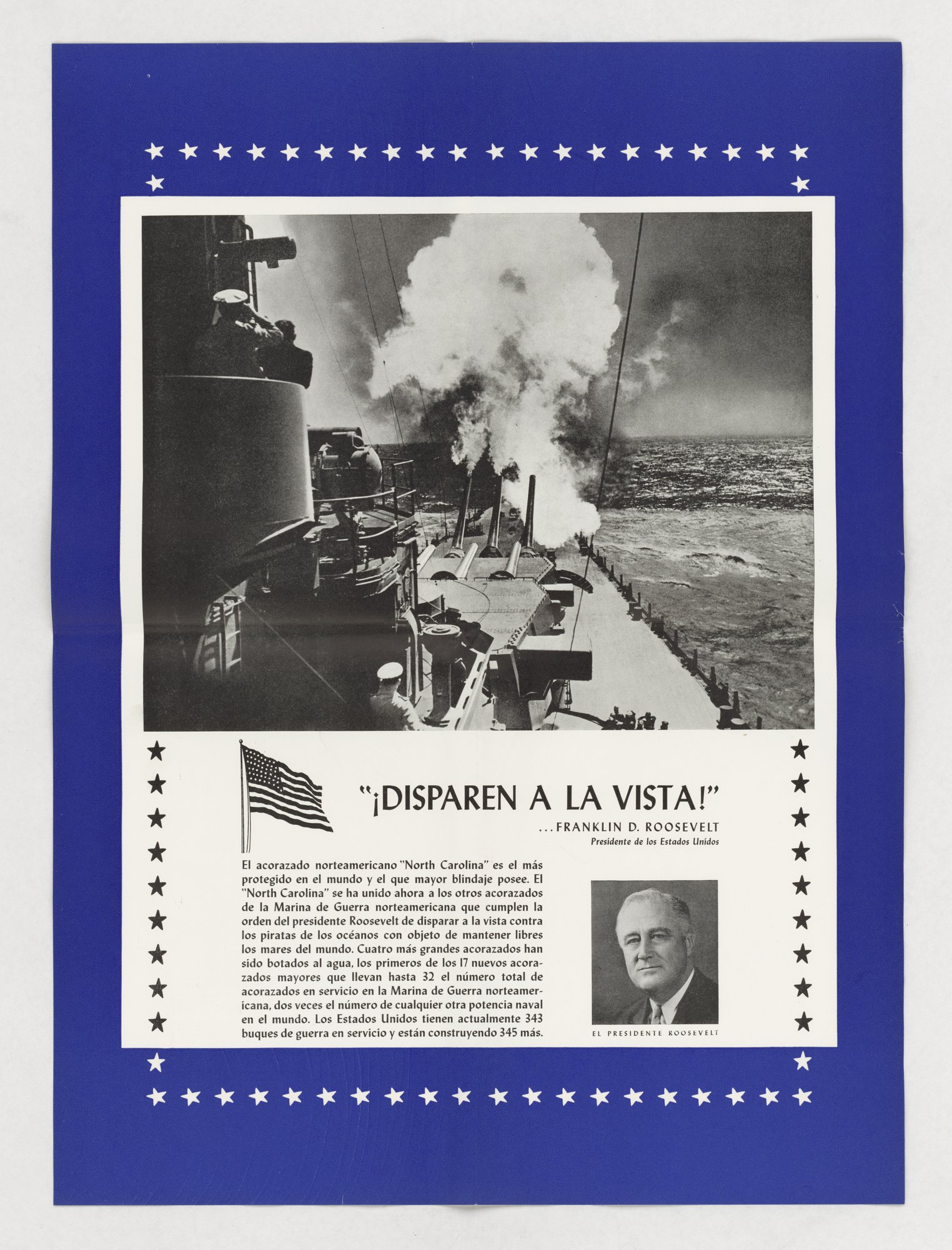
Yes. Of the 189 posters, 58 are foreign-language editions of overseas designs in the National Archives' RG 44 series (count made from examples/entries/). This Spanish edition of the "American Battleship North Carolina" design, headed "¡Disparen a la vista!", has no OWI imprint printed on the sheet; its U.S. federal basis rests on its series placement. The caption says the text gives only U.S. ship counts and claims of superiority, which it tags card stacking. These were aimed at foreign publics, so they are not one campaign with the home-front sheets above. Read the technique: card stacking.
What to look for in an OWI poster
- The imprint. Look for an OWI poster number and a Government Printing Office line. Many sheets were made for another agency and only distributed by OWI.
- The technique. The most common technique tags among the 189 OWI posters are transfer (110), card stacking (56), glittering generalities (48) and fear appeal (38), counted from the entries.
- The audience. Home public, foreign-language readers at home, or audiences abroad.
How do OWI posters compare with other countries' posters?
OWI was a named federal agency, and many of its sheets carry its imprint; some overseas editions in the collection carry none. The collection applies the same technique definitions to every government's posters, so the tells above, such as borrowed prestige, broad virtue words and an enemy shown by symbol, are tagged the same way elsewhere. One documented difference is that the OWI Domestic Branch was cut by Congress in 1943 and its writers' resignation was public; this page does not rank agencies by accountability. See British propaganda posters and Soviet propaganda posters for other agencies' output.
Browse Office of War Information posters
The grid below shows posters from the collection issued or distributed by the Office of War Information. Each opens an object page with the holding institution, a link to the original record, a transcription of any text and the rights basis for hosting. For other home-front themes, see careless talk, war bonds, rationing and salvage and women in WW2 posters.
Sources and rights
Posters on this page come from the U.S. National Archives (Record Group 44) and the Library of Congress, directly or through Wikimedia Commons, and one from the University of North Texas Libraries. They are U.S. government works or carry stated no-known-restriction rights; each object page gives the basis. Transcriptions are verbatim. Agency history is taken from the OWI case studies in this archive.
!['¡Disparen a la vista!' [Shoot on Sight!] (American Battleship North Carolina [Spanish])](../../collection/images/us-owi-american-battleship-north-carolina-spanish-1942-640.jpg)