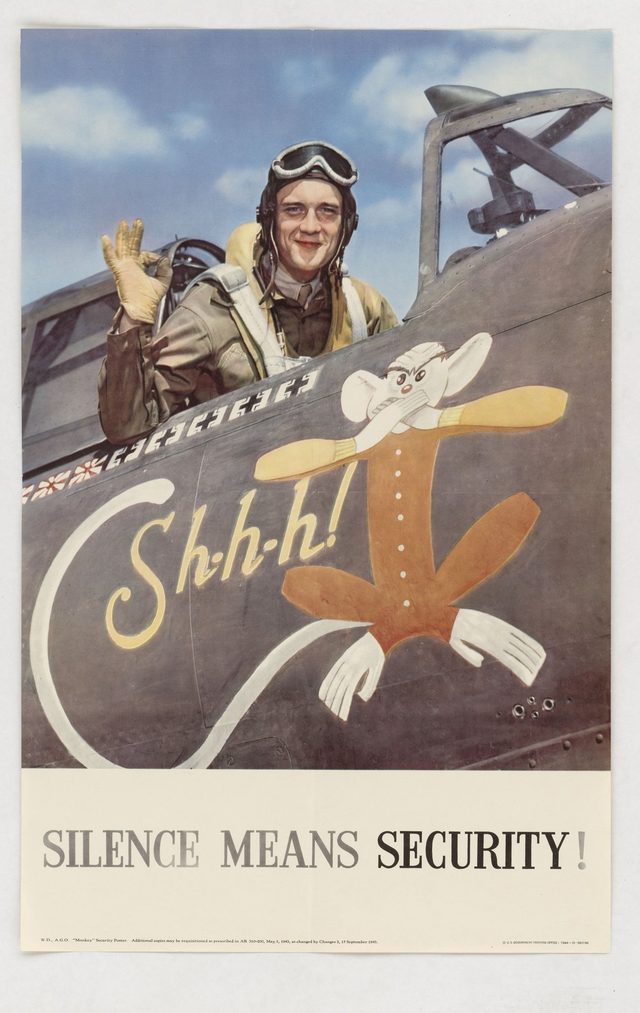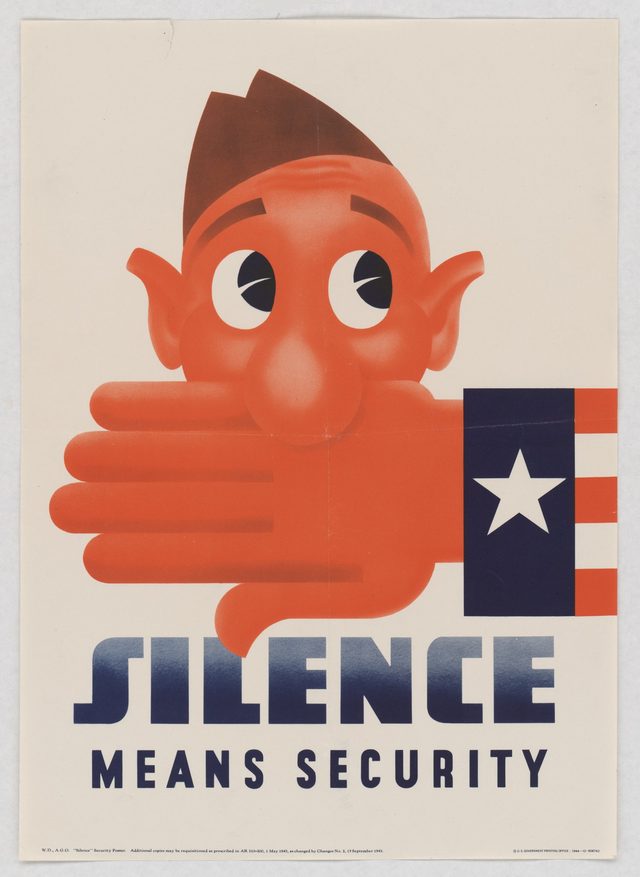
Content note. Some security posters of the Second World War blame women for leaks, one uses an ethnic slur for Japanese people, and several show drowned or dead servicemen. They are shown as issued, as evidence of what civilians were told. Showing a poster is not endorsing it.
What were "careless talk costs lives" and "loose lips sink ships" posters?
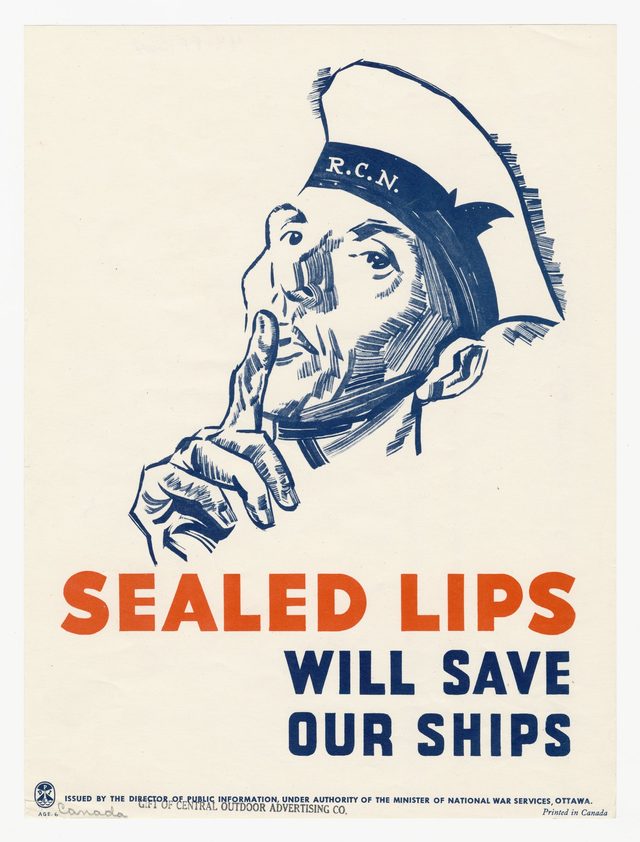
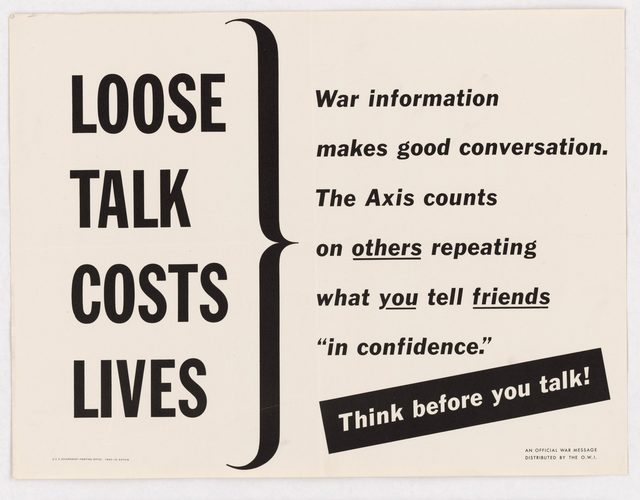
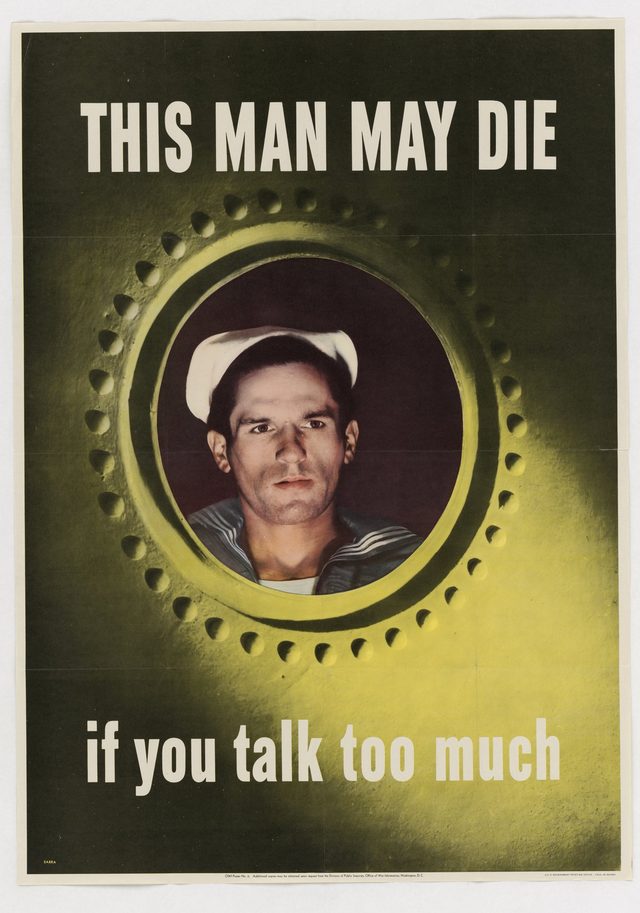
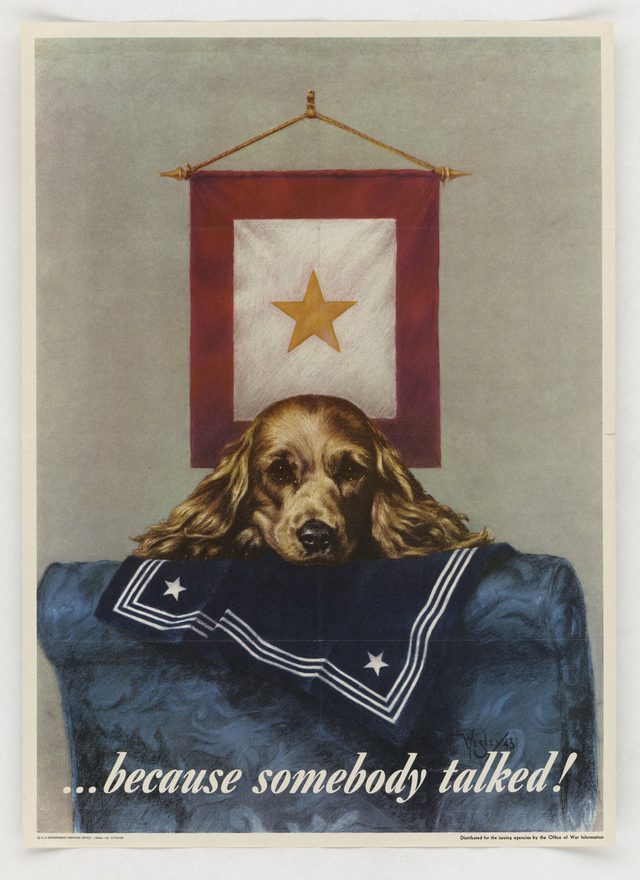
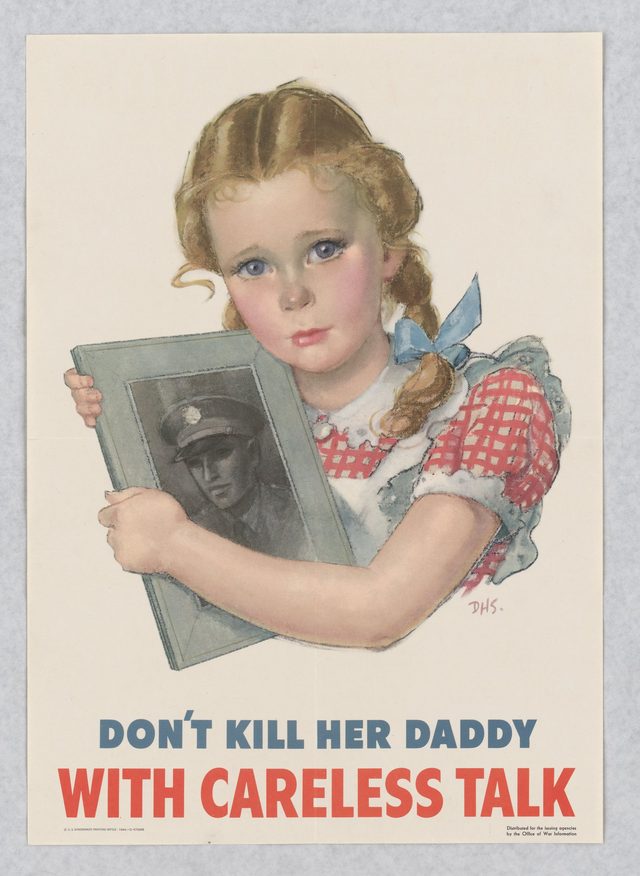
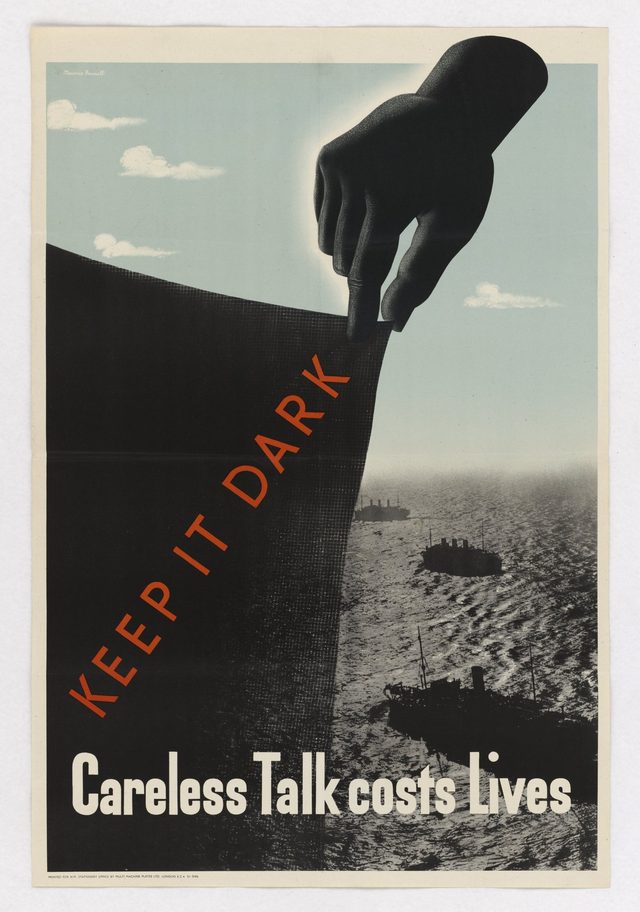
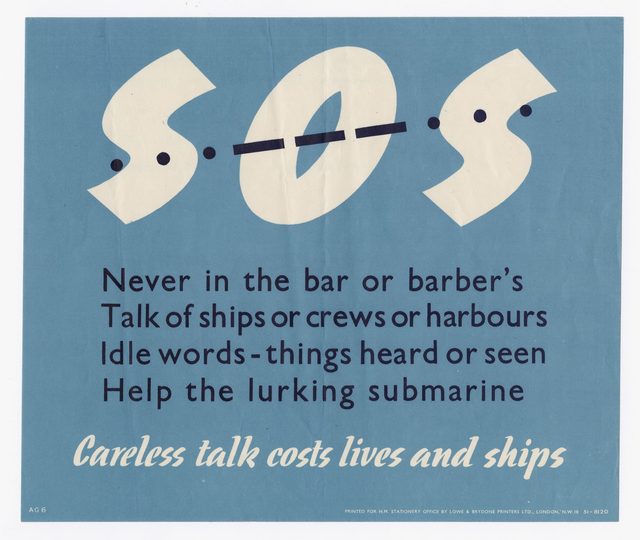
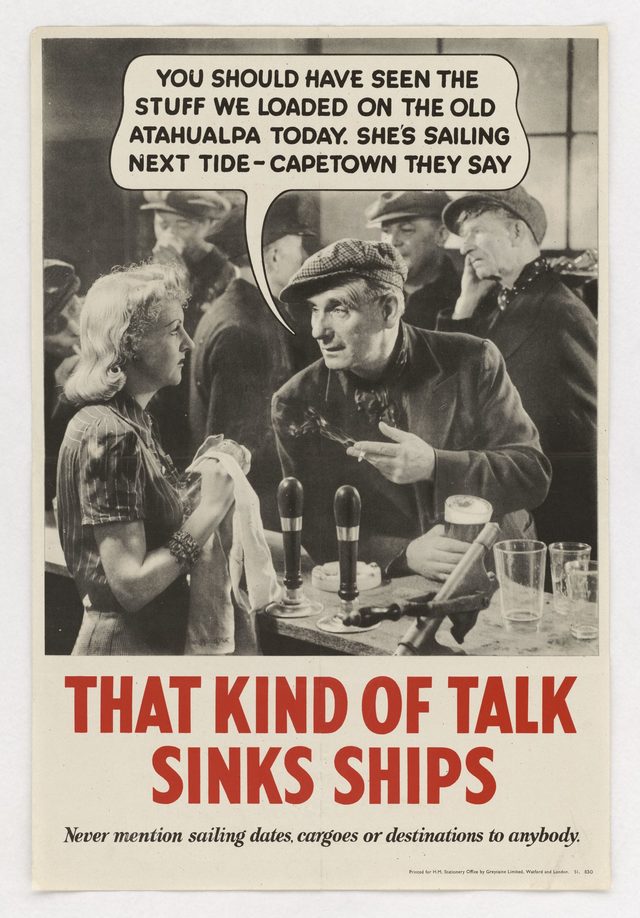
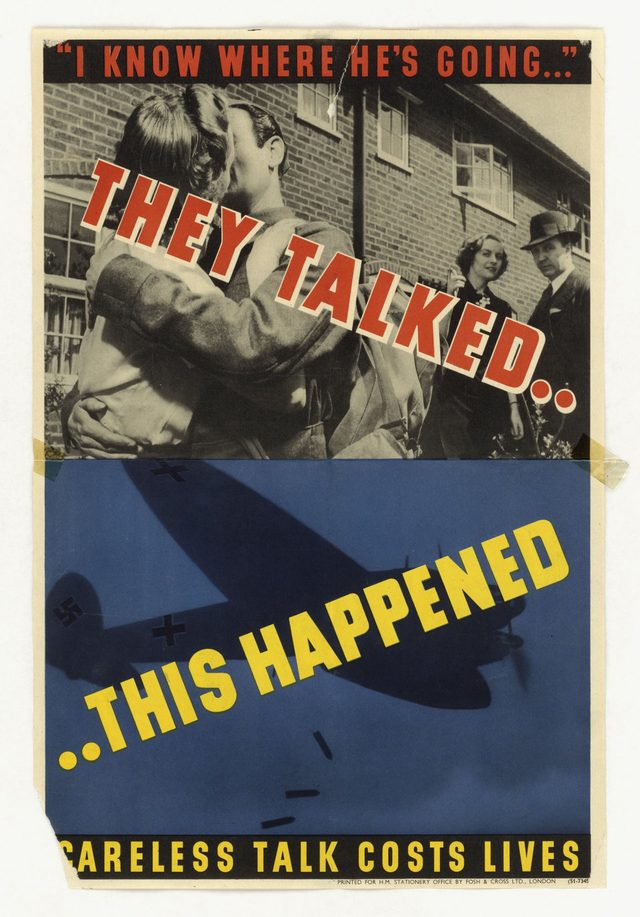
They were Second World War home-front security posters telling civilians not to discuss ship sailings, troop movements or war work. Britain's Ministry of Information launched its "Careless Talk Costs Lives" series in February 1940. The United States issued "Loose Lips Might Sink Ships" and similar sheets from 1941, and Canada issued its own.
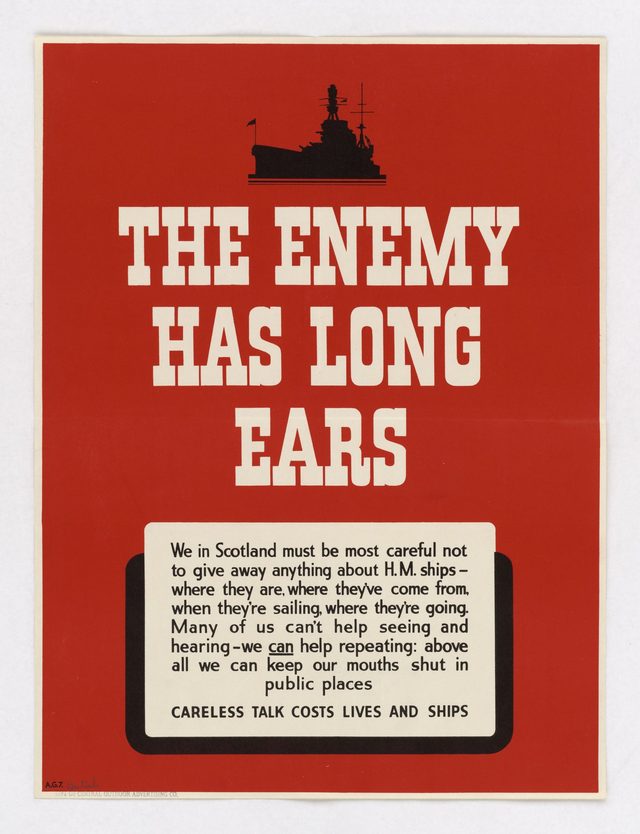
The collection holds 248 posters from 1939 to 1945 tagged with the theme security and surveillance: 167 from the United States, 49 from the United Kingdom, 23 from Canada and 9 from other countries (count made from the entry files in examples/entries/). Most are about talk; the rest cover sabotage, fire, telephones and spies. This page applies the same questions to each side: who issued it, who it was for, what it asked, and which technique carried the ask. For the wider war, see WW2 propaganda posters and propaganda posters.
Who made the "Loose Lips Might Sink Ships" poster?
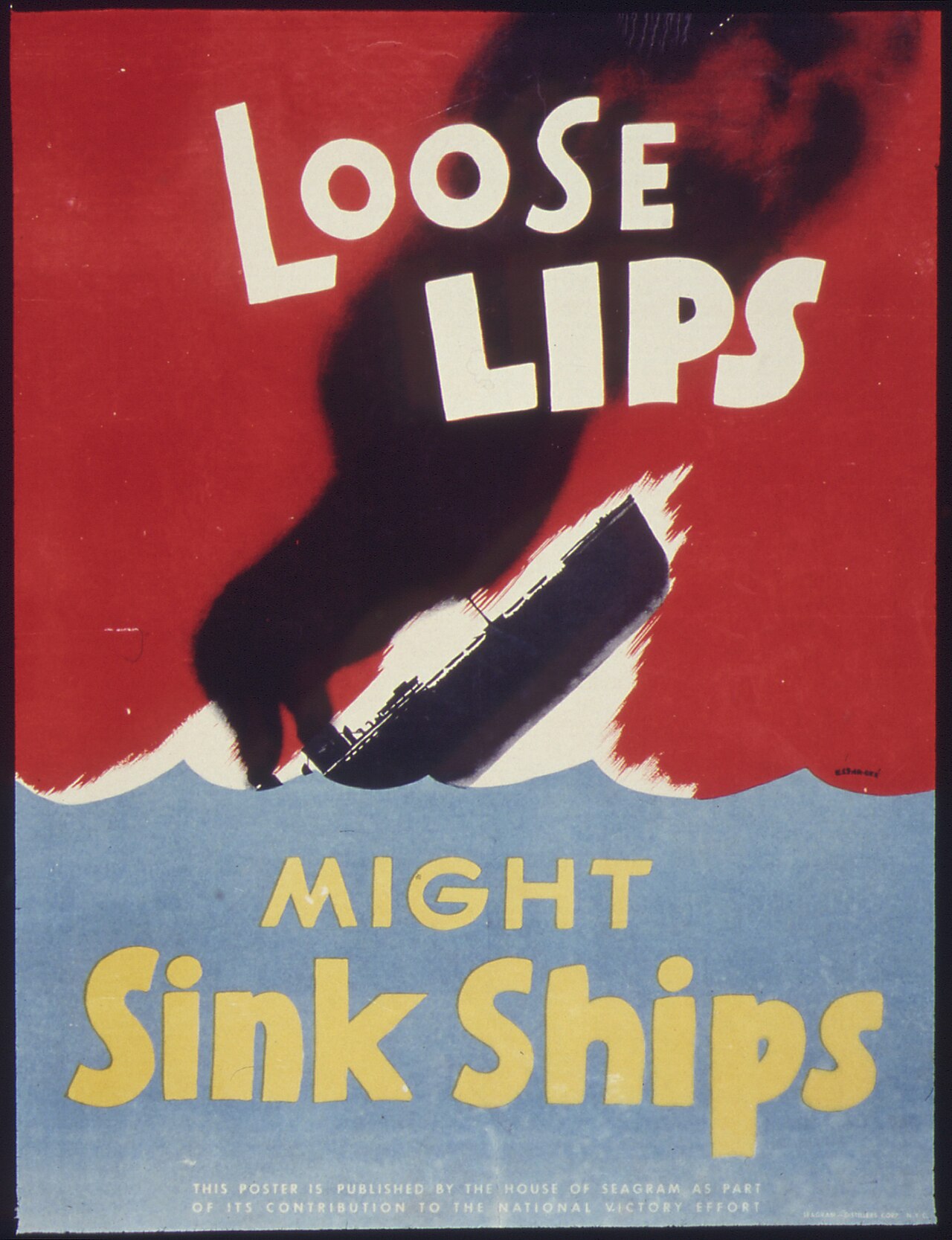
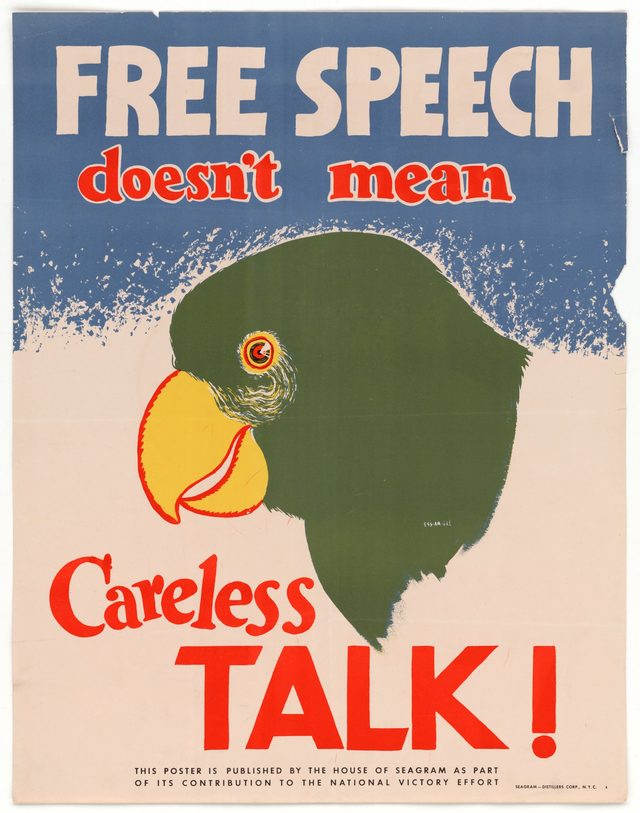
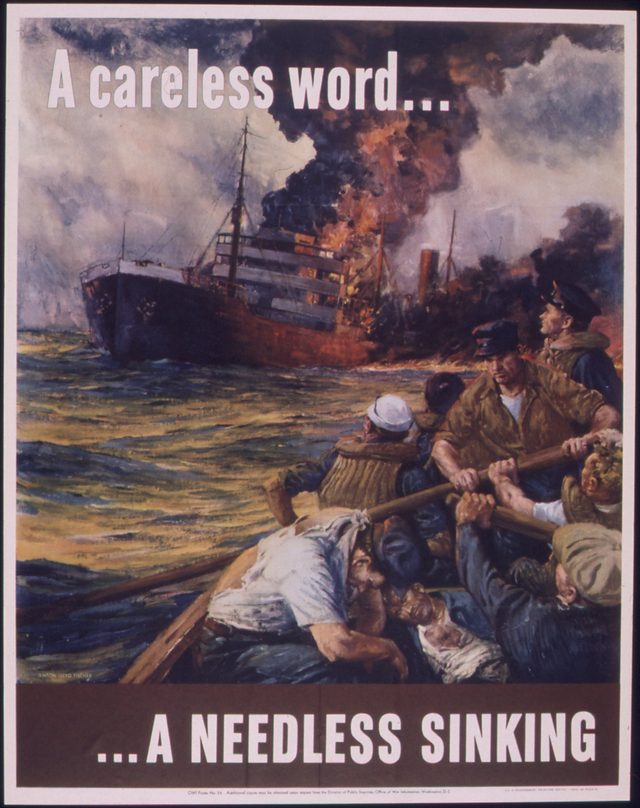
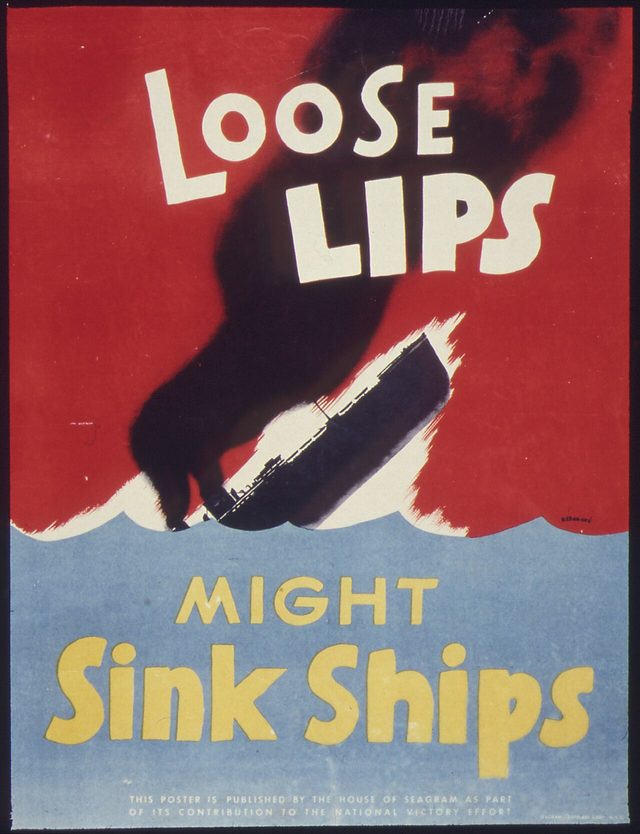
The collection's entry for this poster is dated 1942 and attributes it to a "U.S. government home-front security campaign". The transcription of the sheet itself reads differently: it says "This poster is published by the House of Seagram as part of its contribution to the national victory effort", over the name Seagram-Distillers Corp., New York. The Hagley Library, which holds the Seagram wartime posters, says the company issued anti-espionage posters and postcards for bars in coastal cities and towns, and that the poster is generally attributed to Seymour Goff, Seagram's art director, who signed as "Ess Ar Gee", with some sources naming Henry Goff instead. The image is held by the U.S. National Archives, and the sheet shows a ship on fire and sinking. The collection's caption notes that it reduces the many causes of a sinking (U-boats, weather, mechanical failure) to one cause the viewer can control by staying silent. That is a fear appeal with a single remedy. Read the technique: fear appeal.
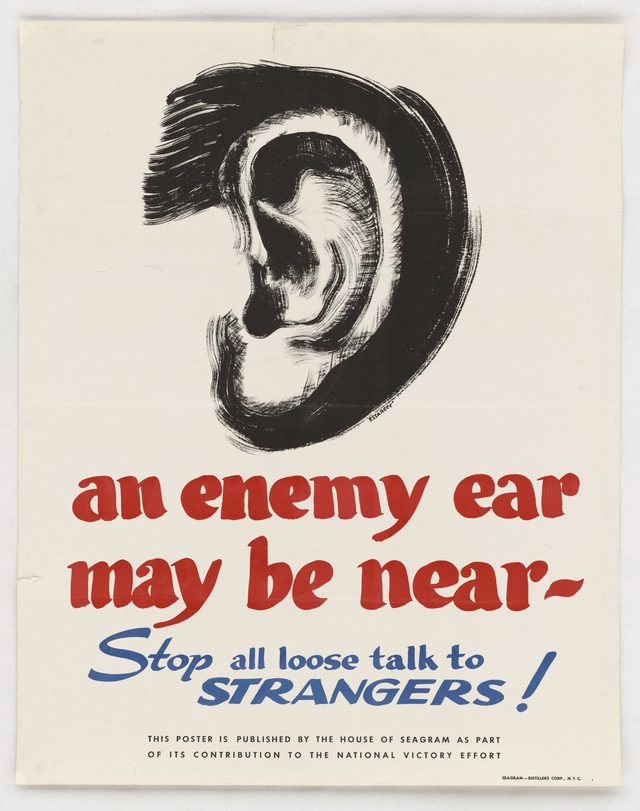
So the best-known American careless-talk poster came from a private company. Other Seagram sheets, such as "An enemy ear may be near", were issued the same way.
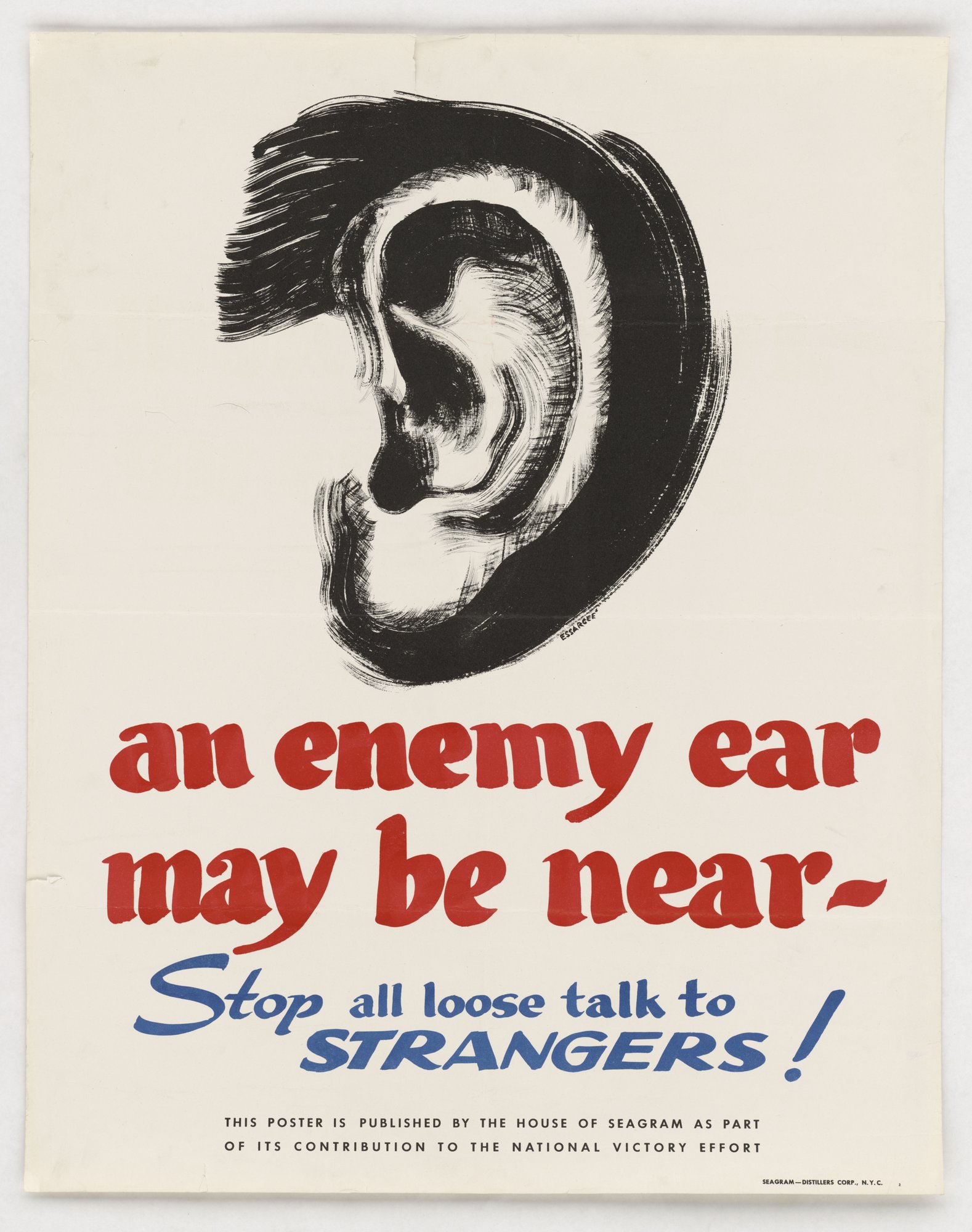
This Seagram sheet, signed "Essargee", fills the upper half with an ear. The ear stands for an unseen listener, and no spy, place or incident is named. Read the technique: fear appeal.
What did the U.S. Office of War Information's careless talk series show?
The Office of War Information (OWI) was created by Executive Order 9182 on 13 June 1942, with Elmer Davis as director. Its Domestic Branch ran posters, and Congress cut its funding in 1943. The agency's history is in the OWI case study. Government posters of 1942 to 1944 carried OWI numbers or an "issuing agencies" line.
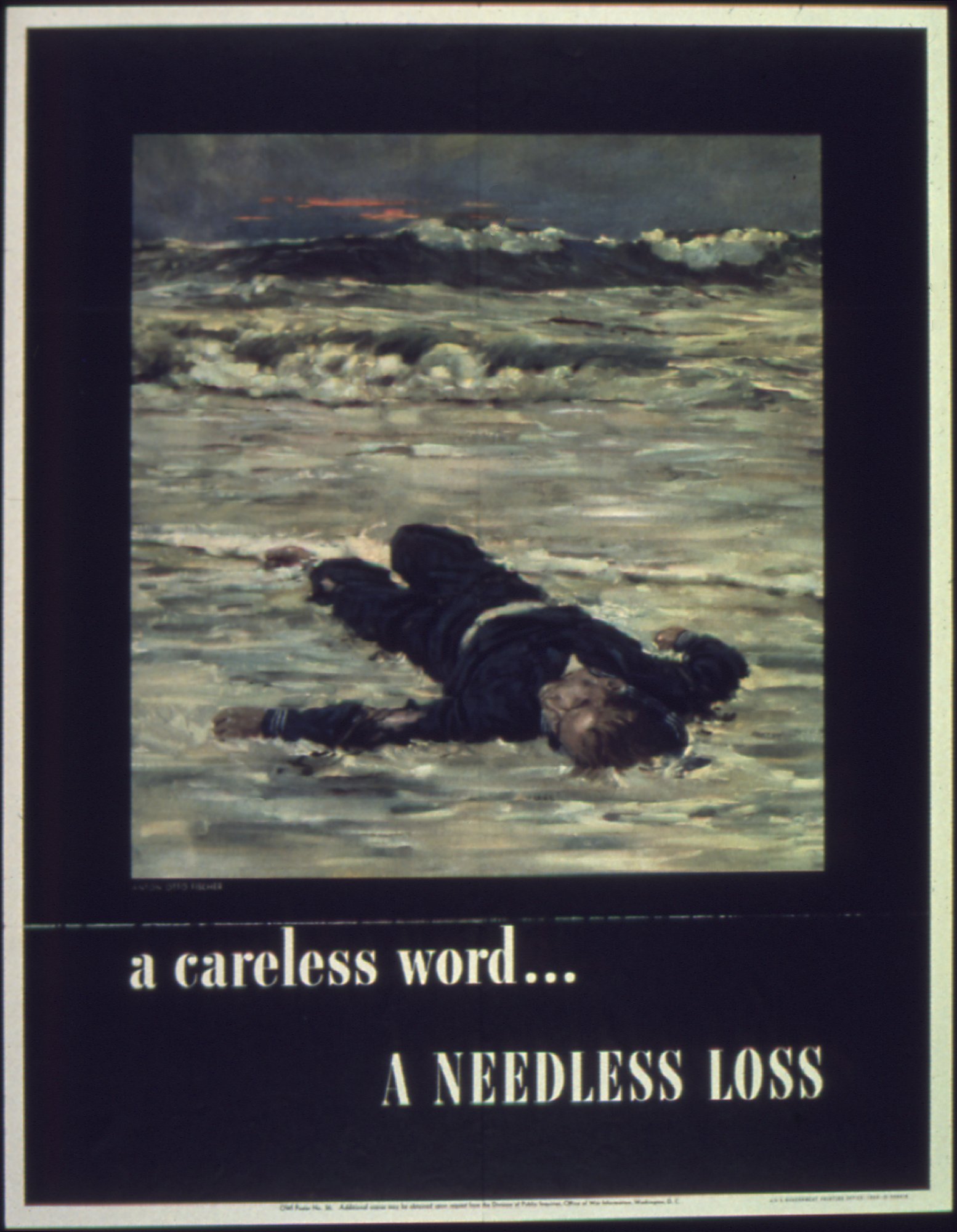
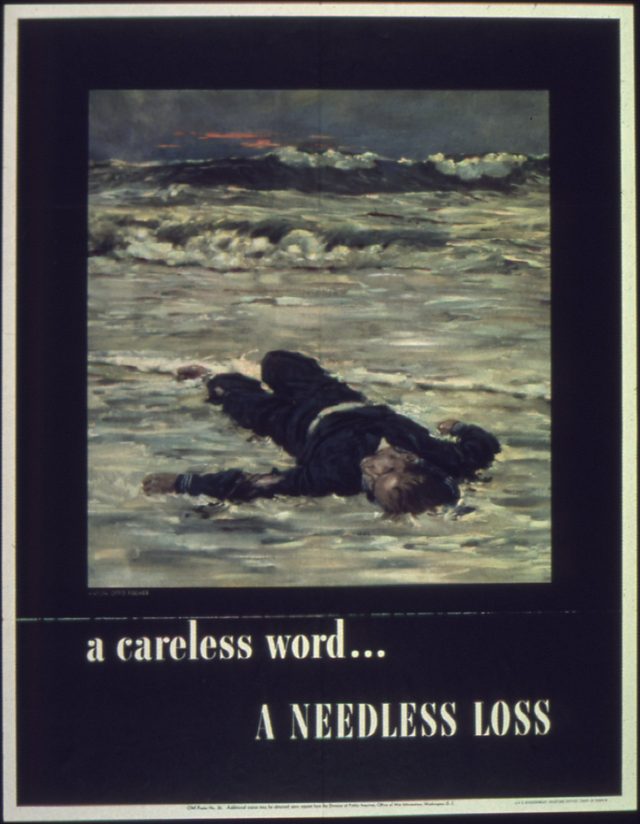
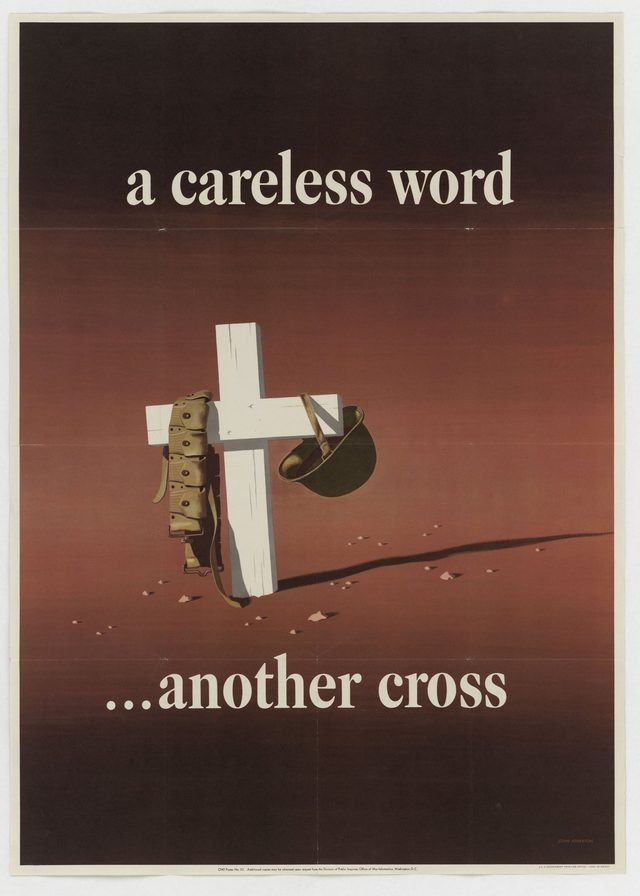
OWI Poster No. 36 is a painting by Anton Otto Fischer of a drowned sailor in the surf, with the words "a careless word... A needless loss". The entry dates it to 1942 by inference from the sister sheet No. 34, since the printing line is too small to read. The picture ties a casual remark to a particular death and offers silence as the remedy. Read the technique: fear appeal.
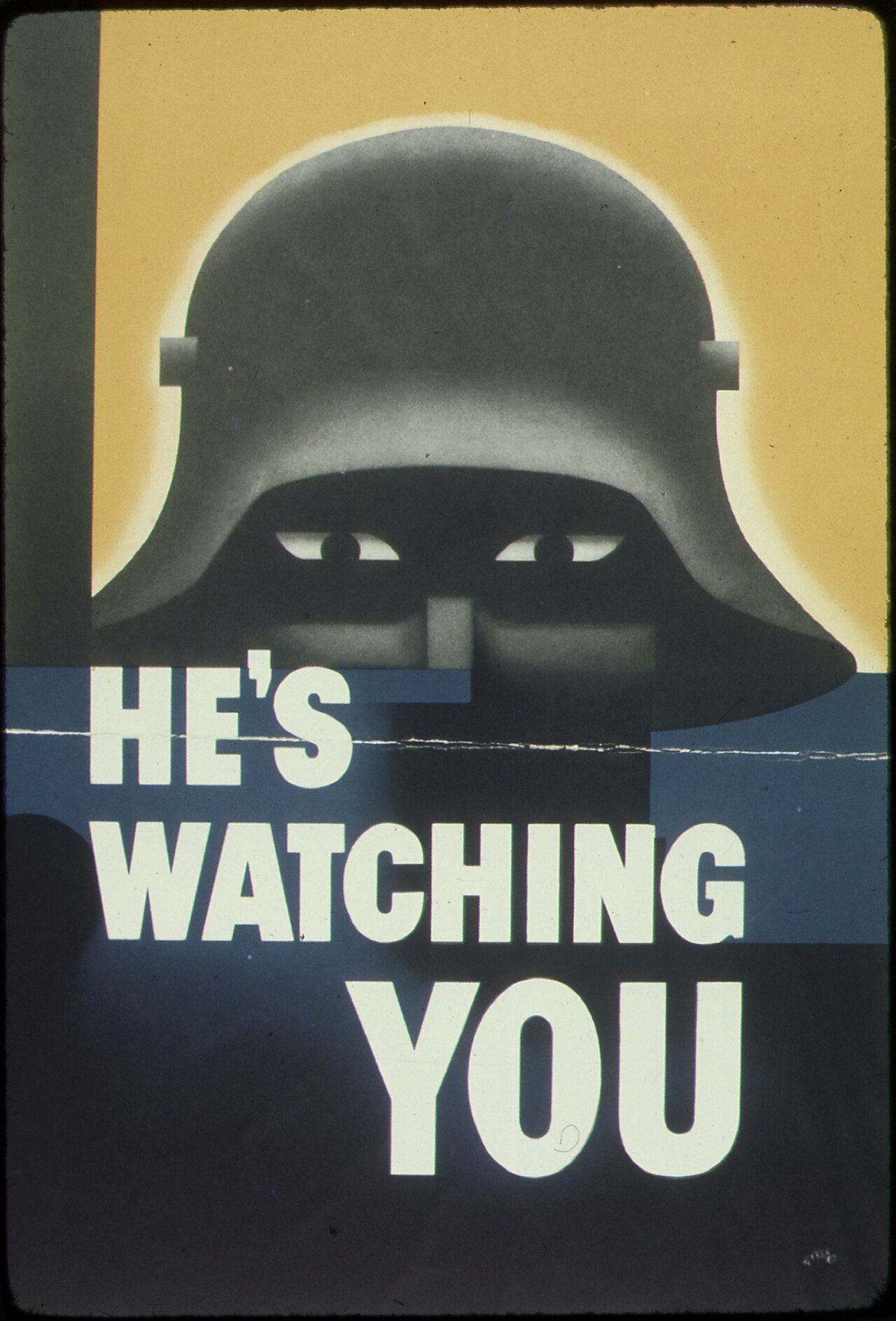
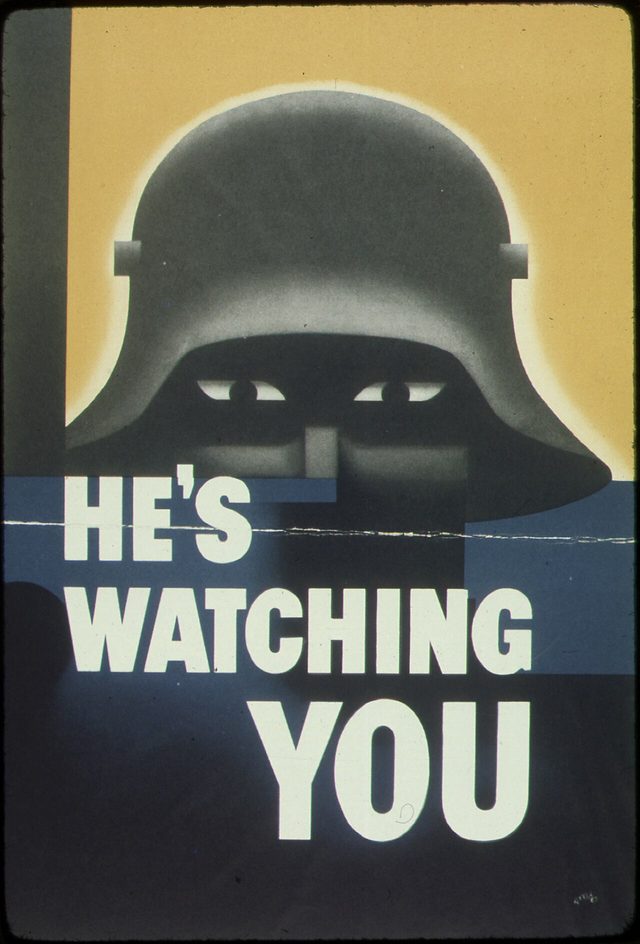
"He's Watching You" (1942, artist Glenn Grohe) shows a helmet and eyes with no unit, place or evidence attached. The collection tags it fear appeal, scapegoating and transfer: the menace is borrowed from a generic enemy symbol, not from a documented case. Read the technique: transfer.
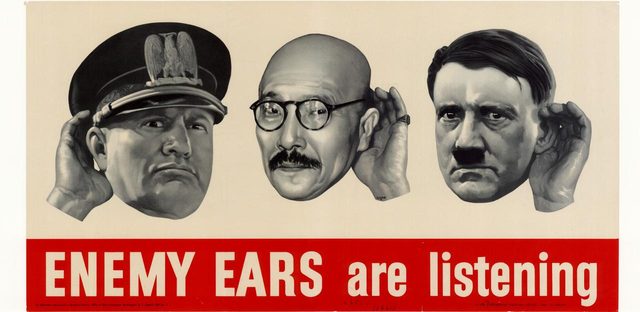
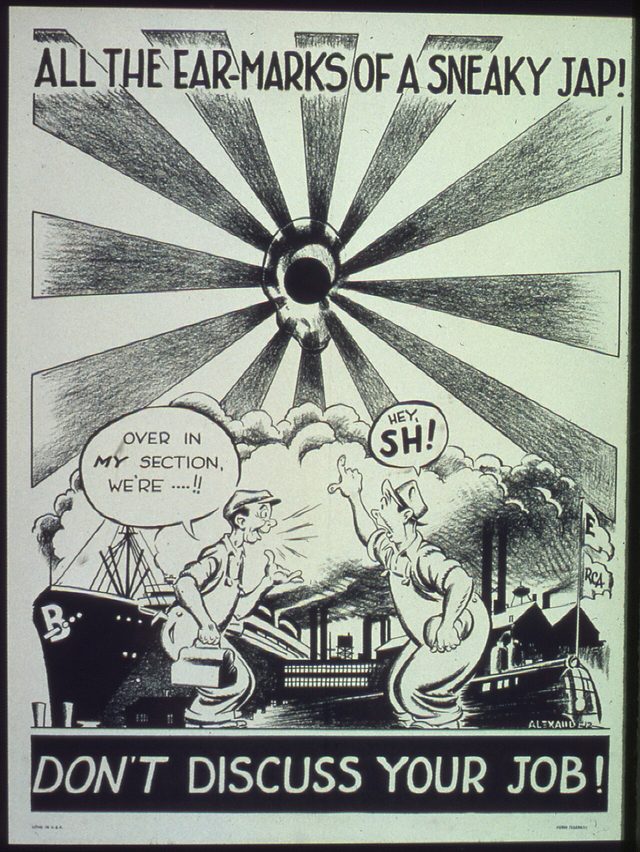
Not every poster pictured Germany. OWI Poster No. 5, "Enemy Ears Are Listening", shows Mussolini, Tojo and Hitler each cupping a hand to an ear. A plant-security sheet targets Japan.
Content note: Ethnic slur against Japanese people in the headline. This object is shown as it was published. Why 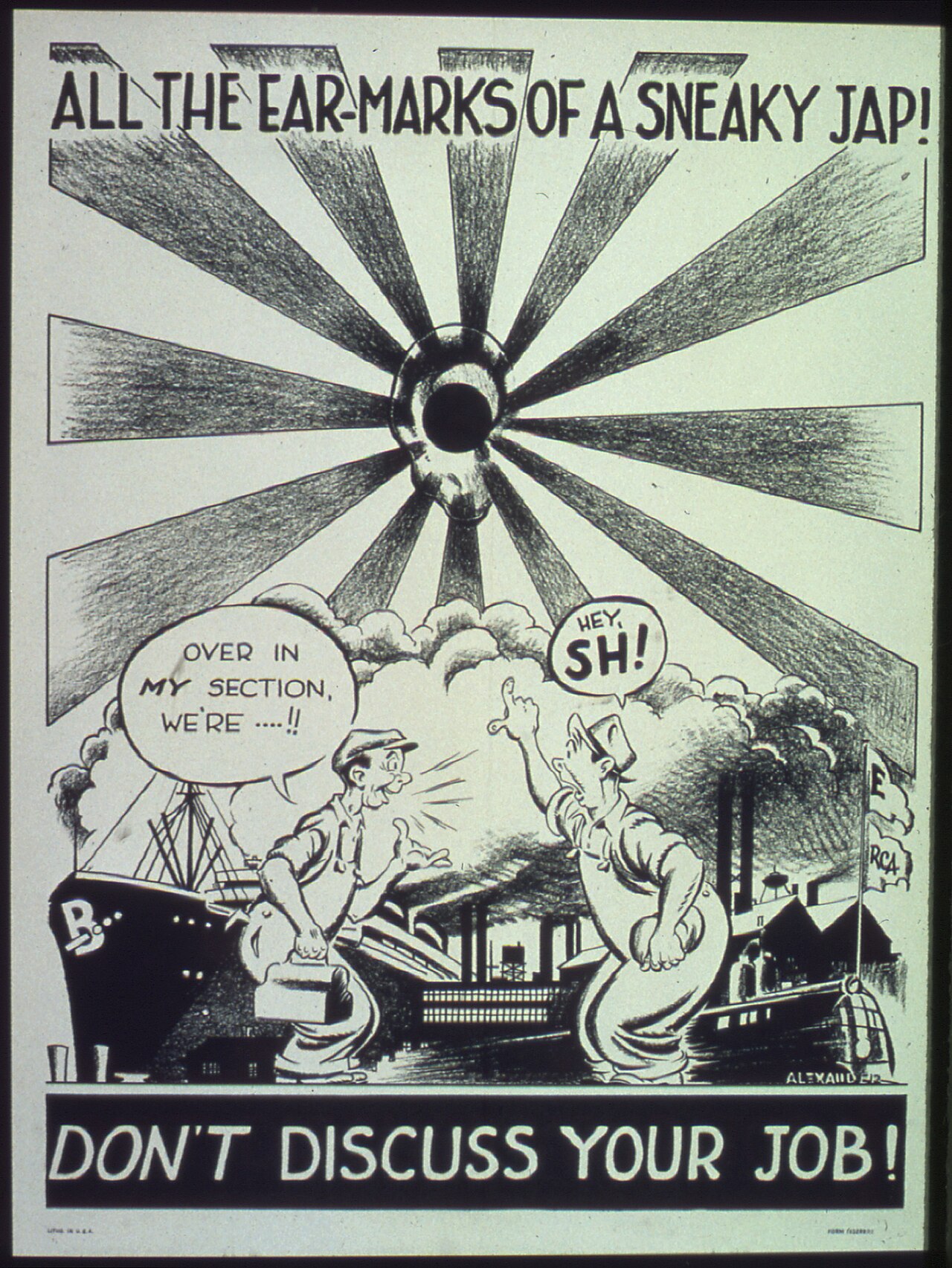
The headline attaches a slur and a trait to a whole nationality, so the label carries the warning and no evidence is offered. The collection's entry notes that Executive Order 9066 of 19 February 1942 led to the forced removal and incarceration of about 120,000 people of Japanese ancestry, most of them U.S. citizens. Read the technique: name-calling.
Why do some careless talk posters blame women?
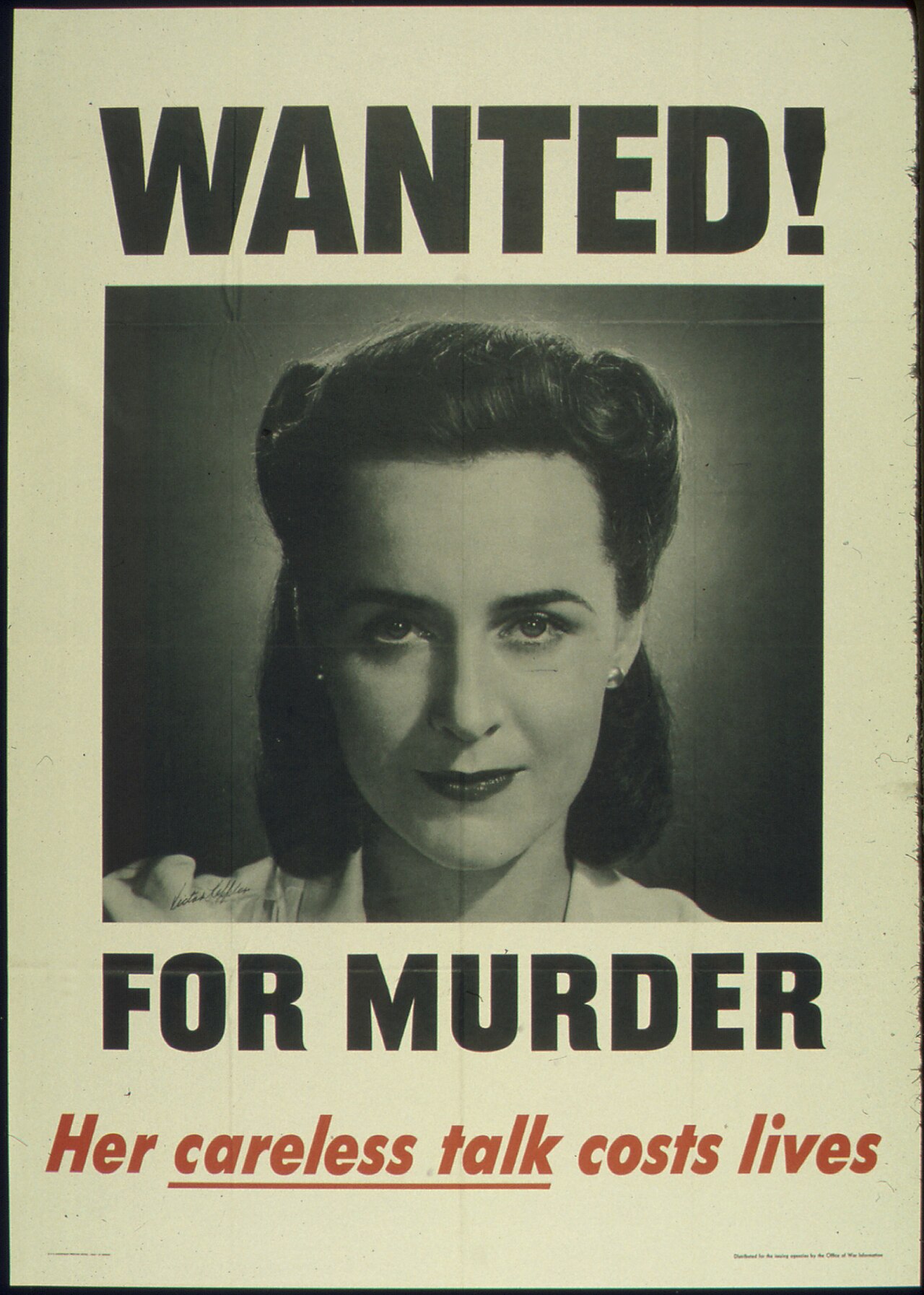
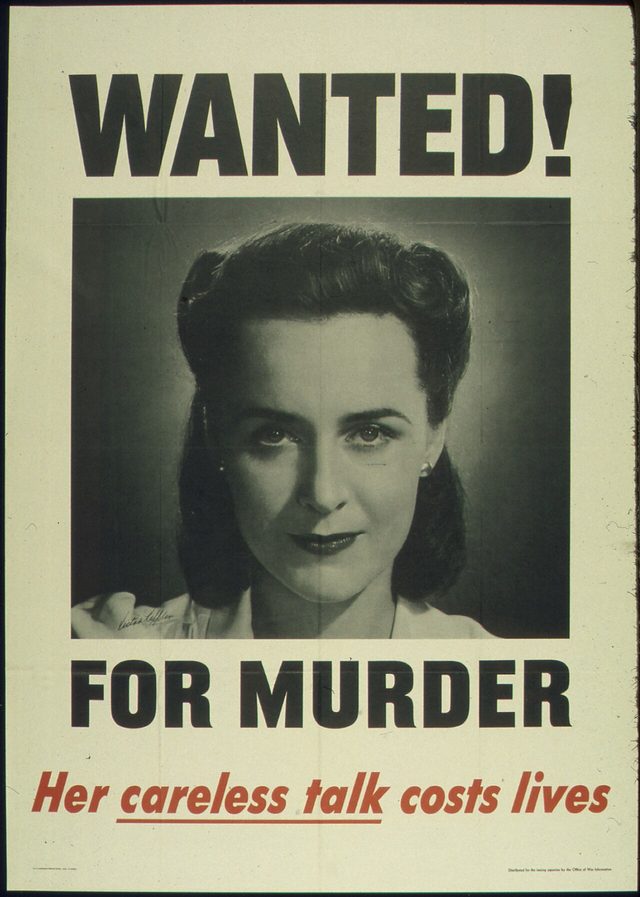
The U.S. poster "Wanted! For Murder" (1942, photograph by Victor Keppler) is styled as a wanted notice. It accuses an unnamed, glamorous woman of murder for "her careless talk" and superimposes drowning soldiers behind her. The collection describes the blame as gendered onto one civilian, rather than spread across command, weather or enemy action, and tags it scapegoating. Unlike most sheets in the series, it names an in-group target rather than an outside enemy. Read the technique: scapegoating.
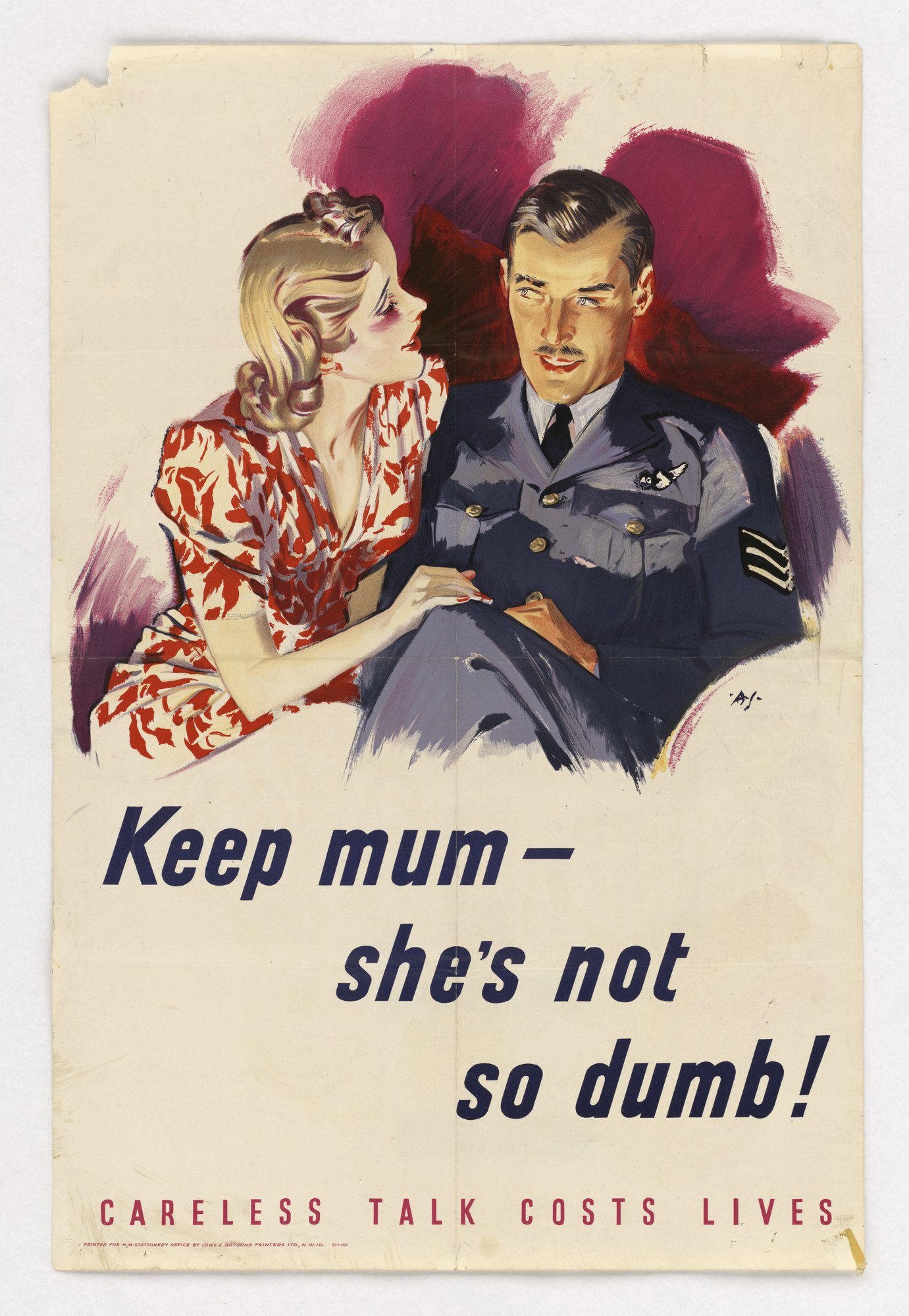
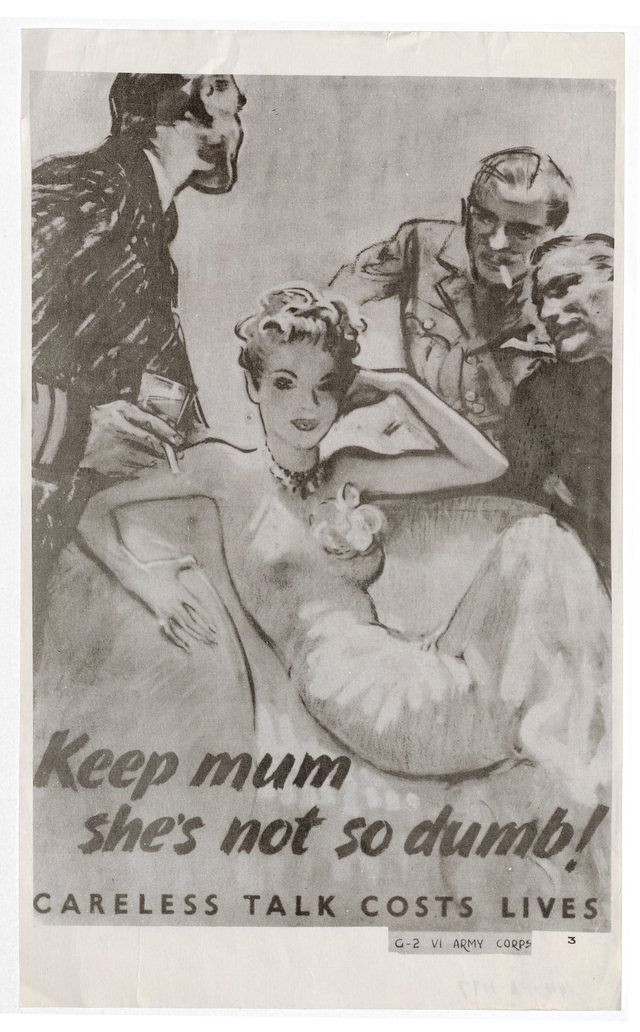
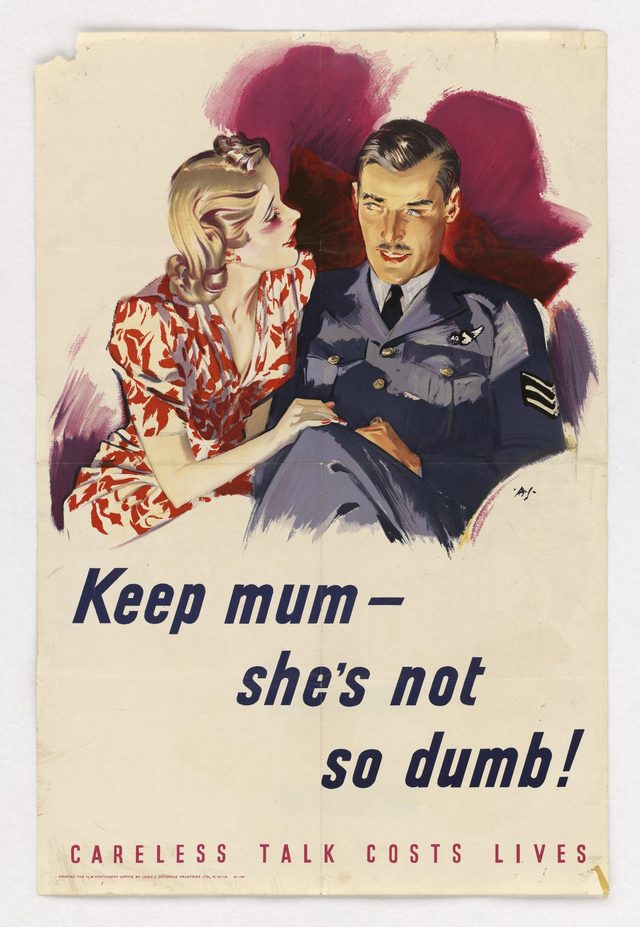
A British sheet printed for His Majesty's Stationery Office, signed "A.S.", shows a woman leaning toward an RAF sergeant air gunner with her hand on his arm. The entry notes that nothing in the picture shows her passing information; it relies on the stereotype of a charming woman as a likely leak. A U.S. Army sheet in the slice carries a similar line, "Keep mum she's not so dumb!". The pattern appears on both sides of the Atlantic, so it was not confined to one country's campaign. Read the technique: scapegoating.
What was Fougasse's "Careless Talk Costs Lives" series?
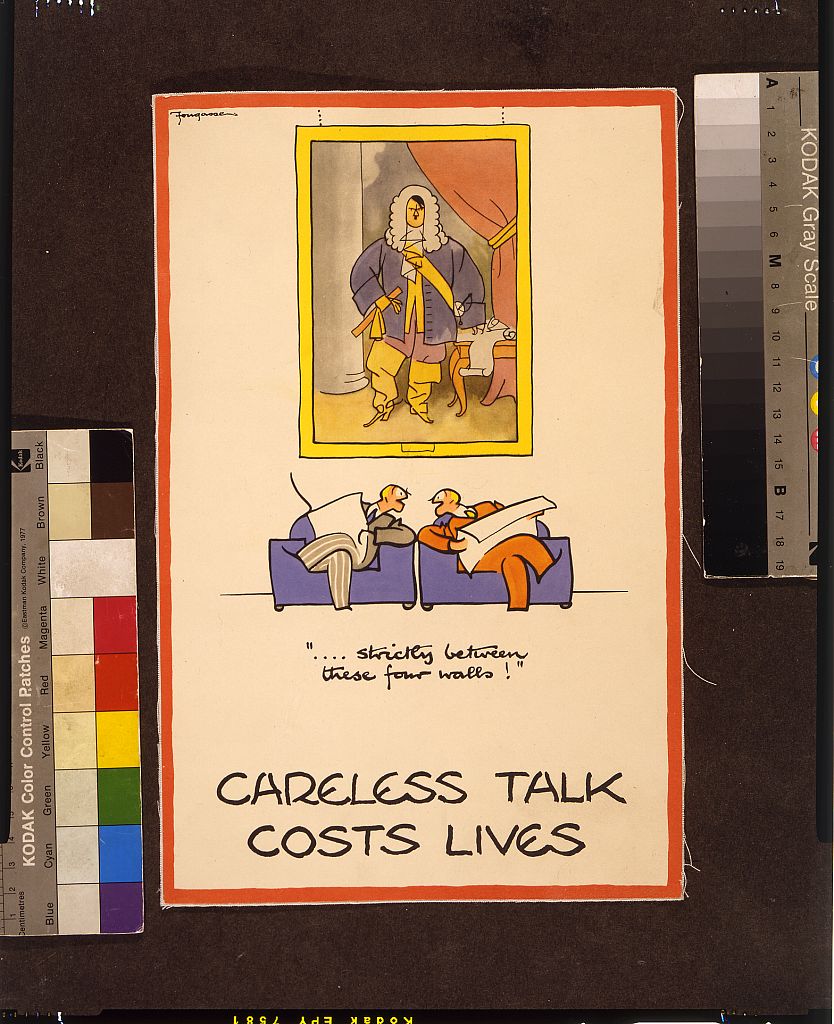
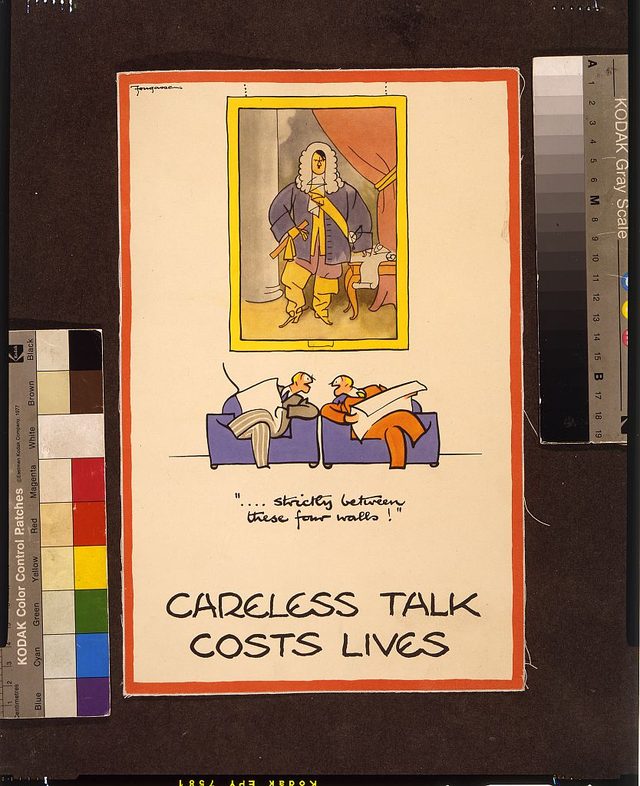
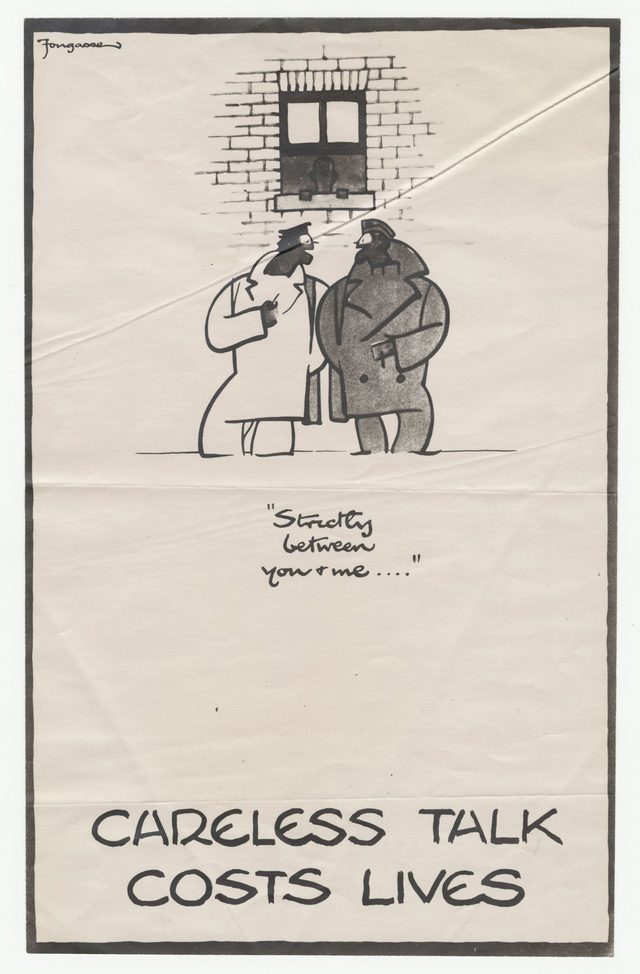
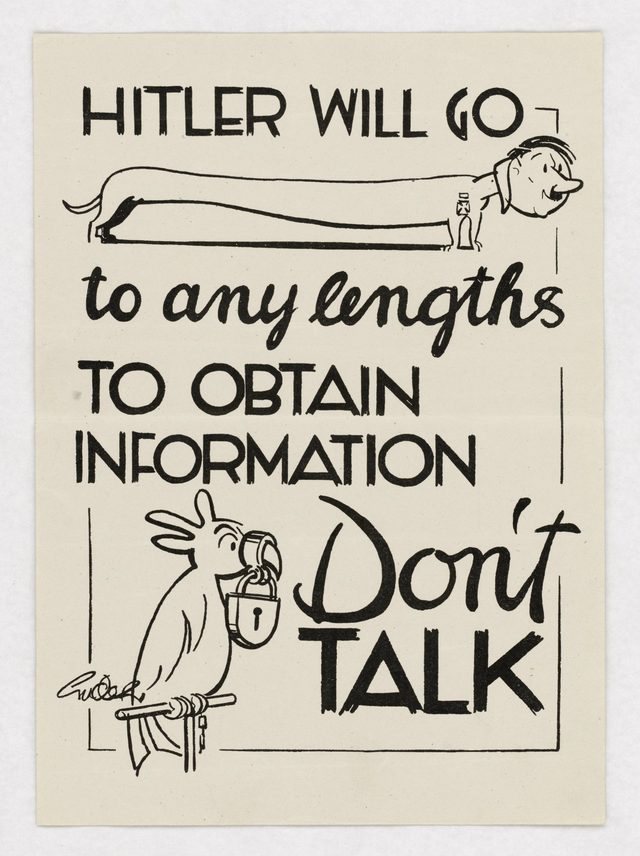
Fougasse was the pen name of Cyril Kenneth Bird (1887-1965), art editor of Punch, who volunteered his services to the government in 1939. The Victoria and Albert Museum records the series as issued by the Ministry of Information in February 1940 for display on public transport. Here two men gossip beneath a portrait of Hitler. The collection's caption points out that the harm is carried by a joke, and that no one in the picture is blamed as a killer, in contrast to the U.S. "Wanted! For Murder" sheet.
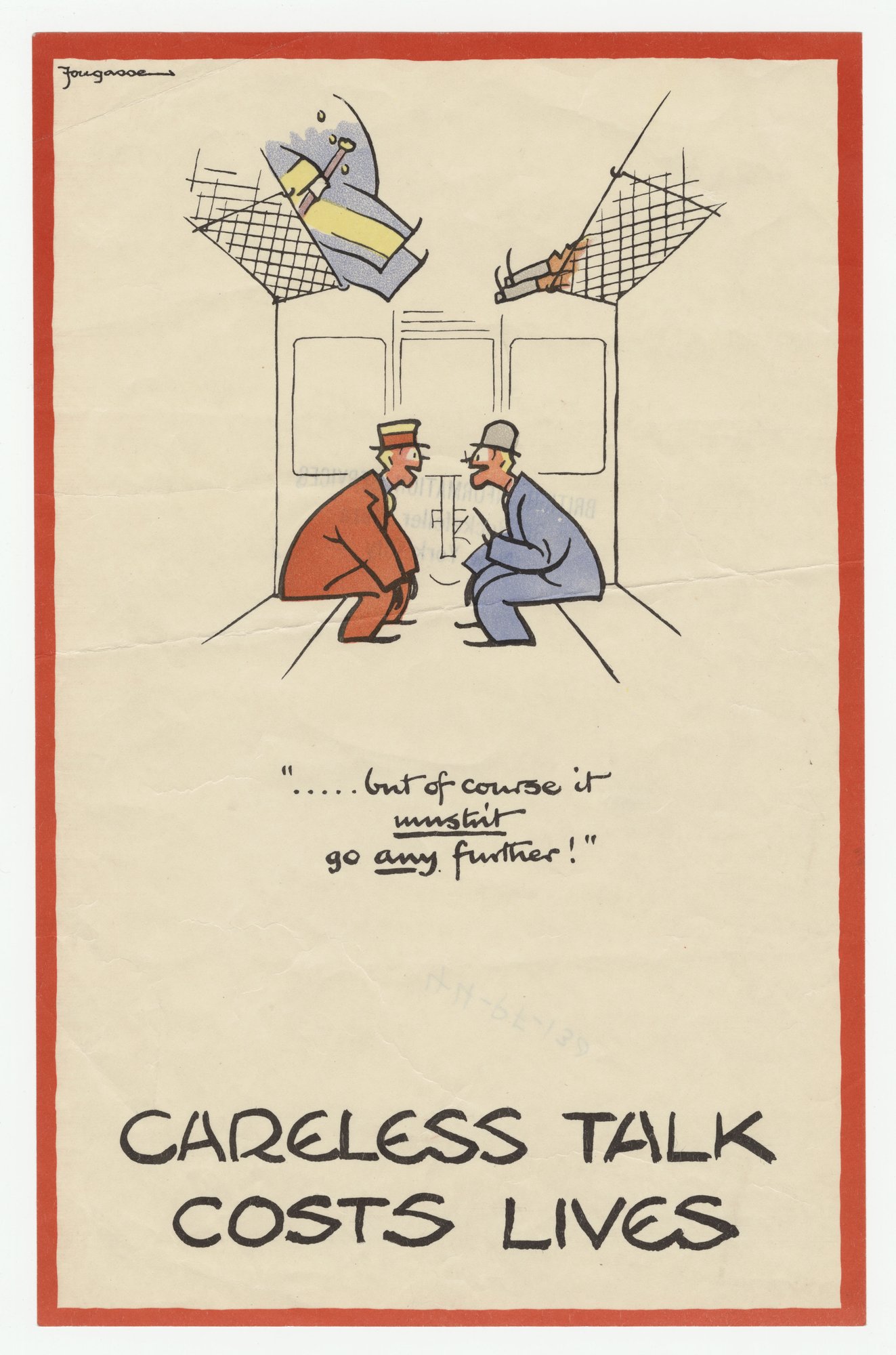
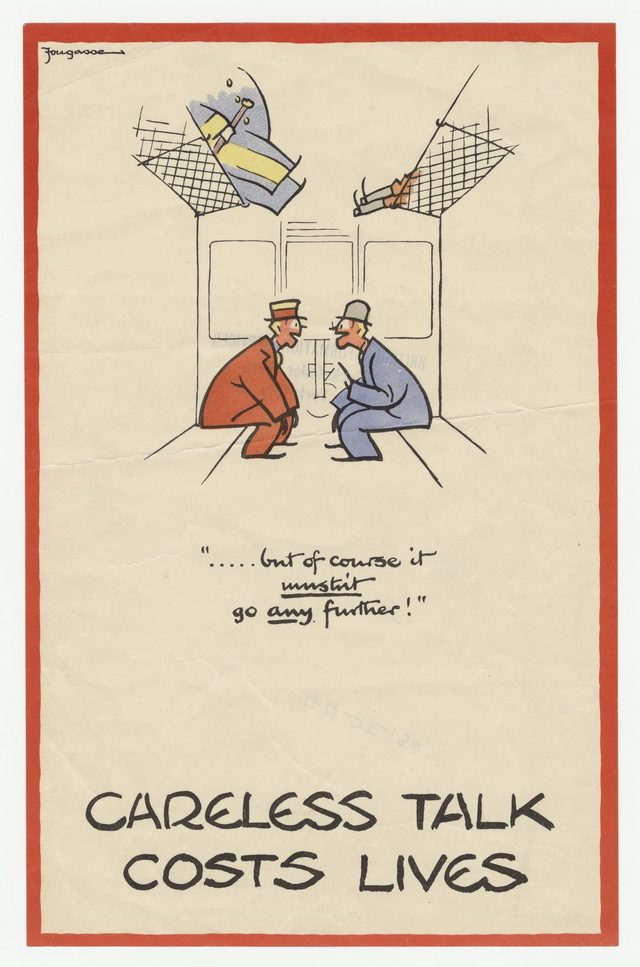
A second Fougasse design places two travellers in a railway carriage, with the speaker saying "...but of course it mustn't go any further!" The bodies above the compartment are the casualties; silence is the single remedy. For the ministry's wider work, see the Ministry of Information case study and British propaganda posters.
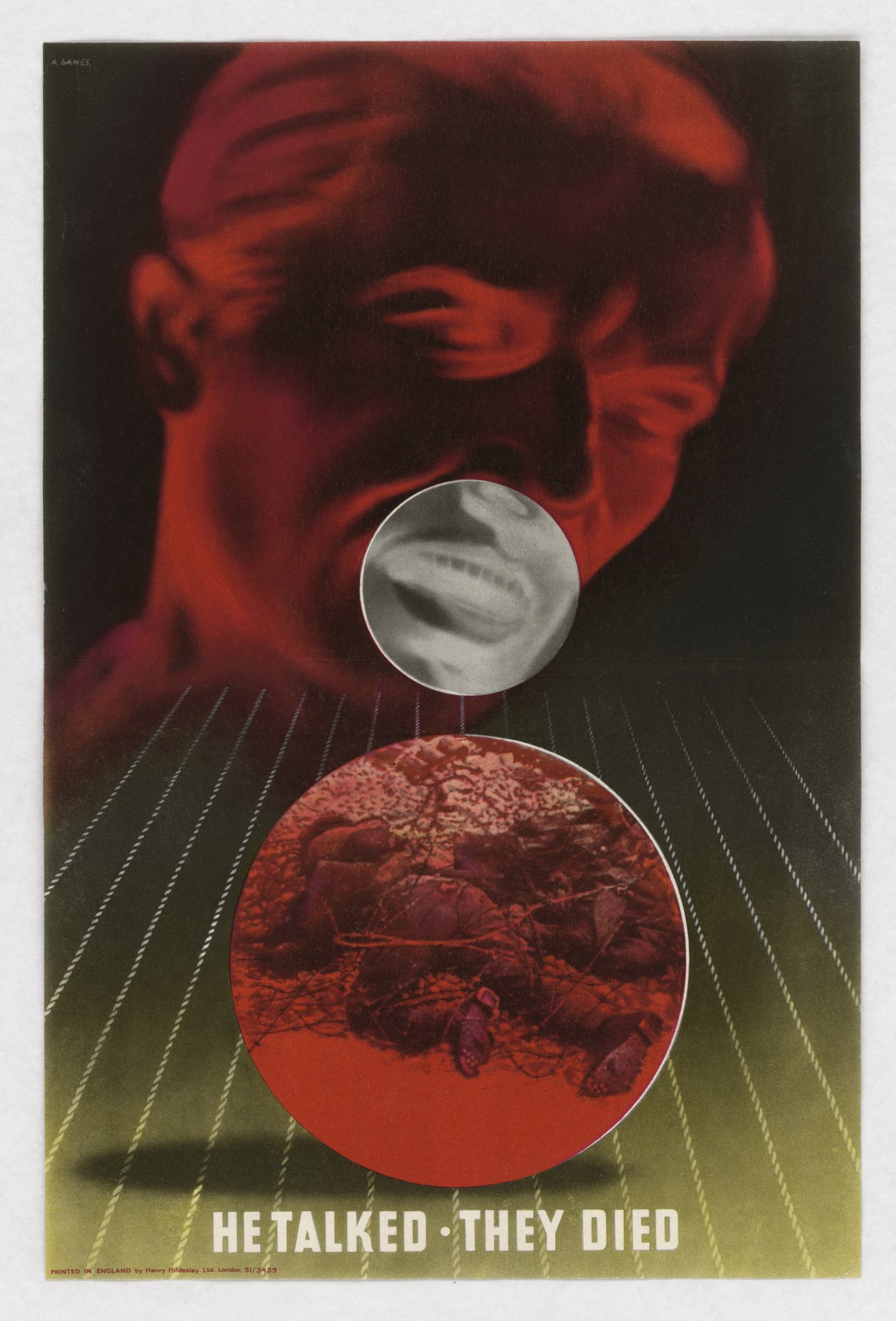
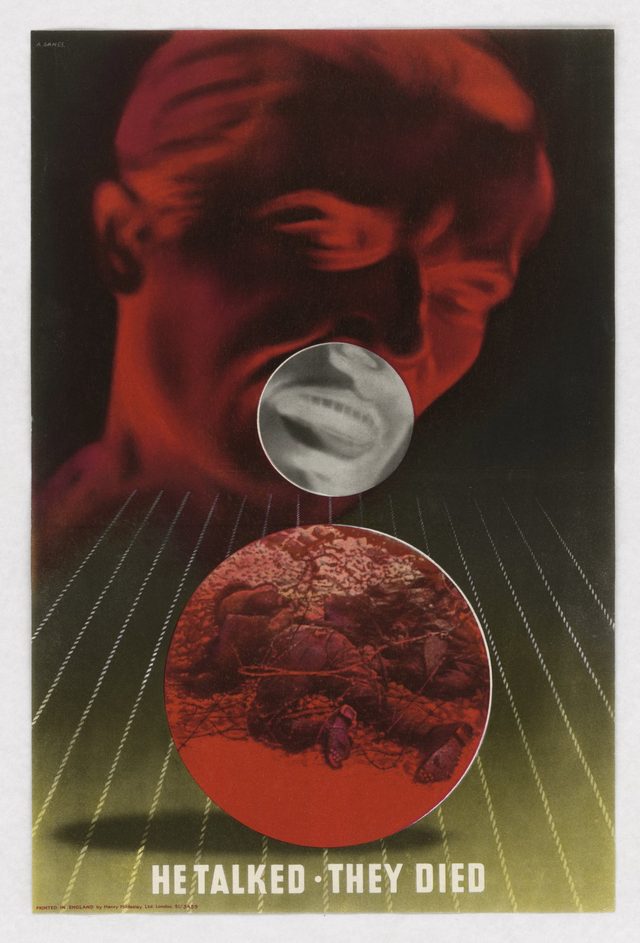
Not all British sheets were comic. This one, by Abram Games, pairs a mouth with a photograph of dead soldiers in barbed wire under "He talked - they died". The collection notes that the sponsoring ministry is not named on the sheet and that no figures or case are cited.
How did Canada's careless talk posters differ?
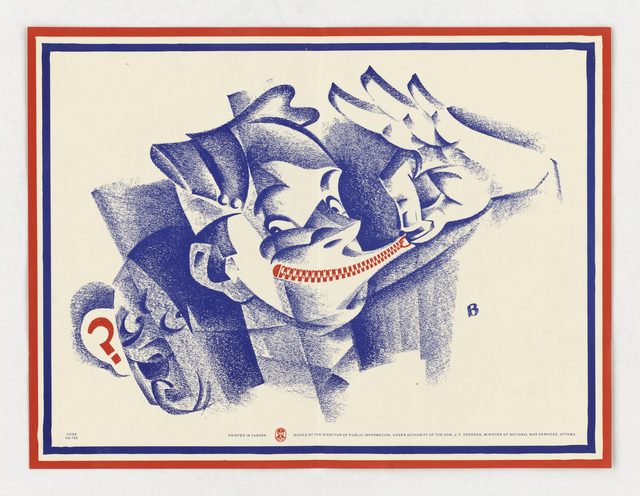
Canadian sheets were issued by the Director of Public Information in Ottawa and, from 1942, the Wartime Information Board, in English and French. The Canadian War Museum describes the board's graphic arts director, Harry Mayerovitch, designing a 1943 poster of a dead man accusing viewers of causing his death at sea, 30,000 copies of which circulated in November 1943. See also Canadian propaganda posters.
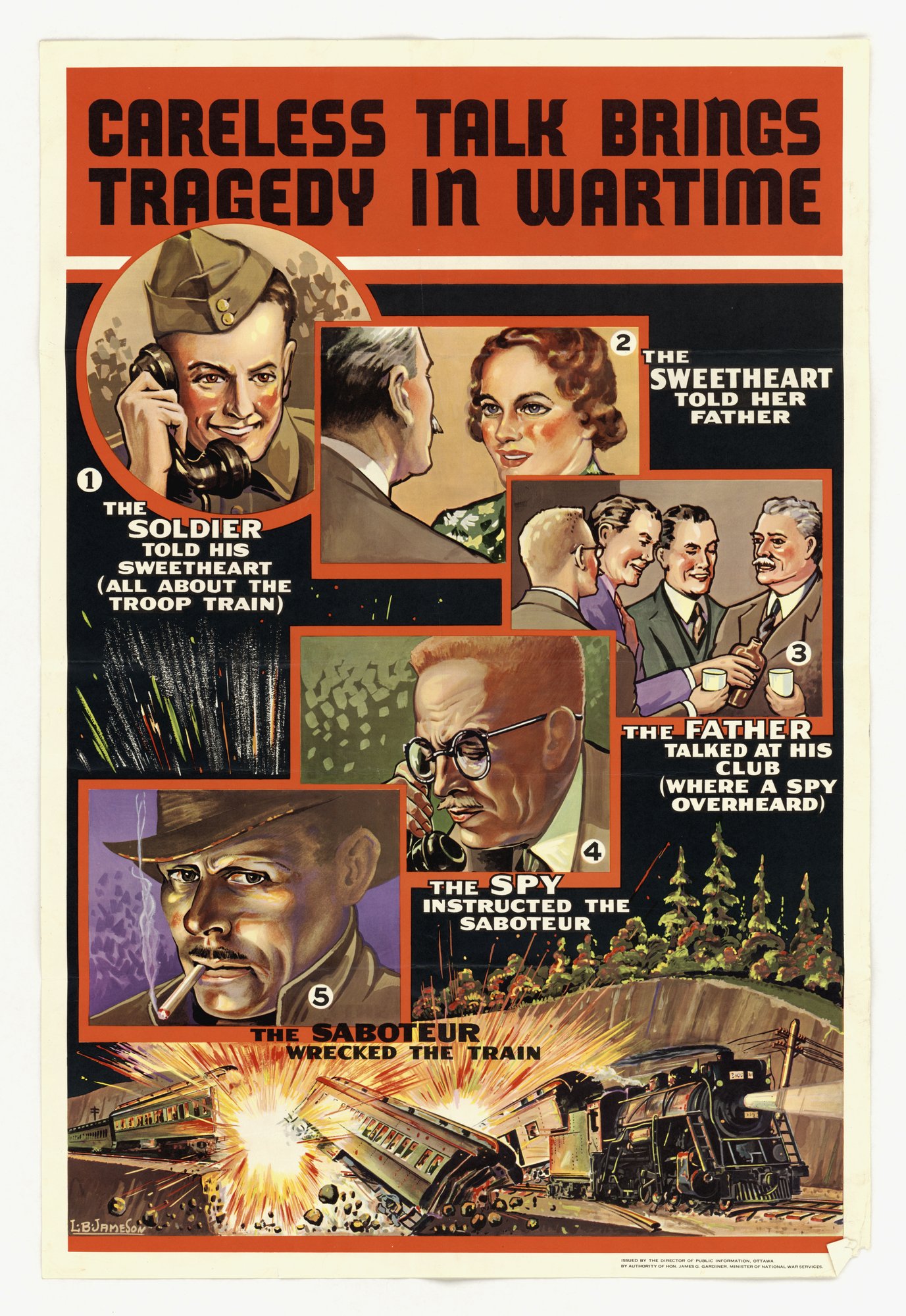
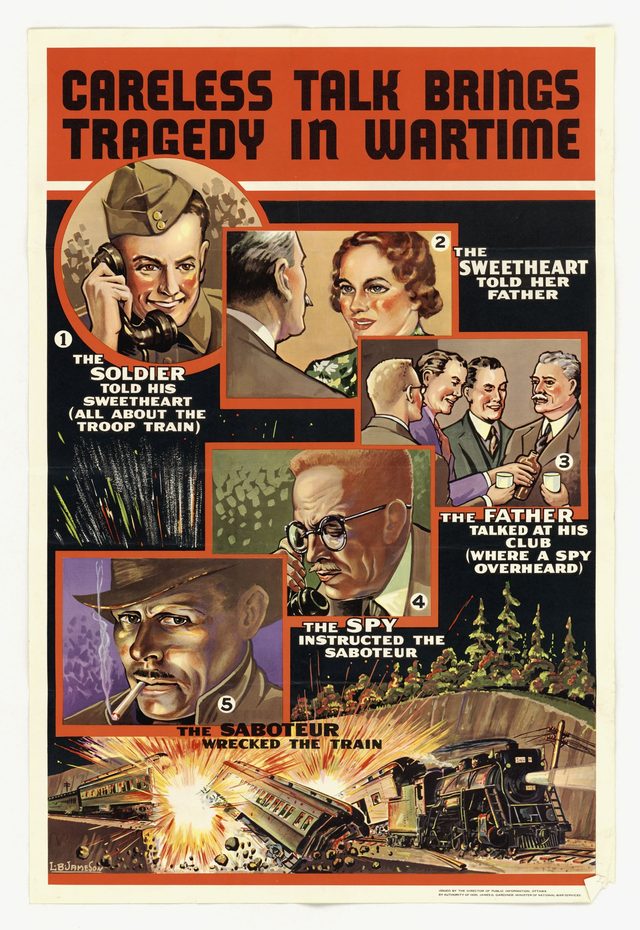
The poster by L. B. Jameson tells a chain story in five panels: a soldier tells his sweetheart about a troop train, she tells her father, he talks at his club where a spy overhears, the spy instructs a saboteur, and the saboteur wrecks a train. The entry states that the scenario is an illustration and not a documented incident. The tell is card stacking: each step is plausible, but the chain is asserted, not shown to have happened. Read the technique: card stacking.
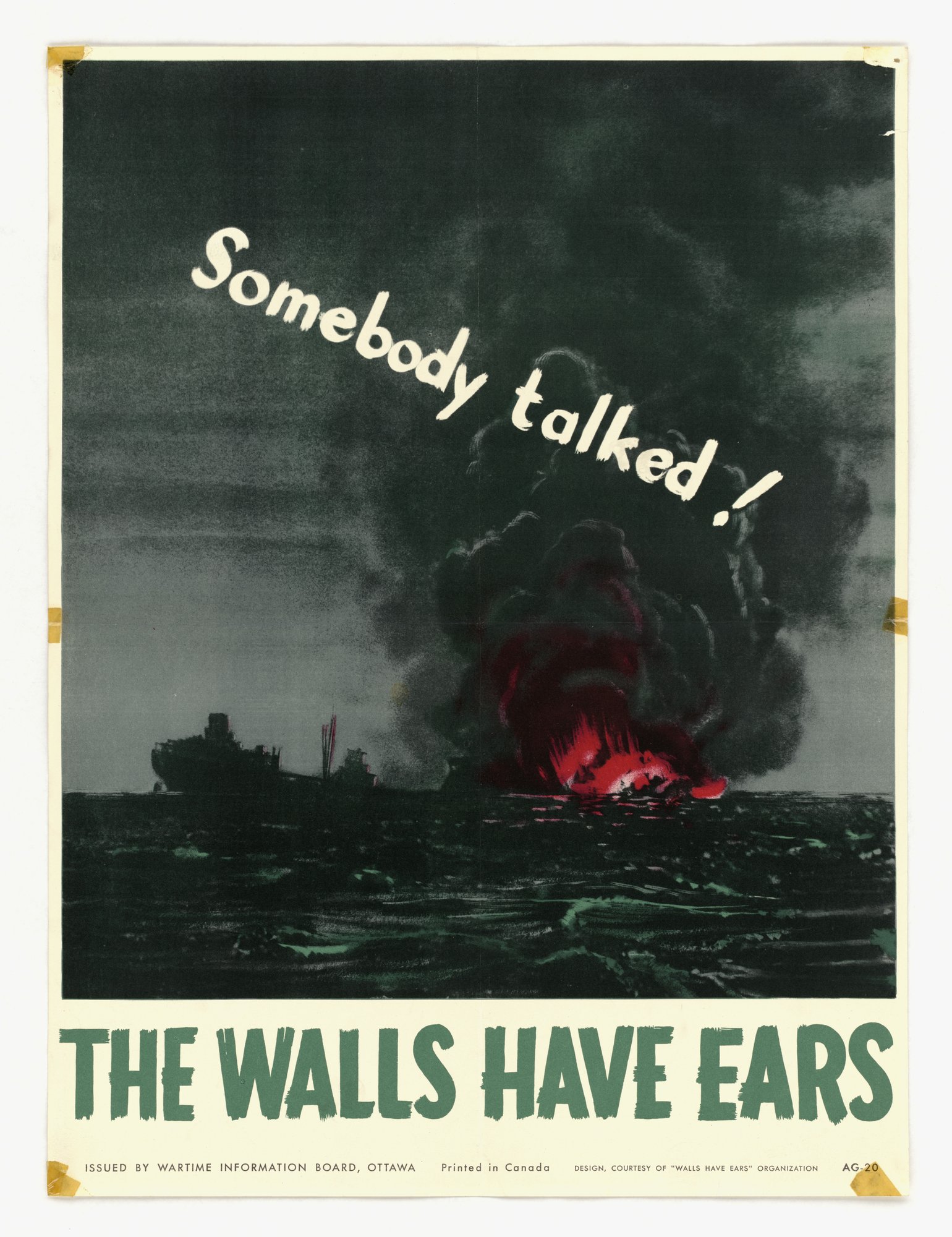
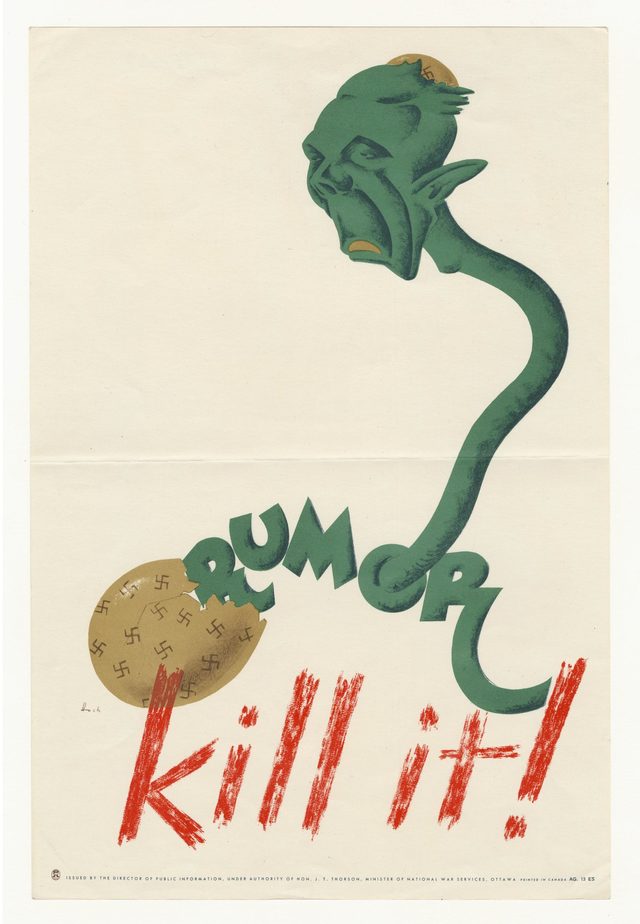
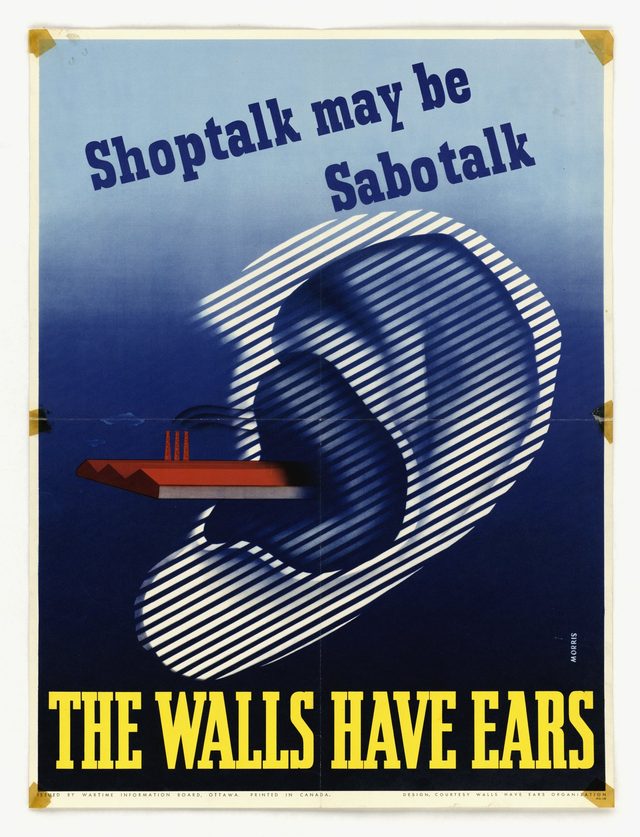
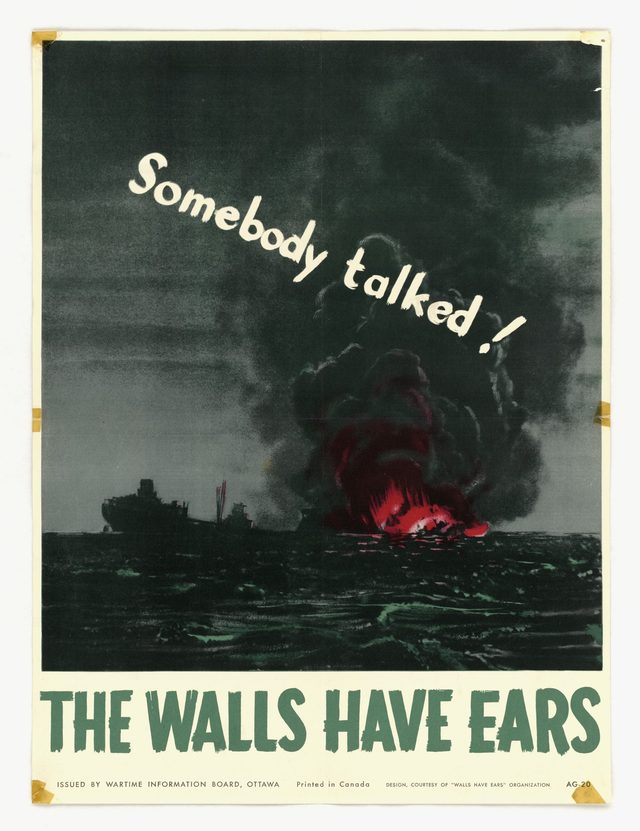
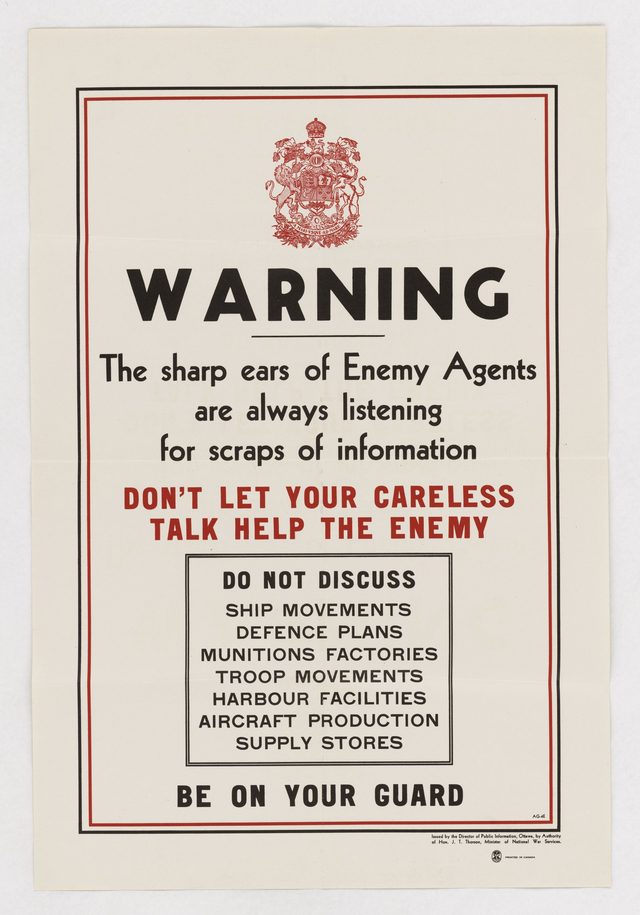
This sheet, issued by the Wartime Information Board with a design credited to the "Walls Have Ears" organization, shows a tanker already burning. The slogan names loose talk as the cause without evidence of any particular case. In the slice, a Canadian poster warning that "the sharp ears of enemy agents are always listening" lists seven subjects not to discuss under the Canadian coat of arms, which lends state authority (transfer). Read the technique: transfer.
Was the spy threat real?
Yes, enemy agents were active. The Federal Bureau of Investigation's account of the Duquesne spy ring says 33 people working for Germany were convicted by 13 December 1941. A double agent, William Sebold, had been recruited by the Gestapo, told the American consulate, and then worked with the FBI. Sentences, handed down on 2 January 1942, ran from 15 months to 18 years.
The FBI's account of Operation Pastorius says that two German submarines landed eight saboteurs, one group near Amagansett, New York on 13 June 1942 and another at Ponte Vedra Beach, Florida on 17 June. The group's leader George Dasch contacted the FBI on 14 June, and all eight were under arrest by 27 June. A military commission tried them from 8 July to 4 August; six were executed on 8 August, and Dasch and Ernest Burger received prison terms, commuted in 1948.
Both cases involved real German intelligence operations on American soil. In the sources cited here, both were exposed through a defector and a double agent, not through a civilian's chance remark. The posters' claim was different: that ordinary conversation about sailings and troop movements could reach the enemy and cause deaths. The entries for individual posters state that they cite no specific incident. This page does not rule on the campaigns' effect.
What to look for in a careless talk poster
- A single cause. Ships, trains or soldiers are shown lost to one remark, with weather, tactics and enemy action absent.
- An unseen listener. Ears, eyes, helmets, portraits and walls stand in for an enemy whose presence is asserted, not shown.
- One remedy. The picture ends on silence as the only action asked of the viewer.
- Who is blamed. Check whether the speaker is a stranger, an enemy agent, a worker, a soldier or a woman.
- Who paid for it. The issuer line may name a ministry, an army section, a printing office or, as with the Seagram sheets, a company.
How the sides compare
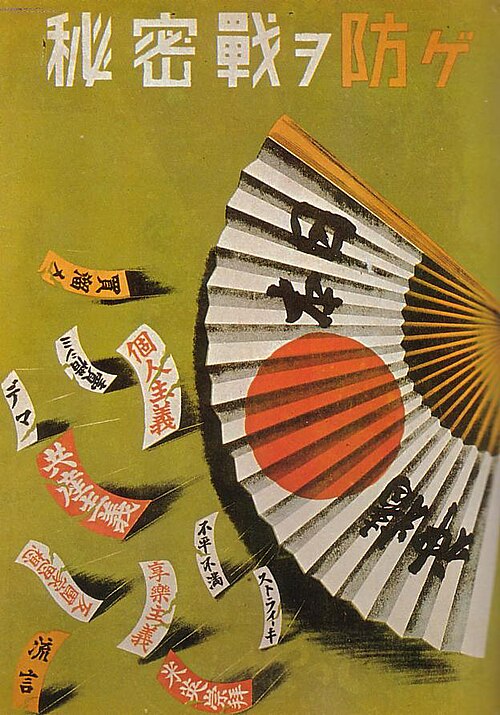
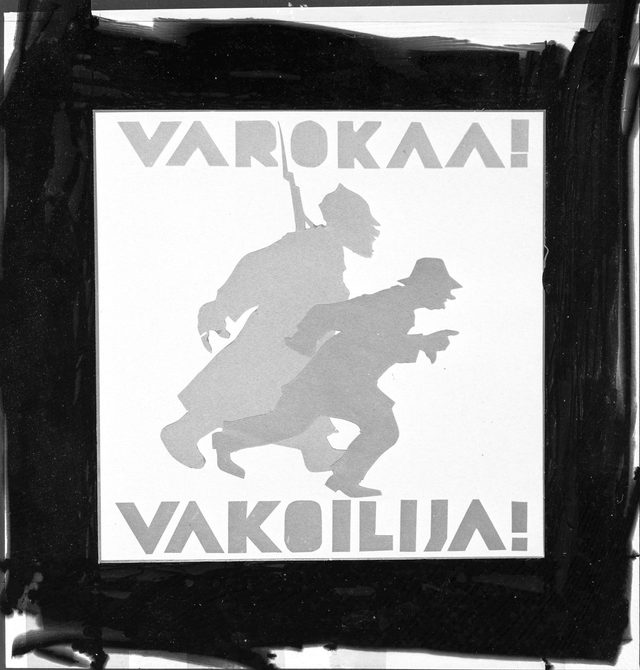
The same four tells appear in the American, British and Canadian sheets. The collection also holds a Japanese counterintelligence poster of about 1940 and a Finnish Winter War poster, "Beware! Spy!". The German "Feind hört mit" ("the enemy is listening") posters are not in this slice, so no German equivalent is shown here. Differences are in form and issuer: British sheets lean on cartoon and a named artist, Canadian sheets on numbered stories and bilingual text, and American sheets on a mix of government, military and corporate sources. For the American record more widely, see American propaganda posters.
Browse WW2 careless talk posters
The grid below shows posters from the collection about careless talk and wartime security. Each opens an object page with the holding institution, a link to the original record, a transcription of any text and the rights basis for hosting. For other home-front themes, see war bonds, rationing and salvage and women in WW2 posters.
Sources and rights
Posters on this page come from the U.S. National Archives and the Library of Congress, directly or through Wikimedia Commons. UK and Canadian sheets are held as Crown copyright whose term has expired, and the object page gives each rights basis. Transcriptions are verbatim. History cited above comes from the Hagley Library, the Victoria and Albert Museum, the Canadian War Museum and the Federal Bureau of Investigation.
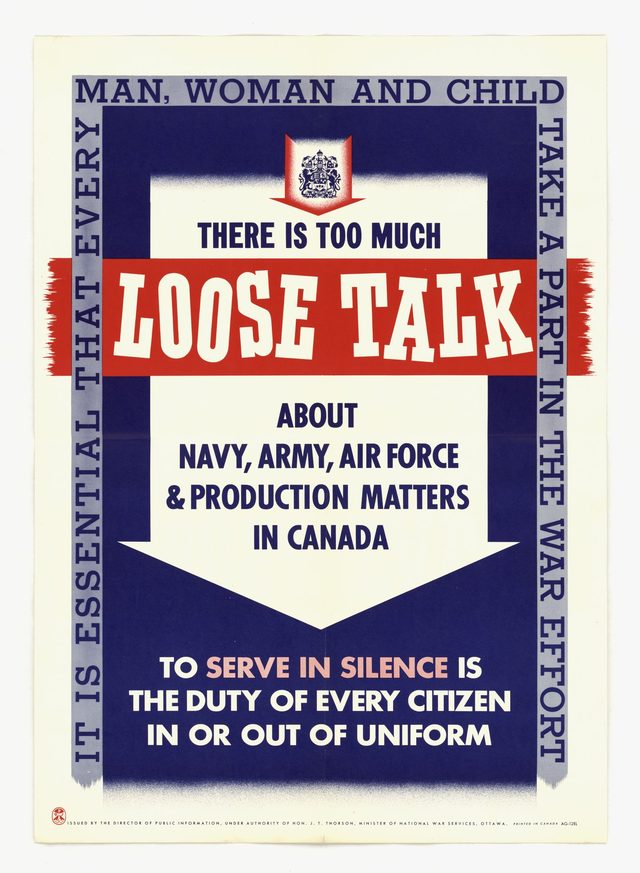
![Méfiez-Vous. Révéler toute information de guerre c'est servir l'ennemi. Silence [Beware. To reveal any war information is to serve the enemy. Silence]](../../collection/images/canada-mefiez-vous-silence-french-1940-640.jpg)