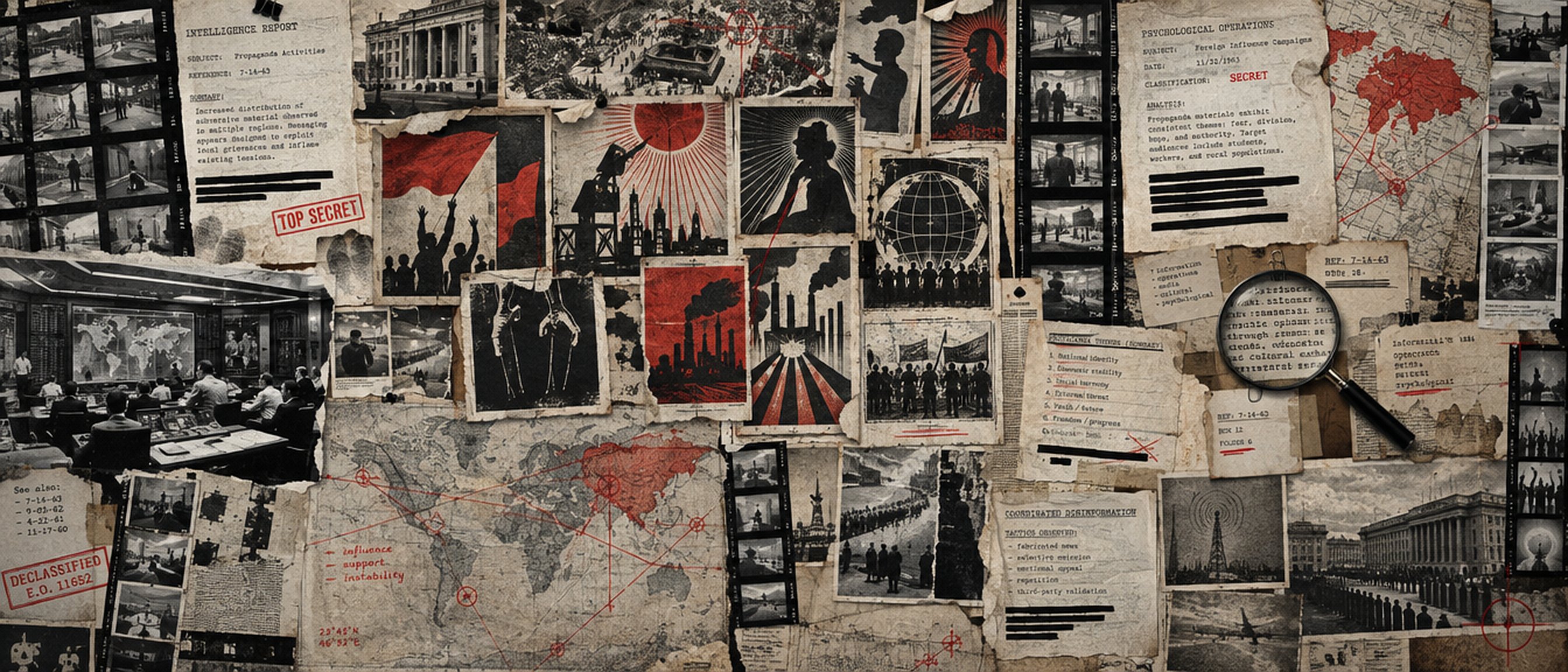
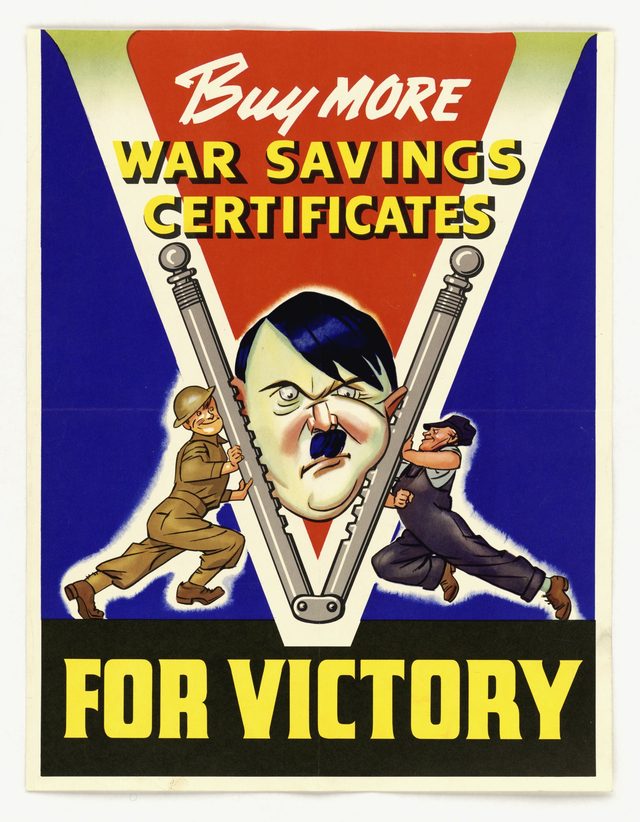
Content note. Canadian wartime posters use the labels "Hun" for Germans and caricature enemy officers, and one war-savings sheet shows a torn "Heil Hitler" notice and the line "To Berlin and Tokyo". They are shown as they were issued, as evidence of what Canadians were told. Showing a poster is not endorsing it.
What were Canadian WWII propaganda posters?
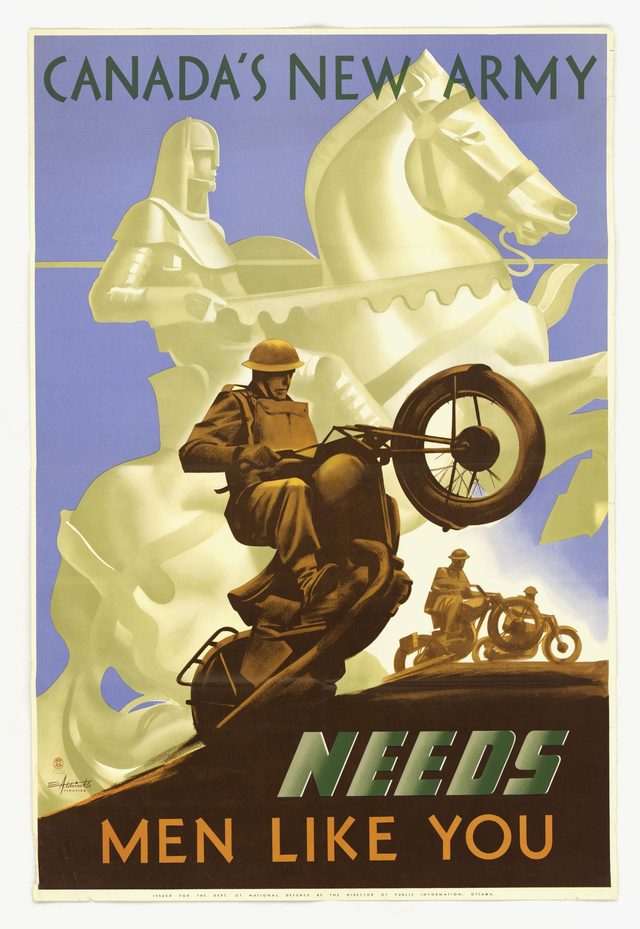
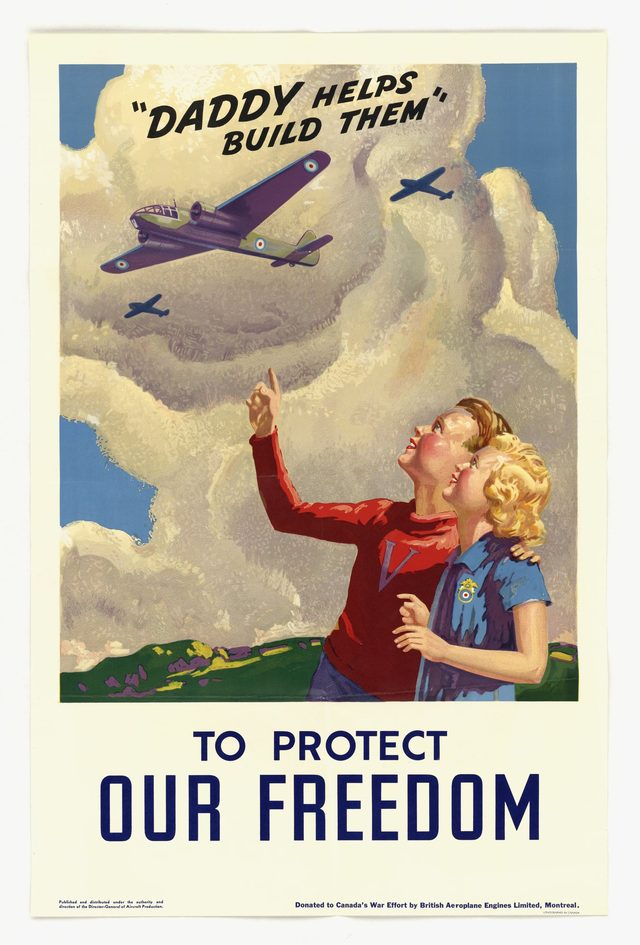
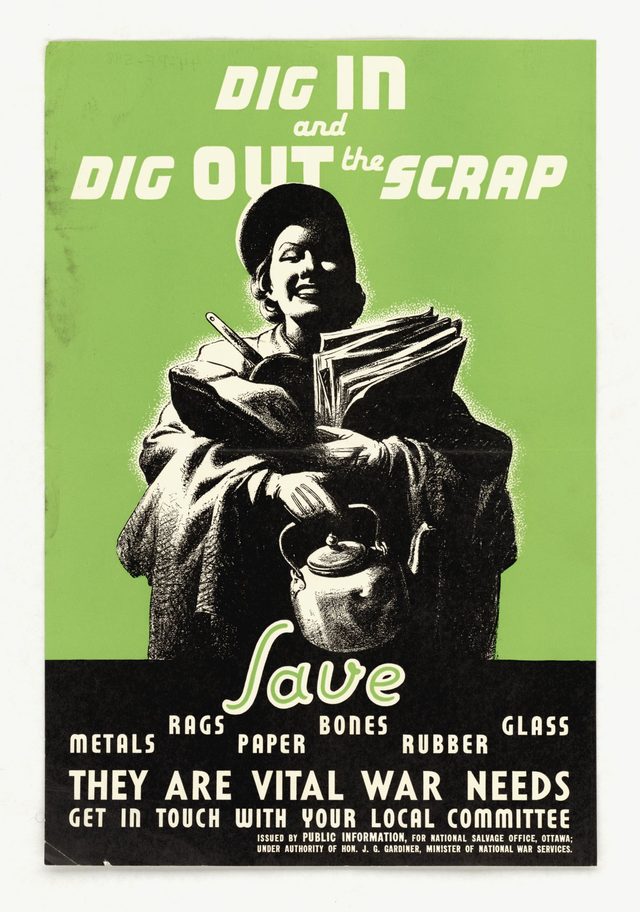
Canadian Second World War propaganda posters were printed sheets issued by federal bodies, mainly the Department of Munitions and Supply, the National Salvage Office, the Wartime Information Board (from September 1942) and the Victory Loan and War Savings campaigns. They asked Canadians to buy bonds, save scrap, keep silent, work faster or enlist, in English and in French.
The collection holds 255 Canadian posters. Ten date from the First World War and 245 from the Second. Many of the Second World War sheets carry no printed year, so the object pages record the start of a 1939 to 1945 range and say so; treat those dates as limits, not issue dates. This archive applies one working definition to every country (how FRAME defines propaganda). For the wider picture see propaganda posters and the WW2 propaganda overview.
Who ran Canada's wartime information effort?
Before 1942 a civilian Directorate of Censorship, set up in July 1940 within the Department of National War Services, controlled what could be published, and ministries issued posters under their own imprints (Canadian War Museum). The Wartime Information Board was established on 9 September 1942 and succeeded the Bureau of Public Information. The Canadian Encyclopedia says the government created it because it believed that troubles over conscription came from inadequate publicity, and names John Grierson, who also headed the National Film Board, as its most influential figure (The Canadian Encyclopedia).
The collection records 18 posters whose issuer is the Wartime Information Board. Their imprints read "Issued by Wartime Information Board, Ottawa", and some are marked "Produced by National Film Board". French sheets call it the "Commission de l'information de guerre".
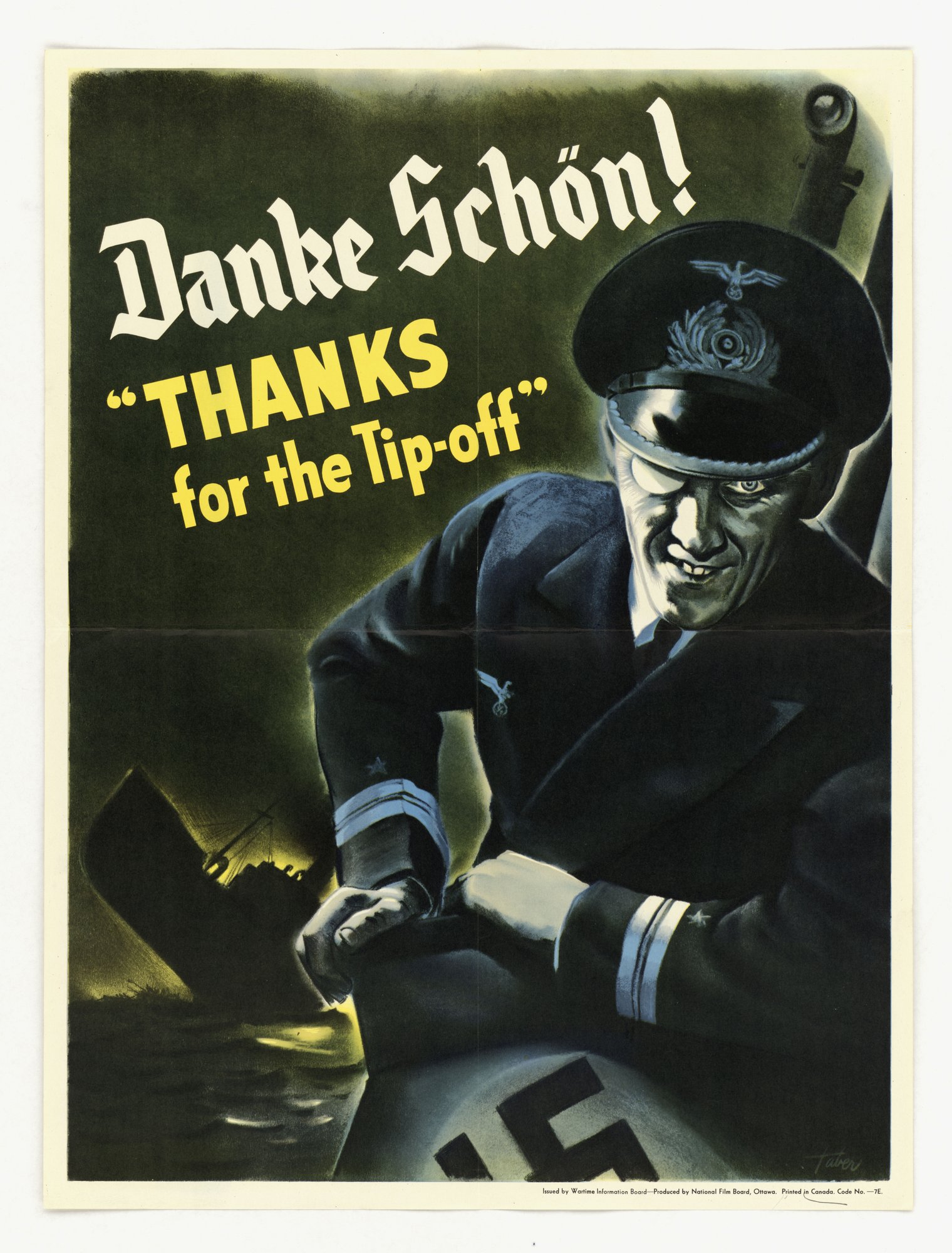
A Wartime Information Board security poster, signed Taber and held by the U.S. National Archives, shows a leering German naval officer in front of a sinking ship under the line "Danke Schön! Thanks for the Tip-off". The burning ship stages the harm that loose talk is said to cause, and the grin is the enemy as loaded label. The sheet names no incident. Read the technique: fear appeal and name-calling.
Did Canadian posters speak to Quebec in French?
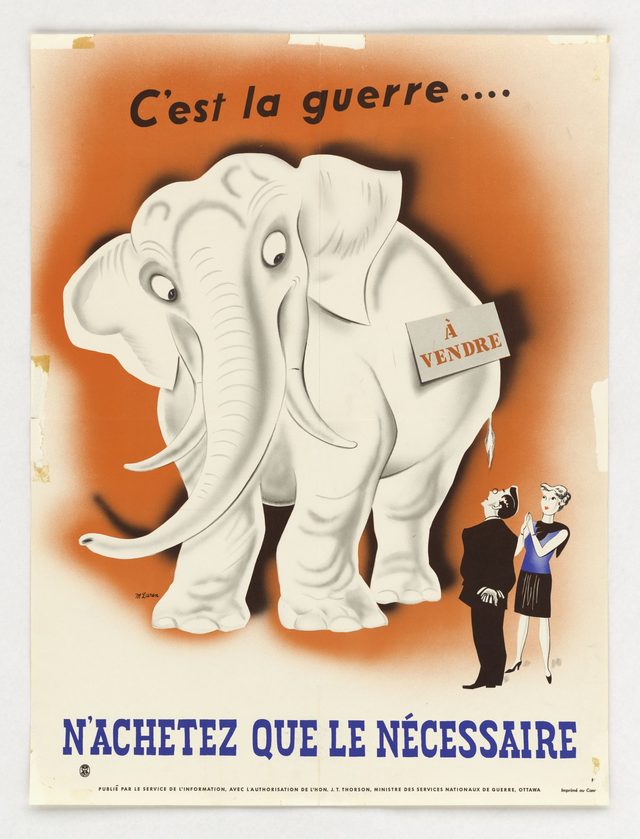
Yes. The collection holds 26 Canadian posters whose text is in French, 23 of them from the Second World War. Several are French editions of English posters, marked by reference codes ending in F instead of E, and the French and English versions can be compared line by line.
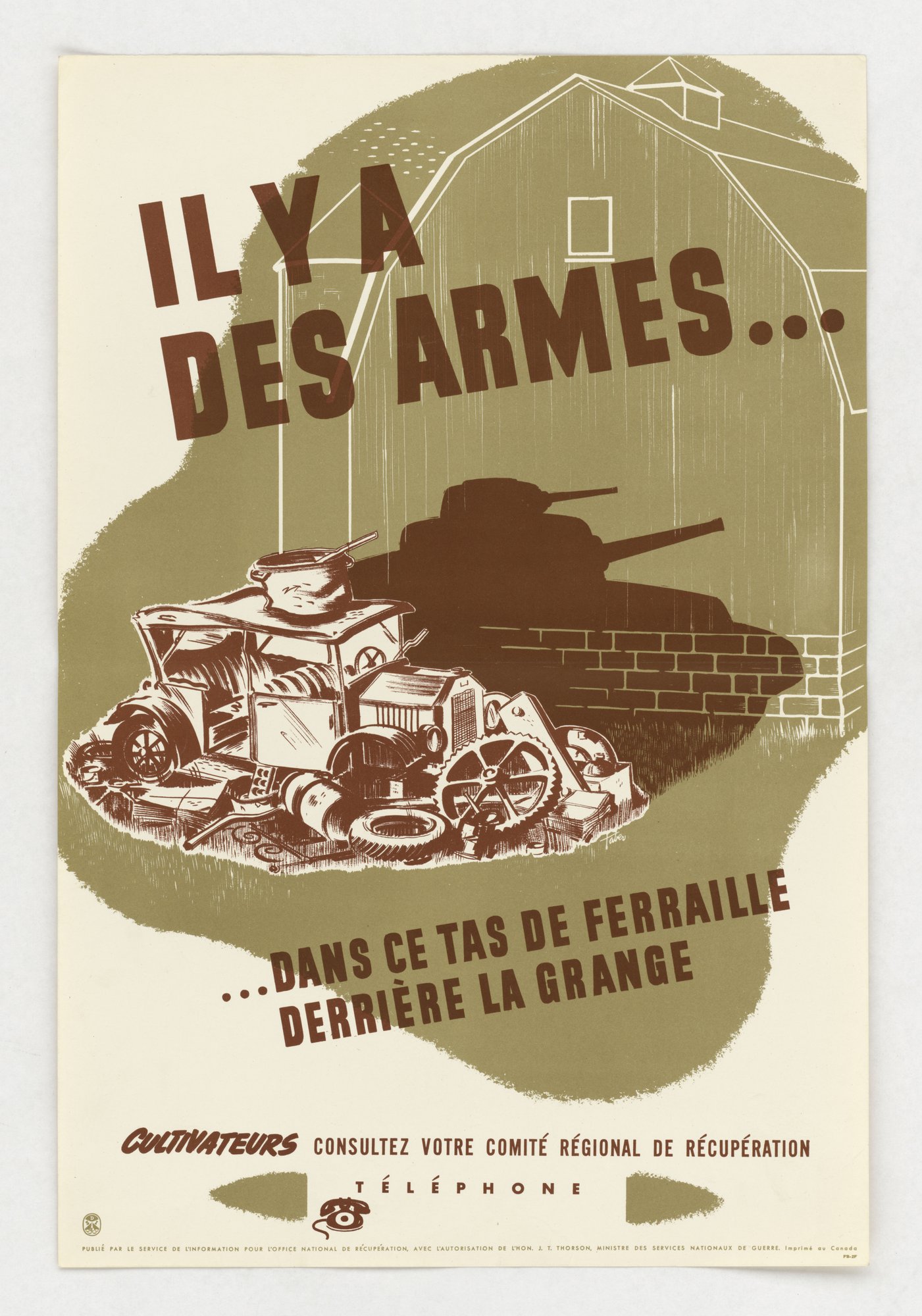
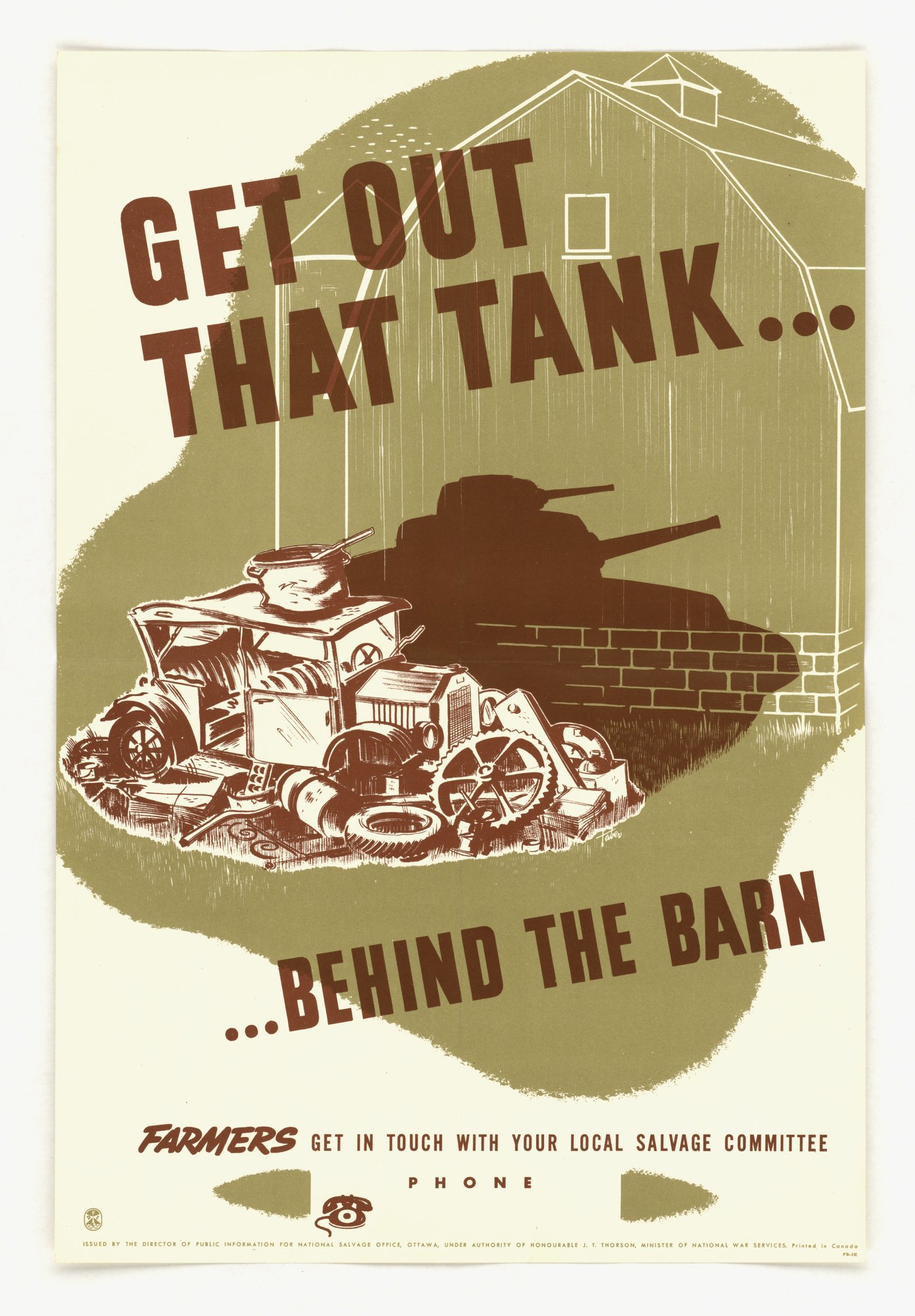
The National Salvage Office issued this farm poster in both languages, under J. T. Thorson as Minister of National War Services. A pile of wrecked cars and machinery casts a tank's shadow on a barn wall. The English edition (FB-2E) reads "Get out that tank ... behind the barn"; the French edition (FB-2F) reads "Il y a des armes ... dans ce tas de ferraille derrière la grange" and addresses "Cultivateurs". Both rely on transfer: the shadow turns scrap into a weapon. Read the technique: transfer.
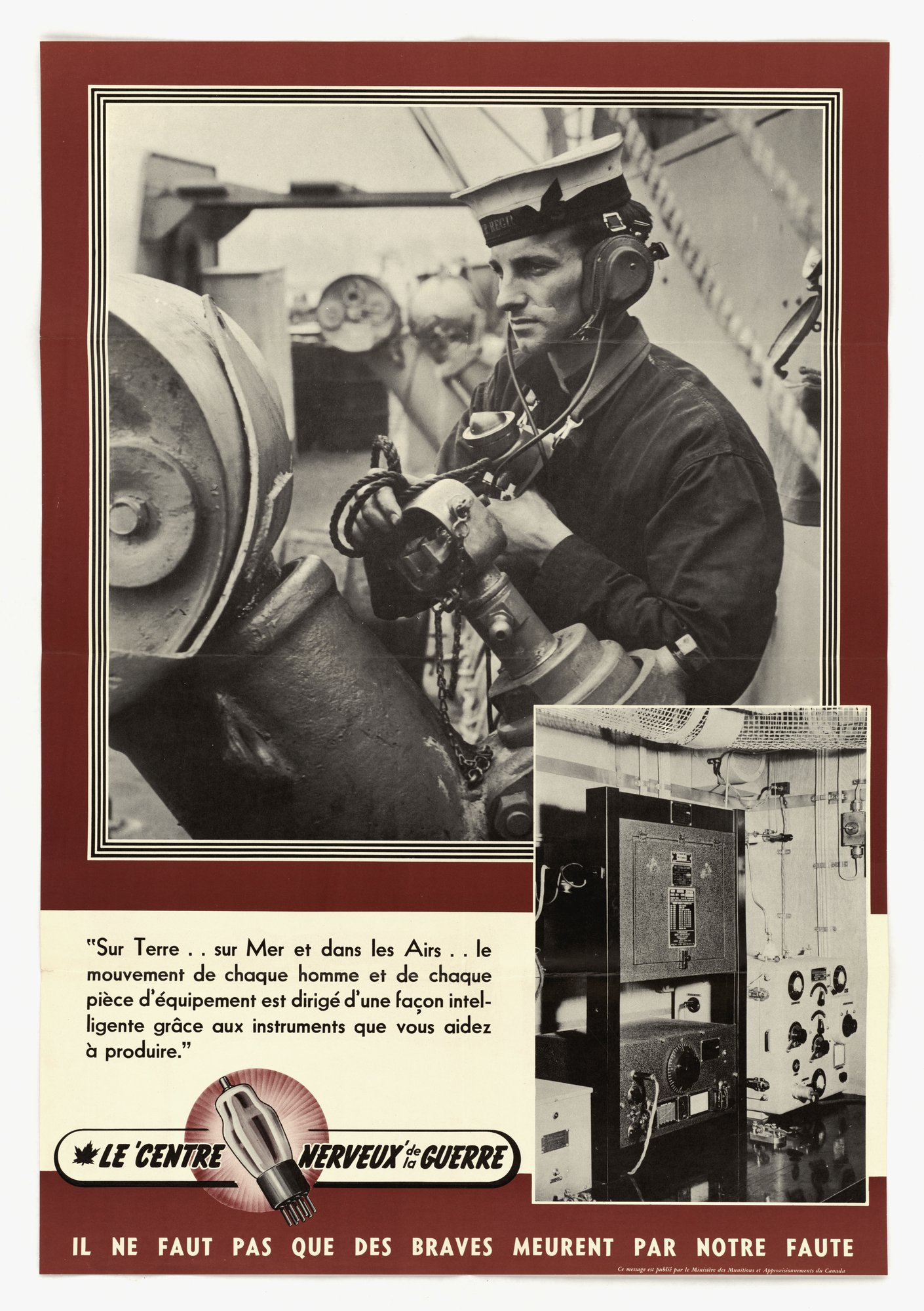
A French edition from the Department of Munitions and Supply carries the line "Il ne faut pas que des braves meurent par notre faute" ("Brave men must not die through our fault"). It places the risk of sailors' deaths on the output of the workers who make the instruments. The English version, "The Nerve Centre of War", has the matching line "Brave men shall not die because we faltered". Read the technique: fear appeal.
French editions also exist for bone salvage, careless talk, rag salvage, war savings and Victory Loan appeals. Most are recorded as aimed at the domestic public in general, and no entry says a sheet was meant only for Quebec. The collection does not show print runs or where copies were posted.
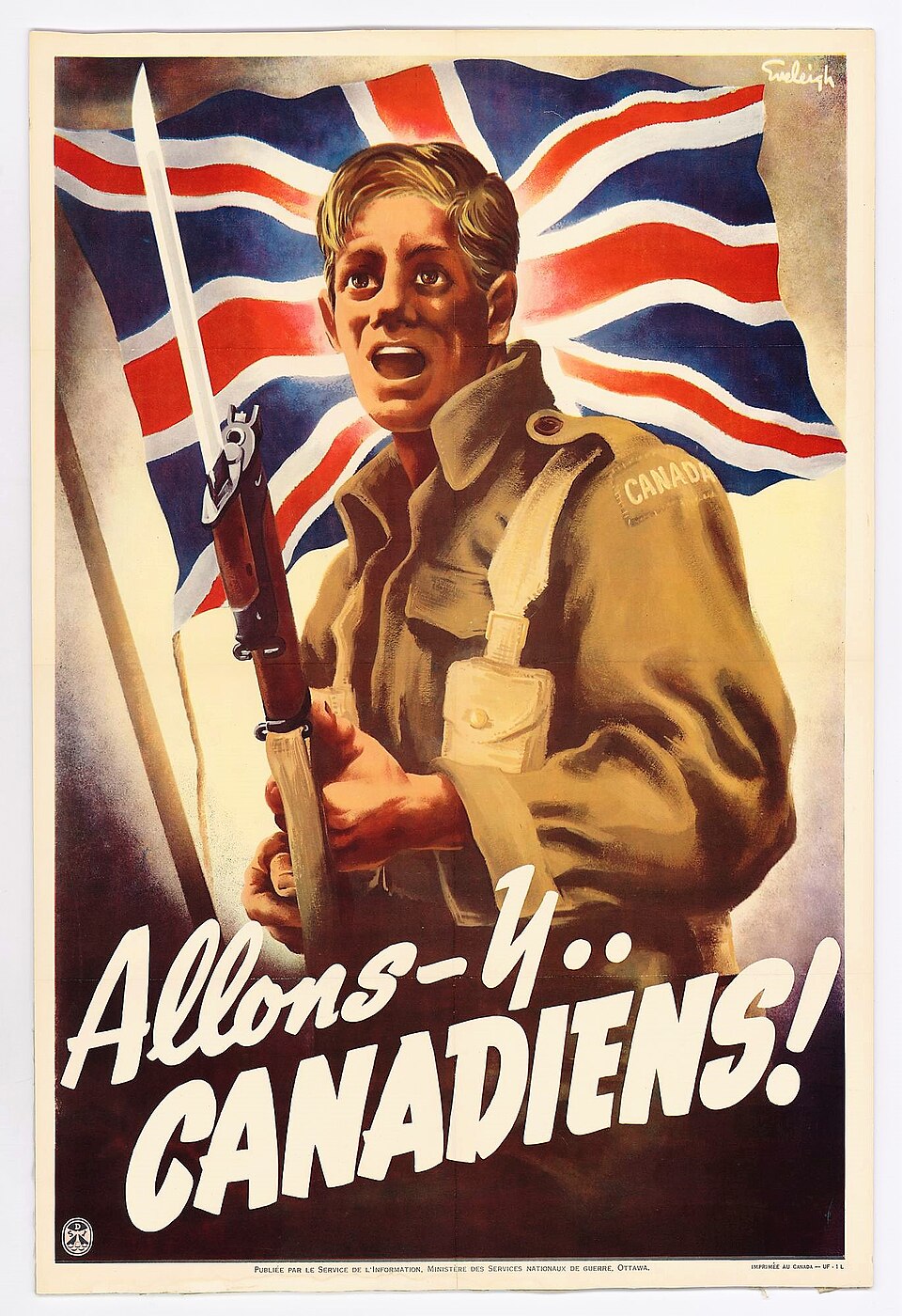
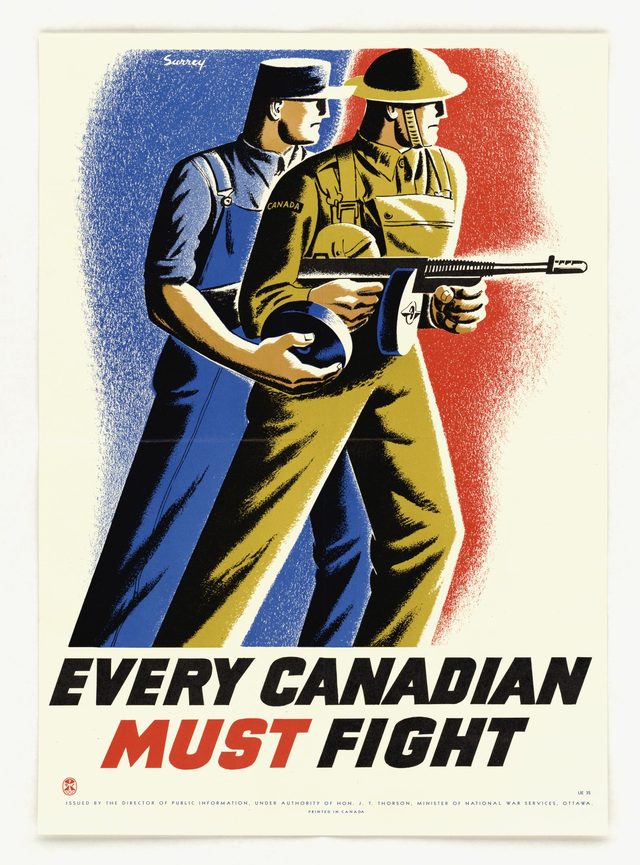
A recruiting poster in French from the Department of National War Services' Information Service, drawn by Henry Eveleigh, shows a soldier with a "CANADA" shoulder title and a bayonet before a backlit Union Jack. The flag's prestige is attached to the call "Allons-y... Canadiens!" (Let's go, Canadians!). The Bibliothèque et Archives nationales du Québec catalogue dates it 1941 to 1942. Read the technique: transfer.
How did Canada use French-language recruiting posters in the First World War?
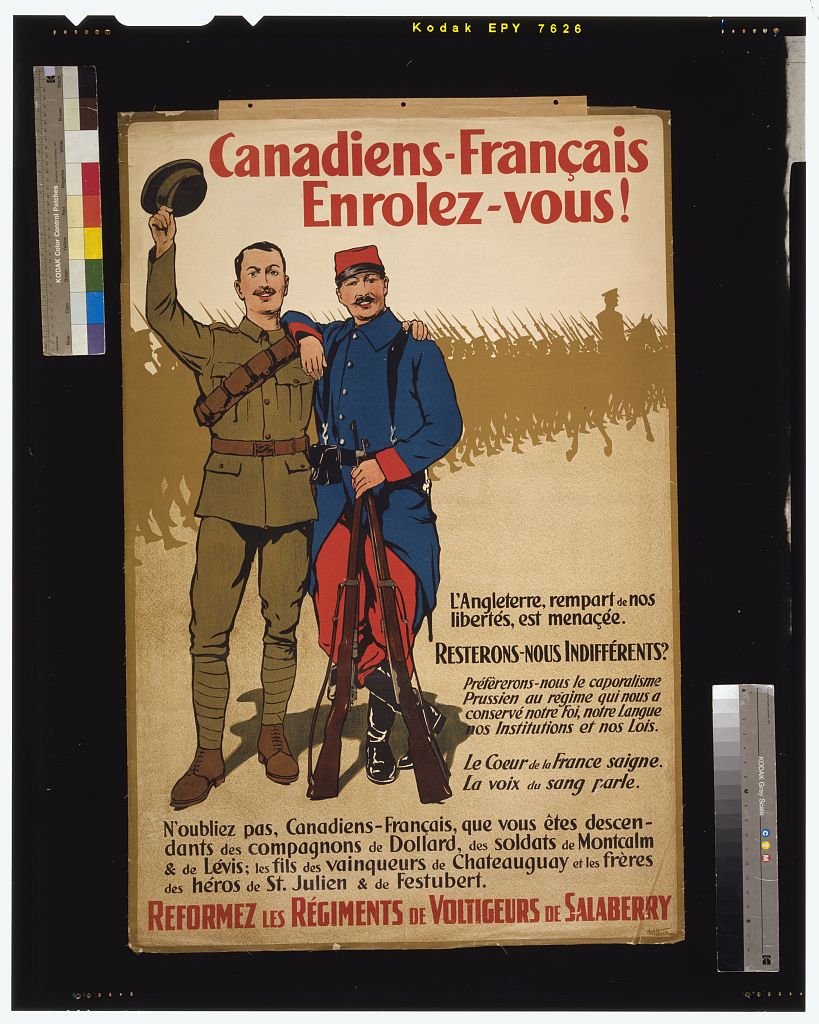
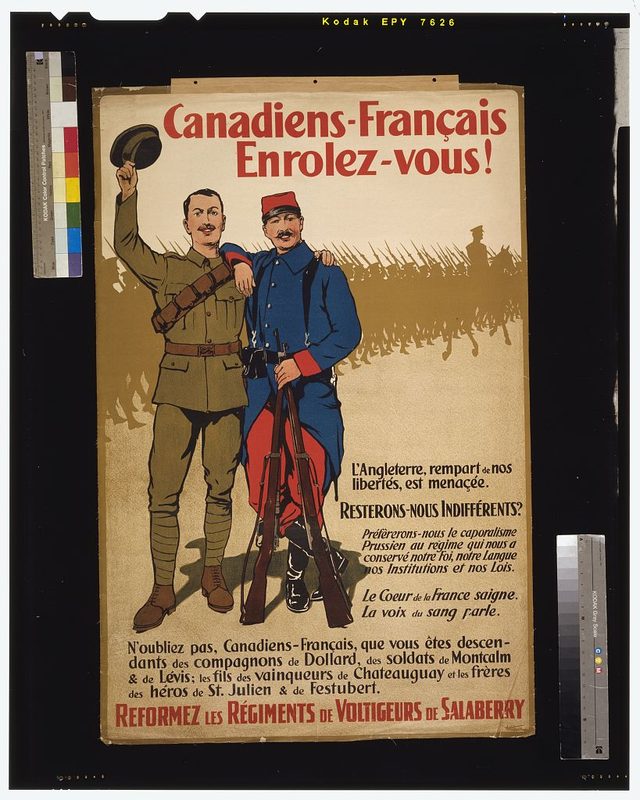
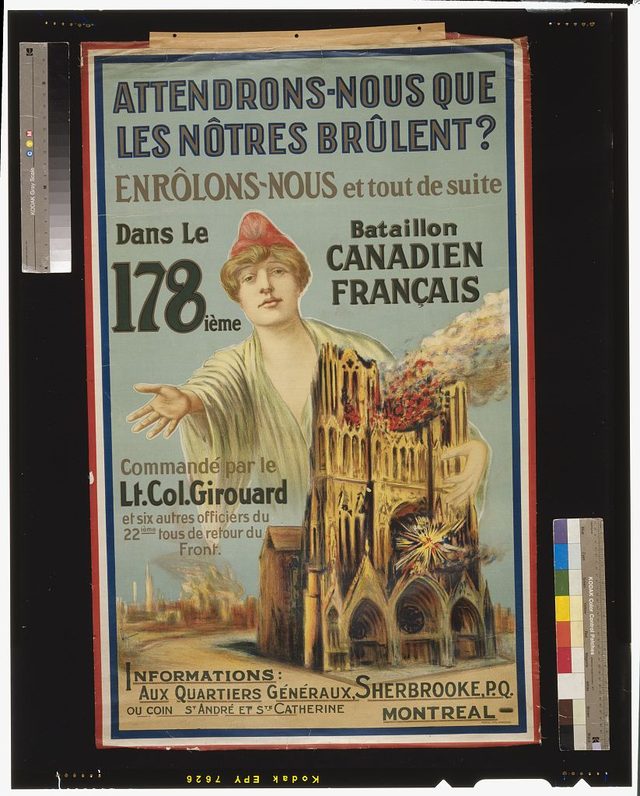
A 1915 recruiting poster for the Canadian Expeditionary Force addresses French Canadians alone. It invokes Dollard, Montcalm, Lévis and Chateauguay, says England, "rempart de nos libertés", is threatened, and asks whether the reader would prefer "le capitalisme Prussien" to the regime that preserved "notre Foi, notre Langue, nos Institutions et nos Lois". The object note records that enlistment among French Canadians was lower in proportion to population than among English Canadians and that historians debate the reasons. The poster is one appeal, not evidence for any single explanation.
What did Canadian posters say about conscription?
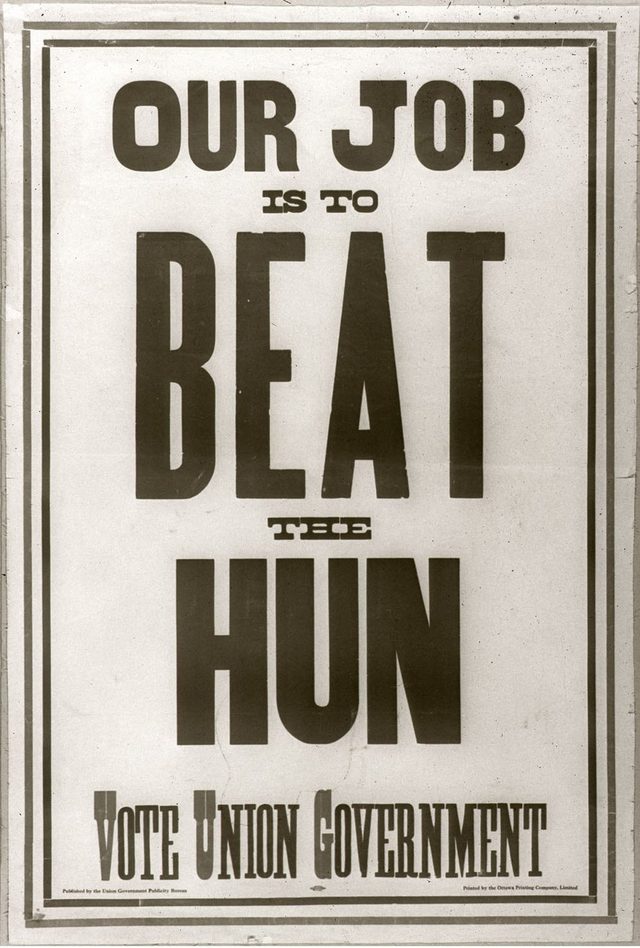
The clearest conscription-era poster in the slice is a 1917 sheet of the Union Government Publicity Bureau, a coalition formed by Prime Minister Robert Borden for the federal election of 17 December 1917.
Content note: Wartime slur: the label 'Hun' for Germans on a 1917 election poster. This object is shown as it was published. Why 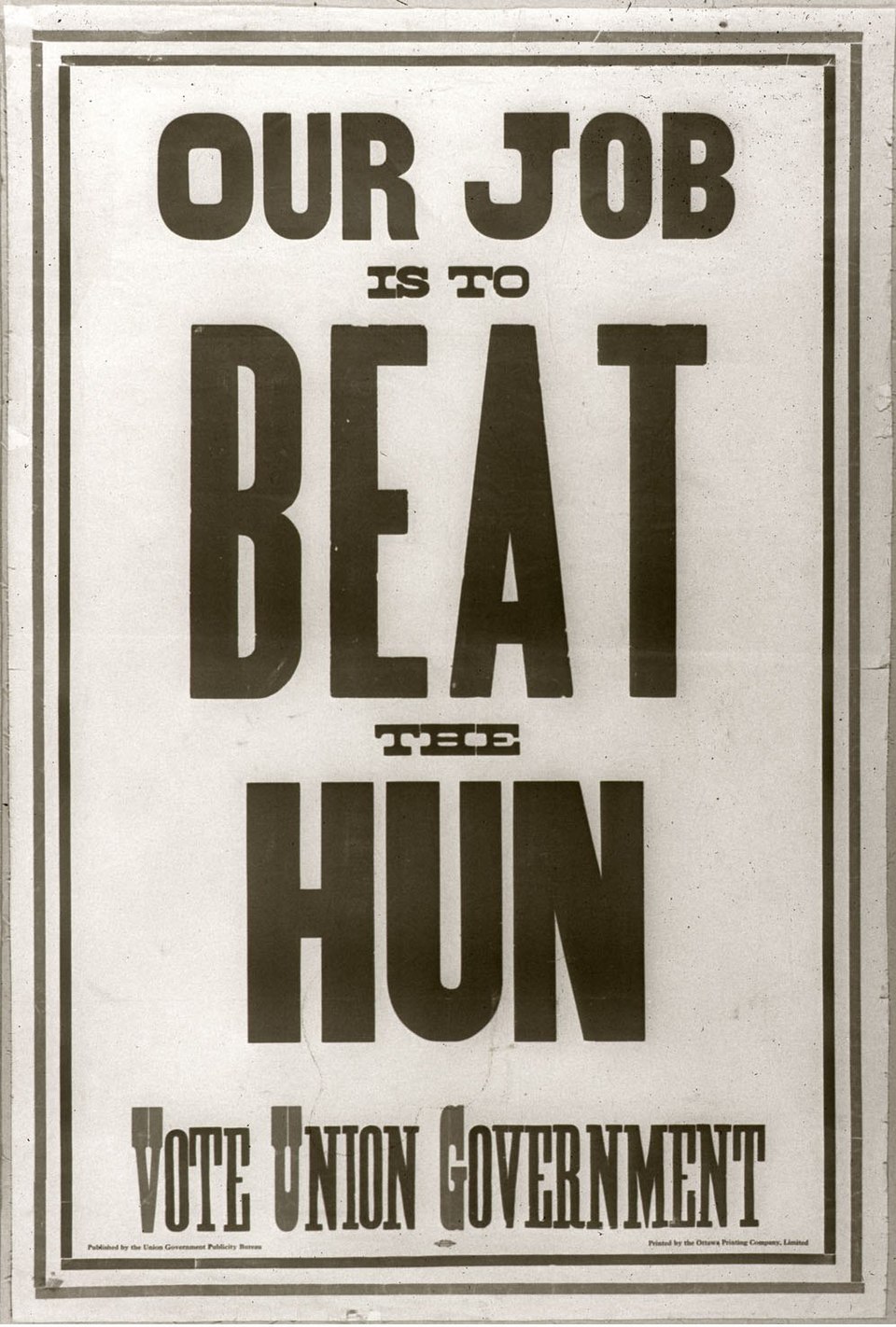
The poster is type only: "Our job is to beat the Hun. Vote Union Government." It names the enemy by a collective label and writes a party vote in as the same act as beating him, which is the identity-fusion tell. The election was fought largely over the Military Service Act, which became law on 29 August 1917 and made men aged 20 to 45 liable for call-up. The Opposition Liberals carried most of Quebec, where the measure was widely opposed. Read the technique: identity fusion.
For the Second World War, the Canadian Encyclopedia records a plebiscite on 27 April 1942 to release the government from its anti-conscription pledges: 72.9 per cent of Quebec voted no, while the yes vote won by about 80 per cent in every other province. (The Canadian Encyclopedia). I found no poster in the slice that names the 1942 plebiscite; the recruiting sheets of 1941 and 1942, such as "Let's go... Canada!", appeal to volunteers.
How did Victory Loan posters ask Canadians to buy bonds?
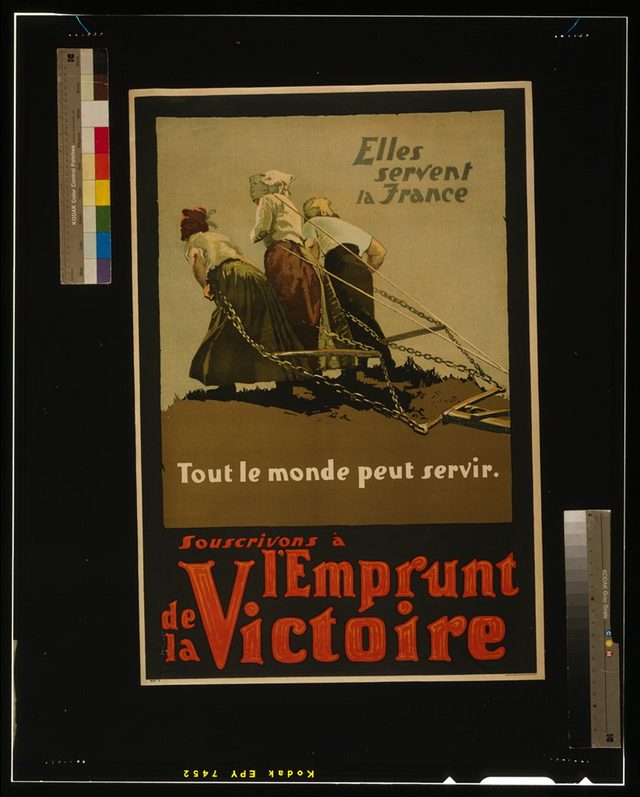
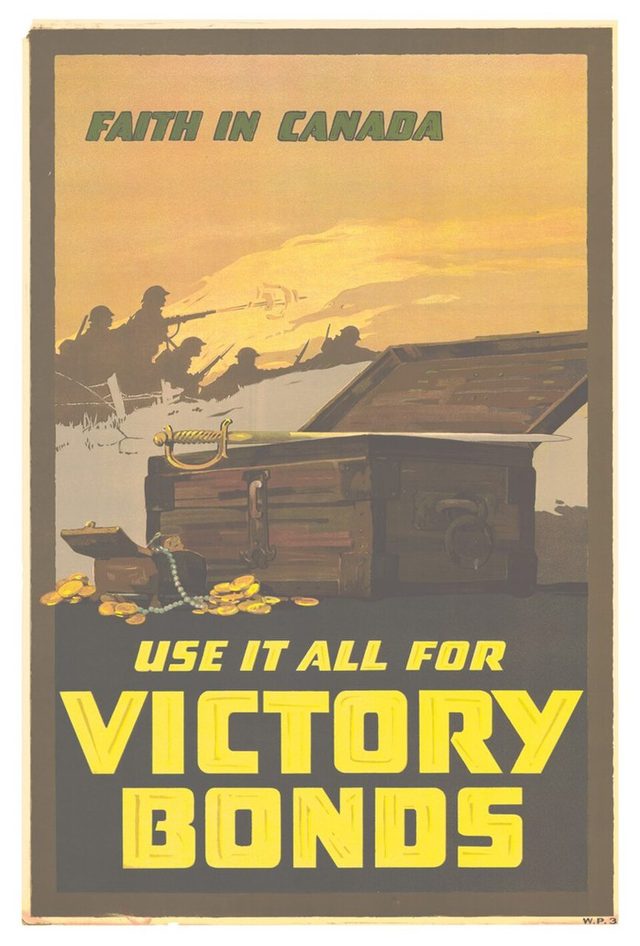
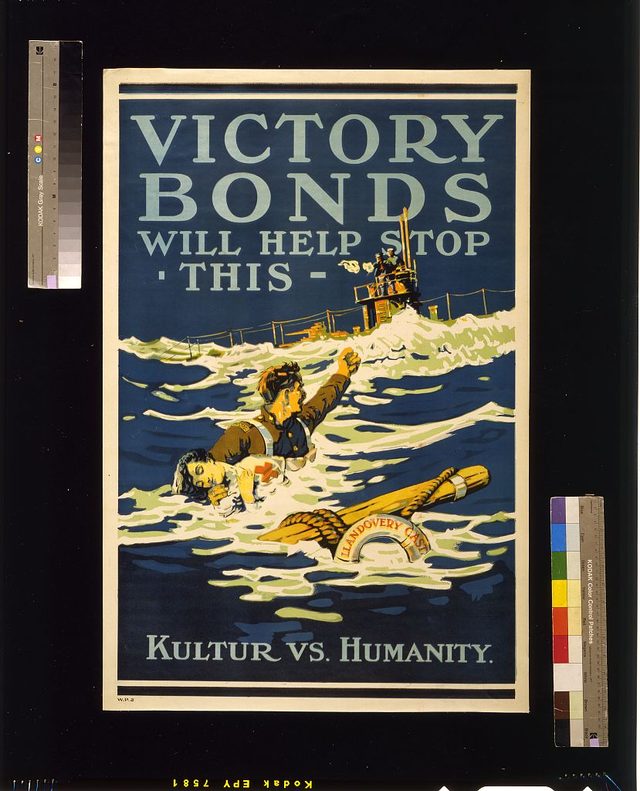
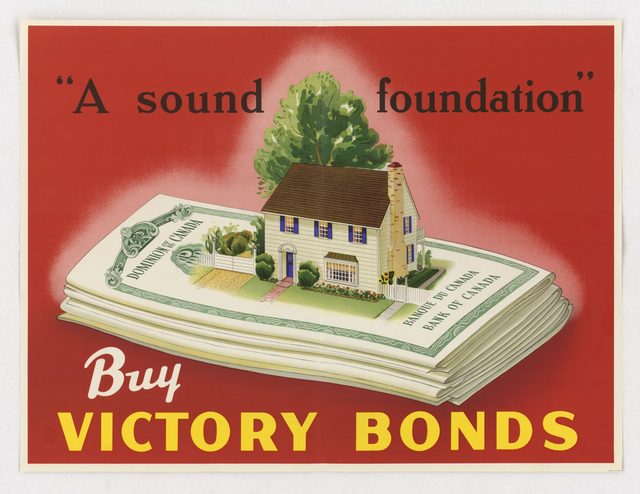
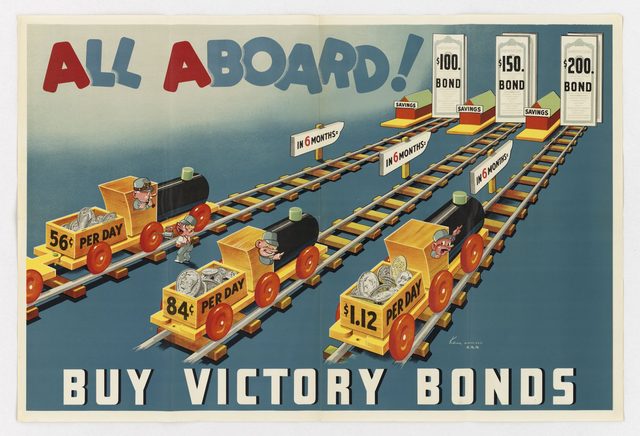
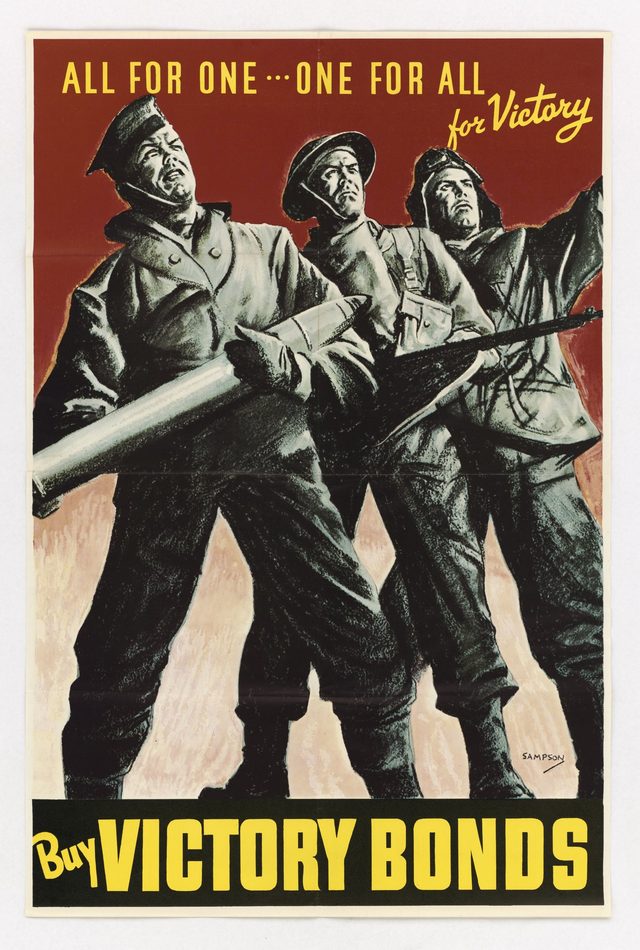
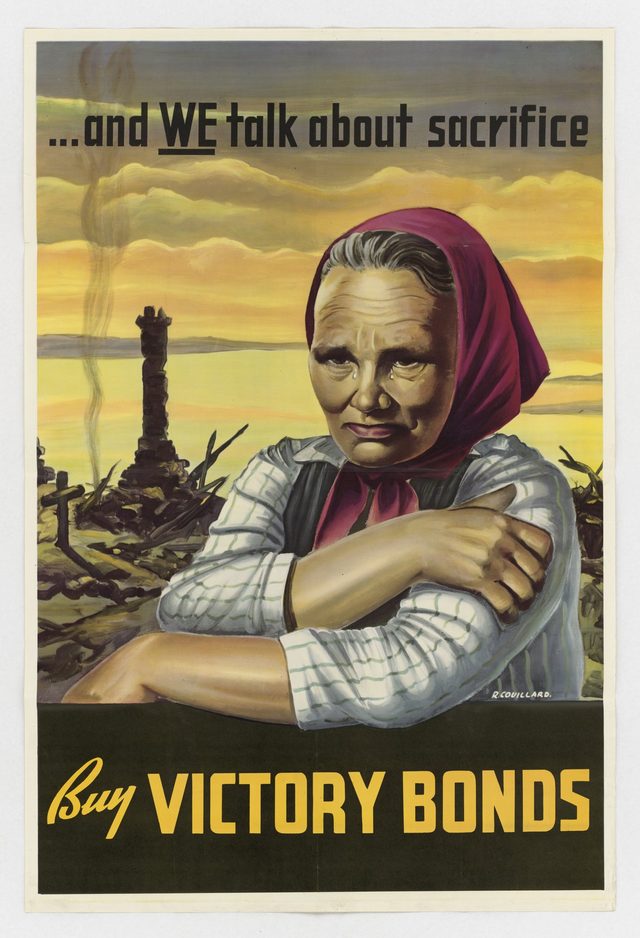
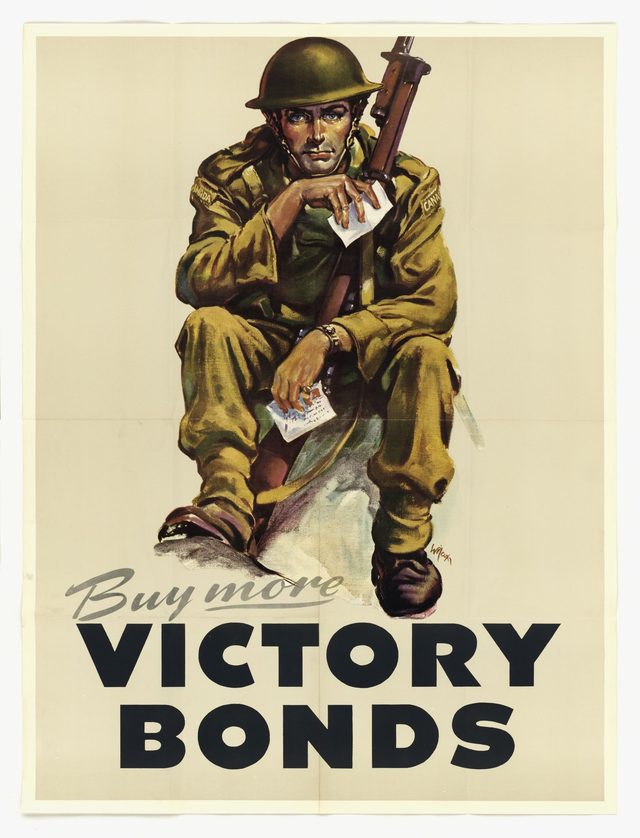
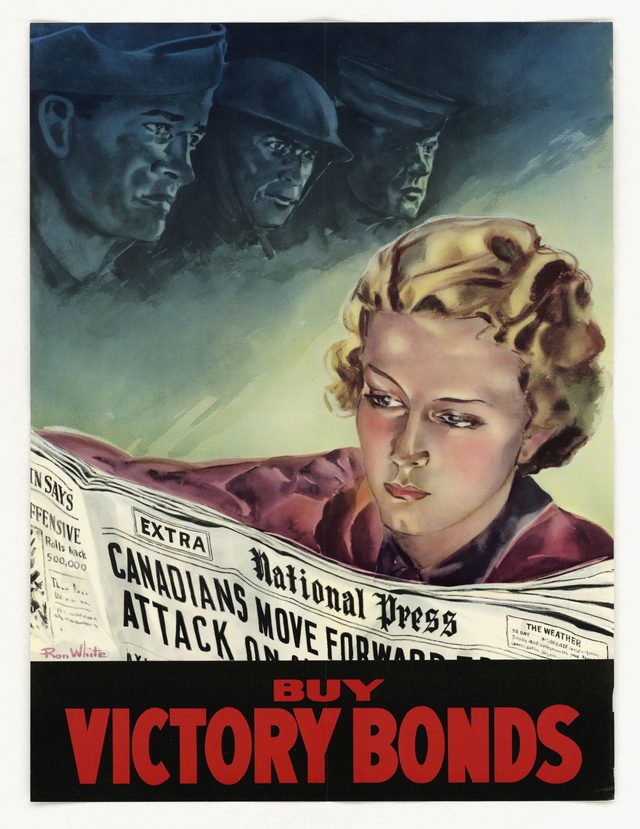
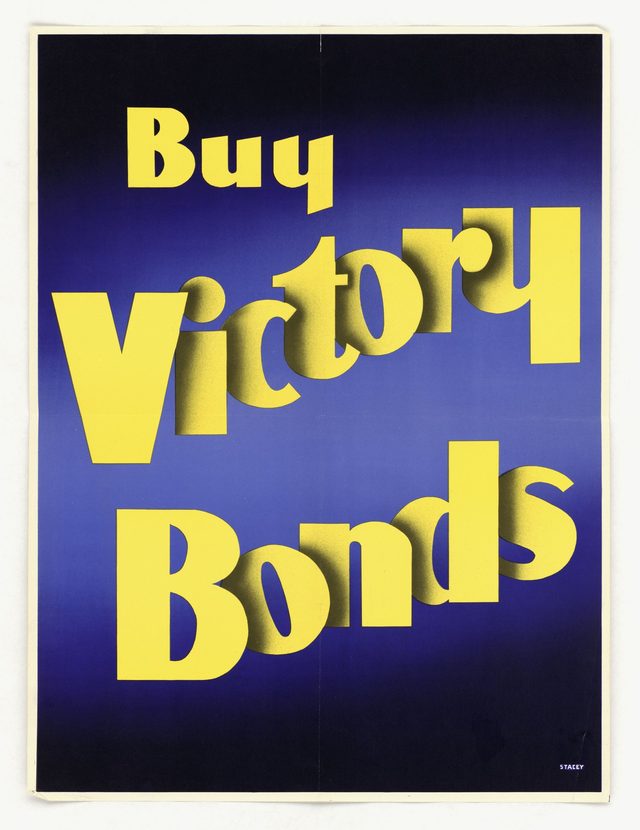
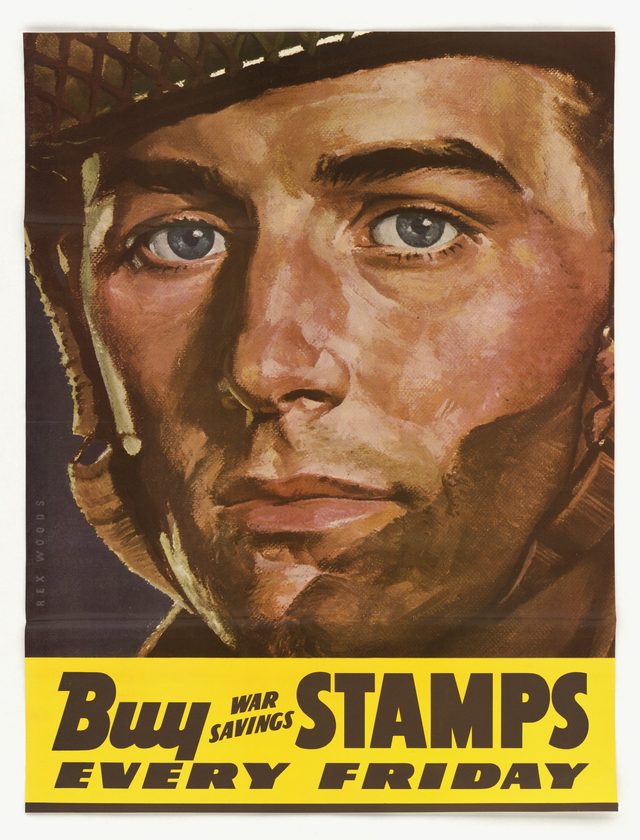
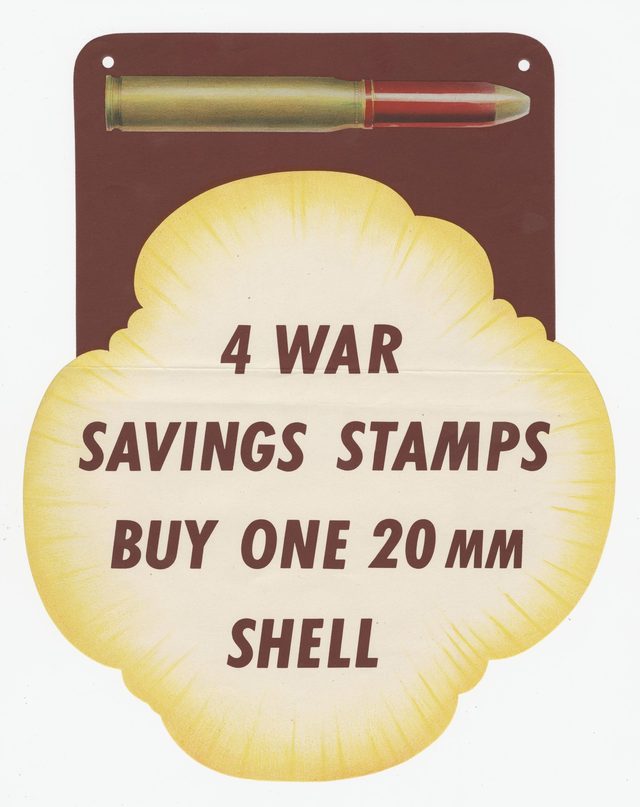
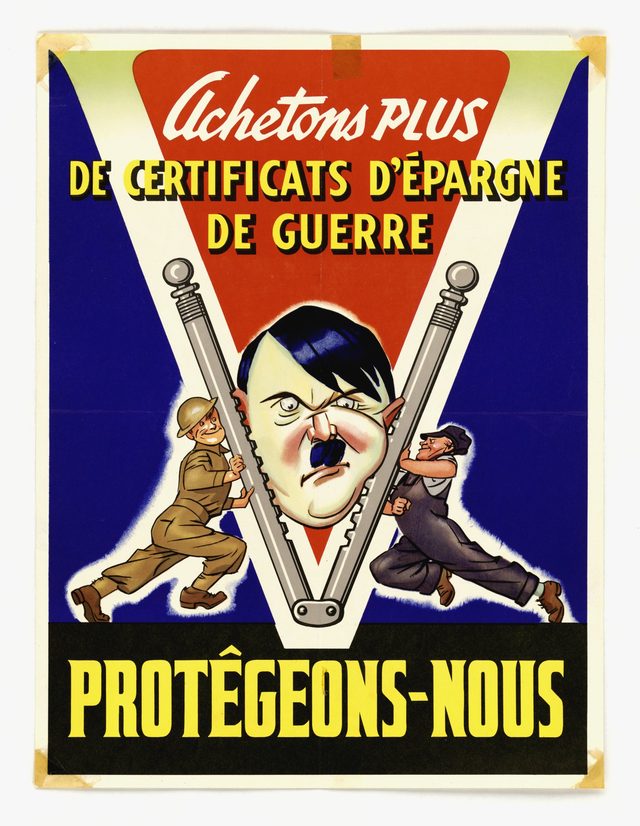
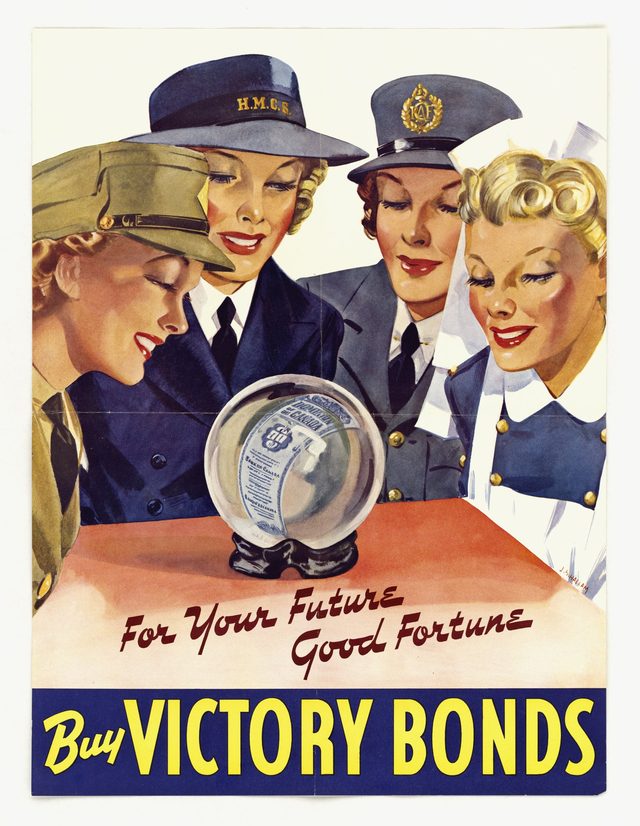
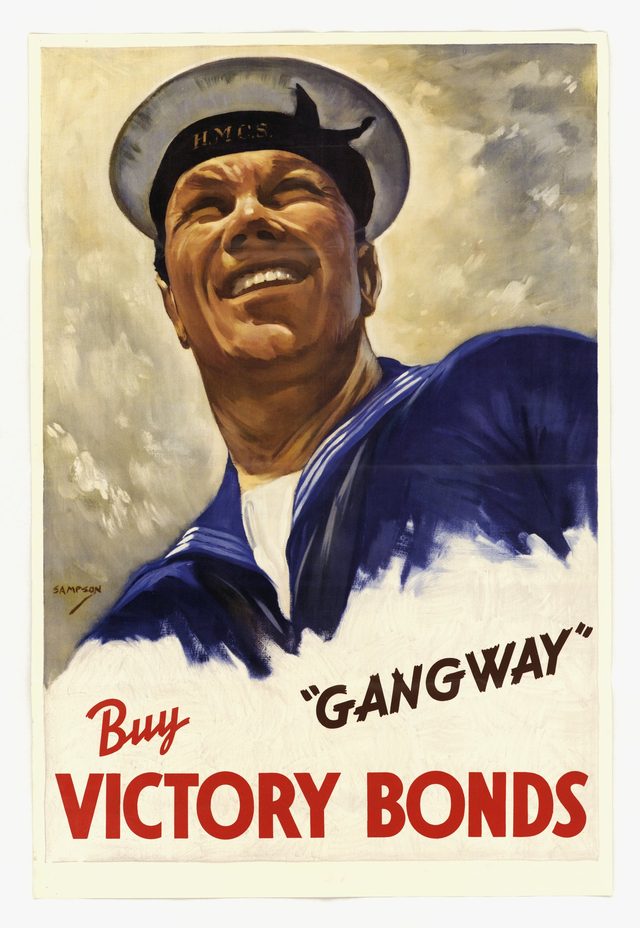
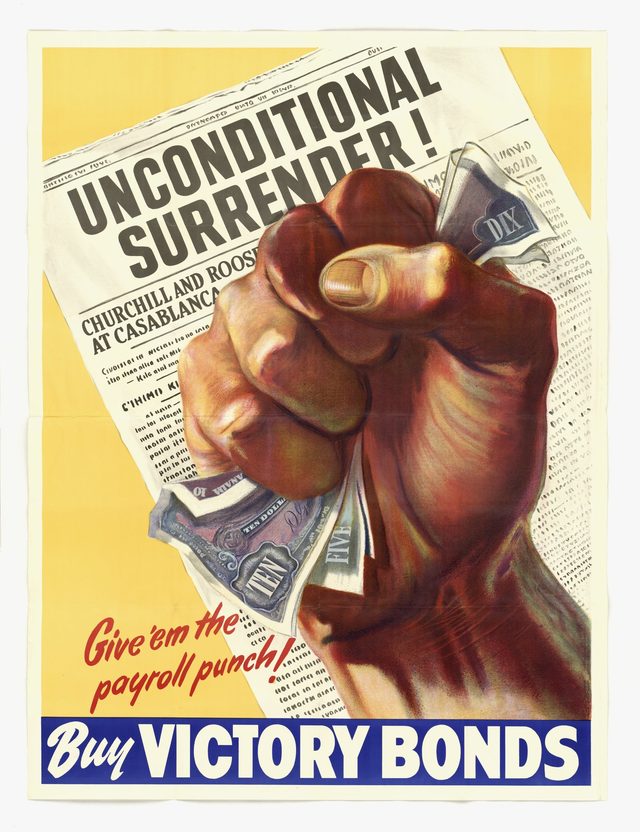
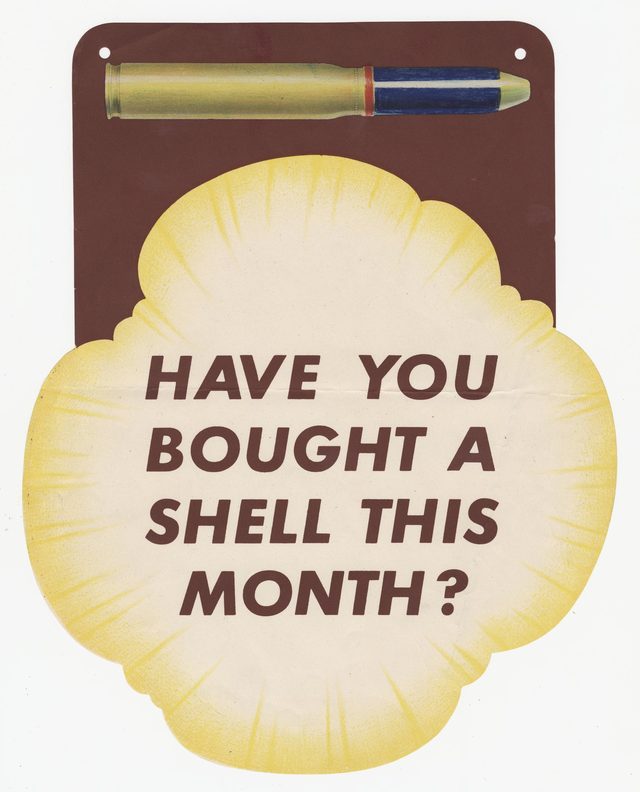
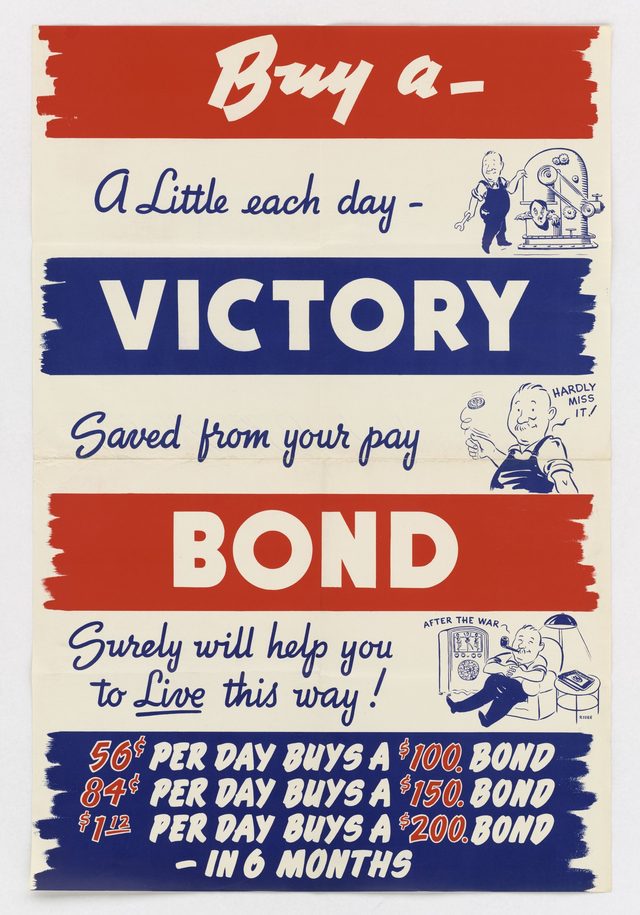
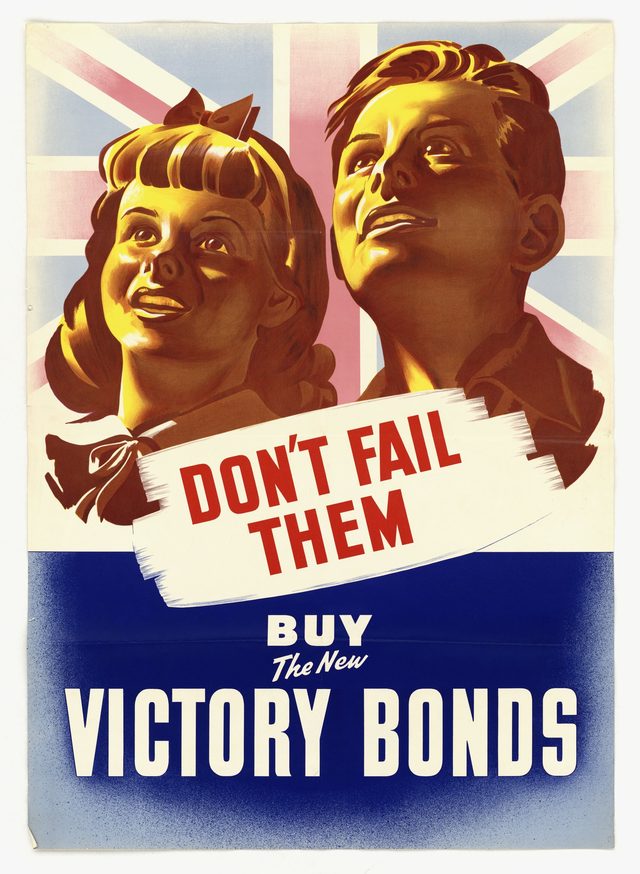
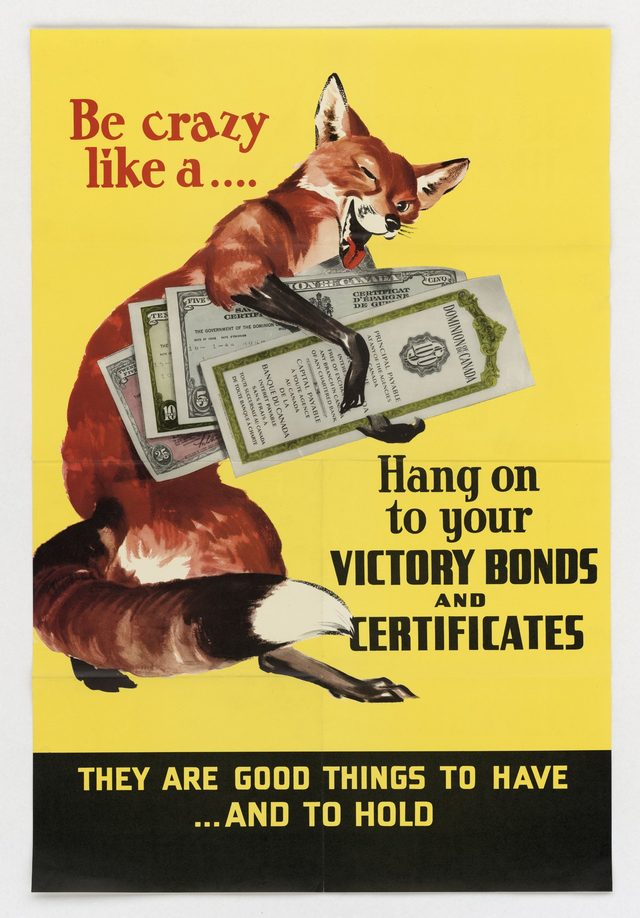
The Canadian Encyclopedia counts nine Victory Loans in the Second World War, from June 1941 to November 1945, and says they relied on "colourful posters, patriotic pleas and vast sales apparatus" (The Canadian Encyclopedia). In the collection, 112 of the 255 Canadian posters have the purpose "fundraise", more than any other purpose.
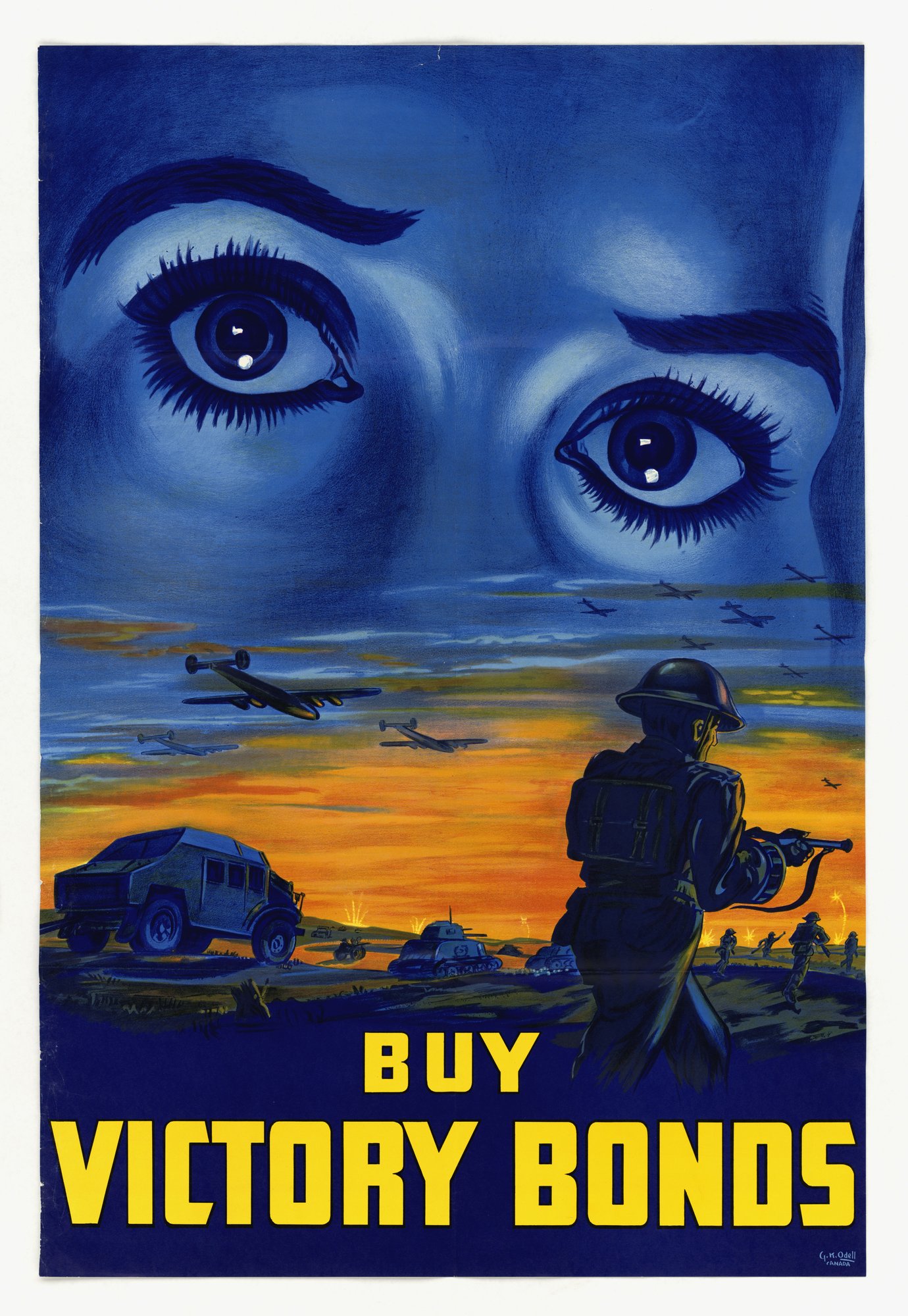
A poster signed G. K. Odell fills the top half with a woman's wide eyes above a battlefield and the words "Buy Victory Bonds". It pairs worry for those fighting with the purchase and gives no rate or term. Read the technique: fear appeal.
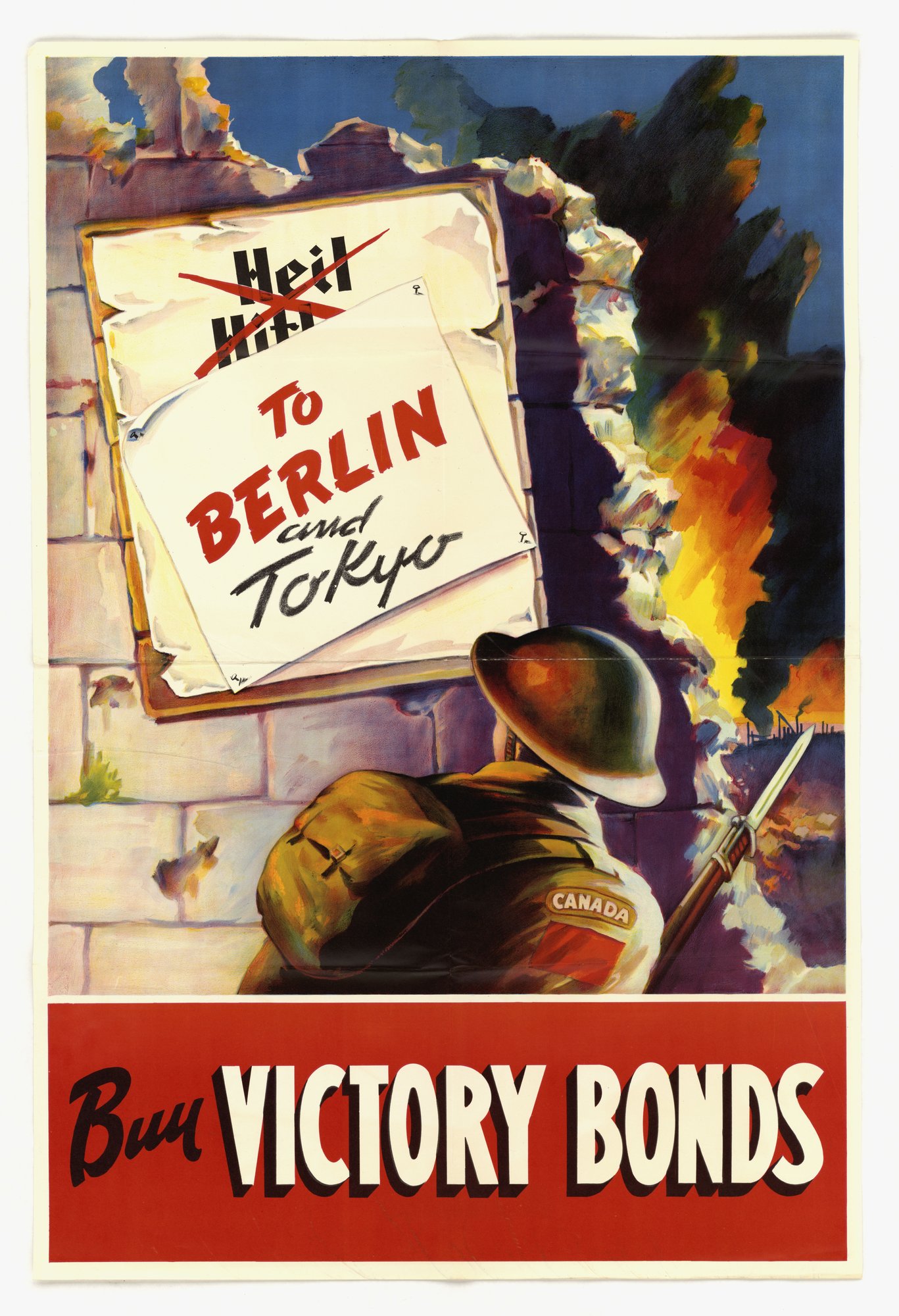
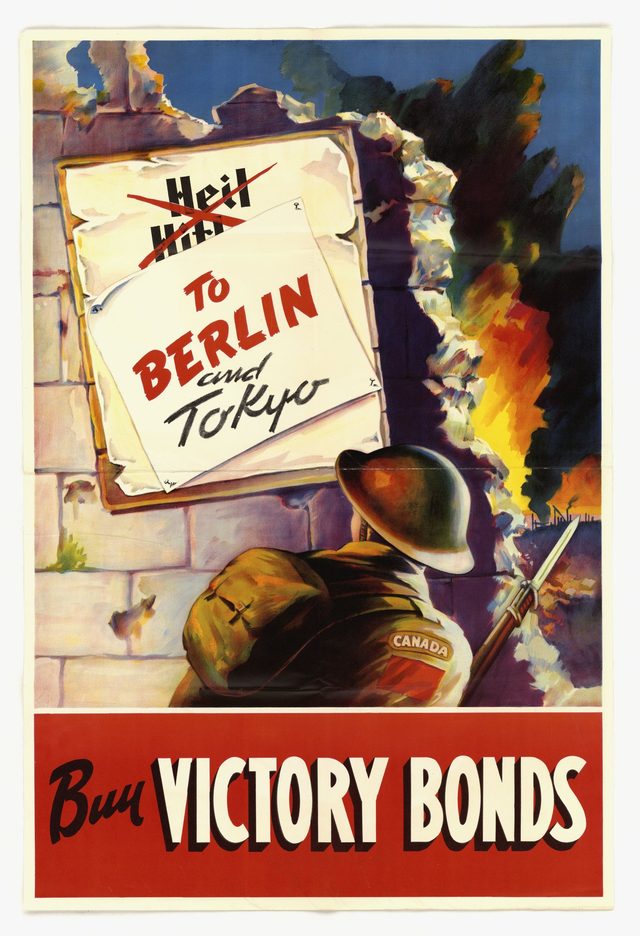
This unsigned sheet has a soldier advancing past a defaced "Heil Hitler" notice, now overwritten "To Berlin and Tokyo". The soldier's advance is linked to the act of buying, which is transfer.
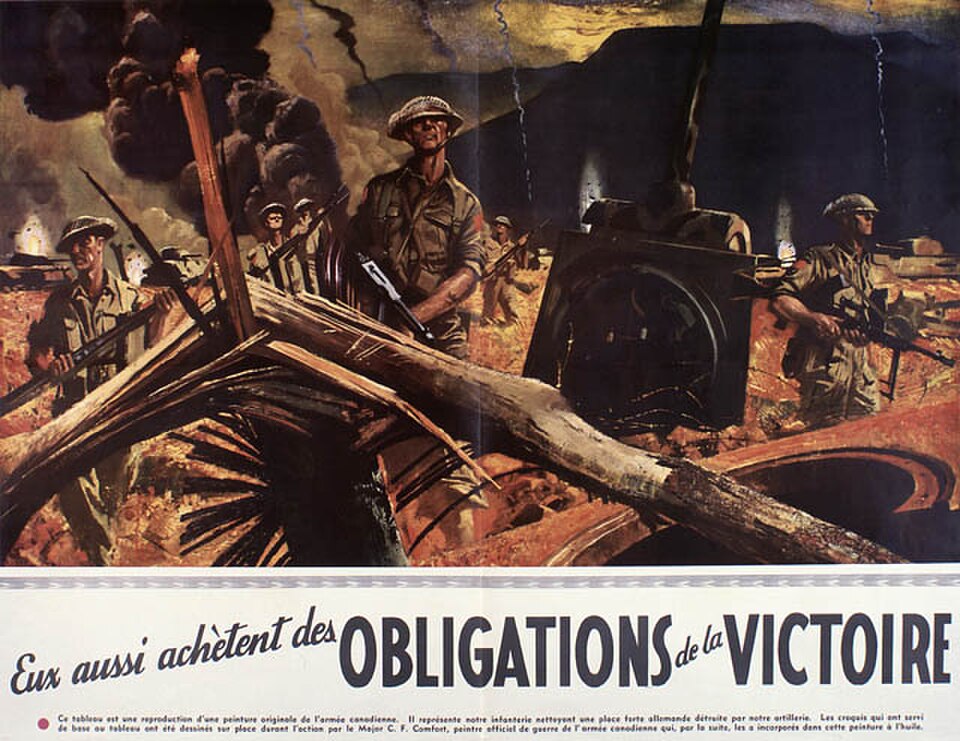
The French-language poster reproduces a painting by Major C. F. Comfort, an official Canadian Army war artist, under "They too are buying Victory Bonds". The headline does not say what buying bonds means for the soldiers; the picture and the headline carry the appeal together.
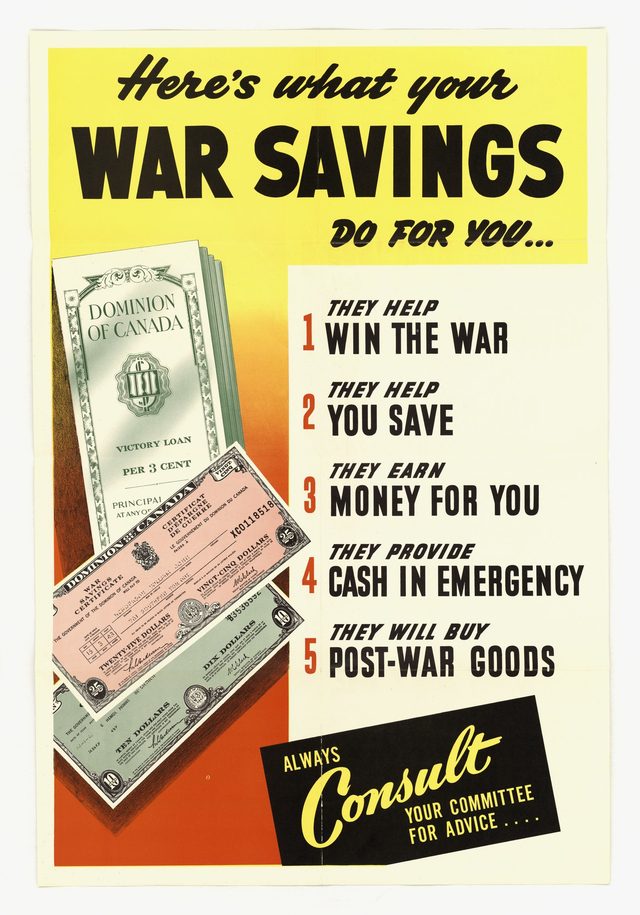
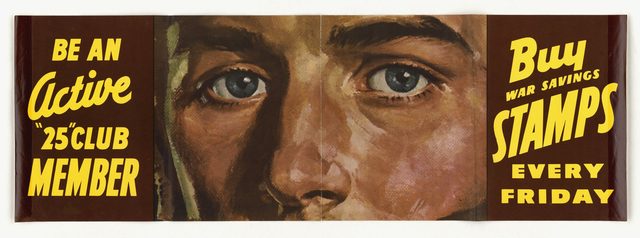
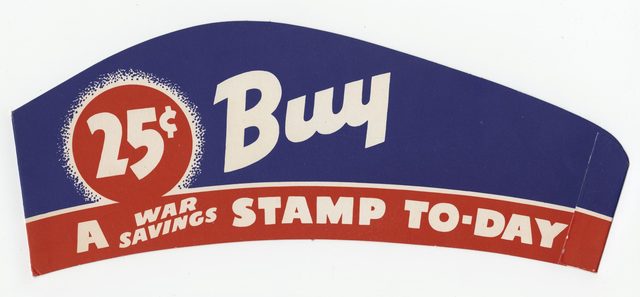
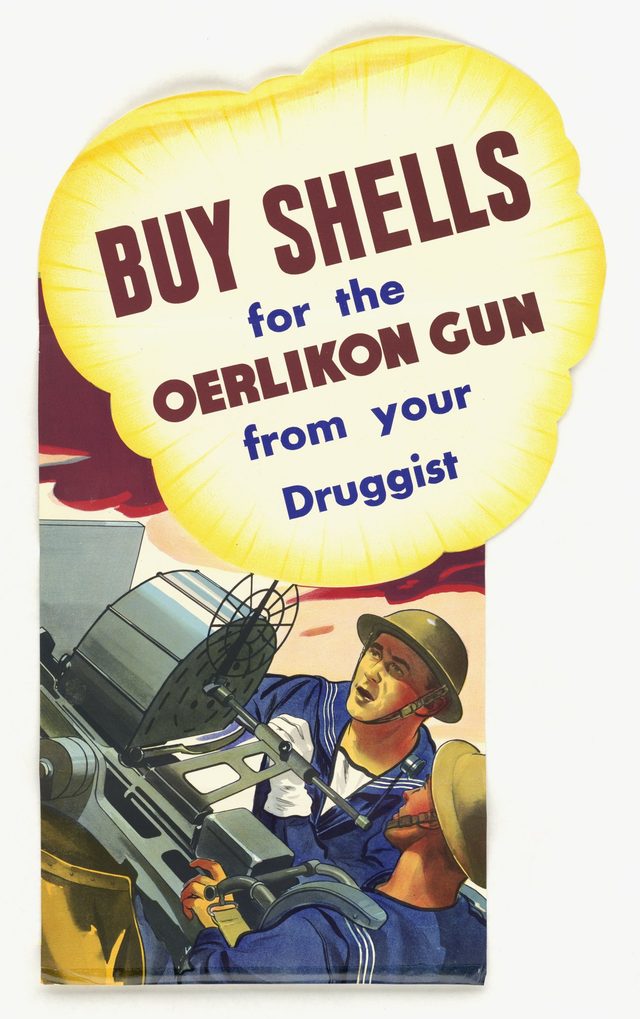
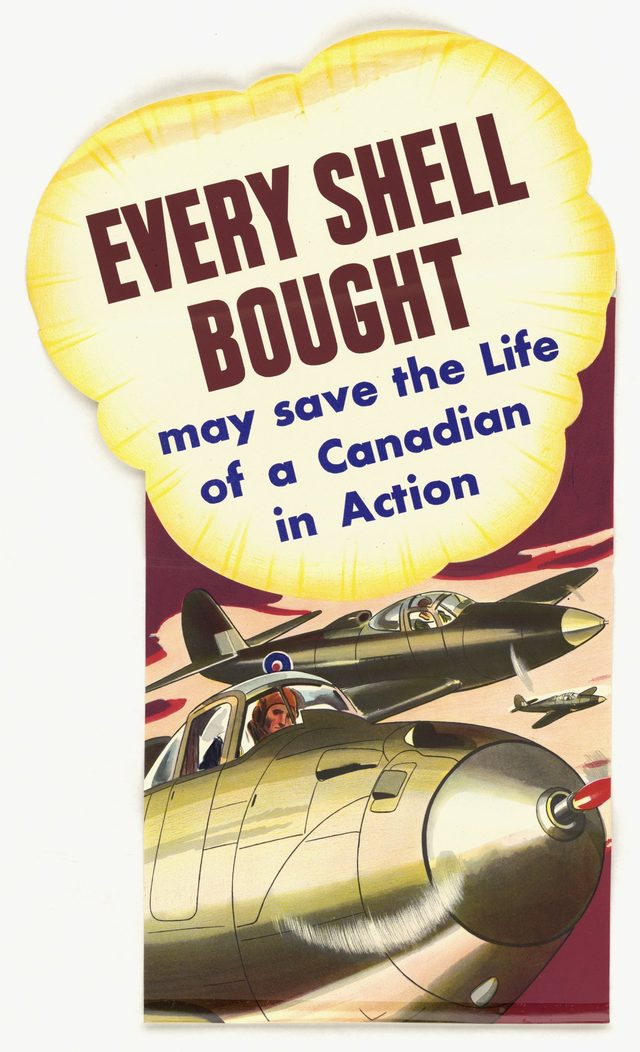
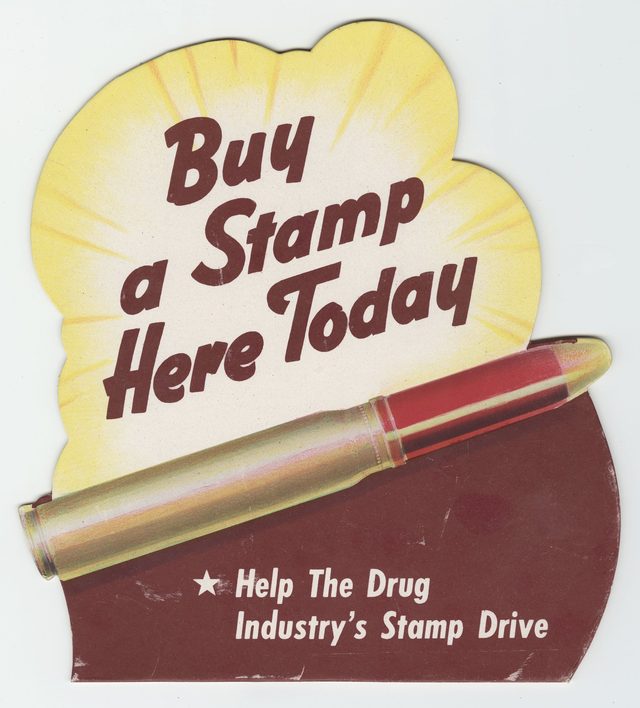
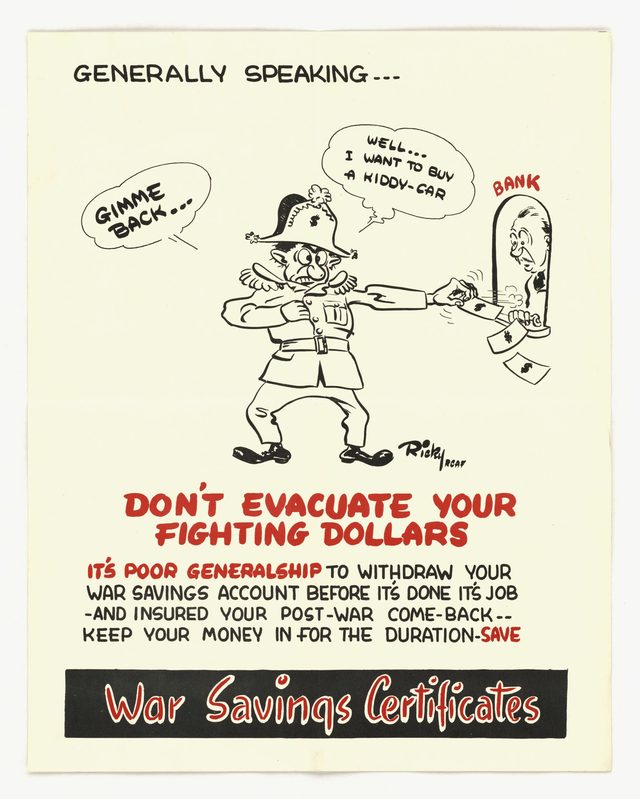
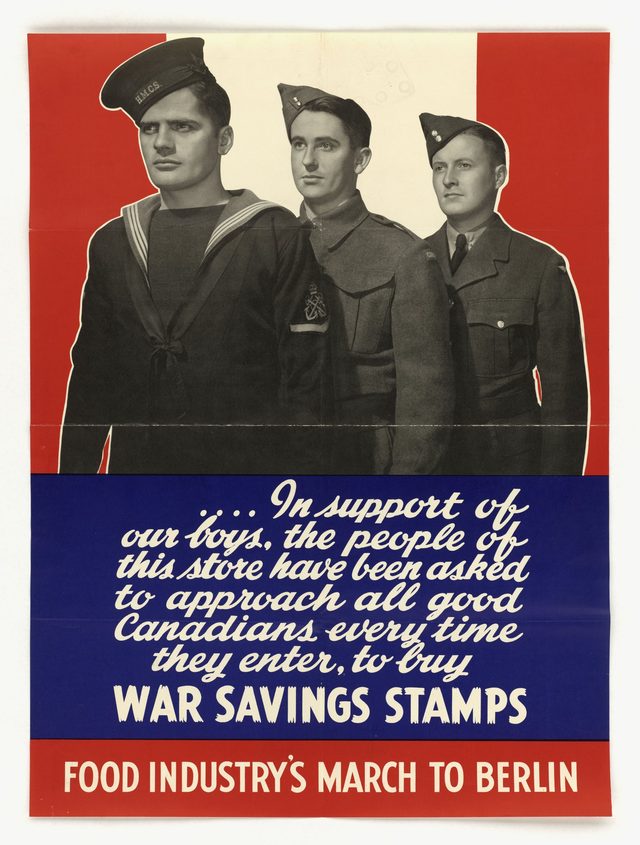
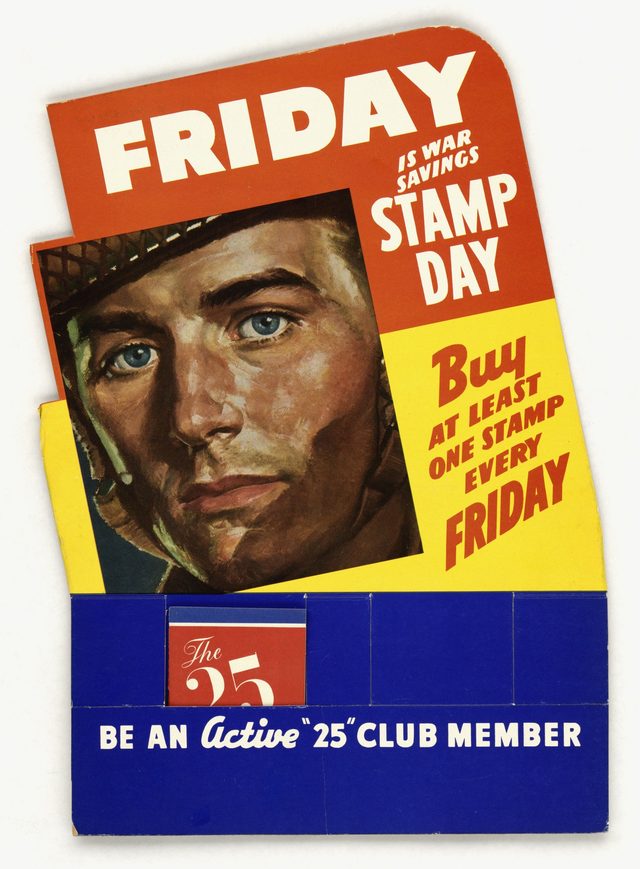
Not all bond posters are solemn: "Sorry, Canada got it first! Buy Victory Bonds" is a bedroom joke. The War Savings material also includes trade-group drives, such as the drug-industry "25 Club" and the food-industry stamp drives, with counter cards. Read the technique: bandwagon. See also WW2 war bonds posters.
What did Canadian salvage and production posters ask for?
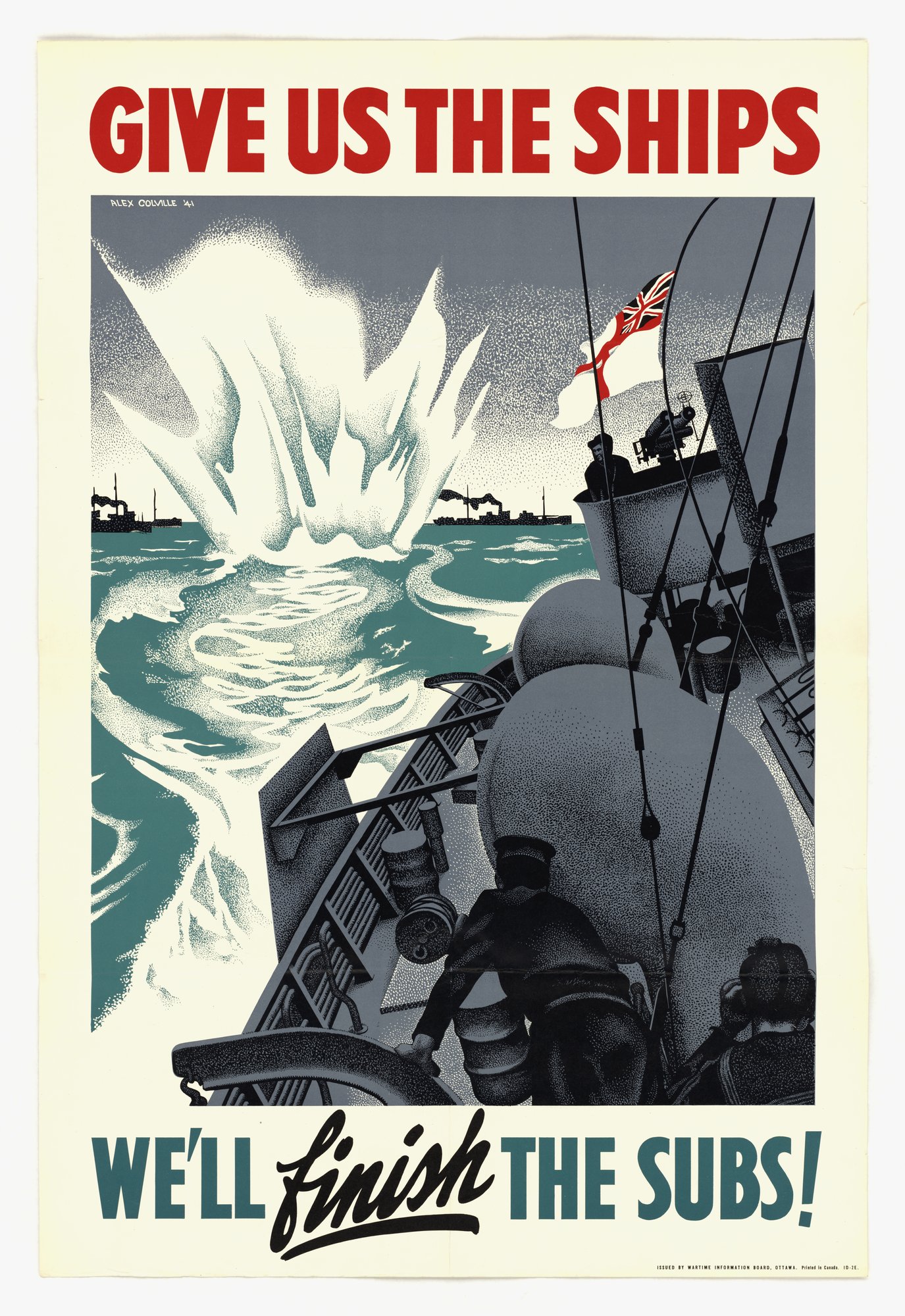
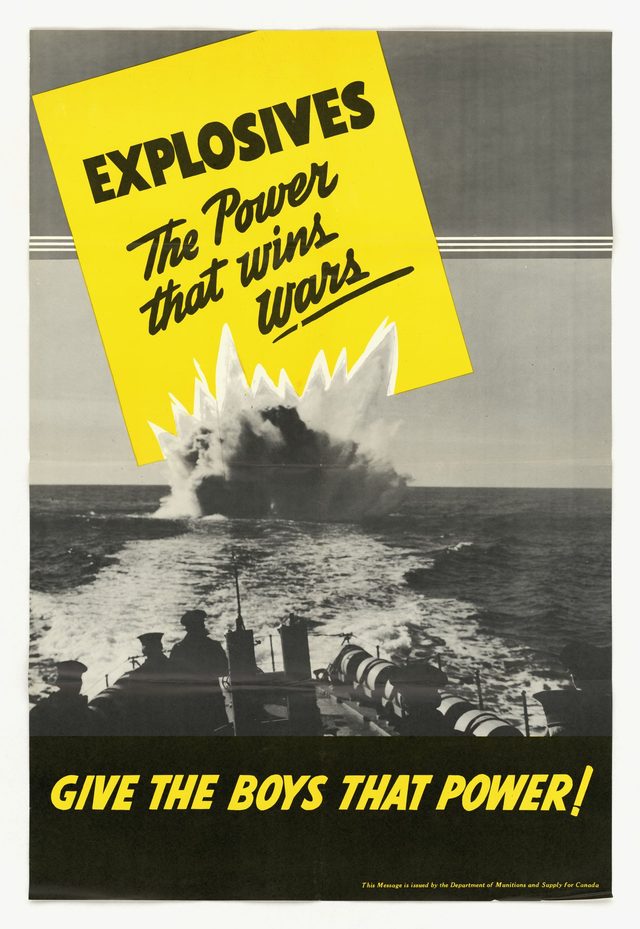
Alex Colville signed this poster '41, and its imprint names the Wartime Information Board, which did not exist until 1942, so the printing is later than the artwork. The sailors speak to shipbuilders in the first person, and the explosion lends combat urgency to a request for output. The French edition, "Faites vite... Faites bien. Leur victoire sera la vôtre", folds the worker's output into the sailors' result, and the collection tags it identity fusion. Read the technique: identity fusion. See also WW2 rationing and salvage posters.
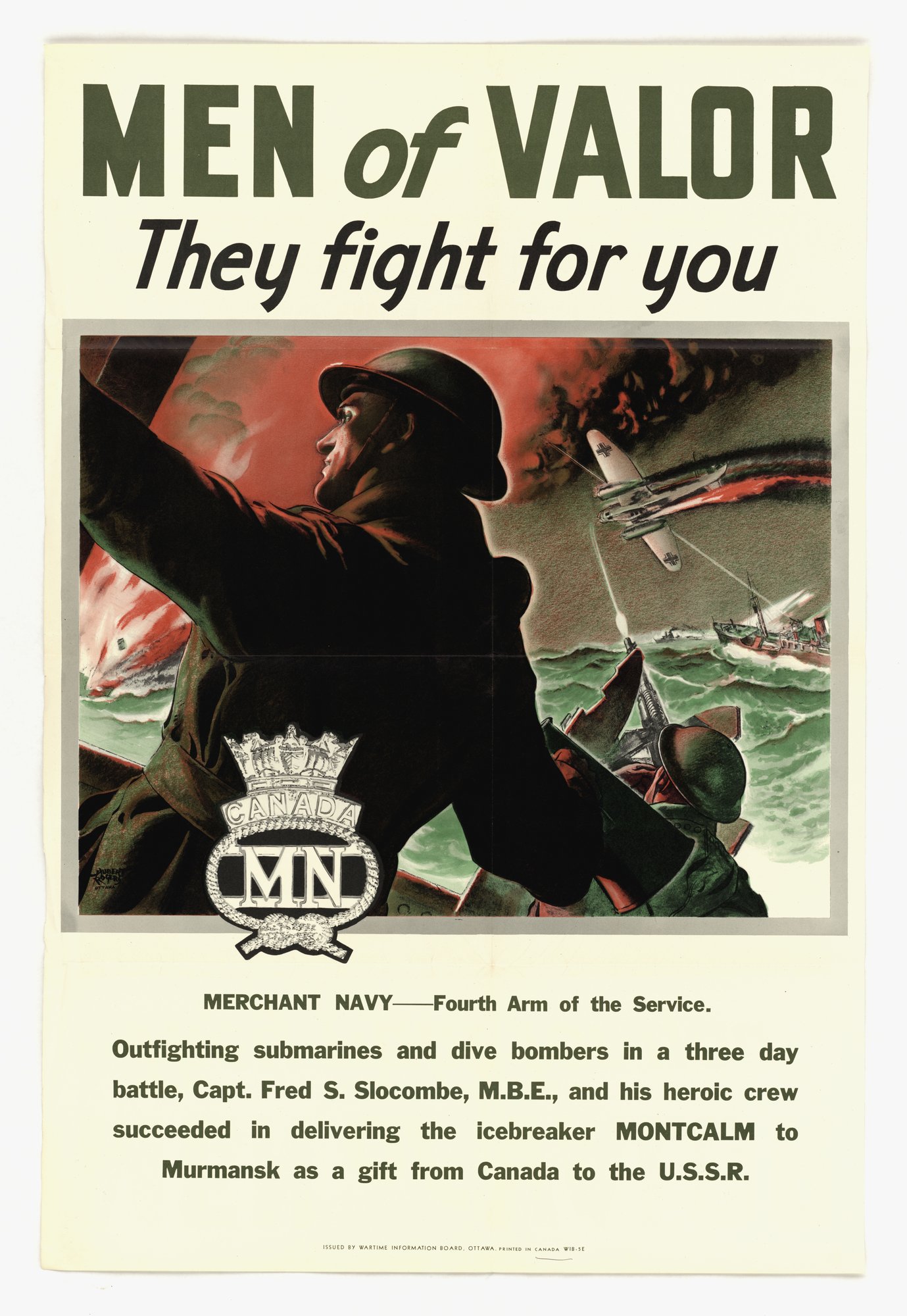
A Wartime Information Board sheet signed Hubert Rogers names a captain and his ship's three-day battle, and calls the crew "heroic". The named individual is the testimonial tell. The poster's claims about the voyage are the issuer's and were not checked against other records. Read the technique: testimonial.
How do Canadian posters compare with American and British ones?
The same technique vocabulary fits all three. Careless talk is the clearest case. The British Ministry of Information launched Fougasse's cartoon series in February 1940, with humour carrying the warning (V&A). The Office of War Information's "A careless word... another cross" uses a grave cross for the same fear appeal; see the OWI domestic branch and the American poster page. Canadian sheets, such as "She Sails at Midnight... He Talked... This Happened", put two photographs in sequence and assert a direct cause from a pub remark to deaths at sea. All three tie speech to a death without citing a case. See careless talk posters and the British page.
One difference is plain in the collection: Canadian sheets regularly appear in French editions with their own reference codes. The issuers also differ: American posters come from federal agencies, military branches and private firms, British ones largely from Ministries and the National Savings Committee, and Canadian ones from a handful of departments plus trade groups running the savings drives. The collection's counts reflect what the archive has found and can host, not the size of each country's output.
How to read one
- Check the imprint. Canadian sheets name the department or the Wartime Information Board and often a minister, and a reference code ending in E or F marks the English or French edition.
- Check the date. A great many are recorded at the start of a 1939 to 1945 range because none is printed.
- Compare the two languages. The picture often stays the same while the wording moves.
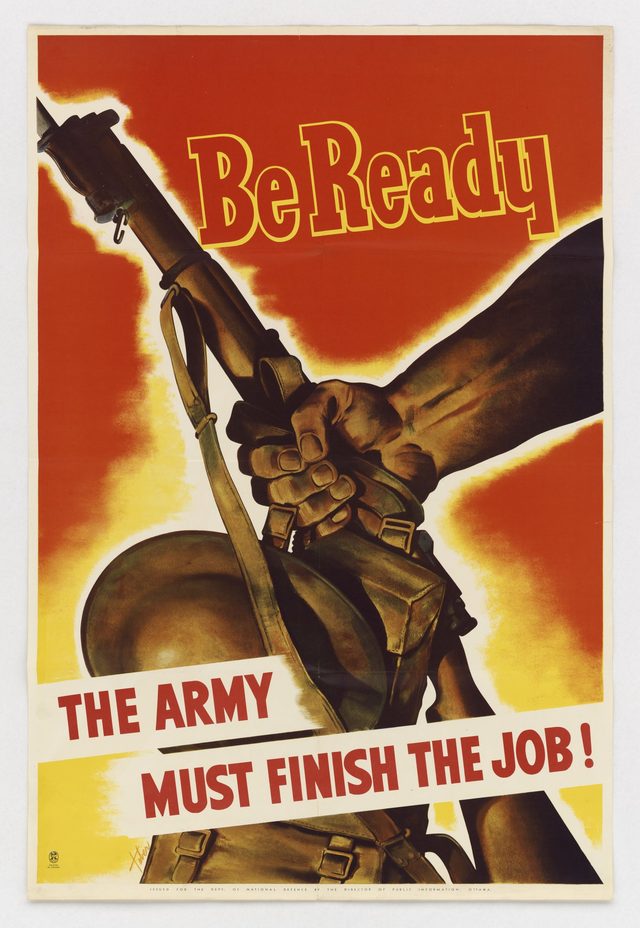
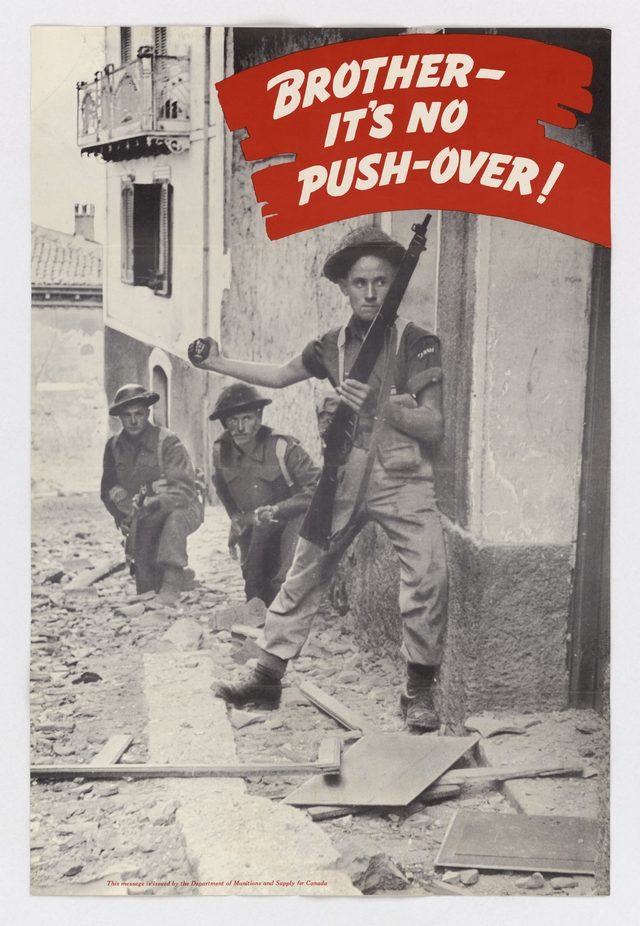
- Name the technique from the ask. A soldier beside a household chore is transfer, a sinking ship after a remark is fear appeal, a "we" for the whole nation is identity fusion.
Browse Canadian propaganda posters
The grid below shows Canadian posters in the collection, many in both languages. Each opens an object page with its source record, transcription and rights basis. For every object, use the full collection, filtered by technique, era, country and medium.
Sources and rights
Most posters here come from the U.S. National Archives' foreign poster series (Record Group 44), with others from Library and Archives Canada, the Library of Congress and Wikimedia Commons. Canadian Crown copyright on these government imprints has expired, and each object page states its own basis. Transcriptions are verbatim and translations are labelled.
![Buy Victory Bonds [4]](../collection/images/buy-victory-bonds-bayonet-charge-canada-1939-640.jpg)
![Buy Victory Bonds [3]](../collection/images/buy-victory-bonds-bond-lettering-canada-1939-640.jpg)
![Buy Victory Bonds [1]](../collection/images/buy-victory-bonds-soldier-and-crying-child-1939-640.jpg)
![Buy Victory Bonds [2]](../collection/images/buy-victory-bonds-watching-eyes-canada-1939-640.jpg)
![À l'œuvre, c'est notre guerre [At work, it's our war]](../collection/images/canada-a-loeuvre-cest-notre-guerre-french-1939-640.jpg)
![Buy War Savings Stamps Every Friday [2]](../collection/images/canada-buy-war-savings-stamps-every-friday-strip-1939-640.jpg)
![Ça c'est MON bateau! On peut compter dessus! [That's MY ship! You can count on it!]](../collection/images/canada-ca-cest-mon-bateau-french-winter-1939-640.jpg)
![Have You Bought a Shell This Month? [2]](../collection/images/canada-have-you-bought-a-shell-this-month-1939-640.jpg)