Content note. Hitler's speeches contain antisemitic statements, threats of violence and, in 1939 and 1942, public statements about the annihilation of Jews. The quotations below are shown as published in the cited editions, uncut and without added commentary, so that readers can see what was said and who was told. The photographs show Nazi Party and state events as issued, with swastikas and salutes. Showing a speech or an object is not endorsing it.
Where can you read Hitler's speech transcripts in full?
Two standard English collections exist: Norman H. Baynes (ed.), The Speeches of Adolf Hitler, April 1922 to August 1939 (1942), scanned on the Internet Archive as volume 1 and volume 2, and Max Domarus, Hitler: Speeches and Proclamations 1932-1945 (Bolchazy-Carducci, 1990 to 2004). No audio source is cited in this archive.
What does this archive hold?
The quotes file for Hitler, documented here, has 26 entries (counts made from the Hitler quotes data). Of these, 25 are verified against a named edition and 1 is disputed. By form, 13 are tagged speech (12 verified, 1 disputed), 5 are from Mein Kampf, 5 are written statements or orders, 2 are private remarks recorded in minutes and 1 is court testimony. The speeches run from 12 April 1922 to 30 September 1942. Each entry gives the text, translator, date, place and a page-level source. The file also lists four widely shared lines it rejects, covered below. Hosted primary texts are in the library, which holds the German Mein Kampf, a book rather than a speech.
What do the verified speech quotations say?
The selection below keeps public and private settings apart, because the same man said different things to different rooms. Each quotation is copied from the quotes file.
Explain moreShow less
Reichstag, Berlin, 17 May 1933 (the "peace speech"), translated by Mary Fran Gilbert in Domarus, vol. 1, p. 327:
"Finding a reasonable and lasting solution to the problems existing today lies in the interests of all. No new European war would be capable of bringing about anything better in place of the unsatisfactory conditions of the present."
Sportpalast, Berlin, 26 September 1938, translated in Baynes, vol. 2, p. 1517:
"And now before us stands the last problem that must be solved and will be solved. It is the last territorial claim which I have to make in Europe, but it is the claim from which I will not recede and which, God willing, I will make good."
Reichstag, Berlin, 30 January 1939, authorized English translation in Baynes, vol. 1, pp. 740-741:
"To-day I will once more be a prophet: If the international Jewish financiers in and outside Europe should succeed in plunging the nations once more into a world war, then the result will not be the bolshevization of the earth, and thus the victory of Jewry, but the annihilation of the Jewish race in Europe!"
Obersalzberg, 22 August 1939, to military commanders, Nuremberg document 1014-PS (Nazi Conspiracy and Aggression, vol. 3, p. 665), translated by the Office of United States Chief of Counsel:
"I shall give a propagandists cause for starting the war — never mind whether it be plausible or not. The victor shall not be asked, later on, whether we told the truth or not. In starting and making a war, not the Right is what matters but Victory."
Reichstag, Kroll Opera House, Berlin, 1 September 1939, as published by the Avalon Project, Yale Law School (translator not named on the page):
"This night for the first time Polish regular soldiers fired on our territory. Since 5.45 A.M. we have been returning the fire, and from now on bombs will be met by bombs."
Sportpalast, Berlin, 30 January 1942, translated by Mary Fran Gilbert in Domarus, vol. 4, p. 2574, delivered ten days after the Wannsee Conference:
"We are fully aware that this war can end either in the extermination of the Aryan people or in the disappearance of Jewry from Europe. I said as much before the German Reichstag on September 1, 1939. I wish to avoid making hasty prophesies, but this war will not end as the Jews imagine, namely, in the extermination of the European-Aryan people; instead, the result of this war will be the annihilation of Jewry. For the first time, the old, truly Jewish rule of “an eye for an eye, a tooth for a tooth,” will obtain."
Read together, the 1933 public statement about peace, the August 1939 private remark about a pretext and the 1 September 1939 public statement about returning fire show the gap between what was said to the commanders and what was said to the Reichstag. That is a comparison of three documents, not a finding about every speech he gave. The 1939 and 1942 statements about Jews were public, and the 1942 one says he is repeating the 1939 one.
Which quotations are disputed, and which are rejected?
The file marks one entry disputed: the Obersalzberg address of 22 August 1939 as recorded in document L-3, the version given to the American journalist Louis Lochner. The Nuremberg tribunal admitted documents 798-PS and 1014-PS but not L-3, and historians differ on how closely L-3 reproduces what was said. This page does not use it as a verified quotation; the full text and notes are in the file.
Explain moreShow less
Four other lines are rejected in the file with reasons:
- "Make the lie big, make it simple, keep saying it, and eventually they will believe it." Rejected as a paraphrase: it is not found in Murphy's Mein Kampf, Baynes (vols 1-2) or Domarus. The nearest real text, in volume 1 chapter 10, describes what Hitler says his opponents did. See the big lie technique page.
- "What luck for rulers that men do not think." Unverifiable: no primary text located.
- "I want to raise a generation of young people devoid of a conscience, imperious, relentless and cruel." Unverifiable: it comes from Hermann Rauschning's reconstructed conversations, Hitler Speaks (1939), which most historians regard as unreliable or partly invented.
- "Who, after all, speaks today of the annihilation of the Armenians?" (the wording attributed to Lochner's version). Unverifiable: it does not appear in 798-PS or 1014-PS, and L-3 reads differently.
How were Hitler's speeches staged?
Before 1933 the stage was the rally and the campaign trip. The case study NSDAP early propaganda, 1920 to 1923 shows a Bavarian propaganda drive, and the Nuremberg rallies case study follows the annual rally from 1927. The 1932 campaigns case study covers the chartered flights that took him to several cities in days.
Content note: Photograph of Adolf Hitler and NSDAP members on a 1923 propaganda drive. This object is shown as it was published. Why 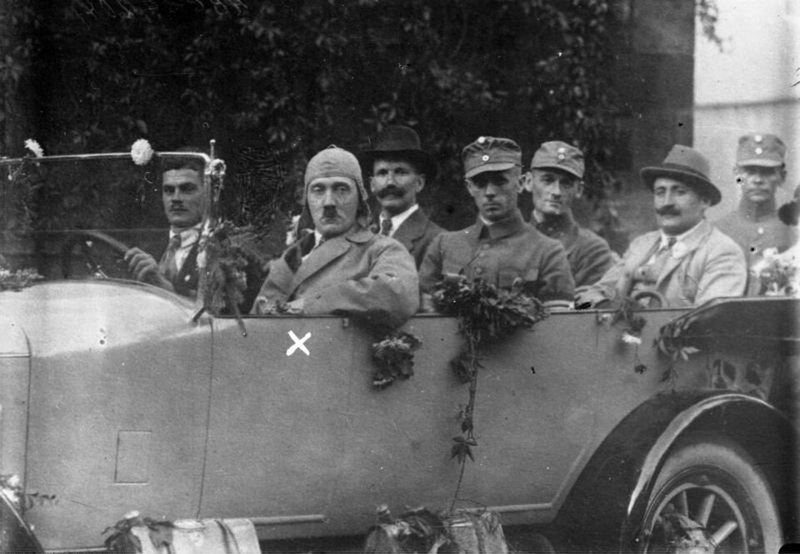
Content note: Nazi swastika standard ("Deutschland Erwache") at the 1927 Nuremberg rally. This object is shown as it was published. Why 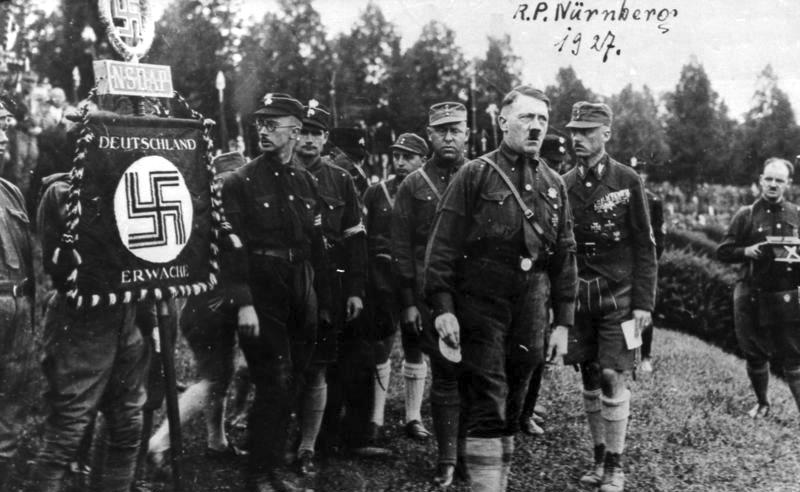
Content note: Nazi party salute and regalia at the 1929 Nuremberg rally. This object is shown as it was published. Why 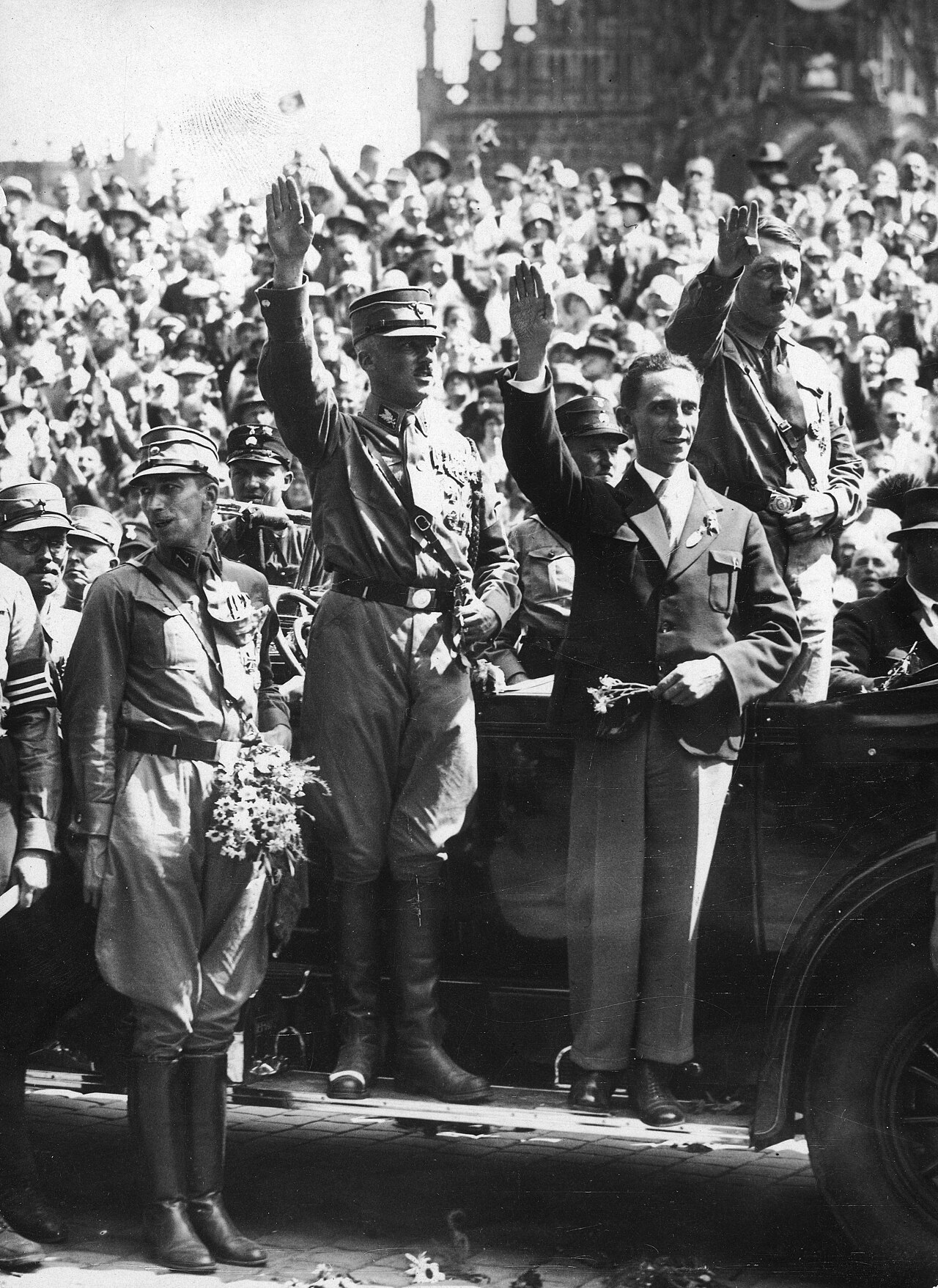
Content note: Photograph of Adolf Hitler speaking at a 1932 campaign rally with uniformed SA men beside him. This object is shown as it was published. Why 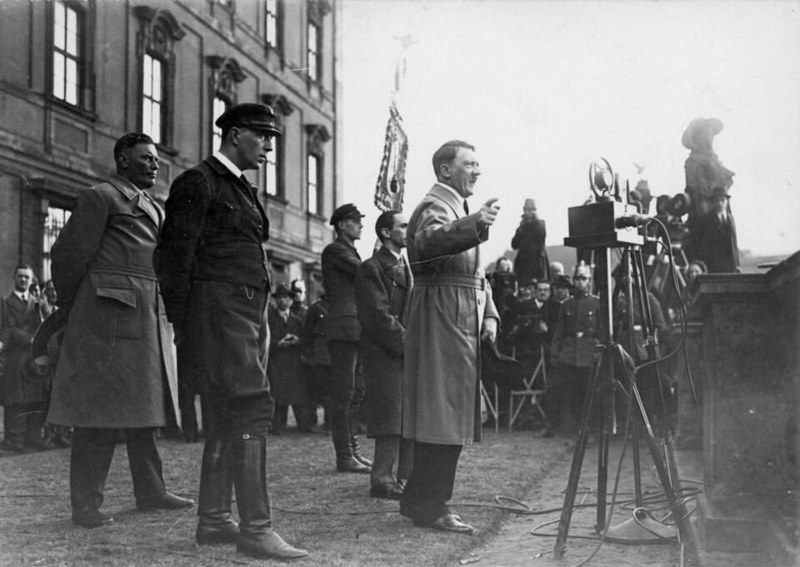
Explain moreShow less
Hitler, marked with a white cross on the print, in an open touring car decked with foliage and flowers, on a propaganda drive in Bavaria, 1923 (Bundesarchiv catalogue date; Bundesarchiv, Bild 102-00204, public domain in the U.S.).
Hitler marches with SA and party figures, including Rudolf Hess and Franz Pfeffer von Salomon, behind a standard reading "Deutschland Erwache" at the Nuremberg rally, August 1927 (Bundesarchiv, Bild 146-1969-054-53A). The case study notes the party's national vote share was then in the single digits, so the column projects a larger movement than the ballot box showed.
Hitler, Goebbels and Pfeffer von Salomon salute a crowd from an open car at the Nuremberg rally of 1 to 4 August 1929 (photo by Robert Sennecke, held by the Polish National Digital Archive, Public Domain Mark).
Hitler at a microphone in the Lustgarten, Berlin, on 4 April 1932 during the runoff campaign against Hindenburg; press photographers and a film camera stand beside the platform (Georg Pahl, Bundesarchiv, Bild 102-14271B).
How were the speeches broadcast and heard?
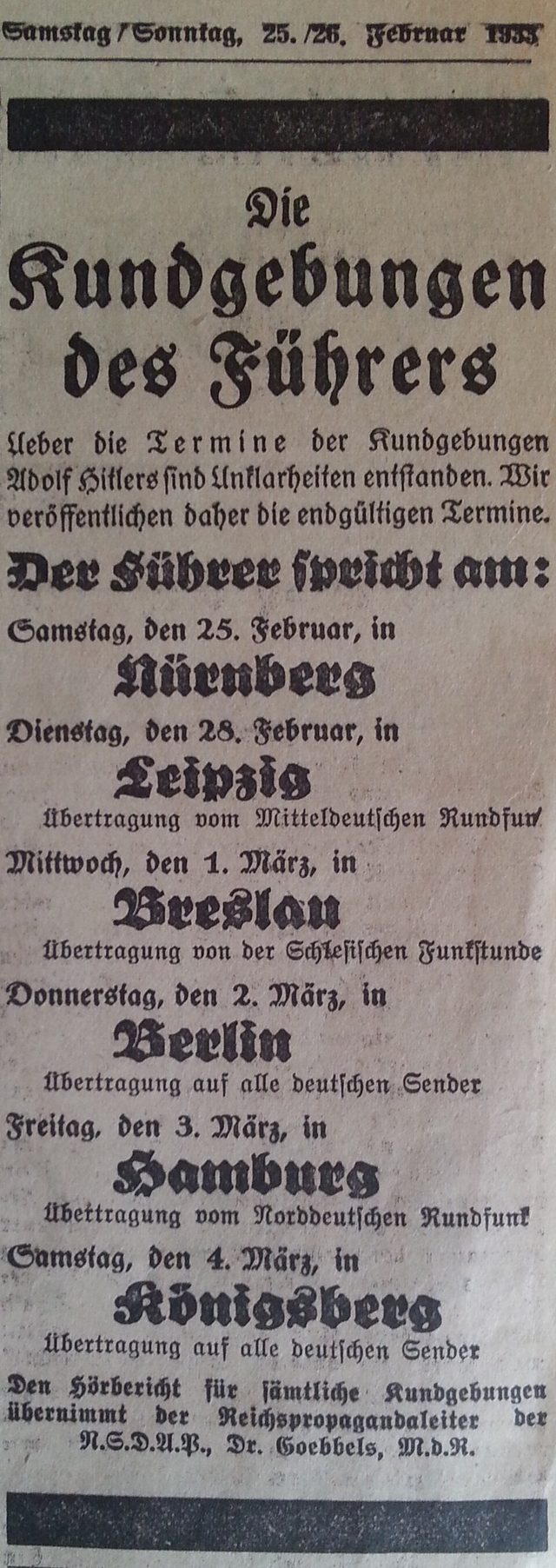
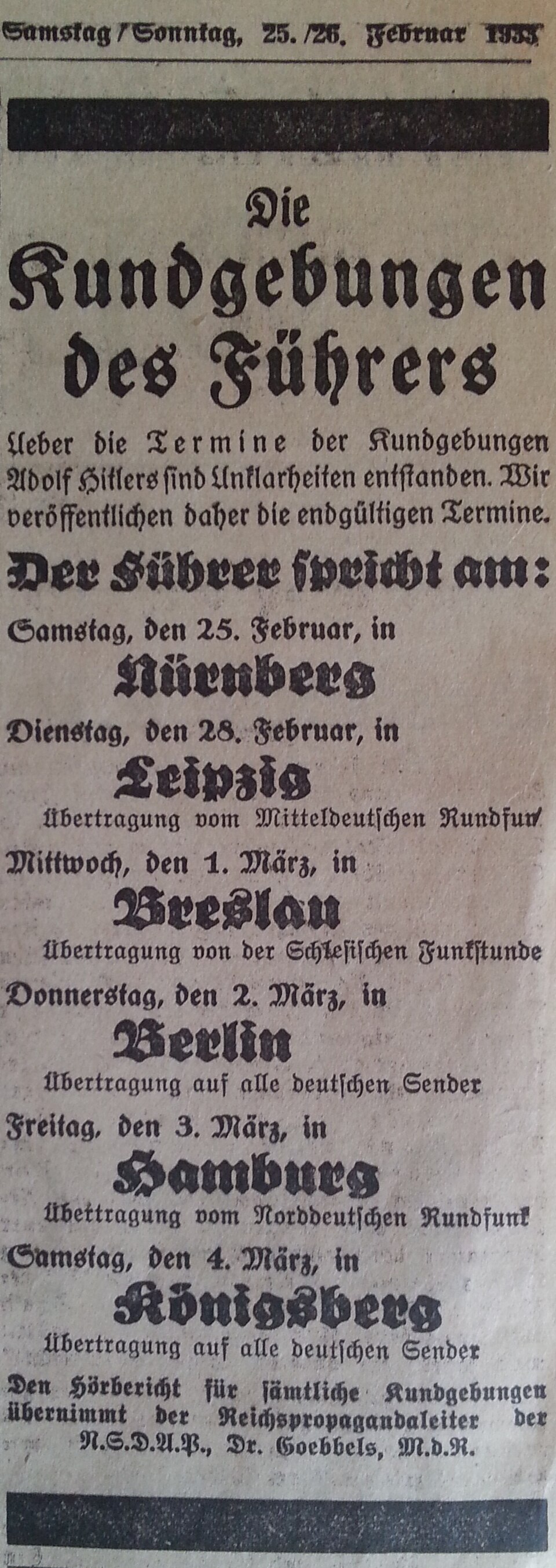
From February 1933 the party daily told readers where to listen.
Content note: Massed SA formations with swastika standards at the 1933 Nuremberg rally. This object is shown as it was published. Why 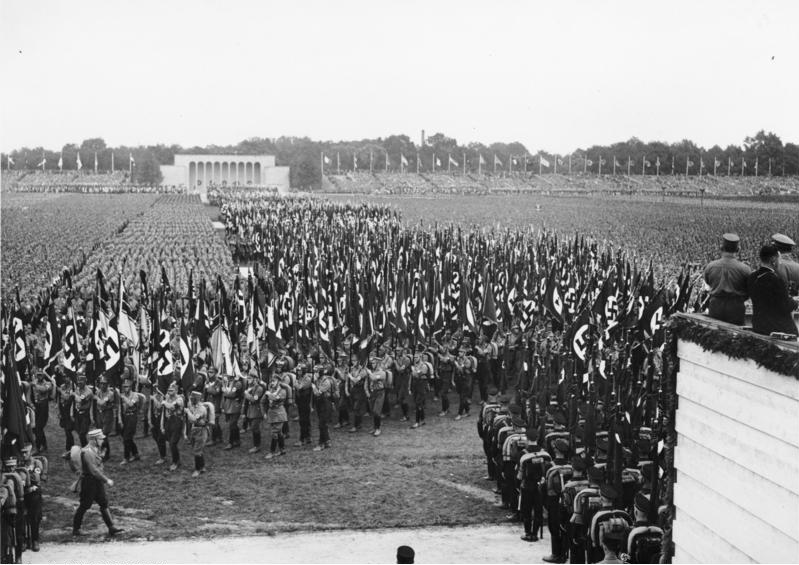
Content note: Nazi swastika armbands on Hitler Youth members at a Nuremberg Rally roll call. This object is shown as it was published. Why 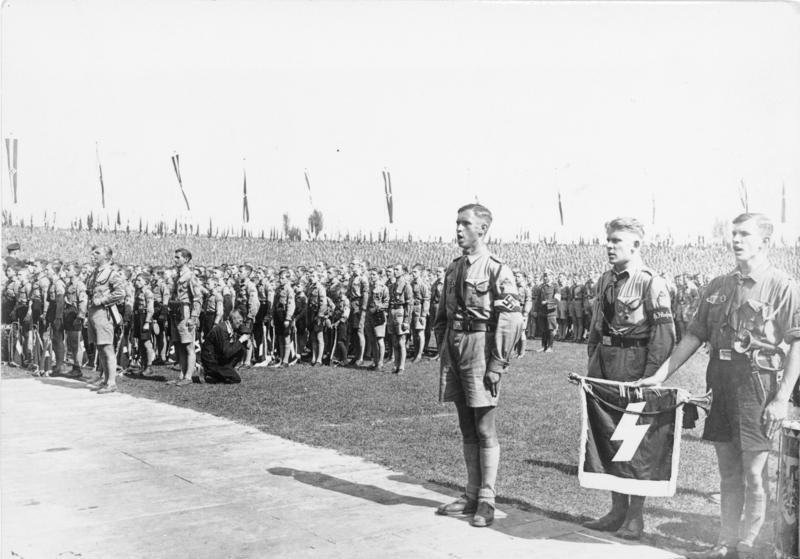
Explain moreShow less
The Völkischer Beobachter (South German edition, 25/26 February 1933) lists Hitler's election rallies from 25 February to 4 March 1933 in Nuremberg, Leipzig, Breslau, Berlin, Hamburg and Königsberg, with the radio stations carrying each, and names Goebbels as radio commentator for all of them. Hitler had been chancellor since 30 January. The entry tags it identity fusion.
SA units massed with swastika standards on the Luitpoldhain at the Reichsparteitag des Sieges, August to September 1933, the first rally staged with the resources of the state behind it (Bundesarchiv, Bild 183-1987-0410-501).
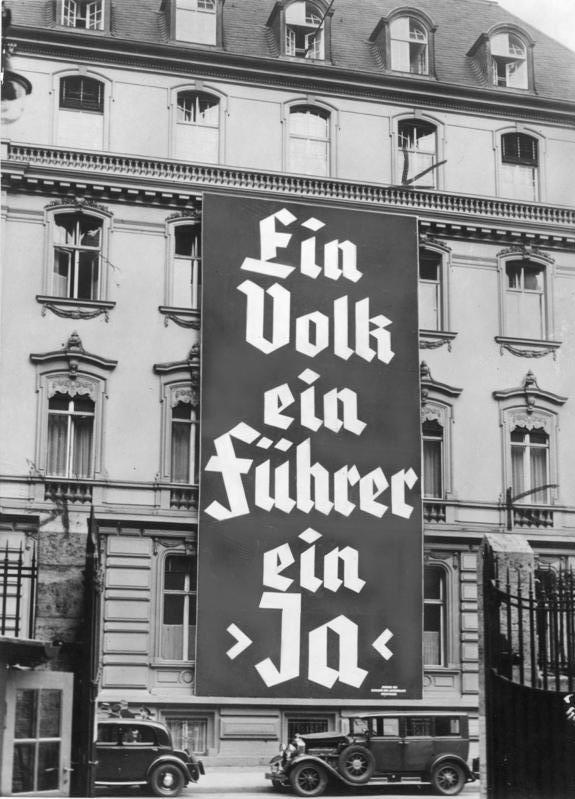
A banner for the single-list Reichstag election and referendum of 12 November 1933 reads "One people, one leader, one Yes". Only NSDAP candidates stood, and official results gave the party list about 92 per cent and the referendum about 95 per cent. The entry tags it identity fusion and demagoguery.
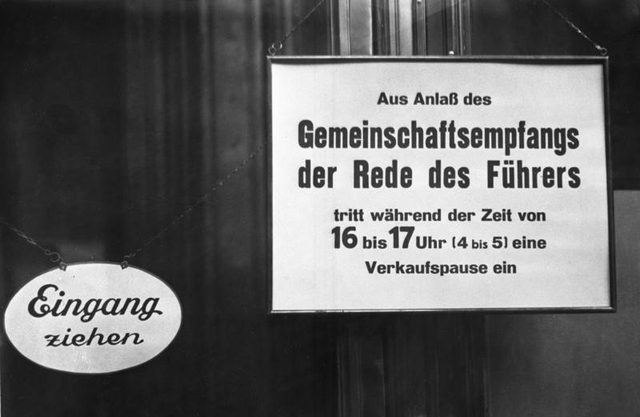
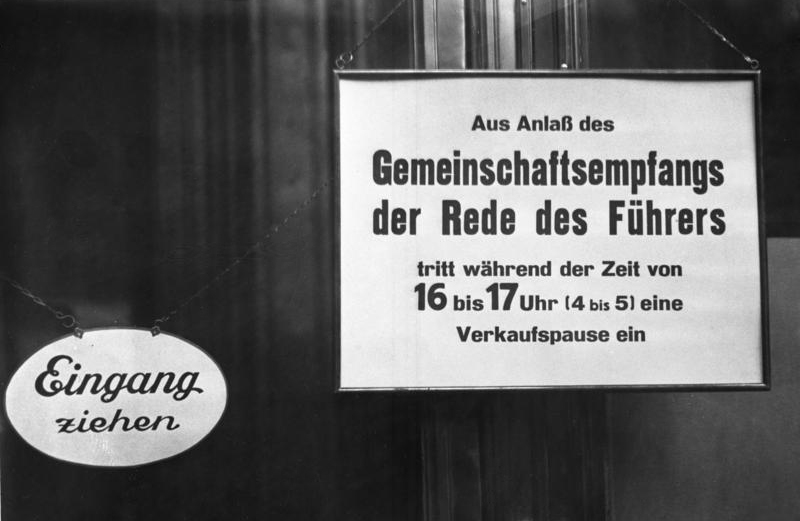
A 1935 shop notice announces a sales break "on the occasion of the communal reception of the Führer's speech" (Bundesarchiv, B 145 Bild-P046302, photographer Carl Weinrother). The entry explains Gemeinschaftsempfang: the ministry and party relayed major speeches to factories, offices, shops, schools and squares, organised locally by party radio wardens, so that people heard a speech among others and saw them listening. It tags it bandwagon.
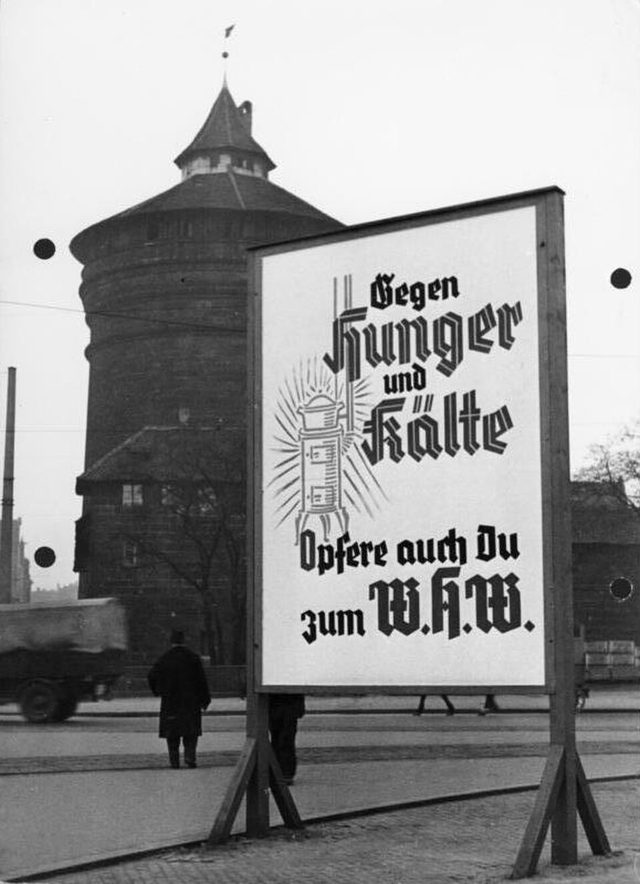
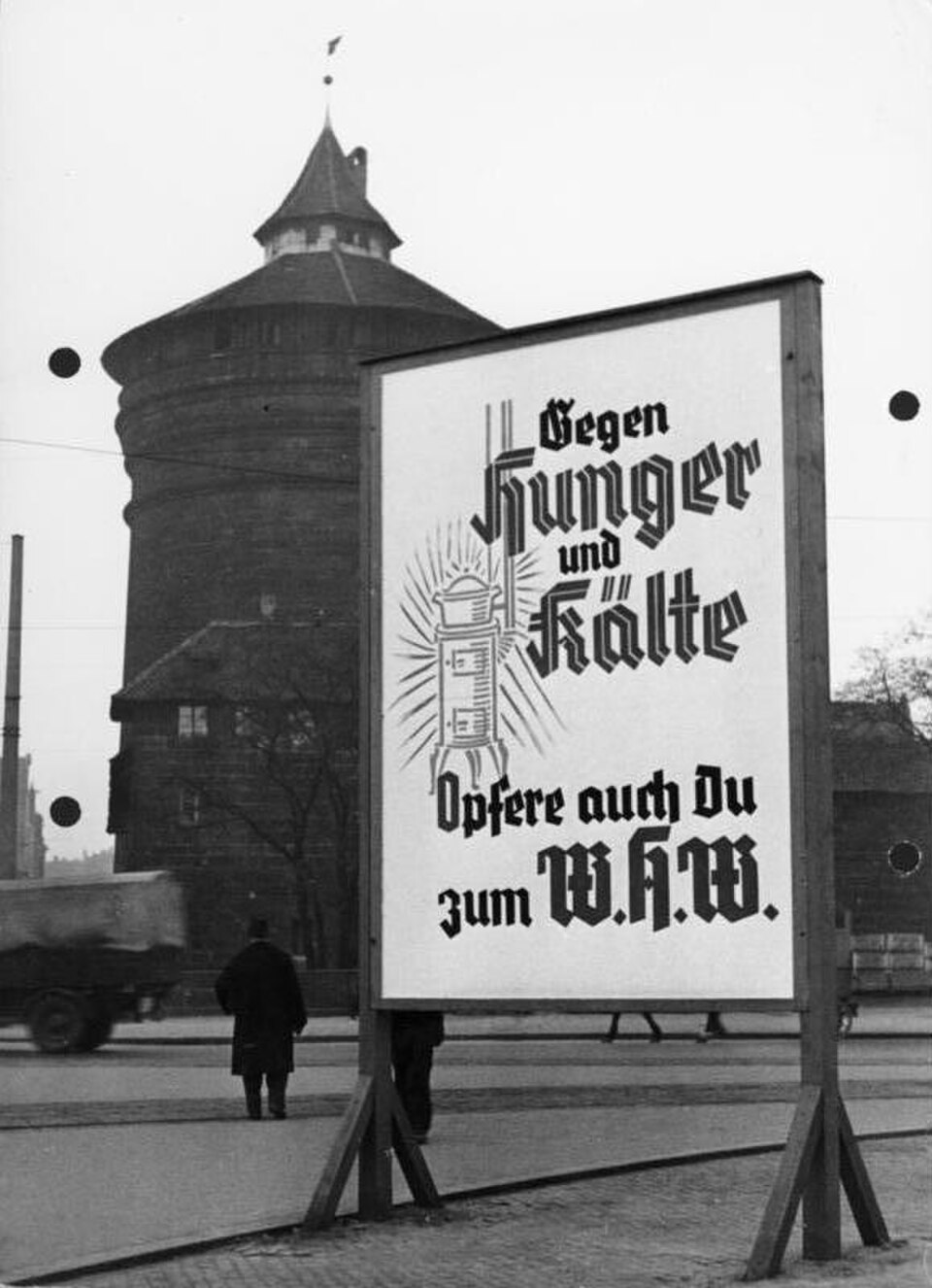
A Winter Relief (W.H.W.) donation board in Nuremberg, December 1936 (Bundesarchiv; NSDAP, Amt für Volkswohlfahrt, Gau Franken). Hitler opened the 1942 Winter Relief campaign in the Sportpalast, in the speech of 30 September 1942 in the quotes file. The entry tags this board bandwagon.
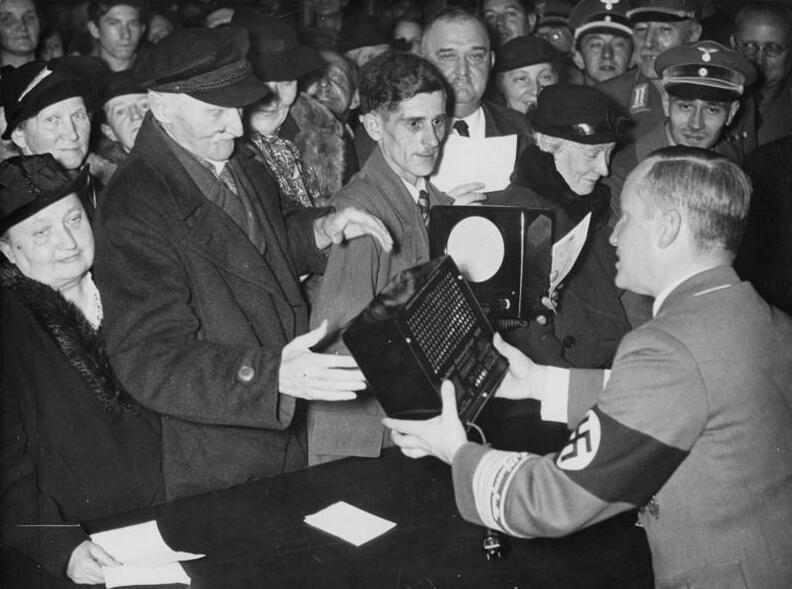
Party officials hand out 500 small radio receivers to "needy national comrades" in Berlin on Goebbels's birthday, October 1938, per the original press caption (Bundesarchiv, Bild 183-H14243, photo: Nau). Goebbels said at the Berlin radio exhibition of 18 August 1933 that taking power would not have been possible "without the radio and the airplane"; see the Goebbels page and the Reich Propaganda Ministry case study.
Hitler Youth in formation for a roll call ("HJ-Appell") at the Nuremberg Rally grounds (Bundesarchiv, Bild 146-1981-160-05). The case study records that from 1933 one day of the rally was set aside for the Hitler Youth, who were addressed directly by Hitler. His speech to German youth of 1 May 1937 says the Reich "will give its youth to no one" (Baynes, vol. 1, p. 549; text in the quotes file).
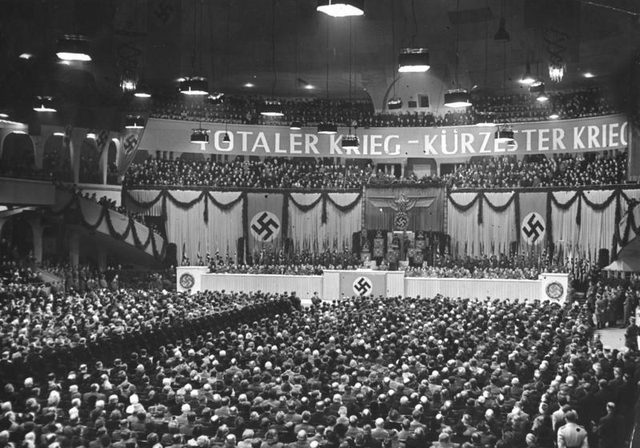
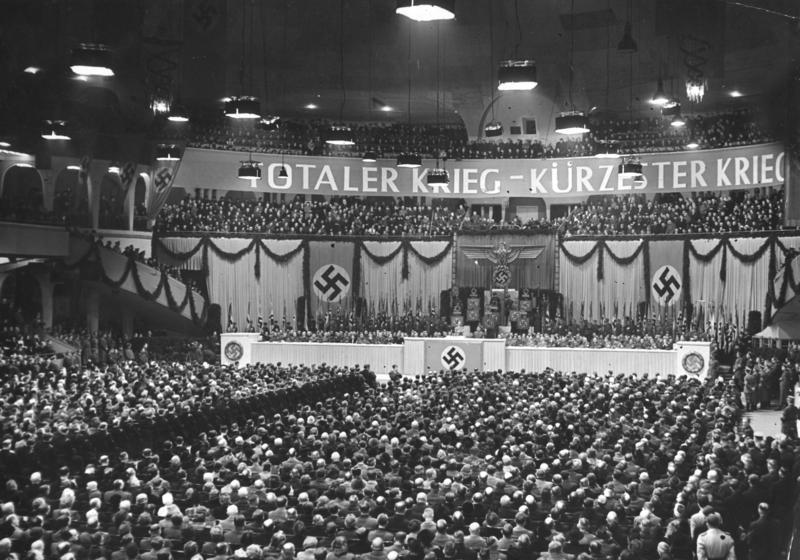
The Sportpalast on 18 February 1943, during the "total war" speech given by Goebbels, not by Hitler, under a banner reading "Total war - shortest war" (Bundesarchiv, Bild 183-J0523). Hitler spoke in the same hall on 26 September 1938, 30 January 1942 and 30 September 1942. The audience for the 1943 event was invited and seated in advance, and the speech was broadcast on radio and shown in the newsreel. The entry tags it fear appeal, bandwagon and demagoguery.
How do these compare with speeches by other leaders?
The archive applies the same definitions to all sides: see the Stalin page and the Goebbels page, and the quotes files for other leaders, which use the same fields. Relaying a speech by radio and staging a crowd are techniques many states have used; the differences lie in what was said and what followed, which the cited texts and the Nazi Germany regime page record.
Browse
Nazi propaganda posters, Hitler in the collection, Nazi Germany regime page, how Adolf Hitler died, the Learn page on the big lie, and the Nazi propaganda ministry doctrine page.
Sources and further reading
Sources and rights
Quotations come from the quotes file, each with its translator and page-level source.
Quotations come from the quotes file, each with its translator and page-level source. Short extracts are given for identification and study; for full texts use the editions named above. The Avalon Project text of the 1 September 1939 address is at avalon.law.yale.edu/wwii/gp2.asp, and the quotes file also cites the Avalon Hossbach memorandum and the political testament text at ns-archiv.de. The German Propaganda Archive at Calvin University, maintained by Randall Bytwerk, is described in the archives guide. Photographs are from the German Federal Archives (via Wikimedia Commons, CC BY-SA 3.0 DE), the Polish National Digital Archive and the holders named in each caption.