Content note. Joseph Goebbels was Reich Minister of Public Enlightenment and Propaganda, and several verified quotations below are antisemitic statements from his speeches and articles during the war. They are given in full, with date and source, as evidence of what the Nazi state told its public, not as endorsement. The Holocaust context is linked, not left out. One Allied item caricatures him.
Which Goebbels quotes are real, and which are not?
The archive holds 15 verified Goebbels quotations, each with a dated primary source and a named translator, and rejects three popular lines. The best-known one, "If you tell a lie big enough and keep repeating it, people will eventually come to believe it", has no source in his name. (Counts made from the Goebbels quotes data: 15 entries with status verified, 3 in the rejected list.)
Did Goebbels say "if you tell a lie big enough"?
No source has been found for it. The quotes file records the finding for each of the three popular lines:
Explain moreShow less
- "If you tell a lie big enough and keep repeating it, people will eventually come to believe it." Rejected as misattributed. The checked Bytwerk German Propaganda Archive texts, the International Military Tribunal transcript and Nazi Conspiracy and Aggression vols. 1 to 8 have no such wording in Goebbels's name. The phrase "big lie" is Hitler's, from Mein Kampf (vol. 1, ch. 10), where he used it of opponents.
- "A lie told once remains a lie, but a lie told a thousand times becomes the truth." Rejected as apocryphal. No German original or dated source was found; it is repeated on quotation sites without a citation.
- "Propaganda works best when those who are being manipulated are confident they are acting on their own free will." Rejected as unverifiable. It is not in the Goebbels texts checked and is often given without a citation.
Randall Bytwerk of the German Propaganda Archive at Calvin University, who hosts and translates many of the speeches below, lists the first line among things Goebbels did not say. The big lie technique page traces where the idea does come from: Hitler's accusation in Mein Kampf, and a 1943 report for the U.S. Office of Strategic Services by Walter Langer that describes a big lie as a deliberate method. The psychology library entry covers the repetition research.
What did Goebbels write that is close to the big lie?
The nearest verified text is a weekly lead article, "Aus Churchills Lügenfabrik" (From Churchill's Lie Factory), Das Reich, 12 January 1941, translated by Randall Bytwerk. In it he accuses the British government of misreporting ship losses and air raids:
Explain moreShow less
"The English follow the principle that when one lies, one should lie big, and stick to it. They keep up their lies, even at the risk of looking ridiculous."
Source: Die Zeit ohne Beispiel (Munich: Zentralverlag der NSDAP, 1941), pp. 364-369. The quotes file notes that Goebbels attributes the principle to the English leadership and does not state it as his own method. This is the pattern the archive tags accusation in a mirror: the opponent is charged with the technique the speaker's side is accused of using. Whether his ministry also lied is a question for the record in the ministry case study, not for this sentence.
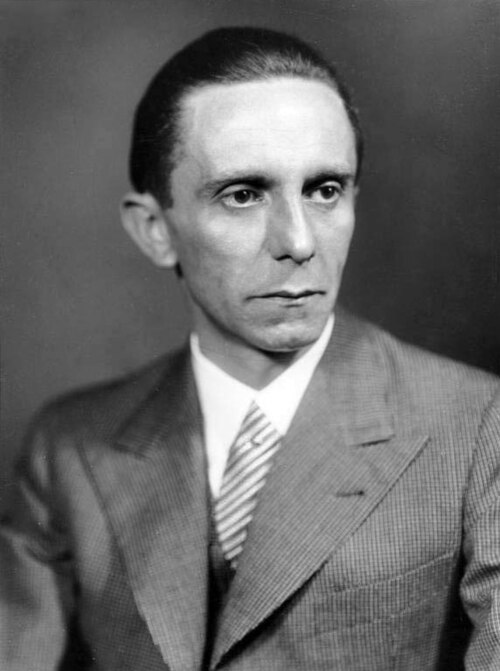
Bundesarchiv portrait of Goebbels, 1933, the year the Propaganda Ministry was founded (Bild 146-1968-101-20A, photograph by Heinrich Hoffmann).
What did Goebbels say about propaganda itself?
Two verified definitions, both in Randall Bytwerk's translation.
Content note: Nazi party salute and regalia at the 1929 Nuremberg rally. This object is shown as it was published. Why 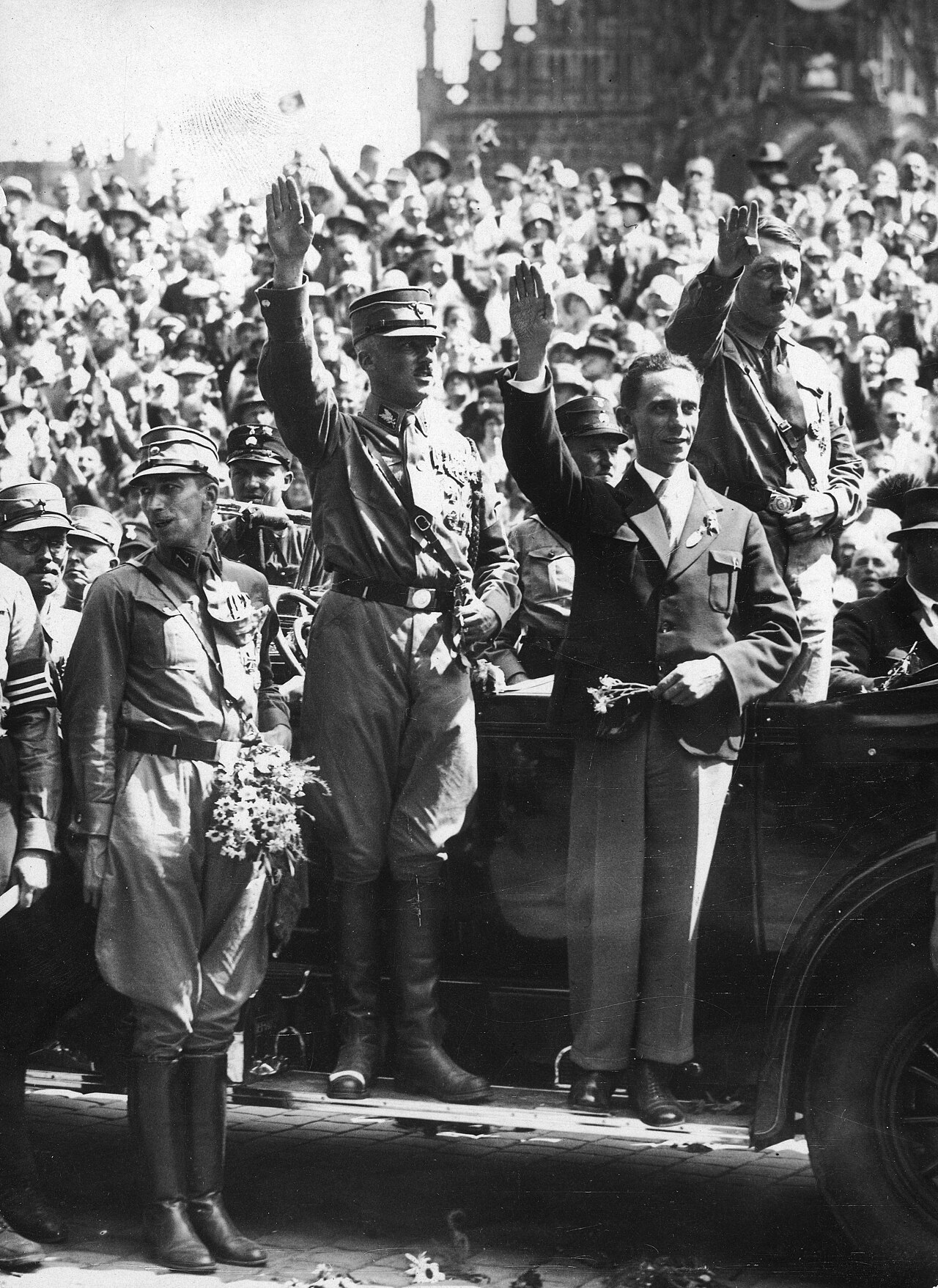
Explain moreShow less
On 9 January 1928, in the Berlin speech "Erkenntnis und Propaganda" (published in Signale der neuen Zeit, Munich: Zentralverlag der NSDAP, 1934, pp. 28-52): "We do not want to be a movement of a few straw brains, but rather a movement that can conquer the broad masses. Propaganda should be popular, not intellectually pleasing. It is not the task of propaganda to discover intellectual truths."
At the Nuremberg Party Rally, September 1934 (Der Kongress zur Nürnberg 1934, Munich: Zentralverlag der NSDAP, 1934, pp. 130-141): "Propaganda is a means to an end. Its purpose is to lead the people to an understanding that will allow it to willingly and without internal resistance devote itself to the tasks and goals of a superior leadership. If propaganda is to succeed, it must know what it wants. It must keep a clear and firm goal in mind, and seek the appropriate means and methods to reach that goal. Propaganda as such is neither good nor evil. Its moral value is determined by the goals it seeks."
The quotes file gives the rally month but not the day within it.
The three salute from an open car at the Nuremberg rally of 1 to 4 August 1929, five years before the 1934 speech above (Nuremberg rallies, 1927 to 1933).
What did Goebbels say about radio and state control?
On 18 August 1933 he opened a Berlin radio exhibition with the speech "Der Rundfunk als achte Großmacht" (The Radio as the Eighth Great Power), printed in Signale der neuen Zeit (1938 edition, pp. 197-207), translated by Randall Bytwerk:
Explain moreShow less
"It would not have been possible for us to take power or to use it in the ways we have without the radio and the airplane. It is no exaggeration to say that the German revolution, at least in the form it took, would have been impossible without the airplane and the radio."
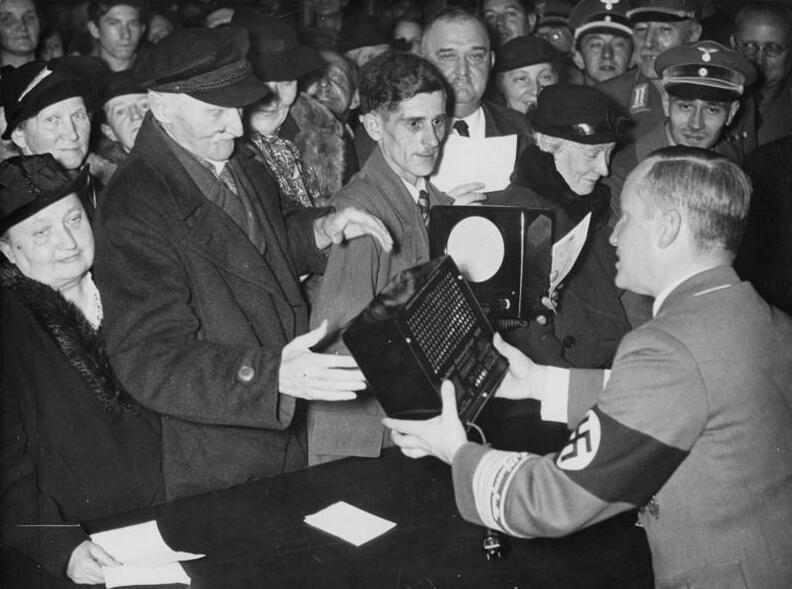
In October 1938 party officials in Berlin handed out 500 small radio receivers to "needy national comrades" on Goebbels's birthday, according to the original press caption (Bundesarchiv, Bild 183-H14243, photograph by Nau). The radio landing page covers the medium more widely.
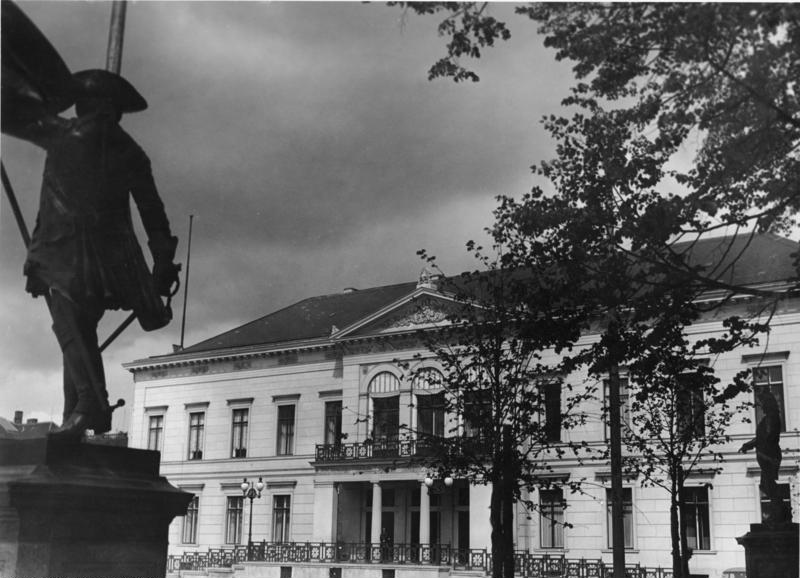
The ministry building from Wilhelmplatz, July 1936 (Bundesarchiv, Bild 146-1993-020-32A). It faced the Reich Chancellery.
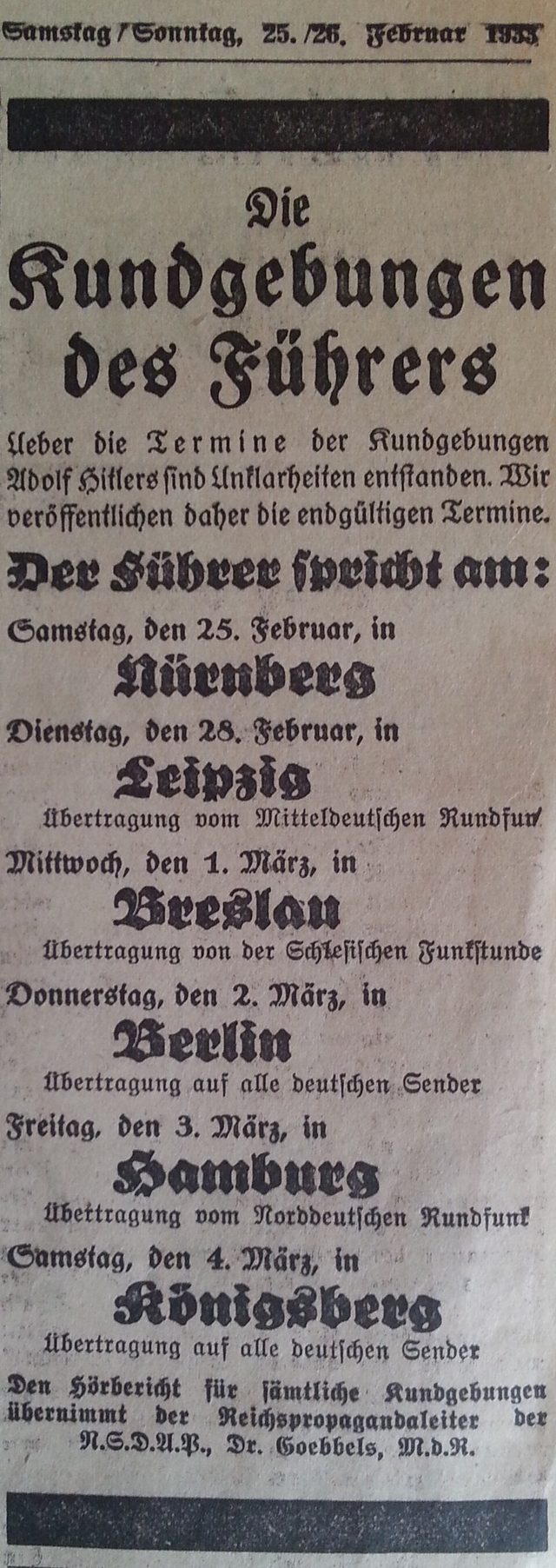
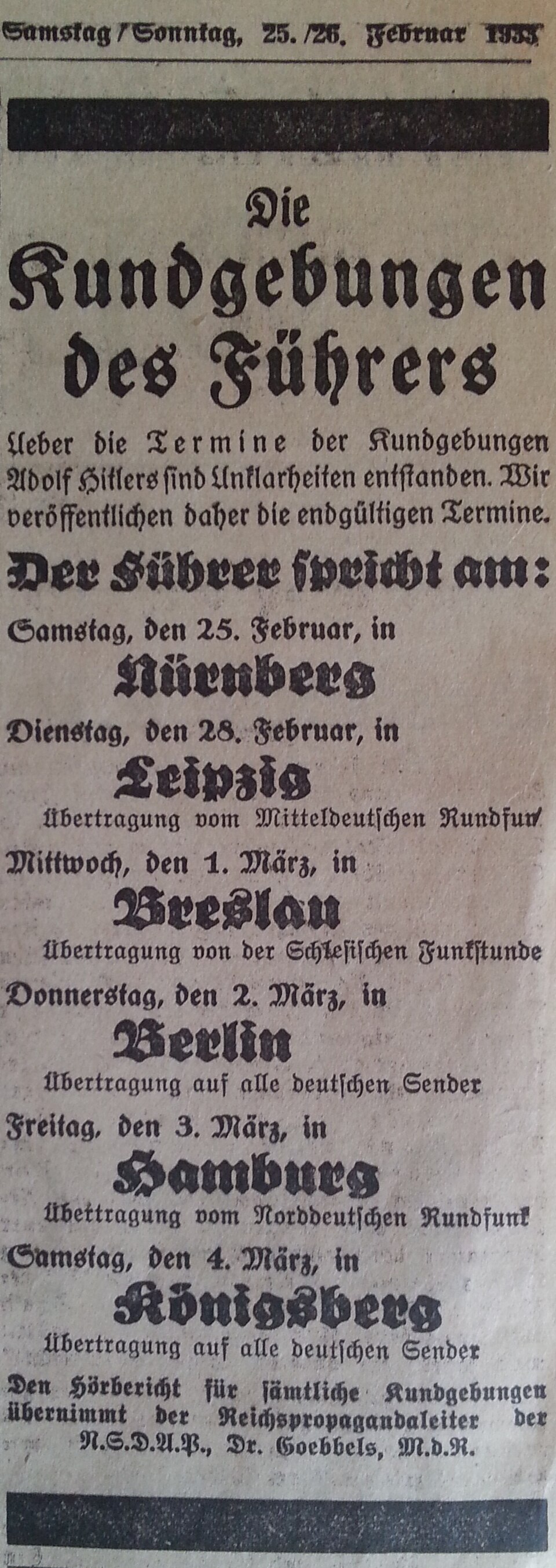
Six months earlier, in this Völkischer Beobachter notice of 25 and 26 February 1933, the Party's propaganda head, Dr. Goebbels, is named as taking over the radio report for all of Hitler's rallies from 25 February to 4 March. The entry tags it identity fusion.
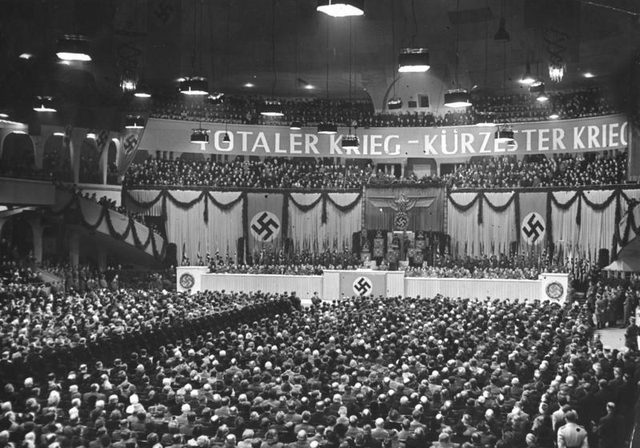
What did Goebbels say in the Sportpalast speech of 18 February 1943?
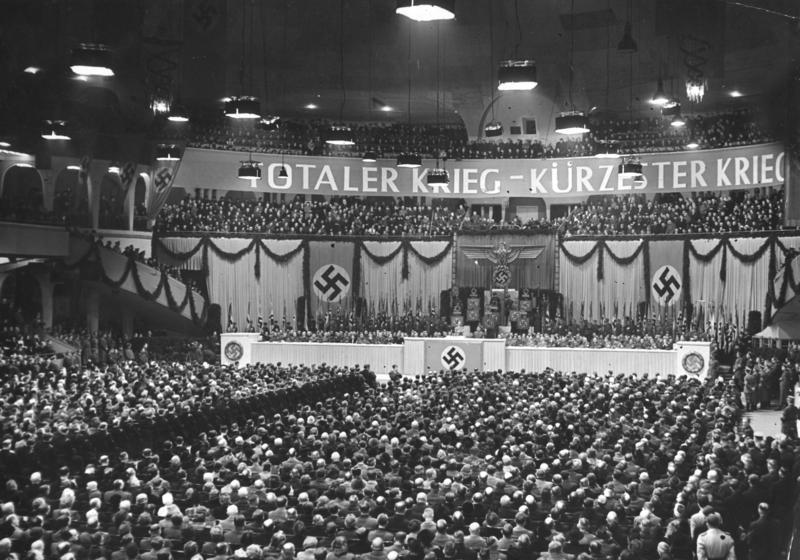
The speech "Nun, Volk, steh auf, und Sturm, brich los!" was delivered at the Berlin Sportpalast less than three weeks after the surrender at Stalingrad, to an invited audience. The quotes file uses the printed text from Der steile Aufstieg (Munich: Zentralverlag der NSDAP, 1944, pp. 167-204), translated by Randall Bytwerk, who notes that the printed version differs in places from the spoken one. Crowd responses appear in parentheses in the print. Two of its verified passages follow.
Explain moreShow less
The fourth of ten questions put to the hall: "Fourth: The English maintain that the German people is resisting the government's total war measures. It does not want total war, but capitulation! (Shouts: Never! Never! Never!) I ask you: Do you want total war? If necessary, do you want a war more total and radical than anything that we can even imagine today?"
The Bundesarchiv press caption lists Knight's Cross holders, armaments workers and wounded soldiers among those present. The audience was seated in advance, not a sample of the public, and its answers were broadcast as the voice of the nation. The entry tags it bandwagon, fear appeal and demagoguery.
The second passage is antisemitic and describes the Soviet advance: "Behind the oncoming Soviet divisions we see the Jewish liquidation commandos, and behind them terror, the specter of mass starvation and complete anarchy. International Jewry is the devilish ferment of decomposition that finds cynical satisfaction in plunging the world into the deepest chaos and destroying ancient cultures that it played no role in building." Bytwerk notes that in the spoken version Goebbels begins to say "extermination" of the Jews and breaks off mid-word.
What did Goebbels write about Jews during the war?
Seven of the 15 verified quotations are antisemitic (a count of the entries marked offensive in the quotes file). They are not trimmed here. Two examples, both from Das Reich, Goebbels's weekly paper, in Bytwerk's translation.
Explain moreShow less
On the yellow star, from "Die Juden sind schuld!" (The Jews Are Guilty!), 16 November 1941, reprinted in Das eherne Herz (Munich: Zentralverlag der NSDAP, 1943, pp. 85-91): "One of these measures is the institution of the yellow star that each Jew must wear. We wanted to make them visible as Jews, particularly if they made even the least attempt to harm the German community. It is a remarkably humane measure on our part, a hygienic and prophylactic measure to be sure that the Jew cannot infiltrate our ranks unseen to sow discord."
From "Der Krieg und die Juden" (The War and the Jews), 9 May 1943, reprinted in Der steile Aufstieg (1944, pp. 263-270): "None of the Führer's prophetic words has come so inevitably true as his prediction that if Jewry succeeded in provoking a second world war, the result would be not the destruction of the Aryan race, but rather the wiping out of the Jewish race. This process is of vast importance, and will have unforeseeable consequences that will require time. But it can no longer be halted. It must only be guided in the right direction."
The quotes file notes the date follows Bytwerk's page and may be early, since Bytwerk records a diary entry of 8 May 1943 discussing the article. The other four (Nuremberg 1933, the longer passage from Das Reich of 16 November 1941, and Das Reich of 21 January 1945 and 25 February 1945) are listed with their sources in the quotes index. For what these campaigns were part of, see Holocaust propaganda.
What did Goebbels say in 1928 about using democracy?
On 30 April 1928, before the Reichstag election in which the Nazi Party first won seats, he wrote in Der Angriff, "Was wollen wir im Reichstag?" (What Do We Want in the Reichstag?). The translation is the one published by the Office of United States Chief of Counsel for Prosecution of Axis Criminality (document 2500-PS, Nazi Conspiracy and Aggression, vol. 5, 1946, p. 236): "We go into the Reichstag to supply ourselves at the arsenal of arms of Democracy with its own weapons. We become Deputies of the Reichstag to paralyze the Weimar way of thinking with its own support. If the Democracy is so stupid as to give us free tickets and Deputies' pay for this sham "service," that is its own affair. We will not worry about it. Any lawful means will do if it serves to revolutionize today's conditions."
Explain moreShow less
The same file also holds the Das Reich article "Das Jahr 2000" (25 February 1945), which uses the phrase "an iron curtain" a year before Churchill popularised it; it carries an antisemitic line, so it is given in the quotes index only.
Are there Goebbels quotes in the objects themselves?
Some collection objects carry his name or words.
Explain moreShow less
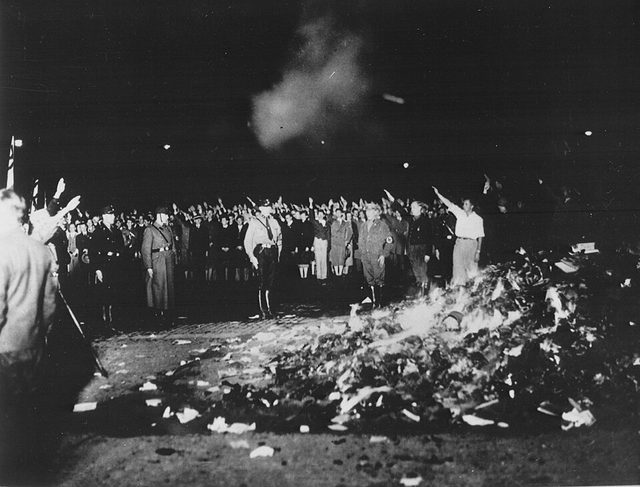
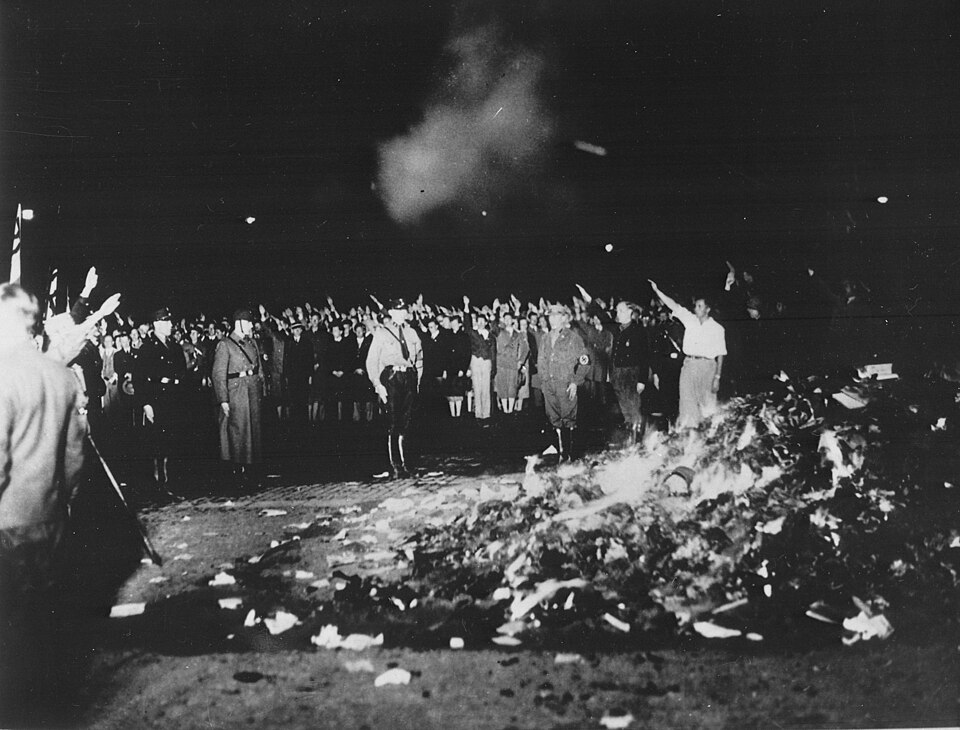
On the night of 10 May 1933 students burned books on the Opernplatz; Goebbels spoke near midnight (details in the book burnings case study). The Bundesarchiv press caption calls the burned works "undeutsche Schriften" (un-German writings), tagged name-calling. That speech is not in the quotes file, so no line from it is given here.
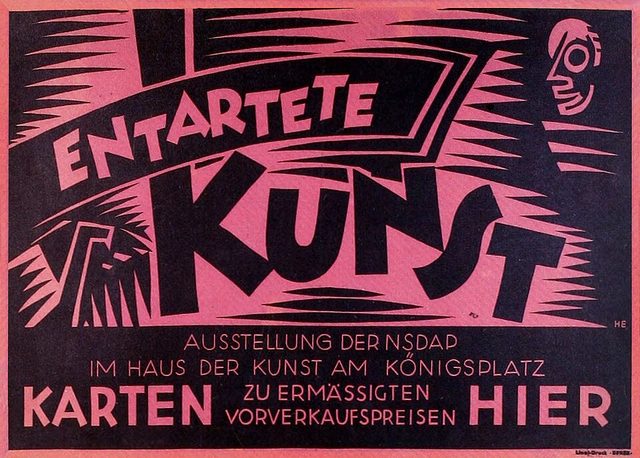
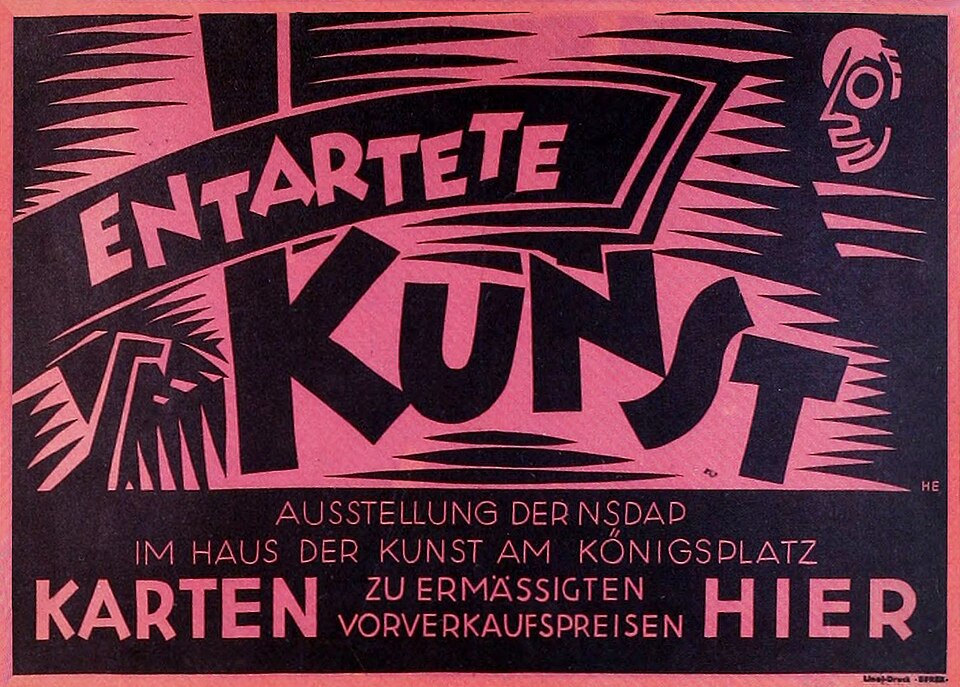
Poster for the "Entartete Kunst" exhibition published in Berlin by Berek (Federal Archive); the title is the label. The entry credits the NSDAP and tags it name-calling and scapegoating.
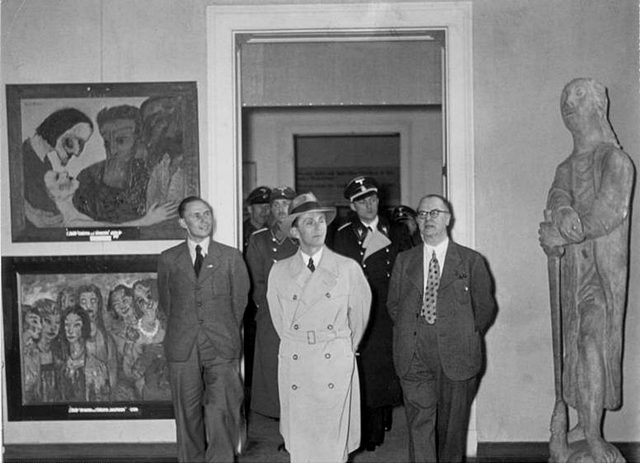
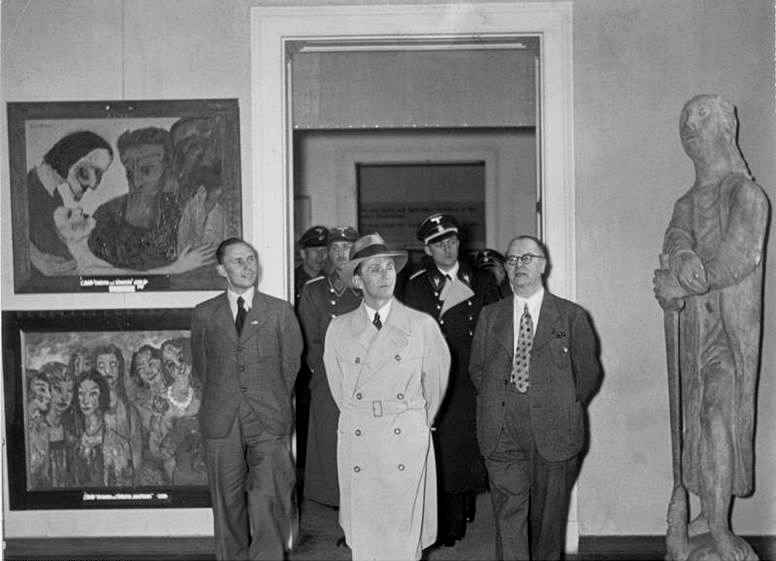
The Bundesarchiv caption dates his visit to Sunday, 27 February 1938, at the Berlin showing.
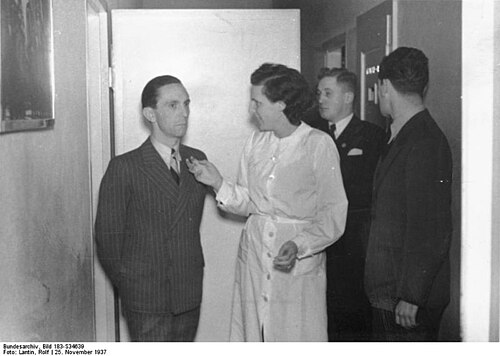
Goebbels visited Leni Riefenstahl on 25 November 1937 during preparations for her film Olympia (Bundesarchiv, Bild 183-S34639, photograph by Rolf Lantin). See Film under Goebbels.
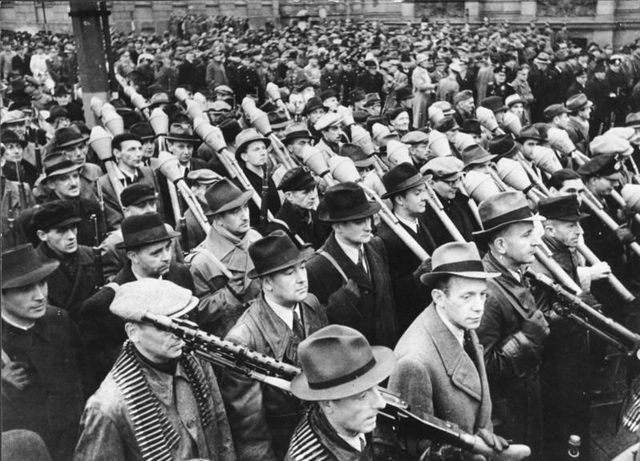
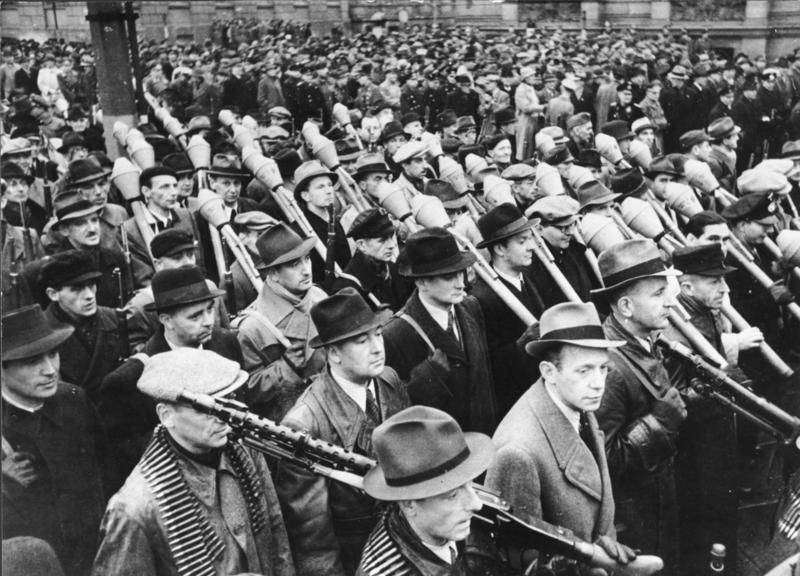
On 12 November 1944 Volkssturm volunteers were sworn in at Berlin and marched past Reich Minister Goebbels (Bundesarchiv caption). The entry notes the event was staged as a mass spectacle for the press and tags it bandwagon and identity fusion.
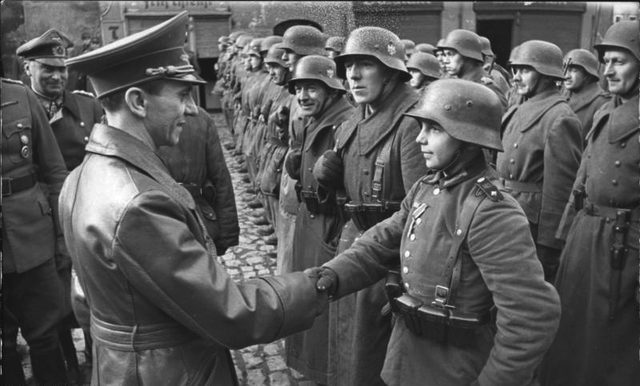
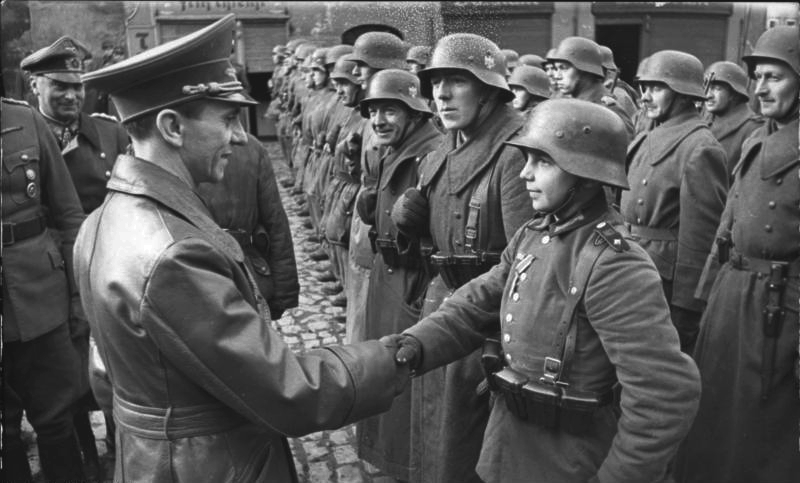
The archive title names the boy as Hitler Youth member Willi Hübner, photographed on 9 March 1945 (Bild 183-J31305). Published accounts identify the man as Goebbels; the entry says that identification rests on those accounts, not on the print. It is tagged transfer.
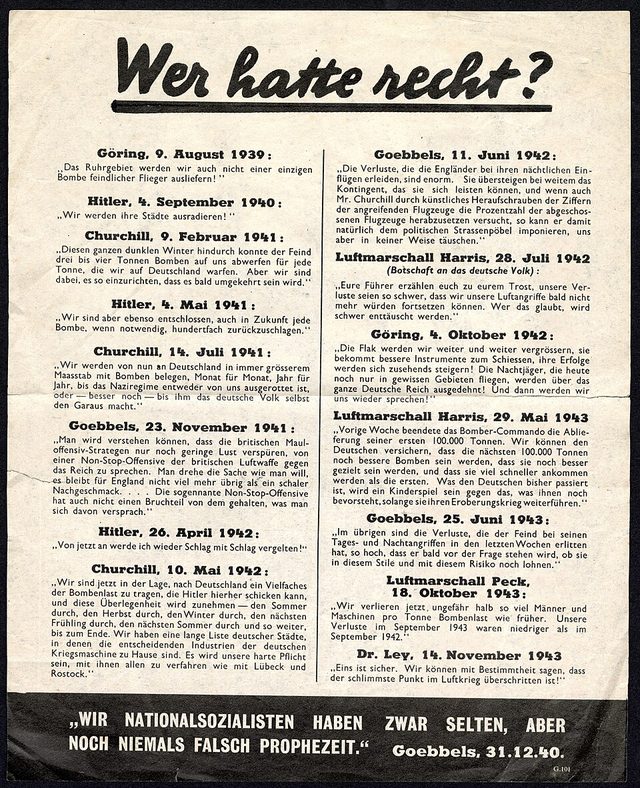
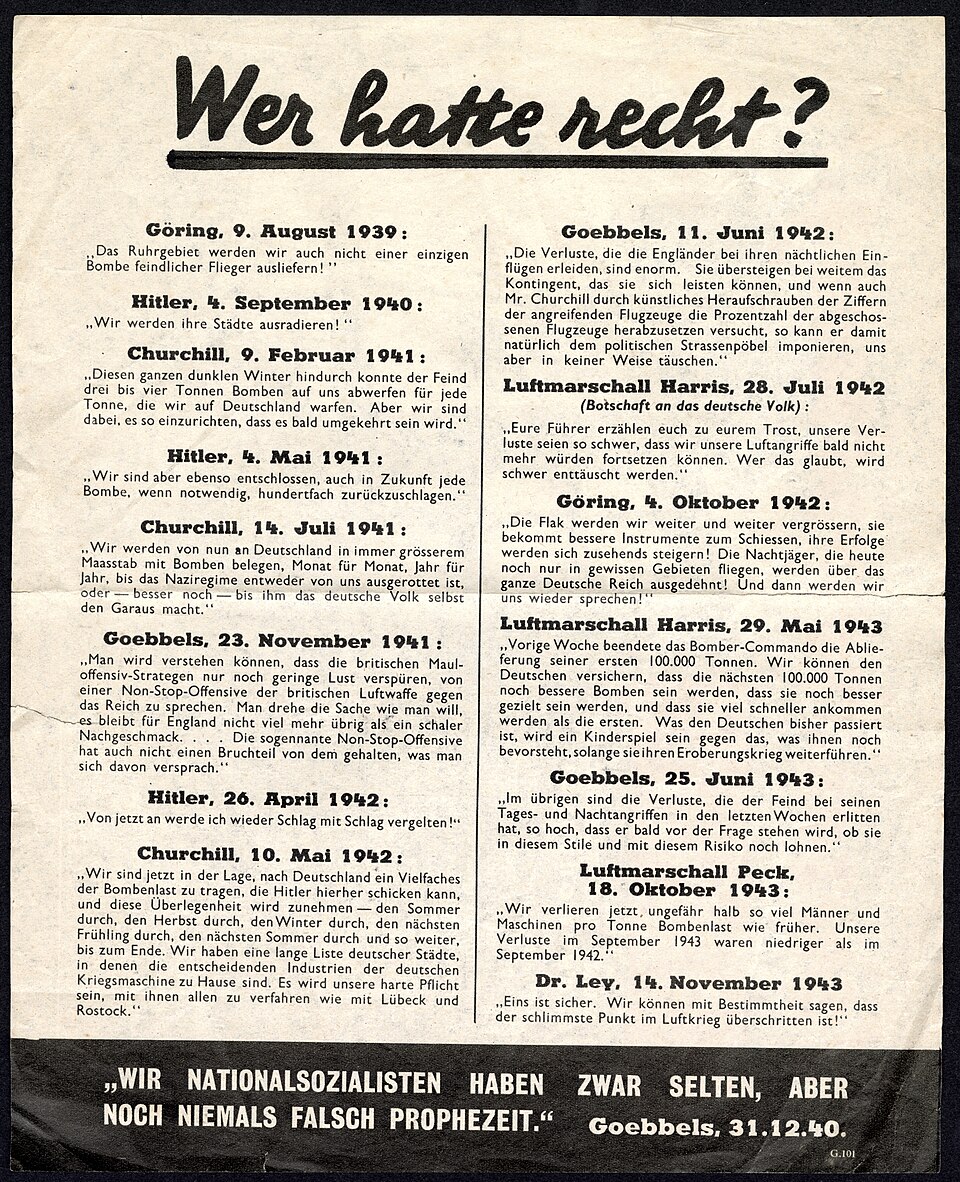
This British leaflet of 1943 prints a line it attributes to Goebbels of 31 December 1940. The entry tags it card-stacking and notes the quotations are as printed on the leaflet, not checked against the originals. That line is therefore not among the verified quotations in this archive.
How did the Allies answer Goebbels's words?
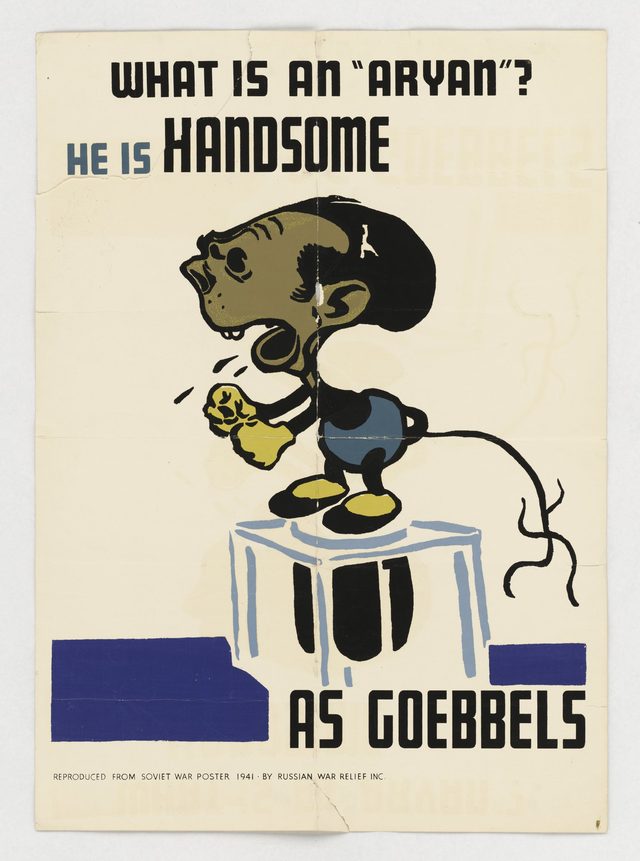
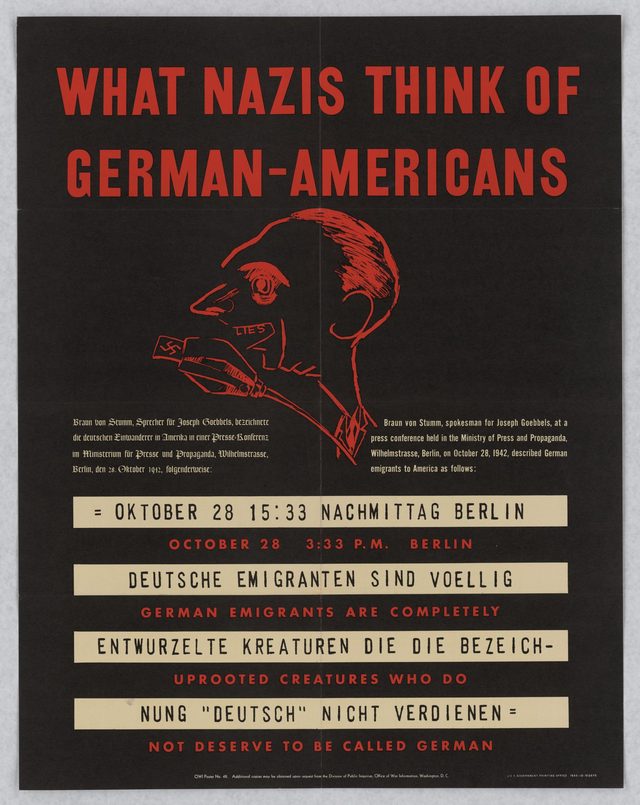
Allied propaganda also quoted him and also caricatured him, and the archive tags it by the same definitions.
Explain moreShow less
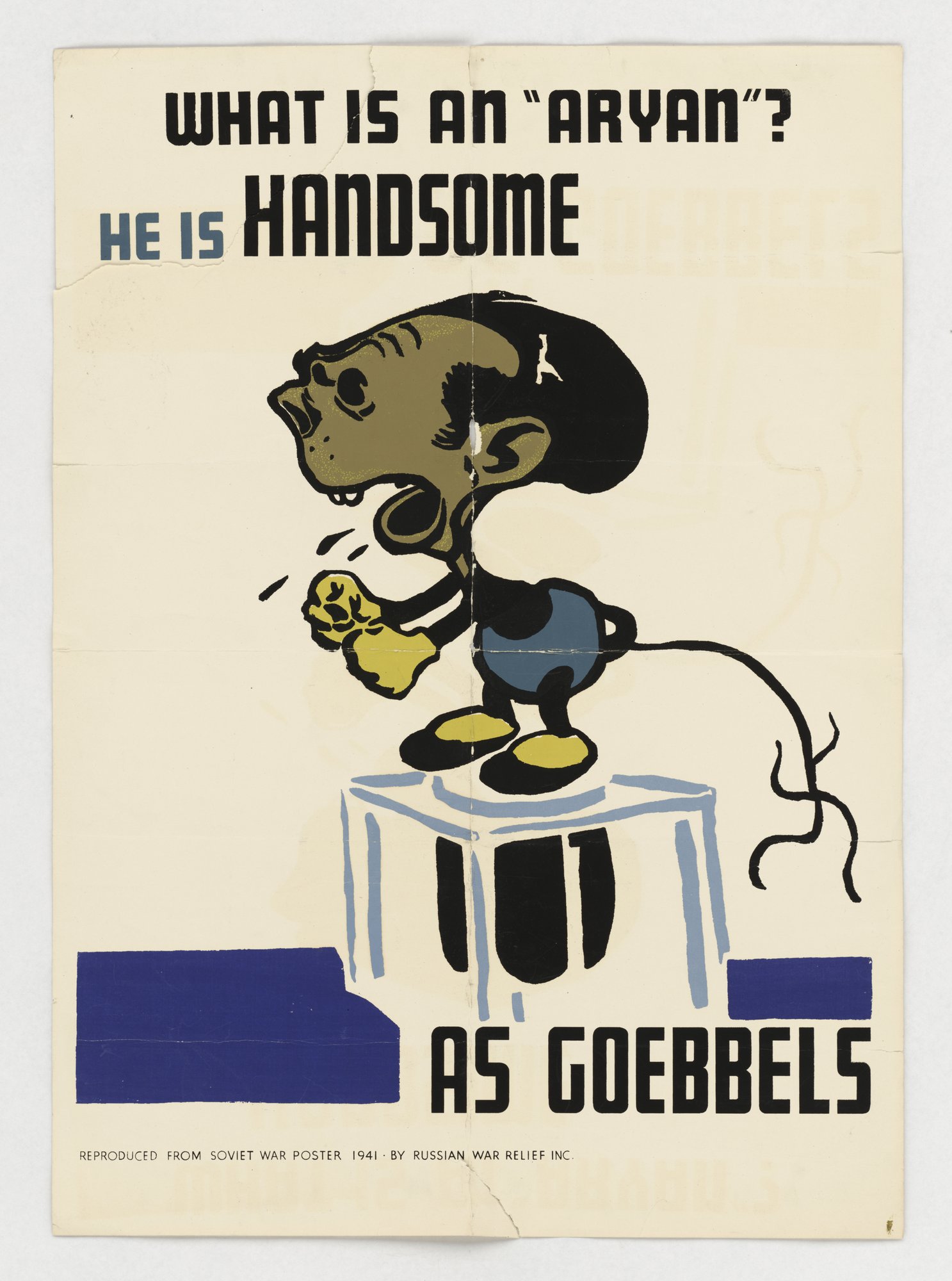
A 1941 Soviet poster reproduced in the United States by the private charity Russian War Relief; the American date is not stated. It is tagged name-calling: an animal caricature and a sarcastic label for a named official, the same technique recorded on the Nazi side.
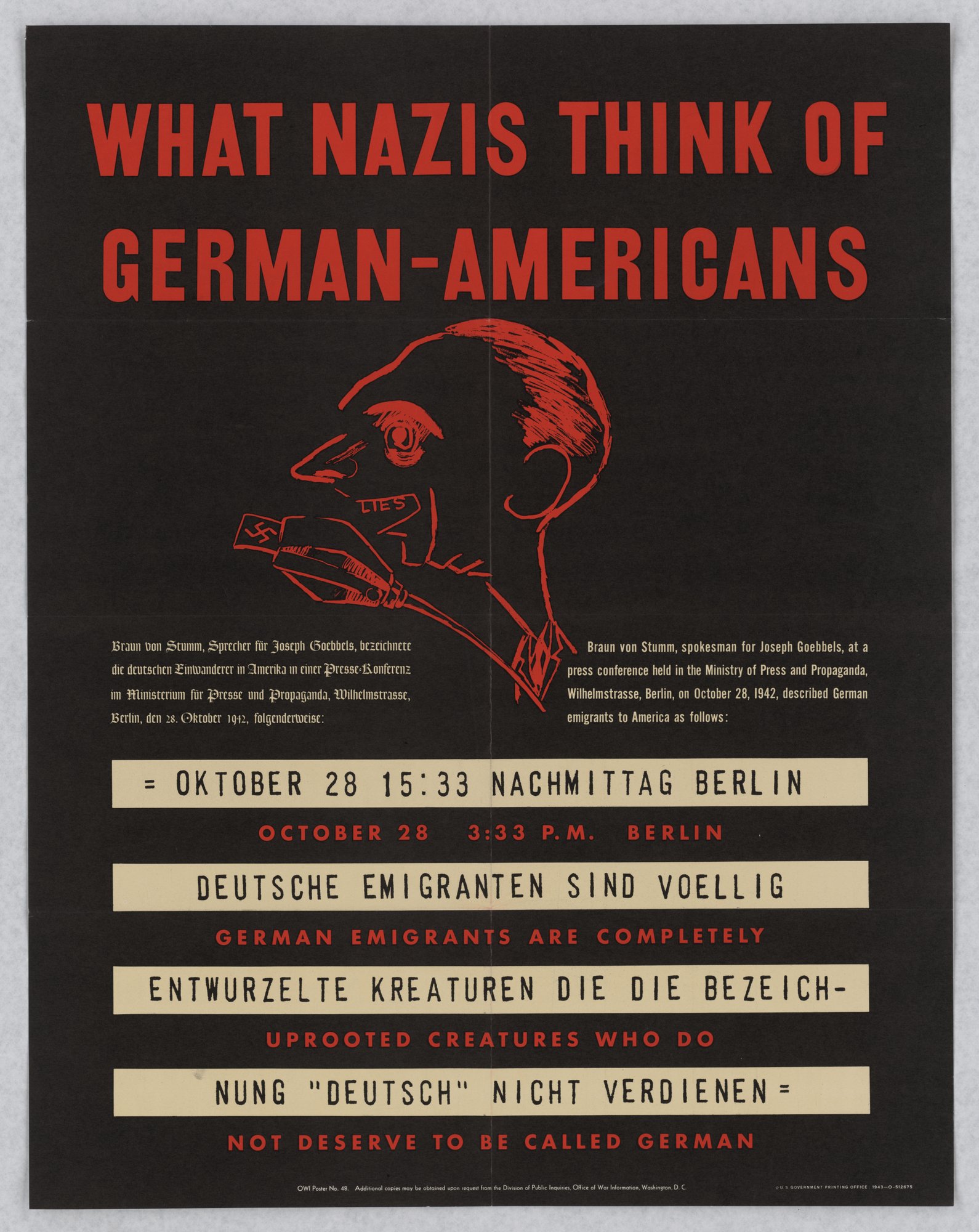
US Office of War Information poster No. 48 (1943) quotes a Berlin spokesman of 28 October 1942, as printed on the sheet without a source. It is tagged card-stacking and name-calling.
Are the Goebbels diaries in the archive?
Only in part. The archive does not host the diaries and the quotes file has no diary entry, so no diary line is given as a quotation on this page. Three repo pages cite them as evidence:
Explain moreShow less
- The Reich Propaganda Ministry case study says his diaries record years of friction with the Reich press chief Otto Dietrich.
- The Film under Goebbels case study cites the entry of 2 November 1939 about Łódź, from Die Tagebücher von Joseph Goebbels, ed. Elke Fröhlich, Part I, vol. 7 (Munich: K. G. Saur, 1998), with the German original and a translation.
- The Nazi propaganda ministry doctrine page records that Leonard Doob's "nineteen principles of Goebbels" (Public Opinion Quarterly 14, 1950) are Doob's reconstruction from the diaries, not a document Goebbels wrote.
Diary entries are private notes, not public statements, and are held to the same source test as the rest: date, edition, translator. Until the archive verifies an entry against an edition, it is cited in a case study and not added to the quotes file.
How to check a Goebbels quote
- Find the date and the publication. A real quote has a speech, an article or a diary entry behind it.
- Check the translator. The quotes here are Bytwerk's translations unless the file says otherwise (the 1928 article is the US prosecution translation).
- Check who is speaking. In the 1941 article he reports what he says the English believe.
Show all 5Show fewer
- Distrust round numbers and slogans. "Repeated a thousand times" has no source here.
- Read the passage, not the line. Each entry in the file says whether the passage is continuous or has cuts.
Sources and further reading
Sources and rights
Quotations: Randall Bytwerk's English translations, German Propaganda Archive, Calvin University…
Quotations: Randall Bytwerk's English translations, German Propaganda Archive, Calvin University (research.calvin.edu/german-propaganda-archive), except the 1928 Der Angriff article, which is the translation in Nazi Conspiracy and Aggression vol. 5. German originals were not checked against the print. Photographs come from the German Federal Archives (Bundesarchiv, via Wikimedia Commons, CC BY-SA 3.0 DE), the US National Archives and the other holders named on each object page. The Völkischer Beobachter page is public domain. Transcriptions are verbatim. Other sources: Doob (1950); Fröhlich (ed.), Die Tagebücher von Joseph Goebbels (1998); Langer, OSS report (1943).