Content note. Several of Mao Zedong's own sentences below advocate terror, executions and the silencing of opponents, and one boasts of killing intellectuals. They are quoted in full, with the date and source of each, as evidence of what he said. The posters show the cult around him as the state issued it, and two leaflets show how his enemies portrayed him. Showing or quoting an item is not endorsing it, and nothing here is a verdict on any people or party.
What are the best-known Mao Zedong quotes, and are they real?
The best-known Mao quotes are real and datable: "Political power grows out of the barrel of a gun" (6 November 1938), "A revolution is not a dinner party" (March 1927) and "We have stood up" (21 September 1949). The archive holds 22 checked quotes from Mao, each with date, source and translator, and rejects 3 widely repeated lines it could not trace to a primary text. Counts are made from the Mao quotes data.
Explain moreShow less
Of the 22, 20 are marked verified against a primary text and 2 are marked verified-secondary, meaning they rest on an unofficial English translation of a Red Guard publication. Seventeen have a Chinese original beside the English. Seven carry a content note because they advocate violence or contempt. The full index is at the quotes index.
Did Mao say "political power grows out of the barrel of a gun"?
Yes. The sentence is in his concluding speech at the Sixth Plenary Session of the Sixth Central Committee, 6 November 1938, published as "Problems of War and Strategy". The Foreign Languages Press (Peking) translation reads:
Explain moreShow less
"Every Communist must grasp the truth, "Political power grows out of the barrel of a gun." Our principle is that the Party commands the gun, and the gun must never be allowed to command the Party."
每个共产党员都应懂得这个真理:“枪杆子里面出政权”。我们的原则是党指挥枪,而决不容许枪指挥党。
Mao Zedong, Problems of War and Strategy, 6 November 1938, in Selected Works of Mao Tse-tung, vol. 2 (Peking: Foreign Languages Press, 1965). Translator: Foreign Languages Press, official English translation.
The record gives the context as the war against Japan and the role of armed force in the Party's work. The second sentence is the part searchers usually leave out: the Party commands the gun. How the Party kept that principle inside the army is on the PLA political commissar system page.
What did Mao say about revolution and violence?
Two sentences come from his March 1927 report on the peasant movement in Hunan, written after a 32-day investigation of five counties and in answer to the charge that the movement was going "too far".
Explain moreShow less
"Secondly, a revolution is not a dinner party, or writing an essay, or painting a picture, or doing embroidery; it cannot be so refined, so leisurely and gentle, so temperate, kind, courteous, restrained and magnanimous. A revolution is an insurrection, an act of violence by which one class overthrows another."
第二,革命不是请客吃饭,不是做文章,不是绘画绣花,不能那样雅致,那样从容不迫,文质彬彬,那样温良恭俭让。革命是暴动,是一个阶级推翻一个阶级的暴烈的行动。
Report on an Investigation of the Peasant Movement in Hunan, March 1927, in Selected Works of Mao Tse-tung, vol. 1 (Foreign Languages Press, Peking, 1965). Translator: Foreign Languages Press.
From the same report, in the section answering the objection that peasant associations were punishing landlords and "evil gentry":
"To put it bluntly, it is necessary to create terror for a while in every rural area, or otherwise it would be impossible to suppress the activities of the counter-revolutionaries in the countryside or overthrow the authority of the gentry. Proper limits have to be exceeded in order to right a wrong, or else the wrong cannot be righted."
质言之,每个农村都必须造成一个短时期的恐怖现象,非如此决不能镇压农村反革命派的活动,决不能打倒绅权。矫枉必须过正,不过正不能矫枉
Same report and translator.
The first line is often quoted alone. The second is the same argument stated bluntly, and the archive marks it with a content note because it advocates terror against landlords and counter-revolutionaries.
What did Mao say about art, enemies and the right to speak?
In the 1942 Yenan talks on literature and art, the opening remarks set the function of the arts:
Explain moreShow less
"The purpose of our meeting today is precisely to ensure that literature and art fit well into the whole revolutionary machine as a component part, that they operate as powerful weapons for uniting and educating the people and for attacking and destroying the enemy, and that they help the people fight the enemy with one heart and one mind."
我们今天开会,就是要使文艺很好地成为整个革命机器的一个组成部分,作为团结人民、教育人民、打击敌人、消灭敌人的有力的武器,帮助人民同心同德地和敌人作斗争。
Talks at the Yenan Forum on Literature and Art, 2 May 1942, in Selected Works, vol. 3 (Foreign Languages Press, 1965).
In "On the People's Democratic Dictatorship" (30 June 1949, three months before the People's Republic was proclaimed) he answered critics who called the coming state dictatorial and not benevolent:
""You are dictatorial." My dear sirs, you are right, that is just what we are. All the experience the Chinese people have accumulated through several decades teaches us to enforce the people's democratic dictatorship, that is, to deprive the reactionaries of the right to speak and let the people alone have that right."
“你们独裁。”可爱的先生们,你们讲对了,我们正是这样。中国人民在几十年中积累起来的一切经验,都叫我们实行人民民主专政,或曰人民民主独裁,总之是一样,就是剥夺反动派的发言权,只让人民有发言权。
""You are not benevolent!" Quite so. We definitely do not apply a policy of benevolence to the reactionaries and towards the reactionary activities of the reactionary classes."
“你们不仁。”正是这样。我们对于反动派和反动阶级的反动行为,决不施仁政。我们仅仅施仁政于人民内部,而不施于人民外部的反动派和反动阶级的反动行为。
On the People's Democratic Dictatorship, 30 June 1949, in Selected Works, vol. 4 (Foreign Languages Press, 1961).
From the same essay, in a passage the archive records as three adjacent sentences, uncut, he also wrote about the end state he said the Party was aiming for:
"We, on the contrary, declare openly that we are striving hard to create the very conditions which will bring about their extinction. The leadership of the Communist Party and the state power of the people's dictatorship are such conditions. Anyone who does not recognize this truth is no communist."
我们则公开声明,恰是为着促使这些东西的消灭而创设条件,而努力奋斗。共产党的领导和人民专政的国家权力,就是这样的条件。不承认这一条真理,就不是共产主义者。
"Their" refers to the classes, parties and state machinery named in the sentence before it, which the archive also holds: "When classes disappear, all instruments of class struggle -- parties and the state machinery -- will lose their function, cease to be necessary, therefore gradually wither away and end their historical mission; and human society will move to a higher stage." (30 June 1949, same essay and translator.)
What did Mao say when the People's Republic was founded?
On 21 September 1949, opening the First Plenary Session of the Chinese People's Political Consultative Conference before some 600 delegates, a little over a week before the People's Republic was proclaimed on 1 October 1949:
"Ours will no longer be a nation subject to insult and humiliation. We have stood up."
我们的民族将再也不是一个被人侮辱的民族了,我们已经站起来了。
Opening address, 21 September 1949, in Selected Works, vol. 4. Translator: Foreign Languages Press.
The archive's page on the state that followed is the People's Republic of China under Mao.
What did Mao say about "poisonous weeds" and the Hundred Flowers?
The 1957 quotes are the ones most often shown without their dates. Read in order they show a policy and then its reversal. On 27 February 1957 he said, in a speech he revised before it was printed in the People's Daily on 19 June:
Explain moreShow less
"Letting a hundred flowers blossom and a hundred schools of thought contend is the policy for promoting progress in the arts and sciences and a flourishing socialist culture in our land. Different forms and styles in art should develop freely and different schools in science should contend freely. We think that it is harmful to the growth of art and science if administrative measures are used to impose one particular style of art or school of thought and to ban another."
百花齐放、百家争鸣的方针,是促进艺术发展和科学进步的方针,是促进我国的社会主义文化繁荣的方针。艺术上不同的形式和风格可以自由发展,科学上不同的学派可以自由争论。利用行政力量,强制推行一种风格,一种学派,禁止另一种风格,另一种学派,我们认为会有害于艺术和科学的发展。
On the Correct Handling of Contradictions Among the People, 27 February 1957, in Selected Works, vol. 5. The text is the version Mao revised for publication, not the verbatim record.
On 12 March 1957, to Party propaganda officials:
"All erroneous ideas, all poisonous weeds, all ghosts and monsters, must be subjected to criticism; in no circumstances should they be allowed to spread freely. However, the criticism should be fully reasoned, analytical and convincing, and neither rough and bureaucratic, nor metaphysical and dogmatic."
凡是错误的思想,凡是毒草,凡是牛鬼蛇神,都应该进行批判,决不能让他们自由泛滥。但是,这种批判,应该是充分说理的、有分析的、有说服力的,而不应该是粗暴的、官僚主义的,或者是形而上学的、教条主义的。
On 15 May 1957, in an article circulated among Party cadres about three weeks before the Anti-Rightist Campaign began:
"The current criticism and rectification movement has been launched by the Communist Party. As we expected and hoped, poisonous weeds have been growing side by side with fragrant flowers and ghosts and monsters appearing together with the unicorn and phoenix. Anyway, good things outnumber bad. Some say we are trying to catch big fish, and we say we are digging up poisonous weeds, which are only different ways of saying the same thing."
这一次批评运动和整风运动是共产党发动的。毒草共香花同生,牛鬼蛇神与麟凤龟龙并长,这是我们所料到的,也是我们所希望的。毕竟好的是多数,坏的是少数。人们说钓大鱼,我们说锄毒草,事情一样,说法不同。
On 8 June 1957, in an inner-Party directive:
"Better let the reactionary professors, lecturers, assistants and students spew out their venom and speak without any inhibitions. They are the best teachers."
最好让反动的教授、讲师、助教及学生大吐毒素,畅所欲言。他们是最好的教员。
On 9 July 1957, to cadres in Shanghai, a month into the Anti-Rightist Campaign:
"Let ghosts and monsters come out and make an exhibition of themselves, and afterwards the people will say these ghosts and monsters are no good and must be eliminated. Let poisonous weeds sprout, then uproot them and plough them under for manure."
牛鬼蛇神让它出来,然后展览,展览之后,大家说牛鬼蛇神不好,要打倒。毒草让它出来,然后锄掉,锄倒可以作肥料。
All five translated by the Foreign Languages Press (March, May, June and July texts from Selected Works, vol. 5). The archive flags the July text with a content note because it labels critics "ghosts and monsters" and "poisonous weeds" to be uprooted.
The labels in these lines are name-calling in the archive's definition: a loaded term attached to a target so that it is rejected unheard. The archive applies the same definition to every issuer.
What did Mao say about executions and the first emperor?
Two quotes are in the file with content notes for the violence they state. The first is an internal directive of 17 January 1951 during the Campaign to Suppress Counter-Revolutionaries, drafted after reports of executions in western Hunan. The record notes that the same group of directives also urges care to avoid wrong executions.
Explain moreShow less
"To strike surely means to pay attention to tactics. To strike accurately means to avoid wrong executions. To strike relentlessly means resolutely to kill all such reactionary elements as deserve the death penalty (of course, those who don't will not be executed). So long as we avoid wrong executions, we don't have to worry even if the bourgeoisie raises an outcry."
所谓打得稳,就是要注意策略。打得准,就是不要杀错。打得狠,就是要坚决地杀掉一切应杀的反动分子(不应杀者,当然不杀)。只要我们不杀错,资产阶级虽有叫唤,也就不怕他们叫唤。
Strike Surely, Accurately and Relentlessly in Suppressing Counter-Revolutionaries, directive of 17 January 1951, in Selected Works, vol. 5 (Foreign Languages Press).
The second is the 8 May 1958 remark at the Second Session of the Eighth Party Congress, made after Lin Biao interjected that the first emperor, Qin Shi Huang, had "burned the books and buried the scholars alive". This one is graded verified-secondary: the English comes from an unofficial translation of a Red Guard compilation, so the wording may differ in other translations, and the archive has no Chinese text for it.
"What did he amount to? He only buried alive 460 scholars, while we buried 46,000. In our suppression of the counter-revolutionaries, did we not kill some counter-revolutionary intellectuals? I once debated with the democratic people: You accuse us of acting like Ch’in-shih-huang, but you are wrong; we surpass him 100 times. You berate us for imitating Ch’in-shih-huang in enforcing dictatorship. We admit them all. What is regrettable is that you did not say enough. We have had to say it for you."
Speech of 8 May 1958, English translation of the Red Guard publication "Long Live Mao Zedong Thought", via the Maoist Documentation Project on marxists.org. Translator: unofficial, as given there.
What did Mao say about the atom bomb and about his own responsibility?
On 6 August 1946, answering the American writer Anna Louise Strong on what would follow if the United States used the atom bomb against the Soviet Union:
Explain moreShow less
"The atom bomb is a paper tiger which the U.S. reactionaries use to scare people. It looks terrible, but in fact it isn't. Of course, the atom bomb is a weapon of mass slaughter, but the outcome of a war is decided by the people, not by one or two new types of weapon."
原子弹是美国反动派用来吓人的一只纸老虎,看样子可怕,实际上并不可怕。当然,原子弹是一种大规模屠杀的武器,但是决定战争胜败的是人民,而不是一两件新式武器。
Talk with Anna Louise Strong, August 1946, in Selected Works, vol. 4 (Foreign Languages Press, 1961). The day comes from the Chinese text page.
On 30 January 1962, to a conference of about 7,000 cadres held after the Great Leap Forward and the famine of 1959-61:
"Any mistakes that the Centre has made ought to be my direct responsibilty, and I also have an indirect share in the blame because I am the Chairman of the Central Committee. I don’t want other people to shirk their responsibility."
Talk of 30 January 1962, English translation in Peking Review, no. 27 (7 July 1978), as reproduced on marxists.org. The misspelling "responsibilty" is in that transcription and is kept. The page notes the text differs significantly from at least one existing edition.
The context for that admission is the Great Leap Forward yield claims case study.
What did Mao say during the Cultural Revolution?
Two sources are in the file. The first is "Bombard the Headquarters - My First Big-Character Poster", dated 5 August 1966, written during the Eleventh Plenum of the Eighth Central Committee about the handling of the early movement by "some leading comrades from the central down to the local levels". The English is the text printed in Peking Review, no. 33 (3 November 1967):
Explain moreShow less
"Adopting the reactionary stand of the bourgeoisie, they have enforced a bourgeois dictatorship and struck down the surging movement of the great cultural revolution of the proletariat. They have stood facts on their head and juggled black and white, encircled and suppressed revolutionaries, stifled opinions differing from their own, imposed a white terror, and felt very pleased with themselves."
The second is a talk of 23 August 1966 at a central work conference, graded verified-secondary because the English is an unofficial translation of a Red Guard compilation:
"The main question is what policy to adopt towards the so-called chaos at various places. In my opinion, we should let the chaos go on for a few months and just firmly believe that the majority is good and only the minority bad."
How the 5 August note was turned into a national campaign is the subject of the Cultural Revolution big-character posters case study.
What did Mao say to Nixon and Kissinger?
Two lines come from US memoranda of conversation printed in Foreign Relations of the United States. The English is the American interpreter's record, and the Chinese record of each meeting is a separate account that does not match word for word.
Explain moreShow less
On 21 February 1972, at his first meeting with President Nixon (interpreter: Tang Wen-sheng): "I like rightists. People say you are rightists, that the Republican Party is to the right, that Prime Minister Heath is also to the right. [...] I am comparatively happy when these people on the right come into power." The record marks the omitted lines with [...].
On 17-18 February 1973, in a late-night conversation with Henry Kissinger, with Zhou Enlai present: "You know China is a very poor country. We don’t have much. What we have in excess is women. [...] So if you want them we can give a few of those to you, some tens of thousands. [...] Let them go to your place. They will create disasters. That way you can lessen our burdens." The record has Kissinger and Zhou replying, both noted with laughter. The archive marks this one with a content note because it offers women as an export commodity in a joke to a foreign official.
How did the state show Mao and his book in pictures?
The objects below were issued by or for the People's Republic or photographed in it. They are scored for technique, not for the truth of the claims they carry. The cult of personality page defines the main technique and applies it to Mao, Stalin, Mussolini and others on the same terms.
Explain moreShow less
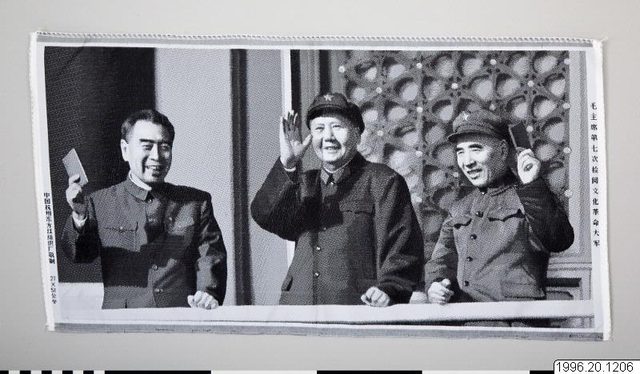
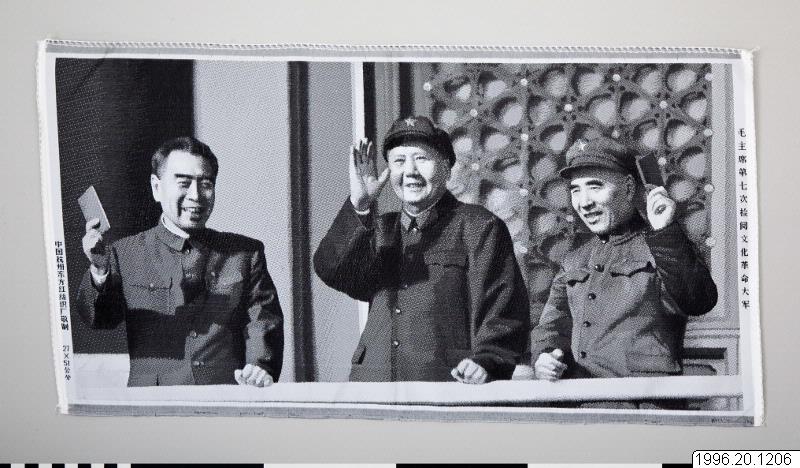
Woven silk from the Hangzhou Dongfanghong (The East Is Red) Silk Weaving Factory, 1966, museum inventory 1996.20.1206. The vertical caption calls the scene Mao's "seventh review" of the "great army of the Cultural Revolution", placing it in the autumn 1966 series of Red Guard receptions in Beijing. The entry tags it transfer and cult of personality. Read the technique: transfer.
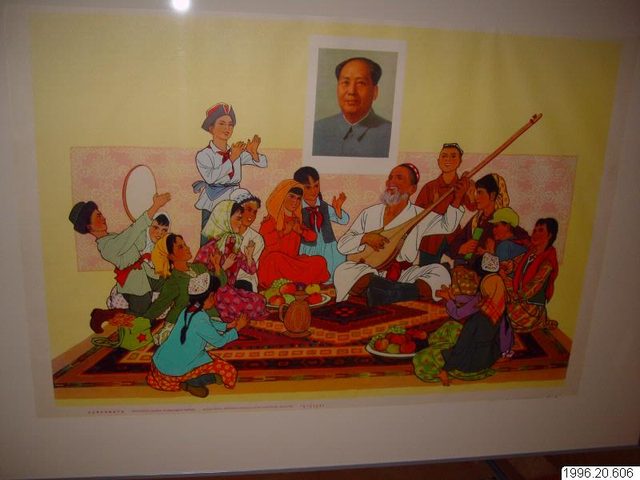
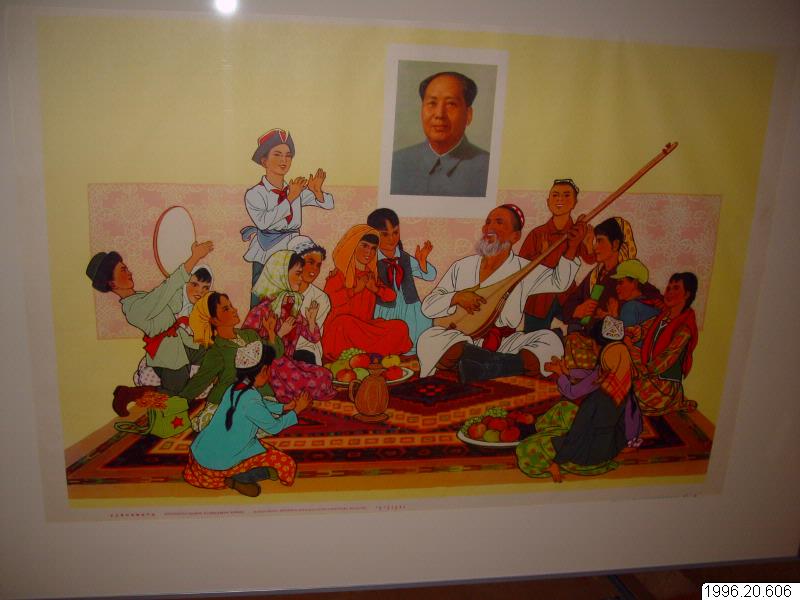
Poster, Xinjiang, 1973, museum inventory 1996.20.0606. The museum's English title is "We never stop praising the thoughts of our Chairmain [sic] Mao". The portrait is the focal point and the household joins in. Tagged transfer, bandwagon and cult of personality.
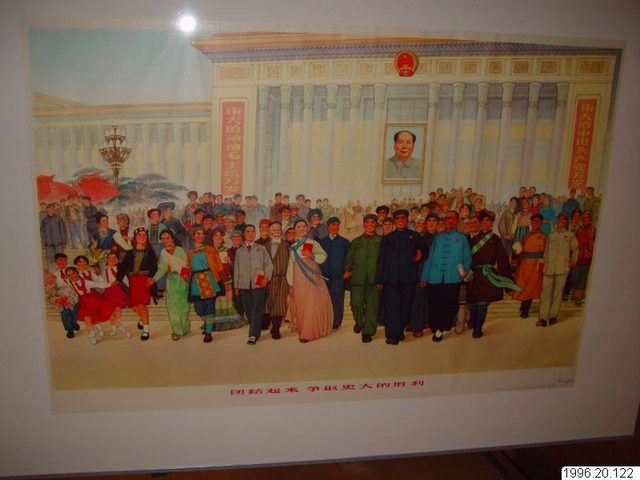
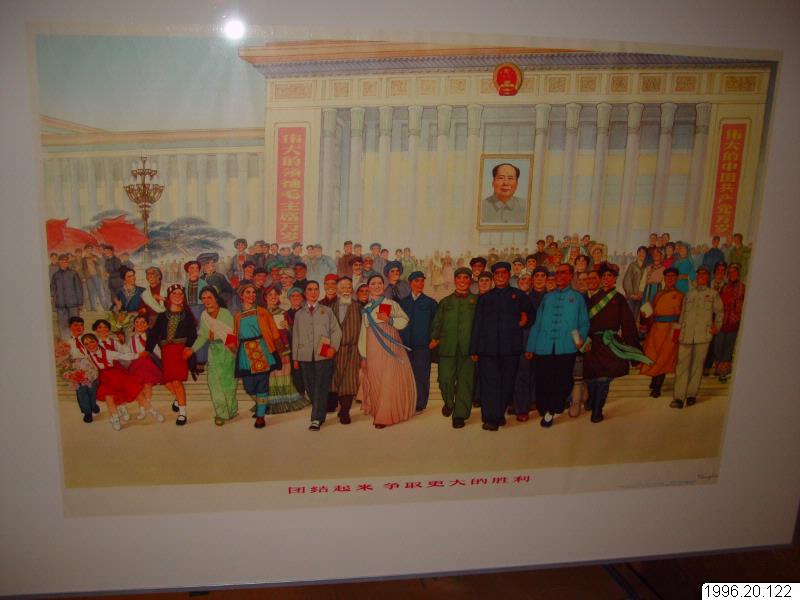
Poster, Shanghai, 1974, museum inventory 1996.20.0122, titled in English "Join together to achieve greater victories!". Many of the marchers hold small red books. Unanimity is the argument: every group walks one way under one portrait. Tagged bandwagon and transfer. Read the technique: bandwagon.
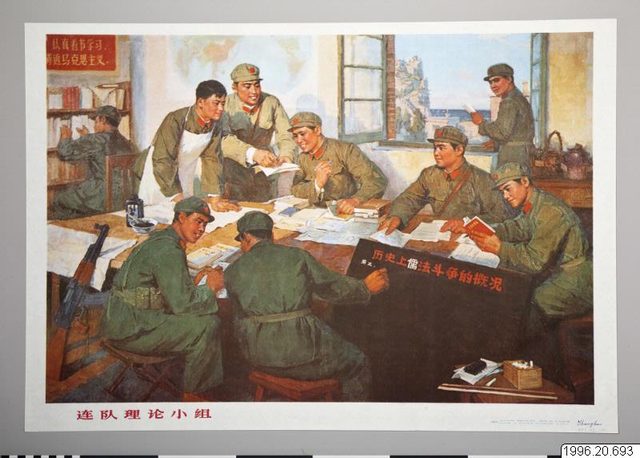
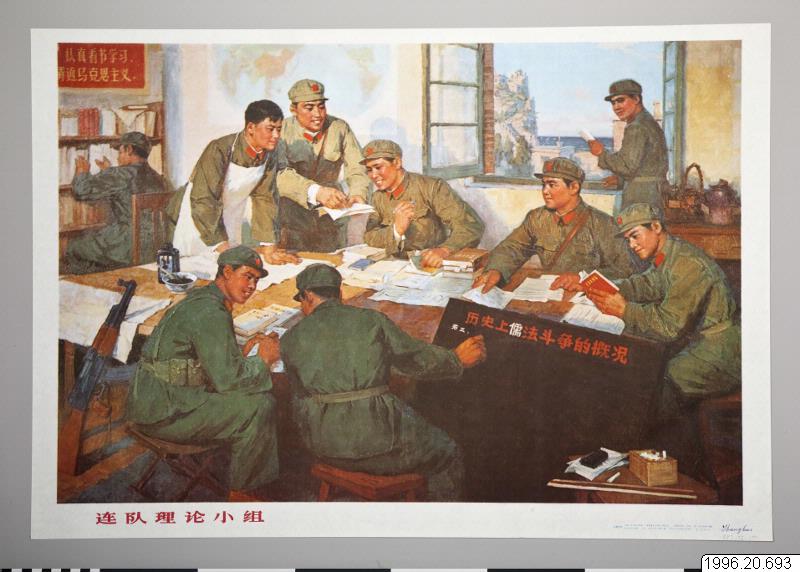
Poster, Shanghai, 1975, museum inventory 1996.20.0693. The blackboard reads "Third: an outline of the Confucian-Legalist struggle in history", a topic of the 1973-1976 "Criticize Lin, Criticize Confucius" campaign. Study is staged as the army's routine, with one soldier holding a small red book. Tagged transfer and glittering generalities.
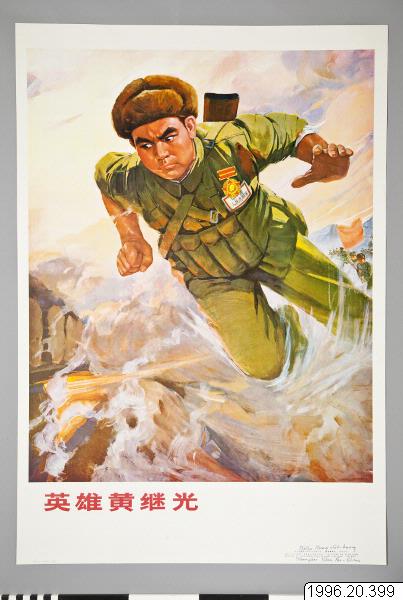
Poster, Shanghai, 1973, museum inventory 1996.20.0399. One named martyr's image carries the message with no argument attached. In the official Chinese account Huang Jiguang (1931-1952) was a Chinese People's Volunteer killed at the Battle of Triangle Hill; the entry notes that accounts of the battle differ between sources and scores only the poster. Tagged transfer.
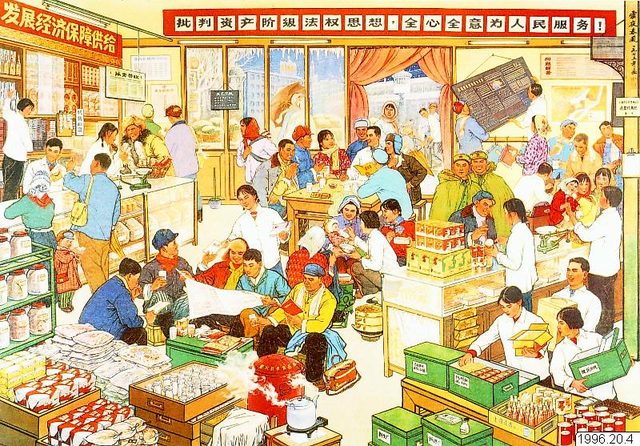
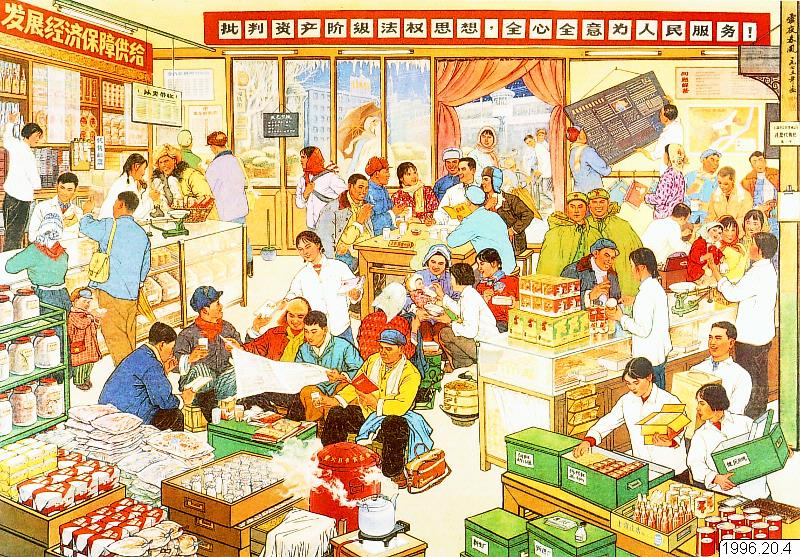
Poster, Shanghai, 1976, museum inventory 1996.20.0004, English title "Spring breezes in the snowy night". The banner reads "Criticize bourgeois-right thinking, serve the people wholeheartedly!". The slogan uses virtue phrases as the warrant for a campaign line with no testable claim attached. Tagged glittering generalities. Read the technique: glittering generalities.
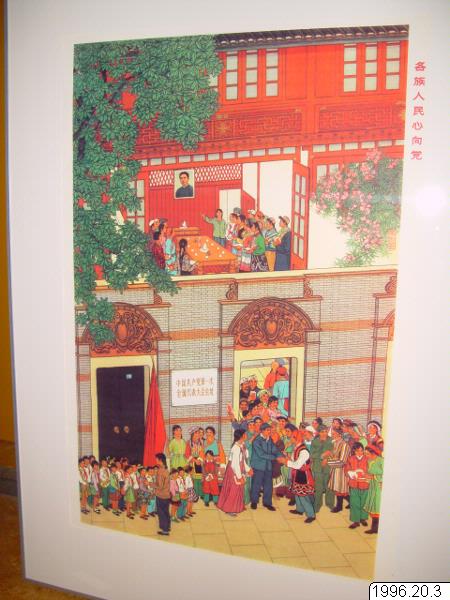
Poster, Shanghai, 1976, museum inventory 1996.20.0003. The founding-site setting lends the Party's first-meeting prestige to the message (transfer), and the multi-ethnic crowd stands for "all peoples" as evidence of support (bandwagon). The museum photographed it at an angle, so the resolution is low.
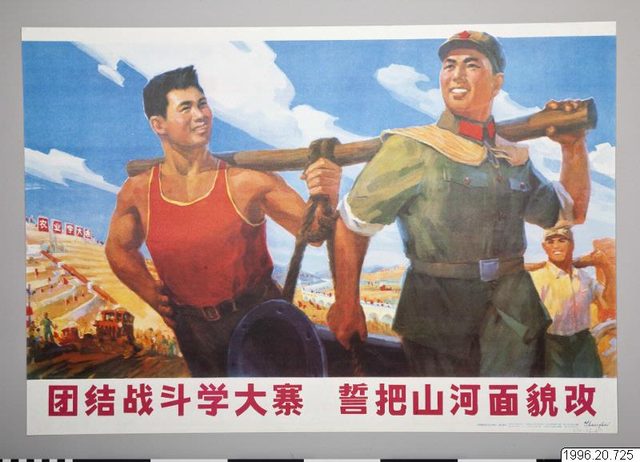
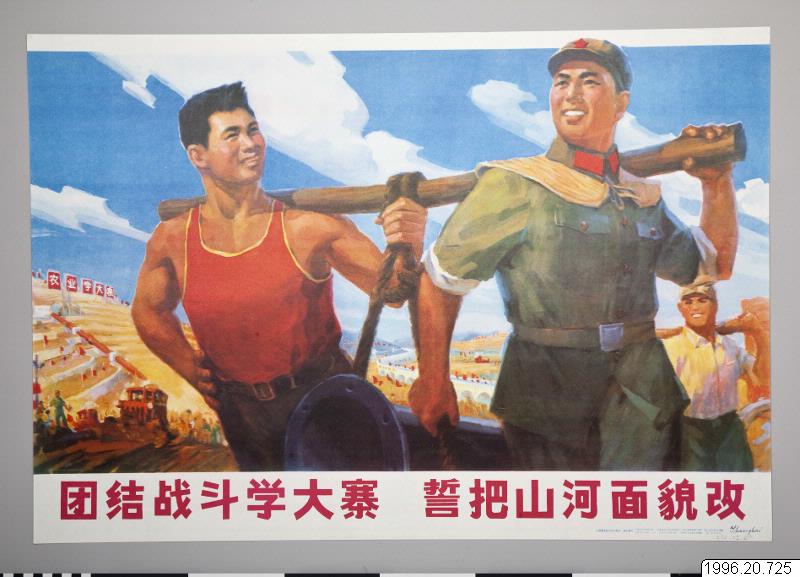
Poster, Shanghai, 1976, museum inventory 1996.20.0725. "In agriculture, learn from Dazhai" was a national campaign from 1964 that held up one Shanxi brigade as a model. The entry notes that Chinese authorities themselves reassessed the model from 1978, and that 1976 was the year Mao died in September.
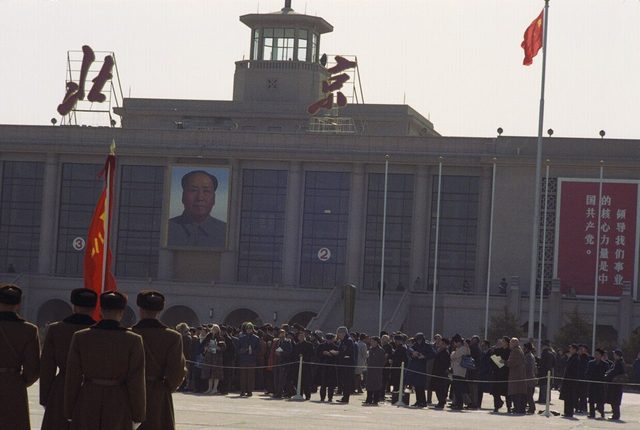
White House Photo Office image of 21 February 1972, the arrival of President Nixon's party at Beijing airport (Richard Nixon Presidential Library, via the National Archives). It is a US Government photograph of a PRC display. The entry says the banner's wording is a sentence from Mao's opening address to the First National People's Congress in 1954 that was also printed in the Quotations from Chairman Mao. Tagged transfer.
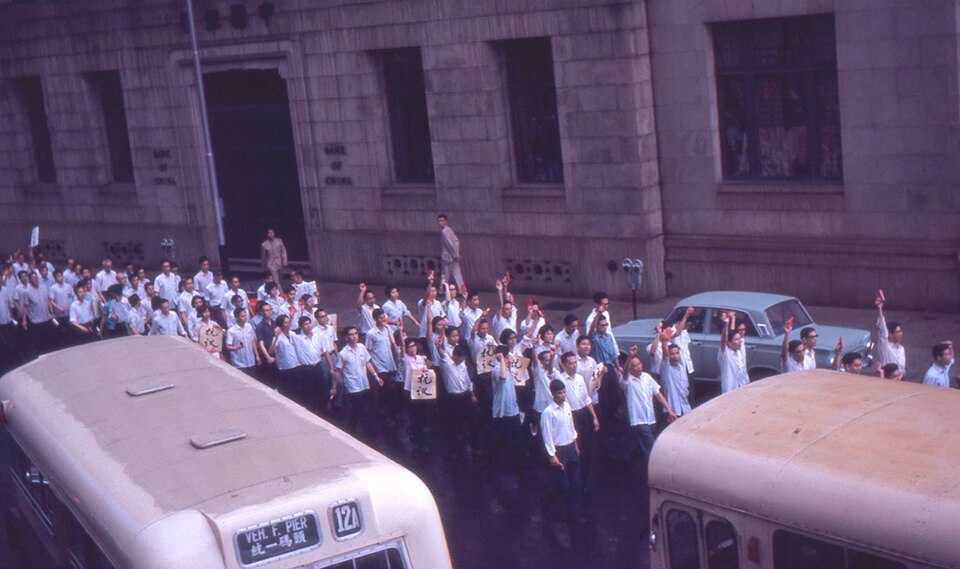
Demonstrators in Hong Kong on 20 May 1967, raising small red books of Mao's sayings during the 1967 Hong Kong disturbances. The case study notes it was taken in Hong Kong, not on the mainland, in the same months as the Red Guard movement. Photograph by Roger W, CC BY-SA 2.0, via Wikimedia Commons. See Red Guards and youth mobilization.
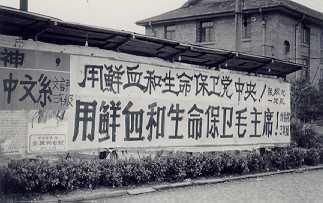
Fudan University, Shanghai, spring 1976: "Defend the Party Central Committee with blood and life! Defend Chairman Mao with blood and life!" Public domain photograph by Wikimedia user Villa Giulia. It dates from the end of the Cultural Revolution and is shown for the form of the loyalty slogan.
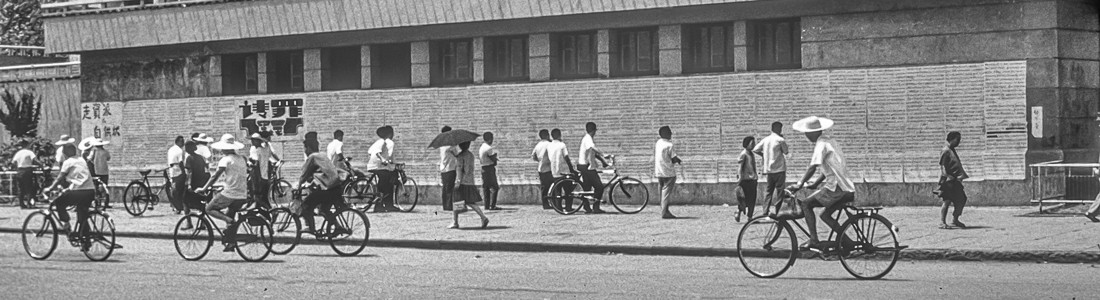
Big-character posters in Beijing, 22 August 1976, photograph by Heinz Bunse, CC BY-SA 2.0. The posters date from 1976, not 1966; the picture shows the form, a public wall of handwritten sheets anyone could read and add to. Mao's own 5 August 1966 note, quoted above, is called his first big-character poster.
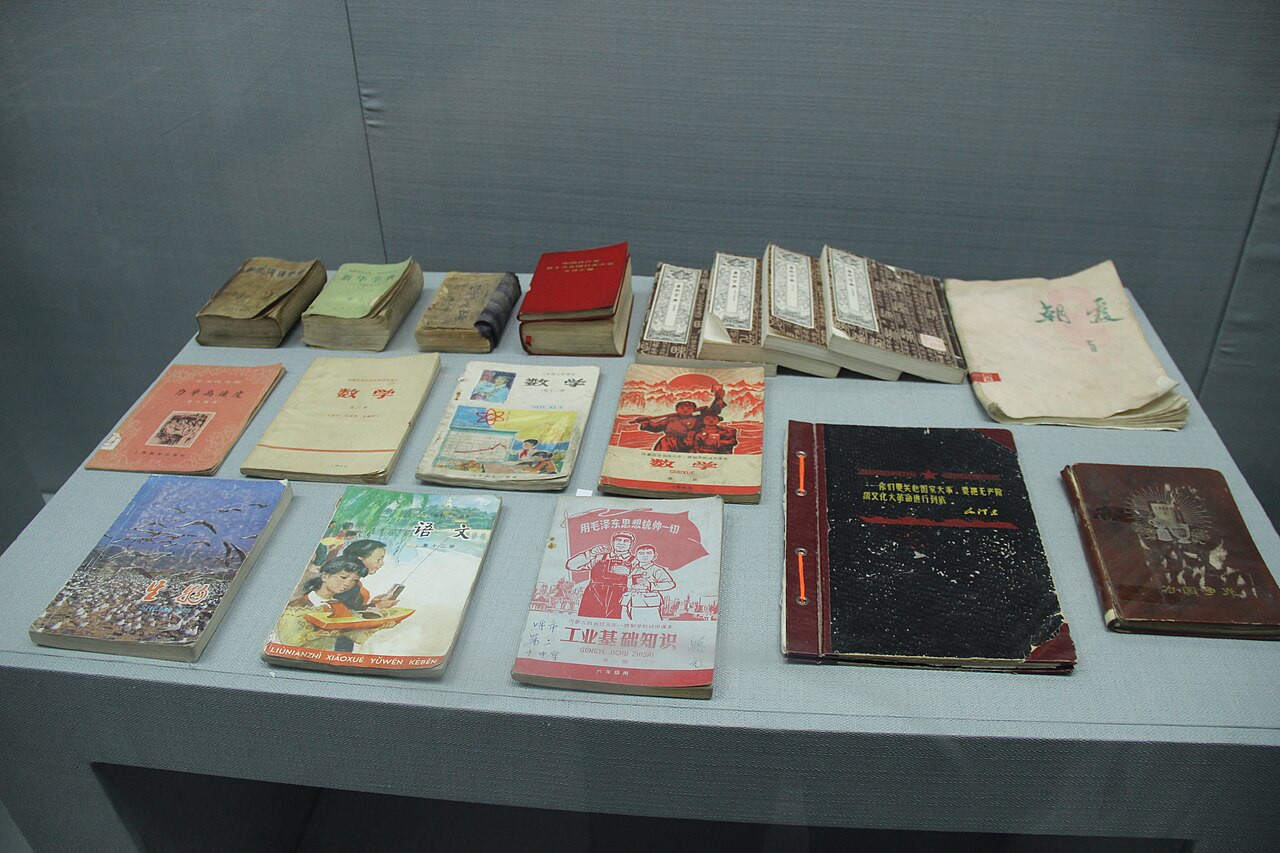
School textbooks and notebooks in the Inner Mongolia Museum, Hohhot, photographed 14 July 2015 (CC0). One cover carries the slogan "Use Mao Zedong Thought to unify everything". See Maoist school curriculum control.
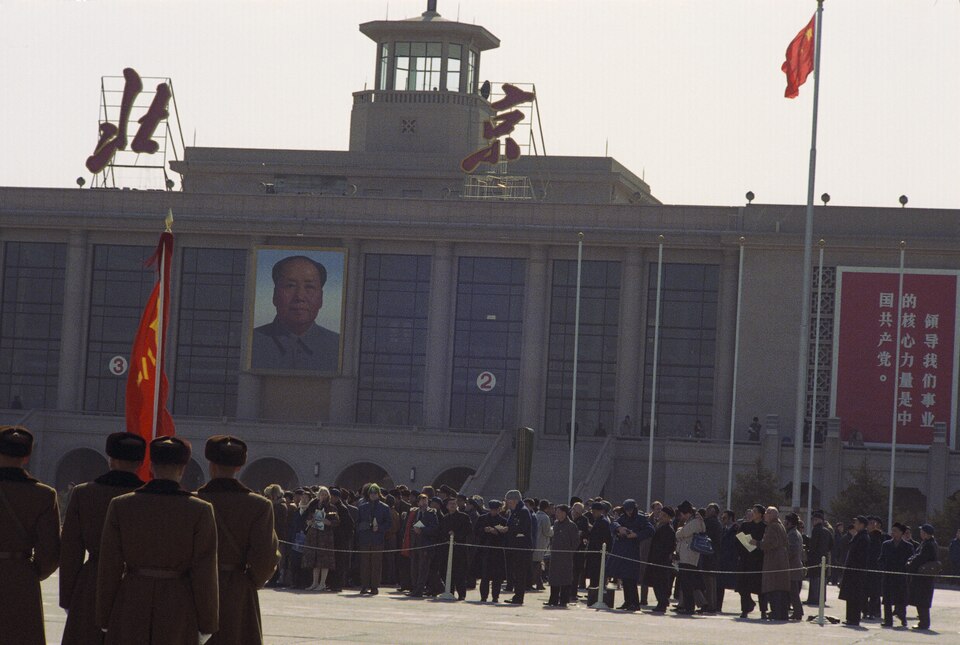
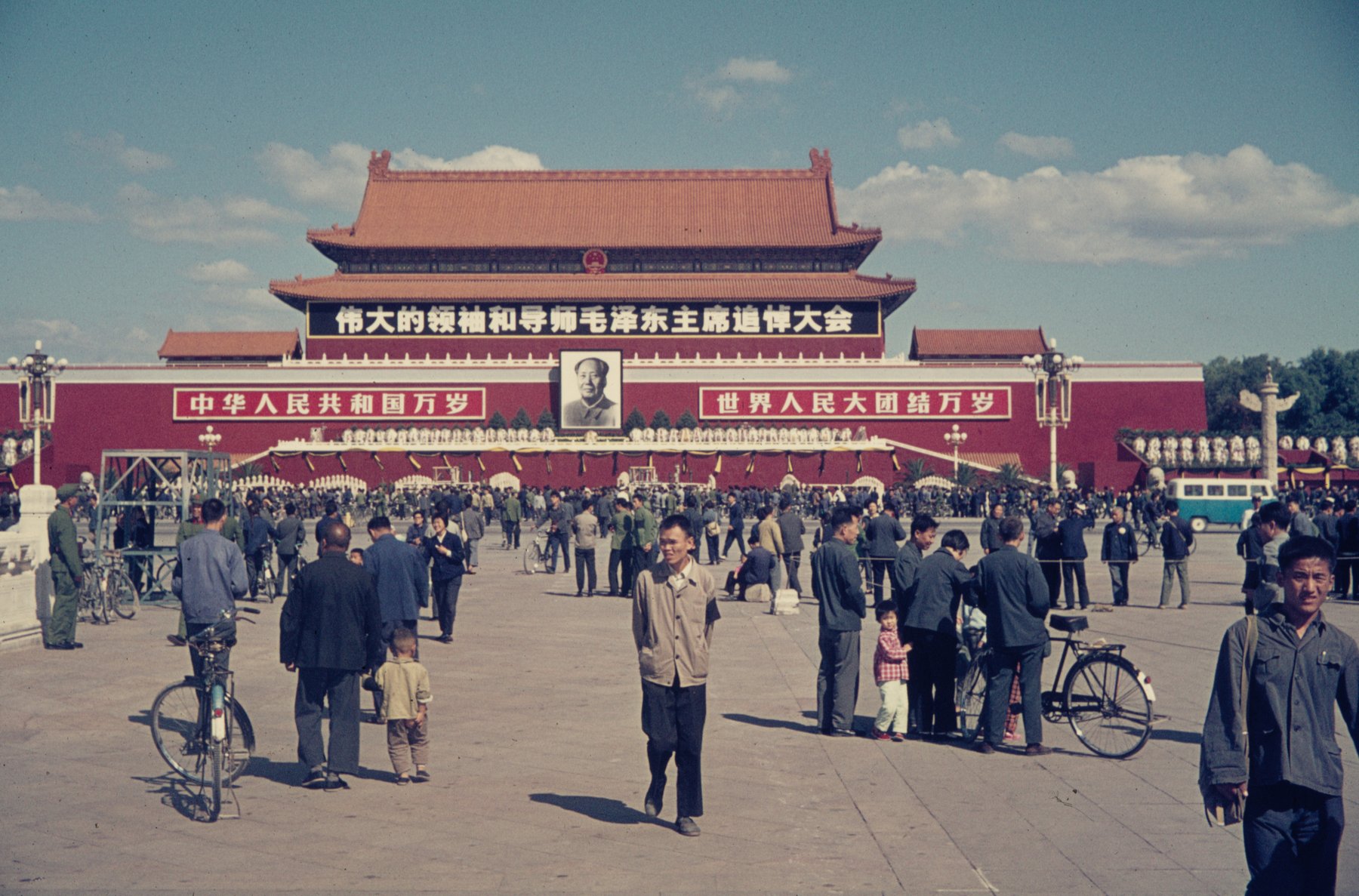
The Gate of Heavenly Peace after the 18 September 1976 memorial meeting. Photograph by Karl-Heinz Wellmann, September 1976, CC BY-SA 4.0, via Wikimedia Commons. The staging of his death is covered in Mao's death and the succession.
How did Mao's opponents portray him?
The archive holds sheets issued against him as well, under the same definitions. Both below were produced by US forces for audiences in Vietnam and are tagged by technique like any other.
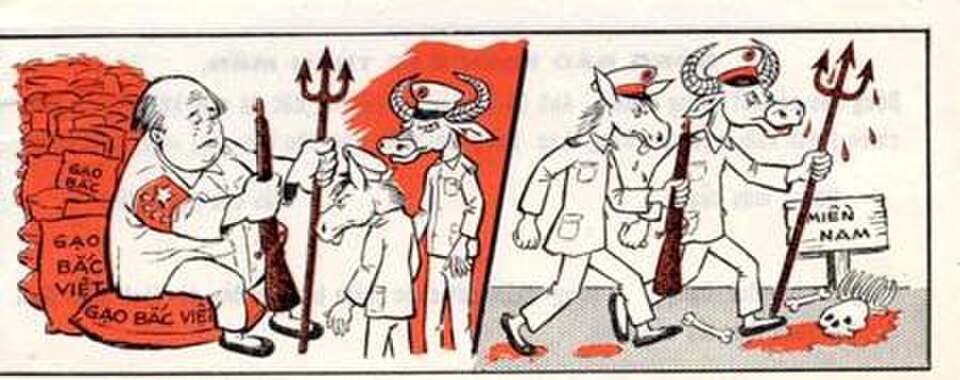
Explain moreShow less
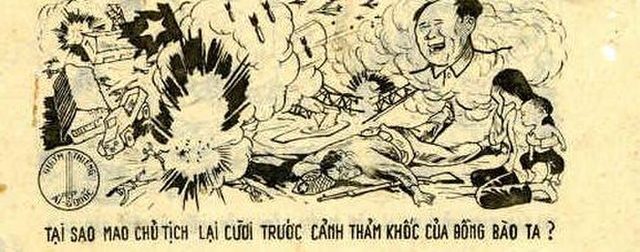
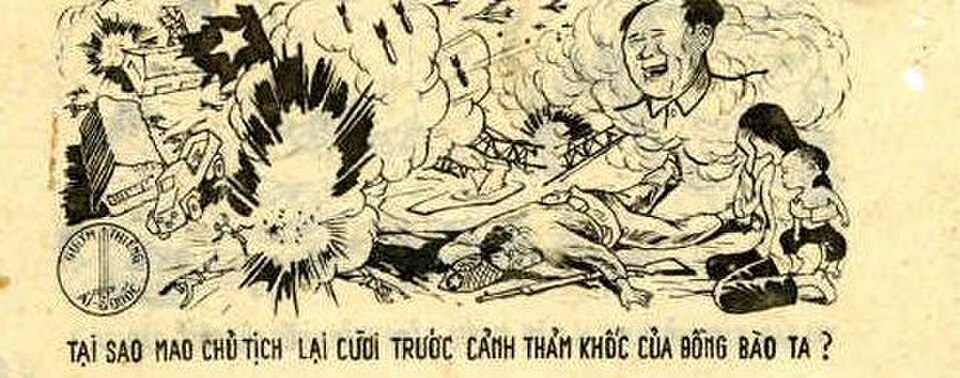
Leaflet designed by MACV-SOG in the name of a notional resistance body, the Sacred Sword of the Patriots League, from 1964. The caption asks why Chairman Mao laughs at the sufferings of "our compatriots". The scene is pinned on Mao, and the League's US origin is not shown. The entry dates it 1964 as a floor, since no date is given. Tagged scapegoating and narrative laundering. Read the technique: scapegoating.
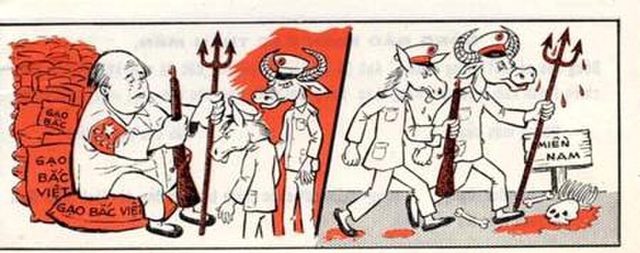
US psychological-operations leaflet, 1966, "Demoralization leaflet 26", described on Commons as meant to suggest enemy soldiers fought for Mao's interests rather than their own. Enemy soldiers are drawn as livestock. The sheet carries no visible US mark, so the entry colours it gray. Tagged name-calling and fear appeal.
Differences of scale are plain: the posters were issued by a state that controlled its press, and the leaflets were issued by a foreign military for use in a war. The archive scores technique on each and does not rule on the truth of any claim.
Which Mao quotes are rejected or unverified?
The file lists three widely repeated lines it did not publish, and why:
Explain moreShow less
- The nuclear-war remark (that if half of mankind died in a nuclear war the other half would remain and imperialism would be razed). Claimed as a speech at the Moscow meeting of Communist and Workers' Parties, 18 November 1957. Rejected as unverifiable: the speech is held in the Wilson Center Digital Archive, but that host could not be reached from the research environment, secondary accounts word the remark differently, and the Chinese minutes for that date on marxists.org contain only other passages.
- "It is better to let half the people die so that the other half can eat their fill." Claimed as the Shanghai meeting of March 1959. Rejected as unverifiable: not found in the 1959 talks reproduced in Selected Works vol. 8 on marxists.org; reported in secondary accounts that could not be matched to a primary text.
- "Women hold up half the sky." Claimed as a 1950s-1960s slogan attributed to him. Rejected as unverifiable for the reasons in the Little Red Book section above.
"Unverifiable" is not a finding that he did not say them. It means no primary text was found, so no wording is published here.
How does the archive treat Mao quotes?
The standard is the one applied to every person in the quotes file: the text is copied from a primary or official source, the translator and date are given, and the source is named. Where the English is an unofficial translation or a US interpreter's record, the entry says so. The Chinese originals are shown where the archive read them. Mao's words and the cult around them are described with the same technique definitions as the Stalin, Hitler, Mussolini and Kim cases, and differences of scale and context are stated and not smoothed over. For the wider pattern, see Chinese propaganda posters, communist propaganda and Stalin propaganda.
Browse Mao-era objects
The grid below shows these objects from the collection. Each opens an object page with the holding institution, a link to the original record, a transcription of any text and the rights basis for hosting. For the regime, see the People's Republic of China under Mao, and for the 1981 Party verdict on him, the 1981 resolution case study. The origin of the cult in the 1940s is in Mao cult origins 1943-1949.
Sources and further reading
Sources and rights
Quotations come from the Mao quotes data, which gives each entry's source, translator, date and the text it was checked against.
Quotations come from the Mao quotes data, which gives each entry's source, translator, date and the text it was checked against. Sources include the Foreign Languages Press Selected Works of Mao Tse-tung as transcribed on marxists.org, Peking Review, the Maoist Documentation Project and Foreign Relations of the United States. Objects come from the Museum of Ethnography, Stockholm (Etnografiska museet, inventory series 1996.20) collection of Chinese posters and woven pictures, the Richard Nixon Presidential Library and National Archives, Wikimedia Commons and its contributors, the Inner Mongolia Museum photograph, and psywarrior.com via Commons. Each object page gives its own rights basis. Transcriptions are verbatim.