Illustration: a dossier collage of an evidence wall of pinned propaganda posters, leaflets and printed matter from many eras, with contact sheets and catalog labels.

Collection

Japanese propaganda in WWII: posters from Japan, Manchukuo and occupied Asia

Japanese WWII propaganda from Japan, Manchukuo, Taiwan, Malaya and Java: posters, stamps, leaflets and film stills, tagged by technique.

Illustration, not an archive object

Content note. This page shows Japanese wartime material as issued, including caricatures of Allied leaders and of Americans and Britons, and slogans that called Japan's war a liberation of Asia. They are shown for the record, with who made them and for whom. Showing an item is not endorsing it.

What was Japanese propaganda in WWII?

Japanese wartime propaganda was the posters, magazines, stamps, newsreels, leaflets and street signs issued by the Japanese government, army and navy, and by bodies they controlled, between the 1937 war with China and the surrender of 1945. Its audiences were three: households in Japan and Taiwan, the people of Manchukuo and the occupied territories, and Allied troops. Each got a different message from the same state.
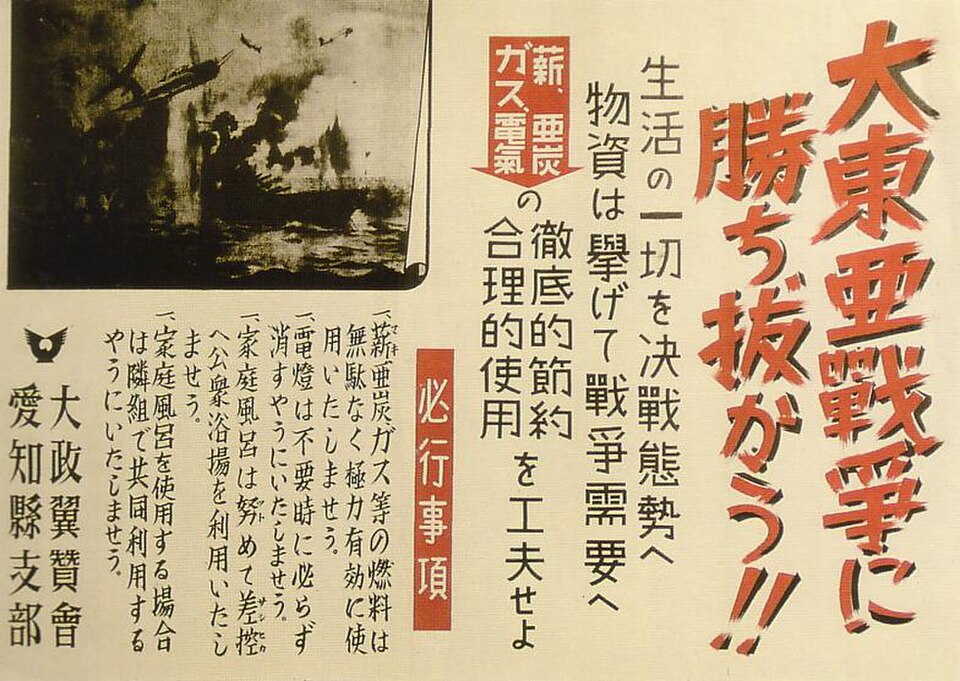
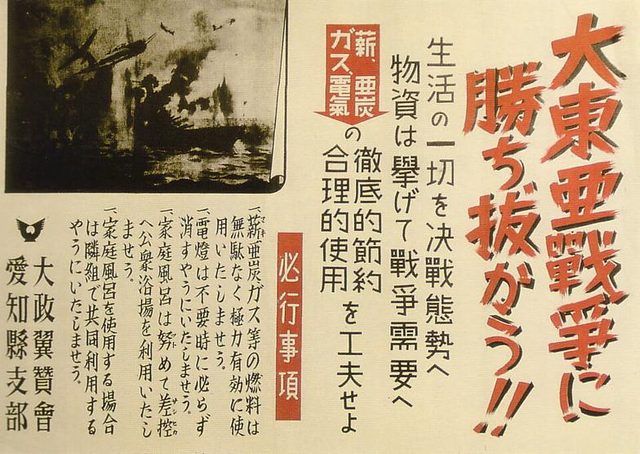
Poster of the Imperial Rule Assistance Association, Aichi branch: a warship under air attack above four household fuel-saving rules

At home: sacrifice, savings and the neighbourhood

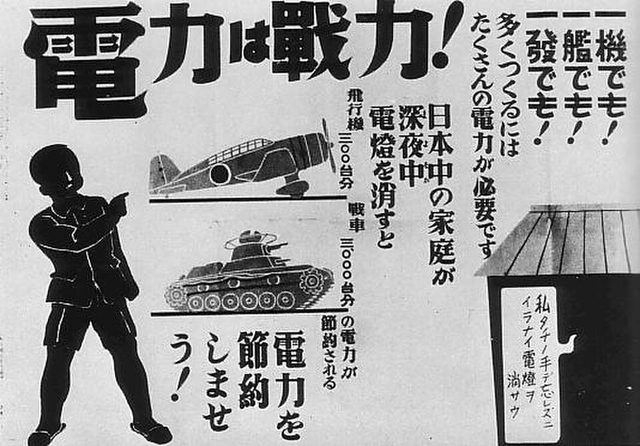
The Imperial Rule Assistance Association's Aichi branch put a ship under air attack above four household rules for saving firewood, gas and electricity, so a chore borrows the standing of the fighting (Transfer). A 1944 poster by an unnamed issuer tells households that switching off the lights at midnight saves the power for hundreds of aircraft, a figure with no source (Card stacking).
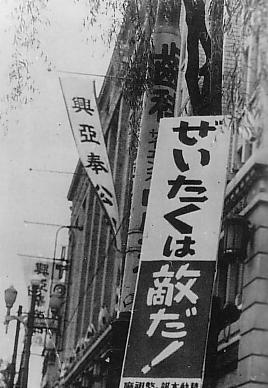
Street sign in Tokyo, 1940, reading Luxury is the enemy, beside a banner to serve the rise of Asia

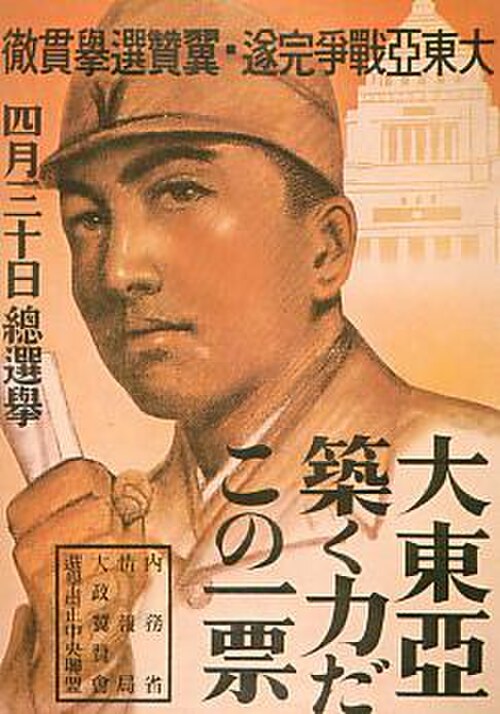
Election poster, 1942: a young man in an army field cap holds a rolled paper before the Diet building

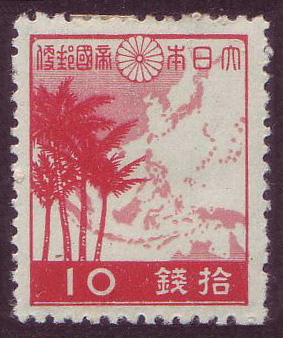
Japan 10 sen stamp of 1942 with a silhouette map of east and southeast Asia under the imperial crest

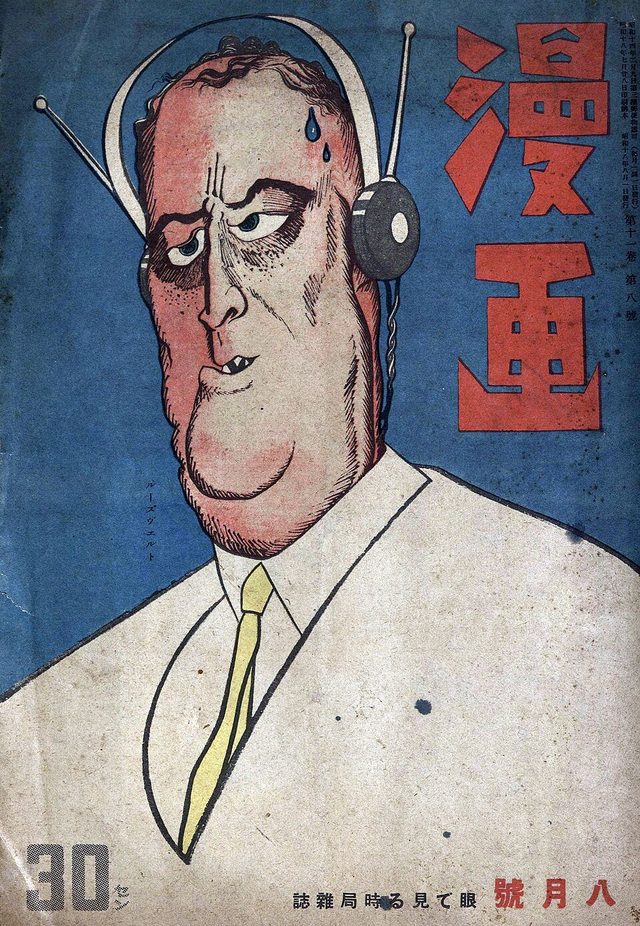
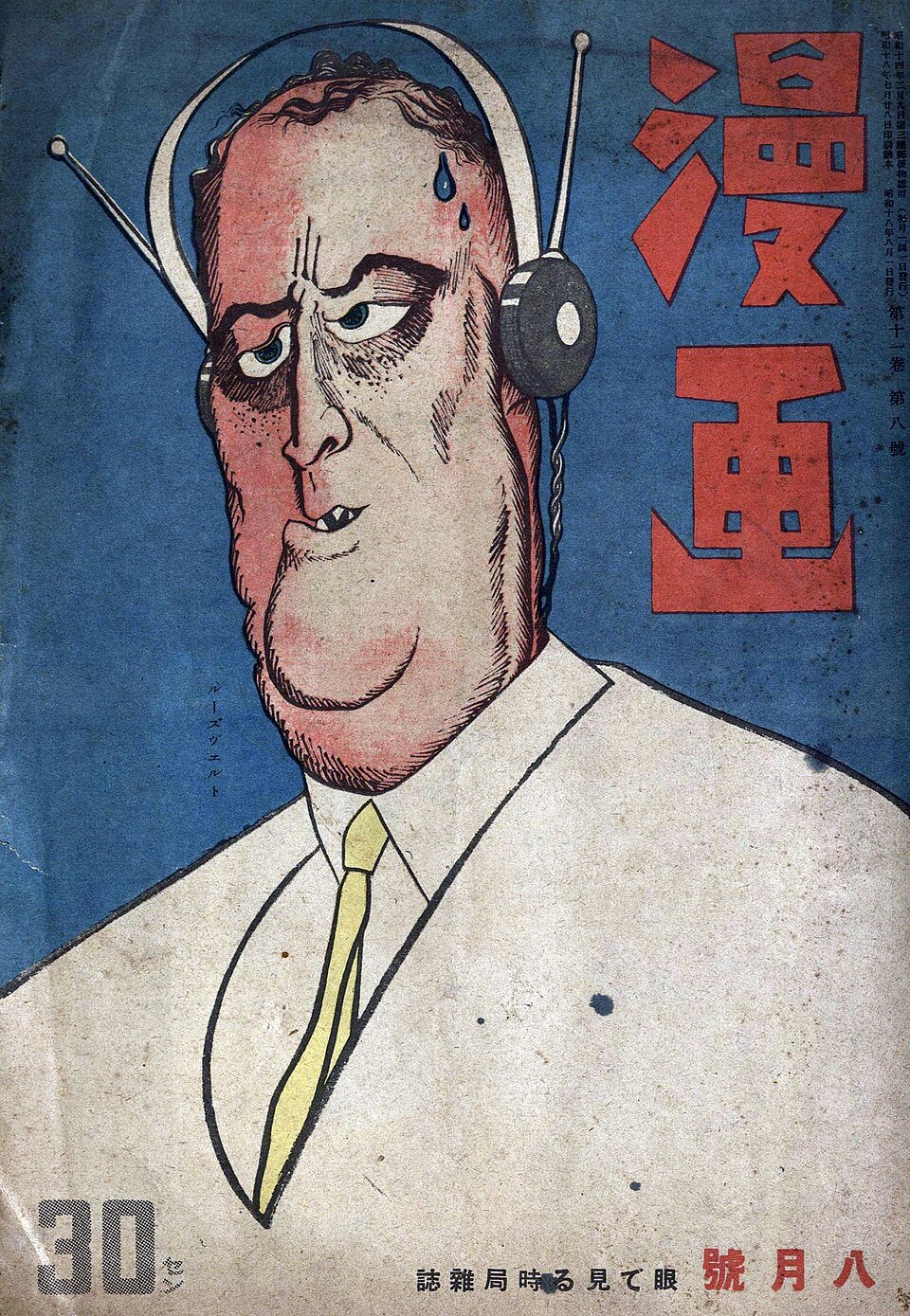
Content note: Wartime Japanese magazine cover with a caricature of US President Franklin D. Roosevelt (exaggerated jaw, buck tooth, sweat drop). This object is shown as it was published. Why Cover of the magazine Manga, August 1943: a caricature of Franklin D. Roosevelt with a bead of sweat and headphones
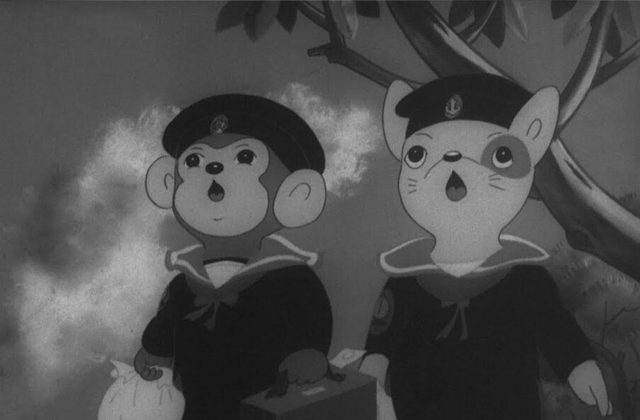
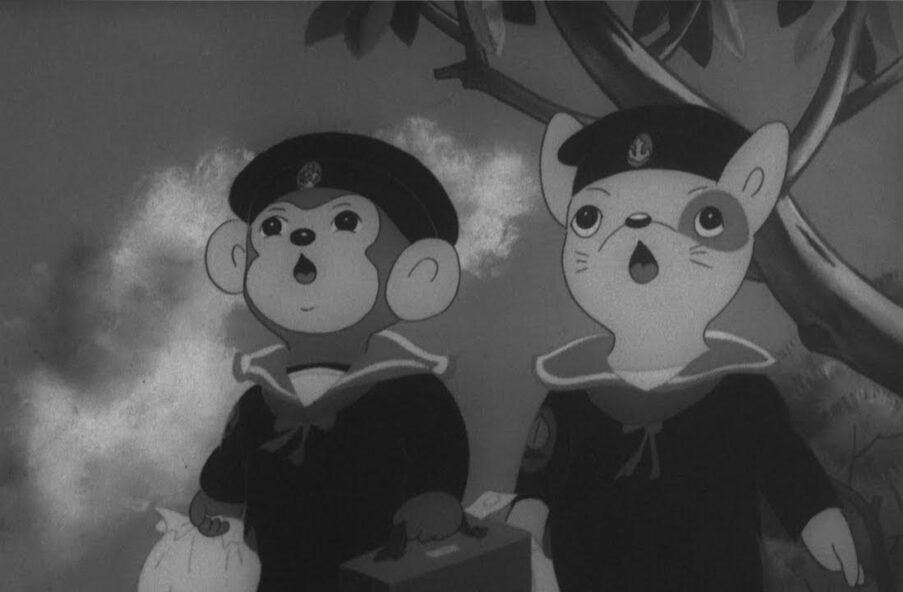
Still from the 1945 animated film Momotaro's Divine Sea Warriors: a monkey and a dog in navy sailor uniforms

Explain moreShow less

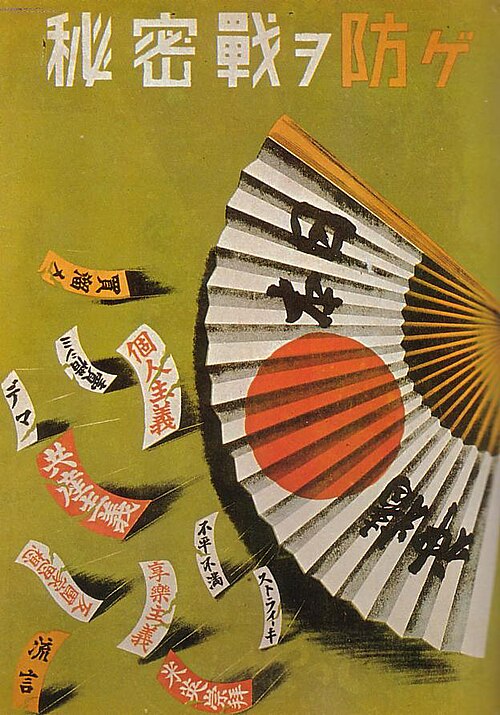
"Luxury Is the Enemy!" (Tokyo, 1940), from the National Spiritual Mobilization Movement, stretches the word "enemy" to cover silk and restaurant meals (Semantic hijacking). A c. 1940 counterintelligence poster lists hoarding, individualism, communism and rumour as the slips of paper a hidden enemy throws at Japan (Name-calling).

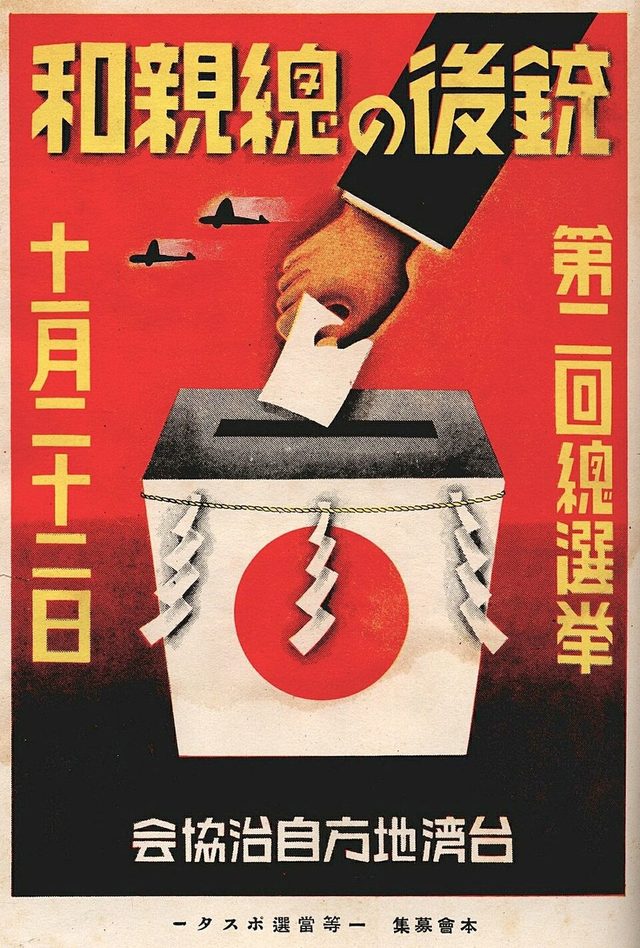
For the April 1942 general election the Home Ministry, the Information Bureau and the Imperial Rule Assistance Association put a soldier beside the ballot (Transfer). In Taiwan, a 1939 poster prize-winner pairs a ballot, shrine streamers and warplanes under "Total Harmony on the Home Front" (Glittering generalities).

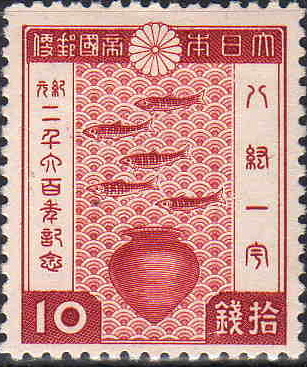
The Ministry of Communications issued a 1942 stamp whose map the Commons record identifies as the Greater East Asia Co-Prosperity Sphere (Transfer), and a 1940 stamp inscribed hakkō ichiu, a phrase naming no testable aim (Glittering generalities).

The monthly Manga (Tokyo, August 1943) drew Roosevelt flushed and sweating (Name-calling). A Navy-commissioned film, Momotarō: Umi no Shinpei (1945), dressed a monkey and a dog in sailor uniforms to attach a folk tale to the navy (Transfer).

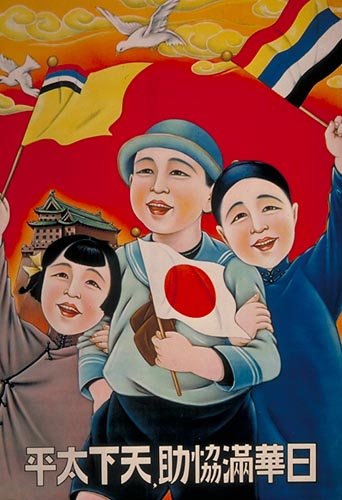
Content note: Colour poster of smiling children of three peoples with flags, issued to promote the Japan-Manchukuo-China relationship under Japanese occupation. This object is shown as it was published. Why Manchukuo poster, 1935: three smiling children with flags, one holding the Rising Sun, over a slogan on Japan, China and Manchukuo cooperating
Manchukuo: the state Japan founded in 1932

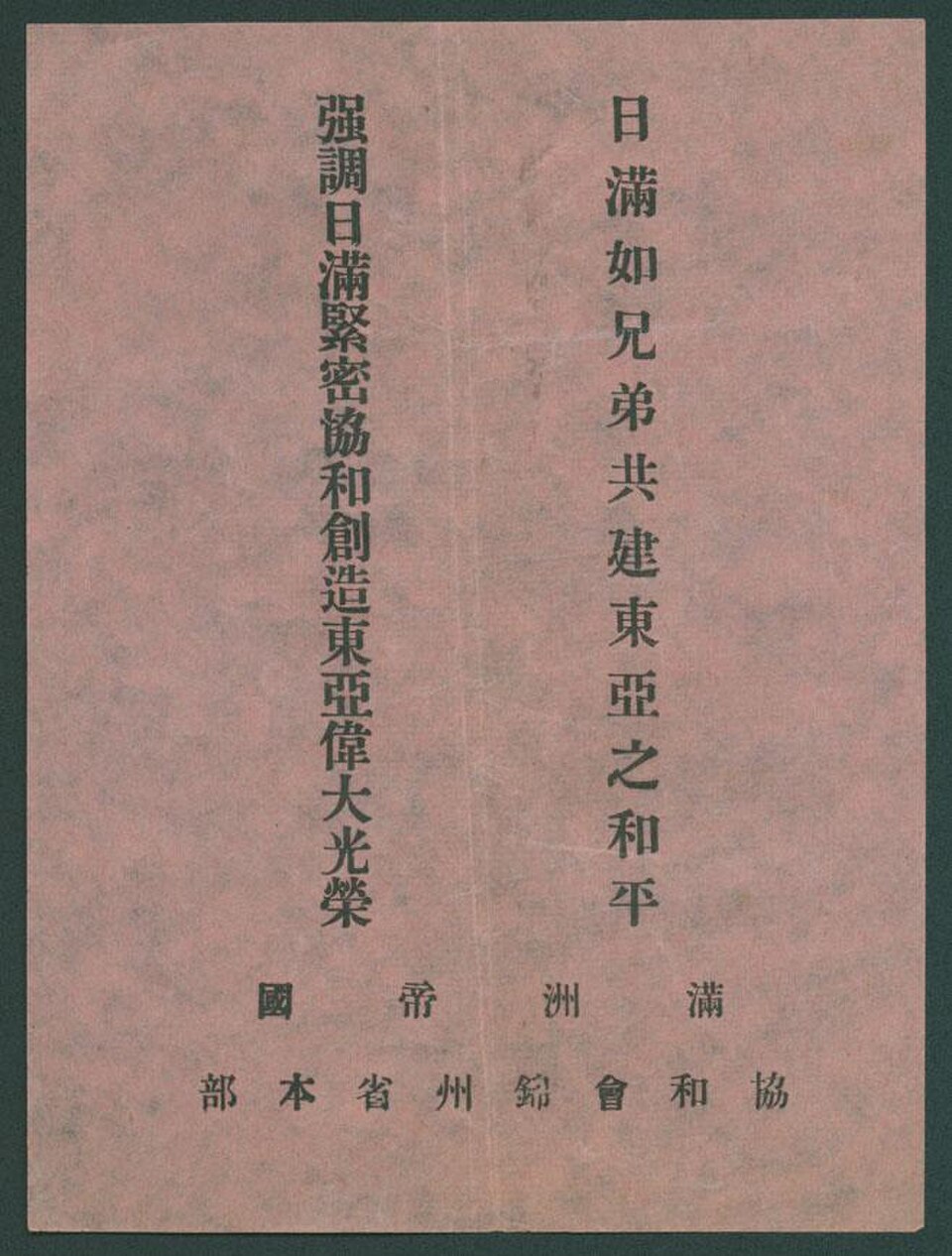
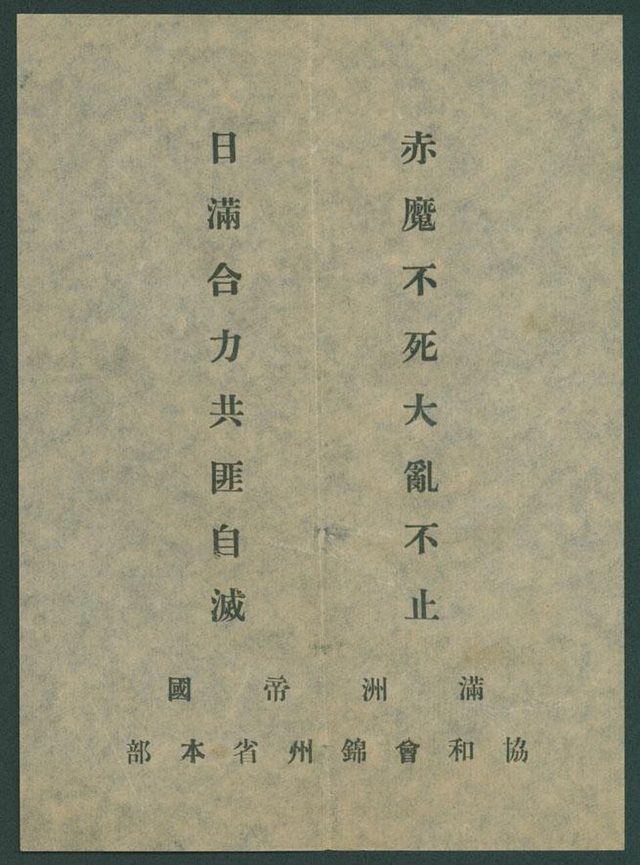
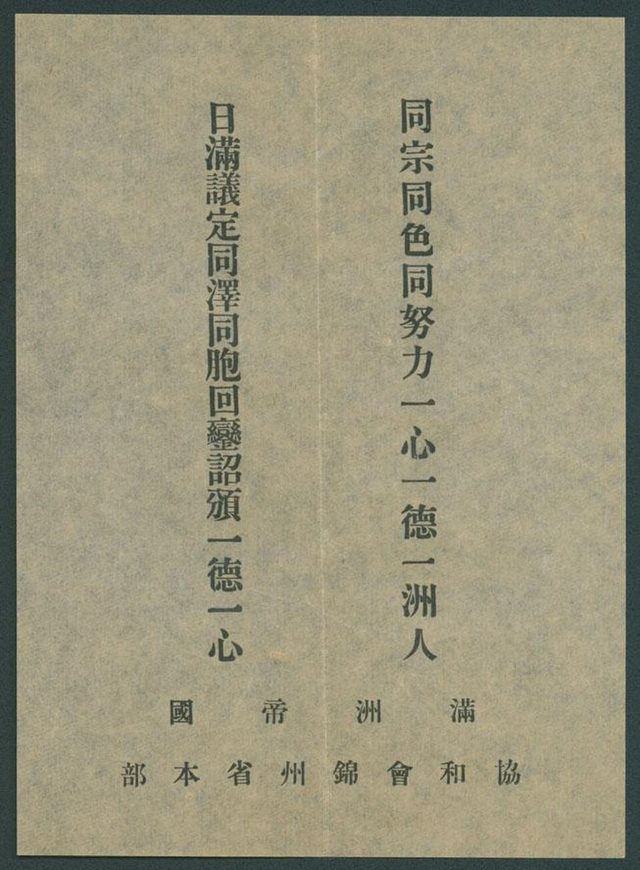
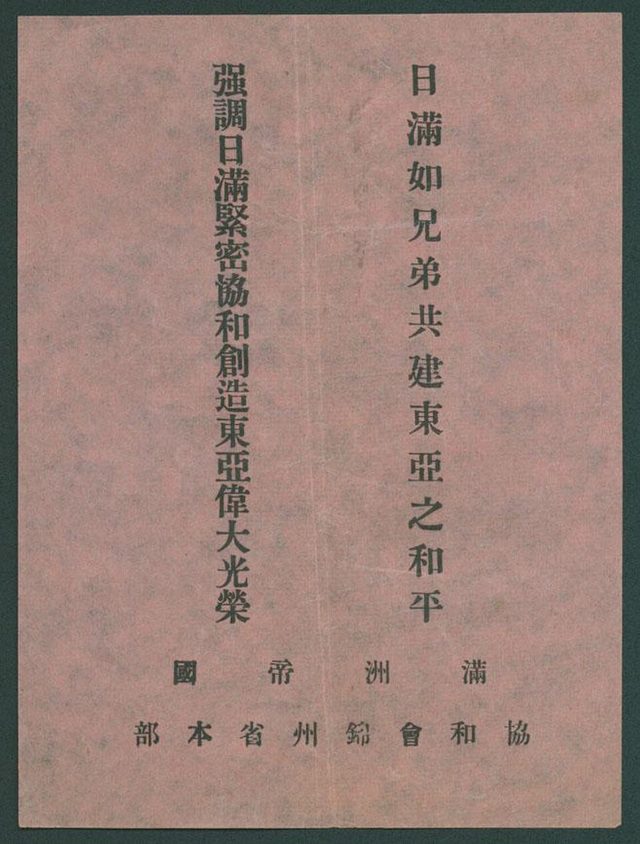
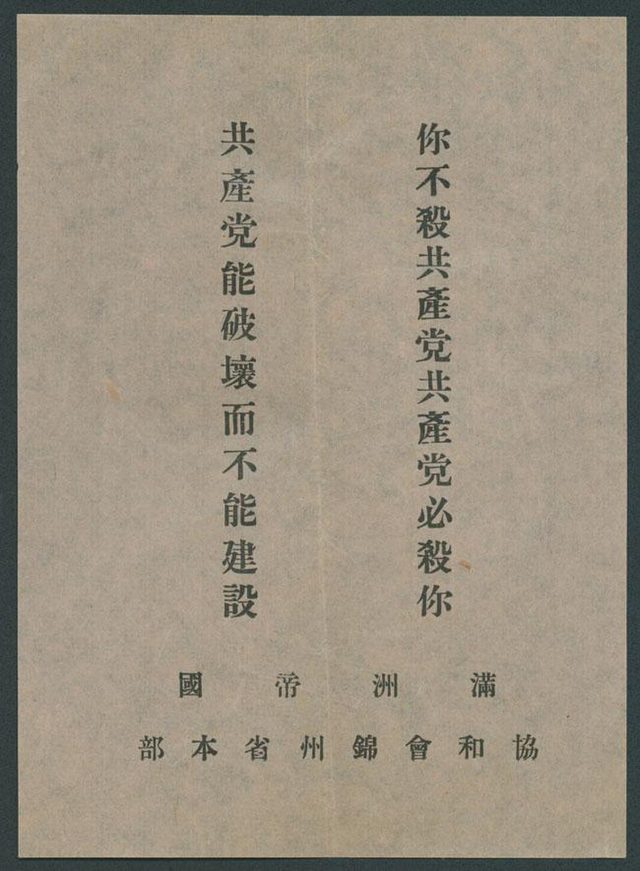
A 1935 poster, presumably for the Manchukuo State Council, shows three children and doves above "Japan, China and Manchukuo Cooperate; Peace Under Heaven", a slogan with nothing testable in it (Glittering generalities). The Concordia Association's Jinzhou headquarters issued text-only leaflets in 1936.

Concordia Association Jinzhou leaflet, 1936: Japan and Manchukuo are like brothers

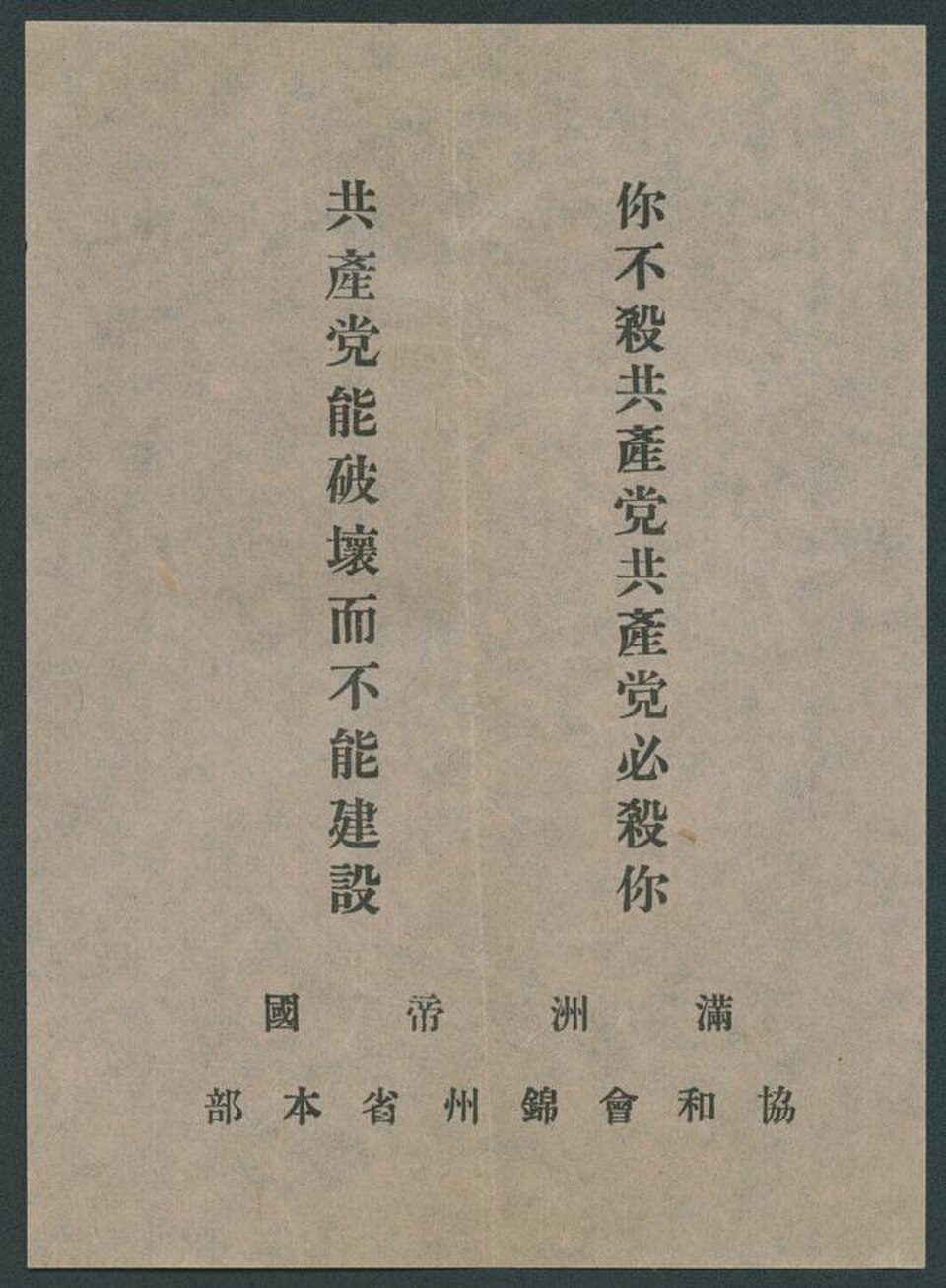
Content note: Text-only leaflet urging readers to kill Communists ('If you do not kill the Communists, the Communists will surely kill you'). This object is shown as it was published. Why Concordia Association Jinzhou leaflet, 1936: If you do not kill the Communists, the Communists will surely kill you
Explain moreShow less

One says "Japan and Manchukuo are like brothers", presenting the two states as equals (Glittering generalities).

Another gives the reader a kill-or-be-killed choice about Communists (Fear appeal).

Occupied Malaya and Java
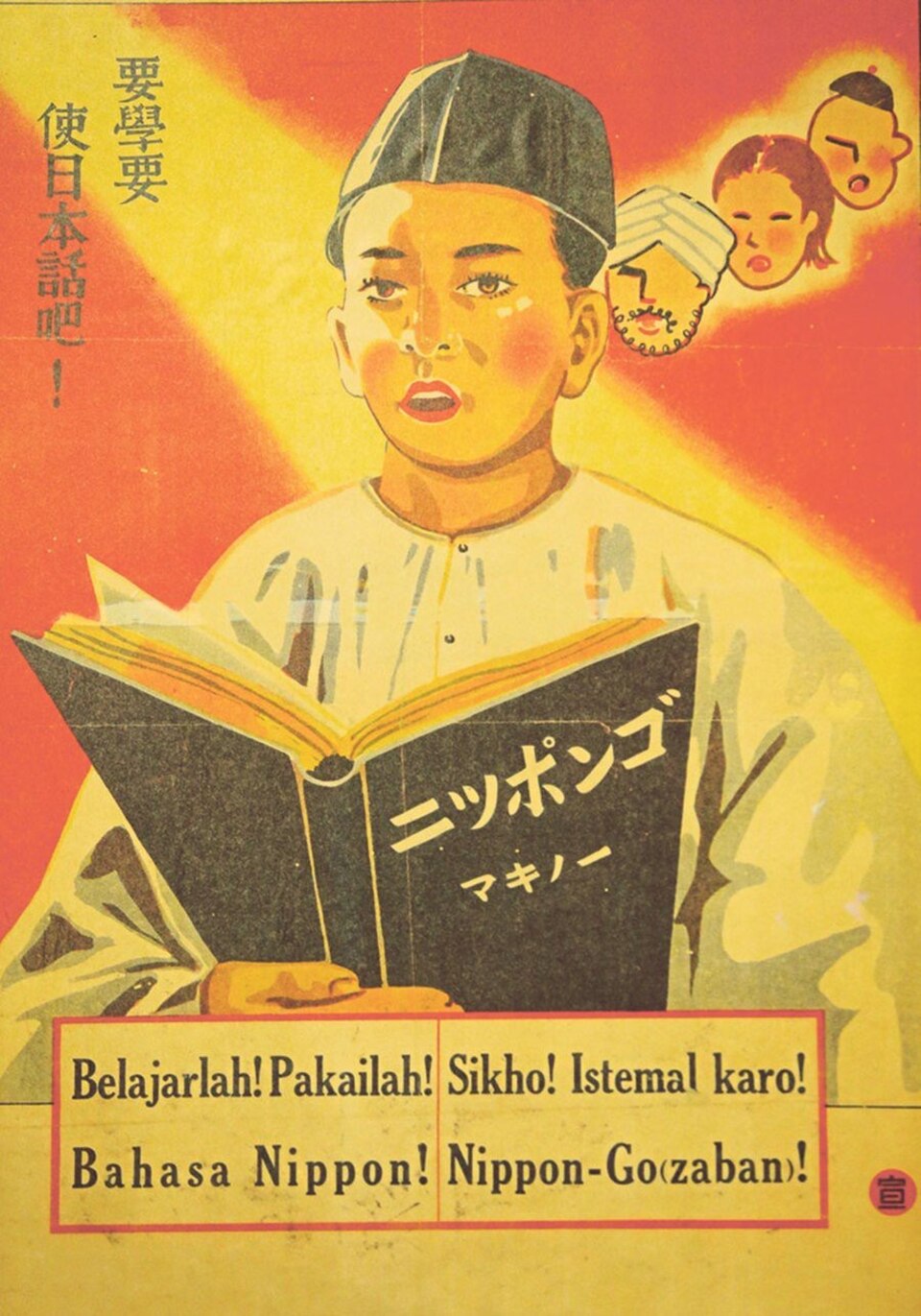
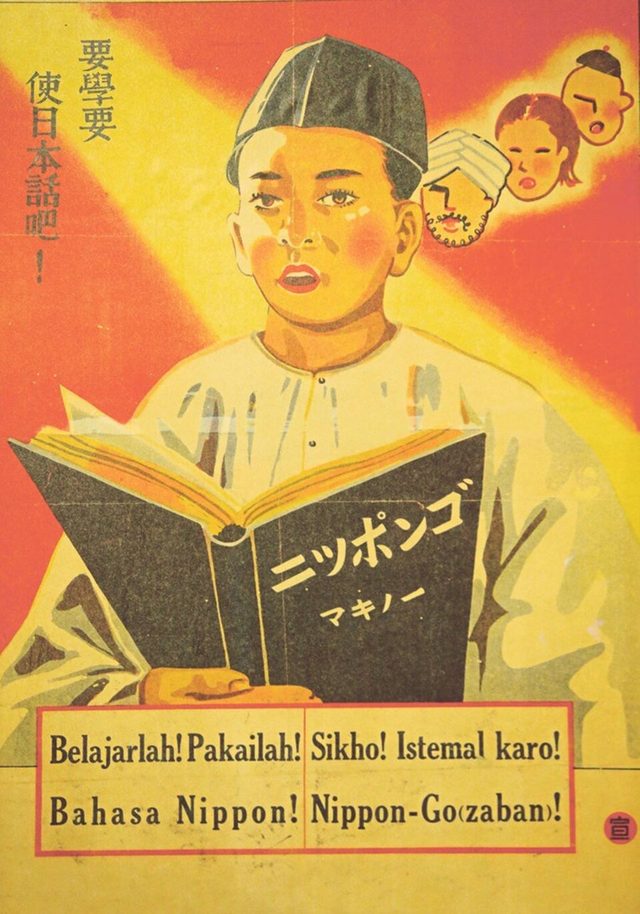
Occupation poster, Malaya, 1942: a Malay youth reads from a book marked Nippon-go while faces of other communities fill the rays behind him

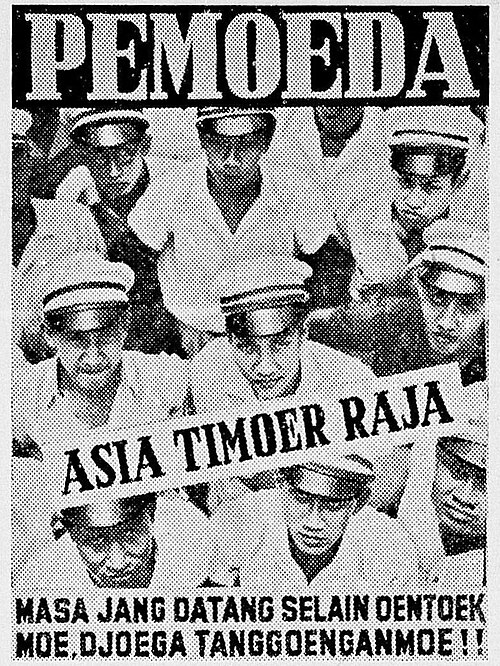
The occupation administration in Malaya told residents to learn Japanese, pictured as a movement several communities were joining (Bandwagon). In Java the military administration's Propaganda Department (Sendenbu) published Djawa Baroe.
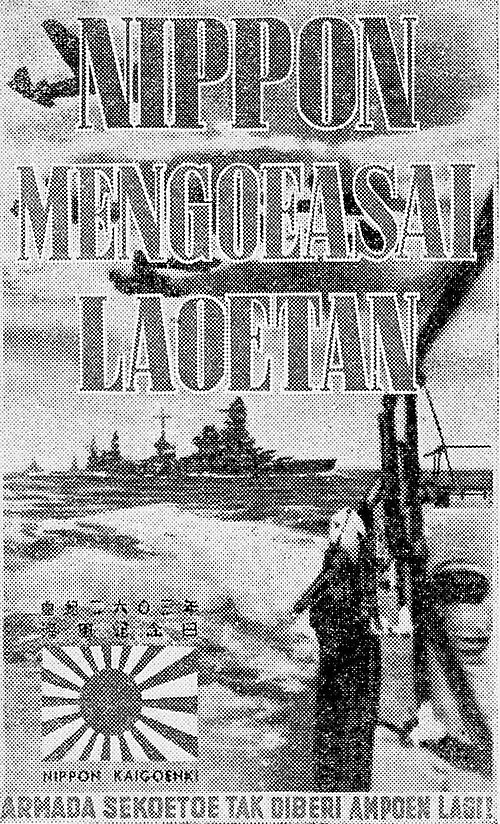
Djawa Baroe page, June 1943: Nippon Mengoeasai Laoetan, Japan controls the seas, over aircraft and warships

Its June 1943 page "Japan controls the seas" states a settled fact over warships (Bandwagon).
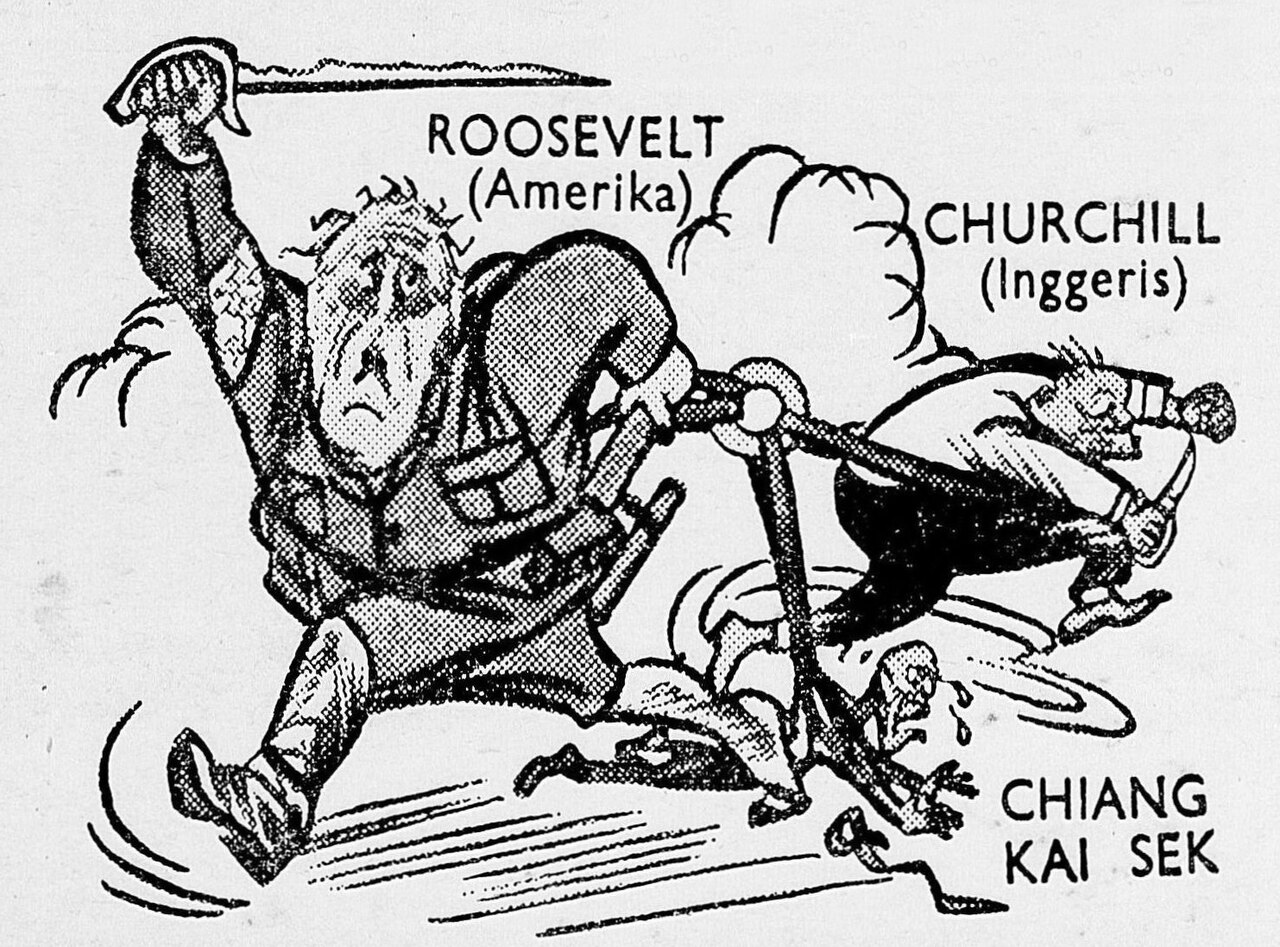
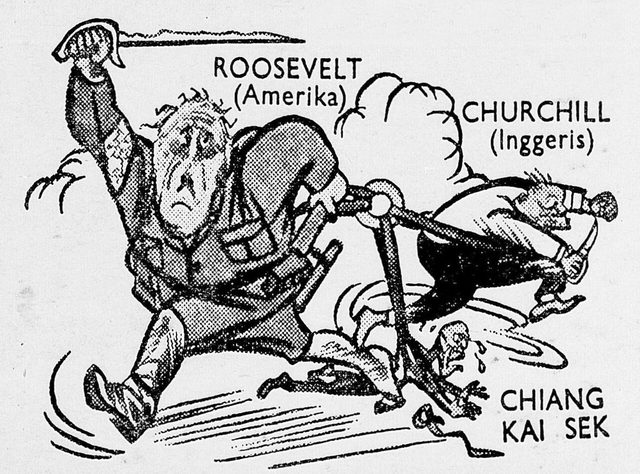
Cartoon in Djawa Baroe, June 1943, of Roosevelt, Churchill and Chiang Kai-shek tangled on a wheeled frame

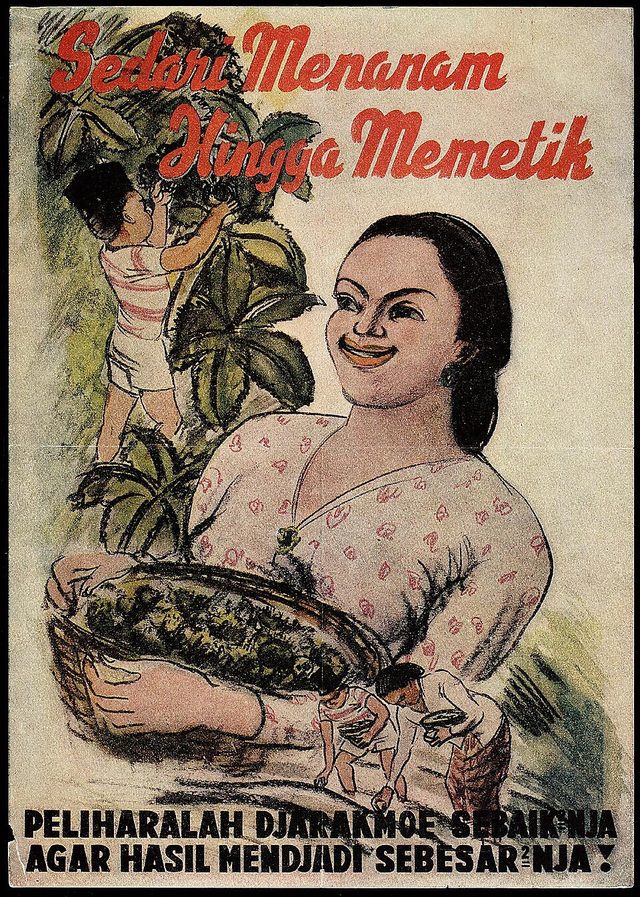
The same issue carries a cartoon of Roosevelt, Churchill and Chiang Kai-shek in a pratfall (Name-calling). A Java poster asks families to tend jatropha, voiced through a cheerful local family with no issuer named (Plain folks).
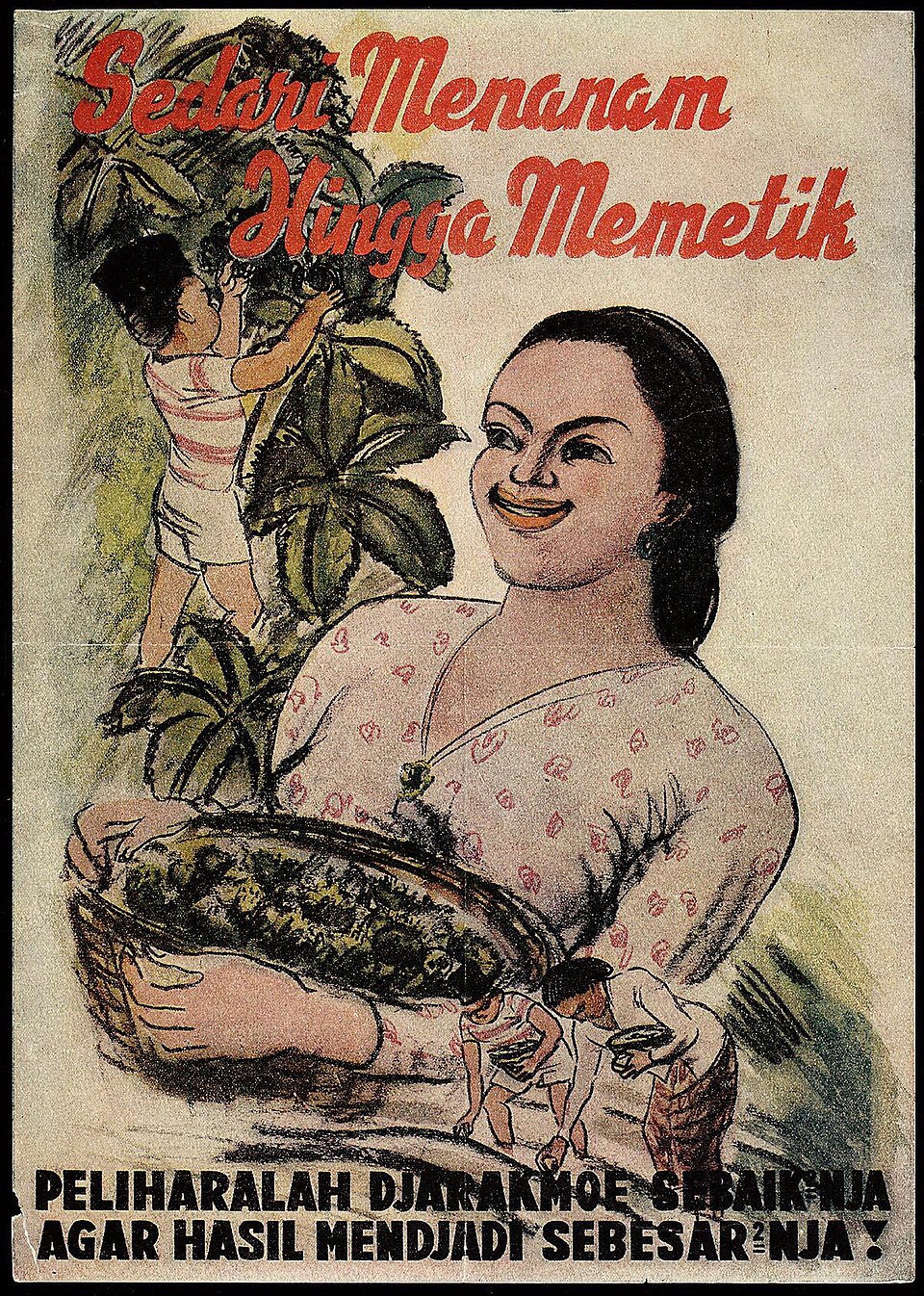
Occupation poster, Netherlands East Indies, 1943: a smiling woman with a basket of leaves, a child picking from the plant behind her

For the opposing side

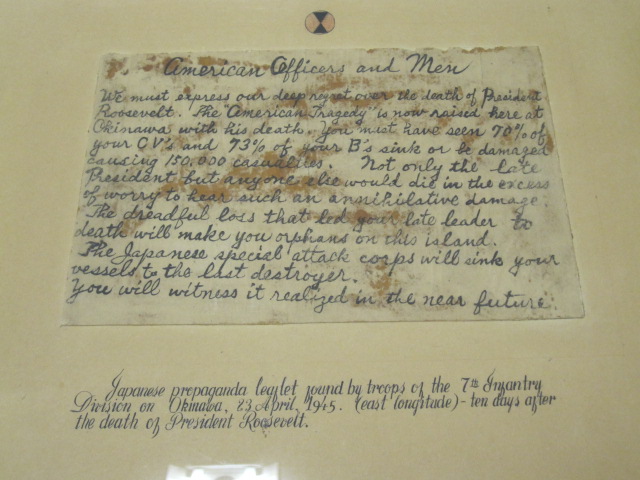
The collection's Japanese leaflets include a 1945 sheet to Americans on Okinawa that cites claimed carrier losses and promises the special attack corps will sink their vessels (Fear appeal). The American side of the same war is on the sibling page Anti-Japanese posters, under the same technique definitions.

What the collection does not hold

  • Not here: posters from Japan proper held at the Hoover Institution, the Imperial War Museum or the Japanese national archives; most of these items come from Wikimedia Commons scans and museum photographs.
  • Thin coverage: Korea, Burma, the Philippines and French Indochina under Japanese rule by poster; and Japanese-language posters on conscription, the "comfort" system or the occupation's forced labour.
  • Scale: Japanese state production and its distribution figures are not measured here, so nothing is claimed about reach compared with other belligerents.

Sources and further reading

Sources

Each item in the grid carries its own source and rights note, mostly Wikimedia Commons (PD-Japan tags), the Koninklijke…

Each item in the grid carries its own source and rights note, mostly Wikimedia Commons (PD-Japan tags), the Koninklijke Bibliotheek and NIOD, and the Tropenmuseum. Context: Barak Kushner, The Thought War: Japanese Imperial Propaganda (University of Hawai'i Press, 2006); John W. Dower, War Without Mercy (Pantheon, 1986).
Japanese WWII propaganda in the collection

Showing 30 of 30 objects. Filter the whole collection.

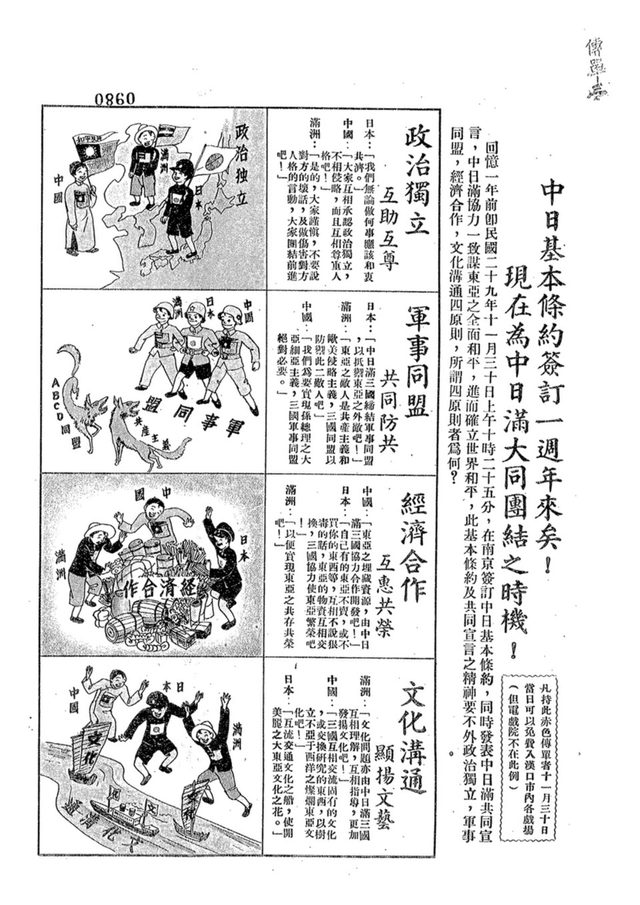
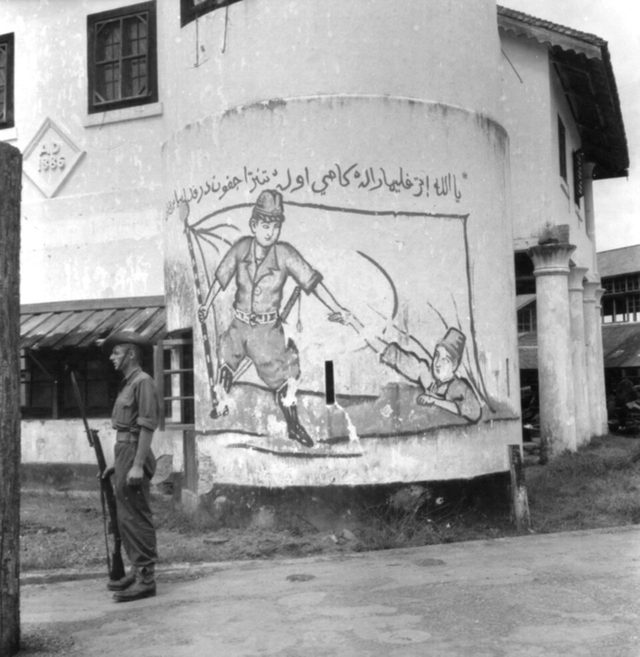
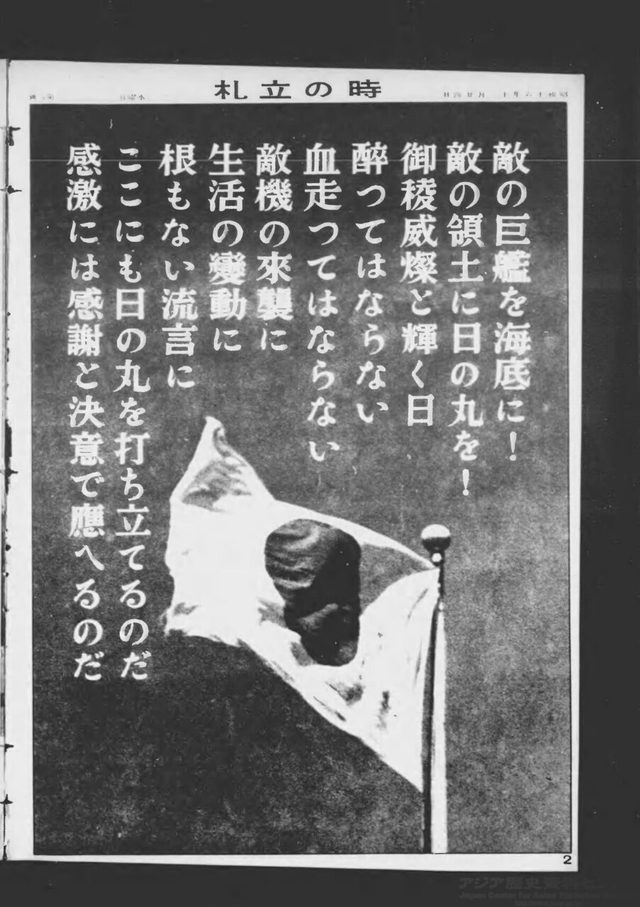
日華滿恊助天下太平 (Japan, China and Manchukuo Cooperate; Peace Under Heaven), Manchukuo posterManchukuo日華滿恊助天下太平 (Japan, China and Manchukuo Cooperate; Peace Under Heaven), Manchukuo poster1935 · Glittering generalities, Transfer日滿如兄弟 (Japan and Manchukuo Like Brothers), Concordia Association Jinzhou leafletManchukuo日滿如兄弟 (Japan and Manchukuo Like Brothers), Concordia Association Jinzhou leaflet1936 · Glittering generalities你不殺共產党共產党必殺你 (If You Do Not Kill the Communists, the Communists Will Kill You), Concordia Association Jinzhou leafletManchukuo你不殺共產党共產党必殺你 (If You Do Not Kill the Communists, the Communists Will Kill You), Concordia Association Jinzhou leaflet1936 · Fear appeal赤魔不死 日滿合力 (Red Devils Not Dead; Japan and Manchukuo United), Concordia Association Jinzhou leafletManchukuo赤魔不死 日滿合力 (Red Devils Not Dead; Japan and Manchukuo United), Concordia Association Jinzhou leaflet1936 · Name-calling, Demonization同宗同色同努力 (Same Ancestry, Same Colour, Same Effort), Concordia Association Jinzhou leafletManchukuo同宗同色同努力 (Same Ancestry, Same Colour, Same Effort), Concordia Association Jinzhou leaflet1936 · Glittering generalities銃後の總親和 第二回總選挙 (Total Harmony on the Home Front: Second General Election), TaiwanEmpire of Japan銃後の總親和 第二回總選挙 (Total Harmony on the Home Front: Second General Election), TaiwanOct 1939 · Transfer, Glittering generalities秘密戰ヲ防ゲ (Guard Against Secret Warfare), Japanese home-front counterintelligence posterEmpire of Japan秘密戰ヲ防ゲ (Guard Against Secret Warfare), Japanese home-front counterintelligence poster1940 · Fear appeal, Name-calling10 sen stamp for the 2600th year of the imperial era, inscribed 八紘一宇 (Hakkō ichiu) (1940)Empire of Japan10 sen stamp for the 2600th year of the imperial era, inscribed 八紘一宇 (Hakkō ichiu) (1940)1940 · Transfer, Glittering generalities'Zeitaku wa teki da!' (Luxury Is the Enemy!) street sign, TokyoEmpire of Japan'Zeitaku wa teki da!' (Luxury Is the Enemy!) street sign, TokyoAug 1, 1940 · Semantic hijacking, Identity fusion'Daitōa sensō ni kachinukō!!' (Let's win the Greater East Asia War!) fuel-saving poster, AichiEmpire of Japan'Daitōa sensō ni kachinukō!!' (Let's win the Greater East Asia War!) fuel-saving poster, Aichi1941 · Transfer中日基本條約簽訂一週年來矣! (The Sino-Japanese Basic Treaty's first anniversary has come!), four-panel leaflet for HankouEmpire of Japan中日基本條約簽訂一週年來矣! (The Sino-Japanese Basic Treaty's first anniversary has come!), four-panel leaflet for HankouNov 1941 · Glittering generalities, Fear appealPainted wall sign with Jawi inscription and Japanese soldier, Kuching, Sarawak (photographed 14 September 1945)Empire of JapanPainted wall sign with Jawi inscription and Japanese soldier, Kuching, Sarawak (photographed 14 September 1945)Dec 1941 · Transfer'Toki no tatefuda' (Notice Board of the Times), Shashin Shūhō No. 200, page 2 (24 December 1941)Empire of Japan'Toki no tatefuda' (Notice Board of the Times), Shashin Shūhō No. 200, page 2 (24 December 1941)Dec 24, 1941 · Transfer, Glittering generalitiesBelajarlah! Pakailah! Bahasa Nippon! (Learn! Use! The Japanese Language!)Empire of JapanBelajarlah! Pakailah! Bahasa Nippon! (Learn! Use! The Japanese Language!)1942 · Bandwagon'Daitōa kizuku chikara da, kono ippyō' (This one vote is the power that builds Greater East Asia) election posterEmpire of Japan'Daitōa kizuku chikara da, kono ippyō' (This one vote is the power that builds Greater East Asia) election poster1942 · TransferStill from "Chabar Dai Toa" no. 31, Japanese newsreel with Indonesian-language title cards for occupied Java (1942)Empire of JapanStill from "Chabar Dai Toa" no. 31, Japanese newsreel with Indonesian-language title cards for occupied Java (1942)Feb 19, 1942 · Glittering generalities, Transfer10 sen stamp with a map of the Greater East Asia Co-Prosperity Sphere (1942)Empire of Japan10 sen stamp with a map of the Greater East Asia Co-Prosperity Sphere (1942)Dec 1, 1942 · TransferStamps for the first anniversary of the Greater East Asia War, 2+1 sen and 5+2 sen (1942)Empire of JapanStamps for the first anniversary of the Greater East Asia War, 2+1 sen and 5+2 sen (1942)Dec 8, 1942 · TransferMatchbox label, Japanese wartime propaganda in Malay: "Tentoe dapat kemenangan" (Victory will surely be won), No. 3 (c. 1943)Empire of JapanMatchbox label, Japanese wartime propaganda in Malay: "Tentoe dapat kemenangan" (Victory will surely be won), No. 3 (c. 1943)1943 · Name-callingSedari Menanam Hingga Memetik (From Planting to Harvest)Empire of JapanSedari Menanam Hingga Memetik (From Planting to Harvest)1943 · Plain folksNippon Eigasha newsreel, intertitle on Prime Minister Tojo's visit to Java and the Central Advisory CouncilEmpire of JapanNippon Eigasha newsreel, intertitle on Prime Minister Tojo's visit to Java and the Central Advisory Council1943 · Glittering generalitiesPage 'Pemoeda: Asia Timoer Raja' aimed at Indonesian youth, Djawa Baroe, Java (1 March 1943)Empire of JapanPage 'Pemoeda: Asia Timoer Raja' aimed at Indonesian youth, Djawa Baroe, Java (1 March 1943)Mar 1, 1943 · Glittering generalitiesPoster 'Nippon Mengoeasai Laoetan' (Japan controls the seas), Djawa Baroe, Java (1 June 1943)Empire of JapanPoster 'Nippon Mengoeasai Laoetan' (Japan controls the seas), Djawa Baroe, Java (1 June 1943)Jun 1, 1943 · BandwagonCartoon of Roosevelt, Churchill and Chiang Kai-shek, Djawa Baroe, Java (1 June 1943)Empire of JapanCartoon of Roosevelt, Churchill and Chiang Kai-shek, Djawa Baroe, Java (1 June 1943)Jun 1, 1943 · Name-callingContent noteCover of the Japanese magazine Manga (漫画), August 1943: caricature of Franklin D. RooseveltEmpire of JapanCover of the Japanese magazine Manga (漫画), August 1943: caricature of Franklin D. RooseveltAug 1, 1943 · Name-calling'Students, from today we are the Emperor's shield': student conscription examination, Shashin Shūhō No. 297Empire of Japan'Students, from today we are the Emperor's shield': student conscription examination, Shashin Shūhō No. 297Nov 10, 1943 · TransferContent noteDjawa Baroe cover no. 23, "Tari meroentoehkan Amerika dan Inggeris" (A dance to bring down America and England), 1 December 1943Empire of JapanDjawa Baroe cover no. 23, "Tari meroentoehkan Amerika dan Inggeris" (A dance to bring down America and England), 1 December 1943Dec 1, 1943 · Transfer'Denryoku wa senryoku!' (Electric Power Is Military Power!) home-front posterEmpire of Japan'Denryoku wa senryoku!' (Electric Power Is Military Power!) home-front poster1944 · Card stacking'American Officers and Men' (Japanese leaflet on the death of President Roosevelt, Okinawa)Empire of Japan'American Officers and Men' (Japanese leaflet on the death of President Roosevelt, Okinawa)1945 · Fear appealContent noteStill from "Momotarō: Umi no Shinpei" (Momotaro's Divine Sea Warriors), Japanese navy-sponsored animated featureEmpire of JapanStill from "Momotarō: Umi no Shinpei" (Momotaro's Divine Sea Warriors), Japanese navy-sponsored animated featureApr 12, 1945 · Transfer